
Chapters 29
-
1 00 - Preface 3:17
Swax Candle. Banking Under Difficulties by George Ogilvie Pressure. Or Life on the Goldfields of Victoria, New South Wales and New Zealand by a bank official. Two. George Miller, Esquire, General Manager of the Bank of New South Wales. This work is, with his permission, respectfully inscribed. The old days, when the title page of a book was almost as good, or at any rate as explanatory as a preface, have departed. Now you may learn nothing from the name. Who has not heard of that agricultural society who sent for Edgeworth's essay on bulls, only to find that the bulls were Irish? And principally verbal. In this work, an endeavour has been made by the free use of old diaries, extracts from newspapers and personal reminiscences, not merely to show banking under difficulties, but the general life on the goldfields.
The writer would, at the outset, endeavour to disarm criticism by candidly stating that of pretension to literary merit he has none. Facts are recorded, and for the truthfulness of the narrative the author vouchers. Nor to extenuate, nor ought to set down in malice, has been the motto pursued throughout. Many of the anecdotes told are within the memory of several who will read the book. The extraordinary vicissitudes of travel, the rough way of living, and the hardships that the early pioneers encountered in the early days of the West Coast diggings have never, at least to the writer's idea, been fully set forth. In those days, as a rule, People were hand, not head workers. Now the past is to them, but as a dream.
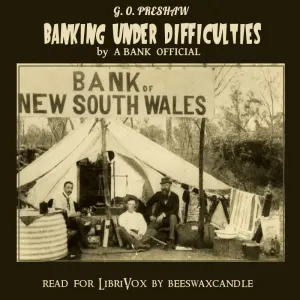
The writer of the following pages kept a diary, and the scenes described are therefore presented as they appeared to him at the time. At the present time, 1888, it may appear almost impossible to many that a bank agency should have been in a tent, that bankers should have, often on foot, gone long distances to purchase gold from small storekeepers. The said gold often being carried by them on their backs, till the security of some rough bush shanty had been reached. That instead of cedar counters, massive ledges, impregnable strong rooms, and all the appliances of modern banking, a gin case to write on, a notebook or piece of wrapping paper, and a saddle bag should then have been considered quite the correct thing.
Yet that such was often the case is a fact. These experiences will doubtless modify considerably the prevalent opinion that easy times are, or have been, the lot of bank officials. I am indebted to my revered father, the late Dr. Pressure of Castlemaine, Victoria, for particulars contained in the opening chapters. All other authorities cited, and they are many, are duly acknowledged.
-
2 01 - Victoria. Chapter 1 17:39
Land ahead. The crew looked. The people ran, and all were anxious for the land of promise. Australia Felix was looming in the distance. The garland passed the heads in safety, and dropped her anchor in. The officer of health and the pilot had left, and all were alone to gaze on the vast and mighty land before them. To build castles in the air and dream of the gold and the land so near. Until the commissioner had inspected the ship, none were supposed to leave. But the morning sun found us minus half the crew. Jack Tarr could not resist the temptation of making a rapid fortune at the mines, for the pilot had brought an Argus on board, which was read aloud for the common benefit, and many ears listened to the golden news.
During the night a child died, and as we were too near land to bury it in the sea, the carpenter made a little coffin, which was conveyed on shore in one of the ship's boats, manned by a few sailors. I went with them to bear the father and grandfather company. We were soon at Williamstown, where all was bustle and activity, and no one had time to look at the little burial party. I asked one where the graveyard was. He did not know, and passed. Another where the sexton lived. He laughed. We walked on, got out of the crowd, and at length found a man who informed us where the graveyard was, and said that the folks who wanted graves had to make them, for all the idle folks of Williamstown were digging holes elsewhere.
He pointed to a shop where we could purchase a spade. The father and grandfather of the child were decent people from old Scotland, and this seemed a strange way to bury a beloved one. However, there was no help for it. A spade was purchased, and while the shopman was taking his ten shillings for it, we had time to inquire where the minister lived. One went to tell him, and the others went over the trackless waste to seek the churchyard. It was close to the sea. A rude fence rounded, and large blocks of blue stone were studded between the scattered graves. The father fixed on a spot and began his sad work. It was the first time he had ever known a parent dig his own child's grave, and the tears ran down his face.
His anxiety was increased when he found that there was only a few inches of soil on a rocky bottom. However, there were deeper patches, and he found one and dug a grave. I wandered round the graveyard till the minister should arrive. There were a few gravestones and a few graves fenced in, and around one or two a little walk of sand and shells with which the beach abounds. My attention was particularly directed to one grave, an adult's by its size, but whose, or whether male or female, I could not tell. Somebody's body, doubtless, and the rude memorial left was a little wooden cross, not carved. But simply two bits of wood, one long and one short, tied together by a bit of silk, torn from a kerchief, and on the upper piece two letters rudely carved.
But I was aroused from my reverie by someone saying, The minister, sir. I saw a tall man dressed in black with a bundle under his arm, and a pair of long boots on his legs, duly bespattered with mud, for he had to wade some distance through rotten, boggy ground. He got over the fence. Before I got up, he had untied his bundle, put on a surplice, and very kindly and feelingly performed the last sad service of the Episcopal Church. This was another thing my Scotch friends had never heard, and I knew that they thought this was a queer country. The minister shook hands with the bereaved mourners. It was their feelings, not their dress, that betokened them. He very kindly refused a fee, bade us goodbye, and returned home.
We to the ship. The second sun that dawned on us found nearly all our sailors gone. The ship's company consisted of the captain and his wife, the doctor and his family, and two men, who were either too lame or lazy to follow the rest. When the captain had to go ashore, the doctor and his sons had to pull him to the beach. Next day, the doctor had some business on shore, and the captain and the doctor's sons constituted the crew. On both, and on sundry other occasions, the boat was moored. After a knobbler at Liarditz, we wended our way to Melbourne, a two-mile walk and half-way nearly knee-deep in watery mud. After leaving the beach, we did not pass a tent between there and Melbourne. There were hundreds of ships in the bay, and consequently thousands of people were coming and going to Melbourne.
No one had inclination to laugh at the dress of another, for people thought and dreamed of nothing but nuggets. When we got there, and after sundry adventures, I invested in a pair of seven-league boots, for I thought of the minister in Williamston, and wished for a pair of high boots, too. But the price? Oh, tell it not in gath! A pair of low ones cost £4.10. We got on board, and after sundry trips between the ship and Melbourne, it was time to consider ultimate prospects. Everyone had been, or intended to be, at the diggings, but from all accounts it was no place for the soft sex. So I made up my mind to leave my share, and no small one, a wife and four daughters, at some quiet suburban cottage.
With this view I took the boys and a boat, and we soon found ourselves at Brighton. We got there, thanks to the tide, for our boat's crew was not equal to one-fifth part of a sailor. We landed close to a large house, the Brighton Hotel. Here we determined to treat ourselves to a bottle of porter, and one went with a few shillings to purchase it. The bar was full, and the boy, with bare legs, for we had to wade ashore, thought that for his three shillings he would get back sixpence and a bottle of porter. Eight shillings, said the barmaid. The boy was dumbfounded, but there were lots of lucky diggers about. Who was shouting for everybody, so the porter was soon paid for, and the bottle carried in triumph to the seaside.
But we had neither corkscrew nor drinking cup. However, a sharp-edged stone set the neck flying, and as it was not the first bottle cracked in that corner, a bottle bottom was a good makeshift for a glass. Brighton, now, is one of the finest municipalities out of Melbourne. "'Tis good roads, noble bridges, throw their span wherever required, whilst magnificent villas, surrounded by lovely gardens, show that, to the wealth and fashion of marvellous Melbourne, it is a favourite resort. Nothing of this sort met our gaze. Nought but a few scattered cottages in the bare beach was to be seen. One of these cottages was obtained at a figure weekly, not much less than a yearly rental at home. "'Twas secured, however."
And we attempted to return. We got into the boat, and a short way out to sea, and soon found a short way back again. We then made a fresh start, and had the same bad luck as before, and gave it up as a bad job. We then landed the boat high and dry, and trudged along the beach to Melbourne. At least to Liaditz. We hired a boat on trust, got to the ship's side, paid our fare, and then retired to rest. As I had made up my mind to give the diggings a trial, I had all my traps packed, ready for departure, and was dreaming over the subject. When about midnight, the captain came to my cabin and informed me that one of the water police wished to see me. I started up and saw one of the officers of the water police.
Who asked me if I was prepared, at a moment's notice, to go as a surgeon on board a steamboat that was almost ready to proceed to sea in quest of a number of people supposed to be shipwrecked on King's Island. To be sure I am, I replied, and at once unpacked my box and filled my pockets with a little of this and a little of that, pills, plasters, etc. And then with a God bless you wife, down the ship's side and off we went. Captain C and Captain J had given the officers orders to find a surgeon. The health officer had given the names of all the new arrivals and new chums, and I was one of them. Money was no object, said the officer. All the better, thought I, for it was to me. And after a long pull and a strong pull, we were close by the boat.
Someone said, Oh, we've got a doctor. He's close at hand. However thought I, first come, first served. I was first on board, introduced by the officer to Captain C, who turned coolly on his heel and said, Oh, Captain, I have got one already. I then returned to the garland. After our kind captain had got a few hands, we left in the ship's boats and got safely to Brighton, landed our cargo and crew on the beach there, Made the best of our boxes, and went to Melbourne to purchase sundry articles for domestic use, and to provide for my departure to the diggings. We purchased a camp oven, a tea kettle, and sundry pots and pans. But how to get them home was the question. Why carry them, to be sure?
Everything answered. For the mode and manner of all was, I care for nobody. No, not I, since nobody cares for me. So one took a pot, and another a pan, and I took the kettle. We purchased a tent, eight by ten, for nearly as many pounds. This was put on a pole and shouldered by two men, and off we started Brighton Woods. The tent-bearers failed by the way, left it at a house, and returned next day with more strength. On the arrival of the tent, it was pitched on the green, now one of the streets of Brighton, to see how it would look, and it did look funny. However, it was to be my future house and not to be laughed at. I afterwards saw it properly packed, then we got our swags fastened, and after a many hearty kiss and blessing, left one fine morning to seek our fortunes.
Any notice of the early days of Victoria would be manifestly incomplete were an account of ragfare omitted. The following is from Westgarth's Victoria. The great influx of people attracted from Europe by the gold discovery set in about September 1852. The accommodation of Melbourne was now tried to its utmost extent. Every house was filled and overflowing, and many respectable families were under the necessity of living in tents or sleeping in the open air. A large city, named Canvaston, sprang into existence on the south side of the Yarra. It commenced on the slope of the hill just past the approach to Prince's Bridge and extended nearly to St Kilda. It was laid off in streets and lanes, but the poor immigrants were not allowed to occupy even the small space necessary to stretch their limbs upon without paying for it, as the government of the day charged five shillings per week for the accommodation.
An unnecessary infliction, we admit, upon the really distressed, but which tended to operate beneficially in preventing speculators from erecting tents and leasing them out, and deriving a profit from the necessities of the immigrants. This might, however, have been prevented in some other manner, and the heavy charge for the poor privilege of occupying a few feet of ground with canvas was prejudicial to the British name in the eyes of foreigners, and almost unworthy of a British government. Could all the secrets of Canvastown have been collected and published, they would have formed quite as romantic and extraordinary a volume as the literature of the world ever produced. Persons of all ranks, of all countries, and of all creeds were there huddled together in grotesque confusion.
The main streets were crowded with boarding houses and stores, all of canvas, and they were said to afford a harbour for some of the most vicious scoundrels with which the colony abounded. The corporation, not behind in cupidity, leased out the two market reserves for similar purposes, and there were therefore two small canvas towns in the centre of the city. The erections on the market reserves fronted good streets and had a great value for business purposes. It was positively discreditable to the corporation thus to endanger the health of the citizens and also the safety of the property around these reserves. The revenue which they wrung out of the poor, distressed immigrants was apparently the only object they had in thus deforming the city.
The necessities of those extraordinary times also brought into existence a mart for a peculiar kind of traffic. It was held daily on the line of Flinders Street, opposite the Custom House, and was designated the Rag Fair. There, immigrants who had not means to start for the diggings, or had a superabundance of articles of wearing apparel, congregated to expose their property for sale. They spread their wares, or held them in their hands, and offered them to the passengers at prices so low as to entice them to become purchasers. The alarming sacrifices here made day after day and all day long excited astonishment. Every article, from a needle to an anchor, could be purchased on this spot. Some went with a large amount of valuable property, which they were under the necessity of disposing of.
Others had perhaps only one or two superfluities that they were positively compelled to turn into money to buy bread. There were every variety of characters engaged in this singular traffic. The handsome and distinguished-looking scion of some good family, anxious to dispose of the best portions of his valuable outfit bought at Silver's, and which his fond mother or sister had taken so much pains about. The care-worn, broken-down gentleman or tradesman, or his wife, endeavouring to dispose of a silver teapot or a gold snuff-box or some other carefully hoarded-up family relic which only actual want would have compelled any of them to part with. The stalwart farmer's son from Gumberland or some other inward county, offering a gun or a watch which he found useless in a country like Australia in the golden era.
Some with a book or umbrella or a pair of boots. In a word, there were every class of seller, with every kind of article to dispose of. The traffic in Ragfair became at last so considerable as to interfere with the interests of the legitimate storekeepers, and a memorial on the subject having been forwarded to the city council, that body thought it necessary to suppress it, and an order went forth to take into custody all persons guilty of offering goods for sale on the forbidden ground where Ragfair was held. The pretext was that it had become appropriated to the sale of stolen goods, and that persons met at a regular place of traffic, getting themselves up for the occasion as poor immigrants, and catching up any unwary purchaser who might visit the scene.
The contrast was very striking between the immigrant thus disposing of a few necessaries and superfluities in order to purchase a small outfit for the diggings, And the half-fledged immigrant who had made a successful trip to Bendigo or Forest Creek had revisited Melbourne to dissipate a portion of the treasure he had secured. The hotels presented a singular, and to a mind of any refinement, a disgusting scene. The bars, parlours and public rooms were crowded with people in all the various stages of drunkenness. Some were drowsy, some foolish, some violent, some excited, some idiotic, some positively mad. Such assemblages of the worshippers at the shrine of Bacchus could hardly have been jumbled together in any other part of the world, and the freaks of some lucky diggers were so erratic that the stranger to such scenes would hardly believe that they occurred.
The great and unaccountable propensity of such as had been very successful in obtaining treasure to fly to dissipation, and to squander their wealth in extravagant profusion, astonished men of reflection. Cases have been known where these men have taken up rolls of banknotes in their drunken fury and eaten or destroyed them. It was a common occurrence for such persons to entertain every person they could prevail upon to enter hotels with the best these houses afforded, and hundreds, nay thousands of pounds were spent by many foolish and improvident gold-diggers in the course of a week's Saturnalia. It too often occurred that they had good cause to repent their thoughtless behaviour, as, generally speaking, they were not again fortunate on the goldfield.
A rich claim was seldom met with, and it was a very fortunate individual who happened to fall upon rich spots twice in his digging experience.
-
3 02 - Chapter 2 14:37
Sweckscandle. Chapter Two. I wish I possessed a picture of the little company. The head of the house in highland bonnet, blue guernsey, long boots, a leathern belt, and a staff for protection, for I had a horror of pistols. And a swag fore and aft, to use a sailor's expression, as we were apt to do, having so recently crossed the deep sea, where one gets graduated to great perfection in seaman vocabulary. Each of the party had a Jew equipment of some kind or another. We were soon at the hut of a person who was to take what we could not carry. We at length reached Melbourne, the principal rendezvous, and there had to wait at the Rob Roy until a sufficient loading was procured. Two hours were now occupied loading a horse-team and bullock-dray with the swags of a party no less than forty in number, thirty-nine men and one woman.
Our trysting-place was Flinders Lane, and we met, twas in a crowd, of diggers, anxious to start for the far-famed Bendigo. But the owner of the team's would not start without his full freight, nor would he commence loading until we all collected our swags, which were weighed as carefully as if there had been silver, and the cartage at the rate of one shilling per pound, first paid before a single article was deposited on the drays. As we felt rather hungry, we entered an inn opposite the Rob Roy. I remember I looked for a servant. But soon found that Jack was as good as his master, and everybody dressed alike. I went into a large room where some fifty people were at dinner. After waiting a while, two women rose from the table, for the two serving-maids had taken the precaution to serve themselves first.
I happened to be close to one of them, and she at once accosted me with, This way, mate. Any more with you? The feed is four shillings. Take this seat. Here I got my first lesson in the art of looking after myself. I overheard one of the party speak of the provision he had made for the journey, and discovered that my party had made none. However, by the time the loading was completed, I found myself with a leg of mutton under one arm and a four-pound loaf under the other, and each of my party, with something to cheapen the loading, as riding, when one would be charged, at the rate of one shilling per pound, was out of the question. At length we were ready to start, thirty-eight of the party duly armed with gun and pistols.
I had my walking-stick, and our solitary lady her parasol. She had been married the day before to a lucky digger, and they were now starting on their marriage trip. We were a motley group, but there were many such, and everybody's motto seemed to be, Mind your own business. We got safely to Elizabeth Street, at least to the last house in it then, When we encountered Rutt the First, and over went the horse-dray. Oh, what a row! What a rumpus! But there was no use grumbling. I knew my medicine chest was aimed on in the mud. But so was a digger's fat wife, who had just been capsized into a deeper ditch in the act of laughing at us in our difficulty. Serves her right, said the lady in our party. Our men set their shoulders to the wheel, and the dray was soon righted, no damage being done.
The master of the teams was the driver of the horse-dray on which our property was deposited. He seemed to be a quiet, inoffensive fellow. But the driver of the bullock team was an old man, with a face that had not seen water for many a month, and although almost everybody had a beard of some sort, his was enough to terrify any new chum. The poor Bullocks, seeing the capsize, stood still as if by instinct. But woe to their weary hides, for they had a foretaste of what was in store for them during the journey, albeit an example of the driver's style in the shape of oaths and imprecations on brownie and strawberry. And for what? I could not tell. As it was well on in the afternoon before we started, nightfall found us only five miles from Melbourne, and here we were to encamp for the first time.
A cord was fixed between two suitable trees, and on this we slung our tent, eight feet by ten. All hands to the pumps, one cutting wood, another gathering leaves to spread our beds on, a third trying to light a fire at the bottom of a gum-tree. We had no bellows, so we sent one of the party to a store close by to buy a pair. He was laughed at for his pains, and told to use his wide-awake. I tried my bonnet, and it answered admirably, and saved a few shillings to boot. By this time the water was boiling, the pannikins distributed, and everyone had chops and bread to his heart's content. And according to arrangements, each had, at his option, a tablespoonful of rum in the last half of his pannikin of tea as a specific against the dangers of damp.
It was now time to retire to rest. We almost left our little bushfire with regret. And indeed it was a very pretty sight to see so many fires, for our company had divided into eight or ten parties. Some were singing, some laughing, and the bullock driver was busy fixing the dray so that the newly married couple might sleep below it, considering it, no doubt, the best bedroom. He threw a large tarpoll in over the dray and fixed the pole on a rest. The old man went to look after his horses, and we retired to pack. My staff was called into requisition as a candlestick. The candle was duly fixed on the top, and after spreading the leaves, blankets, and oilskins, I got two of our party disposed on one side and three on the other, blew out the candle, and said, Good night, and gently wedged myself between the lot.
I don't know if we got the length of the first snore before there was an alarm in the camp. Seemed to be the cry of a female, and we had only one. It was a wonder that in the scramble to get our weapons of defence some harm was not done. However, the old man's voice was soon heard. All right, lads, all right. By daybreak we were all astir, shaking and folding blankets, kettle boiling, chops frying, and all the et cetera's of a camping party. What was up last night, old boy? said I to the driver. Oh, nothing in particular, said he, turning his quid in his mouth. Only after I took a look at the bullocks and saw that all was right, I went to take a snooze on the top of the dray. But it being on a balance, as I was getting up behind, the stick keeping up the pole fell down.
Down went the dray, and the young bride fancy it was the bush rangers. I said as I threw down my swag for the last time on the Saturday night, Thank God the morn is Sabbath! I had never dreamt of starting at the usual hour. But the bustle of the bullock driver made Me asked him what he was after this morning, when his gruff voice with a string of oaths said, A lot of lazy Scotchmen. Come, get up, and let's start. Why move, said I. This is the Sabbath. The better the day, the better the deed, said he. We have no Sabbaths in the bush. The poor bull has got an additional share of cursing for my attempt to give us all a day's rest. The roads were so bad that we did not even make a Sabbath day journey.
For at the end of three miles we were fairly stuck in the mud. Evening came and we camped for the night. The moon shone out in her glory and we had a huge fire. Almost everyone had cut down a tree and taken the leaves as bush feathers for his bed, and the trunk and the branches were added to the common fire. The Bullock driver was alone in his notions about a holy rest on the Sabbath, for although we were almost strangers to each other, For we had, like a snowball, grown larger as we had moved on. Everyone seemed to feel that we had come from a Christian land. I was not the oldest, but I felt as a father, and starting to my feet, said, Come, let us remember that we have spent the Lord's Day in the bush.
Let us sing to his praise the twenty-third psalm. I am no singer, and the only tune I knew was Stroadwater. I began, a few joined in. And by the time the psalm was ended, the black forest resounded with a song of praise. Bedtime came, and nearly all retired to rest. I was alone at the fire, and the only person I saw about was the driver, who was settling up for the night by looking around to see if the dray was all right. I said, How did you like the singing? First-rate, said he. You've not a church here, I suppose. Church, said he. I haven't been in a church for twenty years. But you say your prayers, don't you?" Me pray, said he. I've never prayed in my life. Oh, yes, said I. I heard you pray this morning, and I was so struck with the words that I wrote them down, and took out my pocket-book, for our slow coaching gave me too much time to write memos, and with other things I had noted some of the oaths and imprecations of the driver.
I began and read on a little, when he said, Do you mean to say that I use those words? I said, indeed you did. I took down the very words as they fell from your lips. Stop! Stop! said he. I am ashamed to hear you say them. I am ashamed of myself. Next morning we started, and there was less cursing. But now and then a sad imprecation escaped his lips. Had almost a bite mine as the poor fellow declared that the almost forgetting himself bullocks would not pull without a little cursing now and then. The roads remained the same, but the cursing propensities perhaps improved. Got to the end of our journey, and I have never seen our driver since. On reaching Kyneton, I called at a respectable-looking store, and to my surprise found that I was served by my late hospital assistant on board the good ship Garland.
He was getting good wages, and was quite pleased with his new employment. He said that after leaving the ship, he spent the last shilling he had for a knobbler. and was almost too weary to walk from Liarditz to Melbourne, where he found a man in a bar of a public-house offering a five-pound note to anyone who could paint his name on a boat he had just purchased. My friend engaged to do it if his employer furnished the materials. This he promised to do, and the bargain was soon struck. The painter got a beard on tick and slept soundly in the prospect of getting something to do. He was accommodated with sleeping room on the top of the kitchen table. and was awakened early next morning by the boatman with a paint-pot in hand and all its settlers for commencing his job.
After my late assistant had given me this general account of himself, he accompanied me a short distance to where there was a disturbance taking place in the street, and we stopped to see what was the matter, for there seemed to be a general fight in front of a public-house. At this juncture, A gentleman rushed from the hotel, bawling at the top of his voice. What's the matter? What's the matter? Who are you? said a rollicking Irishman. I'm the chief magistrate, said the gentleman. Take that then, giving the dignitary such a blow in the face as made him reel across the street. I presume, he thought, under the circumstances, discretion was the better part of valour, and quietly walked on with what he got.
The next instant, the crowd started off Balling out, Peeler! Peeler! And two policemen were seen riding up to the inn in charge of a man mounted on a fine young horse. The policemen were dressed in plain clothes, and, as I understood, they had just captured a bushranger, a gang of which were in the neighbourhood. I was anxious to see a real live one, and pushed my way amongst the crowd, when half a dozen voices called out, That's mister! I did not catch the name. I thought by the twinkle of the man's eyes that he was all right, but at this moment one of the policemen said to the other, Take that fellow in charge. Dash the eyes of anyone that interferes with me in the discharge of my duty, and with that he brandished his revolver, which he threatened to discharge at the first man that dared to rescue his prisoner.
At this moment a smart little gentleman came up, who I understood was the newly appointed coroner. to give a hint to the policeman, who seemed to be riding at the top of his commission. But was met at once by a, "'Stand off, sir. If you speak another word, I will walk you off in double-quick time.' The coroner walked off, muttering something to himself, which was construed into contempt of court, and the policeman nearly had him by the collar when he darted upstairs to his own room, sheltering himself behind his double-barrelled gun, and the pursuit of the constable was only hindered by the landlady. Who stood on the stairs, preventing any further proceedings. By this time, the Peace Officer, who, by the way, was a new chum, discovered that his prisoner was an old and well-known squatter in the neighbourhood, whose black pipe and dirty cabbage tree had, in some measure, deceived the constables.
At the same time, he, not knowing the men in plain clothes, mistook them for bushrangers, and not caring to come into contact with them, put spurs to his horse, which made the men think he was fair game. So, however, without any more to do, they pursued and bagged him. "'Badad,' said an Irishman, "'as ye have got of Sir Aisy, ye cannot do better than shout for us.' "'No,' said he, "'no, I'll toss the constable.' It fell to the squatter's lot to pay for drinks for the company, and this, at the rate of one shilling sixpence a drink, was no joke. He was prevented from doing so by a digger, who was returning to Melbourne after making a pile, which he had made up his mind to knock down, and return to the old spot to make another.
He had taken the precaution to send his gold by private escort to town. He had luckily some for present purposes, for turning the lining of an old wide-awake, he handed a ten-pound note to the landlord, saying, "'Come on, old fellow, let's have a drink all round.' This was called a colonial shout.
-
4 03 - Chapter 3 13:16
Prior to fixing my tent at Campbell's Creek, and at that part now designated Preshaw's flat, I had, in obedience to the law, taken out six licences, the number of our party. These expired just as we were fixing our tent. I went to the camp once or twice to obtain new ones, or rather to get my own, for each man now was on his own hook, but the rush was so great that I could not afford time to wait. But, reckoning on myself as a resident, I thought there was no necessity for haste, and that I could obtain my license at another time. I sent one of my sons, and he stood for his turn, and after an ordinary amount of pushing and squeezing got up to the temporary desk at the commissioner's tent. Someone had frightened the little fellow into the belief that if he had not a license, the Traps would be after him, and in the simplicity of his heart he said to the commissioner, "'Have boys to get licenses, sir?' "'What do you do, my lad?' "'Keep my father's tent.' "'But don't you rock the cradle now and then?' "'Yes,' said he.
"'Then you must have a license.' "'What's your name?' "'Here's your license. Give me the cash.' Thirty shillings? That's right. Pass on. I thought it sharp practice, but there was no help for it in those days. The boy felt a man's importance, and I believe the little affair gave him a lesson in life.
One morning, about 8am, the lads came rushing into the tent, calling out, The traps! The traps! I looked out, and about twenty mounted men drew up within a hundred yards of my tent. Word of command, they dispersed. They were license hunting. One went one way, another went another. The twinkling of an eye, they were soon scattered all over the flat. Some of the diggers had licenses, others had not. The fellows below kept there, and those on the top, who had not the necessary document, were walked off, and as soon as thirty or forty delinquents were secured, were taken to the camp, more like dogs than men, for many an honest heart was beating beneath a blue Guernsey. and felt degraded by being driven before an armed force to jail, and, having neither friends nor money, sent to the roads to work out the fine.
While I was musing over the matter, a policeman came up and asked me if I had a licence. "'Yes,' said I, "'to sell physic in all parts of Her Majesty's dominions.' "'But,' said he, "'I'm in a licence to dig for gold.' I told him that I had paid for eighteen licenses during the last three months, in all thirty-six pounds, that I had sent my thirty shillings for another, and that my little son went for me and had to save himself at my expense. But," said I, you see there's an air of stability about my establishment. If you have no license to sell, go your way, and if on your return I am not able to produce one, then deal with me accordingly. The policeman, who was a cool, sensible fellow, went away and reported to his superior.
Who sent him back to say, if I had no license I must follow the multitude. I put a couple of pounds in my pocket and was marched behind two men with fixed bayonets to the camp. I asked to be taken before the commissioner, but was taken to the watch-house, and my name placed on the police sheet. The watch-house keeper said that I might deposit five pounds as bail and appear at ten o'clock. I had only two pounds, but sent to my friend, Mr. Lowe, the Scotch minister, to borrow three, bailed myself out, and returned at ten, at least according to my watch. I met the policeman at the court door. Bail forfeited. Too late, sir. Maybe so, said I, but being a Scotchman, believed that there were two at making a bargain.
I went into court, and when the case in hand was disposed of, asked the PM why my bail was forfeited. He gave me an audience, and said that he would re-hear the case, then asked what the charge was and if I had a license. He said he did not make the law, but administered it, that I would have to pay the Queen thirty shillings for not having a license, and would have to take out a new one at once. The weather was warm and lemonade all the rage. In fact, it was difficult to get anything else. There were no licensed public houses nearer than the Sawpit Gully, Elphinstone. A distance of seven miles, and there ale and porter with eight shillings a bottle and brandy one shilling and sixpence per glass.
A decent-going Scotchman was determined to give the lemonade trade a trial. He erected a very nice tent within a few yards of my establishment, and no sooner opened his door than he opened a very good trade in soda, acid, and dirty water. I profited a little by his speck, for I had a few ounces of tartaric acid in my medicine chest, which he Quickly purchased at one shilling per ounce. The first day he opened, one of the few females we had about called at his counter for a shilling's worth of eye water. Johnny Raw said that he did not keep any, but that a doctor lived next tent. Oh, I don't mean eye water, you fool. It's a little hard stuff, I mean. A new thought flashed across his mind. The new establishment was soon visited by a wholesale sly dealer in Grog, and a supply obtained.
I mentioned to him the risk he was running, not only to have his tent burnt down, but himself fined fifty pounds. The lady customer was soon aware that Simple Sandy had got eye water, and called every morning for some time with a pretty bunch of wildflowers, and got her shillings worth, and returned in the evening with her old chap. as she called him, for Dose the Second. She brought other folk with her, and day after day my friend rejoiced at the vast profits he was making, doing such a stroke.
One afternoon, a little before sunset, he came in breathless haste to my tent, and said one of the women had given him the hint that the traps were on the lookout for sly grog-sellers, and that he had better keep a sharp lookout, and keep no more beside him than was permitted for private use. And asked if I would take charge of a case or two of Hollands for him. I told him that I would have nothing to do in the matter, and as he would not take my advice, I had no shelter or pity for him. It was just dark when two men and two women ran into his tent and told him that forty troopers were on their way to moonlight, and that someone had informed on him. Quick! Make haste! Hide your stuff somewhere!
One of the women suggested to drop the cases into a hole close by. Gap it till, said he. The cases were carried to the hole, and as soon carried off by an accomplice. Some bags of sugar and pairs of boots would not do to be hidden in the waterhole, so they were carried off by someone to a place of safety, who afterwards returned to tell the sly grog seller that he had seen the troopers but had put them off the scent. The storekeeper kept a watch over the waterhole, And it was only in the morning that he found out that he was the dupe of people who were too cunning for him, and who had made themselves scarce before he was aware of their duplicity.
The first gold discovery at Mount Alexander was made by John Worley and Christopher Thomas Peters at Specimen Gully on the 20th of July, 1851, at which time the first named was a bullock-driver, and the latter a hut-keeper in the service of William Barker, Esquire. The late Mr. Pearce of Castlemaine was at that time superintendent of the station, from whom I obtained the following information. He was present when the first dish of stuff was washed, which, to use his own words, was black soil, as black as your hat. It was obtained from a little gully, and panned off in a small soup tin, the result being half a dozen pieces of gold, about the size of wheat corns. They did not appear to know what it was, and asked Mr.
Pearce if he did. He said he did not, but told the lucky finders that if they gave him some of it, he would send it to Melbourne and find out. They offered him the lot, but he took two or three pieces, which he sent to Mrs. Pearce, at that time in Melbourne, who took it to a friend of hers, Mr. Stubbs, the well-known auctioneer of that town, with a message from her husband, stating that there was plenty of that kind of stuff at Barker's Creek, and if it was of any value to send his two sons up. The next attempt was on the hillside. About a hundred yards from the first gold, to which they drove a tunnel, and discovered a court's leader thickly impregnated with gold. This necessitated the breaking up of the courts, which they considered too much trouble, and soon left it.
In about a week the young stubs arrived, and with them others. Hundreds followed, and in less than a week miles of tents were pitched. Soon after gold was discovered at Golden Point in great quantities. Worley and his mates removed their And did remarkably well. As Mr. Pearce was riding past the tent one day, Mrs. Worley hailed him. He went over, and she brought out a pickle bottle full of nuggets, which she informed him was the result of the morning's work. She asked him to take one, which he declined to do. She insisted, however, and gave him one which weighed over an ounce. Worley and party cleared a thousand pounds per man out of this claim. Mr. Pearce then started gold buying. He gave twenty-seven shillings per ounce for the first parcel, which he sold to Dr.
Barker for thirty shillings. The price rose to two pounds. The gold was weighed off in ordinary scales used by grocers. When he had a good parcel, he would take it over to the commissioner's camp and sell it to them, merely saying, I gave so much for this lot, I want ten pounds on my bargain. This was given without demure. The price charged for sheep for the first six months was seven shillings per head. The first commissioner on the field was Captain Darner, with a body of black police, seven or eight in number. These men were sent license hunting. Although unable to read or write, they would go to a hole and say, "'Me want em to see license belong o' you.' If the miners had licenses, they showed them."
If not, a piece of paper was handed to them with which they were satisfied. After a time, the miners were better looked after. The cash obtained from the sale of cattle and sheep was placed in a coffee pot, and planted under a plank floor, or sometimes under a high window ledge. Mr. Pearce was at the first Bendigo Rush. Footnote. Its original name, Bendigo, was given to the place by the first diggers in honour of a shepherd whose hut had stood there for some time. End of footnote.
Dr. Edward Barker, a brother to Dr. William Barker and a friend of his, drove up to Bendigo from Melbourne in an old-fashioned carriage and pitched their tent, where they remained about six weeks, clearing a thousand pounds per man. They then left for Melbourne. The doctor is still in practice. His partner sailed for England, taking his gold with him, but unfortunately never reached there, as the vessel on which he sailed was lost. The doctor took a case of surgical instruments to Bendigo with him, which was stolen out of his tent and never recovered. Mr. Fletcher, the first police magistrate in the district, took up his quarters at Barca Station. The first police camp was pitched at Golden Point.
About this time, Governor Latrobe visited the diggings. It was entertained by Dr. Barker at the station. The following is a report from a select committee of the Legislative Council on the claims for the discovery of gold in Victoria, 10th March 1854. But the prolific deposits of Mount Alexander render it interesting to recall that the honour of first finding gold there is claimed by Christopher Thomas Peters. Then a hut keeper at Barker's Creek, in the employ of William Barker, Esquire, on the 20th July 1851 at Specimen Gully. John Worley, George Robinson and Robert Keane, all in the same employment, were immediately associated with him in working the deposits, which they continued to do until the following month.
On the 1st of September, having become alarmed at the unauthorised appropriation of their produce, Worley, on behalf of the party, to prevent their getting into trouble, published in one of the Melbourne journals an announcement of the precise situation of their workings. With this obscure notice, rendered still more so by the locality being described by the journalist as at Weston Port, were ushered into the world the inexhaustible treasures of Mount Alexander.
-
5 04 - Chapter 4 19:24
Thirty years ago there was little preaching and printing in and around Castlemaine, a place then scarcely known by name. One morning a written notice met the eye of a churchman, and gladdened his heart by the announcement that a minister of the Church of England was to preach that day under a large gum-tree near Heap's store at Leverpoint, Moonlight Flat. The arrival of the hour was guessed at, for watchers were not then in every fob, but one or two had gathered below the gum-tree when a young gentleman, dressed in a black suit, drew near. He was spared the usual, Given to those unfortunates who from necessity had to sport a bell-topper, for to the credit of the digger, be it said, the Lord's Day has been, from the first days of gold-workings, observed with becoming propriety.
The advancing stranger seemed by his very gait to be a clergyman. He took a stand under the tree and began to read the beautiful service for morning prayer. One or two gathered round, and soon about a dozen diggers stood under the canopy of heaven, and listened to the form of sound words uttered by the man of God. One came, and another went. But about a score remained until the termination of the service. Strange to say, not two of the congregation were baptized or shepherded by the same pastor, for all were far from the homes of their youth. Gruff and grim, with mud-bespattered dress, the bearded men were as orderly as could be expected, and had put their pipes into their pockets. Prayer ended.
The minister began. Fellow diggers, I am a stranger to you all, and we are all strangers to each other. This is the first time I have ever preached extempore, or in the open air, and under the blue vault of heaven. And although I had prepared written discourse, yet I feel constrained to speak to you about that for which we are all searching. He did so, and with beautiful simplicity persuaded them not to be less anxious for the gold in the gospel than for the gold in the ground. Lay up for yourselves treasures in heaven, where neither moth nor rust doth corrupt, and where thieves do not break through nor steal. The sermon ended, and all departed after the solemn benediction. Not long after this, the young minister met with a sudden death in the vicinity of Melbourne, and he has now gone to receive the treasure which he laid up in heaven.
Castle Main then was not a township. Its site was not surveyed. The gum-trees and wattle grew where tents and houses have since sprung up, but by the creeksides where the diggers congregated, the reverends Gregory and Shane held occasional outdoor services. Not but that there were other ministers similarly occupied. These jottings, however, refer more to the rise and progress of the Church of England. By and by, a wooden stall was obtained on the camp reserve as a temporary church. Four round saplings were cut into lengths, and fixed in the ground at one end of the edifice. Three sides were closed in with pieces of empty pickle and brandy cases, and all played their part in the construction of the first Episcopalian pulpit in Councilmain.
There were not yet any table, communion rails, or kneeling boards, yet the rude place afforded shelter for the people who gathered for worship, conducted at one time by the Episcopalian clergyman, at another hour by the Reverend Mr. Lowe of the Scotch Kirk. A bell that had been obtained by Mr. G., whilst yet there was no place for it, was lent to Mr. Currie, the Wesleyan minister, and was for a time fixed in his chapel at Forest Creek, and its merry sound proclaimed the Sabbath morn. At length, a rude belfry, surmounted by a wooden cross, ornamented the gable end of the wooden church, and, after no little difficulty, the bell was removed from Forest Creek. It rang for a while in the new belfry.
and now rings in the Church of England's school. Not a few members of the Roman Catholic Church were attracted by the rude emblem of a Saviour's Passion, but, finding the prayers offered in the English tongue, found out the mistake, and turned away. The camp officials, with their wives and families, occupied a considerable portion of the rude church. Yet a few belted diggers, with blue jumpers and clay-stained trousers, filled the lower benches. Soon after, the want of education was much felt, and Mr. G was, for a time, the very acceptable schoolmaster. The clergyman, Mr. Shane, had to ride from Birnbank, a distance of forty miles, to do duty on each alternate Sunday, a duty in which he never failed, although he had to endure trials and hardships but little known nowadays, and by all new chums but little understood.
At length a large tent was converted into a dwelling-place for the minister and his family, in which they roughed it for a time. In the centre of this domicile stood an old camp oven, which had seen some service, and this filled with charcoal was all the hearth in this primitive parsonage. It was not an easy matter to build chimneys in those days, for an ordinary one would cost twenty pounds, and parsons, even in those golden days, were not overpaid. I have heard Father Barrett say from his place in church that once he went all the way to Sawpit Gully for a dirty half-crown, and somewhere else he declared with disgust that he did not get a haypeth. One Lord's Day a small table was placed by the pulpit, and covered with a clean white cloth, and after the morning service some five or six partook of the holy supper which was administered, the communicants meekly kneeling on the ground.
A plain drinking-glass was all the church could then afford, although many ounces of gold had since been dug from below the very spot where the altar stood. The old store, the church as it was often called, began to fall into decay. It was repaired once, and considerable addition made to it. The Bishop of Melbourne paid his first visit to his Castlemaine flock, and preached and blessed the people in this edifice. One day a gentleman in judicial robes was seen entering that humble building who, according to a godly custom at home, went to offer holy worship to him who was the judge of all. But, by some means, this practice was not continued. In 1856, another great personage, the late Sir Charles Hotham, the governor, accompanied by his lady in suite, attended church, and joined at the celebration of the Holy Eucharist, showing by their presence a sense of Christian duty.
and by their deportment, a spirit of humility in the presence and worship of him who is the governor of all. But the wind and the rain exercised their dominion, and the building fell fast into decay. The congregation, after a repetition of Sunday shower baths, resolved on getting a better, more substantial and commodious place of worship. Whereby this time an occasional hassock appeared, and a small harmonium was a great addition to the choir, and a great step in advance of the time when the minister and myself who could only start two tunes between us, contrived to lead the service of praise, and for a little variety took the lead alternately. The font was a simple affair. A teacup from the parsonage was taken to the creek, filled and brought by a parishioner.
As yet there was no regular afternoon service, and the minister would walk off to some creek side, soon collecting a congregation. The worthy bishop went to Forest Creek and mounted the best pulpit of wood he could get. Mr. Shane was removed to another sphere of labour, and the Rev. J. Parlow supplied his place. Prior to Mr. Shane's removal, he had the pleasure of seeing, as well as the honour of admitting, into the bosom of the church a native man named Wedgeman by his tribe, and John in the ordinance of Holy Baptism. I stood sponsor. After this he was married in the church the same day to a half-caste of another tribe. I gave the bride away, and the bridesmaids and witnesses were the few black fellows and their lebrers.
Some had courage to approach the altar rails, but a few others of the blanket-wearing tribe stood by the door. J.W. signed his name in the records of the church, but poor Mary had to make her mark. I had seen a lady and gentleman pass on one or two occasions. And seeing so few gentlemen dressed in black, came to the conclusion that it was a minister of the gospel. Understanding that he was to preach under a gum tree, I made arrangements for the diggers to go, and I was to act as tent keeper. After a reasonable time, I saw them returning, accompanied by the worthy pair, and judged my astonishment when I found we were well known to each other. What a pleasure to meet old friends! I gave them a hearty welcome, gave the lady my chair and the minister a stool.
We had no knives and forks for strangers, so I had to exercise my hospitality in the shape of a glass of lemonade. Fizz up, as the diggers called it. I need not say that there was very much said about Auld Lang Syne and friends at home, and I got a hearty invitation to the manse at Castlemaine. When the minister was about to open the service, he said that if any of the congregation would start a psalm-tune, he would be much obliged. One or two of my party and a young man camping near took courage and tried sthorbed water. They got through it some way, and at the end of the service the minister went up and thanked them, and was pleased to discover they were the sons of friends he had known at home.
Next Sunday was my turn. No Sabbath bell caught us together to worship the God of our fathers. The branches of a fine eucalyptus were the sounding board, the ceiling of the temple, the vast canopy of heaven. One after another gathered around us. We were strangers and pilgrims. We had no books, but the line was given out, and all joined in the beautiful psalm, The Lord's my shepherd. I'll not want. The sound fell on the ears of some who came. The seed was sown broadcast, and the sower will find the fruit in the harvest. The labourer is worthy of his hire. I took my bonnet and went round the assembly. The minister pronounced the blessing, and all retired to their tents. A few days afterwards I called at the manse.
It stood close to the creek side on the campground at Castlemaine, nearly opposite to the present warden's office. It consisted of one fine substantial tent, about twelve by twenty, lined with carpeting, a good floor cloth, and divided into two rooms by a chased and simple screen. The door was canvas at one end, fixed by a colonial lock. Good tape. Outside stood a small round tent. I did not intrude. I presumed it served as a place where the minister prepared his sermons, the wife her social meal. I need not say I got a hearty welcome. There was no township then, and consequently no parish kirk, so the minister had to find a congregation where he best could. By and by a canvas church was erected, and a snug little place it was, neatly lined with rungs of wood driven into the ground, and narrow boards nailed on them as seats.
The Reverend Mr. Lowe was the first to preach there. The manners and customs of the people changed. The walls of a substantial brick church were soon reared around the tent, and in its place the usual complement of first-rate pews and other fittings, with a neat pulpit and presenter's desk. Near the kirk stands the manse, a neat substantial brick building overlooking the town of Castlemaine. But I must not forget what was the first and only place of worship in the old canvas town, and before the present town had any proclaimed existence, the place where Professor Jackson preached. What his faith and practice were was not well defined. Few well-meaning women went from tent to tent and got the willing offerings of all.
A large tent was soon erected below the present parsonage, and where I gave the first course of lectures on scientific subjects delivered in Castlemay. This was the birthplace of the National School, the platform for meetings of innumerable kinds, where Mr. Hitchcock's voice was often heard, where the professor delineated the characters and described the bumps of bystanders on weekdays, and announced the pleasures of sins on Sundays. What lungs the professor had! I was never in the chapel when he preached, but at half a mile distance I have sat on Clinker's Hill and listened to his discourse. There were some large trees then in the market square. He pitched a tent there where he remained a few months, when he disappeared from the scene.
In front of this nondescript place stood a large tent on a hillock, near the site of the steam flour mill. This was the residence of an Italian. A large signboard was fixed in front bearing the name of John Baptiste, thrust maker. John found few trusses were required, and turned his attention to digging. I was passing the place one day and was called in to see a poor black man, whom in a fit of religious frenzy had cut his throat. The poor fellow was quite dead. The trustmaker took it very much to heart and made up his mind to dedicate himself and his home to God. He sold off his little property, sometimes went to church, sometimes to chapel, and stayed away from both, was seen by several ministers, but was inclined to have his own way.
Shut himself in and converted the whole of a large substantial tent into a pretty little chapel, which was lined with red blankets and the roof with white calico, the pulpit and seats all covered with red baize. A deal table, covered with a clean white cloth, stood before the pulpit, a Bible on the one and a prayer book on the other. A neatly made chandelier was suspended from the ceiling, and the floor covered with cleanly washed stones, the tailings of the digger's cradle. He offered the use of the place to all on Sunday, but none seemed disposed to accept his offer. Nothing would satisfy them but the exclusive right to the place. However, the Mormons got hold of him. I called on him once and found the place lit up inside with at least a dozen candles.
He was in the pulpit in a kind of surplus and reading something to a soldier. I never saw him again. He called on me, and left a long written testimony with reference to Mormonism, concluded by stating that he was off to the Salt Lakes. The chapel is gone, and now there is no trace of the existence of either. About this time, many worthy and pious people, who had been seeking to serve God in a little tent at Campbell's Creek, located themselves at Castlemaine, and with a few others holding congregational principles, The Baptists, too, have a place of worship. All seem bent on doing God's work in their own way. The minister of blank was a worthy man. and would rather see a man doing mischief than standing idle.
His man, David, was as industrious as most of his class, but thought that his master wished him to do more than his share of work, and was determined to give him a hint whenever opportunity offered. David slept in a small room in an outhouse, and the minister, thinking that his man was rather late in bed one morning, said so. David excused himself by saying that he had been dreaming, and thought that he had been in Hell. The minister remarked that it was a bad place to be in, and walked away. However, David was a bit of a philosopher, and awaited his opportunity. One morning, the minister met David, who was up earlier than usual, and was quite chatty. "'Well, David, no dreams this morning? You are up too soon.' David was far from being lazy, and hated to be thought so, and, believing the minister minded other folks' work more than his own, said, "'Oh, aye, sir, I had a dream.' "'I've been in heaven this time.' "'In heaven, do you say, David?' "'I think it would have been as well to have remained there, in case you never get back.
But what did you see, David?' "'Well, sir, I saw the angels and a lot of brawfolks. I saw ain better busket than all the rest. And, as she saw I was a stranger, she came up to me and spake as goofy as if she had ganned me all my days. I couldn't have helped making a bow and taking off my bonnet. She made a curtsy and said—' And whar do ye come from, my man? I said, I am the minister's man. The minister, quoth she, and she turned to a brawl young lass standing next to her, and saying, I say, turn up for the books, for I dinna think we've had a single soul from that parish for the last twenty years. Tut-tut, David, for the minister did not relish the rebuke. Dreams ye ken. I gay by contraries. I have little faith than dreams.
I had often seen a tent almost always shut, and as there was a brass plate on one side and a card or two fixed on the other, I thought it no intrusion to have a look at the inscription on either, and found out that the owner was a surgeon, and it was only at the interval of two years I found him a patient but unlucky digger. The doctor was a gentleman, and like many others had to retire from the field of practice to seek for another and more profitable one, and on the eve of his departure felt sleepless. However, he went to bed, After seeing his goods and chattels, duly boxed, and only sorry that he had not a larger treasure. Someone thought otherwise, and at midnight he thought he saw the tent door move.
It's a dog, said the doctor, but he touched his double-barreled gun to give him courage. He was alarmed, however, and seeing a larger object than before, he made no noise. Suspecting there was something up, he watched, and soon after saw the tent move again, and off went one barrel. A little thinking of what would be the result, he fired off the second, saying, Will you take another? No reply. The doctor went to sleep. Next morning a man was found on the hillside, bleeding, sick, weary, and lying under a tree, then between Jack Morris's and the parsonage. In the course of time the doctor was up and about. A man was found, evidently shot by somebody, not dead, but dying. The doctor told his adventure and gave himself up as the man who did the deed.
The man died. A bullet was found in his neck. The doctor went before the authorities, and was at once discharged.
The foregoing chapters are being compiled from my late father's notebooks, which will in some measure account for their fragmentary character. They do not aim at being anything more than plain records of daily events, and are written in the first person. The remaining portion of this work will, of course, appear in the usual form.
-
6 05 - Chapter 5 7:18
Discovery of Forest Creek and Bendigo. Extracts from Macombie's Victoria. The reports which daily reached Melbourne from Forest and Friars Creeks were so favourable that those who were able to resist the mania when Ballarat first became popular now prepared to take their chance, unable longer to oppose the almost universal epidemic which then received the name of the Yellow Fever. The numbers on the road to Mount Alexander far exceeded those who had been observed wending their way to Ballarat. The whole route was literally crowded with passengers. Many of whom were denizens of the Australian colonies, who began to be attracted to Victoria by the fame of her inexhaustible mines. The term Mount Alexander was indiscriminately applied to Forest, Friars, Barkers and Campbell's Creeks, and even to Bendigo and the Loddon.
The great finds of gold were, however, first discovered on the old Golden Point on Forest Creek and on the hills and gullies adjoining. The first diggers on the creek found a seam of gold almost on the surface of the ground and running across one of the small hills, but the precious metal was chiefly dug out of the small gullies which ran between the hills into the main creek. There were two methods of obtaining the gold at this period, washing the soil to the depth of about half a foot on the surface, and sinking pits in order to search for pockets of the precious metal, which was often found above, The Bendigo diggings were discovered a few weeks after, and attracted crowds of persons by their richness.
Those who were on the goldfields in the latter portion of 1851 and the first six months of 1852 could scarcely have failed to obtain treasure. In many of the richest gullies on Bendigo, such as Eagle Hawk, Long, Ironbark, Pegleg, etc., and in Golden and Adelaide gullies on Forest Creek, Nearly every claim was auriferous. In the first-named, few parties who were fortunate enough to possess a claim on the best ground dug out less than three to six hundred ounces. But even at this period, many went away without obtaining any gold. Those persons either could not maintain themselves on the gold fields, were compelled by hunger to leave them in order to obtain employment, Or they could not reconcile themselves to the privations and hazards which diggers have to undergo.
Many had a severe struggle before they obtained their first lucky claim. But the employment was not without its charms, for the excitement and hope of ultimate success cheered on the most desponding. When the unsuccessful diggers at last found the object of their search, He was often painful to contrast their frantic delight with their former melancholy and dejected appearance. It is to be feared that few of them could bear prosperity with that equanimity of temper which is so necessary to the health and peace of mind of such as follow an exciting pursuit like gold-digging. The change from profound despair to the extreme point of delight was to be witnessed any day on Forest Creek or Bendigo.
In no other pursuit, perhaps, is perseverance so necessary as in gold-hunting, and many poor fellows worked on sinking pit after pit in every likely spot without success, while others, falling upon treasure almost immediately and without any apparent effort, became suddenly rich. The ignorance of many was no doubt the cause of their failure, as they neither knew where to find the gold, nor how to know auriferous soil when they struck upon it, and in their anxiety to bottom their claims, they not seldom threw away the richest stuff which would have paid them well to wash. The diggings at Forest Creek and Bendigo were very different in character and appearance from those already described at Golden Point Ballarat.
The tents were distributed along the course of the creeks, and occupied a wide extent of country. The fair sex had moreover in many cases accompanied their husbands in taking their children with them. Indeed, those families who had arrived from the neighboring colonies were under the necessity of adopting this course, as it was impossible to obtain accommodation in the towns which had now become overcrowded by the new arrivals. On the 15th of August, 1851, His Excellency issued a notice in the Government Gazette, proclaiming the right of the government to all gold in crown lands, and declaring mining without license illegal. A fee of 30 shillings was imposed upon every male on the goldfields.
The miners generally paid this sum, but even in the early phases of the diggings, when gold was tolerably plentiful, it was felt to be most unequal in its application and generally complained of. The Government Gazette of 1st December contained a second proclamation announcing the determination of the executive to double this unpopular license fee. It further intimated that all persons on the goldfields, such as tent keepers, cooks, and others, would be required to take out a license on the same terms as those actually employed in digging. This rash step aroused a torrent of indignant remonstrance over the whole colony, and the government brought on a crisis, the diggers positively refusing to pay the increased fee, which indeed in the majority of cases they were utterly unable to get together, as hundreds were compelled to abandon the diggings from inability to maintain themselves.
The executive recalled the objectionable proclamation, and the excitement was allayed. But this infatuated conduct of Mr. Latrobe made the diggers aware of the weakness of the government, and the prestige which alone could maintain order in such a society was utterly lost. The Gold Commission was established towards the close of 1851. It possessed a chief commissioner in Melbourne and a staff of commissioners and assistant commissioners upon the diggings. They resided in the camps on the different goldfields and were responsible for the police The collection and transmission of the revenue, and the gold deposited for safe custody. They weighed and gave receipts for all the gold about to go by escort to Melbourne, packed it in saddlebags for the escort horses, and issued the licenses to the diggers.
They had to hear and determine all disputed claims between the miners. They usually discharged the functions of public magistrates. In a word, they were arbitrary ministers of the executive, who were quite irresponsible to Parliament. And were entrusted with uncontrolled power on the diggings.
-
7 06 - Chapter 6 25:20
In the month of December 1852, my father paid us a flying visit, and returned with my eldest sister, who was one of the first women on the Mount Alexander diggings. She drove up in a cart on the top of some loading, and was five days on the road. As they rode through Forest Creek, the cry ran along the lead. A woman! A woman! Men shouted out to their mates below, who hurried to the top, and hundreds of eyes were fixed on her the whole way from Golden Point, till she reached her future home at Campbell's Creek. Not many weeks after, I was sent for, and although my fare was paid to ride on the dray, I was so anxious to say I had performed the journey to the diggings on foot that I walked every inch of the way.
About a fortnight after, the remaining portion of the family arrived. We found a most comfortable tent, twelve by twenty, erected, with door, window and chimney. These alone cost twenty pounds, boarded and lined with drugget throughout. It was divided into two rooms. The front one, twelve by twelve, was our best parlour. The other, my parents' bedroom. In the front of the tent, a flagpole was erected, and a flag kept flying. Some years ago, I was reading Dickens' household words when I came across the following. There can be no difficulty in finding doctors, as it is the custom for new arrivals to advertise full particulars of their birth, parentage, and education. The majority are Scotch and Irish, some intensely national.
We note Dr. Preshaw of Edinburgh. He begs to intimate that he has pitched his tent at Moonlight Flat, Forest Creek. Dr. Preshaw has been engaged in extensive practice for twenty-four years. His tent will be distinguished by his name across an ensign flying and a Scotch thistle on end. When we arrived at Campbell's Creek, the flat, now known as Presshaw's flat, was a beautiful greens' hood. We had not been there many days before a party of diggers put down a shaft in front of our tent. They bottomed at a depth of about forty feet, and although they got gold, still not in any quantity. The very fact of gold being obtained, however, caused a rush, and before a week passed, fully a thousand men were on the ground.
Although living so near, none of us pegged out a claim till late in the day, and had to content ourselves with a hole down by the side of the creek. Many of the claims were twenty-four feet square. Four men's ground yielded forty pounds weight of gold. A party of Cornishmen living close to us did remarkably well. Instead of washing up as they got out the wash dirt, as was done in most instances, they piled it up in a heap close to their own tent, protected by three or four dogs, and only washed up when the claim was worked out. It was a pretty sight to see their heaps of wash dirt after a shower of rain, nuggets varying in weight from two or three pennyweights to an ounce, sticking out in all directions.
A regular jewellers' shop. I was a young digger, being only thirteen years of age, but there were no schools on the diggings in those days, and all hands had to make themselves generally useful. My first attempt at digging was in the creek, opposite Captain Simpson's store, where I managed to knock out half an ounce a day. But a rush breaking out of the back of where Watson's store now stands, and at that time known as Lushington Hill, I left for that place. At the top part of the hill, the claims were from 30 to 40 feet deep and very rich. The gold was found in the pipe clay. So rich were some of the claims that the lucky owners kept watch below all night, armed with revolvers. Two of my brothers had a claim at the bottom of the hill in the shallow ground, six feet sinking.
On returning from work one day, they said, Come with us in the morning, and we'll show you a hole next to ours which the owner has left. Shepherd for 24 hours. Then jump it. I did so. Going down the hole, I found it had not been bottomed, the party sinking it, having come on a large flat stone which he had mistaken for the bottom. This I took up with the assistance of my brothers, and then I found the true bottom, about eight inches of wash dirt with gold showing throughout. This I put in a bag in the orthodox fashion, and carried on my shoulder to the creek, some two hundred yards away. There I put it into a tub and puddled until I had extracted all the clay, then put it through the cradle, panned off, and to my delight in weighing off at night after it had been carefully dried and cleaned, found I had three ounces of gold, or about nine pounds sterling, for my day's work.
Next day I commenced to drive, i.e., to tunnel, put in a drive about three feet high and as many wide and long when I took out the wash dirt. On picking it out, the gold appeared so thick that I jumped out of the hole and called to my brothers to come and see the vein, and several about heard me and came rushing over to where I was. I went through the usual process, and at the end of the day was rewarded with another three ounces. This sort of thing continued until the claim was worked out. My next did not turn out so well. In fact, was what is known in digging parlance as a duffer, i.e. no good. The rush soon broke out at Preshaw's flat, and although late in the day our party managed to secure a hole on the creek side which turned out well.
The ground was very soft, fully seven feet of drift sand from the bottom. This had all to be taken out, no driving being required, the sand being just shovelled into the buckets. On one occasion, one of my mates called out to come down and hold the candle while he foscecked a nugget out of a little pocket, one of my brothers being at the windlass handle ready to lower me down. I, sitting at the edge of the hole, slid off rather suddenly and jerked the handle out of his hands, which hit him on the breast, knocking him over. I fell twenty-four feet and on a sharp-edged, slaty bottom. Fortunately for me, my mate below, hearing the row, was on the lookout, and as soon as I had reached the bottom, he hauled me into the drive.
Not a moment too soon, for the heavy barrel of the windlass came crashing along after me. I was a good deal shaken, and was incapacitated for a fortnight. On another occasion I was driving in loose ground when some of the drift gave way and partly buried me. I had only my head and hands free, and was dug out by one of my brothers who was at hand. We afterwards started a puddling machine, in which we put through a lot of surface stuff and did very well. The license paid by the diggers in those days was £2 per month, and was afterwards reduced to 30 shillings. On the next page will be seen a facsimile of the form of gold license of that day, 1853. The bearer, Geo Pressure, having paid the sum of two pounds on account of the general revenue of the colony, I hereby license him to mine or dig for gold, or exercise and carry on any other trade or calling on such crowned lands within the colony of Victoria, as shall be assigned to him for these purposes by anyone duly authorized in that behalf.
This license to be in force until and during the month of November, and no longer. P. C. Crespigny. Commissioner. Regulations to be observed by the persons digging for gold or otherwise employed at the goldfields. One. This license is to be carried on the person to be produced whenever demanded by any Commissioner, Peace Officer, or other duly authorized person, and is not transferable. Two. No mining will be permitted where it would be destructive of any line of road which it is necessary to maintain, and which should be determined by any Commissioner, Nor within such distance around any store as it may be necessary to reserve for access to it. Three. It is enjoined that all persons on the goldfield maintain a due and proper observance of Sundays.
Four. The extent of claim allowed to each licensed minor is 12 feet square, or 144 square feet. Five. To a party consisting of two minors, 12 feet by 24, or 288 square feet. Six. To a party consisting of three miners, 18 feet by 24 or 432 square feet. Seven. To a party consisting of four miners, 24 feet by 24 or 576 square feet, beyond which no greater area will be allowed in one claim.
On one occasion, my license had run out. I was working on Pressure's flat next to a tent which was full of hay. When on looking round, I found the traps, as the policemen were called in those days, distributed all over the flat, hunting for licences. On seeing them, I called out to my mate who was below. The traps are coming. I'll hide in the hay. All right, said he, and came out of the hole. I burrowed into the hay. I had not been there long before I heard a voice say, Come out. I see you. I was as still as a mouse. In a minute or two I felt someone beating at the hay, seeing, I see your legs. Come out of that. I was in an awful state. However, I didn't budge. I must have been there fully half an hour when my mate called out, All right now.
Out I came, bathed in perspiration and glad to leave my prison. On going home to dinner I was talking about my imprisonment in the hay. When I noticed all hands tittering, and then found out that my mate had been playing a joke on me, that the policeman had not come near the tent, and that it was he who had almost frightened the life out of me. I would not, however, risk such another escapade, went over to the camp, and renewed my license without delay. Close to our tent lived one redcap, who had no license, and who said, He would never take out one. He would dodge the commissioner. One day, when panning off some wash dirt, Commissioner Gee pounced on him unexpectedly. On being asked to produce his licence, he said, "'Mine has just run out.
I was waiting for you to come round to get a fresh one.' The Commissioner took out his book and commenced to write. When Redcap said, "'There he goes! Cradle and all!' "'Who?' said the Commissioner. "'Don't you see him?' said Redcap. "'He's just rounded that tent.' "'I'll have him,' said the Commissioner. "'Constable, you go that way, I'll go this.' Away they went. Meantime, Redcap made off. The Commissioner returned soon after in a profuse state of perspiration after his chase. On inquiring for the man who wanted a license, he was informed that he was non-exed.
The same Commissioner wore white kid gloves, and on one license-hunting expedition came across a man puddling. I want to see your license, my man. Certainly, sir. Put your hand in my waistcoat pocket, and you will find it. My hands are too dirty. The Commissioner could not do this without soiling his gloves, so left, saying, Never mind. All right. B. and his mates had a hearty laugh at selling the Commissioner. Dr. Dash was a good specimen of an English gentleman. And though now in his blue guernsey and the other accompaniments of a digger's rig, had not forgotten the roast beef of old England. Previous to his going out on his morning round, he had been to the nearest butcher's stall and procured a prime joint, which he left in charge of his hut-keeper, who had mounted an impromptu spit in front of a large fire.
The doctor left, saying he would be home by noon. All right, sir, I'll have the dinner ready. The joint was slowly turning round and round when John heard the cry of, "'Peelers!' He thought at first that somebody was offering an insult to his master, and on looking out of the door was confronted by a policeman who demanded his licence. "'It's in the box,' quoth John. "'The doctor has it with the others.' "'Doctor, be damned! Don't trifle with me. If you can't produce your licence, you must walk this way.' You're not the only one. Come along. John remonstrated, pointing to the roast before the fire, but it was of no use. He was marched off with some fifty diggers who had been rolled up from Golden Point.
After relating the foregoing incident, it may be most appropriate to give a fuller account of this obnoxious custom from the pages of Withers' History of Ballarat. It is there stated, When the European gold hunter arrived in Victoria, just after the gold discovery, he no sooner found himself upon the gold fields than he was unpleasantly brought into contact with a government, in the construction of which, and in the direction of whose policy, he had no more voice than the naked Aborigine he saw prowling about the bush. Before he could legally put pick or shovel in the ground, the digger had to pay a heavy monthly tax. levied upon him by a government and parliament in which he was not represented.
At first for £1.10, then for £3, and then again for £1.10 per month. In this we have the symbol of grievances that roused the Goldfields population. There was a heavy tax levied monthly by a non-representative executive. That tax was often oppressive in itself and unequal in its incidence. And it was often collected in so insolent a manner that its unpopularity became a thousand-fold greater. Here, illustrative of the sport of license or digger hunting, is an episode from a lecture by Mr. William Benson, once an escort trooper in South Australia, then a reporter of the Ballarat Times. The lecture was delivered at a working men's temperance meeting in the Alfred Hall on Saturday, 19 February 1870.
I had been, for some short time, in 1853, occupied at the store of Messrs. Hifling and Greig, on the township where the drapery establishment of David Jones and Company now stands. Not very well liking my employment, I was on my way to the Labour office on Bakery Hill, to offer for a stock-riders billet. Being dressed in somewhat digger costume, and walking near where the Yarrow Bridge now is, I heard behind me a Stentorian voice. "'Hello, you fellow!' I turned round in speechless horror. There, at full gallop, at the head of fifteen or twenty mounted troopers with scabbards clattering and stirrups jingling, rode a stalwart, black-looking chief of the digger-hunters. "'Hello! I see you, sir!' thundered forth he, with a mighty flourish of his sword glittering in the beautiful sunlight.
"'Have you got a license?' Worst luck to me, I never was a digger, even when gold could be got by pounds weight. "'Well,' there flourished the sword of the mighty hunter, and I stammered forth, "'No?' At that moment up came the mounted and foot police. "'Take this man into custody,' shouts the leader of the troop, and off he galloped. I, in my simplicity, saw the mighty hunter did not recognize me. He was a sergeant of police at Adelaide when I was government escort trooper there. "'Well,' said my custodian, "'all I know is that I'm going to take you to Quad.' This was the logs. But all this time I was being taken away from the logs, or camp lock-up, and near where the corner of Barclay Street now is we found another guardian of the spoil of the hunters, holding in terror of his formidable weapon a real digger, whose clothes Bespoke him to be a sojourner amongst the holes of the Red Hill.
We were marched up the slope of Golden Point, the troopers and foot police far in advance, but I refused to go further and sat down. One of the diggers near, espying my bespattered comrade in distress, called out, "'Hello, mate. What's the row?' "'Got licence,' grumbles out the Red Hill digger. "'Can't you get bail?' sings out the charitable-minded questioner. Not I, returns the other, or I shouldn't be without a licence. No more ado, but into his tent walks he of the charitable mind, and out he shortly comes, and walking straight up to my fellow captive, thrusts into his brawny hand five one-pound notes, saying, There's the bail money, and off he walked. Know you that man? said I to my astonished mate in Miss Fortune.
Never saw him before in my life, he replied, but he is a good fellow, and one of the right sword. Benson and his companion were both bailed, and after the examination before the bench, the digger was fined in the amount of his bail. Benson escaped fine, and after some delay, recovered his bail. Such episodes abounded with variations in detail. From an unpublished manuscript by Mr. R. M. Sargent, descriptive of the times under discussion, the following comic picture is taken. We marked a couple of claims on the Eureka, and one or two at Prince Regent's Gully. On returning home one afternoon, we found our Gully, specimen Gully, surrounded by the force on the hunt for licences. I noticed our sod chimney smoking in the hut door.
An old flour sack stretched on a frame of wattle saplings, wide open. I expected that Joe, our cooking mate, could not very well escape two of the police who were marching straight into the doorway. I had approached within a few yards of the scene, license paper in hand, when the trap stepped back, as I thought, rather hastily, and to my surprise were confronted on the threshold by a smart, genteel-looking female, who politely inquired their business, and the next moment Spying me close in the rear said, Perhaps my brother can answer your inquiries, gentlemen. The gentlemen, however, were not among the rudest of their class, begged pardon, and turned on their heels in search of more easy prey.
I proceeded to introduce myself to my newly found sister, whom I then saw throwing up her heels and cutting most unladylike capers around the dining-room table. In the course of the evening, Joe intimated that as he had resolved never to take out a license, he should, if we had no objection, continue to wear his new style of attire, and that in future his name was to be Josephine. Mr. Sargent gives us another lively view of the digger hunting process. Traps! Traps! Joe! Joe! were the well-known signals which announced that the police were out on a license raid, now becoming almost of daily occurrence. The hasty abandonment of tubs and cradles by fossickers and outsiders, and the great rushes of shepherds to the deep hole on the flat as the police hove in view, readily told that there were not a few among them who believed in the doctrine that base is the slave who pays.
Hunting the digger was evidently regarded by Mr. Commissioner Sleuth and his hounds as a source of delightful recreation, and one of such paramount importance to the state that the sport was reduced to an exact science. Thus given. A couple of dirty constables and digger's guys jumping a claim. Gentle shepherd approaches. Footnote. Shepherd. One who takes care of a claim but does not actually work it. End of footnote. With a dilapidated shovel on his shoulder, and proceeds to dispossess intruders in a summary manner. A great Barney then ensues. Constable Derwent and his mate talk big. The crowd gathers round and, A RING! A RING! is the cry. The combatants have just commenced to shape, when the signal referred to at the head of this paragraph rings through the flat.
On come the traps, in skirmishing order, driving in the stragglers as they advance, and supported by mounted troopers in the rear, who occupy commanding positions on the ranges. A great haul is made, and some sixty prisoners are marched off in triumph to the camp. Handcuffed together like a gang of felons, there to be dealt with according to the caprice or cupidity of their oppressors. Irwin, in his letters to the Geelong Advertiser, corroborates Benson's account of the hunting boat, and gives, under date 23rd October 1854, the following statement at a meeting in explanation of resolutions adopted in the Roman Catholic chapel on Bakery Hill. Expressive of sympathy with Father Smith, and of indignation against Commissioner Johnston.
Sometime since, Mr. Johnston was in command of a license-hunting party, one of whom, named Lord, came up to a tent in which was John Gregory, a foreigner on a visit of charity to some other foreigners whose language he knew. The trooper Lord ordered the dashed wretches to come out of the tent that he might see their licenses. Gregory, the servant of Rev. W. Smith, had no such document. On seeing which, the trooper, damning him and the priest, ordered him to come along. As Gregory was not very strong-limbed, he requested to be allowed to go to the camp himself, as he was not able to follow the force while visiting the various diggings, looking for unlicensed miners. So far, right. But on Gregory's appearing unwilling or unable to follow, the trooper ill-used him, and only let him off on Mr.
Smith, depositing £5 bail for his appearance. At the police office, after being fined £5 for not having a licence, Gregory was going away, but was recalled. On reappearance, the charge of wanting a licence was withdrawn by Mr. Johnston, and one of insulting a trooper put instead. For this, he a cripple, was fined the original bail. In the whole affair, the Reverend Mr. Smith was certainly treated with but little courtesy, and the trumpery story of a cripple assaulting an able-bodied mounted trooper is too ridiculous to warrant serious attention. Englishmen free from crime were at the mercy in those days of many demoralizing and ruffinly police. Who treated the diggers like felons, and were too often abetted by their superiors in this treatment of men, thus practically deprived of two centuries of political progress.
To these causes of irritation were added suspicions of corruption in the administration of the common law on the Ballarat goldfields, and this it was that precipitated the events which ended in the collision between the Queen's troops and the insurgents. Begun at Bendigo in 1853, the agitation against the goldfields' license tax, and for representation in Parliament, was quickly taken up in Ballarat, and was there pushed forward with a more eventful incident to a more tragic conclusion. The outbreak was not that of a stupid, solid, ignorant pedicentry in arms against haystacks and threshing machines. But of a free-spirited, intelligent people, goaded to resistance by intolerable wrongs, and guided, at all events, during a portion of the period, by men of education and character among themselves, aided by a provincial press created and sustained, for the most part, by men also from among their own ranks.
When commissioners, magistrates, and troopers had got used to treat the diggers as people to be taxed and worried at pleasure, the offensive method of carrying out the obnoxious license law had grown so irksome that a reform of the whole system was irresistibly pressed upon the population.
-
8 07 - Chapter 7 14:37
Swax Candle.
Chapter Seven. Riots at Ballarat. The principal, indeed the only trustworthy and impartial source of information with respect to these riots, is the history of Mr. Westgarth. It is impossible to write clearly and correctly about the great event in 1854 in Victoria without using his work. The writer takes this opportunity of acknowledging his indebtedness to such a high-class authority. The Ballarat outbreak is a solitary incident in Australian history. It serves to show the danger of inattention to premonitory symptoms on the part of governments, And it may also illustrate what senseless things the people may be hurried into doing in moments of excitement. The Commission wished to close this unpleasant page of the colonies' affairs, and so end at once a subject that had occurred under very exceptional circumstances, and was not likely ever to occur again.
The general amnesty of the past was therefore urged upon the government. But the government, judging its duties differently, put the parties who had been arrested on their trial for high treason. The disadvantage of this extreme measure was that, under what the French would call the extenuating facts of the case, the rioters became objects of public sympathy. In the opinion of not a few, they were patriots who contended against an irresponsible and tyrannical government. They were acquitted by the jury, as had been very generally anticipated, and they were afterwards feted by a section of the people, proceeding well-nigh as culpable and unreflecting as the outbreak itself. The rioting, after all, ended satisfactorily, and even with a reaction of more than usual loyalty.
There are popular prejudices, which, in a society like that of the colony, are sometimes all the more irrepressible and injurious with the political and social importance of the masses that hold these prejudices. The antipathy of the mining population to the Chinese is a case in point. The presence of large numbers of this race in the colony is, at best, a very doubtful benefit. Notwithstanding that they eat rice and increase trade, and that a trader should respect all customers. The government, agreeing in the doubts of the case, has had checked the large and threatening immigration by means of heavy fines or head money imposed on the ships that brought the Chinese, and this procedure has been followed by South Australia and New South Wales.
Nevertheless, The well-known dusky faces peered forth in the thousands over each of the goldfields, and, as the angry and impatient miners alleged, were perpetually in their way, gleaning up everything in their wake upon the diggings. An outbreak somewhere seemed inevitable, and it took place at last upon the Buckland River on the 4th July, 1857. The occasion was an anti-Chinese demonstration. got up by a public meeting of the colonists of the district, with the view of protesting against the Chinese inroad amongst the Europeans. Many prominent residents took part in the business, and resolutions were passed to the effect that the swarming of the Chinese amongst the colonists was an intolerable nuisance that must result in the one or the other race quitting the locality.
Debasing practices were alluded to as prevailing among the Chinamen. As well as the prospect of their using up all the goldfields. The government were condemned for having allowed so many of them to come into the country, and the resolutions concluded with an intimation that if the government would not rid them of the Chinamen, the Bucklanders might do that for themselves. These resolutions were no sooner passed, and the meeting thereupon dissolved, than a cry was made for immediate action. A party of miners At first small, but gradually expanding as it moved along, started at once for the Chinese quarter of the diggings. Here all were speedily confusion, dismay, and rout. Bedding and other baggages were hastily strapped up and mounted on the backs of the flying Chinamen.
Twice they faced about upon the comparative handful of their enemy. One small, but active fellow was observed to be conspicuously energetic in his efforts to rally his countrymen. He was a hero, and deserved a crown even at the hands of his cowardly assailants, all to no purpose. A vanguard of a dozen or so white barbarians once and again set the whole mass on the move, and the line of flight, strewn with all sorts of castaway effects, resembled the root of a defeated army. It is only just to the general body of the Buckland miners to state that a number of them strove most creditably to protect the Chinamen from this disgraceful attack. More especially as they saw that many of the poor timid creatures were shamefully handled, while scandalous robberies were being committed upon their property.
A great deal of bedding was thrown into the river, which was then running in a full stream, and all the Chinese tents, as well as a recently erected joss-house, were committed to the flames. The government took prompt measures to protect the Chinamen, and to recompense them for their losses. There has been no further outbreak of this kind in Victoria, but New South Wales was subsequently the scene of one. Let us now turn to the consideration of the goldfields, where about this time an incident of a rather alarming appearance occurred. This was the civil outbreak that happened at the great goldfields of Ballarat towards the end of the year 1854. The goldfields by this time comprised by far the most important interest in the colony, more than half the population being connected with them.
A growl of complaint from this miscellaneous mass of people had scarcely ever ceased to be emitted from the first, and this ominous noise had been gradually increasing in loudness and sharpness under an accumulating variety of evils. Some of these evils, so far at least as the authorities were concerned, were irremediable, such as the discomfort of digging life and the precariousness of its results. Both of these adverse features having been aggravated by the circumstance of a scanty rainfall in the year 1854, when the yield of gold was in consequence small. Other evils seemed to emit of remedy, and the colonial government received plentiful blame at the hands of the diggings community in regard to them.
There was indeed much substantial grounds for these complaints. A vast, irregular society had been suddenly called up throughout the colony, and the government, somewhat perplexed how to deal with it, had been feigned to let the difficulty solve itself by doing nothing. That is to say, although they had appointed paid officers and paid magistrates who went through a round of duties, and with special strictness that of collecting the gold-mining license of thirty shillings monthly, as well as other government Jews, Yet they had never taken any steps to make the Goldfields population socially and politically a part of the colony. There were no arrangements for a mining franchise and a Goldfields representation, and no social status, even by the simple and usual expedient, of graduating the people to the government by enrolling the more respectable of the great mining community as local justices of the peace.
This state of things had lasted three years, and it was generally aggravated by the vain efforts of the colonists to induce the hesitating government to sell adequate quantities of the public lands. Many a digger longed for a few adjacent acres on which he might rear a home and plant a garden or potato field of his own. And for such a rare luxury, he would willingly have exchanged the tin pannikin or pickle bottle full of gold that lay concealed in a corner of his tent, and that represented the last six months of his mining toils. Discontent centred itself in the question of the monthly license fee, as it was a subject on which a demonstration could be most effectually made. The government had tried some palliatives in the license difficulty, and by allowing a discount on prepayments for longer terms than a month, had hoped to supersede many of the collectors' visits, and so diminished the occasions for the hostile manifestations.
These efforts had not been successful. The Ballarat riot took its more immediate rise from one of the raids upon the diggers for the obnoxious license money. Upon the first serious threatenings of disturbance, A party of military were sent up from Melbourne, who on arrival were confronted by a stockade, erected by the rioters on the famous Bakery Hill. At early dawn, on the 3rd of December, 1854, this place was stormed and taken, not without loss of life on both sides, and thus this very exceptional and unhappy occurrence came to an end. The new governor, Sir Charles Hotham, had arrived about six months previously, and he was not long in discovering that he had fallen heir to a considerable amount of trouble.
Aware of the serious aspects of the Ballarat case, and of the Goldfields generally, he had already, some weeks before the outbreak, projected the appointment of a commission for the purpose of inquiring into and reporting on the state of the mining district. This commission had hardly been constituted ere the intelligence of the outbreak reached Melbourne. and showed to its members the seriousness of their duties, and the urgency for the commencement of the inquiries. The Commission proceeded at once to the scene of the trouble, and were engaged at the mines for several weeks in the months of December and January, 1854 to 5, during which time they visited Ballarat and Creswick, Castlemaine, the capital of the Mount Alexander country, and Sandhurst, that of the Bendigo district.
The commission was well received at the mines, more especially as the recent outbreak had already produced a favourable reaction among the great body of the miners, who disapproved of carrying opposition to the government to the unwarratable lengths of the Ballarat climax, and who, indeed, were anxious to explain so unusual a mistake of their countrymen by attributing the more extreme councils to several impetuous foreigners. and chiefly Germans, whose notions about distinction of constitutional and unconstitutional opposition to a government were of a rather confused description. The Commission produced a lengthened report in which the whole system of Goldfield's management was proposed to be reconstituted.
The miners' earnings were found to be, on an average, rather smaller than those of other branches of colonial labour. A circumstance not favourable to the persistent maintenance of a heavy licence fee of practically very unequal incidents. The report recommended the abolition of this fee, and in its place the imposition of a moderate export duty on gold. The issue of a miner's right was suggested at a cost to each miner of £1 per year, and conferring upon him both the mining privileges and the franchise. The Commission recommended local elective mining courts and benches of the regularly paid magistrates. The title of Commissioner to the head official of each goldfield, a name now associated with the wranglings of the past, was proposed to be changed to the Old English mining title Warden.
The warden was to hold his relations direct with the executive, instead of continuing in the secondary official position under the squatting commissioners, who had hitherto been the lot of the Goldfields Department. The commission's various recommendations were in the main carried out by the government, and, assisted by more auspicious years of digging that followed 1854, they inaugurated quite a new era for the important interests they affected. The Goldfields population have since proved as loyal as the rest of the colony. If there have been a few rowdy incidents at elections and on other exciting occasions, they may be accepted as a kind of local holiday-making to the rough industry of these busy localities.
The more excusable is they have seldom disturbed or disgraced the government. The new regulations, which were based upon the Commission's report, have since been in the main adopted in New South Wales. and still later in British Columbia and New Zealand. A measure of great political importance was involved in one of these regulations. The system of the miner's right was tantamount in reality to the introduction of the principle of a manhood suffrage. A principle which was then conceded only to the special and difficult case of the mining population, but which, between two and three years afterwards, was formally adopted for the whole colony upon the concession of self-government. The more intelligent of the miners were constituted local justices of the peace.
Arrangements were made by which the mining districts elected their representatives to the colonial legislature, and, above all, they found their leisure hours amply absorbed by attending to the new elective local boards ordained for the purpose of framing the gold-mining regulations. A General Goldfields Legislative Measure, on which these local proceedings were based, was drawn up and passed in the year 1855. Three years afterwards, this act was further amended and enlarged, and a Minister of Mines was added to the Executive. We may add, however, that in 1868 another Government Commission paid a visit of inspection and inquiry to the Goldfields, which resulted in a very elaborate report, suggesting further adaptations and reforms.
Chiefly in the direction of increased local legislation, to meet the expanding wants and advancing interests of gold-mining.
-
9 08 - Chapter 8 16:13
Swax Candle.
Chapter Eight. In the early days of the goldfields, dysentery and ophthalmia were the only forms of disease. The one arising from want of food, for mutton was almost quivering when placed in the frying-pan, The damper too crude for the stomach of the new chum, and the lodgings on the cold ground too much for many. Again, the glare of light through the single calico tent was too much for the eyes of many. Medical men then came in contact with many a case in which they could afford but little benefit, and it was soon seen that unless some shelter could be afforded the helpless digger, death must be the natural consequence. There was no lack of money, for the doctor was hardly inside the tent door before the fee was tendered, but a golden age could not cure dysentery.
The subject of in hospital had engaged the attention of several of the benevolent, but at that time it seemed a formidable undertaking. One day my attention was directed to a small tent, which stood immediately in front of where the Bank of New South Wales now stands. In looking in at the door, I saw what at first sight seemed to be a log of wood. On closer inspection, I found that it was two sheets of bark tightly tied around some object, and that it was the body of some fine fellow who had died during the night. His mates, too, had been ill. They had had bad luck, and could only afford to bind their companion in two sheets of bark. I observed two small bits of wood tied so as to form a rude cross.
This was fixed over the left breast of the deceased. He lay alone, for his mates had gone to seek some minister to commit his remains to their resting place. This incident gave an occasion for a few gentlemen to meet and consider the hospital question. The first committee was formed at a meeting held at Reverend Mr. Lowe's tent on the Camp Reserve. Good Friday was the day fixed on to go round and receive subscriptions. A considerable sum was obtained without much difficulty. Application was made to government for a site which was soon granted. The resident warden, Captain Bull, accompanied the committee. The present site of the hospital was decided upon. The government gave a grant in aid. A surgeon was obtained, and provision made for about 30 patients in a small wooden building erected at a cost of £700.
The ward was opened by a team meeting in Ball. H. Macmillan was the builder, who, with the assistance of his wife, decorated the room, and the affair went off in first-class style. The tea pleased some, the ball, others, and all seemed to enjoy the fun. That building is gone. So are the builder and the decorator. Now a large and substantial structure is erected on the old site. Doctors were then difficult to obtain. None for love, and few for money. Now they are in abundance, striving to help in the glorious work of serving suffering humanity. The diggers have not done much to help on such a valuable institution, but, thanks to our government, there has been no lack. Many a fine fellow, far from his father's home, has had his last pillow soothed by the hands of a stranger, and the mortal remains of many an unknown one have been decently laid in the digger's grave.
The following extract I found in one of my old diaries, but by whom it was written I cannot say. Looking back to the early days when cats were quoted at £2.00 and boxes of Lucifer matches were considered almost a legal currency, I see much to interest and amuse in the old reminiscences. The old town, one Greenwich fair erection throughout, save some pretentious slab-side buildings, And scarce they were in those days. Every restaurant with its flag, and every store with its quiet back room for illicit drams, to have taken stealthily and gulped down for fear of the traps. Soon the liberal professions began to flourish. A gentleman learned in the law started an office about six feet by four in an ornamental calico.
Doctors rolled up from unimaginable places. An apothecary's hall sprang into existence. Built upon homeopathic principles as far as size was concerned. The camp then held itself aloof from the common traffickers of the town and the diggers. Now, as the French say, we have changed all that. We must say, however, that the gallant commissioners and their various aides were not insensible to the pleasantry of an evening with a little music, and in a certain calico erection, Where a piano might generally be heard by night, should a commissioner or camp official have been required on an emergency, one or more might always be found. Little blame to them, for there was no other amusement, except an evening with Hitchcock at his auction rooms, or with a still more amusing Hibernian Knight of the Hammer, whose name I forget, but whose humorous method of doing his business is fresh in my memory.
Certainly we had our bagatelle table. Of course, in a shanty dignified by the name of Restaurant, where you could be hocus-ed, robbed, and half-killed, without much stir being made about it. Or, if the unfortunate wight who had fallen amongst thieves went to complain, he would in all probability be asked for his licence, and in default of it his production, his already bruised spirit would be broken by being put in the logs for a few days. The sight of the old post-office reminds me of many an afternoon struggle. Sometimes even a fight to get to the narrow window where letters from home were delivered. The mail service was not, then, a regular one, and consequently everyone was always expecting letters, and hence the rush on a Saturday afternoon.
The old tree, which occupied a prominent position somewhere near what is now the corner of Forest and Barker Streets, on which, before the local newspaper period, all sorts of notices were posted as If the dray man who brought up a carpet-bag on blanket on Thursday will bring them to Adam's Restaurant, he will be rewarded. Should this meet the eye of William Stiggins, he will find his old friend Splodges at the fourth tent on the left-hand side of New Chum Gully. Or, wanted to sell a lot of tools and watchdog applied back of Toodle's store. Much pleasant information might be gathered from this tree. And I have spent some little time in reading this stationary advertising sheet. Then came the stormy days of pulling down tents, and of seizure of property in a most arbitrary style, and brutalities which culminated throughout the goldfields, till the fatal affair of the Eureka at Ballarat, Brought matters to such a pass that the paternal government of the day at last took measures to stay the gold-laced tyranny which had been riding rough-shod over the producing industry of the gold-fields for some time.
Castlemaine was celebrated at that time for its temperance in conducting the demonstrational indignation meetings of the time. I recall one on Agitation Hill, now by the by the locale of the Church of England, where a difference arose, and somebody, Either the reverends, Jackson, Hitchcock, or Aberdeen, does not matter much which, were laid by the heels in consequence. The criminal sessions were a curious sight in those days. In place of the triumphal entry of the judge into an English county town, the whole force of commissioners, troopers, and such civilians as could command a horse used to meet his honour as Sawpit Gully. Now, Elphinstone. As the old ford of the creek through which the cortege had to pass was anything but pleasant, The splashed and bemired appearance of the judicial functionaries and their amateur escort can be better imagined than described.
The scene was, as old Pepys would have said, right pleasant to behold. As a general rule, there was a proportion unseated at this point. However, the rest managed to scramble up the opposite bank, and with much clanking of accoutrement, Jingling of spurs and not a few strange oaths, his honour would be handed over to the commissioner or some official of the camp, who would make him up a shakedown for the time he stopped. Sticking up in the immediate vicinity of the town was common, and persons during their marketings hurried out of town before dark, so as to avoid the possibility of being waylaid and eased of their loose cash. Some idea of the prices of things may be gathered from the following fact.
A digger went into a store, Sour Goods, I think, and while making his other purchases saw an empty packing case. So, being of a mechanical turn of mind, he thought he could make it into a cradle. On asking the price, the storekeeper replied, he might have it for nothing if he would pay the carriage of it up. This offer was eagerly accepted, and the case was put into a scale. But on looking at the cartridge receipt, the weight of £100 per tonne, Made the cost four pounds. Of course, he quickly declared off his bargain. By and by, the sound of the saw and hammer was heard to the right of the old township, and soon a few buildings began to show in skeleton, and the crescent became deserted, leaving nothing but a few weather-beaten old ruins to denote where a thriving trade had been for some two or three years carried on.
Driven forth by the police yucasse, the evicted settled down on the other side of the sheriff's bridge, and a canvas town of some magnitude sprang up on what is now Grave Street. This, however, never stood in comparison with the old township. Almost all the substantial stores were moved into Castlemaine, which soon assumed the appearance of a thriving town. The market square was cleared of trees, some public houses were licensed and opened. A local newspaper was started. Industries of all sorts were developed, and it might now be said to have commenced its existence as a town. How it has improved in appearance, and in reality. How every institution which can elevate the masses and aid the glorious work of social progress has been fostered and cultivated.
Let those who trod the ground now occupied by Castlemaine of the dark days of 1852 Mount one of the hills which command the town, and look around them. And it is strange to me if they do not, on the comparison, wonder at the energy and enterprise that have, in a few years, converted the then wasteland into the now pleasant little town before them. On Christmas week, 1854, I decided to take a week's spell. For want of anything better to do, I put down a hole close to our tent. in the allotment on which Newman's store now stands. I sank to a depth of six feet, took a piece of clay from the bottom, stuck a few specks of gold in it for a joke, and took it into the tent to show my mother and sisters.
While doing so, one of my brothers, who was standing by, ran off to the hole. He had not been there ten minutes when he brought out some rich wash dirt. We there and then pegged out a claim. Although there were at least twenty holes put down all around us, we secured all the gold, about thirty ounces in three weeks. When working on the old ground at Presshaw's flat some months after, I made a valuable discovery. When I was being lowered down a hole, I discovered about four feet from the main bottom about six inches of black sand full of gold and more like the black sand found on the beaches of the west coast of New Zealand, to which I will refer by and by. than anything I have seen. The finding of this deposit induced us and several others to virtually rework our claims, and from several very good results were obtained.
My mates and I lived in a tent, adjoining the one occupied by my father. We took turns a week about to cook. The one whose turn it was would rise about half an hour before the others, light the fire, and prepare breakfast. Breakfast over. All hands would go to work. Half an hour before dinner time, the cook would go home to light the fire and cook the chops or steaks. We made our own bread, which we baked in a camp oven. Sunday was the only day we had a really good meal. Then we would have roast beef and plum pudding. After the day's work, the cook prepared tea, after which we would read, yarn, or visit some of our neighbours. I had two years of this life, and a jolly one I found it. Free and independent, your own master, working you liked, knocked off when you liked.
But a change has come over the spirit of the dream. Digging nowadays is hard work. I know many men at this present moment who are working hard from Monday morning till Saturday night, and scarcely getting enough to keep body and soul together. There were lots of gentlemen diggers in the good old days. In fact, it was hard for those in business to get a man at any price. For no sooner did people land in Melbourne than they were off to the diggings. In concluding the portion of this work relating to Victoria, it may be proper to state that the writer, having completed his probation at the diggings, cast about for some occupation more congenial to his tastes, when he had the good fortune to get employment at the Bank of New South Wales.
And although most of his experiences have been connected with New South Wales and New Zealand, yet there are a few reminiscences of the days when he was a junior and a castlemane that may prove interesting. One day, two men came in and asked what price we were giving for gold. I told them. "'What will you give for a lump like this?' said one of them, at the same time throwing his coat down on the counter, in which he had a nugget, in shape something like a leg of mutton. Weighing six hundred ounces, a fifty pounds weight. They were not satisfied with the price offered, so deposited in the treasury for transmission to Melbourne, where it was exhibited for a time, and eventually sold. In course of conversation, the men told me the nugget was discovered by them at Friars Creek that morning.
There were four of them in the party, and very hard up. They were working in old ground and fossicking in a pillar, when one of them saw a speck of gold. He tried to pick it up with his finger and thumb, but could not manage it, so he tried with his fossicking knife. Failing to get it out with that, he got a pick and unearthed the monster.
On one occasion, a man presented for payment a demand deposit receipt for £45. I asked him how he would take it. In £5 notes, he replied. Nine £5 notes were counted out and handed to him. Noticing them lounging about, I said, you found the notes all right, didn't you? Oh, yes, he replied, at the same time pushing them across the counter, saying, I want to deposit them again. But you have this moment drawn them out, said I. Yes, he said. I only drew the money to see it was all right.
On another occasion, a man deposited a sum of money at call. Can I draw the money at any time? he asked. At any time, I replied. After thinking a while, he said, Suppose I come some fine moonlight night. That was enough for me. I could not keep my gravity, so got one of the officers to explain that, by saying he could get his money at any time, we meant any time during the ordinary business hours.
-
10 09 - New South Wales. Chapter 9 14:58
Swax Candle.
Chapter Nine. On the 5th of May 1860, I was ordered to Keyandra, or as it is more generally known, Snowy River in New South Wales. I accordingly made a start for Melbourne on the 9th EDEM in one of Cobb & Co.'s coaches, which was crammed with passengers. The roads were exceedingly dusty, and the journey consequently anything but an agreeable one. I called at the office in Melbourne, where I received my instructions as to route, etc. I found that I had to proceed per steamer to Eden, Twofold Bay, and from thence to Chiandra, an overland journey of 150 miles. I took my passage per City of Sydney on 17th May, and arrived at Eden at 3am on the 19th, collected all my traps, including saddle and bridle, got into a boat, and went ashore.
It was a good thing that I had my things with me, as the next boat capsized just as it reached the apology for a wharf on which there was no light. I was up the Times next morning and had a look round. The Township of Eden is situated overlooking the bay. There are capital fishing grounds, both in and outside the bay, and in the proper season a good number of the inhabitants devote themselves to whaling. I did not relish the long overland journey, however it had to be done, so I looked round for a horse. This was a part of the business I did not understand. I knew as much about a horse as a horse did about me. At last I met a young man who had a horse for sale. In fact, I have met few colonials who had not.
He told me that he was going about seventy miles on my road. This settled the point. I made up my mind to buy the horse before I had even seen him. To show the style of travelling in those days, I here give an extract from my diary. Next morning I went round to look at the nag and became the purchaser for the sum of twenty pounds. We made a start same day in company. Before starting, I purchased at Solomon's store a woollen jacket, which reached almost to my heels. This I found most inconvenient to carry, to being so bulky and very much in the way. I donned for the first time riding boots and breeches, and very uncomfortable I felt in them. My travelling companion was riding one horse and leading another, on which he had strapped a lot of tin boxes.
The strappings were continually coming undone. And we had so many stoppages on the road that at last my patience was exhausted, and I rode on to Pambula, distant ten miles from Eden. Here we stayed for the night, and I discovered that my friend was a peddler. After tea he informed me that he had just received advices that would prevent his going on for a few days. I saw at once that I had been sold. I made a start the next morning, mounted my noble steed, Gave him a touch with the spur, which I thought was the correct thing. A squatter who happened to be there called out to me. I rode back. Look here, young man, said he, when you start on a journey, always take your horse steady. You will then find that he will be fresh at the finish.
I thanked him for his advice, which I followed too closely as the sequel was shown. The road I had to travel was a good one, and the day before me a long one. Yet, when I got to the end of my day's journey, although travelling the whole time, I found that I had made only twenty-four miles. I pulled up at H.'s station, rode up to the house at a canter, knocked at the door, and asked for Mr. H. He was not at home, but on making my business known, I was told to turn my horse into the paddock. I did so, then walked up to the house. I was just entering the parlour door when I was accosted by a woman with her head tied up in a flannel. in the following strain. It's all very well for you to say your horse is knocked up, that you can't find your way to the next public-house.
It's only twelve miles away. We kept a public-house once, but now have retired into private life. It's too bad to be pestered with strangers in this way. I was completely dumbfounded. I had been flattering myself I was getting on so well, then to be talked to in this way was rather too much of a good thing. However, I had to just grin and bear it. Tea was brought in a few minutes after. A bell rang, and about a dozen men and lads came in and took their seats. They all looked like farm labourers, which I believe they were. I was seated next to Mrs. H., who was at the head of the table, and made myself as attentive as possible, for I was determined to get into her good graces, which I succeeded in doing before I had been in the house a couple of hours.
After tea, the men and lads disappeared. I saw no more of them. Mrs. H., a stout, good-tempered-looking old woman, evidently companion to Mrs. H., and I sat down to a comfortable chat. I asked Mrs. H. what was the matter with her head. She said she was suffering from tic-dollerée. I told her that I was the son of a doctor and prescribed for her. The old lady's conversation was particularly edifying. It was principally upon Punch and Judy shows. She did so enjoy them. I, too, had seen Punch and Judy shows. We compared notes. The old lady laughed immoderately. In fact, until the tears ran down her cheeks. Before bedtime came, we were the best of friends. As I was retiring for the night, I said to Mrs.
H., I must thank you for your kindness to me. I'll wish you goodbye, as most likely I should be away before you are up in the morning. She would not hear of such a thing. What? Go away without breakfast? No, indeed. So I had to promise not to go away till after breakfast. I slept on a feather bed in an old-fashioned four-poster, and had a companion in the shape of a man. A sawney sort of fellow, who was introduced to me as Mr. Somebody. I forget his name. He was nominally a tutor, but in reality a jack-of-all-trades. He told me the H's were very ordinary sort of people, and had made their money by public housekeeping, and that she wore the breeches. I did not half like the idea of sleeping with this man, who was a dirty-looking fellow.
However, there was no help for it. The bed was large, and I gave him a wide berth. Next morning I breakfasted, thanked Mrs. H for her hospitality, and then made a start. I soon overtook two men I had met the day before. They were travelling in the same direction as myself, so I stuck to them the whole day, till I arrived at Bombala, having travelled, I should say, about twenty miles. I put up at the Rose, Shamrock and Thistle, kept by C. Kyle, where I had good tea, and on the whole very fair accommodation. When I awoke next morning, the rain was pattering on the roof. However, I made up my mind to jog on, rain or no rain. I started immediately after breakfast, and had gone about a couple of miles.
when I found I had lost the track. I then turned back and met a stockman, who put me on the right road. I jogged along till about twelve o'clock, when I came to B.'s station. I got off, asked for Mr. B., who was informed that he was in the garden, but would be up directly. Just then a bell rang, and I saw a dinner being carried into the house, and a very substantial-looking one, too. I thought to myself, I'm just in time. Mr. B. is sure to ask me to dinner. Presently Mr. B. made his appearance. I introduced myself, told him where I was going, that I had called to get some information about the road. This he gave me, but not a word about dinner. I thanked him and retired. If ever I was sold, it was in this instance.
Away I went and rode on a few miles till I came to a hut. It was at this time four o'clock. With every appearance of rain. I saw a man, and asked him how far it was to the next accommodation house. Eight miles, was the reply. Such being the case, night coming on, with every indication of a wet one, and there being no track, I asked whether he could give me a shakedown for the night. Impossible, said he. I have a wife and six children. We have only two small rooms. I cannot accommodate you. I got all the information I could from him as to the route I should take. It was just making a start when a woman appeared on the scene. "'Don't let the gentleman go on such a night as this, John,' said she.
"'He is sure to lose his way and will be out on the plains all night. Let him stay here, and we will make him as comfortable as we can.' "'All right,' said the man. "'I'm quite willing. Jump off the horse, sir, and I'll put the hobbles on him.' I did so, and went into the hut, which was small but neat and tidy. The woman bustled about to get me something to eat. And in a few minutes I was seated before a nice cold beefsteak pie. And didn't I enjoy it? She apologized for such poor fare, but I couldn't have asked for anything better and told her so. About two hours afterwards, tea was ready, and I sat down with them. They had a revolver with me. The children had not seen one before, and were very anxious for me to fire it off, which I promised to do next morning.
It did not. And for a very good reason. I had no ammunition. I was cogitating in my mind what I could give these people for their kindness to me. I did not like to offer them money. All at once, I remembered my purchase at Eden. The woolen jacket. Capital idea. I took it out of my saddlebag and presented it to the eldest boy, a lad about sixteen or seventeen. They were all delighted with it. Just the thing he wanted. After tea, a dirty pack of cards was brought out. I played all fours with the youngsters, then showed them some tricks, just astonished them not a little. Before bedtime, I had become quite one of themselves. I had a most comfortable bed, made up on a sort of bush sofa. Nice clean sheets, pillowcase, etc.
The boys of the family slept on the floor of the room I was in, and the girls in that occupied by the father and mother. In fact, I had a capital night's rest, and was on the road next morning by eight o'clock. My journey lay across Stony Plains. I paced slowly along till midday, when I got to the Woolpack Inn, where I fed my horse, had a bit to eat myself, and rested for an hour, then made a fresh start. About six o'clock I reached H.'s Station, Woolway. The owner of the station, I found, was member for the Monaro district. I rode up to the house. A nice, comfortable-looking building. A man came out to meet me. I asked if Mr. H was at home. He replied, Now, he is in Sydney, attending the sessions.
He took my horse and asked me to walk into the house. I did so. A female servant came in, lit a fire, and bustled about to get me some tea. I found myself in most comfortable quarters. The servant came in and informed me that there was no one at home. that Mrs. H. had accompanied her husband to Sydney, and that Mr. K., the overseer, was at Twofold Bay. She showed me into her bedroom, saying, "'This will be your room.' I had a wash, by which time tea was ready. I sat down alone to quite a sumptuous repast, but I had scarcely commenced when Mr. K., the overseer, put in an appearance. He had just come up from Twofold Bay, and had done the journey, which took me four days, in a day and a half. He had scarcely seated himself when a Mr.
W., the squatter from Cooma, and a son came in. We chatted away till ten o'clock when we had a glass of grog and retired for the night. Well refreshed, I started next morning a little after nine, travelled across Plains all day, and about two o'clock I came to a station called Middle Bank, where I got off and asked for a bit to eat. This I got with a grudge. I did not stay there long, but went on about half a mile further from the place. Got off the horse, and let him feed for three quarters of an hour. About four o'clock I came to Dr. M.'s station. I rode up and asked for the doctor. He came out. I told him who I was and what I wanted. He had once asked me in and turned my horse into the paddock.
We had some tea, after which we chatted away till bedtime. I started at 9 a.m. next day, intending to ride through to Kiandra, but I did not manage it, as the road was very sticky. I got bogged once and had some difficulty in extricating myself. I rode on till I came to the snowy river, which was high with a strong current running, and here I was piloted safely across by a policeman who was on the opposite side. I put up at the digger's rest, kept by a man named Russell. This township was known as Russell's, and was, I found, only twelve miles from Keandra. I hoarded my nag and turned him out. The shanty... called a hotel, was filthily dirty. The escort from Kiandra had arrived a few moments before.
I met the sergeant and some of the men at tea. After tea we played whist, and then had a song all round and a nobler before turning in. I slept in a big bed between two policemen, and so was well looked after. Sunday, 27th May. I started a little after ten in company with two men. One walking, the other riding. Had not gone far when they turned back to get a horse for the one that was walking, but told me to go on, and they would overtake me. I went on for half a mile, then came up to the snowy river, which I crossed in a punt. Stayed there about an hour for the men, but as they did not turn up, I determined to jog on alone. Just as I was starting, a mate of the puntman came up and said he was going to Kiandra, and offered to accompany me.
I was only too glad of his company. The road today was hilly, very bad in many places, and boggy. I got off the horse, and we drove him before us. About four o'clock we sighted Keandra, but we had to go a long way round across the river, got into the township just at dusk. I hunted up the agent, Mr. Yates, and we went down to Kid's Hotel and had tea. Later in the evening we went to Carmichael's Hotel, where I got a shakedown on the floor of the bar parlour, and a most uncomfortable night I spent. Cold and miserable.
-
11 10 - Chapter 10 19:18
The township of Kiandra is situated on a tributary of the Snowy River, about fifty miles from Cooma, perhaps the coldest climate in New South Wales. From the mountainous character of the country, the temperature is very low. Sometimes falling as low as five degrees. The mean actual temperature in the shade is 46 degrees. On the morning after my arrival at Kiandra, the agent of the bank, Mr. Yates, whom I had known previously at Castlemaine, took me up to the bank, which I found to be a calico tent built on the high side of the street, fully ten feet higher than the Oriental Bank, which was on the opposite side. On entering, I saw a young man behind the counter, and was introduced to him by Yeats as his assistant, Mr.
Swain. The young fellow was perched on a piece of bark which rested on two logs, a stream of water running under him, in fact right through the building. I was puzzled to account for this, but on examination found it was caused by the snow, which was a foot or two deep at the back of the tent, thawing. The floor was one mass of puddle. No fireplace. So, of course, no fire. No door to the tent, but merely a piece of calico with a piece of sapling at the bottom, which was rolled up or down as occasion acquired. The counter was a novelty in its way. Four saplings stuck into the mud with a few rough boards on the top. Altogether, it was a most dismal prospect. How was it that such a state of things existed?
And who was to blame for all this? These questions were easily answered. Yates was a man that did not value personal comfort. He had been accustomed to roughing it, and so long as he could get his meals and bed at a shanty, he was satisfied. On inquiry, I found out that a select few, principally bank officials, had a private room at Kids Hotel. All these shanties are here called hotels. So there I went and made arrangement for board and lodging at the moderate sum of fifty shillings per week. The private room was eight by ten feet, in which there was a fireplace. Here we had our meals, and at night eight of us slept, four on stretchers and four on the floor. I was one of the unfortunates who had to take a shakedown.
However, I was not so badly off, after all, as I invariably got a middle berth, so that I was always sure of a fair share of the bedclothes. A few weeks after I went there, I was fortunate enough to secure a stretcher. Which I retained possession of until I took up my quarters in August in the new bank, which I shall describe presently. Sunday I found to be the busiest day in the week. Diggers came to town on that day to meet their friends and to make their purchases. Public houses were open and doing a roaring trade. Business, I was going to say in all its branches, I won't say that, however, as the banks were always closed, was carried on the same as any other day. I had not been at Keandra many days when Yeats went to Adelong, a township about seventy miles distance, where we had an agency.
I took the opportunity of his absence to get a fireplace erected, which made the place a little more comfortable. We had no safe in which to put our treasure, which had, in consequence, to be carried to and from the camp, three-quarters of a mile distance, night and morning. This pleasing duty fell to the lot of Swain and myself. We would go to the camp in the morning between nine and ten o'clock, and bring with us what notes and coin would be required during the day. This we put in a pair of saddlebags, leaving the remaining portion of the cash and the bullion purchased in another pair of saddlebags, not in an iron safe, as one would imagine the camp authorities had no safe, but under one of the commissioners' bunks, where it was oftentimes left for hours without a soul being near the place.
Strange as it may seem, For this style of things was just offering a premium for someone about to help themselves, we never lost a penny, which speaks volumes for the honesty of the police and others in the employ of the government. Our day's work ended. We would put whatever cash we had remaining in the bullion purchases for the day into the saddlebags and take them back to the place of safety, i.e., under the commissioner's bunk. One evening, as Swain and I were going to the camp, we saw three men approaching us. Very suspicious-looking characters. We consulted as to what we had better do, and we agreed to part company. He with the saddle-bags on his back going to the right, and I to the left.
We were both armed, and agreed, should any of them attempt to follow either of us, to draw our revolvers, and, if necessity required, use them, of course, each taking care to get out of the line of fire. The men evidently saw we suspected something, and were prepared. So they passed between us without the slightest attempt in any way to interfere with us. That evening, we learnt that their intention was to bail us up, but seeing we were prepared, they determined to leave it alone till the following day. A conversation to that effect was overheard during the evening, information of which was given to the police. That night, they were all secured and marched off to the lock-up, Brought up before the resident magistrate the next morning under the Vagrant Act, and sentenced to three months' imprisonment in the Coomer Jail.
This was my first escape from sticking up. What made our stay in the tent so wearisome was that we had so little to do. And doing nothing in such places as I have described was anything but easy work. Our bank hours were pretty long, too, from 9.30 or 10am to 5.30pm. Extracts from my diary. Sunday, 3rd June. This afternoon a digger got on a rock and commenced to preach. A crowd soon gathered. As he was preaching, a funeral passed about fifty yards further up the hill. The time the funeral was passing, a fight was got up, and in less time than I can write it, the preacher was left alone. Not one stayed or went to see the fight. 4th June. Swain and I amused ourselves today for want of anything better to do by sinking a hole in the bank, got down three feet, when our pick handle broke, so gave it up for a bad job.
The next day, washed some stuff and got a few colours. Eighty Chinamen arrived. I was talking to their head man, who told me he expected there would be 20,000 of his countrymen here in less than six months. 17th July. A meeting was held at the Empire Hotel. Carmichael's this afternoon for the purpose of establishing a hospital. But eighty persons were present. Eighty pounds was collected in the room. It was a thing very much wanted, and I have no doubt the diggers will respond handsomely to the call. Such was my impression at the time the above extract was written. However, the bone and sinew did not respond to the call. Experience has taught me that the more you do for them in that way, the more you may.
The Isis institutions are got up for their special benefit, and yet are not supported as a rule by them. I have known cases where men have gone into the hospital pleading poverty, when at the same time they have had hundreds of pounds to their credit in a bank. 23rd July. Swain went over to the camp alone this morning, and had great difficulty in returning, the snow in some places being three to four feet deep. Did not take the cash over to the camp in the evening, but down to the hotel, and put it in a safe which we have just got up from Sydney. Most of the miners are unable to work, owing to the heavy fall of snow. A great many of them have taken to bringing in firewood as a means of livelihood.
A new scheme proposed today, viz., to engage all the Chinamen in the district to pack up goods from Russell's, it being impossible to get them up by pack-horse. 27th July. The first batch of Chinamen started for Russell's, to bring up the type of the Alpine pioneer, a newspaper which is about to be started here. The great attraction to Kid's Hotel was its restaurant, for in no other on the diggings could a meal be obtained owing to the cold, the difficulty of procuring provisions, and the general discomfort which prevailed. The chance of a good meal, hot, quickly served, and to be eaten with the assistance of knives, forks, and plates, was hailed by hundreds with more than delight. To gentlemen, who of course were unaccustomed to cook out of doors over a miserable fire in the rain, to poor weary diggers arriving after a tiresome tramp of miles over bleak, swampy plains, such an opportunity was not to be lost.
And numbers of diggers, Working on the rich patches of Surface Hill appreciated the boon also, as the time otherwise lost by them in cooking was thus saved. A vast consideration when their small claims could be jumped, worked out in about an hour or so. It may be easily conceived that, with all this in its favour, the restaurant was crowded. And such a crowd. Gold commissioners, bankers, squatters, swells, come to see the rush. Burly diggers, just as they had left their work, shanty-keepers, bullies, loafers and niggers, all pierced with cold and impelled by hunger, that great leveller of distinctions, jostled and pressed eagerly to satisfy the cravings of their appetites. The eating-room, the goal striven for by so many, was a long room, with only one door in the corner, a contrivance of the cute Yankee proprietor.
to prevent the guests leaving without first paying the price of their entertainment. It was only wide enough to contain two narrow tables, which ranged the entire length, with just sufficient room between for the attendants, who waited upon the customers to move about in. The bar was on one side, and the other was flanked by sleeping apartments. The partition, dividing the rooms, not reaching more than seven feet high, left the whole space to the roof above open throughout the entire building. At the end of the passage, between the tables, was a porthole into the kitchen, through which various comestibles were handed. This elegant compartment was lighted by two candelabra, formed of squares of battens, with candles stuck in the corners, suspended from the rafters.
Long before the time stated for each meal, the seats, intended to accommodate about fifty, were occupied by sixty or seventy hungry men who passed the interval of waiting and horse-play, interspersed with vehement demands for the grub. At last the portcullis was opened, and a very Babel commenced. Shouts of Irish stew, liver and bacon, roast mutton, were mingled with a clatter of plates and a rattle of knives, till, all being served, comparative quietness lasted. Then yells for the waiter proceeded from a dozen different places at once. Fellows started up holding up their plates for a return as a second supply was turned, while the cook's mate screamed out the contents of each plate as he thrust it into the hands of the waiter through the porthole.
This went on till the supply was exhausted. Then the unfortunates who came late were told that their favourite dish was off. The aspect of affairs then changed. Curses were heard. Men became quarrelsome and were violently expelled, till at last the lights were put out for a time. The room, cleared up and relighted, was again filled, now with drinkers and gamblers, and lastly it was covered over, tables and all, with shakes down. The viands, dispensed by Host Kidd, were really good, the cuisine excellent, it being under the superintendent of Felix, a chef of Parisian fame. He was a lively, versatile Frenchman, with an inexhaustible flow of good-humour and smart repartee. By the timely intervention of a joke, he frequently changed an angry altercation into a general laugh, and so preserved the peace.
Poor fellow! Years after, he met a dreadful end in New Zealand, being one of the victims murdered in cold blood at Mangatapu, particulars of which will be seen in the following chapter. Disputes could not always be so easily set right, however, and frequently fights took place. The waiters chosen, I suppose, with a view to such services being sometimes required, were strong, active fellows, and generally managed to expel any turbulent customer. On one occasion, they got the worst of it from a party of rough Irishmen. The row commenced by one of these fellows accusing the chief waiter, Isaac, with paying too much attention to the white-collar mob. This designation was applied to anyone who dressed in a manner at all different to the digger's.
Isaac told the man to be quiet, but he attempted to seize a plate or dish which the waiter was about placing on the table. When Isaac, a wiry active man who had apparently been a steward on board a steamer, struck the fellow. It was the signal for a rush to be made upon him by three or four more. Isaac hit out well for some time, keeping them at bay, but at last they managed to close with him and throw him. Now ensued a scene almost indescribable. The assailants gave the regular howl, and several more of their compatriots rushed along the narrow passage, striking and felling all within reach. In the meantime, it was faring badly with poor Isaac. The immediate operators were kicking him and literally jumping on him, yelling like demons the while.
One ruffian, wishing to have a chance in the melee, and thinking it a pity to lose an opportunity for kicking a man while he was down, being unable to effect a passage between the tables, jumped on one of them and actually rushed to the fray over plates and dishes, forcing his way without any regard to the crockery. His example was at once followed by several, and their blood being up and Isaac nearly dead, they had turned their attention to the nearest person. The fearful yells uttered by these ruffians attracted others from outside, who, rushing in, attacked anyone who was convenient. Heads were broken, men were knocked down and brutally kicked. Then someone seized a bottle and hurled it at the attacking party.
This was a signal for a general fusillade. Anything in the shape of a projectile? Plates, cups, etc. were flying in all directions, and one of the missiles severed the cord by which a rude candelabrum was suspended. The rope, encircled a ferocious combatant, who, diverted for the moment by the unusual girdle around him from the business at hand, endeavoured to free himself. Fatal mistake on his part. Directly he became incapacitated from fighting. Friends and foes alike fell upon him, and down he went to be booted. One of the bank managers, a tall, stout, military-looking individual at the outset, made some attempts to rescue the unfortunate waiter, but he was nearly brained with a candlestick that I think had been seized through the porthole.
The possessor of this weapon for some time did good service, but at last received his quietus from a well-aimed teacup. The other bankers, with some more of the white-collar mob, seeing how useless any interference on their part would be, gained a temporary refuge by scaling the bedroom partition. The rooms on the other side of which were filled with bunks, and standing on the top of these, they observed from that coin of advantage the free fight in comparative safety, and now and then they drew over some wounded combatant, and also their bleeding companions. Their proceedings were noticed, and some of the ruffians, thinking it would be a good thing and safe to get into the hospital and worry the wounded, tried to break in the doors.
But just then a strong detachment of police, who had been sent for by the landlord, forced an entrance, and after a sharp struggle managed to capture and handcuff several of the ringleaders. There must be something attractive to the Irish mind in a free fight. They got up this one certainly for the pure love of the thing. Fellows at the far end of the room who had nothing to do with the original row, directly it was well started, would jump up, give a yell, and then go for the next man. Another, scenting the fray from afar, would run to the battleground, force an entrance and wire in, without taking pains to ascertain their respective sides. Enough for them that kicking was to be done. So long as that luxury was to be had, they were not to be restrained.
Their modus operandi was, at least, peculiar. Yelling and foaming at the mouth, they struck out right and left. Someone went down, then the fortunate ones at hand seemed to at once arrive at an understanding. They caught one another by the arms to steady themselves, and kicked and jumped on the poor wretch with the most savage satisfaction, each kick being accompanied by a grunt of approval or a hiss of earnest. Isaac was found in a state of insensibility. His features were battered beyond the possibility of recognition, his clothes torn off him and covered in blood. It is but just to add that the perpetrators of the outrage were committed as soon as Isaac could testify against them. The following is an extract from Knocking About in New Zealand by Mr.
C. L. Money. No class of men in the world are less generally known and appreciated than the diggers. In saying this, I do not for one moment refer to those curses of a goldfield, the low Irish Tips, who for a more cowardly, ruffinly, or brutal character I have never met with than that lively specimen from the Green Isle, who seems to flourish with rank luxuriance in the neighbourhood of gold. Here's the man who will, as long as he is a mob of his mates to back him, smash up a store, jump a claim, rob a church, or shoot a gallant and inoffensive young prince with equal zest. These are not the class to whom I refer as diggers. The true digger, whether Irish, Scotch, or English, is a brave, high-spirited working man, ready with his purse as a friend, or with his fist as a foe.
The dash of peril which necessarily accompanies the pursuits in which he is so constantly engaged, in parts of free and careless bluffness to his manner, which is a great relief from the reserve and formality that prevail among nearly all classes in the old country. I know no more hospitable individual, in the full sense of the word, Then this honest, jolly, free-hearted spendthrift. A share of his damper and bacon, or whatever else he may have, a panikin of tea, or half his blanket or a possum rug, are always at your disposal if you choose to accept them. He on his part would, if compelled to seek it, expect to find the same welcome at your tent door, and would recall the kindness afterwards with gratitude, while endeavouring in every way to make some return.
-
12 11 - Chapter 11 15:58
Some time in the month of August, a quartz reef was discovered at a place called Jackass Flat. A rich lead was found cropping out of the surface. The discoverers marked out a prospector's claim, and then laid on their friends. Claims were marked off for three miles on the supposed line of reef. There were six in the prospector's claim, none of whom would sell out for 500 pounds. One ton of stone was packed down to Adelong, a distance of 70 miles, was crushed at one of the machines there, and yielded 120 ounces.
Nothing more was found. The reef had run out. It was merely a blow. A party of gentlemen connected with a squatting interest, desirous of trying their luck at the diggings, started on a four-month trip, limiting themselves to time so as to return to their station in time for shearing. They had bad luck until the end of their time, when they got fair prospects. One of the party cleared off the surface to a depth of two feet when he came to the bedrock. All at once, one of his mates said, What is the day of the month? The 15th was the reply. Not another day's work will I do at the diggings, said he, at the same time sticking his pick into the rock. His mates were willing enough to give up the digger's life.
One of their number put the billy on the fire, while the others set to work to pack up their traps. Some new chums, passing by, asked them if they could put them on a piece of good ground. Yes, said one of the party. This claim is for sale. Tent, tools and all. What do you want for the lot? Twenty pounds, was the reply. The bargain was struck. The squatters lost no time in making up their squags, and away they went. Before the billy placed on the fire by them had boiled, one of the new chums took up the pick, and after a few strokes unearthed a good-sized nugget. They worked steadily on, and in less than a month cleared five hundred pounds a man. The squatters did not hear of their ill-luck, Till sometime after their return to the station.
12th August. Moved into our new office today. A wooden building with shingle roof. It contained two rooms besides the bank chamber, namely bedroom and parlour. The bank chamber was neatly fitted up and decidedly the most comfortable room in the house, there being a fireplace in it. The bedroom was a great improvement on the room at Kidd's. The parlour was simply a mistake, and never used except as a thoroughfare, there being no fireplace in it, and only four doors. We now commenced to keep regular hours, opened the office at 10 a.m., and closed at 3 p.m. After the bank was closed, we had our dinner behind the counter so that we might have the benefit of the fire. Our first messenger was a darkie, a fair cook, but too extravagant.
We always had a lot of coloured gentlemen about the kitchen, who of course were entertained at our expense, and they very soon got marching orders. We then got a Chinaman, Yon by name, the cleanest and best cook I ever knew. When we got fairly settled in our new establishment, I became a subscriber to the only library in the place. No great choice of books, and for this luxury I had to pay six shillings eight pence per month. 23rd August. Today, one of our select few was taken up by the police as a ticket-of-leave man out of his district. The news spread, as news always will do, like wildfire, and of course was the chief topic of conversation. He indulged freely at times, and when he had had too much, was noisy and oftentimes very abusive.
This, no doubt, attracted the attention of the police, who soon found out his pedigree, and this was the climax. Had he behaved himself with propriety for three months longer, his time would have expired, and he would have been at liberty to go where he pleased. 18th September. A dance-room opened this evening at the Empire Hotel Carmichael's. A first-class band was engaged, and as soon as the music struck up, I could not resist the temptation, so went over. In a room fourteen by twenty, I found some forty or fifty diggers standing about, smoking, chatting, and a few dancing. There were only three dance girls, and those who were fortunate enough to secure one as partner must have found it hard work, dancing on a floor fully an inch thick in mud.
Just fancy. Fifty diggers coming into a room with their muddy boots and walking about. What a nice state the floor would be in for dancing. Struck me as a queer sight to see hairy-faced men in pea-jackets and long boots with pipes in their mouths dancing together. The dance-room was a great attraction. After every dance, the landlord expected each girl to entice her partner to the bar to pay for a drink for himself, his partner, and oftentimes a friend or two. So you see, that sort of enjoyment, with noblers at a shilling each, costs something, and is a great source of revenue to the landlord. At first there were growls innumerable. There being so few girls, it was impossible for all those who wished to dance to get partners.
However, those who were not fortunate enough to get a partner had to take a hairy-faced gentleman or not dance at all. Reliable information being wanted as to the state of the goldfield, and I having been requested to furnish the same, I wrote the following letter to the Melbourne manager. Since I last wrote you, no great change for the better has taken place in this far-famed gold region. With the exception of a 320-ounce nugget, no large discoveries have been made. Several new rushes have taken place, but have not turned out of any account. Our local paper, The Alpine Pioneer, copies of which I have occasionally sent you, asserts that these are the most extensive goldfields yet discovered. There is no doubt but that there is a large tract of auriferous country here.
Gold is to be found everywhere, but not in payable quantities. No payable ground having been discovered, the miners are compelled to work in the old ground in order to procure a living. Some of it is now being worked for the third time, and paying as well as it did when first opened, clearly showing the careless manner in which it was worked. A quartz reef has been struck on surface hill, but of no account. Several parties have commenced deep sinking, varying from 20 to 40 feet, but are just getting wages. The weather for the last month has been very unfavourable to the miners. On Sunday morning we had a very severe hailstorm, accompanied by thunder and lightning. A party of nine, who started from here to visit the four-mile diggings, were overtaken by the storm and took shelter under some trees.
Four were killed on the spot, and the others knocked down by lightning, but are slowly recovering. The population is daily increasing, but numbers return within a week of their arrival, being utterly disgusted with the place. Victorians especially. The township of Chiandra is daily improving, good substantial buildings being erected in all directions. Business, I am sorry to say, is rather dull. However, we may expect the rush here very soon now. Then we shall have our hands full. For my own part, I don't expect to see more than 10,000 persons here at any one time. I have no doubt you will think this is a gloomy account, but I can assure you it is a correct one. I should be sorry to advise any of my Victorian friends to come here.
That is to say, the mining portion of the community. Storekeepers stand a very good chance. They, and the publicans, will be the ones to make money out of the Chiandra rush. My surmise turned out correct, and by the end of the year the majority of the miners had left for Lambing Flat. 1st January, 1861. Great day at Chiandra. Horse races, which were well attended. The racecourse was a few miles out of town, and not a particularly good one, there being rather a short run round, and a rise at the run home. However, it served the purpose. Those present seemed satisfied, and not a few were on the beer. My brother, J.A. Pressure, who was in his glory, rode in the first race, and although he did not come in first, was declared the winner, inasmuch as the jock who rode the winning horse jostled him.
The boys were there in full force, and as the day advanced, the rowdier they became. In one of the races, they had a favourite horse. The favourite in the race was ridden by Charles Cowper, Jr., son of the Premier of New South Wales. At the last round, Mr. Cowper was some distance ahead, and barring an accident, was sure of the race. When Mick B., a sort of king among the boys who happened to be on horseback, rode right across the winning horse, at this time only a few yards from the winning post, and coming into collision, over they went. Fortunately, neither of the riders was hurt. The horses, too, escaped without injury. It was a miracle someone was not killed. The boys, however, won their point.
Their horse, coming in first, was declared the winner. Whether the decision of the stewards in this case was a fair one, I cannot say, not being a racing man. However, under the circumstances, I think they acted wisely in deciding as they did, for had it been otherwise, there would have been some damage done. In another race, the boys entered a horse which had no chance whatever. In this case, they tried to intimidate the owner of the favourite in the race, and finding they could not persuade him to withdraw, threatened to break his horse's knees. Which threat they would have carried into effect had it not been for Mick B who settled the matter somehow. Until Mick B put in an appearance, the boys were jumping about, some of them armed with heavy rails which they got by pulling down a post and rail fence.
The favourite was allowed to run and won the race. I rode home with Tom Horton, agent for the Oriental Bank. As we were leaving the course, we saw a crowd and someone poor unfortunate struggling in the midst, someone we knew. The boys were at him. Horton jumped off his horse, forced his way into the crowd, collared the men, and dragged him away from them. Horton was a great favourite with the boys, who, to tell the truth, were frightened of him. He was a tall, wiry, muscular Christian, and could take his own part. I saw him on three occasions use his fives in each time he came off victorious. As an instance of his manliness, one day four or five of the boys set on one Englishman gave him not only a beating but a kicking.
Horton witnessed the whole affair and determined to take the first opportunity of paying them off, which he did in this wise. One of their number was passing the bank, when Horton went to him and said, Look here. On Sunday last I saw a mob of you fellows on one man. Now I want to take it out of you, or you shall out of me, so hold up your hands. The fellow denied that he was in the crowd. However, Horton knew better, and finding he would not fight gave him an enormous thrashing. 21st March. Tom the bellman went round the town today, announcing that Mr. Business had strayed away and that £20 would be given by any of the storekeepers for his recovery. We had our celebrities in our little town. Tom the bellman, Yakindanda May, a drunken old woman well known on the diggings of Victoria and New South Wales.
The Singleton Chicken and the Tumult Bruiser. Two of the leading townsmen, nicknamed as above, through having a fight in which neither of the combatants distinguished themselves. Old Hoss, Carbichael, landlord of the Empire Hotel, a really good jolly fellow with any amount of fun in him, McDonner, a bush lawyer, and several others, those named above being the principal. For the first few months, In fact, until we got into our new quarters, we spent our evenings in card-playing, drinking and smoking. This was about the style of thing. Mollard, the landlord, would ring the bell for the waiter, on whose appearance he would say, Gentlemen, I am just going to have some whiskey hot, and we shall be glad if you would join me.
Isaac, take these gentlemen's orders. Some would order one thing, some another. Hot drinks were the general thing. This over, a game of cards would be proposed. As a rule, we played for drinks, for the good of the house, the loser paying for all hands. No sooner was one game finished than another was started, so that in the course of the evening perhaps half a dozen games would be played, which meant half a dozen nobblers for each man. Six, say, in the room, and there was seldom a less number, would be thirty-six shillings for the landlord. It did not matter whether you drank your liquor or not. At the end of each game, your nobler would be brought in and paid for. A refusal to drink, when asked by a digger, was looked upon as an insult.
Consequently, one oftentimes had to drink when he had not the slightest inclination. In fact, you could not meet a friend or go anywhere, but the first thing was, let's have a drink. I was ordered to Lanning Flat on the 2nd of July, for which place I started on the 8th Edom. I was fourteen months at Chiandra, during which time I saw more low life than I ever saw before, or have seen since. Up to the time I left Castle, Maine, I may say I had not left my mother's apron strings, and to be transferred to a place like Kiandra was a change indeed. Talking as one who has had a long experience, thirty years, on the goldfields, I consider it a great mistake for any bank to send a lad to a new rush, where everything is rough and one must necessarily mix with all classes and in all sorts of places.
If a young man is inclined to be fast, there is everything in a new rush to encourage him in his downward career. Bad companions, public houses, billiards saloons, etc. In fact, everything that is debasing and low. The following extract is from the Australasian insurance and banking record, of date March 1877, and is quite in accord with my own views. A large proportion of the bank work is here performed by men very young, as compared with British bank clerks. They have not, generally speaking, undergone so long a probation. They have not lived through so many temptations. There are fewer grey heads amongst them. The middle-aged man, generally, probably married, is exposed to fewer temptations than the bachelor without domestic resources in his hours of leisure.
And these leisure hours suggest the consequences laid down in Dr. Watt's hymn. We can quite imagine that the evenings of a young banker at some of the outposts in Australian civilization must be a difficulty. Society of the proper kind, there may be none. The chances are in favour of his gravitating to the billiard-room, which is of course at a tavern. He may be moderate in his play, intemperate in his drinking, but a life of this kind engenders loose habits. May be asked why young unmarried men are selected for these appointments. The answer is that in a comparatively unsettled community, the married manager or accountant is not so transferable a commodity as the young fellow with no impedimenta in the shape of wife or children.
In the one case, there is only a portmanteau to pack. And the other, there are numerous considerations of bank, residence, cost of removal, realization of furniture, etc., all adding to the difficulty of settling an officer to his own satisfaction. And there can be no doubt that an officer dissatisfied with his position is not in the proper frame of mind for doing his best for his employers. In instituting a contrast between bank officials married and unmarried, we do not mean to say that the former do not succumb, but that they are subject to fewer temptations of a dangerous kind.
-
13 12 - Chapter 12 11:07
On the eighth of July, I left Keandra in company with Johnny the Mailman. It was a bad season for travelling, inasmuch as the snow lay thick on the ground, several feet deep in places. On his last trip up, he lost his way and had to camp out all night. Notwithstanding which, he determined to make the return trip, and as he was the best guide I could get, I made up my mind to accompany him. Before starting, Carmichael put a bottle of the best battle-axe into my valise, as he said, "'There is none to be had on the road, and it might come in handy.' But sure enough, it did. On reaching Adelong, I received a pressing invitation from my friends Drummond and Jones, the manager and accountant there, to stay for a day or two and recruit.
which I did. They had just removed into their new premises, a comfortable brick building with every accommodation. One day, during my stay, we went down to an old building which had been for some years used as the bank office, the floor of which we took up, and collected several buckets full of dirt and dust from underneath, which we took down to the creek and washed. So many thousand ounces of gold having been cleaned in the office, it was only reasonable to suppose some little must have found its way through the cracks in the floor. And it is astonishing how little, for out of five or six buckets of dirt they got only a few pennyweights, showing how carefully the gold must have been cleaned.
I have known as much as ten ounces of gold taken from under the floor of a gold office, and had great fun in panning off that part as an old, experienced digger falling to my lot. In panning off the first dish, in which I could see there was very little gold, I took the opportunity, when Drummond, who was watching me closely, was turning away, of slipping a small nugget, which I had in my mouth, into the dish, which he no sooner saw than he took possession of, and said he would take it as his share of the day's work. It was a case of the biter bit. Before I left, I told him of the little joke I had played upon him. On the morning of 16th July, I started for Lanning Flat, in company with a gentleman named Saunders.
About midday we met Gundagai. Here we found two townships, known as North and South Gundagai, the former of which was almost washed away in a great flood in 1852. Out of eighty houses, only about half a dozen remained. A hundred people were drowned, and cattle and sheep swept away in hundreds and thousands. Another township was formed at a safe distance from a high-water mark. Here we rested a while. Then made for Dallas's station, where we stayed for the night, starting again next morning. Mr. Dallas gave us a black boy as a guide to take us a short cut to the next station, or leaned being Mackay's. Here we got on the main road, and the guide left us. Now the excitement commenced. We were riding quietly along when a man who was repairing a fence hailed us.
We rode up to him. "'Are you going to the flat?' he asked. "'We are,' replied Saunders. The best thing you can do, said the man, is to remain where you are. The bush rangers are on the road. They have stuck up every one who have travelled it today, and are sure to bale you up. He described the men, how they were dressed, the colour of the horses they were riding, and said two of them had rifles. We'll chance it, said Saunders. I have a pea-shooter, and if they'll only give me a chance I'll have a pop at them. We wished the man good day and rode on. We had not gone more than half a mile from the station. And about quarter of a mile to our right front, we saw three men on horseback riding in single file, and answering the description of the bushrangers in every particular.
They were in the bush, riding down a slight rise. We were riding along the road at right angles to them. Had we gone on, we would have met. As we caught sight of them, Saunders said, Get off your horse. I did so, just a little off the road. He followed suit. Get your horse between you and them, said he. Then he took out his revolver and leaned across the saddle, watching their movements. I was unarmed, and did not at all relish the position we were in. The men, evidently puzzled as to whom or what we were, kept riding on at a snail's pace, talking to one another and looking at us. We never moved, but watched. When they got to the road, they seemed undecided what they should do. Whoever they crossed it and rode quietly away, we watching until they were out of sight.
We had ridden about a mile when we met a young man on horseback, who told us that Lambing Flat was deserted, that there had been a great roll-up, the bankers had fled to Yass with their treasure, the military had been telegraphed for and started from Sydney, that the courthouse had been burned down by the mob, and that the town was in a complete state of uproar. We were inclined to disbelieve all this. But found when we got to the flat that it was too true. We told the young fellow about the three men we had seen, who said there was no doubt as to who they were. This was my first introduction to the Bushrangers. I can only say that I did not like being in such close quarters with them. Had I been alone, or in the company of almost any other man, we would have been stuck up beyond a doubt.
Saunders was quite cool throughout, and would have stood his ground, I am sure, even against odds. On reaching the flat, I learnt that a lot of Chinamen had set to work on the diggings, that the diggers had risen en masse and turned them off, giving as a reason that they wasted the water, which was very scarce. They went to the Chinese encampment, pulled down their tents, which they burned, and ill-treated the poor unfortunate Johns, and in many cases cutting off their pigtails. The police, of course, interfered, took up some of the ringleaders who were taken to the lock-up, but rescued by the mob, who burned down the courthouse, etc.
The day after I arrived, finding that Russell, agent of our bank, was in Yass, I telegraphed to Sydney for instructions, and received a reply to proceed to Yass. So I made a start on the 25th in company with Mr. C., inspector of the Oriental Bank, and a very unpleasant ride we had, it raining heavily the whole time. When about five miles from Murrumburra, Twenty miles from Burungong, which was as far as we intended to go, we came to a slight rise, so pulled up at a walk. As I have said, it was raining heavily. However, we were well prepared for the weather, having on long boots and waterproof cloaks. I had on an old cabbage tree hat. A coach appeared at the top of the hill. The passengers, six or eight in number, jumped out, some going one way and some another.
We could not understand the meaning of this strange behaviour, so rode up to the coachman, whom C. knew to enquire the reason. "'All right,' called out the driver, at the same time beckoning to the passengers right and left of the coach, who came running up. "'What is the meaning of all this?' enquired C. "'We took you for the bush-rangers,' replied the driver. "'There are two men on horseback who have stuck up every person on this road to-day.' When we got to the rope brow of the hill and saw you two gentlemen, we mistook you for them. The passengers was frightened and got out of the coach. We were strongly advised not to go on, for as sure as we did, we would be stuck up. "'What say you?' said C., addressing me.
"'I have nothing to lose,' said I. "'I think we had better push on.' By this time the passengers had taken their seats and the coach had driven on. "'Well,' he said, I have a lot of cheques, amounting to some hundreds of pounds, but they're all crossed and stamped with the bank stamps, so it would be of no value to them. He did not, however, seem to relish the idea of going on. Not to tell the truth, did I, but I did not believe in turning back to be laughed at. Look here," said he. I have a sore finger. You take my rifle and give me your riding whip, a hammer-headed one. We exchanged weapons and proceeded on our journey. We rode quietly to the top of the hill. "'Now, then,' said I, "'come along,' and at the same time putting spurs to my horse, and going off at a sharp canter.
On our way we came to a bark hut shanty. To my disgust, C. pulled up, and asked the shanty-keeper if he had heard the bush-rangers were about, etc. I felt annoyed at him, so put spurs to my horse, and galloped into Murrumburr. He following me. Not a sign of bush-rangers did we see. We put up in an excellent hotel. Then name of which I forget. After tea, a Mr. Barnes, who was a few months afterwards shot by the Bushrangers, an account of which I were given the proper place, came over and spent the evening with us. I retired to rest about twelve o'clock. By this time it had ceased raining, the moon shone brightly, and everything seemed favourable for our trip on the morrow. We both slept in the same room, a good-sized one, in which there were two beds, but very little bedding.
It was all I could do to get to sleep. But at last I dropped off. During the night I was woken by sea, shaking me. "'Hush,' said he. "'What is the matter?' said I. "'The bush rangers are outside,' he replied, speaking in an undertone. I sat up, listened. The only sound that I could hear was the ticking of an old-fashioned clock in an adjoining room. As I did not see the force of turning out on such a cold night, I told him it was all right, rolled myself up in the bedclothes, and went off to sleep again. I could not have been asleep long before I was awoke again. C persisted that there was someone prowling about, who would have me get up and go round the house with him. I put on my inexpressibles, armed myself with his revolver, he had my whip, and out we went.
A beautiful night, as clear as day. Nothing would do but we must walk round the house, which we did, and saw nothing. I was hurrying to get inside again. He said, they're at the stable. The door is open. They'll take away our horses. Well, let them, said I. I don't intend bothering myself about them. You can go to the stable if you like. Suffice it to say he did not. I toddled off to bed and was very soon in the arms of Morpheus. When I woke up early next morning, he told me he hadn't slept a wink all night. When we reached Yars, we found all in a state of excitement, the military having arrived. About sixty or seventy marines came up in the afternoon, bringing with them a small cannon which they called the Bull-Pup.
Next morning they all made a start for bounding, and there was scarcely a soul to be seen in the town by two o'clock, when both soldiers and sailors had disappeared.
-
14 13 - Chapter 13 10:04
On Monday, 29th July, I made a start from Yass to Burrower, en route to Laming Flat, in company with Messrs. McCarthy, Towson and Milne of the Oriental Bank. We remained at Burrower till the 31st, when an escort consisting of Messrs McCarthy, Townsend and Milne of the Oriental Bank, Messrs George Green, LJ Cobb and Gannon of the Commercial Bank, and Messrs TOS Green, Spofforth, Russell and myself of the Bank of New South Wales, started for the flat with the treasure. We were all armed, and when we reached our destination at half past 5pm, we found that the military had arrived at 2 o'clock that afternoon. The bank was not a very elegant-looking building, a slab hut with a weatherboard front and iron roof, part of a building occupied by a shanty-keeper.
Behind the bank office, a room eight by ten, was another room about the same size which was used as a dining room, in which Thompson, the messenger, slept. He always slept with an axe by his side, for, as he said, it would never miss fire and was a good weapon at close quarters. Russell slept behind the counter. and I and a space between the dining room and office, divided off by a sheet of bark, with just room for a stretcher. On the whole, the quarters were not so bad. Certainly much better than I had the first few months of my stay at Keandro. I went to bed early the night we arrived, feeling tired after my ride. But not to sleep. That was impossible. In the next building, which was only divided for almost by a slab partition, a lot of the boys were assembled singing, yelling, cursing, and swearing, a noise which Thompson informed me was a nightly occurrence.
Oftentimes, Thomas would get savaged and call out, Go home to bed! And then they would reply with a volley of abuse, and threaten to come in and do all sorts of wicked things. I found the flat pretty lively. The first rush took place on a station situated on the Burangong Creek, and on what was known as Lambing Flat. Diggers generally spoke of the rush as the flat, although the post town was Burangong, and the government named the township Young, so that we had no less than three names for the place, Viz, the flat, Burangong, and Young. A rush having just taken place close to, in fact, the township, Russell and I found plenty to do. Saturday was our great gold-buying day. The diggers would begin to pour in about two o'clock, and from that time to seven or eight we were kept hard at work.
There was many a growl at the apology for a bank. In front of the counter there was only room for half a dozen men at a time. Sometimes there were that many in a party. Others would come and stand about the door, at last get tired of airing their heels, and go off to another bank. The oriental bank had a more commodious building, not so the commercial, which was even smaller than ours. But much more comfortable. Our opposite neighbour was William Mears, or as he styled himself, the greatest wonder of the world. The principal hotel, Great Easton, was the only one patronised by the officers of the 12th Regiment, the commissioners and bankers, where we met every afternoon and evening. Garrotting was the order of the day, or rather night.
When I first went to the flat, I have often, when snug in bed, heard some poor fellow who was being eased of his cash calling out, "'Murder! Police!' In coming home from the Great Eastern, I invariably carried a revolver with me. One night I came in about eleven o'clock. Thompson told me he was sitting reading with the back door open as the chimney was smoking, when a big fellow walked in and asked him for a drink of water, which he gave him. When the man went away, Thompson took the precaution of shutting and locking the door. It was well he did so, for in about ten minutes he returned and wanted Thompson to let him in, which he declined to do. Telling him to be off about his business. In the meantime, I came in.
Thompson was just telling me about this when we heard a hammering at the front door. I called out, Who's there? And the same fellow said, I want to come in. If you're not off in one minute, I'll fire at you through the door, said I. When he retreated a few steps, I opened the door, raised my revolver, and fired, not at, but close by him, then took to his heels and was seen no more. Next morning I went to see if I could find any trace of the bullet. Found it lodged in one of the post office piles, a distance of sixty yards from where I fired. Russell and I lived at the bank. Thompson was not much of a cook, but we preferred a steak at home to a better meal at an hotel.
23rd October. Great many diggers left for New Zealand. Truly the digger is a migratory being. No matter how well he may be doing, or comfortably settled in a place, at the first talk of a rush he is... For off. Sells out, and away he goes. In this instance, several hundred miles. I presume this is to be accounted for by the fact that the man who is first on a new field stands the best chance. It may be so. But of this I am certain. These changes are good for his constitution, and a pleasant break in what otherwise must be a very monotonous life. For instance, say a miner sold out of a claim on Lambing Flat and went to New Zealand, was unlucky and returned. The Change of climate and sea air must do him good, and although his pocket may suffer, he is still the gainer of something.
Yates arrived here this afternoon from Kiandra, having closed the agency there. He is off to New Zealand. Remained with us a few days, then took his departure for Sydney. How, when and where I next met him will be seen in a following chapter. A large population, comprising men of all creeds in almost all nations, reckless in the extreme and ready for any emergency, many of whom were without character, while on the other hand there were hundreds of honest, hard-working men determined to put down ruffianism at all risks. Such was the state of affairs at this human hive in 1861. All the Australias were casting a longing look at this far-famed goldfield. Men from each colony were arriving daily. And early in 1861, there could not have been less than 13,000 souls located within the radius of the goldfields.
The first gentleman, or at any rate, one of the first that appeared among us to teach us to love our neighbor as ourselves, and to inculcate divine knowledge into the hearts of the multitude, was a diminutive cleric hailing from the ranks of the great John Wesley. He took up his quarters at the Great Eastern for the night, and was accommodated with a shake-down on the billiard-table. Next morning, he sought shelter under the wings of the camp, and announced that divine service would be held there on the following Sunday. Only half a dozen attended. He then and there bade farewell to the unruly flock. The next clergyman that arrived displayed far more tact and energy. He quietly took all the jiving that was indulged in at his expense with good will.
Nothing daunted, he made arrangements for a service on the vacant ground near the Great Easton. Got some temporary seats erected, and on Sunday morning started the bellmen round the town to announce that divine service would be held at 11am. Some 120-150 availed themselves of the opportunity to listen in to good, solid truths. Soon after this, we were favoured with occasional visits from clergymen connected with the Church of England at the neighbouring townships. The Roman Catholics were, however, the first to build a church at Laming Flat. The honour belongs to the Congregational body for having first established a Protestant church. This came about in the following way. The Rev. J. D. Thain, formerly connected with the Mariner's Church, Sydney, resigned his charge there and determined to establish a cause at Lamming Flat.
On his arrival at Goulburn, he met Mr. Henry Greek, storekeeper of Lamming Flat, who drove him in a buggy to the diggings. Letters of introduction brought him into contact with Mr. William Big, a storekeeper in Main Street, with whom he remained for some weeks. Many, almost insurmountable obstacles presented themselves, but Mr. Thane was determined, and at once set to work. He purchased an old, patched-up tent for one pound, and expended two pounds or three pounds in seats and small bush tables. Notices were issued, and Sunday morning saw him with a congregation of seven worshippers. Viz. Two Presbyterians, a solitary member of the Church of England, two Wesleyans, one Baptist, and one Congregationalist.
At the conclusion of the service, Mr. Thain announced that a public meeting will be held in the Church on the following evening, where he would lay before them his credentials, etc. The meeting was held. Only seven or eight persons attended. The agreement then entered into was that Mr. Thain was to be satisfied with the offerings of the people, which gradually increased from three shilling sixpence. Five shillings, seven shillings to twelve shillings, fifteen shillings, twenty shillings, and an occasional small nugget. After a few weeks, it was arranged by two or three of the prime movers in this matter that a commodious iron house, built for a public house, should be rented at a rental of twelve shillings sixpence per week.
The rent was always forthcoming. Comfortable seats were erected and a large congregation gathered together within twelve months. Mr. Thain was duly ordained to the pastorate, and a new church, at a cost of two hundred pounds, was built, the minister's stipend increasing in like manner. Such was the beginning of that gentleman's labours at Lambing Flat. After the decline of the goldfields, Mr. Thain resigned his charge and went to England.
-
15 14 - Chapter 14 27:46
Riots at Lambing Flat. As at the present time, but little is known of the Lambing Flat riots, I have endeavoured to give as full an account as is possible in a work of this description. The account of the first riot, which took place in the early part of 1861, is taken from the official history of New South Wales, and I have besides given copious extracts from my own notes. In December 1860, serious riots occurred at Lamming Flat, owing to the influx of Chinese and large numbers. Several grog shops and gambling shanties were burnt, many persons were wounded, and a large body of police had to be dispatched to restore and maintain order. The following account is taken from The Official History of New South Wales, 1788 to 1880.
The goldfields, recently opened up at Borengong, having proved extraordinarily rich, caused a rush thitherwards. When at the end of January 1861, crowds of Chinese arrived on the ground, the miners held a great public meeting for the purpose of deciding whether Borengong was a European or a Chinese territory. They also addressed a petition to the Assembly. Which was presented by Mr. Robertson on the 12th February, complaining of the recent arrival at Burangong of several thousand Chinese, and praying that such a measure might be passed by the House as should relieve them of all Chinese who had occupied or intended to occupy those gold fields. Unfortunately, peaceful measures were not the only ones resorted to, for the meeting above referred to culminated in a riot.
After various inflammatory speeches, a band struck up. The commissioner cautioned the mob against any violence. The Chinese hurried away before their victors. A few tents were burnt down, and while the bulk of the diggers were engaged in shifting the Chinese, a drunken fellow galloped over two or three of them, whereupon he was locked up. On the return of the diggers, they demanded the release of the captive, and as the threats and demeanour of the mob, numbering upwards of 4,000, grew very alarming, and there were only eight policemen to guard the place, the commissioner consented to take a responsible bail. This was found, the man released, and next morning he duly appeared before the commissioner, who reprimanded, cautioned, and discharged him.
A Miner's Protection League was then formed on the goldfield. Having the twofold object of creating a body of miners' police and of ridding the field of Chinese. The information concerning the riot had in the meantime been communicated to the government in Sydney, and instructions were issued resulting in the assembling upon Lambing Flat of a body of fifty mounted troopers. A deputation from the Chinese to the Commissioner stated that many of them were starving through having been turned off their claims or had been jumped by Europeans. Riots now became very frequent, and so great were the fears of a general outbreak that urgent appeals were made by the officials to the executive for the aid of the military.
A force, therefore, consisting of two officers and 42 men of the Royal Artillery, with two 12-pound pieces, seven officers and 123 men of the 12th Regiment, and 21 mounted police, was dispatched from Sydney on Monday, the 23rd of February. On 26th February, in the Assembly, Mr. Cowper explained the action of the government in the matter, and stated that there had been some difficulty in deciding which officer should be entrusted with the direction of the military. The next day, the announcement was made that the Premier himself had proceeded to Barangong. On 28th February, in moving that leave of absence be granted to the Premier, Mr. Robertson explained the reasons which induced the Cabinet to send the Chief Minister of the Crown to the scene of disorder.
Firstly, that although all difficulties were to be settled, if possible without bloodshed, the law was to be upheld at any cost. And secondly, that under all the circumstances the supreme conduct of affairs at these diggings should be entrusted to a civilian. On his arrival at Lambing Flat, Mr. Cowper was well received by the miners. On the Tuesday following, a great aggregate meeting of miners was held, which Mr. Cowper addressed, refuting the statement made in the Manifesto of the Miners' Protective League, and showing that they had no good grounds for the attitude they had assumed. On the following Saturday, at Stony Creek, Mr. Cowper addressed a monster meeting of miners, informing them that the authority of the law, at whatever cost, would be upheld.
And not until confusion and riots ceased could they hope to obtain any redress. Mr. Cowper then returned to Sydney. The excitement thereafter rapidly subsided. A new rush to the locality called Tipperary Gully carried away miners to the number of 6,000 from the scene of their former disputes, and the Chinese withdrew to other fields. A Goldfields Bill was introduced on 7 April 1861 by Mr. Cowper. In moving its second reading on 24th April, Mr. Cowper explained that the bill was brought in to prevent a recurrence of the disorders that had taken place at Lambing Flat. Aliens would only be allowed to work on fields specially proclaimed for them. The military were recalled and returned to Sydney on 4th June 1861.
It would be well, before entering upon the details connected with the disturbances at Lambing Flat, to inquire what was the avowed cause of these riots. Avowed, because I very much doubt whether the facts of the case were consistent with the avowed cause. Must be borne in mind that for a long period there had been an almost utter stagnation in mining enterprise. The old diggings were not suitable for poor men. New rushes had become things of the past. Hundreds of diggers were scattered over vast tracts of country in New South Wales and the adjoining colonies, digging and prospecting with but scanty returns for their labour. As soon as the lambing flat field was fairly opened up, thousands of diggers hastened thither in search of a golden harvest.
The very nature of the gold field held up great inducements to the miner, as in the early history of the field the deepest sinking was from 60 to 80 feet, and in many cases it was simply surface digging. It may, I presume, be considered as essentially a poor man's field. Every man that could and would work was enabled to make fair wages, while in very many instances the yield was above mere wages. In 1861, the population was very large, numbering, according to the census, over 15,000 souls. It is painful to record that a great number of this vast crowd was composed of the worst class of men. And had it not been that there was, in nearly every locality, a wholesome leaven of true, noble-hearted men, ready at all times to stand loyal to the best interests of the state, it is impossible to imagine to what extent the lawlessness would have reached.
As it was, even with all the good and true men, it frequently happened that the mob defied all attempts to keep law and order. The records of the police court will unhappily reveal the truth of these assertions. All eyes were centred upon Lambing Flat. Every man who could use a pick and shovel was anxious to try his luck, and at last John Chinaman put in his appearance. I am no apologist for the Chinese. I do not advocate their claims as equal to those of our own countrymen, but still they have certain rights which ought not to be trampled upon. As soon as John got a footing on Lambing Flat, he communicated with his countrymen. They came up from all quarters and commenced their digging operations.
Europeans, as a rule, are not fond of small earnings on a gold field. John is perfectly satisfied with fair wages. Europeans take up certain localities, work for a short time, a dissatisfied rush off to a new place, and the abandoned ground is then forthwith occupied by the Chinese. Perhaps within a few weeks, the same Europeans are again disappointed and return to their old quarters, to find they have really abandoned a good claim, which was being assiduously worked by John Chinaman. It seldom happens that Chinese take up new ground. They'd rather prefer ground abandoned by Europeans. The consequence of all this was an appeal to the gold commissioners, with the usual list of complaints against the Chinese.
The commissioners can do nothing, so the diggers will, and at it they go to drive John off the field. Such are really the facts of the case. The water question had in truth as little to do with the riots as the writer of these lines. It was simply that the Europeans wanted, and would have, the ground occupied by the Chinese. By what means did they obtain the end sought for? The first step taken was to form a miners' league. The manifesto of this body was a strong appeal to the government to bring about certain reforms, and dictating, in rather strong terms, what was the duty of the crown to these diggers. The document was, as might be expected, a very extravagant appeal for redress of certain grievances which scarcely existed, and even if in existence, were greatly exaggerated.
After the first Chinese riot, the then Goldfields Commission is applied to the government for more police protection, and the response was a large addition of troopers, foot police and detectives. Within about three months of the time at which the events transpired, which are here narrated, the population of the Goldfields at Burungong, embracing as it did, Demondrill Creek, Stony Creek, Spring Creek, Wombat, Back Creek, Victoria Hill, Petticoat Flat, Chance and Maori Gullies, Blaggard Gully, Tipperary Gully and the Bathurst Road, five, seven, and ten mile rushes, and extending over a large tractor country, numbered over 15,000 souls. The Chinese element being considerably in the minority, it is questionable whether there were at any time more than 2,000 Chinamen located on this field.
These Mongolians were scattered about in small encampments of a few hundreds in each, on various parts of the diggings. One of the first decisive demonstrations emanated at Stony Creek, Spring Creek and Wombat, and at last culminated in a processional march of some 6,000 diggers, armed with pick handles, revolvers, bowie knives, etc., and headed by a brass band and banners. The object of the demonstration was to threaten the several storekeepers in the township, and to fire their premises if they... The storekeepers continued to supply the Chinamen with provisions. A certain large storekeeper in Main Street was particularly obnoxious to these diggers, and it was only by great persuasion that the mob were induced to waive their threats and pass the doomed premises.
The inside of the store presented the appearance of a place about to be besieged. Several of the friends of the storekeeper were secreted on the premises, determined to give a warm reception to the first that endeavoured to force an entrance. The Oriental Bank was the adjoining building, in which a detective police officer and the special correspondent of the Sydney Morning Herald were located, and remained all night, keeping a sharp lookout through the chinks of the building at what was going on outside. Anything but a comfortable position, as the Special was particularly disliked by the rioters in consequence of his pen striking hard blows against actions disloyal to the government. So much did the rioters dislike anyone who dared to write on the side of the law and order that a halt was made in the main street, and after yells and jeers it was determined to proceed en masse to the great Eastern Hotel, and then and there bring the Special to summary punishment.
On they marched and stormed the Great Eastern, calling upon the landlord to bring out the special. After convincing the men that he was not in the house, they deliberately fired a volley through the roof of the hotel and spent the night in a regular carouse, camping in the street and drinking to excess.
The landlord took over eighty pounds in cash during the night for noblers. Several cases of gin, brandy, etc. were thrown to the mob. The moral effect of this demonstration was to produce a painful distrust of public peace and safety. People were anxious in the extreme, and scarcely knew how to act for the general good of the country. It must be borne in mind that this lawless mob scarcely represented the true minor. Many of them were doubtless gold-diggers, but the majority were men abandoned to all respect of civil rights. Many adventurers of the lowest type. It can scarcely be wondered at that after the demonstration, crime was greatly on the increase. So far, the lawless had got a firm hold of the flourishing goldfields.
The police were unable to cope with the difficulty, and step by step, the evil advanced till the crisis arrived. In speaking of the leaders of the anti-Chinese movement, especially the three foremost, for whose apprehension the government offered a reward of £100 each, Messrs Spicer, Cameron, and Stuart. It is only fair to state that the movement which was inaugurated by them had assumed such gigantic proportions that they were unable to wield the weapon they themselves had forged. They were not parties to, nor did they sanction the cruelties that were committed against the unfortunate Celestials. They were for hunting these men off the diggings, and little expected that such an act would end in an open violation of the law.
Blaggard Gully appeared to be rightly named, for in this locality crime of the worst type was fostered and brought to a climax in robbery, violence, and cruelty. Soon after the incidents before narrated, a regular and systematic mode of procedure was initiated to hunt down and drive off the Celestials and burn and pillage their encampments. Sunday, being a leisure day with the miners, it was not an uncommon thing to hear the band playing a lively air, such as Cheer, Boys, Cheer. etc., and see a mob of two thousand or three thousand men proceeding under their leaders with banners and flags, often ornamented with the pigtails of some unfortunate Chinamen, to the nearest Chinese encampment. It will suffice for the present to give as nearly as possible a sketch of one such Sunday scene.
On this occasion, the procession arrived in Barowa Street from Tipperary Gully, collecting stragglers on the way, till the mob numbered about two thousand men. They turned the corner into Main Street, proceeding down that street over the Main Creek, where they ascended a gentle rise towards Victoria Hill. On this hill were located about 300 Chinese. A neater little canvas town could not well be found. The Chinese here were making fair wages. They were industriously plying their callings and interfering with no one. On marched the mob, and as they neared the encampment, made a run for it. And with yells and hoots, hunted and whipped the Chinamen off, knocking them down with the butt ends of their whips, galloping after them and using the most cruel torture upon the poor, defenseless creatures.
In many cases, pulling their pigtails out by the roots and planting their fresh trophies on their banners. Not satisfied with this, their next step was to rifle the tents of all the gold and then deliberately fire every tent in the encampment. In less than two hours, all that remained of the camp, The homes of some three hundred Chinese. It was a heap of smouldering ruins. The Chinamen were severely handled. One poor fellow was knocked down by a horseman with a loaded whip and his head cut in a most frightful manner. It is questionable whether he recovered. The procession then reformed. The band struck up rural Britannia and proceeded to the encampment of Back Creek. They met an old, grey-headed man who volunteered to act as guide.
The march was proceeded with, and after a walk of nearly five miles, the larger encampment was reached. It may be interesting to some of my readers to know that the gray-headed old man was not Spicer, who afterwards suffered unjustly on this account. The Back Creek encampment mustered about five hundred Chinese. These were treated as badly as, if not worse than, those at Victoria Hill. One poor creature, a Britisher who was married to a Chinaman, was maltreated by the mob, and her infant lying at the same time in the cradle narrowly escaped, the wretches setting fire to the cradle. But for the result of this manly expedition. Scarcely had the encampment been destroyed and the Chinese hunted away when these men jumped their claims.
So matters went on till the police force was augmented, when the authorities determined to bring some of the miscreants to justice. An opportunity soon offered. A raid was made upon a small Chinese encampment of Blackguard Galley, and information being conveyed to the police, a body of troopers was dispatched to arrest any person or persons found molesting the Chinese. Three men were arrested and marched to the lock-up, and safely housed within that stronghold. The police were called in from all parts of the diggings, and every available man was placed under arms to protect the police court and lock-up. Soon it became whispered about that an effort was to be made to rescue the prisoners, that a grand roll-up would take place that night.
The arrests took place in the afternoon, and no stir was perceptible until nearly dusk, when ominous sounds were heard in the distance, and after a while the strains of music, and the deafening and defiant shouts of a vast mob could be distinctly heard. The mob steadily but surely advancing on the police camp from Stony Creek, Spring Creek, and Wombat. On came the mob, augmenting its numbers till it reached 3,000, and on they marched, yelling defiance at the police. Directly in front of the police camp, there was a stout three-rail fence, and through this fence it was unlawful to pass without permission. Here, the mob halted. And with threats and shouts, demanded the instant release of the three prisoners in the lockup.
Captain Zouge, not wishing to go to extremes until every effort had been made to appease the turbulent spirit of the mob, left the steps of the courthouse. Having first taken off his sword and placed it in his revolver in the courthouse, he proceeded to harangue the mob. Cautioning them of the trouble they were likely to bring on themselves, and declaring most emphatically that as long as he had a man left, he would retain procession of the prisoners at all hazards. He told them the prisoners would have a fair trial, and could see their solicitors if they wished. The riot act was then read by Commissioner Griffin. This was received with clamour. After vainly endeavouring to reason with the rioters, the captain returned to the courthouse, resumed his sword and revolver, and awaited events.
Not many minutes elapsed before the suspense was brought to an end by the mob firing several shots at the police. Whereupon the foot police, sixteen in number, under Inspector Sanderson, were ordered to fire. Fortunately for the mob, the police fired high. The fire only took effect on one man killed and another man, not engaged in the affray but standing at his tent door in the township, was wounded on the knee by a spent ball. Nothing daunted. The mob fired again and again. The mounted police, twenty-four in number, led by Sub-Inspector McCleary, then charged. The effect was instantaneous. The mob, making a most ignominious retreat, helter-skelter down the hill and through the creek, leaving behind them a miscellaneous collection of hats, caps, sticks, guns, etc.
Many a foolish fellow will remember that retreat, as long as life lasts. Many a scar from the broadswords of the troopers told a sad tale, one man receiving a sword cut across his face, severing his nose, etc. Four of the police were wounded, Sergeant Brennan on the arm, and several horses, one Sergeant Brennan's receiving eight bullet wounds. Of the mob, one was killed, and about sixteen wounded, the latter mostly by sabre-cuts. The small number of casualties may be attributed solely to the darkness of the night. The commissioners present on the occasion were messrs. Griffin, Lynch, Clark, and Fitzsimmons. No attempt was made to take any fresh prisoners. All the police were anxious to do was to hold their own.
The poor fellow, Lupton, who was killed, was conveyed to the Empire Hotel, where it was ascertained that he had been shot through the heart. The mob being routed, the next question was how were the police still to hold possession of the prisoners? Captain Zouch made inquiries as to what program was to be promulgated next by the rioters, and it became certain that a more determined and well-matured plan was propounded to rescue the prisoners and make a terrible example of the police. To this end, it was believed by the police authorities that large numbers of guns and other firearms had been put into requisition, that some thousands of bullets had been moulded to attack the camp on the next opportunity and release their comrades from custody.
The police force had been under arms of their horses as long as it was prudent. The ammunition was exhausted, and they were consequently not in a position to resist a second attack, which certainly would have followed. There being no chance of obtaining reinforcements from Sydney, 300 miles distant, in time to quell the riot, Captain Zouch and the Gold Commissioners consulted together, and determined to effect a retreat to Yass, 65 miles distant, and there wait reinforcements. Such the determination being arrived at, the whole of the police force, together with the commissioners, beat a retreat, opened the prison doors, and released the three prisoners with others charged with other offences, and thus left the goldfield to the mercy of a mob.
The several banking establishments conveyed their specie, etc., away during the night. And then, to add to the consternation and alarm, it was discovered early next morning that the court-house had been burnt down to the ground. It was never satisfactorily proved who caused the courthouse to be fired, but it was generally believed to be the act of a poor, insane man who was liberated from custody and was to be taken to the madhouse. So we ended the first riot at Lambing Flat. Poor Lupton was buried, some 3,000 people following his remains to the cemetery, where an oration was made by one of the leaders. 15,000 souls without a solitary policeman was a nice state of affairs. It's strange to say there was very little crime during the interregnum.
Talk of martial law and all the concomitant evils were first indulged in, and at length it was determined to dispatch a detachment of military and men-of-war sailors from Sydney to the flat. The force sent on this occasion consisted of one detachment of the 12th Regiment. One party of artillery with one gun. Seventy-five marines from the fawn under Captain Cator, The march from Sydney was long and tedious, but at length the force arrived and inspired the people with renewed confidence. Captain Lovell's artillery were looked upon with wonder and admiration. The military soon settled in their new quarters, when no fear was entertained of any attempt to renew the already defunct riots. The morning after their arrival, a force of a hundred men, consisting of sailors, foot police, and a part of the 12th Regiment, under the directions of Captains McCleary, Wilkie, and Cater, proceeded to Tipperary Gully, and arrested the following men.
Patrick Leveney and Bernard Burns, for the riots on 30th June. William Mackay and Stenson, for riots on 14th July. John Nesbitt and Edward Rowland, for robbery, and Henry Kilsecki, Deserter from the ship Nile. No resistance of any kind was offered, the appearance of Inspector Sanderson causing only a feeble attempt to joe the crowd. The ship's gun, or as it is more generally called, the ball-pup, accompanied the forces. So ended what was considered by many to be a governmental farce, costing the country at least £50,000. Not one of the leaders had yet been arrested. Although a hundred pounds reward for each was offered. At length, weary and worn out through being constantly on the Qu'viv, two of the leaders gave themselves up to the police by the hands of a friend, thus obtained the reward, and were brought up for trial and acquitted.
The last one, Spicer, by what was considered to be a miscarriage of justice, was convicted and suffered an imprisonment in the Berima jail. As stated, the cost to the country was fifty thousand pounds. I have endeavoured to get particulars as to how this amount was made up, but have been unsuccessful. The only reliable information that I can gather is that amount voted for first expedition was £9,506,17,07. Further amount voted, £1,500. Amount voted for second expedition, £9,630,09,09. Amount voted for maintenance of military at Lambing Flat, £500. Amount voted for ration supply to Chinamen, £2,099. Compensation to Chinese, £4,240. Total, £27,476, seven shillings fourpence. This, however, was only about half the actual cost.
I am informed on good authority that it was stated in the Legislative Assembly that when the discussion on the riots took place, that the cost of the country was £50,000. From the financial statement of the Hon. Elias Carpenter Weeks, made on 7 August 1862, as reported by the Sydney Morning Herald, the following paragraph appears. There is a sum for £2,099 for rations supplied to the Chinese during the Burungong riots. It is well known that the Chinese were off the Burungong goldfields during these riots. They took refuge at a squattage on the road to Yas, where they were absolutely starving. The owner of the squattage undertook to supply them with sufficient food to keep them from starving. They were kept there in this way for some time, but no longer than was actually necessary, and the cost of rations supplied was £2,099.
There is next a sum of Four thousand two hundred and forty pounds for compensation made to Chinese for losses sustained by them during the Burungong riots. This has been found to be a most tedious and difficult matter to settle. There were no less than one thousand five hundred sixty eight claims made, and of these, seven hundred and six were admitted. The amount claimed was forty thousand six hundred twenty three pounds, nine shillings, nine pence, whilst the amount admitted or proved out of this was four thousand two hundred and forty pounds.
-
16 15 - Chapter 15 18:09
In a previous chapter, I gave an account of a funeral at Williamston, where a father had to dig his own child's grave. A similar case occurred about this time. One morning, R. A friend of mine was strolling through the first burial ground on Lamming Flat at the back of the Great Eastern when he saw an old man digging a grave. He accosted him with, Good morning. For whom are you digging the grave? The old man replied, As my son, a young man about twenty-two years of age, the stay and prop of me and my wife in our declining years was coming to the flat with a load of produce. He fell sick and died. We have brought the corpse here for burial, and it is lying under the dray yonder. I could not find anyone to dig the grave, so I had to dig it myself.
R. told him to leave off, and he would find someone to finish it, at the same time recommending him to notify the circumstance to the Commissioner. On his way home, R. called at the Great Eastern, where he related the sad tale. The few persons in the bar at once subscribed a sum sufficient to defray the necessary expenses of the burial.
The following incident was related to me by an eyewitness, who at the time held a responsible position at Lambing Flat, and is described in order to give some idea of the extraordinary powers exercised by the police in trying to suppress crime. I give it in his own words. Called at my hotel, and gave me a pressing invitation to accompany him to Blaggard Galley, to see a bit of fun. I readily assented, took my walking stick as a protector, while the police officer, of course in private clothes, was armed with a small single-barrel pocket pistol. After walking for about an hour and a half, we came upon the dreaded locality, Blaggard Galley, and entered a large shanty. Where it was supposed some unfortunates had been stuck up the night before.
The shanty was somewhat better than the usual style of sly grog shop, being very comfortably furnished and containing three large rooms. As soon as we entered, the landlady uttered an exclamation of horror and surprise at seeing the well-known face of the old detective. The officer was wonderfully cool and collected, commencing his inquiry something like this. Good day, mother. Where is Jimmy? Meaning, of course, the landlord whom he was seeking. Tears and protestations of innocence were of no avail. Neither could the detective gain any clue as to whereabouts of Jimmy. However, there were other expedients at hand, so he sallied forth among the diggers, the claims being in close proximity to the shanty.
The first person interrogated was the son of Jimmy, but he no sooner said, I don't know, Mr. Cairns. Then off he bolted among the diggers. The arrival of the detective at this place naturally raised the suspicions of the diggers that something was up, and consequently one after another called down the shaft to his mate that Carnes was there. Then, one by one, came up from his claim, and in the course of some fifteen or twenty minutes we were surrounded by a goodly number of diggers, most of them decent fellows, anxious to aid the police in discovering the perpetrators, as such crimes were then a very frequent occurrence in the gully. Among the arrivals from below, Jimmy's head at last was seen above ground.
The detective hailed him with, Jimmy, I want you now. Now you might as well tell me where you have put the plant. I'm sorry to have to do it, but I must take you to the flat. Jimmy, however, made the most solemn declaration of his innocence and his total ignorance of where the plant was secreted. All, however, to no purpose, as he Jimmy was at length handed over to the safe custody of about twenty diggers, while Mr. Carnes settled his reckoning with the landlady. Inside the shanty, mother and children were crying and protesting against taking Jimmy to the flat. All to no purpose, for the police officer merely said, Well, mother, I'm sorry to have to do it, but I can't help it. You'd better pack up what duds you want with the money you have and clear out.
Poor things. They soon gathered together the few bits of clothing necessary to clear out with and left the shanty, with the furniture, bedding, grog and fixtures, never to see it again. As soon as the inmates were outside, the police officer struck a match and set fire to the whole concern. Of course, in a few minutes not a vestige of the shanty or its contents was left standing. With a prisoner under the escort of some diggers, we proceeded to the camp at Laming Flat, where he was safely placed under lock and key. The crime for which he was arrested being laid under the Vagrant Act, as a rogue and vagabond. Next morning I went to the police court at the camp to hear the trial. Jimmy was brought in and had to answer to the charge of being a rogue and vagabond.
Detective Carnes gave evidence to the effect that he had known Jimmy for some years as the associate of thieves and vagabonds. The officer called a witness to corroborate this evidence. Jimmy had no witness. The bench considered the case proved. and sentenced him to 12 months hard labor in the Goulburn jail. On the evening of the 2nd January 1862, Dr. Temple was stuck up about eight o'clock near the graveyard by two men who took his watch, saddle and bridle, and bound him and left him there. About 12 o'clock, two men passed along and heard his cries and released him. A few days after this, two men bailed up 20 people at the same place and eased them of everything they had of any value. This was within half a mile of the camp, where there were over a hundred soldiers, seventy-four marines, and twenty policemen.
On the 1st of February, Captain Wilkie, who was in command of the troops, fell off his horse in an apoplectic fit and died that night. His wife had only joined him about a fortnight when this melancholy event happened. They were living in a bark hut until their new quarters, which were in course of erection, were finished. Strange to say he had a presentment that he would not occupy them, and often said so to his wife. This sudden death cast quite a gloom over the town. The funeral, a military one, took place on the third and was well attended. There being no band connected with the regiment, the circus band volunteered their services. No Church of England clergymen residing in the district, the burial service was read by Lieutenant Morris.
Mrs. Wilkie attended the funeral and drove alongside the procession in a carriage. Three volleys were fired over the grave, which concluded the ceremony. Some short time after, Mrs. Wilkie erected a handsome monument over the grave, and, since I left Burrungong, has, I believed, erected a memorial church. 5th March. Great excitement in town today. News having been received that Gardiner The Bush Ranger had stuck up Messrs Hewitt and Horsington, two storekeepers from Wombat, who were bringing in their gold purchases for the week. It took £1,000 worth from Horsington and £700 from Hewitt. McCarthy, agent of the Oriental Bank, went out immediately, both parties being constituents of his, to whom he had advanced the money for the purchase of gold, the loss in this case falling upon the bank.
10th April. Davis, one of Gardner's mates, was captured by Detective Lyons, Inspector Sanderson, and another after a hard fight. He was shot through the thigh and brought in by the coach. I went up to see him. In fact, was present when the wound was probed and the bullet extracted. The fellow never even flinched during the operation, and it struck me he was not any too tenderly handled. Detective Lyons was wounded in the fray. He had the top of one finger shot off. Davis was well taken care of and mended rapidly. A few months after this, he was tried at Goulburn, and sentence of death was recorded, but was commuted to imprisonment for life. I was in Goulburn at the time of the trial. When sentence was pronounced, Davis said to the judge, I would rather be hanged, Your Honour, than imprisoned for life.
No matter what you would rather, replied the judge, the sentence of the court is that you be imprisoned for life. This was all bravado on the part of Davis, who that very morning said to one of the warders he did not care how long he was imprisoned, if he but escaped with his life. 29th January, 1863. After being out the greater part of the night, Captain Batger, Inspector of Police, succeeded in capturing two bush rangers connected with the Bathurst mail robbery. It was currently reported that Gardiner was in the town, which turned out to be the case. I had a messenger who was for some time employed as Ostler on the road between Burungong and Forbes, at a place frequently visited by Gardiner and his satellites, and who therefore knew him very well by sight.
On this evening he came to me and said, Gardiner and one of his mates are at Dealey's hotel. I thought it was he, so went in to see. He also told me two horses were tied up at the door. I wrote a note, which I sent up to Captain Batty, marked immediate. But which, in his absence, was opened by the officer next in command, who, on reading it, ordered out four of the foot police. But instead of going quietly to the hotel, marched into town, making a great fuss, and halting in front of the bank, came to inquire from me as to the whereabouts of Gardiner. Having given them full particulars in the notes sent to the camp, I was simply disgusted at their want of tact and told them so. They then went down the street, some 200 yards away, or so from Deely's.
For which time the bush telegraph was at work, and turning sharply round, walked bravely up to the hotel, to find, no doubt much to their satisfaction, that the bird had flown. I may as well explain what I mean by saying the bush telegraph was at work. In the billiard rooms of the bars of the principal hotels of Burungong might be seen one or two young men dressed in boots and breeches, velvet-edged coats, etc. Neat and spruce-looking, but without any visible means of support. For a long time, these fellows were a puzzle to me. They were occasionally seen on horseback, and well-mounted, too. On inquiry, I found these young gentlemen were working in concert with the bushrangers, and kept them posted up as to the movements of the police, etc.
In the case above referred to, no doubt they knew of the police being in town, walked quietly up to the hotel, and gave the alarm. 2nd February, 1863. Dickinson, storekeeper of Spring Creek, was stuck up by Gardiner Gilbert Hall, O'Meally and Pat Daly. About sundown, Dickinson saw five horsemen pull up at Dalton's Public House, which was immediately opposite his store, one of them in police uniform. It was just closing time, but a customer putting in an appearance, Dickinson went in to attend to him, when four men walked in presenting revolvers at Dickinson, his storeman, and the customer. Dickinson treated it as a joke. But on O'Meely's remarking, there's no bloody mistake about it, picked up a five-pound weight, when Hall and O'Meely presented revolvers at his head ordering him outside, daily being placed as guard over him.
They then demanded the keys of his safe, which were given up. They took £180 in notes, about £5 worth of old coins, two or three watches, £11 in gold and silver coin, some cabbage tree hats, boats, breeches, etc., in all about £250 worth. Two or three passers-by were bailed up and placed alongside of Dickinson. The bushrangers had some trouble with one man, a trooper in plain clothes who was returning to the camp after a leave of absence. When called upon to bail up, He rushed his horse at them, striking out right and left. He was soon overpowered, however, and his horse taken from him, and afterwards used by them as a pack-horse. Daly was very nervous and trembled like a leaf. The prisoners, noticing this, rushed them, but Ben Hall, coming to his assistance and saying, You fellows think there's only five of us.
There are others within Cooey. They coolly submitted to their fate. The bushrangers, having packed up, mounted and galloped away, Dickinson receded to the police camp and gave information to the police. Troopers were at once sent in pursuit, but missed them by turning off at the Stony Creek Road instead of going on to Wombat, where the bushrangers had gone to stick up Solomon's store. They found the store closed, and Solomon fired at them. He, however, surrendered, and they helped themselves very liberally. Daly was captured soon afterwards, and sentenced to fifteen years imprisonment. Gilbert, Hall and O'Meally were all shot, as will be shown in the following chapter. Gardner was sentenced to thirty-two years imprisonment, but after serving ten years was liberated by the New South Wales government.
15 February. At 7 p.m. Kirkle, a storekeeper and publican at Stoney Creek, was stuck up and shot. The man Kirkle referred to was a Constituent of mine, a really plucky fellow. In getting money for the purchase of gold, I often said to him, What would you do, Kirkle, if Gardner got hold of you? Do, he said. I would fight for my life. I would just as soon lose my life as my money. It seemed that a little before dusk, two men rode up to his store and asked the barman for drinks. While in the act of getting them, one of the men walked around to the back of the counter and presented a revolver at the barman's head. And cleared the till of its contents. At this moment, Kirkle came in at the back door, saw what was up, and made an attempt to get into a little room at the back of the counter where he had his revolver, and on which Mrs.
Kirkle was lying in bed seriously ill. He grappled with the man behind the counter, who placed the revolver behind Kirkle's ear, pulled the trigger, and down he fell stone dead. Mrs. Kirkle, hearing the report, jumped out of bed, ran into the bar where she saw, as she thought, a drunken man on the floor, but whom she soon discovered was her husband, weltering in his own blood. The bushrangers left immediately. Next day an inquest was held on the body. Poor fellow. He was a German by birth, had travelled all over America in the roughest times, and was at last shot dead in his own house in a miserable hole like Stony Creek. The funeral took place on the 17th. The Masons attended in full force, the service being read by Grand Master Booth.
A large number of Germans were present with band, flags, etc. The German flag was lowered into the grave when his countrymen vowed vengeance on his murderers.
18th February 1863. Meeting held at the Empire Hotel, the object of which was to petition the government to increase the police force in the district. 19th February. A storekeeper named Cullen came into town today, stating that he knew where the murderers of Kirkel were to be found. He succeeded in getting several volunteers, Germans, to go out with him. Mr. Pearce, our worthy PM, was hunting all over the town for horses, revolvers, guns, pistols, etc. The German Legion returned the following evening, bringing with them three prisoners. It so happened that none of the men they brought in were wanted. Second March. News reached town this evening that an inspector of police had been carried away by the bushrangers.
Another sticking-up case today, or I should say, another murder. A miner named McBride was coming into town from the Ten Mile, when about a couple of miles on the road, He saw two men on horseback stick up a man a little way in front of him. He walked on till he came within firing distance, and placing himself against a tree, he took out his revolver and commenced to fire away. The bushrangers then turned their attention to the newcomer, whom, without any fuss, they shot through the thigh and then rode off. Some men came along, made a sort of stretcher, and started to carry him to the hospital. The poor fellow died on the road. The Ten Mile, above referred to, so called from being within ten miles from Burungong, was visited weekly by the representatives of the different banks, their chief object being the purchase of gold.
I often think of the risks we ran, and how strange it was that we were never stuck up. I attribute it to the fact that no one knew when we would be on the road, or which road we would travel, as sometimes we would go one way, and sometimes another, now by the main road, another time by the bush. We were always armed, but a man does not know what he would do until he is tried. It is all very well to say, I would do this, I would do that. Circumstances alter cases. In the whole of my travels, I was never stuck up, although I have seen the bushrangers and they have been on the lookout for me. Still, I am glad to say I never got into their clutches. Often times, when at meals at the hotel, I have been asked, When are you going home?
Noticing the bush telegraphed close to or opposite me, I would reply, "'To-morrow morning, early.' Soon as the meal was over, I would saddle up and away, so not a soul knew when I would be on the road."
-
17 16 - Chapter 16 15:54
June 1863. One afternoon, a few minutes before three, our usual closing hour, two men, well-mounted, rode up to the bank, hung up their horses outside, and both came into the office. Inside the front door was a green bay swing door, which was always closed. One of them walked up to the counter, the other remaining just inside the inner door. My assistant, Mr. Deacon, asked the man at the counter what he could do for him. He seemed confused, fumbled about in his pocket, and at last said, I want a draft on Forbes for four pounds, at the same time producing four one-pound notes. I remarked to Deacon when I saw the men coming up to the bank that I thought they were up to no good. I stationed myself behind the gold scales, which were in a large glass case.
This had been placed over them to prevent John Chinaman from manipulating and blowing into them. Revolver in hand, I kept my eyes on the man at the door and watched him the whole time. The draft written out and signed, away they went. When they had gone, we compared notes. And were both satisfied that they were bushrangers. Next day, about the same time, the two men came in again. The same scene was enacted. And what do you think they wanted? They had changed their minds, were not going to Forbes, and wanted the money back for the draft. This was given to them. They took their departure, and we never saw or heard of them again.
29th June. Sticking up in all directions. No less than four storekeepers bailed up in one day, viz. Messrs. Howard, Murphy, Tom Copeland, and Emanuel. Monday, in Burrungong, was the great collecting day with the storekeepers, who used to visit the neighbouring diggings and collect amounts due to them by the small storekeepers, publicans, etc. One day about this date, four or five of them went together. Johnny Murphy was one of the number, and Emanuel's representative, A young man named Cohen, another. The last-named was the only one of the party who was armed, and was continually telling his companions what he would do if they met the Bushrangers. They had visited the Ten Mile and other places, and were returning home by the main road, when suddenly, at the top of a slight rise, there appeared four or five horsemen.
The Bushrangers! they exclaimed simultaneously. However, on getting nearer to them, Cohen in great glee said, It's the police! As they drew near them, they saw the police uniform, heard swords clinking, etc., and were just about speaking to them when the foremost of the supposed policemen drew a revolver and ordered the party to bail up. Mr. Cohen now had an opportunity to distinguish himself, but his courage, like Bob Akers, had oozed away. The Bushrangers, for such they were, summoned Gardner's crew. John O'Meally and others ordered the party to dismount and release them of all the cash they had in their possession, took away Cohen's revolver, and not satisfied with that, his poncho and breastpin.
He begged them to return both these articles. The first, he said, had cost him thirty shillings, and the last had been given to him by his grandmother. They would not listen to him. His tears and entreaties were unavailing. From Murphy they took a watch. A family relic, one that had been in the family for years. This he tried to get back, but no, not a thing would they return. Meantime, the saddles and bridles had been taken off the horses, and the beasts let loose. Having possessed themselves of all they possibly could, they remounted their horses, wished their victims g'day, and away they went. To account for their appearing in police uniform, the police camp at blank had been stuck up a few days previously.
At a time when the police were looking after the bushrangers. On the return of the storekeepers to town, information was given to the police who did not succeed in capturing the robbers. Paul Cohen got chaffed unmercifully, so much so that for some days he showed out as little as possible. 31st August. Mr. Barnes, storekeeper at Murrumburra, shot dead by O'Meely the bushranger. It seems O'Meely had been pretty hotly pursued by the police, who had got possession of his horse and saddle. He soon got another horse, but was at loss for a saddle. Barnes happened to ride by, and he went after him. Barnes put spurs to his horse. O'Meely followed, firing four shots at him, some of which took effect. The poor old man fell a corpse within a short distance of his own house.
The following are extracts from the papers of the day. Bush Ranging in New South Wales. Gardner, the leader of the band, is a native of the Loughlin District, New South Wales. After serving some years at Cockatoo Island for cattle stealing, he received his ticket and established himself as a butcher on Lambing Flat. There he was arrested again for cattle stealing, got two parties to bail him out, and leaving him to settle with the authorities, took to the highway. He is a man of dauntless courage. Has numerous cuts and scars received in diverse encounters, and is very clever in the art of disguising his personal appearance. His clever capture by Detective McGlone from Victoria, in Queensland, will be remembered by all.
He was sentenced to 32 years imprisonment in the beginning of July 1864. In passing sentence upon him, who, after the jury had delivered their verdict, handed in a letter imploring the mercy of the court. The Chief Justice said, You have been the acknowledged captain of a band of robbers, carrying terror and rapine through every part of the colony. If you are now repentant, I am infinitely glad you are so, but I cannot see how society can be benefited by that. You have, by your lawless outrage, brought the community to the last stage of degradation. The idea of New South Wales, entertained in England and the other colonies and elsewhere, is that it is nothing but a den of thieves. Surely you must know that you will have to undergo the punishment due to your crimes.
Suppose you were allowed to go. Perhaps you were rich. If not, what a lesson should your past career teach you? If you were liberated or dealt lightly with, what encouragement would this not give to those who are now emulating your example? What an outrage it would be on society! I am told that you have in your robberies abstained from excesses in regard to women. Is this an excuse of bush-ranging? But you not only rob the rich, but plunder the poor also. I know many rich men, but I know not one that has not become so by the sweat of his brow in honest industry." It is hard for these men to have their long, hard earnings taken suddenly from them by a band of robbers, over whom you have been the captain, the leader, the head and front.
Many young men owe their present misfortunes to you. That young man, Paisley, owes his death on the gallows to you, and another who was launched suddenly into eternity, not far from this very spot, owes his untimely end to you, and I fear others will follow. If justice was to be hoodwinked by professions, there would be no security to property. It would be a reflection on the administration of justice to allow you to go. Look not on the robberies you have committed, but on the two constables, Middleton and Hosey. What harm had they done you? You have seen them alive this day, but it is by God's providence rather than your will that they did not die. His honor, having read the statement prepared by himself, setting forth certain facts, in the criminal career of the prisoner concluded by sentencing him to various periods of imprisonment, the aggregate of which amounted to thirty-two years.
Gardiner has since been liberated by the New South Wales government, and is now, I believe, keeping an hotel in some part of America. Gardiner had been guilty of six mail and highway robberies under arms, of six robberies and outrages under arms, in all twelve offenses. The gang consisted of Vane, Bowe, Fordyce, Paisley, Manns, Lowry, Burke, Dunn, O'Meely, Benhall, and Gilbert. Vane, who surrendered through the instrumentality of Father McCarthy, was sentenced to fifteen years. He had been guilty of three male robberies and three other robberies under arms. Bowe and Fordyce were sentenced to death, which was afterwards commuted to fifteen years' penal servitude. They had each been guilty of one male robbery.
Paisley, who had been guilty of one murder, three male robberies and five robberies under arms, altogether nine, was convicted and executed. Manns was guilty of one male robbery, convicted and executed. Lowry, of one male robbery and two robberies under arms, was shot dead at Goulburn by Senior Sergeant Stevenson. Burke, of two male robberies and three underarms, was shot dead by Mr. Kitely, gold commissioner, whose house near Rockley Gilbert and the gang were attacking. Mr. Kitely surrendered, and Vane, one of the bushrangers, was about to deliberately shoot him to avenge the death of Burke, when Mrs. Kitely and a woman's servant rushed in between them. After much petitioning on the part of the women, the gang agreed to spare Mr.
Kitely on condition of the payment of a ransom of 500 pounds. This was paid, and he was released.
O'Meely, one murder, nine highway robberies, and 17 other robberies under arms, was shot by Mr. Campbell while attacking his house at Goimble, in company with Gilbert and Hall. Ben Hall was accessory to two murders, and he also committed 64 robberies under arms, was shot by Sub-Inspector Davidson on a plane near the Billabong, about 12 miles from Forbes. On Friday morning, the 5th of May, Sub-Inspector Davidson and a party of police surprised him in the act of catching his horse, about 12 miles from Forbes. On seeing the police, he ran away. Davidson followed up closely, and when within range, fired and shot him. As he still ran forward, Sergeant Condal and a black tracker fired, both shots, it is believed, taking effect.
Hall still continued to run in the direction of the scrub, but on reaching it was confronted by four or five troopers posted there, who fired simultaneously, almost every shot hitting him. Hall, unable to proceed any further, laid hold of a sapling to support himself, but speedily loosened his hold and fell to the ground, exclaiming, I'm wounded! Shoot me dead! He died a few seconds afterwards. Thus died Ben Hall, who, with his associates Gilbert and Dunne, committed among them six murders and no end of robberies, with or without violence. He was born at Breezer, Liverpool Plains, in February 1837. Gilbert, over a career of three years, He had perpetrated one murder, was accessory to another, and he also committed 68 robberies, gazetted, under arms, the most notorious of which were the sticking-up and plunder of the gold escort near Yugaura in June 1862, and that of the Araluan escort on 15 March 1865.
In the first affair, gold and notes were taken by the robbers to the amount of £13,000, and only £4,000 of it was ever recovered by the authorities. Where the remaining £9,000 went to is a mystery. For this man's, the least guilty, was hanged, or rather slowly strangled, and Bowen Fordyce, through the unsupported and uncorroborated evidence of an accomplice, Charter, got fifteen years each. Gilbert was shot dead by a party of police in the bush near Binalong, about fifteen miles from Yass. He was a Canadian by birth, and was for many years a stock keeper at or near Marengo, among the inhabitants of which he was a general favourite because of his good temper and inoffensive habits. He quitted stock riding in the Marengo district in the year 1861, and was lost sight of for two or three months, and then reappeared with John O'Meally flashily dressed and flush of money, turning off with a jest or laugh all questions thereon.
It was during the above-mentioned two or three months that he fell into the society of and was seduced by Gardiner, the founder of modern bush-ranging. Dunne, who was guilty of two murders, 12 male robberies and 14 robberies under arms, was convicted and executed. The Wedden Mountain District was considered as the headquarters and stronghold of Gardner, and the other scoundrels who carried on their nefarious calling, and for years rendered the travelling in the bush so dangerous as to seriously retard the progress of the colony. All this is changed now. The lawless vagabonds that haunted the recesses of these mountains have all been shot, hanged, or banished. And in place of diggers armed to the teeth, or the timid travellers that once passed in fear and trembling through these ill-reputed solitudes, we see the plodding ploughman, the gentle shepherd, or the brisk commercial traveller, with his natty buggy and smart turnout, passing on his peaceful mission unconscious of peril and untroubled by thoughts of evildoers.
Pence and plenty now rain, where once all was terror and turmoil.
Owing to the prevalence of bush-ranging, hardly anyone in those days carried any money with them. This habit once placed me in an awkward predicament. In November of this year, 1863, I took a trip to Melbourne, via Sydney, in the SS Madras. When I went on board, I had only ten shillings in my possession. Which I thought would be sufficient for me until I landed in Melbourne. The day after we sailed, a subscription was made by the captain, Pascoe, for some widows and orphans fund. I was asked to subscribe, and not wishing to acknowledge my poverty, gave the only coin I had, viz. half-sovereign, which left me without a penny. A nice fix to be in. Not even sufficient to pay my boat fare from the ship to the wharf on reaching Melbourne.
I explained the position of affairs to one of the passengers, a perfect stranger to me, who kindly lent me a pound, which I returned to him through the post later in the day. Returning to Burrungong in the early part of January 1864, I went from Melbourne to Sydney per Wonga Wonga. I was introduced to the captain by the agent of the steamer. In course of conversation, Captain Troughton said he knew a Dr. Pressure at Campbell's Creek years ago when digging there, and asked if I was any relation. I told him I was a son. We then had a good crack about olden times. He told me on one occasion the doctor had invited him over to spend the evening. He, wishing to make a good appearance to meet the doctor's two daughters, whom he had heard of but never seen, hunted up a white shirt.
This had only been rough dried. He was at his wits end to know how to iron the front of it. Last a thought struck him. In a teapot he put some hot ashes, and with this he ironed the front of his shirt, which, when done, was worse than before. He had forgotten to wipe the bottom of the teapot. Had only been a few days at Burrungong, when I received instructions to close the agency at the end of March, which having done, I went to Sydney, and received marching orders to Nelson, New Zealand, for which place I sailed on the 25th of May.
-
18 17 - New Zealand. Chapter 17 26:58
I had not been in Nelson many days when I was ordered to Walker Marina, a new digging some forty miles distant. I did the journey on horseback. Crossing the Maungatapu Mountain, the scene of the diabolical murders committed by Burgess and Partey in 1866, particulars of which are given in another chapter. On reaching Havelock, I found all bustle and excitement. Diggers were flocking in hundreds from Otago and other parts of New Zealand. The diggings were 20 miles from the township, at a place called Deep Creek, but were not sufficiently extensive or remunerative Two. Support a large population, which dwindled down to a mere handful on the discovery of the West Coast goldfields in the latter part of 1864.
21st October, 1864. Gold, having been discovered in payable quantities on the West Coast of the Middle Island, a footnote. Extract from an address delivered 8th October 1862, being the anniversary of Captain Cook's first landing in New Zealand by Julius Haast, president of the Philosophical Institute of Canterbury, New Zealand. Eitherto, great confusion has prevailed relative to the island, which is called both the Middle and South Island. The appellation Middle Island is a mistake, as the size of Stewart's Island precludes it from being ranged with the two others. The most eminent geographies of Great Britain and of the continent of Europe, such men as Arrowsmith, Keith Johnston, Peterman, Hockstetter, etc., call it always the South Island, while in New Zealand, even in official documents, it is called sometimes by the one and sometimes by the other name.
In order to avoid further misunderstanding, would it not be appropriate to give this island the name of Cookland? For so far as I am aware, no country visited by that illustrious navigator has been so designated. End of footnote. I was ordered to take a run down by the steamer Nelson, leaving on the above date to have a look at the place and report upon it. Arrived at the Buller on the afternoon of Sunday the 23rd. A miserable-looking place it was. Only two buildings. Both stalls or shanties, kept respectively by Messrs. Martin and Hodges. Found a good many Māoris camped about. Was amused at seeing a Māori lady wash her baby, a little thing a few months old, which she took down to the river and dipped several times.
The child took it kindly, and although the water was very cold, it cried but little. She slung it on her back without even drying it and trotted away. A number of Māoris were busy writing letters to send by us to their friends at the Grey River. I saw one or two of their letters, most creditable productions, both as regards spelling and writing.
The Bullough is a large river, wide at the entrance, with water enough at low tide for vessels drawing from 10 to 12 feet. The first steamer that entered the river was the Tasmanian Maid on the 29th January 1862, in command of Captain Whitwell. The boat went in unexpectedly and landed her cargo in the scrub, there being no war for a regular landing place. She took down 60 diggers, which increased the population of the district to 200. These were scattered about, some at the diggings known as the Old Bula, some at the Waimangaroa. Further south than the Bula was at that time uninhabited, save by a few Māoris. Nearly twelve months elapsed before the next steamer. The Wonga Wonga was sent down under charter by the provincial government.
The only places of accommodation were the Kawatira Hotel, kept by a man named Martin, and a store kept by Reuben Waite. The old Buller diggings were discovered in 1859, and the Waimangaroa a short time afterwards. In May 1863, the town of Westport was surveyed, and in October of that year the first sale of town sections was held at Nelson. But so much money having been expended by the early settlers on the old township, they, naturally enough, objected to shift, and give the high prices asking for building allotments by the lucky owners of them. On the left of the town, some miles up the river, lies Mount Rochefort, on which the hopes of the Westport people to a great extent depend, coal of first-rate quality having been discovered there.
The approach to the mount is bad. And it would cost an enormous sun to construct a railway. 25th October. Made a start for the Grey River at 6pm. About seven miles from the entrance to the Bulla are some high rocks, known as the Steeples. As a rule, vessels go outside them, although there is an inside passage which would save a good many miles. It is seldom used, and only in the finest weather. The Grey is 60 miles south of the Bulla. We ran down in eight hours. The tide, not being favourable when we arrived, anchored in the homestead till it suited. When the captain, Leach, thought there was sufficient water on the bar, he went to the masthead and piloted his vessel in. This was his first trip.
We got in all right. The grey bar is a shifting one. At one time, the run in will be a straight one, at another a long way to the north or south, in which case the vessel has to run broadside on the breakers between the sand spit and the beach. The few people resident at the Grey turned out to meet us. Only found one store kept by Reuben Waite, one of the earliest, if not the earliest, settler on the coast, who supplied me with the following information as to the rush. I give it in his own words. On or about the month of May 1860, I was on the Collingwood goldfields, distant about 70 miles from Nelson. And a party of Maoris came overhand from the river Bula by travelling up the sea coast, and thence by the Auraere to Collingwood, there being no other way for them to come in those days, bringing with them a parcel of gold, which they said they had obtained from a place some twenty miles up the river Bula.
We started in the good steamship Nelson in the middle of July 1864, with a cargo of provisions and every requisite for the diggings. From my long experience on goldfields, I knew exactly what was wanted. The diggers took no tools, as it was only a prospecting trip, or provisions from Nelson, and were satisfied with my prices for all that was wanted. The government of Nelson, finding I was going to the Gray, gave me a contract to procure for them forty tons of coal as a sample from the Gray coal mine. On arriving at the Gray, we entered it in first-rate style, and steamed up to the landing opposite to what is now called Machuera Quay. Here we landed the goods, which were, of course, left exposed on the river beach, and all hands started off prospecting.
My Māori sat cheerfully to work, and with plenty of help, I soon managed to get up a temporary store. In the meantime, the goods were going out as fast as I could possibly sell them. Aye, before I could get them out of the vessel, the diggers were jumping down the hold for them. At the Māori Pa, there were none but women, and when they saw the steamer, they could not tell what to make of it. It was the first steamer that was ever on the grey. The Māori men had all gone to get gold, which made the white men all the more anxious to go, and before long I was left almost alone, all the diggers having gone to the Terumakau River, where the Māoris were digging, and with the exception of my stallman and Mr.
Batty, who came down with me to get the coal, there was no other white man left at the grey. About a week after I had been at the grey, some Māoris came down from the diggings and brought with them a sample of about fifty ounces of the finest gold I had ever seen. I was pleased to see it, and purchased it from them. These natives told me that the whole of the men that went up were coming down with the intention of killing me. Soon after, two white men came down and advised me to get out of the way, as the whole party were close at hand, and coming down to ransack my store and hang me. It appears that they had not been up to the Greenstone Creek, but merely to the Terramakao. From what I could understand, The white men were led astray, owing to the Māoris having heard from some of their own people that a great number of Pākehās had arrived by a steamer at the grey.
They accordingly came down from the greenstone and commenced working in the Terumakau, where they could not earn their salt for the purpose of leading the diggers to suppose that the gold had been gotten that quarter. Here let me add that shortly after the greenstone had been discovered, I was informed that the Māoris had completely stopped up the track. Thus it was that the new arrivals went wrong. I cannot vouch for the truth of this, but it was told me by a half-caste, and it is exceedingly probable. I stood my ground, however, and the Māoris promised to help me if I was interfered with. The next day, the whole crowd came down and camped near the store, so that I could hear some as they passed the store cursing and swearing at me, while others said nothing.
There was a Dutchman who had most to say, who stole a case of gin from my store that night. This Dutchman came into the store. And said I was wanted outside. He had been around the digger's tents, trying to incite them against me, and although the case had assumed a serious aspect, I could hardly refrain from laughing at the horrible attempt at the English language displayed by this man, even more especially owing to the state of excitement into which he had worked himself from imagining that he was a deeply injured individual. I had neither arms nor ammunition of any kind, for up to that time they were not wanted on the west coast. I went to the fire. A large one, which, by the by, was being fed by coals that had been brought down the river for the Nelson government.
It was rather an exciting moment. As stepping outside the store, the thought struck me that my life hang, as it were, upon a thread. The weight of a feather would probably turn the scale either way. I was standing there accused, though wrongfully, having willfully brought a number of my fellow countrymen to an outlandish district, probably to suffer wanton ruin. I knew that nothing but self-possession would avail me, so I made the most of my position, and put my trust in Providence. I shall never forget the impression of that scene as it first met my gaze. The bright glare of the huge coal-fire, the motley group of roughly attired figures around it, some silent and thoughtful, others fierce and clamorous, with every species of anger and revenge visible on their countenances.
The solemn and monotonous roar of the distant breakers, together with the surrounding mountain scenery and all its pristine grandeur, formed a romantic picture, rude and wild in the extreme. There were a great many men around the fire waiting for me. When I made my appearance, they began to ask questions of me. I may as well state here that all the Māoris, men and women, were then close by and ready to give me any assistance. There is no need to tell what they were armed. I answered that I did not cause the rush, that I was in Nelson to get a small vessel to bring me to the Grey, that I had called them all together in Nelson and told them that I was only going prospecting, that it did not lead them to believe that they were going to a goldfield.
But that, according to the letters I had received, I thought there was gold in the country, which I still believed that a proper trial would prove it. The next question was put to me by a cockney. I'm sure he was, for he so murdered the letter H. Dear Mr. Veit, how would you like to come here without money and have to starve as we have to do? My answer was that I did not ask him to come. He had pleased himself. Dear Mr. Veit, you seems to treat this ear matter very lightly. But I think it's no joke to come down here and spend all one's money and not get any gold. The aforesaid Dutchman then spoke up again and said, Well, pois, we will take what we want from Fait's store, and we will hang him afterwards.
Just at that moment, an Irishman whispered in my ear the words, Cheer up, my boy, don't be frightened. You have more friends than enemies in this crowd. With that, I felt I was safe. But just at At that moment, a man who had come down to hear what was going on, one of Mr. John Rochfort's men, fell down in a fit close to my feet, and that put an end to the meeting. But I was still annoyed by the discontented, and most of them brought back what provisions they had with their picks, shovels, tin dishes, etc., and I gave full value for them. One man, an Irishman, assaulted me one night and tore my coat, and had it not been for two of his countrymen who were friendly to me, I have no doubt I should have had everything smashed in the store.
The two men referred to took him away and gave him a good drubbing. I shall ever feel thankful to a person named Peter Hawkins, now a Nelson, who happened to be in the store at the time. A fellow had a bottle in his hand, about half full of old Tom, ready to strike me a blow on the back of the head. Peter stayed his hand by grasping the bottle. Well, perhaps I should not be here now. The men who came down and were engaged in this business were now only waiting for a steamer to take them away. But while they were waiting, two parties with more patience than the rest had penetrated a little farther up the country and found out a track which led them to the Greenstone Creek. Having by chance, during their researches, discovered the fresh prints of men's feet, They followed them up until they came to the desired spot.
I will now give an account of what followed. They came into the store, and one of them, Michael Spillin, asked me when I was going to get my Bullocks and Dre done. I told him I was sorry to say that they would be down by the next steamer. You ought to be glad, said he. Look here, my boy. I've got this in a day with a dish off the bottom of a paddock, six feet deep by seven feet square. They had seven ounces, twelve pennyweights. The other party had three ounces of the same kind of gold, and the same as that which I had purchased of the Māoris. The parties who were waiting for the steamer came in, and seeing the gold could scarcely believe their eyes. But when I showed them the fifty ounces I had bought of the Māoris, they wanted to know why I had not shown them that before.
My answer was that they would not have believed me had I shown it to them. Then came a rush for stores again, and those who had been among the grumblers I charged an extra price, as they had compelled me to take back their stores and tools. From that time commenced the great rush, which up to the present date has brought out of the earth forty tons of gold, and for which I was to be hanged, because those first arrivals chose to call the expedition a Duffer Rush. After this the gold began to come down pretty freely, and all were satisfied. In fact, I believe that the greenstone was as good as any diggings afterwards found on the coast. I have seen many of the crowds since who were in that circle to hang me, but I have not seen the Dutchman.
Perhaps he did not forget the case of gin and kept out of the way. But the worst had to come, for in consequence of the disappointment I have narrated about the rush, I had ordered no more goods to be sent down. By the second arrival of the steamer, she brought more passengers, but no provisions, so that we ran short of them, and I had to curtail a great many, and especially those who had been so hard on me. These I put on half-rations till the steamer came in again. When she came, she brought my bullocks and dray, and with two horses and a mule I had purchased from Mr. Dobson, C.E., who had just completed the survey of the coast, I sent goods to the mouth of the Terra Macau, and up that stream to its junction with the Ho'huna.
By canoe about nine miles, where it was carried by the diggers until some more pack-horses came to the Greenstone Creek. I started a store at the mouth of the Hohuna. After this, I returned to Nelson by the first opportunity for the purpose of obtaining goods, and also to make arrangements for transport. I was greatly astonished on my landing to find myself an object of notoriety. It appears that a report had reached Nelson that I had been hanged at the grey during the little adventure before described, and so great was the excitement of many people who were glad to see me return safe and sound with a good parcel of gold, that it was with difficulty that I enabled to get away from them at the wharf.
But a mile south of the landing-place were two stores, one kept by Horsington of Lamming Flat celebrity, the other by Isaac Black, after whom the township Blaketown was named. The diggings were between twenty and thirty miles from the grey at a place called Greenstone. I heard a horse and got a packer named De Silva, a foreigner, a talkative, consequential little fellow, to accompany me thither. The day was anything but an inviting one, the rain coming down in torrents and a strong north wind blowing. The first ten miles of our journey lay along the beach, southwards, the sea very rough, and the breakers rolling in with great force. My guide did not seem to mind, but rode right through them. Six miles from the grey we came to a river, the Paroa, generally known as the Saltwater Creek.
This we crossed and rode for four miles further, then we reached the Terramaco. Here I found two stores. Our journey now lay inland from the mouth of the Terramaco, which river had to be crossed four times. The Mowries, camped about, advised us to stay where we were, that a fresh would soon be down, and that it would not be safe to cross the river. De Silva, however, knew better. I trusted entirely to his judgement in the matter, and off we went. Got over the first ford all right, but found on reaching the second that we could not get across. The river was rising so rapidly. De Silva then came to the conclusion that the best thing we could do was to hurry back. We recrossed the river, We found fully a foot higher than when we had crossed half an hour before, and a good thing we did, for a heavy fresh came down which prevented any traffic for some days.
Had we succeeded in getting over the second Ford, the chances are that we should have had to remain in the riverbed between the second and third crossings till the fresh went down. We had no alternative, so rode back to the grey. There being no prospect, Of my getting to the Greenstone for a week at least, and having collected all the information I could about the place, I thought it advisable to return to Nelson, which I did. My report, on the whole being a favourable one, was determined to send me back by return steamer with a view of opening up a business on the west coast. The Bank of New Zealand were quite alive to the importance of sending a man down to occupy the field, especially as they saw we were making preparations for so doing.
So they sent one of their staff, a young man named Wormsley, who was a fellow passenger with me on my second trip.
5th November. Made a second start again in the Nelson at 6.30am. Later in the day, it came on to blow so hard that we had to put back, and anchored under Tonga Island. Made a fresh start again in the afternoon of the 6th. Rough sea and very foggy. At night, met the Wallaby, a new steamer from Sydney. Built to the order of N. Edwards and Company. This boat came down just in the nick of time for the West Coast rush. She coined money for her owners. In fact, paid for herself on a few trips. 7th November. Awoke by a heavy sea coming into the cabin. Jumped up and found that we were putting into the Whanganui Inlet, it being too rough for us to proceed. Heavy chopping sea and headwind. After breakfast went on shore.
Not much to be seen. A good cold scene was discovered here a short time after this by some passengers, who, like ourselves, had put in there unexpectedly. About noon, the wind having lulled and the sea gone down, we made a fresh start and reached the grey at 10.30pm. 8th November. Great excitement. A new goldfield having been discovered at the Tautara, about 40 miles south of the grey. Med Constable O'Donnell. A fellow passenger on my first trip, who with Sergeant Brown and Constable Cooper formed the police force on the west coast. Their camp was pitched at Blaketown. The Grey River divides the provinces Canterbury and Nelson. The diggings are on the Canterbury side. 10th November. Made a start for the Totoro on foot.
My swag, containing a pair of blankets, gold scales, etc., I put on Sweeney's wagon, a light American one, and the only one on the coast. Heavy walking along the beach. At Terramaco met Walmsley and Mr. Revel, the government storekeeper, whom I shall particularly mention in another chapter. They too were on their way to the rush. Lunched at an eating-house, which had been erected since my last visit, kept by a Mrs. King, one of the first women on the west coast. We slept in a Māori farei building. All were very tired, and were soon in the arms of Morpheus.
11th November. Raining hard all day, could not stir out, so amused ourselves by playing uca and whist. Uppertimes next morning, crossed the river soon after breakfast, but found we could not get along owing to the high tide. Discovered an old phare in which I lay down, not to sleep. That was impossible. Sandflies, a little black fly which bites hard and raises a lump like a mosquito, being here in thousands. Walmsley and Revel went on, driving a pack-horse before them, of which they had a tent, provisions, etc. When the tide was about half out, I started in company with two or three others. We met seven or eight Māoris on horseback, returning from the Tautara. They told us there were five hundred men on the ground, and that they were returning to the Greenstone.
My own impression was to take up some of the ground left by the Pākehā, white men, and this eventually turned out to be the case. We jonked along till we came to the Arahura. Where we camped. We were informed that to catch the low tide we must turn out early. This we did certainly. At 12.30am we were roused and shivering and shaking up we got, thinking in a most unusual hour to start. We found when on the tramp that Maury, the driver of the wagon, had mistaken the time and had thought it was 4.30. It turned out just as well that he did so, as by starting at that hour we had a splendid beach to walk over. The tide being well out. Arrived at the Okatika River at five o'clock. Here I found a calico store and another building close to it, built of brushwood, flax, etc.
The only two buildings on the north side of the river. The store was kept by Messrs. Price and Hudson. Hudson attended to the store, Price did the packing. Their supplies were obtained from Reuben Waite of the Grey. The other building was occupied by Ramsay and Partey. The first ferry boat was formed from a large tree scooped out all in one piece, two shillings sixpence for charge for crossing the river. On the south side, we found several tents and four stores. Finding the wagon was not going any further, so many returning from the Totara and the day turning out wet, we determined to return to the grey. I camped at the Arhura in company of Mori, and a man named Murrell had a small tarpaulin which we rigged above us.
With bows at the back and sides, made a large fire, boiled the billy, and had tea. The rain came down in torrents and put out the fire. Our blankets were soon wet through. Murrow and I were seated on a box containing my gold scales. There we sat shivering, not a drape the crachio, and in this plight did we remain till one a.m., by which time rain ceased. Murrow was between Morrie and myself, and decidedly had the best of it. But he would snooze away, leaning his head first on my shoulder, then on Maury's. A fresh fire was lighted, the billy boiled, and some coffee made. Bush rats were about us in hundreds, the ground all around us some inches deep in water. This was, without exception, the most miserable night I ever spent.
What made it so bad was being compelled to sit in one position from seven in the evening till daylight in the morning. As soon as daylight appeared, we were up and spread out our blankets to dry. Discovered a faray within fifty yards of our camping-place, which would have afforded us good shelter. Unfortunately for ourselves, we were not aware of the fact till too late. Started for Terramacao in the afternoon, which we reached about dusk. Crossed the river early next morning. On reaching the salt-water creek, we found it flooded, so had to camp for the night. Sent one of our party to the Terramacao for some flour and some wai perro, strong water, i.e. gin. We were determined not to be in the same fix that we were on Sunday night at the Arahura.
16th November. Brown and I met yesterday for the first time at the Terramacau. He was in MacGregor's tent writing his usual weekly report. He was squatted on the ground and writing on his knees, the raindrops coming through the roof on his paper, writing under difficulties, and no mistake. 17th November. When on the south spit today I noticed a Māori picking up something and putting it into a kit, basket, I was inquisitive enough to ask what he was about, and found he was collecting eggs. The eggs of a small bird called tara, or sea-swallow. I picked up a few, which we fried for tea. They were excellent. I may state here that I was called by the Māoris fish-o, which was the nearest approach they could make to press-o.
By the diggers, I was known as the banker with the cabbage tree hat. A few days after this, on my return from one of my trips to the Greenstone, I was fortunate enough to come across about three dozen of these bird's eggs. These I put in my cabbage tree hat and rode along till I came to a tent. Hating the owner thereof, I said, What have you for dinner? Bacon, damper, and tea, was the reply. You all right, I said. You provide the bacon, and I'll provide the eggs. Eggs be damned, was the reply. Well, here they are, old man. Give me the frying pan, and I'll fry them. Which I did. In less than five minutes, we were both sitting down to a sumptuous repast.
-
19 18 - Chapter 18 30:02
The following information I obtained from Mr. Hudson, one of the early pioneers of the West Coast. In the early part of August 1864, he and his partner, James Price, crossed the Turamacau saddle, on arriving at which they discovered a very nasty ravine over which one of the pack-horses toppled. On looking over, they saw him some fifty feet below, landed on a ledge of rocks. As this was the horse that carried their blankets, etc., it was necessary to get to him, and they consequently made their way down, taking with them a tomahawk and pick. They cut the straps and girths to get the saddle released, and decided to roll them into the ravine below. After doing so and taking their traps up, Hudson went down to have a look at the horse.
On reaching the spot, he was surprised to find him munching at the scrub, not a bit the worse for his rough handling. It was miraculous, the animal having fallen a distance of 150 feet. On arriving at the bed of the Terumiko, they found it to be a complete mass of boulders and experienced great difficulty in getting the horses along. They found as they proceeded that the travelling was getting more difficult, and very trying to the horses' hoofs, until finally they had to cut up the saddle flaps to make shoes in the shape of sandals, which were laced the best way they could with tent cord or anything available which answered their purpose, not having met with any flax. which is the great New Zealand substitute for manila or European rope, up until this time.
They continued their journey till dusk, and judging roughly must have travelled ten miles. They made for a flat and camped, and after feeding the horses they had supper and pitched their tents for the night. Next day they made a start, but their progress was very slow, owing to the time taken up in the constant fixing of the leather sandals, As the horses' hoofs and the cord were all worn. Soon, however, they arrived in the precincts of the flax bushes, which abound on the banks of the rivers and creeks of the west coast. All the leather being used, they now had to substitute bags, clothing, or anything that could possibly be spared. About midday, they met a party of men returning from the coast, making their way to Canterbury, and during the afternoon several other parties, all of whom gave a deplorable account of the coast.
Begging them to turn back as there was no gold, no food, and nothing but starvation staring them in the face. They determined to proceed, however, and judge for themselves. That evening they camped about forty miles down the river. Next morning they again started at daylight, and had the same difficulties with the horses as on the preceding days. Midday brought them to the natural paddock, Lake Brunner, where there remained a day to give themselves and horses a spell. Dick Ward arrived at the camping ground with a horse, mule, and a real live donkey. The following morning Ward and Hudson started for the Greenstone to obtain some shoe-horse nails. After innumerable difficulties, they arrived, and found that great dissatisfaction existed among the mining population, the majority of them pronouncing the rush to be a duffer.
Horseshoe nails were not to be had for love or money. They travelled on as far as the junction. Where they came across a Māori canoe on the point of starting for the Terumako. In this they went as far as the Pa where they camped for the night, and were hospitably entertained by the Māoris. Next morning they went with the Māoris in their canoe as far as the beach, and then on to the Grey, where they were in hopes of procuring some horseshoe nails, which they obtained from one of the storekeepers there at an exorbitant price. Ward started off with the nails, Hudson remaining at the grave for a few days, till Warden Price returned with the horses, blankets and other effects. On the way down, the poor donkey was drowned, who was subsequently thrown upon the beach, which created great consternation among the Māoris, who travelled miles to see it, never having seen such an animal before.
On their arrival at Blaketown, they erected a flax, farei. Which was scarcely completed when they received private information of gold having been discovered in the Capotea Creek. The steamer Nelson, arriving opportunely, they purchased from Captain Leach and Reuben Waite sufficient stock to commence work, and started with pack horses for the rush, and on their arrival there found the place pretty well deserted. They determined, however, not to return to Greymouth, but camped at the foot of the creek. It rained very heavily and continued for three weeks, during which time they were disposing of their stock to miners and others camped about. The weather clearing up, they, at the desire of Jimmy Little and several Māoris, proceeded south as far as the Big River, where they erected a store.
On arriving at the Arahura, they found excellent grass, where they camped for the night. Next day arrived at what was known as Okatika, 1 October 1864, And where they erected the first store or building in the now well-known town of Hokitika, which was built of saplings and covered with calico, size 12 by 20. They determined to remain here for the summer, land a good stock, sell at low prices, and afford every encouragement to prospectors. On the 2nd October, Lidl started south of the Hokitika River with a party of Māoris, and Donnelly with two whites, on a prospecting expedition. Every day, small parties of diggers arrived, but none went further south than the river, nor would they push inland to prospect, but spent their time in sports such as running, jumping, leapfrog, etc.
In the meantime, Hudson and Price sent their horses two trips to the grey and then turned them out at the Arahura. A fortnight passed, and no news of the prospectors. Many of the miners camped about left for Canterbury, but at the end of the third week, The camp was surprised by hearing a cooey from the opposite or south side of the river. A canoe was at once dispatched to bring them over, the whole of the population waiting and anxiously watching their arrival. On their stepping ashore, their first report was no gold. This was a great damper to all. But from the wink of Jimmy Liddell, Hudson knew it was all right. The others disbelieved their report. The prospectors appearing too jolly for men returning disappointed.
Every move they made was closely watched. A meal was at once prepared, which consisted of hot tea, bacon and eels. In passing through the store to get tea, the eyes of the self-constituted detectives being off for a moment, Liddle slightly raised his jumper at the waist, just enough to show Hudson that there was a good-sized bag of gold hanging to his waist belt. He then knew all was right. Shortly after this, Price came in from a fishing expedition, and Hudson told him what had transpired. It was arranged that Price should at once proceed to the grey and buy all the provisions obtainable. He slipped away to the Arruhura for the horses, and after some trouble drove them in at about eleven o'clock at night.
The difficulty now was how to get the saddles, as the miners were all congregated in the back of the store with the object of gathering information. Hudson spoke to his partner, and arranged that he and Liddle, with a Māori half-caste, should leisurely walk towards the river, knowing that the crowd would follow, which would give Price an opportunity of abstracting the saddles from the tent, which, being done, he had once saddled up and went off to the grey, where he engaged two packers, De Silva and Ray, at the same time purchasing goods sufficient to load all the horses. Soon after Price had started, Two Māoris made their exit in order to inform their friends at Greenstone, Terumako, Gray, and many other places.
Many schemes were devised to entrap the prospectors, but failed. An idea was then hit upon to make the prospectors drunk so as to loosen their tongues. The run on Hudson's liquor was so great that by four next morning the stock of spirits had entirely run out. The boy's blood being up. They informed the prospectors that they must either disclose their secret, or they would be killed. A general fight took place, many taking the side of the prospectors, who, though weaker in number, came off victorious. Matters now settled down into their usual groove, the prospectors retiring into Hudson's store, where they remained for the night. It was then he learnt full particulars of the gold discovery, which took place in the Tautara and a branch creek, now known as Donnelly's.
In the afternoon, the vanguard of the rush hove in sight, consisting of Māoris of all ages and sexes, and by nightfall, fully 150 miners had arrived. This party of Māoris had evidently been induced to come to this locality from the representations of the fugitive members of the prospecting party. The prospectors at once declared the result of their research at south, and many who the evening before were ready to hang them now greeted them with the greatest joy. The consequent increase of the population and declining stock on hand induced Hudson to raise his prices to nearly the extent of 250%, which was cheerfully given, as it was a great surprise to many of the miners to get provisions in such a place.
Price arrived that night about 12 o'clock, with the horses fully laden with provisions. On the following day, four or five storekeepers arrived, including Sweeney, Ward and Murphy. They decided on going south to the rush. But found it impossible to cross the river with Wait's Bullock Tray, which they had hired, so had to return to Greymouth for a boat, which originally belonged to the old gypsy schooner. On the arrival of the boat overland from the Grey, there was a general rush of storekeepers and miners to secure it for the rush to the Totara. Amongst the storekeepers was Messrs. Sweeney, Murphy, Cochrane, Ward and Co. Hudson thought it advisable to erect a store on the new diggings so as to keep pace with his opponents, and did so.
and engaged Mr. James Morton to manage the business at Hockerticka, while he proceeded to the rush. About this time an accident occurred, which tends to show how the hardy, sturdy miner will endeavour to relieve his fellowmen in difficulties. Whilst a party of miners, known as Blanchard's party, was engaged in felling a tree, one of them, a Portuguese by birth, slipped, and the butt of the tree, coming down on his thigh, smashed it. His mates at once came up the river for assistance. 150 volunteers went up to fetch the man down. They made a sort of box out of the trunk of a tree, split into slabs, in which they placed him, and after innumerable difficulties they reached the township, which was about nine miles from the beach on a long point of the Totara River.
Here they camped all night, placing the injured man in Murphy's store, started next day and made Ogilvy's Lagoon, arriving at Hudson's store on the succeeding day. They then constructed a wagon out of a huge tree, and Mr. Ramsay, a saddler, now a hokotika, made a saddle and a harness out of a pair of moleskin trousers and some rope. All being ready, they started with the poor man next morning to Greymouth, and placed him on board the SS Nelson, and he was taken to the Nelson Hospital, where he was carefully attended to and cured. The diggings turned out very well, and in a great many instances were very remunerative. The greatest hardship that the pioneers had to undergo was the total absence of fresh meat.
Wild pigeons and other birds were very plentiful, and were shot by the dozen, and boiled by the bucketful, adding fruit tops called pick-a-pick, which, when boiled, made a splendid vegetable in substitute for cabbage, and to which the population were indebted for the absence of scurvy during their constrained daily diet of salt meat for six months. The one and only theft committed up to the time of the great rush was by a Maori named Jacob, who was in the employ of Mr. Hudson. He entered a digger's tent at the rear of Hudson's store at Hokotika, and stole a small quantity of gold. He was, however, caught with the gold upon him, and at once tried by a jury, and was sentenced to be tied up to a stump all night and hanged next morning.
He was, as was thought, securely fastened to the stump. But lo, next morning... Jacob was nowhere to be seen. How he freed himself never transpired. After a lapse of six weeks, Jacob returned looking penitent and seeking employment.
The greatest scourges on the opening of the coast were sandflies and mosquitoes. They were quite unbearable. The only remedy the diggers could adopt to rid themselves of these pests was to rub their hands and face with bacon, which was by no means pleasant. With the increased facilities for communication with one point and another, it would appear strange to narrate in detail the numerous difficulties and hardships the pioneers of the west coast had to contend against. When boats or bridges were things unknown, scarcely a day passed without hearing, Poor so-and-so has drowned in some creek or river. The wonder is that the number drowned was not greater. Many stout, hardy fellows were missed. Lost in the bush, and perished by starvation, drowned or killed by accident, for at that time there were no bush-rangers on the coast, gold not being plentiful enough to induce these demons of society to locate themselves in such a wilderness.
The next important event that took place was the big rush to Hokka-tika, early in 1865, about which time Hudson made a visit to the place, and finding money was to be made there, and their business requiring the whole attention of himself from Price, They decided to close the store at Totara, which was done accordingly. Hudson then took up his abode in Hokotika, where he has remained ever since. 22nd November, 1864. Young man named Shillingford, who arrived by the last trip of the Nelson, was drowned today at the second Ford of the Terumako. The poor fellow was on his way to the Greenstone, travelling alone. Had mistaken the Ford, got into deep water, and was carried down about a hundred yards into an eddy which sucked him under.
The sad news cast quite a gloom over the town. He was well known in Otago, where he had made money, and had come to the coast with the intention of starting in business. Since my arrival, there has been, on an average, one death per week through drowning at this Ford.
23rd November. Immediately after breakfast, made a start with my washing. My first attempt, which I would have made a mess of had it not been for Waite, who happened to be passing at that time. I had my flannel things and a bucket of water which I intended to boil. Fortunately for me, I did not. 24th November. Inquest held on the body of Shillingford by Mr. John Rochefort. Went to the Greenstone and company with Horsington and De Silva. Put up at a shanty kept by a man named Tracy. Our lodging was on the cold ground. We had some sacking under us, and my blankets, which I had brought up with me, over us. I, as usual, managed to get the middle berth. 25th November. Sunday was the business day. During my stay, I visited the few storekeepers in the town.
Not being satisfied with this, I found out one or two parties who had large parcels of gold went to their tents, purchased it from them, and issued some deposit receipts. Having no office and no safe, I had to carry a pair of saddlebags with me wherever I went, which was anything but agreeable. 28th November. Harry Abbott arrived with his pack horses at one o'clock. There being nothing more for me to do, I packed up and went with him as far as the Honua, a creek five miles from the Greenstone, which empties itself into the Terramako. Here I got a... Canoe which took me to the Terumukou, having got out at one place called the Devil's Elbow. This was a sharp turn in the river, where great skill had to be shown in handling the canoe.
A capsize in that spot meant sudden death, for under the high bluff was deep water with numerous whirlpools. I did not care to risk it, so got out with my swag. From the riverbank, it appeared as if nothing would save the canoe from being dashed to pieces against the bluff. She shot down the rapids at the rate of ten knots an hour, when, by the skilful handling of the man at the stern, she turned in a twinkling. I got in again, and in a few minutes was safely landed at the Terremacaux. Hearing that the Nelson was in port, and being anxious to send my gold by her, I looked round for a pack-horse, but could not get one. They had all left about an hour before. I was determined not to be beaten. So after getting something to eat and drink, made a start on Shank's pony for the Grey, a distance of ten miles along the beach.
I had a large cloak on, a heavy revolver by my side, and last, but not least, a bag containing 350 ounces of gold dust. High tide and the wind and rain right in my face. Fortunately for me, a storekeeper named Everest was going down, who was kind enough to carry my swag occasionally. Had he not been with me, I must have broken down long before I got to the grey. As it was, two or three times I had to lie down on the shingles to rest till, feeling cold, I would jump up and make a fresh start. Owing to the tide being high in the night dark, we both had several tumbles over logs, stumps, etc. Everest had one nasty tumble and cut his lips severely. We called at Mayer's store, Saltwater, where we had a pannikin of tea each, which freshened us up.
Reached Horsington's store at eleven o'clock, as done up as I ever was in my life. Roused up Jones, Horsington's right-hand man, who pulled off my clothes and rubbed me down with a rough towel. I then had some bread and cheese and a bottle of ale, and went to bed. Up at nine o'clock next morning, as fresh as a lark. Sent my gold, etc., per steamer. Went out in the afternoon, hunting for eggs. No luck. 3rd December. Not being able to get a horse started for the Greenstone on foot. Most disagreeable travelling. The Hohuna having to be crossed no less than twenty-two times. In many places water above my knees. Took up my quarters at Tracy's shanty. Fourth December. Business being slack and so many rowdies about, I left early.
People going from the Greenstone to a rush southward. Sixth December. Nelson arrived. Brought at seventy passengers, Mrs. Cassius and Comiskey amongst the number, and what pleased me most, a horse for me, which did not arrive before it was wanted. 7th December. Captain Leach of the SS Nelson started overland to take a look at the Okotika River. 8th December. First rush to the Six Mile, now known as Waimea. 9th December. Wormsley and I started in company for the Greenstone. I on my little horse, Nobby. New saddle and bridle. In fact, quite smart looking. When we got to the second Ford of the Terumako, we found the river too high to cross with safety, so made up our minds to visit the Six Mile Rush, which is all the attraction just now.
Wormsley said he knew the Fords, so off we started. The first place he went into was so deep that he had to swim for it. I followed. Nobby, being new to the business, did not like it. Getting into deep water, he reared up, and I believe would have fallen on me had I not slipped off and struck out for the bank. Fortunately, there was no current, so I got out all right. The folk in the township had been watching to see how we would get on. As soon as they saw me in the water, they sent a canoe to the rescue, but before it was half-way over the river, I was out, knobby, close at my heels. We had a row with the ferryman who saw us coming, yet allowed us to take the wrong ford. I was in a pretty plight, went through, and had a couple of thousand pounds in banknotes in the breast of my shirt.
These, of course, were wet, and my revolver also. I sent the ferryman to McGee's for some dry clothes, and in the meantime took off my wet ones, which I hung around a fire to dry. Could not stand this long. The sand-flies soon found me out, so I had to put on my wet clothes till dry ones came. The notes I put round the fire and soon dried. The revolver I took to pieces, dried and oiled, purchased some brandy at a shanty kept by an old fellow calling himself Dr. S.S., and went over to McG's, where I stayed for the night.
Sometime in December I took a trip to the Greenstone. Wormsley and I went up at the latter end of every week, usually on Saturday, sometimes on Friday, remaining over Sunday, which, as I have before stated, was the business day. On this occasion, a Friday, I was at Terumiko, when Walmsley called en route for Greenstone. I got ready to accompany him, for I made it a rule, if possible, to travel in company. The Terumiko being such a treacherous river, it was unsafe for one to travel alone. At this time I had my safe, a little thing which two men could carry in McG's store under his bed, which was immediately behind the bar. The tent was a calico one. I had my safe here for two reasons. In the first place, Terumakoe was a central position as regards the then-existing diggings, viz.
Greenstone, Totra, and Six Mile. And again the police tent, occupied by Sergeant Brougham and Constable Cooper, was erected there, O'Donnell being at the Grey. Soon as Wormsley rode up and said he was going to the Greenstone, I saddled Nobby, took my saddlebags into the bedroom, unlocked the safe, Took out what notes and coins I wanted, strapped up the saddlebags, put them on the pony, and away. It so happened that I was particularly busy on this trip, both on the Saturday and Sunday. The weather most miserable, raining the whole time. As usual, I took up quarters at Tracy's. On Monday we rode to the Hohona and found such a fresh in the river that we could not proceed on our journey. We stayed at Everest's.
About an hour after I went to bed, I put my hand in my breeches pocket. For let it be known, I always slept with my breeches on, and often times in my boots, and missed the key for my safe. I felt first in one pocket, then in another. I lay for some time, trying to remember when I had it last. For the life of me, I could not. I remembered going to the safe and locking it up, but nothing more. Got up, struck a light. Searched the saddlebags, but no trace of the key. Next morning I gave a man one pound to go to the Greenstone to see if I had dropped it at Tracy's. He returned in the afternoon without it. I was in a nice fix. My safe at Teramako, myself a prisoner of the Hohuna, where I was likely to be for days, and my key lost.
In this state of suspense, I remained till Wednesday evening. When, by good luck, a Māori in a canoe called in on his way to Terumako. The river was anything but safe. However, I was in such a state of mind that I would not lose the chance of getting down, so left Nobby to be sent after me. Off we went. I did not relish the trip, but sat down at the bottom of the canoe and remained perfectly steady and trusted entirely to my Māori friend. I did not even ask to get out at the devil's elbow. And in less than half an hour, I was safely landed at Teramako. Paid the Māori his fare, one pound, and marched up to the store. Here I saw McG, and after a while said, By the way, did I leave a key here? Yes, said he.
Dan found it on the table immediately after you left on Friday. He did not know whose it was, and hung it up inside. Pointing to the bedroom, I went in, and sure enough, There was the missing key. I opened the safe, which, as I said before, was a small one, in which I left several hundred ounces of gold and two thousand pounds in notes. The treasure I had packed away at the back, and the few books I had in use piled up in front. On opening it, everything appeared to be as I left it, so I locked up, determining to go down and balance up after tea. This I attempted to do, but a lot of drunken men coming in I had to give it up. That evening I went to Brougham's tent, where I slept. Of course, I told him about losing the key, finding it again, etc.
Sometime in the night I awoke with severe pains in my stomach. I was regularly doubled up, groaning and perspiring with pain. Brougham knocked up Cooper and sent him to McG's for some brandy—real poison it was—and gave me nearly half a Panikin full, which I drank. This had the effect of sending me to sleep, and I slept soundly till morning. I got up, and after breakfast, tried to get to the store, being anxious to balance my cash. But finding myself too weak, returned to the tent, but I remained the whole day. Next morning, feeling better, I went down to the store, wrote up the books, counted the cash, and balanced. I was truly delighted, and went home to Brougham in great glee.
A day or two after this, the Nelson arrived at the Grey. I took what gold I had to that place and weighed it at Horsington's. It could not weigh off at Terumiko, my scales only weighing a few ounces at a time. My large scales I kept at Greenstone. Horsington assisted me to weigh off some hundreds of ounces. When I tottered up the turtle, I found I was something like 85 ounces short. I said to him, This can never be. We must weigh it over again. We did so, but with the same result. I did not know what to do. However, before sending it away, I determined to ride back to the Terramaco and have a look on the safe, thinking I might possibly have left a lot in it. No such luck. Then struck me the gold must have been taken out of the safe.
I told Brougham the whole circumstances of the case, and moreover, whom I suspected. He went to the store and searched, but without discovering anything. The gold was gone without a doubt. I had no alternative but to report the loss to my inspector at Christchurch, which I did by the first opportunity. My anxiety now was to know how the report of my loss would be received, and I must say I fully expected to be called upon to make it good. I did not hear from the inspector for some considerable time, letters in those days having to go via Nelson. Meanwhile, I was continually asked by one or another whether I had heard from the inspector. At last a letter arrived to the effect that, although leaving the key of the safe behind was careless, still taking everything into consideration, the difficulties I had to contend with, etc., it was decided that the loss should not fall upon me.
On taking the letter to Jimmy Price, he said it would not have affected me in any case. I replied, only this much, that it would have been some one hundred and forty pounds out of pocket. Nothing of the kind, said he. Had you been called upon to make good the amount, it would have been paid by the principal businesspeople here and at Greymouth unknown to you. I was thunderstruck, and at the same time gratified to think that I had such kind friends who would have assisted me out of my difficulty.
To account for my cash balancing at Terramaco, as I said before, I had no gold scales there large enough to weigh off, so took the weight for granted, putting the value down at so much, say, 500 ounces at Four pounds to thousand pounds, which balanced my cash. But on weighing off, I found I only had 465 ounces, which at four pounds would be one thousand eight hundred and sixty pounds, or 140 pounds short. A letter was written and signed by nearly all the business people on the coast, and forwarded it to my inspector, calling his attention to the hardships I had to undergo, the liability to loss through having no office, etc. When at the Greenstone, I always slept with my clothes on, even to my boots and hat.
I had my own blankets, which were kept, or supposed to be, in a bushel bag to prevent their being fly-blown, but which had not the desired effect. For when I had the occasion to use them, I found them crawling. I was, of course, disgusted, but what was I to do? Just had to grin and bear it. My bedstead, too, was anything but a comfortable one. Four posts stuck on the ground, three saplings on the top. The middle one a shade higher than the other two. The first time Brougham had occasion to sleep at the Greenstone, he went to Tracey's shanty. Tracey said, You can have Mr. Pressure's bed. You will find it very comfortable. Brougham and I have had many a laugh since then about my bed at the Greenstone.
-
20 19 - Chapter 19 13:39
20th December 1864. Captain Leach of the SS Nelson visited Okotika and satisfied himself that he could take his steamer into the river. The owners, Ian Edwards and Company of Nelson, chartered her on her first trip to Messers, Ferguson and Buchanan. Up to this time, these gentlemen had been engaged as packers, but they now started business as storekeepers in Oketika. The river was full of snags, many of which could not be seen at Hydewater, and were therefore dangerous for vessels entering without a pilot. A boatman named James Tear acted on this occasion. The sea was as smooth as glass, so smooth that he crossed the bar alone in his boat and piloted the vessel in in safety. She was full of cargo and crowded with passengers.
Brougham and I were on the south spit and assisted to make her fast. The passengers were taken to the north side of the river, where the township of Hokitika now stands by boat. The place at that time was one mass of driftwood, so thick that it was impossible to get a horse or wagon through without clearing it away. The cargo was discharged inside the river on the beach, and at a point close to the sea. A storm coming on and afresh in the river, a lot of goods were carried out to sea before they could be removed. Some of the storekeepers sustained severe loss. Weight was one of the numbers, and J.R. Fraser another. Ferguson and Buchanan had erected a store on the south beach, but, afraid of it being washed away, removed it over to the north side.
On the passengers being landed, there was quite a rush for allotments. Amongst the first marked out were those for Cassius and Comiskey, the Bank of New Zealand, and Ferguson and Buchanan. I did not mark out one, but got the mailbag and rode off to the grey. I reached there at 10 o'clock at night. And rather astonished Mrs. Waite by putting in an appearance at that hour, and with the mail. When I returned to Okatika the next day, I scarcely knew the place. It had so changed an appearance, even in that short time. Buildings were going up in all directions. The inspector of the Bank of New Zealand decided to put up a building, which he did as soon as timber was procurable. I agitated for an office, and was informed that one would be provided if the rush turned out.
A good one. As soon as the Bank of New Zealand building was finished, two or three hands were sent down, and an agency opened. I was then working at a great disadvantage, inasmuch as Walmsley was still my opponent in the field, and his bank having an office in Oketika had by far the best chance of securing the business accounts, and of this they did not fail to take advantage. Notwithstanding such odds against me, I managed to hold my own, especially in the gold purchases. Mr. Ravel, the warden, was busy most of the day marking off sites of 40 feet frontage. He also laid out two streets and measured off the different allotments, reserving one chain frontage to the river and 40 feet wide for the street.
Several disputes have already risen. Not a ripple on the bar. The captain of the Wallaby crossed it today in his boat, taking soundings. Cassius opened a store. 21st December. Sergeant Brougham marked out the camp, on which site now stands the Bank of New Zealand, Town Hall, Union Bank, Drill Shed, and other buildings. His tent was pitched here, and here I was generally to be found at mealtimes. 22nd December. The Cutter Nugget of Invercargill and the Cutter Petrel arrived from Jackson's Bay with 39 men, who have been prospecting in that locality. Barrington and party amongst the number. Christmas Day of this year fell upon a Sunday. I was busy all day buying gold, etc. A short time after I got to bed, my saddlebags being under my head and revolver at my side, three drunken men rushed in.
One came to me, took my hat from over my eyes, and said to the others, Boy, Dad, it's the blank banker. Suppose we give him a crack on the head with a stick. And off they went into the bar. I have often heard it said that when people are drowning, the principal events of their lives pass through their brain. So it was with me in this instance. I thought of all sorts of things, and at the same time made up my mind what to do. I knew perfectly well should any scrimmage take place in the report of a pistol be heard, there were so many maniacs about that, without inquiring why or wherefore, but eager for the fray, they would rush in, and I would stand a very poor show. Still, I had to protect myself and the bank property as far as I could, and this I was determined to do.
I turned with my face to the door, and took out my revolver, which I always kept in good order, and waited. They had drinks at the bar, and away they went. I did not see any more of them. My idea was, had they shown up again to challenge the first man at the doorway, had he attempted to advance, fire. I knew I could depend on my revolver, and unless the mob tore down the tent, I was good for six of them. All I can say is that I was in a very awkward predicament and was not at all sorry that they did not turn up again. I have often thought, since, what risks Walmsley and I ran, both of our lives and of the bank property. Fortunately for us, Burgess and Partey were not on the coast. Had they been, we would have stood but a poor show.
28th December. A dispute arose this morning between Messrs Cassidy and Price about one of the business sites. Mr. Revel was called on, decided in favour of Cassidy. Price persisted in putting down his pegs and digging post holes. Mr. Revel interfering, Price made a blow at him with a shovel, striking him across the instep of his left foot. I was present when the assault took place. The allotment and dispute was marked out by Mr. Cassidy, and adjoined the one occupied by Messrs. Price and Hudson, the first storekeepers at Okotika. It seemed hard that these men should not be allowed an extra allotment or two, having been the pioneers of the place. Still, not having applied for an increased area, Cassidy was fairly entitled to it, having marked out the ground.
As far as my recollection serves me, Price apologized to Mr. Revel for his conduct, and was led off with a stern lecture.
15th January 1865. Mr. Cassius appointed Postmaster Pro-10. He did not retain the position long, a young man named Andrews being sent down from Nelson. He was only on the coast a few months, and Mr. Keogh was appointed, after him and Mr. Stevenson, who was in Hokka-Tikka for some considerable time. When he left, Mr. Curtin was appointed. 16th January. A heavy fresh in the river bringing down huge trees and washing away the riverbanks. One store on the south side had to be shifted for fear of being washed away. 26th January. The steamer Wallaby arrived at the grave with his honour the Superintendent of Nelson, Mr. Robertson, Mr. Blackett and Captain Wormsley, Chief Postmaster of Nelson. On the return trip of the Wallaby to Nelson, when off the Buller, the day being fine and the sea smooth, a boat was put off, in it Mr.
Robertson and several others. When crossing the bar she capsized, and his honour was drowned. The body was never discovered.
James Tear, before mentioned as piloting in the Nelson on her first trip, is now, or was when I left Hokka-Tikka in 1874, a boatman on the Hokka-Tikka River. He was one of the fourteen survivors as the General Grant, which was wrecked on the Auckland Islands. He was on the island for nearly two years, and a rough time he had of it. The General Grant had £20,000 worth of gold on board which went down with her, and this is still at the bottom of the deep blue sea. Whether it will ever be recovered is very doubtful, the ship having run into a cave of rocks against which the waves are always beating. One party from Nelson went down, but the expedition failed on account of the weather not being fine enough to allow the divers to go down.
Tyr went with the party, and is living in hopes of again visiting the spot and securing the gold. When washed ashore, one of the fourteen had two dry matches. The fire they lighted was sacred. Something dreadful was agreed upon as the penalty for letting that fire go out. Drinking cups were scooped out of roots, and ropes were made of native flax. Wild pigs were plentiful, but how to get them was the thing, the party having no guns nor dogs. Tia invented something, which was no more or less than a barbed hook at the end of a flax rope, baited. With this, they caught as many pigs as they required.
About this time, a new rush broke out of the Totara, sixteen miles south of O'Katika. I went down to have a look at this, and found it was seven miles inland and up a creek called Jones. Here I found a Calico township, but there not being much doing in my line, I did not make a long stay, but returned to the foot of the river the same evening, where I, in company with some packers, camped. I put a halter on Nobby and tied him up. Next morning he was not to be found. He had bitten the rope through. I walked to Oketika, where I heard of him. He was at the Arahura on a patch of feed he had found out on the way up. On my second trip from the Totara, I was detained on the South Spit for two days, owing to a heavy fresh in the river.
I camped with Main, a storekeeper, and was provided with a rough stretcher, and was comfortable enough as far as bed and bedding was concerned. The first night I went to bed, expecting to get a comfortable night's rest, but was sadly disappointed. As soon as I got into bed, the mosquitoes came buzzing about. So I put my head under the blankets. In a few minutes I felt something heavy running over me. I jumped up and found the place full of bush rats. I'd beat them off till I was fairly tired, and found that with these pests and the mosquitoes there was but very little chance of getting any sleep. So I took my blankets, went down to the beach where I lay on a couple of logs with a piece of wood for my pillow.
On my return to Oketika, I received advice that an assistant Mr. B., would be sent me from Dunedin. The poor fellow never reached the coast. He was drowned in the city of Dunedin on her way from Dunedin. She must have found it, as she was never seen or heard of after leaving Wellington. A young man named Kempthorne was sent down, but as he was suffering from a severe attack of asthma, I sent him back by the same steamer in which he came. He, poor fellow, was drowned some years after in the harbour of Dunedin, while boating with two or three others. The boat capsized, and he, although a good swimmer, was drowned. His body was never recovered. On one of my trips from the Greenstone, the Terumiko being flooded, I had to walk from the Hohuna to Terumiko, carrying with me about three hundred ounces of gold.
I was in company with Harry Revel, a brother of the warden, a big, powerful man, who kindly exchanged swags with me occasionally, I taking his blankets, and he my gold, which for me was a pleasant exchange.
The following week, the rivers being still flooded, and knowing that my customers had a lot of gold on hand, I rode up overnight from Greymouth and stayed at Brougham's, intending to make a start from Terramiko at daylight. However, on talking the matter over with him and finding that I would have to walk first twenty miles up and then back that distance with about fifty pounds weight of gold and possibly a loan, I changed my mind. Not but that the will was good to do the deed. But simply because I did not feel up to it. So next morning I returned to the grey. Later in the day I learnt that Walmsley started from the grey at daylight, then he rode to the Terumako and walked the rest of the way, returning on Monday evening with between 500 and 600 ounces of gold.
For the first time since our arrival on the coast, he had the largest escort, he having purchased my gold in addition to his own. My customers kept their gold up to the last, making sure I would turn up. Finding I did not put in an appearance, they sold to him. What will a zealous banker not do? What we should have done was to erect offices at the Grey and allow storekeepers and diggers to come to us, instead of our running after them. In place of this, each manager was chasing the other all over the country, crossing, often swimming, Dangerous rivers, carrying gold on our backs like beasts of burden, sleeping on the damp ground, camping out in all weathers, and of course risking our lives. It's all very well to see these things afterwards, but at the time, with an opponent in the field, one is anxious to do his best.
-
21 20 - Chapter 20 18:07
Steam tugboats had not been introduced on the west coast in the early part of 1865. Sailing vessels had often times to wait a day or two until the Nelson or some other coasting steamer came up before they could cross the bar. One morning a steamer, the Lady Darling, anchored in the roadstead. A passenger by one of the sailing vessels had a whale boat, which he lowered and went to the steamer, and soon filled up with passengers. People were so anxious to get on shore that they were quite heedless of the risk they ran in crossing the bar in an open boat. At all times a risky thing, owing to the blind rollers rising up unexpectedly. The day was beautifully fine, the sea unusually calm. In fact, scarcely a ripple on the water.
It soon got rumoured about that an open boat was making for the shore with the evident intention of crossing the bar, and a crowd soon collected on the beach. One man put up a handkerchief on the end of a stick, at the same time running down the beach northward away from the bar, and signalling the steersman to steer that way. He did so. Everything went well until within half a mile of the shore when a blind roll arose. The boat shot forward with lightning speed, and when the wave passed, we saw the boat had capsized and the passengers swimming for their lives. Two or three of them got on to the boat, but only to be knocked off by the next wave. Several struck out for the shore. I noticed one poor fellow who got within a few yards of the beach.
The backwater was too strong for him in his weak state, and he was drowned. Another, Ogilvy, the owner of the boat and steersman, who had hold of an oar by which he kept himself afloat, got ashore senseless. The usual methods for restoring those apparently drowned were used on this occasion, and he eventually recovered. Six out of thirteen were drowned. The bodies were thrown up on the beach within a few hours of the accident. I saw them lying side by side in the lock-up. A melancholy sight it was. All young men, cut off in the prime of life. One of the number was married. A day or two after, the funeral took place. Five bodies were placed in one dray, and that of the married man on another. The wife, seated on a chair beside it, wended their way slowly through the busy town to the cemetery, where the burial service was read by a layman.
This was the first public funeral in Hokka-tika.
Sunday, 5th February, at the Waimea all day. Took up my quarters at blank store. Wormsley at Cassidy's. We were both very busy during the day. Towards evening, I put my saddlebags containing gold and notes in a flour sack. Wormsley came in soon after and put his valise and the same bag on the top of my saddlebags. I had no dinner, so asked a storekeeper named G. W., formerly in our bank at Otago, to keep an eye on the bag. Well, I went out to get something to eat. W was a storekeeper on the Waimea, but being unwell that day, and to be a bit quiet, had come across to blank and was lying on a kind of bed on the ground. Wormsley was in and out, so away I went to a digger's tent to get something to eat.
My friend had scones and tea, of which I partook and had a hearty meal. That over, I went back to the store and found the place in a state of commotion. Walmsley Valise was missing. I didn't ask any questions about my saddlebags, but walked into the room at the back of the store where I saw the bushel bag on the floor and passing, which I gave it a kick. Finding it heavy felt considerably relieved. At the first opportunity, I opened it and found the saddlebags as I had left them. I watched them pretty closely for the remainder of the trip. Walmsley was as cold as if nothing had happened. His valise was gone, and that's all he could say. Fortunately, Brougham was on the spot. The loss was reported to him.
Both he and Walmsley remained up the whole night. I slept in a small tent with Revel and another. We were greatly annoyed with drunken fellows rolling up against the tent. I was up soon after daylight, was disgusted to find some old sacks we had rolled up and used as a pillow were quite maggoty. Maggots nearly an inch long. Went down to the creek and had a wash, then to was delighted to hear that Brougham had succeeded in finding some of the lost treasure. At daylight, Brougham was on watch, saw N come out of his tent and go to a small terrace some distance away. He was not there many minutes when he returned and went into his tent again. As soon as he was inside, Brougham went to the terrace and on searching about discovered the valise, with six hundred and seventy pounds out of the eight hundred pounds in notes, but no sign of the gold.
N was taken up on suspicion, but nothing could be proved against him. The value of the gold lost was nine hundred and twenty pounds. The loss fell upon the bank of New Zealand, and Walmsley lost his situation. He was not long idle, for being in want of good officers on the coast, I recommended our Nelson manager to take him on. Which he did at once, sending him down to me. What became of the missing gold? I think I have a clue to the mysterious affair. Soon after the robbery, N. went to Nelson, paid periodical visits to the coast, while on every visit sold a small parcel of gold, say from four ounces to six ounces. Where he got the gold from, no one could tell. He had no store, but he just came by steamer and went away again.
Some time after the robbery, Say, two years. I don't remember the exact time. There was great excitement one day at the Waimea, a large quantity of gold having been discovered in a stump. It was found in this way. Some men had been felling a tree which fell across a hollow stump. On looking into which, the man cutting it up saw what he took to be a speck of gold. He put it in his hand, scraped away some chips, and came across a patch of gold. Some sixty ounces or seventy ounces, which I firmly believe was the balance of the gold stolen from Wormsley. The hollow stump was no doubt the place into which it had been put at first, and from whence N obtained the small parcels which he sold. Some cruel reports were spread abroad regarding the gold robbery.
One was that a sham fight had been got up. Both the bankers had left their treasure to see the fight, during which time the valise had been stolen. In these days a fight was no novelty, fighting being the order of the day. The great difficulty was to get anything to eat, which was what I was looking after at the time of the robbery. On the 3rd of September in the same year, 1865, Walmsley was stuck up between No Town and the Twelve Mile by five armed men masked and robbed of 824 ounces of gold and a thousand pounds in notes. Total value, four thousand pounds. He left No Town early in the day, accompanied by William O'Brien, a packer, the gold being divided, O'Brien having 800 ounces and Walmsley 824 ounces.
The road they had travelled down was the bed of a creek, thick bush on each side. When about half-way, he was suddenly surrounded by the robbers and pulled off his horse before he could even make an attempt to withdraw his revolver. O'Brien, who was some yards ahead and hidden from his view by the roundings of the creek, had a gun suddenly presented at his head by one of the gang, who in presenting it stumbled and fell. O'Brien put spurs to his horse and galloped away, and so saved eight hundred ounces of gold. Wormsley saw nothing of this, and rode into the midst of them. They surrounded him and had him off his horse in a twinkling. First of all, they took away his revolver, then possessed themselves of his treasure.
Wormsley turned round to have a look at them to see how they were dressed, so he would recognise them again. But two of the number drew revolvers which they placed at his head, and swore that if he moved one inch, they would blow his brains out. O'Brien only saw one of the party, and was not sure that Wormsley had been stuck up till he rode into the twelve mile and reported the affair at the camp. The police, old Nelson identities, were quite unprepared for any such emergency, and took fully an hour to get ready for the pursuit. Caught such a start and so thickly bushed a country was everything in the robber's favour. Wormsley came on to Hockaticka that night and reported the matter to me. I at once went over to the camp and informed Inspector Broham of the robbery, and within half an hour he, two detectives, Wormsley and myself, were on the road to the Grey, which we reached soon after daylight.
We lost no time but pushed on to the Twelve Mile, where I remained. Broham and the detectives first visited the scene of the robbery. They then started a pursuit of the robbers. They were out some days, and arrested four men on suspicion. One of the number, I afterwards heard, was one of the gang, but unfortunately the police could not bring the charge home to them. This affair determined the banks doing business at the Rush, No Town, to withdraw and close their offices, and about three weeks after the robbery, an escort arrived and all left, forming a strong party, some seventeen in all, well armed with Van and rearguard. We proceeded to the 12 mile, and thence by canoes to the grey. I don't remember the names of all the escort, but the following did duty on that occasion.
D. Wormsley, G. F. Martin, and G. O. Pressure, Bank of New South Wales. C. S. Allen and George Curtin, Bank of New Zealand. J. P. Martin, Union Bank. Inspector Broham, and Sergeant O'Donnell of Police Force. There was some talk of a gang being formed to stick up the escort, and great doubts were entertained whether we should reach our destination in safety. We did, however, and glad I was when I saw our treasures safely deposited at the Grey. Wormsley's bad luck still stuck to him. In the early part of 1869 he again met with a loss. The banks doing business at Brighton had closed their agencies there, and the agents were bringing on horseback to Charleston, the bullion, cash, etc. Soon after their arrival at Charleston, it became known that some half-sovereigns had been picked up on the road.
This excited suspicion, and the agents at once counted their cash. The New Zealand agent found his correct. Not so with Wormsley, who discovered he was 160 pounds short in his gold coin. A nail in the pack-saddle had penetrated one of the bags containing the gold coin, and by the jolting of the horse, the money had been shaken out. Wormsley rode back, and about four miles from Charleston found quite a rush of persons on the road raking and sweeping up the dust. He was only fortunate enough to pick up some £3.10. In this case he had been particularly careful. His half-sovereigns he put in a small bag. This he put in a larger bag. These were some notes he rolled up in a sack, which he placed into another sack, carefully sewing them up.
A nail in the pack-saddle had worked a small hole through the four bags, and just large enough for a half-sovereign to fall through, which they must have done one by one. The following extract is from the Westport Times. 1st February, 1869. The banks of New Zealand and New South Wales have lately closed their agencies in Brighton, and the agents were bringing to Charleston on pack horses the books and papers of the two officers in their golden cash. After their arrival in Charleston, it became known that between that place and Brighton, some travellers had been picking up brand-new sovereigns or half-sovereigns in situations where current coin of the realm is not usually to be found. It is nothing unusual in that particular district to find gold among shingle and sand, but it was a phenomenon, even to old diggers, to find it bearing Her Majesty's image and the mark of the mint.
Suspicions were excited, and the bank agents wisely counted their cash. The Bank of New Zealand agent found his correct. The agent of the Bank of New South Wales did not, and it is said that a deficiency of about £150 was discovered. And it was further discovered that what had happened at Hokka-Tikka had happened here. A nail in the pack-saddle had penetrated one of the saddlebags containing gold coin, and by the jolting of the horse, the money had been shaken out along the road by which the party had come. An immediate and diligent search was of course made on behalf of the bank, but we believe it resulted in the recovery of only some £3.10. The officials and the police had been anticipated by some persons who had got upon the trail sometime sooner, and it is probable that some of the money remains yet to be found, concealed as it has probably been by traffic along the sands.
Future travellers by the beach road may yet benefit themselves. Or, if they are honest, the bank, by making it a part of the object of their journey to search for some of the undiscovered coin. It is not recorded that as yet anyone has discovered more than a few half-sovereigns, or has thought of delivering the same to the bank. It is insinuated, however, that there was for one night a considerable amount of spare cash among some people at Charleston, and that there was more liberality in the matter of shouting than is usual at the present dry season and dull times. Some are said to have recognized the occurrence as a special providence, happening as it is done when money is rather scarce, and when, for want of water, the metal in its pure state is not procurable.
Mr. Wormsley is said to have been the agent in whose charge the money nominally was at the time of the loss, and if that is the case, Mr. Wormsley has certainly very bad luck. For this is not the first or the second occasion which has been associated with similarly purely accidental but unfortunate circumstances.
This being the third loss made by Wormsley, the bank authorities, naturally enough, came to the conclusion that he must be a very careless man, and so wrote to me. Knowing him to be anything but that, in fact a most careful, steady man, I replied to this effect. Though at first sight it did seem strange that Mr. Wormsley was so unfortunate, But not so when one took into consideration that he was the officer in our service on the coast who was called upon to do the risky work, and so long as he was in that position, any losses made by sticking up, or such as that above stated, would fall to his lot. Other men might be in the service for a lifetime and never lose a penny, and for the simple reason that they were never called upon to run any risk.
We were not the only bank that made losses in this way. Sometime in 1865, a bag of gold which contained 230 ounces belonging to the Union Bank was dropped while under escort from Waimea to Hokka-Tikka. And although the track was closely searched from end to end, not a trace of the missing treasure could be discovered. It was, however, found in the month of January 1866. The West Coast Times reports 5th January 1866. It will be remembered that some three months ago, a bag of gold which contained 230 ounces belonging to the Union Bank was dropped while under escort from Waimea to Hokitika, and although the track was closely searched by the police from end to end, not a trace of the missing treasure could be discovered.
It has, however, undoubtedly turned up at last. On Saturday week, extraordinary rumours were current in town to the effect that heavy gold had been discovered at the back of a hospital. Women and children picking up gold in handfuls, and that a richer patch had not been struck on any western beach. It appears that some packers were leaving town for some of the northern beaches when one of the horses, in kicking up the sand, unearthed a number of glittering specks, which upon examination proved to be gold dust. A closer inspection revealed a quantity of the metal, which, of course, was carefully collected. Early next morning, this lucky find became known, and resulted in quite a scene in front of the Prince of Wales Hotel.
On proceeding to the back of the houses, where at some waterholes many were seen washing out the sand, we saw such results as convinced us that there was no exaggeration, but that gold was being obtained in considerable quantities. Many were the prospects washed, varying from a few grains to two and three pennyweights. But the richest sand had been collected into little heaps, and there lay to be washed at leisure after the rush had subsided. How this gold was originally deposited may to some appear unaccountable, but we feel assured that the mystery of the lost bag of Waimere gold is at last cleared up. Some aver that in a very few minutes, 108 ounces was their reward. But whether it was so much is uncertain.
Though it is accepted as an indisputable fact that at least 40 ounces were obtained by the seekers. Many of the aftercomers did remarkably well. Indeed, we heard of one party whose dirt would average one ounce to the dish, and many others managed to secure for their day's work from one ounce to twenty ounces. Our assumption that the bag was not damaged before it fell from the pack's saddle is borne out by the fact that no gold had been found further along the track. The gold lay in a patch. Not very wide, but about forty yards long, evidently so formed by horses passing to or fro, which kicked the main deposit that it lay on the ground and scattered the gold along the road.
-
22 21 - Chapter 21 19:15
12th February 1865. Atwymere purchased 500 ounces of gold. Flour very scarce. As soon as the packers arrived at the stores, the diggers took possession of the flour made up in 50-pound bags for the convenience of packing. Indeed, Many of the diggers, in their anxiety to get a bag, went down the road to meet the packers, took the flour off the horses' backs, and carried it to the store on their own. A lot of drunken fellows about in the evening. Had hard work to get rid of them. The treasure, as usual, under my head. 18th February. Brougham, Walmsley and Self started with the gold to the mouth of the creek. The gold on pack-horses we following on foot. Had to tramper to the Arahura, no horses having been sent to meet us.
Drove from Arahura to Okatika in a bullock-dray, great excitement in town on the arrival of the escort. At the Waimea there was a warden's court, and of course a warden's clerk. The gentleman holding that position had an excellent opinion of himself, so much so that he got up a petition from the miners of that locality in favour of his being made alive warden in the place of Mr. Warden Shaw. This little arrangement didn't come off, and the warden's clerk remained warden's clerk still. But he had been in the habit of sitting on the bench, that is to say, in a place alongside the magisterial seat. And on the appearance of that most excellent magistrate, Mr. Warden Price, the following colloquy is said to have occurred.
Warden, observing the clerk sitting by his side, Have you been made a J.P.? Clark. No, sir. Warden. Then please take your seat below there, pointing to the body of the court below the bench. Clark. But there is no table. Warden. Then get a carpenter to make one immediately, or get a box. Get a box, sir. And the ambitious clerk, of course, subsided. The sequel, however, is better than the story. The following day, a brother of the offended clerk, who appears to have been in the Indian Army in the capacity of a surgeon, called upon Mr. Warden Price, and the scene that occurred is related to be as follows. Brother, presenting card. Sir, I am Mr. So-and-so, an officer in the Indian Army. You have insulted my brother, sir.
Warden. Dear me, I have also been an officer in the army. Bailiff, turn this man out. Mr. Price's motto is Nemo me impune lecesit.
At this time, the roads were so bad that packers found great difficulty in getting from the beach to the Waimea, the distance of five miles, but reckoned twelve. Several diggers, whom I presume to have been unfortunate, took to packing. And amongst others, Charles L. Money, known as Charlie the Packer, and from whose book Knocking About in New Zealand, I have extracted the following. At this time, the road from the beach up to the township, a distance of twelve miles, passing as it did, the whole way through heavy bush and thick undergrowth, and crossing and re-crossing the creek bed every hundred yards, was in a condition perfectly inconceivable to those who have not been to a great rush on the West Coast diggings in New Zealand.
Roots of all sizes, torn and mangled when small into a sort of macaroni squash, and when large remaining a dead hindrance to both horses and man, caused the mud ploughed by cattle and pack-horses to assume the appearance of a torrent. So bad was it that the whole distance was marked by the bones of dead animals. The price given for the package of stores was three pounds per hundred for the twelve miles. And I suddenly bethought me of the possibility of making myself into a very profitable pack-horse. Turning into the nearest store accordingly, I called for a knobbler and asked the storeman, while he bittered the decoction, what he would give a man for bringing the various articles he required.
He stared on hearing my question and said, Why, you're never going to make a beast of burden of yourself, mate, are you? I replied that I would make any sort of beast of myself if the remuneration were any sufficient. He said, Well, old man, you bring me the goods and I'll pay you the same as the ossies. Done, said I. What are you wanting up most at this time? Well, said the storekeeper, I've had a run on my picks, so you can bring as many of them as you like, though they're not a lively lot to carry about, and I should fancy we'll give a man a crick in the back. There's a little keg of rum waiting for me down at the beach, so you can make up a load the best way you can. I found the keg awkward enough, but the picks were altogether too lively to carry far.
After working the skin off the small of my bag, I left them halfway and completed my journey with the rum cask. Next day, in place of wood and iron, I shouldered a fifty-pound bag of flour and did the distance comfortably, earning thereby thirty shillings. I continued to carry from fifty to seventy pounds for some days, always increasing little by little the weight of my load. As this was the first time such a thing had been attempted on those diggings, I had to undergo a tremendous fire of JAWS from every chum I passed. The word JAW expresses the derision usually bestowed on new chums on the diggings, or any man acting, or dressing, or speaking in any way considered as OUTRA by the diggers themselves.
He laughs who wins, and as I knew many who thus jeered were glad to get a pound a day by even harder work than I was doing for double the money, I could afford to laugh with them. After three weeks' practice, having become known Charlie the Packer, I had plenty of orders to carry up every description of store, from tea and gin cases to soap and salt fish, and seldom after that did I shoulder less than a hundred pounds. Times getting dull about the sixth mile, I was joined one by one by many others, several of whom had been among the first to jaw me at the beginning. Never having strained myself beyond my powers, I did not feel any ill effects on the heavy labour I underwent, though a hundred pounds was a weight which very few cared to carry on such a track.
Two men who had taken to this means of gaining their livelihood fell victims to their ambition. For, instead of commencing with the calf and ending with the bull, as I had done, they staggered under the full weight of a hundred-pound bags of flour, sugar, etc., until their strength gave way, and their coffins had to be prepared for them.
A day or two after the demise of one of these poor fellows, I took a bag of flour to Charlie MacLeod, the storekeeper, who, being a carpenter by trade, did duty when required as an undertaker. As I dropped my load inside the door, Charlie looked up from his hammering, and eyeing at where it lay, said, pointing to his work, Thought one was enough, but I guess you'll want your measure, old hoss, before long. And he believed it, too.
23rd February, 1865. Purchased an allotment for the bank, and put up a small building thereon, size 12 by 12. 5th March. Westland Goldfields proclaimed first week in March. W. C. Revel appointed resident magistrate and warden, sworn in at Wellington by Judge Johnston, also appointed deputy commissioner of customs. Messes Seed and Liming came down to arrange matters.
6th March. Purchase the largest parcel of gold that has yet been sold on the coast, 600 ounces, from a party of miners, four in number, the result of two months' work. Two steamers off the bar. Nelson and Stormbird. The Nelson tried the bar stern first, finding she could not manage it steamed onto the grey, followed by the Stormbird. The rush may now be said to be fairly set in. Finding the place going ahead so rapidly, Mr. Brown marked off a street at the back of and parallel to Revel Street, which he named Wharf Street, the steamers lying just at the foot of it by the riverbank and where they discharged cargo. Twelve or more allotments were pegged off. Brown put as many numbers in his hat as there were allotments, which were drawn by the few persons about at the time.
The allotments were valued at £20 each, and in less than two months were selling from £200 to £300. 7th March. I started for Nelson per SS Wallaby. 8th March. Met a small steamer, Waipara, bound for Hokitika, her first trip. Arrived at Nelson at 5pm. When we reached the wharf, had quite a rush of businesspeople on board, all eager to hear the latest news, and in a frantic state of excitement, when they heard we had brought up 1900 ounces of gold, the escort up to this time not exceeding 700 ounces.
26th March. Started again for the west coast per SS Nelson. Arrived off Hoeketika on the morning of the 28th, and found quite a fleet of vessels in the roadstead. Took passengers from two or three of them at one pound per head. Crossed the bar soon after ten. Found the SS Stormbird ashore at the North Spit. Scarcely knew the place again, yet it had so changed. Found Revel Street nearly a mile long. Some very good buildings erected. No end of shanties, and the street crowded with diggers. So crowded that it was with difficulty that I elbowed my way through. Went over to see my friend Brougham, with whom I had lunch. Found quite a crowd of government officials at the camp—Mrs. Seed, Revel, Rolleston, Kenrick, Mallet, and Liming—having arrived from Christchurch, per Nelson, on the 19th March.
On the 21st, Mr. Revel opened an office in a tent, and issued the first miner's right to a brother of his, Mr. H. Revel. At the time of which I am writing, money was so plentiful that all seemed to have more than sufficient for their needs. Of course, it was the gold digger who made the capital for all, but that capital was distributed in many curious ways. Remember one young fellow, of a type that would seem impossible to any but a colonist. He was the son of a professional man, and had been educated with a view to succeeding his father. But after trying that, and various other occupations, banking included, he determined to come to the west coast and try his luck. Here, He did almost anything and everything.
He was by turns clerk, customs house officer, auctioneer, digger, and at last paper seller and general postman. It is in connection with the last that his experiences may prove interesting. They are as nearly as possible in his own words, as related by him to me many years after. You want to know about my paper running experiences? Yeah, those were queer days and money was plentiful as dirt. I've told you that I went into the Custom House, of which I soon got tired. After leaving that, I hardly knew what to do. I had but little money. One day I was in the shop of a bookseller with whom I was acquainted. I asked him if he knew of anything that would suit me. Yes, he replied. There's a fortune to be made paper-running at the diggings.
After a little talk, I thought I could but try it. At that time... Once one left Greytown, there was no postal communication to any one of the numerous diggings situated on or about the Grey River, although they must have contained a population of some 5,000. Accordingly, the next day I started with a stock of papers on my back to travel around the various diggings. The first halting place was No Town, a small village about 12 miles from Greymouth. Up to here I went in a whale boat, which was partly pulled, partly polled, and the rest of the distance dragged up by the crew. They up to their waists in water with the rope over their shoulders. This was termed tracking. Such a trip it was. The boatmen, the roughest and strongest men that could be got, were half the time wet through with water, to eliminate which, from their cistern, they consistently soaked themselves with rum.
Every few trips, some one of them would lose his life, as the smallest slip in a rapid river like the grey meant almost certain death. Once safely arrived at No Town, I used to start for German Gully, about eight miles away. Road, there simply was none. It was a mere track cut through the dense bush, and available for packhorses only. These used to go sliding and slipping along, and every now and then one would get hopelessly bogged. Then, should there not be sufficient help to get it out, the poor brute would be unloaded and simply left to sink deeper and deeper, till at last he sank out of sight, engulfed in the horrible morass. Once at the diggings, however, all previous discomfort was forgotten.
Paper! A regular rush. Here you are, lad. Give me an Australasian. How much? Five bob, old man. Give it here, then. Have you a nation, dear? Only one left. I want a pound for it. Too much. I'll give you fifteen bob. All right, collar. And the paper and money would change hands. It was simply coining money. The regular price was five shillings for any of the Australian weeklies, and as much as you could get, but never less than ten shillings for any of the home papers. The life, though, was simply awful. At that time, to many of the diggings, food had to be carried on men's backs. Flour ranged from nine pence to one shilling sixpence, the panic in full, and other things in proportion. Thus, it would be seen that although one got two shillings sixpence for posting a letter and as much more for bringing one from the Greymouth Post Office, it was money hardly earned.
A fortnight's troop I usually used to make from 40 to 50 pounds. With this I used, when I got to Greymouth, to make myself comfortable and live as a gentleman for about a fortnight or three weeks. Of course, I was a young fool in those days. It made the money fly. And even when there was a certain percentage of well-bred loafers who were only too happy to be shouted for without having to shout in return.
On one occasion, whilst at Red Jack's, I heard of a way to No Town that would materially shorten the distance. I had nearly sold out. I was on my way down to Greymouth. I had with me nearly a hundred pounds, beside a few watches given to me to get repaired, as well as several letters. By this time my constant appearance at or near the stated time had invested me with all the privileges of a postman. Mails to the outlying districts there were none. To me came a digger. You want to find the short trek to No Town? I do. Then we'll travel in company, for I'm going there too and knows the way. Thanks, I replied. We'd better start at once. It was then about 3 p.m. And the short track was reckoned eight miles.
Before going, we had, of course, the usual liquor up, in fact two or three, and my guide also took some with him. After some steep climbing, we found ourselves at the top of a range, having walked four miles. There were several tracks about, leading to various old prospecting claims, most of which had been long since deserted. "'Are you quite sure of the way?' I asked. "'Yes, I think so.' was my companion's reply. At any rate, this is our direction. I thought this pleasant, especially as a dense, mizzling rain was falling, rendering it impossible to distinguish the points of the compass. We walked on for about a mile when my mate exclaimed, I believe we're wrong after all. Anyhow, no town must lie this way.
I remonstrated and endeavoured to induce him to camp where we were. and return on the same track in the morning, wishing heartily I had not taken the short track. It was of no avail, and not wishing to be left behind, I started into the bush with him.
Soon night closed in. Nothing was to be heard to disturb the deathlike silence but the drip, drip of the rain, or the melancholy cry of the weka or Māori hen. Cold, weary, footstool, blanketless and suppleless, We had nothing to do but watch for the first dawn of day. As certainly we had my mate's bottle of rum, I had, I think, two small drinks of it. Next morning I awoke, and thus found that I had slept, that the grog must have been drugged, and that my guide had decamped, having robbed me of all my cash, and two of the most valuable of the watchers entrusted to my charge. Here was a predicament. I had had nothing to eat since the previous night. I was utterly bushed and half stupefied with the drug that had been used.
It was no use, however, crying over spilt milk. I started in what I thought was the direction of No Town, and after two days of utter misery found myself utterly worn out on the summit of what appeared to be a dividing range. Which side should I descend? I made a mistake. I knew I was too exhausted to retrace my steps. My late friend had left me a solitary shilling. I tossed up. Heads to the right, and tails to the left. Fortunately, it was tails to the left. I descended the range to the left, and after about half a day, such as I hoped never again to experience, I found myself on the banks of the Grey River. At about an hour more, a boat came close to where I was lying. I hailed it. And on relating my story was kindly taken to Greymouth, where, by the aid of some good Samaritans, I was enabled to lie up for about a fortnight.
Having recovered, I got a stock of papers on credit, but it was my last run. During my absence, others had taken my place, and soon after I again returned to the digging. I may add that the diggers whose watches had been stolen refused to accept any compensation. I, of course, informed the police. The thief was never taken. Verily, poverty makes one acquainted with strange bedfellows.
-
23 22 - Chapter 22 15:04
Revel, after whom Revel Street is named, was appointed agent for the provincial government of Canterbury at the west coast on 1 January 1864, in the room of the late Charles Townsend, unfortunately drowned while attempting to cross the Bar of the Grey on 9 October 1863. Mr. Townsend was the first government agent on the west coast, and arrived at Orkiteka on 27 May 1863, per Crest of the Wave. The following comprising the crew. They left the boat at Doqueteca, and walked over to the Grey, arriving there on the afternoon of the 31st Diem. The following paragraph appears in Mr. Townsend's diary under the date October 7th, 1863. This morning has been particularly fine and clear, and the sea very smooth for the coast, so much so that I contemplate going to Okatiki for the boat, if I can get a crew together.
He started next morning the company of Peter Mitchellmore and others, and in crossing the Grey Bar on the following day was drowned, Mitchellmore sharing the same fate. The bodies were recovered, Buried on the north side of the grey on the 10th of October, and removed by Revel and party on the 9th of April, 1864, to the New Cemetery at the south side of the river. Previous to coming to the west coast, Mr. Revel was Inspector of Police at Canterbury, stationed at Timaru. He received the offer of appointment as agent for the provincial government on the west coast in November 1863, which he accepted. At the same time, he received an appointment as Justice of the Peace. He was accompanied by his brother, J.
C. Revel, who was appointed as his assistant. They left Littleton for the West Coast via Nelson, per S. S. Nelson, on 8th January 1864. The following information I obtained from Mr. Revel. The first lot of gold purchased by him was on the 27th January 1864. from a man named Hughes, viz., one ounce, twelve pennyweight, one grain, for which he paid six pounds, six shillings, being at the rate of three pounds, ten shillings per ounce. He underwent some severe hardships. On one occasion it took him two hours to light a fire. On another, being foot-score, his boots all in pieces, he strapped Maori shoes on for soles. Often he had to make a meal of Maori hen. On one trip, which lasted 14 days, he was carrying 30 pounds of flour besides blankets, tent gear, etc.
On the 8th of April, an old Māori chief died, by the name Tarupui. He was a good friend to the Pākehā, white man. He would share his last morsel with him without payment, while others would refuse. On the 9th of April, the remains of C. Townsend and Peter Mitchellmore were removed by revel and party to the new cemetery. And on the 11th, Tarupui was buried in an old cave a short distance from the Māori encampment, together with his clothes, blankets, stick, and in short, everything he had in his possession. The first horses on the grave were brought down by Simon the Māori on the 11th April 1864. On the 15th, Ravel, Kennedy, and Hughes went to the Terumaco to disinter the remains of the late John Whitcomb, who was drowned in May 1863 while endeavouring to cross the Terumaco River in two small canoes tied together.
They returned next day with his remains, as they interred in the cemetery at the Grey. The three graves are side by side. On the north side lies Whitcomb, in the centre Townsend, and on the south Mitchellmore. A monument has since been erected to their memory at Hokotika, the only one in that town.
On the 22nd May, Smart and French returned from a prospecting tour about the Terumako and Hohuna rivers, having found gold in payable quantities. A. Hunt, one of a party of four miners, having been at work there for some time and getting payable gold. On the 20th June, he reported to John Revel that during the last two months he had obtained about 15 ounces of gold, samples of which he showed him, and some of the pieces weighing close upon two pennyweights. He applied for a prospecting claim, which was granted. He was the first person on the West Coast who found gold in payable quantities. 19th July. W. H. Revel and J. Hammond, jail messenger, Started overland for Christchurch to report the discovery of a goldfield, and to obtain a supply of boots, clothes, etc.
21st July. A fire was observed burning on the North Beach this afternoon. Six men en route for the diggings arrived under the leadership of John French, who reported the charter of the Schooner Mary to bring Mr. Blake's store from the Buller. 22nd July. S. S. Nelson of Nelson arrived during the night and entered the river this morning at twelve o'clock, it being then about three-quarters flood. Reuben Waite was a passenger by her. This was the first steamer that crossed the grey bar. 29th July. Mr. Rochefort returned to-day from a trip southward, having been as far as Jackson's Bay. He left the grey on the second May. 31st July. About twenty diggers arrived at the Hojounas dissatisfied, trying to create disturbances and threatening French with a razor.
Ninth August. Accounts from the diggings very conflicting. Nineteenth August. WH Rebel, Sergeant Brougham and Constable Cooper arrived at the Greenstone overland from Christchurch. Twenty-second August. The three above named arrived at the Grey. 23rd August. Smart and French staying at depot, waiting for the diggers to become a little pacified. 11th September. The Cutter Equilla 27 tons, J. Horst and Master, from Limbercargill arrived at the Grey, crossed the bar on the afternoon tide with 18 miners, 10,000 feet of timber, and two tons of flour. The captain reports a bark and cutter for Jackson's Bay, where they intend to remain during the summer months. 15th September. The ferry started at Paroa, Saltwater Creek.
8th October, 1864. Two parties at work at the freshwater creek on the grey side of the Paroa, doing remarkably well, cleared out with a hundred and fifty pounds of gold respectively.
14th October. Thomas Brennan, ferryman at the Paroa, drowned while trying to secure the ferryboat from the heavy seas that were rolling in. He was under the influence of liquor at the time. Any account of the early days of the West Coast would be incomplete with the name of Commissioner Sayle omitted. The following is from the Tomahawk of date 21st May 1870. George Samuel Sayle is a native of Rugby, Yorkshire, a man of high classical attainments, and possessed the full confidence of the Canterbury government at Christchurch by whom he was employed. On the first rush, occasioned by the gold discovery on the western side of the ranges, Mr. Rebbe was appointed by the government as their acknowledged representative.
But as the rush set in to an extent never anticipated by them, Tuchotika, not of the mining population alone, but men of intelligence and wealth, of good business habits, and who had considerable experience of gold-field life in other parts of the colonies. These were also accompanied by their employees, and craftsmen of almost every branch of mechanics. And to form this heterogeneous mass of people in an orderly and well-governed state of society, it was wisely deemed that a man of superior talents and high administrative qualifications was required. And for this purpose, Mr. Sale was transferred from a lucrative post in the Treasury at Christchurch to Hokka-Tikka, with unlimited powers to deal with all judicial and financial questions.
assisted, as he was ably, by the police to preserve the peace and good order of the district. How well this was carried out in the face of insuperable difficulties, none can judge but those who witnessed the extraordinary efforts made for that purpose, or, as it were, his inner life, in the organization of every department for carrying on the government satisfactorily. Under the comprehensive title of Commissioner, he performed the various duties of a Deputy Superintendent, Treasurer, Magistrate, Warden, and a host of other duties that came in those rude times under his supervision. As a man of principle, he was firm and unyielding, whilst his integrity and honesty of purpose were unquestioned, even by his bitterest foes.
For who is there in such a position that could avoid making enemies, even whilst rendering strict justice? More especially by one who took a secret pleasure in defeating the machinations of those who sought to pervert its due course for their own selfish purposes. Ever ready to listen to the calls of humanity, every case of sickness caused by accident or temporary destitution was cared for. Medical attendance provided until a hospital could be erected, or a building such as could be extemporized under great pressure for that purpose in Revel Street was prepared. So arduous were these duties, that from early morn to deepest night, except when on the bench, he was literally besieged by applicants for assistance or advice, oft-times very wearying from the absurdity or ignorance displayed.
A change in the government of Canterbury brought about a still greater change in the financial affairs of Westland. Jealous of the rising importance of this district, they placed a check upon its rapid progress. Hitherto, the commissioner had full powers not only to subsidize many improvements made by the inhabitants for the advancement of the town, but of forming streets, erecting public buildings, making a wharf, protecting the riverbanks, etc. But this was all suddenly suspended. All money received as revenue was ordered to be paid into the Bank of New Zealand to the credit of the East Canterbury government. All public works were countermanded until the plans with the accompanying details were submitted for its approval.
Nor were any bills to be paid unless authorized by its vouchers. Thus the whole course of public improvements, so much needed in a young community, became paralyzed and prevented for a time the completion of work already far advanced. One circumstance alone will prove the vast amount of damage to the town by this ill-advised restriction placed on the public purse. The inroads of the Hokka-Tikka River below the wharf had become very serious. Several acres of the north bank betwixt the wharf and the sea had been swept away, which so alarmed the merchants of South Revel Street that they subscribed a large sum of money to continue the river protection westward. A sum from the general revenue was also promised by Mr.
Sale to assist in carrying out this necessary work. But he was informed by Mr. Red Tape of Christchurch that if he expended any money on that work, he would be held accountable for the same. Or, in other words, it would be deducted from his salary. What was the result? Nearly a thousand pounds worth of this partly-furnished protective work was swept away by the floods, and properties of some of our wealthiest merchants, to the extent of many thousands, were washed into the surf. And the river now runs triumphantly over the place where not only costly buildings once stood, but the happy homes of many industrious families. Now, although the suspension of this work had caused such irreparable damage, and the blame was attributed to him alone, he shrunk not from the censure, but endured all the sarcasm and contumely then unjustly showered upon him.
Nor was it till long after that the whole truth was told, that he had been the constant. After much agitation, a change was wrought in Westland's favour. Two gentlemen were permitted to represent her wants and wishes in the provincial council, and afterwards three more were added to the number. These were often powerless for good, being outvoted by superior numbers. But after a gallant struggle, They retired from the unequal contest. The continual sense of wrong under which Westland had so long laboured found a vent in an attempt to gain separation from Canterbury. Several fruitless meetings were held, till at last about a dozen patriotic men were elected and went to work in right earnest, and got up such a bill of indictment, or rather a false statement of Westland's grievances, as was never before witnessed in the Southern Hemisphere.
Its effects were electrical. Thousands of names were attached to the monster petition and dispatched to Mr. Stafford, then Chief Secretary at Wellington, and to the Hon. John Hall, his colleague, and to the energy of these two, Westland is indebted for her severance from a cruel stepmother and for giving her a simple form of local government. During all this time, Mr. Sayle administered the affairs of the district unswervingly. And although during the latter portion of this time Mr. Bonar was nominally the head as Goldfield's secretary, and during his year of office as county chairman, Mr. Sayle as county secretary was the mainspring of the government machinery. For all business of importance was referred to him, and without his advice, nothing was done.
He continued to hold office until the amended act came into operation. When, by some oversight of the authors of the bill, the post of County Secretary was omitted. He was by this time better appreciated, and being invited to stand as a candidate for a seat in the new County Council for the Borough of Hokka-Tikka, he consented and was accordingly elected. Unfortunately for us, his constituents, business of importance called him to England, and we have now to deplore his loss for a man of more business capabilities. Purer disinterestedness or sterner integrity never trod the shores of Westland.
-
24 23 - Chapter 23 16:55
The first building erected by the Bank of New South Wales at Horkertigga was a corrugated iron one, 12 by 20, divided into bank office, 12 by 12, and sleeping apartment, 12 by 8. In the smaller room, four of us slept on the floor on a bed of straw. Our meals we took at an eating-house close by, for which we paid 50 shillings per week each. This building did duty till the rush fairly set in when a more commodious bank chamber was erected with managers' residence at the rear. The front of this building had three French windows in it, facing and abutting the pathway. One night, when I was away from home, A horse camped in front of one of the windows, and backed into the bedroom, nearly frightening the life out of my wife.
Mrs. Preshaw was one of the first ladies on the west coast, and for a long time had to do all her own work, no servants being obtainable. After some months we succeeded in getting one, one pound a week being the wages paid, which was equivalent to two pounds, inasmuch as living was so dear. Flour, one shilling fourpence per pound. Meat from one shilling to two shillings sixpence, milk four shillings per quart, washing twelve shillings per dozen, and other things in proportion. Vegetables were not to be had at any price. An occasional carrot from a bag of horse carrots and dried peas were all we could get. The horses were fed out of nosebags. My little nag, Nobby, like his master, was a capital fossicker.
His own feed finished and nosebag taken off. He would make for the nearest horse, quietly take off his nose-bag, and feed away. He would kick out right and left, no getting near him till the feed was finished. Oftentimes when horse-feed was scarce, I've seen horses eating sugar-bags and post-and-rail fences. As an instance of the discomforts of the early days and the servant-girl nuisance, a friend of mine, Mr. B., a well-known magistrate, was appointed warden, etc., of a certain goldfield. and proceeded to the field of his future labours, leaving his wife and family behind until he could secure some place for them to live in. He was successful so far, and wrote to Mrs. B to join him. The weather was extremely wet.
On Mr. B's return from visiting some outlying district, the rain was descending in torrents, and on entering the house he found Mrs. B and her children in bed, Mrs. B with an umbrella over her head and a tea tray on her lap. As being the best or about the only way to keep her and the children from being drenched. Matters improved, however, after a time. A better habitation was erected, and a servant obtained. The latter was another trouble. One evening Mrs. B. entered the kitchen and found the servant sitting on the knee of the sergeant of police. Making some remark, she walked out. Next morning the servant gave her notice to leave, and on being asked the reason replied, Well, Mum, I think you were very rude to the sergeant last night.
We had been without the sight of a beefsteak or a chop for a month, when late one morning a steamer was seen coming towards the dreaded bar. Soon she was made out as the William Miskin, a small screwboat owned by two friends of mine, now resident in Sydney. All the town went to see the Miskin cross the bar, or pile up on the beach. For at that time there were twenty-nine steamers and sailing vessels piled up at the entrance of the river, some on top of others. On she came fairly well, until the cry went up, One hundred to ten she goes ashore, and the odds went on to one hundred to five, amidst great excitement, without finding takers. But at this critical moment, just as she was struck by a heavy roller and her fate seemed sealed, she shook herself free, and answering her helm like a yacht, steamed over the last danger and into the river to the joy of all.
It was seen that she had some sheep and cattle on board. We anxiously looked forward to a good square meal, all hands being pretty well tired of bacon and sardines. On reaching the wharf, a rush was made on board, and the owner was asked what he would take for his livestock. He knew how to open his mouth, for he had seen goldfield rushes before. Sold his fat bullocks at £75 a head, and sheep at £5 each, cashed down before delivery, and the removal at the risk and cost to the buyer. In another hour, a crowd was to be seen about the butcher's shop, waiting in turn to secure beef at £2.06 per pound. The steamboat owner did well, for he informed me he had purchased the cattle at £18 a head and the sheep at £18 each, 48 hours before in Nelson.
And placed them on his already over-freighted ship deck, for better or for worse. We had a novelty about this time. A vessel coming over the bar bottom-up. The report came one tide time that a ship was sailing in bottom-up. It is needless to say the Informer was an Italian. We, of course, rushed to see the site. And to render assistance. When, sure enough. There was a vessel bottom-up, and a crew and the rollers trying to make for the shore. They'd each secured some floating object and got safely over the break, but kept drifting with the current along the shore, and it was a considerable time before we could manage to get a line thrown far enough to reach them. At last we had the satisfaction of landing them all on the beach.
Their craft capsized with a strong wind and heavy rollers, eventually landing on the shore with her deck downward and her keel in the air. Ochotika being a bar harbour, Only vessels of light draught could enter the river. The ocean steamers were tended by small steamers. The Favourite and the Bruce were two of the principal ones. The charge for conveying passengers from the roadstead to the wharf, a distance of three miles, was one pound a head, four pound a ton for goods. Allotments were marked off on the sea beach, a safe distance above high watermark, ranging from 30 feet frontage by a depth of 60 feet. These sold readily from £20 to £100 in allotment, and, if anything of a decent building thereon, from £200 to £500.
£3.10 per cubic weight was the charge for packing goods from Hokotika to Waimea, a distance of 15 miles. The shipping losses in 1865, i.e. value of ships and goods damaged and destroyed, must have been hundreds of thousands of pounds. One of the first wrecks was the Montezuma, followed by the Oak, Sir Francis Drake, Titania, and others. In many cases, the vessels did not become total wrecks being thrown high up on the beach. They were then raised on screwjacks and placed on ways. The distance between the sea and the river, which here ran parallel to the beach, was about 50 yards, so that after being elevated to the highest point on the spit, they readily ran down the greased incline. One of the leading auctioneers...
R. Reeves did an immense business selling cargoes, and often times the vessels themselves. To give an idea of his business, his advertisements in the local paper, the West Coast Times, came to £250 a month. One of the most exciting days in shipping circles was the 6th of October 1865. No fewer than thirteen vessels sailed over the bar, and all but one got in safely. The Maria was the unfortunate one. She was loaded up for Cassius in Comiskey. Cassius was on the beach in a most excited state.
On one occasion, a steamer was unable to land her passengers for ten days. In the offing was to be seen the Claude Hamilton from Dunedin and Christchurch, with a large crowd of passengers in light freight. There she had been, to the discomfort of her people, pitching and rolling, and awaiting the chance of a small steamer tendering her. Though she steamed into the roadstead every tide, and fired guns and hoisted signals, no one went to her assistance. To my friend in the Miskin, for the small consideration of five hundred pounds, agreed to go out next tide and transship in boats to his own craft, those ill-fated ladies, children and diggers, who were so eager to get ashore and turn their valuable time to a more profitable account.
And in six hours, my friend, for his pluck, Was five hundred pounds a better man? On blank, the steamer Lioness got ashore, and being a gold mine to her owners, they spent a thousand pounds at least lifting her on wooden blocks of timber ready to launch. During the night, a flood came down the river and opened out a new channel under the steamer's keel. She sank down and gradually turned her paddle boxes in the sand, and at daylight was found keel up. Her fate was now considered sealed. All the clever folk railed at the owners for not cutting open her side and saving the machinery. But they replied, like the Yankee who was stuck up, "'Your money or your brains? Blow away, mate. I guess you might as well go to New York without brains as without money.' "'What is the use of old machinery in no hole?' Next morning they had the satisfaction of seeing the lioness return to her proper position, upright, From which she shortly afterwards was launched into her native element.
Yeats, whose name is mentioned in Chapter 10, arrived on the coast in July 1865 per SS Titania, which vessel was wrecked in crossing the bar and sold next day for the benefit of the owners for £125. I was just on the eve of starting for the Grey River with Walmsley. News from that place of extraordinary deposits of gold having been discovered being received. Yeats accompanied us. We found on our arrival such a state of excitement as I have rarely witnessed. The few miners returning for supplies reported the new diggings to be the richest ever opened in New Zealand. The following entry appears in my diary. Twelve new gullies, all now in course of being worked, the yields from some of which are remarkably good.
The diggings are all on the Nelson side of the grey, but as the government of that province have no one to represent them on the ground, The port township is likely to be formed on the Canterbury side of the river, which is in every respect the better, having deeper water, etc. Fine block of land. Country suitable for the formation of a township. Having secured a site and shipped timber and iron for an office from Hokotika. The miners are leaving the Hokotika district in hundreds, and before many weeks are past I expect the Grey township will be the most important on the west coast. The bar entrance, though narrow, Is in a line with the river, and is reported not likely to be such an obstruction to navigation as the Hokka Tika.
Sweeney, referred to under date 10th November 1864, did remarkably well at carting and packing. This he gave up after a time, and took to storekeeping, at which he made money. Soon after the Totara rush broke out, he started a branch store on the riverbank, half a while from its mouth, which was conducted by my old Kiandra friend, Maxwell. Or Daddy, as he was generally known. On one of my trips in the Totara, I called in to see him. I had made an early start and found the store closed. However, I pulled the tent door aside and found my noble Daddy stretched at full length on the front of the counter wrapped up in his blankets with his head in a bag. I roused him up. He informed me the bag acted in place of a mosquito neck.
I pointed to some flour in regular tracks and asked the meaning of it. He said it was to keep the rats from the flower bags in his head. Daddy, in course of time, went into business on his own account, made money, and is now in an independent position. Sweeney was a genial, good-natured sort of fellow. In fact, his good nature was the ruin of him, inasmuch as he always had a lot of hangers-on at the store, men whom he had known at different times and at different places, and who imposed on him. On one occasion I said to him, Why are these fellows, who are as well able to work as you are, loafing about you? He laughed and said, What's the odds? It's only a feed. I don't miss it. Maybe hard up myself some day.
Many a pound he gave away to men who were too lazy to work. Poor fellow. He has joined the great majority. He died in Auckland in 1875 of consumption, leaving a wife and family totally unprovided for.
The following extract is from a West Coast paper. Many a meal I have had in the kitchen referred to. Blake had a good helpmate in his wife, coined money in the good old times, and is now living on his means. A short, thick-set, muscular man, strong of will and resolute of purpose, with a weakness for Nelson Ale and massive greenstone pendants to his watch chain, was Blake. A man who was more at home on a vessel's deck than behind a counter, and could handle a steer-all better than a steel pin. In short, like that redoubtable old king, whose mark for wrecks was a single X, and whose drink was ditto double, Blake scorned the fetters of four and twenty letters, and it saved him a vast deal of trouble.
Yet a shrewd character was Isaac Blake. The first time we visited the town that bore his name, we crowded into the kitchen of his little slab-store and regaled ourselves on half a crown's worth of ship biscuit and butter, prefaced by a thin rasher of bacon and a couple of high-coloured malodorous eggs, the whole dignified by the name of Dinner. And being somewhat pushed for room, we remarked on the fact, and suggested that our host should get more commodious premises. Aye, aye. was the response. If the coast goes ahead, I'll get some corrugated iron from Nelson. No orthepist, but an able dealer, he did not believe in parting with his goods, unless he received full value in return. A poet of the period, who had possibly been refused drinks on account, thus gave vent to his spleen.
Old Blake is the mercantile lion, the king of the beasts of the port. You're putting through tricks you may try on, but he's not the one to be caught. But though an unlettered man, naturally rough, and not made any smoother by years of hard buffeting with men as rude as himself, Blake still possessed a little of the poetry of childhood. The love of the beautiful that is implanted in all youthful breasts was not altogether dead within his. And when the above lines were warbled to him by a half-intoxid customer, he shouted for all hands and vowed that that pioneer, the writer of that ear song, should never want a fifty of flour while he remained on the coast.
Another characteristic anecdote showing the man's firmness and sensibility, and we let Blake alone. He received a business letter, and I read it for him. It merely contained invoices of goods and solicited further patronage. What's on the envelope? said Blake. Your name and address, I answered. What's that behind the name? Esquire, I replied. Well, I'm damned, said the merchant. I've laid out money, cash down, hundreds of pounds with that firm, and now they take a rise out of a man by calling him Esquire. Not another penny will they see of my money, he added with an oath. And he kept his word. Lives of great men all remind us we may make our lives sublime, and departing leave behind us footprints on the sands of time.
Blaketown had its day, and its glory departed. How's trade? I asked one morning, shortly after Greymouth was a township. There ain't been a fight this week, was the answer. It was brief, and to the uninitiated ambiguous. But to me it told a sad tale of ruin and decay.
-
25 24 - Chapter 24 15:42
Swaxcandle.
Chapter Twenty Four. The following paragraph appeared in a West Coast paper of July 1865. We hear that no slight excitement was caused at Ross Town by the stirring commercial news from England. and especially by the report that the commercial bank in Dunedin had suspended payment, and that a run had been made upon the Bank of New Zealand. The latter item created a panic, which occasioned quite a rush upon the branch of that bank at Rostan. The establishment was besieged by depositors who clamorously demanded cash, but in their hurry forgot to discriminate between the relative value of gold and paper, very readily accepting notes in lieu of gold. So heavy were the demands that the notes of the establishment ran out, and what might have happened no one can tell had not the New South Wales and Union banks come to the rescue by sending in a timely supply of their paper.
Fortunately, this was amply sufficient to meet all demands, and the day closed peaceably. By the next morning the panic had ceased, and in due time the bank again received its own. But we should imagine that the parties interested must have felt quite chapped-fallen at their ludicrous mistake.
About the same time, I received intimation from our agent at Ocherito that a rush on the Bank of New Zealand had taken place in that township. The regular coasting steamer, the Bruce, was wrecked on the 8th of July, and from that time, the postal communication with Hokotika was very irregular. In fact, the people of Ocorrito were entirely dependent on private parties travelling for their correspondence. And on one of these gentlemen arriving and bringing with him a copy of one of the hooker ticket papers, they were made acquainted with part of the first telegram of English news. The newspaper was handed to the editor of the Westland Observer, who about 11 o'clock on the 23rd issued an extraordinary In this, amongst other failures in London, the name of the Oriental Bank appeared, and in the provincial part of the Telegram, it was reported that in Dunedin there was a heavy run on the Bank of Otago, the Bank of New Zealand, and the Union Bank.
Although the extraordinary was freely issued in the town of Okorito, there was not the slightest alarm felt by the business community as to the stability of the Bank of New Zealand, and until 2.30pm, Business went on as usual. About that time, a number of miners rushed into the Bank of New Zealand from the Five Mile and demanded gold for their deposit receipts. The agent was at his wits' end to know how to act. Fortunately for him, Yates put in an appearance, and learning the cause of the excitement, he told the diggers that he did not believe in the truth of the report. Had it been true, he would have received some special communication from Hokka Ticker. Several miners asked him if he would take Bank of New Zealand notes.
He replied in the affirmative. This tended to allay the excitement. The next mail brought the news of the stoppage of the New Zealand Banking Corporation. The similarity of the name to that of the Bank of New Zealand had caused the panic. Okarito is situated about 50 miles south of Hokotika, and was at the date above mentioned a stirring place. The diggings were a few miles south, at a place known as the Five Mile Beach. The claims, strange to say, were on the beach, just above high watermark. The lead extended for fully three miles, and the digging was only a few feet in depth. The top sand was scraped off until a layer of black sand a few inches thick was reached, which was immensely rich. Many a pile was made at the rush.
A second lead was found some time afterwards a little further back from the beach, and a third still further inland, all running parallel to each other, the gold getting coarser the further they went from the sea. On this, as well as on many of the other beaches of the coast, was quite a usual thing after stormy weather to find men removing the black sand, which had been thrown up after each tide, to a safe distance above high-water mark, where it was piled up and washed at leisure. Many have been the theories to account for the beach deposits of gold on the west coast. The gold found are so fine and scaly that if dried it will actually float in water. One, and to me the likeliest theory, is that it has been washed down by the rivers, then washed up on the beach by the surf.
It favors this theory that the deposits are nowhere found more than three or four miles from the entrance to the various rivers. This gold being so fine, and the black sand so heavy, renders a very complicated process for extracting the gold necessary, involving the use of quicksilver and copper plates. The latter I have known to be sold at the rate of one pound per one pound of copper.
I was the first bank officer that visited the rush, and although the majority of the miners had large quantities of gold in their possession, my purchases were very small. The price offered not being considered enough, but afterwards turned out to be a fair one. It was an impossibility to get the dust out of the gold being so fine. On my second trip I was nearly coming to grief. I was in a boat with three others that got alongside the SS Nelson, which was headed downstream, and just on the point of starting for Hokka-Tikka, when the captain, no doubt thinking all passengers were on board, gave the order full speed ahead. I was standing up in the boat. I had got hold of the sponsons when the wheels revolved, taking the boat from under me.
As soon as my legs touched the water, the tide running in at a rate of four knots an hour, I had to let go, and down I went. When I came to the surface, I was some distance astern of the steamer. I was perfectly cool and collected, and headed for the shore, which I would no doubt have reached, but had not gone far when the boat came after me, and I was with difficulty dragged into it. My clothes were so heavy that I could scarcely stand up on them. Got on board without delay, had a good stiff knobbler, and changed my clothes. Borrowed a shirt from one, and a pair of trousers from another, and a cap from somebody else, and was such a guy that when I reached home in the afternoon, my best friends did not know me.
The following incident occurred about this time. Mr. Inspector Brown was conducting some charge which had been preferred by the police against a prisoner. When, requiring a legal work to assist him, he turned round to one of the constables and desired him to go for Roscoe on evidence. The constable, not hearing the precise words made use of, took it to mean that a Mr. Roskow was required in court to give evidence. There being only one Roskow in Hokka-Tikka, who was the proprietor of the Manchester Hotel, the constable hastened out of court, making up Hamilton Street with all speed, He soon reached the establishment and inquired for the landlord. Is it Mr. Roskow you want? asked the barman. Yes, certainly, was the answer.
He's wanted to give evidence at once at the police court. Where is he? You'll find him at the barber's across the street getting shaved, said the barman. The policeman ran over and found Mr. Roskow a little more than half shaved. You're wanted at once, Mr. Roskow, at the police court. I'm sorry, I can't wait till you've finished. You are to come at once." The jolly host naturally wished to know who wanted him, and what he was wanted for. Don't know anything about it, said the constable. All I was told was to bring Roskow at once, and you must go without waiting any longer, shaved or unshaved. In obedience to the stern commands of the law, Mr. Roskow Only shaved in part, and the lather still clinging like a fringe of hoarfrost along the edges of his whiskers, accompanied the policeman and soon reached the court.
Upon putting in an appearance, Mr. Brown smartly demanded of the constable if he had found Roscoe. "'Yes, sir. Here he is,' replied the man, producing the landlord of the Manchester Arms. Mr. Brown saw the mistake at once. So did the magistrate." So did all assembled in the body of the court. So did the barristers and solicitors, and there was such a laugh laughed as has been seldom heard before within the walls of a magistrate's court. It was a great mistake, but an excusable one, which many a bright man might have committed. It is a strange thing, unfortunately too true, that in the early days of the diggings there was more intemperance amongst doctors than any other class. One would naturally imagine that they, above all others, should be aware of the direful effects produced by this habit.
And yet it is so. They would advise their patients to abstain from stimulants at the very time they themselves are strongly under the influence of them. I remember rather a ludicrous affair in connection with this subject. In one place on the west coast of New Zealand there were two doctors. Dr. D, sober and incompetent, and Dr. W, always drunk but very clever. At least he got the reputation of being so. The magistrate, having to send a man to the Lunatic Asylum, required the certificate of two medical men. There was nothing else to be done. He had to call in Dr. W., who appeared in his usual form. After signing the necessary papers, to do which Dr. W. had to hold on to the table with one hand and wield the pen with the other, he said, addressing the magistrate, Mr.
B., I'm so much obliged to you." For what? said the magistrate. For the good advice you gave me two years ago. You advised me not to drink, and I have felt so much better ever since. Poor old Dr. W. He died in the Brighton Hospital a few months after. How is it that a drunken doctor is usually called clever? On the 12th of June, 1866, four men, named Felix Matthew, John Kempthorne, James Dudley, and James de Pontius left the Deep Creek diggings with the intention of proceeding to Nelson, and from thence to the west coast. The first named was a respectable hotel keeper, whose name is mentioned in Chapter 10. The second a storekeeper, the third also a storekeeper, and the last a digger. That night they camped at the Polaris Bridge, and after breakfast on the following morning started for Nelson.
Several persons met them on the road, and they were last seen a little way on the Nelson side of Franklin Flat, where all traces of them ceased. The arrival of Mathieu and party had been anxiously awaited by Messrs. Leo and Hartman, who had preceded the missing men from Deep Creek, and who were staying in Nelson in anticipation of meeting them. Their prolonged absence caused suspicion. A search party was formed and started on the 18th of June. On the 19th, a man named Levy, who was identified as having been seen at Matthew's hotel on the 10th of June, was arrested on suspicion of having been implicated in some way for the loss of Matthew's party, a short time after three others, viz. Burgess, Kelly and Sullivan, were also taken into custody.
The search party first discovered the dead body of a pack horse shot through the head, together with the swags of the missing men. which had been opened and searched. Afterwards, a pannikin containing some moistened gunpowder, as if prepared to blacken and disguise men's faces, had subsequently a double-barrelled gun and other things, but no trace of the missing men. On the 28th, Sullivan, availing himself of the offer of His Excellency the governor of a free pardon to any but the actual murderers, confessed to his complicity in the deed, and gave information which led to the recovery of the bodies of the four men. As well as of a fifth, James Battle, whom they had cruelly murdered on the same day, 12th June.
The bodies were recovered on the 29th Eden, and brought into Nelson the same evening. An inquest was held on the 30th, and a verdict returned that on or about the 13th June 1866, Felix Mathew and Partey were willfully murdered on the Mangatapu. The funeral took place on 1st July, and was attended by a large number of the leading citizens. During the short stay of Burgess and Partey in Nelson, they disposed of the greater portion of the gold taken from the murdered men to the different banks. Levy visited the bank of New South Wales, and concocted a plan of murdering all the inmates of the establishment and robbing the bank. The bank was visited by each of the men in succession, and as they all concurred in the feasibility of the scheme, It was agreed that Levy should proceed to Melbourne to procure the necessary disguises, and that the other three should remain in Nelson.
The plan of murder and robbery was this, that when all was ready, one of the gang, well-dressed for the occasion, should gain access to the manager in his private room just before closing, while others of the gang should be in the bank on pretense of business, and on the closing of the doors, overpower the officers and murder them in a manner which would give no alarm outside. It was then intended to bury one of the bodies, leaving the others in the bank in order to give the appearance of one having murdered the rest and absconded. Sullivan also gave information which led to the discovery of the body of Mr. G. Dobson, surveyor, who was supposed to have been murdered a few miles from Greymouth in May 1866.
Burgess and party were on the lookout for a gold buyer named Fox, who was in the habit of carrying the gold to Greymouth from his store at Mowry Gully by a bush track. but who, by some means receiving information that the bush-rangers were on the lookout for him, resolved to go down by boat. Dobson, happening to go down the track, was bailed up by these demons, strangled and buried. The body was recovered on 5th July, and buried on the 7th. The funeral service was read by the Lord Bishop of Christchurch. I will not dwell longer on this painful subject, but merely state that Burgess, Kelly, and Levy were duly tried, convicted. And executed. The execution took place in Nelson on 5th October. Sullivan, after a time, received his pardon and took ship to England as a first-class cabin passenger, but was recognised by a lady passenger, who happened to have a photo of him, and pointed out to the authorities on reaching England.
Finding his movements closely watched, he took the first opportunity of returning to the colonies. On reaching Melbourne, he was immediately pounced upon by the police and incarcerated in the Melbourne jail, for he remained for some months. His liberty was after a time given him, and he made for his old home in Victoria, Wedderburn. But his friends knew him not. Every man's hand was against him. After a time, he made his way to New South Wales, and, I believe, has since died.
-
26 25 - Chapter 25 21:00
In the early days of the goldfields, and in out-of-the-way places, if there were not two full-blown lawyers to be had, mining advocates, as they were termed, were allowed to appear and plead the cause of their clients. On one occasion, a court was being presided over by the commissioner, a rough and ready naval officer, who insisted upon deciding every case on equity principles, paying no attention whatever to legal quibbles, a rule that might be more applied these days with advantage. Mr. Smiler, mining advocate, commenced quoting Coke on Lyttelton, probably to show his erudition, but was immediately silenced by the worthy commissioner with, Go put Littleton be damned! What did he know about Wharton's Cots?
5th February 1867. Returned from a trip to Foxes, now known as Brighton. Found people in a great state of excitement, news having been received that gold had been discovered in large quantities at the Haast River, situated 50 miles south of Hawkatika. The SS Alhambra was put on the berth and soon filled. I made up my mind to go down and have a look at the place. A trip in a steamer such as the Alhambra was a treat to one like myself, who was accustomed to travel in small coasting steamers overcrowded with passengers. One of my trips to Woodpecker Bay, Brighton, I shall never forget. Fancy, a small steamer, 110 tons register, crowded to excess with scarcely standing room on the deck. Safely over the bar, the purser commenced his pleasing duty of collecting the fares, which was done in this way.
All hands were called aft. The purser stood at the gangway, and as each one passed through, he had to pay as fare. Growls innumerable were to be heard on all sides. That, however, was of no avail. Many pleaded poverty. In that case, the police flag was hoisted on reaching the port of destination. By the time the police boat came alongside, and often times before, men who had refused to pay or pleaded poverty, etc., found sufficient for their fares. On this ferry trip, one man swore he hadn't a shilling, would go to jail, etc., but on the police putting in an appearance, suddenly found he had something like twenty ten-pound notes in his pocket. They often pitied the pursers, who had anything but enviable billets.
As dinner hour approached, quite a crowd gathered around the cook's galley, and as soon as the meat, potatoes, and bread were handed out, they were rushed and taken possession of by a few. I was seated on the bridge, where I could see all that was going on. One man got a piece of beef, ten or twelve pounds in weight. This he divided amongst four of his mates, who took their respective junks, and tore away at them, without either salt, pepper, bread, or potatoes, like so many dogs. A billy of potatoes followed. This was seized by a big, hulking fellow who helped himself plentifully and passed it on. Another man with an overcoat on I saw fill both his pockets. The bread was treated in like manner.
This, with a plentiful supply of tea for all hands, formed the midday meal. In consequence of all this rushing, the majority had to go without. Had there been anything like discipline, there would have been plenty and to spare. As it was, the grub got into the hands of the few who ate until they were filled, and what they could not eat they threw away. As a rule, the digger is quite as well behaved as any other man, but on this occasion I must say I was truly ashamed of the behaviour of some of them. Of course the cabin passengers were provided for and fared as well as could be expected. To proceed. On board the Alhambra one sat down in a comfortable cabin to a good substantial meal. Which was exactly what I wanted, not having had anything worth eating for about a week.
My friends Bonnard and Byrne accompanied me on this trip, which was rather enjoyable than otherwise, though we all had to do our share of roughing. Arrived at the Haast at seven o'clock in the morning on the 7th, and after breakfast two of us landed on one of the ship's boats. Not a safe thing to do as a rule on the coast, what are known as blind rollers often rising and swamping a boat. But Captain Turnbull Chief Harbour Master at Hockaticka, having crossed the bar a short time before and pronounced it quite safe, we chanced it. Captain, or as he was generally called, Jack McLean, had his hands full with such a crowd on board, but owing to his good-natured jocular style, he kept the best of friends with them all.
One man was particularly noisy. Bah crumbs! He would do this and that. Just as our boat was hauling off, he jumped in with Bah crumbs, Captain! You mustn't go off without me! The rest of the passengers were taken ashore by the steamer Waipara, which vessel had been sent down to tender the ocean steamer. On landing, we found very little stir and an apology for a township, and on making inquiries, found the diggings were some three miles away. The miners doing fairly, but no pile claims. We hunted about till we found our friend Broham. We had a small tent erected close to the one occupied by the R.M., Mr. Fitzgerald. Here we took up our quarters for the night, made up a bed on the cold, cold ground.
About two o'clock in the morning it began to rain and blow. So hard did it blow that Burran and I had to hold on to the pole inside and brough on to the ropes outside. Meanwhile, our blankers got saturated. This style of thing lasted for about an hour. We had no medical comforts. What with wood lice, wet blankets, and want of P.B., we were in a nice fix. However, we weathered it out until daylight. Of course, sleep was out of the question.
After breakfast, Mr. Cooper, the surveyor, started to mark off the township. No sooner did he put down a peg than down went at least a dozen alongside of it, each peg owner claiming that particular allotment. This lasted for the best part of the day, and gave plenty of work to the RM for a day or two after. Byrne and I took a walk round, hoping some charitably disposed individual would ask us to dinner. As no invitation came, and we were as hungry as hunters, we went to a store and purchased some ham and eggs, which we ourselves cooked and partook of there. I managed to secure a good tea at a storekeeper's named Mark's. Happening to drop in their promiscuous-like I smelt something very like roast mutton, so I waited about until it was ready when I received a hearty invitation to join them.
This I was not slow to accept. After tea, I was standing at the store door doing the Calamé of Peace when I saw three drunken diggers enter a shanty opposite. They called for drinks, which the landlord handed to them. They were leaving without payment when he said, Hold on, mates. I want free Bob. One of the three walked back, and with his fist struck the landlord between the eyes. He objected to this style of payment, and pulled a revolver out of his pocket, which he presented at the fellow. The very sight of the revolver seemed to sober him, for he walked up and said, Take my advice. Never draw your revolver unless you are determined to use it, and walked out of the place. I fully expected there would have been a row.
When all was quiet, I walked over and remonstrated with him for acting as he had done. He said he knew he had acted wrongly in presenting the revolver, which he showed me, a proper pepper box so rusty that the barrel wouldn't revolve, but smarting under the pain of the blown and the impulse of the moment, he scarcely knew what he was about. I visited the diggings next day, which we found about three miles from our camp. Nearly all were on gold, but no pile, claims. A return by the Bruce, a dirty little coasting steamer, the only advantage gained in travelling by her being that she could and would bump over the bar at any time when another vessel would not face it. We had a magnificent view of Mount Cook and the Francis Joseph Glacier.
9th July, 1867 I was truly shocked to hear of the death of my old friend and brother officer, Joe Yates, which melancholy event took place at Westport yesterday morning. The following is an extract from the West Coast Times. It is with sincere regret that we have to recall the death of Mr. Joseph Yates, Inspector of Goldfield Agencies on the West Coast of New Zealand for the Bank of New South Wales. Mr. Yates was a gentleman of great ability, and has, in a very great measure, contributed to the successful working of numerous goldfield branch agencies attached to the Bank of New South Wales. Perhaps few can realise the hardships a branch inspector in the position that Mr. Yates occupied is compelled to undergo.
Not only is he, in a great degree, held responsible for the success of any branch he may recommend to be opened, but he is called from one new goldfield to another at long distances asunder. Frequently having to tramp the whole distance on foot in company of diggers, oftentimes sleeping hard and faring worse. We have known Mr. Yates, holding the high position of a confidential employee of the bank, being compelled for days altogether to take his meals under a calico covering through which the rain penetrated as it would a sieve, and surrounded by the roughest of the rough, and to sleep almost anywhere he could find a vacant spot to lay his head down upon. Of course, this gentleman had to undergo no worse trials than others in similar situations of responsibility, but it certainly is not the pleasant, comfortable and remunerative employment many people are apt to suppose.
Mr. Yates used to say that although treated with all reasonable liberality by the bank directory, his expenses exceeded those allowed to the full extent of his income, and that without any extravagant indulgence. He was a gentleman widely known, deeply respected, and will be greatly missed. We subjoined an extract touching the death of Mr. Yates from the Westport Times. It is with sincere and profound regret that we have this day the melancholy duty of announcing the unexpected death of Mr. Joseph Yates, Goldfields Inspector of the Bank of New South Wales, but recently, temporarily, located here on the reopening of the Westport branch. The death of this gentleman has given quite a shock to the town, for he was universally respected by all who came in contact with him.
And his honourable, genial nature endeared him to those who were intimate with him. No better friend to the miner was ever at the head of mining-banking matters. No more charitable, kind-hearted man ever listened to a tale of distress, and none who told it were ever sent empty away by him. A more diligent or faithful servant no bank ever had. And we feel assured that the management and all who ever came in contact with the deceased gentleman will deeply share in the heartfelt sorrow that is felt in Westport at this unexpected death. He was taken ill only six days ago, with what were thought to be spasms, and was confined to his bed. Subsequently, he became worse, and eventually was delirious, having only lucid moments for about ten minutes on Sunday.
He died about 3 a.m. yesterday morning, the only persons being present being Mr. Porter and Dr. Rockstro. I first met Yates at the Castleman branch of the Bank of New South Wales. From there he went to Maldon, then known as Tarangoa. It was he who opened our branch there, and where he was stationed for some time. His next move was to Adelong in New South Wales, and from there he went to the snowy river, Keandra. He was for some time in Attago as a superintendent of goldfield agencies, and when the great rush to the west coast took place, he was removed thither. He was, as I once heard a friend of mine say, a man of rough exterior but of noble heart, a faithful servant of the bank, and a true friend to many.
He was buried on the beach at Westport, And a plain but substantial monument was erected over his grave, the cost of which, £120, was readily subscribed in a short time by his numerous friends on the west coast. A much larger sum would have been subscribed, but the subscription was limited to £1 each, and the list closed as soon as the £120 was collected. In 1868, so much of the beach was washed away that it was found necessary to remove the body to the new Westport Cemetery. The monument was taken down and re-erected over the spot which now marks the last resting place of my well-beloved friend. A curious case of attempted bribery occurred on one goldfield when I was on the spot. A dispute arose between two parties of miners.
H. Party, claiming damages for encroachment, and K. Party, admitting the encroachment, which they said was unintentional, but maintaining that the plaintive H. held too much ground. On the evening previous to the hearing of the case, H. made his appearance at the warden's private residence, and requested an interview in private, which was accorded him. He then stated that his party wished to make the warden a present of £40. On being asked the reason, they said they knew he, the warden, was very poorly paid, and they wished him to accept the gift purely for friendship's sake. The warden Rather a vacillating person, but strictly honourable, did not know what answer to make. He had no intention of taking the money for his own use, but at the same time he wished to punish the men, so he asked H to call again in an hour.
In the meantime, he consulted a solicitor, who advised him to take the money and advertise it in the next morning's paper as having been given to the hospital by H, through the warden. This was done, and H. had the satisfaction of reading in the morning paper that he had been a benefactor to the hospital to the extent of forty pounds. H. also lost his case.
I was once staying at the Melbourne Hotel, Charleston, where there was a waiter named Mick. To what country he belonged, I will leave the reader to guess. Mick acted as waiter and delivered his orders to the cook from the dining room to the kitchen through a slide in the wall. One day, the warden came to dinner, and Mick recounted the various dishes, amongst which was sheep's head and brain sauce, on which the warden decided. Mick roared out the order thus, Sheep's head and brains for the warden. No one laughed louder than the warden himself. In the same, Charleston was a character named Black Jamie. Jamie was engaged by the manager of the union bank to keep the premises clean and look after the place in the evenings.
The manager supplied Jamie with a revolver, and instructed him to keep watch, and if he saw any person prowling about at night, he was to challenge them three times, and if they did not answer, he was to fire. "'All right, sa,' said Jamie. "'Suppose my own mother come, sa. She not answer when I challenge. I bust her up like a carrot.' It will not be surprising to learn that the disturbing element in British politics for many years should make itself felt in the Antipodes. After the execution of three fanatics at Manchester for the murder of the policeman Brett, a certain fanatic, named O'Farrell, at Sydney concealed a weapon on his person and maliciously fired at the Duke of Edinburgh. Fortunately, although the ball took effect, the result was only a temporary indisposition from which the Duke has since entirely recovered.
At the trial over Farrell, his intention, no doubt, was to take the life of the Duke. The jury found him guilty, and he was duly executed. At the time of the disturbances on the West Coast, the news from England brought accounts of the execution of three fanatics at Manchester, also the outlines of the attempted assassination of the Duke of Edinburgh at Sydney. During the great excitement of party feeling, when leading citizens went about carrying arms and almost everyone wore a distinctive badge, The loyal and law-abiding had blue ribbons in their hats or coats. The Fannians, of course, sported green, and frequent minor collisions occurred, which resulted in free fights. The county police, a very fine, well-trained body of constables recruited from the Irish Constabulary, under the command of Inspector Brougham, did good and effective service, the inspector himself displaying evidence of great coolness and determination.
On one occasion, single-handed, he walked into the room of a public-house where about a dozen of the ringleaders of the Fenian party were assembled, and arrested the lot, and with assistance marched them to the camp and kept them in confinement. If this had not been done in the nick of time, who knows to what length these misguided people might have gone. The situation of the West Coast is particularly favourable to the development of any disturbance of law and order owing to the difficulty of access. At times, the entrance to the river from the sea is entirely blocked. In 1866, the bar was closed for a hundred days. The road from Canterbury over the mountains, on which the mail coach runs twice a week, is in places exceedingly steep and difficult.
No other approach is open except the sea beach, north and south, and there is great difficulty and danger in landing, even by surf-boats. In such an isolated district, where several thousand Irishmen were scattered, of course a certain proportion of Fenians were sure to be found. It may be remarked in passing that the diggers on the west coast were as fine a race of men as could be found on any goldfield, well-grown, strong-bodied men, and generally well-behaved. Large meetings were held, inflammatory speeches delivered, and, sad to say, a priest of the Romish church, who exercised great influence amongst the miners, Did not fail to appear and aid by every means in his power to stir up dissension and trouble.
Their exertions culminated in a mock funeral and a forcible entrance to the cemetery near Hochticka to plant a huge cross with the names of the supposed martyrs. This was effected on Sunday, 8 March 1868, with bands of music and various devices such as I.R., Irish Republic, Emmet, "'Tis treason to love her, death to defend," etc. Previous to the trial taking place, a demonstration was made in favour of law and order. The Fenians numbered 800. But when the procession of law-abiding citizens rolled up, from Waimea and Stafford and other outlying towns, over 1200 strong, it was easily seen what would be the result of a disturbance should the Fenians interfere with the peace of the district. Before the trial began, the affair was treated as a fiasco, but having been committed by the magistrates, they would have to go through the Supreme Court.
Judge Richmond said the counts of indictment against the prisoners had been more carefully prepared than he had reason to expect in that remote district. He explained the law of treason and unlawful assembling. An eminent Melbourne barrister had been brought over specially to defend the prisoners. He raised points of law, some of which were allowed, and then made an eloquent speech on their behalf. Conviction followed. Father, Larkin, got a month for the celebration of mock masses, and was fined twenty pounds for being in the procession. This and the other judgments were mild, and peace once more prevailed.
On one of the rushes, no need to particularize, the warden, who certainly never ought to have been placed in such a position, was hearing evidence as to some mining dispute, and as too often happens, the twelve men forming the plaintiff's party swore diametrically opposite to the same number of defendants. This placed the poor warden in a dilemma from which he saw no means of escape, and he whiningly said, How am I to decide this case? Here are twelve men swear one thing, and twelve others swear directly opposite.
-
27 26 - Chapter 26 17:56
Truly, the banker of the old digging days was different to that curled darling Montmorency Fitzjones, idled at the block and much invited out of Potts Point. A slab hut, roofed with galvanized iron, Formed but a sorry contrast to the palatial buildings in the cities, or the comfortable residences in the towns of the present day. As will have been seen, in many instances, a tent was deemed sufficient in which to transact business of thousands per diem. The manager, too, had to be hail fellow well met, by no means too proud to go out and have a nobler with the lucky seller of a large parcel of gold. Clerks did their work on hot days with their coats off. And on cold, wet ones with hats and greatcoats on, and often a lighted pipe was a welcome solace while standing at the counter.
What would a smug clerk of the Bank of England, who had probably faint at his counter or desk without the regulation dress code, think of this? Scene. Country bank. Dramatis personae. Manager and assistant at counter in cabbage tree hats and smoking. Size of banking room, eight feet by ten feet. Enter Luggy Dicker, lock. I say, boss, what you giving for gold? Manager, turn it out into this dish and let me have a look at it. Digger turns it out. Manager, that's why mere gold can't give you more than three pounds, seventeen shillings an ounce. Digger, that be blood. Why, the Bank of New Zealand's giving £3.18. Not for why mere gold? At last a price is agreed upon, and the cleaning process commences.
The gold is placed in a small copper scoop and is stirred round with a powerful magnet to clear it of any iron that may be amongst it. It is then carefully shaken up until any sand that may be in it is brought to the front. This is blown out. A sort of careful winnowing, in fact. By these means, the gold is cleared from all impurities. I may explain to the entirely uninitiated that this only applies to alluvial gold. For that found in reefs, another and much more elaborate process is necessary. The copper scoop must of course be thoroughly dry, and so damp was the climate of the west coast that I had frequently to carry about with me a small stove over which the scoops were placed.
A banker, again, is not usually the sort of man upon whom one would expect practical jokes to be played. The digger, however, reverences no one, as will be seen by the following little incident. Enter into the banker digger. "'I say, mister, how do you sell crinolines?' "'What do you mean?' was my reply. "'Well, old man, you needn't be so Scotty.' Only when a fellow sees a crinoline hanging over at the door he naturally thinks they're for sale. I rushed out, and sure enough, exposed to the gaze of an admiring crowd, was a prodigious crinoline that had been quietly hung over the door by my neighbour, Mr. B., a large storekeeper. There was nothing for it but to join in the laugh and endeavour to repay the joke, which I did, with interest, by misplacing some of his price-tickets on his goods.
and sending an irascible digger to purchase the cheap goods. Let's have four pair of emoleskins, such as you have ticketed up outside. The trousers, whose ticket I had altered from twelve shillings to four shillings, were made up into a neat parcel, and sixteen shillings duly deposited for payment. Some mistake, sir," said B. These moles are twelve shillings a pair. Then what the sanguinary sheol are those you have outside marked four shillings? Another dodge, I suppose. You don't do me, old man. Let's see him as is ticketed. B, of course, explains that he is none at that price, and when, after a rather heated discussion, he is dragged outside to see, he protests it's a mistake, etc. But this his customer won't see.
And makes such a row that he is eventually allowed to go away with his cheap purchase. Next day, I remarked to B that I heard he was selling moleskins cheaper than I could afford to sell crinolines. When a big, or in fact any, account is now open, we all know that there is some small business-like work done. The signature is taken leisurely, and the whole transaction is methodically completed. One day, walking along the beach, I met Mr. K. of the well-known firm of Kaye Brothers. Just the man I wanted to see. You're Mr. Pressure, aren't you? Yes, I replied. I want to open an account with your bank. You may as well take the money now, handing me a deposit consisting of notes, gold and silver coin, which I transferred to my trousers pocket, at the same time making a memorandum of the transaction in my pocketbook.
I bid Mr. Kaye good day and went on my way. On another occasion, I gave a man on the beach a deposit receipt on a leaf torn from my pocket-book. These, in similar instances, will show how implicitly anyone connected with banking was trusted in those days. Unfortunately, the converse would not always hold good. A favourite trick of the diggers was to endeavour to pass off gold from one part as having been obtained at another. The assays of the different diggings varied immensely. And while some gold was worth £3.18 per ounce, that from other diggings might not be worth more than £3.12. However, after little practice, one soon got used to these little tricks, and was astonishing with what ease one could place any particular parcel of gold brought in.
I hardly think, however, that many of our Colonials would have exhibited the same amount of gullibility as is shown in the following extract from the Banker's Magazine. The London Banker and the Irish Mountain. The flourishing seaport of Sligo, on the northwestern coast of Ireland, is celebrated for the boldness and beauty of its scenery. A short distance from the town, there is a perpendicular, or slightly sloping mountain called Ben Bolden, better known in Ireland than in England. About half a century ago, a trader in Sligo, more remarkable for enterprise than integrity, Having exhausted all the legitimate and ordinary means of raising money, conceived the idea of floating fictitious acceptances, and with this object, he forwarded to his English banker for discount several bills of exchange drawn on and accepted by Ben Bolburn and company.
The London banker, not being acquainted with the acceptors, wrote to his Irish correspondent for his confidential opinion of the firm. The latter, well known for his humour and treating the inquiry as a joke, replied as follows. The parties inquired about a long resident in this locality, and are looked up to as the most extensive landholders in this district, possessing within their own limits the varied resources of rich pasture, turbary, and an exhaustible supply of mineral wealth and an unrivalled water power. In character Ben, the principal of the partnership is what we call here a stiff-necked sort of fellow, and I have heard it said that if his cap were on he would not take it off to royalty.
Although he is constantly imbibing mountain dew, a term often used to express illicit spirits, his steadiness is undoubted, and as to his stability it cannot be questioned. In fact, he is the principal of the chain of mountains which runs through this in the adjoining counties. This description, though meant as a joke, was actually considered by the London banker as a bona fide communication, and though the bills were actually drawn on Ben Bolwyn and Company and Mountain Range near Sligo, they were actually discounted, and the manager of the bank, when the fraud was discovered, was compelled to resign.
With all the apparent roughness and seemingly loose way of doing business, great care had to be exercised. And if some, accustomed to the strict discipline of the head office, rejoiced at the apparent slackness, they soon found that, though it was pleasant enough to have a yarn with a customer in the middle of the day, yet it was more than made up by having to get up, possibly at night, to buy a parcel of gold, or that riding on business was very nice, but when it came to your horse bolting, upsetting you, and leaving you to foot it some ten or twenty miles, carrying possibly some five hundred ounces of gold, it was not altogether so pleasant. How would some of my young juniors in Sydney like the following experience of a well-known officer, for the truth of which I can vouch, and which I give in his own words?
In 1863, when acting as junior at Manoharikia Agency, situated at the junction of the river of that name with the Clutha, Mr. Yates paid a visit of inspection, on the completion of which he said, Youngster. I will require you to accompany me to the Teviot to bring down cash and collect gold bought by our storekeepers." What am I to ride, Mr. Yates? The grey, of course. I can get nothing else. This announcement was not very comforting to me, seeing that Sherman's rough rider had been entertaining the residents with his feats of horsemanship on this animal. I could ride, but not with the seat required to maintain one's position for a buck-jumper, and the grey could go in a docker when started. Quietly took my chance.
The nag was brought out the following morning. All the good folk turned out to see the fun. Luckily for me, a friendly packer who was going with me said, Leave your spurs behind, and don't touch her with your eels. Following his advice, I mounted. Yates had a twinkle in his eye, but my friend pushed his horse alongside of the grey, took a lead, and to my relief, she followed without a kick. Our road lay over the knobby ranges, and when nearing a deep chasm or gorge about three miles from the Teviot, Yates, seeing my steed travelling as lively as a bag of fleas, said, "'You take my horse, as you're a light-weight, and I will ride your mount.' As we had to lead our horses up and down to cross this ravine, I took the lead with Yates' horse, and being young and active, I was up and out of it some time before my boss.
The thought then struck me, if he rips his spurs into her, there will be a kick-up. I went ahead, keeping good lookout behind. I saw him mount, but the horse did not move ahead. Yates weighed over sixteen stone and had a good seat, so I had no fear for him, therefore went on my way, reaching Ballantyne's store. Long after, in marched Yates leading the grey and speaking a strong language. He informed me that if I had remained, he would have finished his journey on his own horse. I thought so, too. After our supper of sardines and dry bed, I said, Where am I to sleep? Anywhere you like, except in those two bunks, one being Ballantyne's, the other mine. Ballantyne said there was a tent outside with a flour bag stretched between two poles, and he gave me half a blanket.
The night was bitterly cold, with heavy snow, and the place was swarming with rats, so that I was glad when daylight came. What have you for breakfast? I asked. Tin of cold fish and bread. I will try for something better in the township. I found a small shanty, and on asking if they could furnish me for the hot breakfast, was informed they could, and a good steak was the result, which I had hardly finished when the chief's rosy face appeared. Hello. You here? What? Had breakfast? Landlord. Get some ready for me. And a good comfortable tuck in the old man had. We were now ready for work, and after riding many miles, visiting numbers of small stores, we took their various purchases, leaving cash for future operations.
Night saw us back again at the wretched Ballantyne erection with 500 ounces of gold which Yates slept on while I went to roost with the rats. Next morning we started on a return journey, but with only one horse. As the grey belonged to a party at Teviot, we expected to get a bank horse that was turned out at a place near Teviot. When we reached there, we found the horse could not travel. Yates determined to go on ride and tie. The latter operation was effected with the aid of snow poles, which a thoughtful government had provided to travellers over this wild range. The snow was heavy underfoot and dense in the air, and we blessed these poles. As it was not safe to leave the gold on the saddle, on fastening the horse to the pole, the rider humped the gold till the mounted one overtook him and relieved him.
Now five hundred ounces of gold is a heavy handicap to carry in snow, and we did not reach Manahari here until night. Here we borrowed a dray horse and journeyed on to the Dunstan township, Yates headquarters, where we arrived late at night. This trip will give some idea of the exposure and peril which this devoted servant of the bank was always ready and willing to face in the interests of the great institution which he so well served, and will also illustrate the training which Mr. Yates gave his juniors, which, though severe, was looked back upon with feelings of thankfulness by those officers who served under him. On reviewing my past life on the goldfields, especially that part of it spent on the west coast of New Zealand, I wonder how I could have gone through the dangers and hardships I did.
Nothing would induce me to go through the old life again. For the first six months of my stay on the coast, I had no office. My safe was for a time at Wait's store, afterwards removed for convenience sake to the Terumako. I was continually on the move, following the different rushes. I had no home. When at the Grey, I had my meals and a bed at the police camp with my friends Brougham and O'Donnell. And on the move, had to do the best I could. Sometimes have a meal at a shanty. Sometimes purchase a tin of sardines, and a few ship biscuits. Sometimes have a meal of seagull eggs, and so on. Once a week, my wife, who was living in Nelson, sent me a kerosene tin filled with homemade bread, cake, potatoes, and different sorts of vegetables.
The only time we got any, none being procurable for love or money. These I took to the police camp and shared with my friends. I had to do my own washing and mending, a good deal of it, too, my stock of clothing being limited, and the wear and tear being very great. One had to be extra particular as regards personal cleanliness in those days, for sleeping in all sorts of places and with all sorts of persons one was apt to get more than he bargained for, in the shape of pediculus, humanus corporus. As to sleeping accommodation, I was fairly well off when at the grey. But when on the move, I had to sleep on the damp ground, a sack under me and my fly-bone blankets about me. I always slept in my clothes, boots, hat and all.
The saddlebags, containing gold dust, gold and silver coin, under my head for a pillow. The notes about my person inside my Crimean shirt. My revolver by my side. Oftentimes I have slept on the beach, on the log, just above high watermark. I chose this airy situation to escape those pests, the sandflies. Mosquitoes and Bushrats. For the first month, I had no horse, and had to do my journeys on foot, carrying a pair of saddlebags on my shoulder. On the up journey, it was comparatively easy work, but on the return trip, with 500 or 600 ounces of gold dust, it was no joke. Such a road, too. The first ten miles beach-travelling, then inland through dense bush with only a bridle track, almost impassable in wet weather.
It would have been the easiest thing in the world for a man to have Popped me off from behind a tree and dragged my body into the bush, where the chances are it would never have been discovered, and gone off with the treasure. Fortunately for me, the attempt was never made. Rivers had to be crossed in canoes and creeks on foot, in places waist-deep. When I got a horse, my journey then on leaving the beach was up the riverbeds. On the Greenstone trip, the Terumako had to be crossed no less than four times. The first and second fords were the worst, the bottom being very rough, with large and slippery boulders and a strong current. The second ford was the most dangerous, the river being ten feet deep in the middle for ten or twelve yards, necessitating a swim.
Each time I came to this ford, I looked at the opposite bank, and wondered if I would be fortunate enough to reach it. My horse, the good little Nobby, evidently knew the danger as well as his master. As we reached the ford, he would cock his ears and carefully feel his way until he found the water over his back. Then he would put forth his utmost strength, I keeping a gentle pressure on the rain, and his head well upstream, until he regained his foothold. Poor little Nobby. He was a good and faithful servant. When I gave over my perilous journeys, he was sold to a butcher, and came to an untimely end, being killed by falling down a digger's shaft.
-
28 27 - Chapter 27 13:37
In May 1870, Thatcher, the well-known comic singer, paid a visit to Hockiticket. His local songs, in which he brought in the names of most of the residents, were a great draw. He was particularly severe on a well-known Knight of the Hammer, who waited his time and had his revenge. The following extract is from The Tomahawk, a Saturday journal of criticism, commentary, and satire. But here another individual of extraordinary talents becomes interwoven with the thread of our narrative, and must share our consideration, being an offspring of Momus, and one of those mirth-provoking creatures that would never allow an opportunity to slip of raising a laugh, and sometimes the wind, at another's expense.
This genius was a musician of the foul-foul Tolder Riddle School, exquisitely clever on the Jew's harp, and assisted by a very unfortunate man, who had convulsed his audience by vocal and instrumental sketches of our local celebrities, amongst whom was our worthy knight, who came in for his share. So continuous was this satire, often provoked, that a spirit of revenge was fired within his hitherto placid bosom. With the assistance of one who promised to see him through it, and a few more kindred spirits who had become immortalized by this comic minstrelsy, he resolved to repay these jokes and jibes with interest. And as this Terpsichorean was about to leave us to our original sober sadness, it was thought a fitting opportunity to carry this plot into execution.
A handsome spread was prepared, and laid out in compliment to the departing guest. And with him, Also were invited a large company of the elite of Hokka-Tikka, with the ostensible purpose of witnessing the presentation of a gold watch and appendages to the chief musician, whose musical talents had caused a furore in our quiet little town. Let us now contemplate the festive scene. A jovial party, after the toils of business, had assembled to enjoy one of those hilarious beatings that Englishmen so much appreciate. Gaily dressed was the apartment. Flags and flowers, at least of speech, were abundant. The viands were choice, whilst the wines, as they sparkled in the uplifted glasses, imparted an unusual glow to the countenances of the guests, animated, as they were, by the hearty merriment of the busy scene.
The royal toast of Britain's, having been duly honoured, became the duty of the President to propose the health of this honoured guest. Bumpers were insisted on and drained with the utmost enthusiasm. The gift for presentation had all this while laid encased in front of the chairman, who now arose and, in a dignified and courteous speech, deprecated his inability to do justice to the occasion, but desired this highly honoured individual to accept the small token of esteem as a slight proof of the value at which they rated his flight of genius. Unopened, he received the proffered gift, with sundry protestations of gratitude for the unexpected tribute to his humble abilities, and declared that he would preserve it as a memorial of the kindness and support he had so abundantly received.
Retiring to his chair, he proposed the health of the present company, when a few satirical remarks and sounds of suppressed laughter Caused him to open the splendid jewel case. And to his great horror and surprise, he discovered the trick played upon him. The gift was a child toy, a mere gilt ball. If the astonishment was great to the disappointed recipient, it was also great to the majority of the company. Only a few knew of the intended treachery, and those few kept their own counsel. Explanations were demanded, but not given. And the wandering minstrel put his toy in his pocket, remarking that it would please his little child as well as himself. Discontent soon became manifest, and the hilarity of the evening having become suddenly suspended, the company broke up much dissatisfied with the abrupt termination of the evening's amusement.
For the hoax was attributed, and thought justly, though not then present, to our friend the Knight of the Hammer.
Bank clerks stationed on a goldfield do not, as a rule, save money. Their salaries will not allow them to do so. In the first place, on a rush, everything is very rough. They are compelled, through the force of circumstances, to live at a hotel, so-called. The billiard room is the only place of resort. A game of billiards is indulged in, first for the love of the thing, then for drinks for the good of the house. By and by, he is induced to try his hand at pool. One thing leads to another. Until he finds that a small salary is insufficient for his wants. Getting into arrears, he borrows money at a high rate of interest, and, gradually sinking deeper into debt, till in order to pay his debts of honour, he borrows some of the bank's money, no doubt intending to return it, when some day he is pounced upon unexpectedly by his manager or inspector.
His cash is found short, he is dismissed from the service, or taken up on the charge of embezzlement, and sentenced to a term of imprisonment. But there is an exception to this, as to every other rule. On the west coast, there lived a bank clerk, who arrived at a time when things were very rough, and when fully half his income would have gone and board alone had he lived at an hotel. This he determined not to do. How was he to manage? Where could he go? He soon solved the problem, overcoming the difficulty in this way. He purchased a quarter-of-an-acre allotment in a back street, which was swampy, heavily timbered, in fact a most inhospitable-looking spot. On this, he erected a one-room cottage, in which he lived for several years.
I did not make his acquaintance until he was leaving Hoxhetigge, when I purchased his house and ground from him. When I went up to inspect it, I had a long chat with him. The cottage I found to be ten feet by fourteen feet. Facing the street was a door, a window on each side. These were pasted over with newspapers, which served the place of blinds. On the left, as you entered, was a fireplace, which was full of pots and pans. Over the fireplace was an oil painting of some relative of his, and other pictures, extracts of newspapers, and, what struck me as strange, several pieces about misers. In the centre of the room was an apology for a bedstead. This he showed me. It was nothing but palings.
No mattress and very few blankets. Under the bed was a stock of potatoes and onions. At the right of the fireplace, a large box containing a really valuable lot of books. Under one window, a small table, covered with odds and ends. Cords were stretched from one corner of the room to the other, on which were hanging coats, trousers, and all sorts of wearing apparel. Close to the back door, an iron tub and a sponge. All together as nice a litter as one could wish to see. He noticed me eyeing the place, and said, It's never been cleaned out since I came here. He then proceeded to give me his reason for living in this style.
When I arrived here, he said, I found everything so dear. No place for a young fellow to live, but at a public house. So I resolved to get a place of my own. Had no friends, and was determined to live sparingly and save sufficient money, so that if anything happened to me, I would have something to fall back on. I built the house, fenced the ground, which I have trenched in places ten or twelve feet deep, cut down the trees, which have kept me in firewood. All my spare time has been spent on the ground. I worked at it from daylight till breakfast, then I changed my clothes and went to the bank. As soon as my duties for the day were over, I would buy sufficient meat for tea and come home, changing my clothes into work again.
If it was raining, I would not get wet by degrees, but take a header into the creek, then work away until dark. When I came in, I would take off my wet clothes, have a sponge bath, and then take my tea. I knew no one and went nowhere. I've been here for six years, have got the ground into the order in which you see it, and I'm very sorry to part with it. I've gained my point. I was determined to save a thousand pounds, and I've done it. My living has not cost me, on an average, more than seven shillings sixpence per week. I was very much interested in this young man's story, in telling which he admitted to state that although living sparingly, grudging himself every pleasure and endeavouring to gain his object, he never turned a deaf ear to those in need of charity.
Several instances came under my notice, when he was asked to subscribe to this charity or that, and in the most uninstentatious manner put his name down for one pound, two pound, or five pounds, as the case may be, at the same time tendering his cheque for the amount. It may give some amusement to my readers to give a real, genuine love letter, which was passed from a would-be benedict to a smiling hebe. The first, an active man of about 4 feet 9 inches or 10 inches, weighing about seven stone, to the second, who was a gay, buxom lass of 5 feet 8 inches and stout in proportion, weighing at least 12 stone. The damsel did not wish to treat the offer lightly, but showed the epistle to her employer.
Who laughed at it. The original is now in my possession, and reads as follows. Miss Julie.
I now take up my pen to write you an interesting letter, and I hope this interesting letter will find you, dearest Julie, in good health. Thanks to be thy Lord for his goodness. Miss Julie, I must give you to understand that I have been informed that you are a single young woman, and also you are willing to take an husband in marriage. Miss Julie, I must give you to understand that I am a single young man. And I also must give you to understand that I intend for to settle down upon a piece of land near Hokka-Tikka and get married, so that, dearest Julie, I want you to let me know if you will concant to be my bride and get married to me, Miss Julie. And as I must give you to understand that I am going to the hotel to get answer from Mr.
Hungerford about his ground and house. And I also must give you to understand, Miss Julie, that if Mr. Hungafer will not concant to agree to sell me his twenty acres of land and house four miles from Hokitika upon they same purchasing terms and conditions, as I must give you to know, Miss Julie, from me, that there is a gentleman in Hokitiki who has offered to sell the twenty to twenty-five acres of land four miles from Hokitika. So, Miss Julie, I must give you to understand that you will never get a better match than George Ross Holmes, for to join in matter money with, as I must give you to know that I am sober, steady young man. I must give you, Miss Julie, to know, Miss Julie, also that I am a native of Ireland, and also a Roman Catholic.
And I must give you also to know, Miss Julie, that I am from the country Lim-Rick in Ireland. Miss Julie, I thus give you to know I can turn my hand to any kind of work as I am jack of all trades and master of one. Miss Julie, I must give you to know that I am by trade a practical gardener. I must conclude as I have no more room. X. Miss Julie, as I do not know your other name, I must also give you to know that I understand how to shear. Also can drive. Seven horses in American wagon. I also can drive eight working bullocks a dray. I can also plough up ground with horses. I can also build and save corn. Also can build up stacks of corn and then thatch them in also. Full stop. Miss Julie, I must give you to know from me that there is a young woman in Christchurch who has offered to put £70 in my hand a week before getting married, if I will concant to become dear husband and get married to her.
So, Miss Julie, if you do not concan to get married to me and become my bride, Miss Julie, I must give you to know that I will write to that young woman in Christchurch for to come up to me. I must give you to know, Miss Julie, that you ought to strike the iron while it is hot, as a bird hand is worth two in the bush. As it is not very day, Miss Julie, you will get a good mate. In marriage like Mr. George Ross Holmes. So now good-bye, my dear, for the present.
-
29 28 - Chapter 28 15:19
Early Hokotika was situated on a sandy beach, overgrown with pine trees and undergrowth, through which it was scarcely possible to penetrate. Streets were gradually laid out and formed. A municipal corporation was soon established. Then streets were slowly improved. Now the corporation possesses many miles of well-made, clean, healthy streets. All the houses are built of wood, covered with iron, and consequently the whole town and the densely built parts is liable to destruction by fire. One such calamity occurred in 1869 through the careless use of kerosene, and a big gap was made in Revel Street. Much genuine sympathy was felled for the sufferers. and the handsome sum of about nine hundred pounds was collected and distributed to the principal sufferers who had lost their means of earning a livelihood.
At one time, nearly two hundred public-houses could be counted in Revel Street from the Wharf to the Montezuma, a distance scarcely exceeding a mile in length. I suppose almost everyone who applied for a license to retail wines and spirits got it, as the fees were useful to the corporation. The corporation deserved credit for the administration of the rates. The money was well laid out, and the town has creditable streets to show for the expenditure. The treatment of criminals can also be favourably noticed. Able-bodied prisoners are employed in useful works of road-making and police improvements, and the value of each working prisoner's labour is set down against the expense of the prison establishment, and reckoned to be worth, on average, about two shillings per diem.
Their diet is regulated in some degree according to their work, and those that work and behave themselves are well treated and get good food. Among other useful pieces of work, they cleared the ground for a fine rifle range of 800 yards, leaving the original trees on each side standing, so that volunteers can practice whichever way the wind blows. In course of time, dwelling houses were built. At first, every man slept in a tent or at a hotel. And then little patches of gardens were formed, some for flowers, and others for the purpose of growing vegetables, at first scarce in deer. Some planted potatoes. Those on a terrace, some distance back from the river, and at a much higher elevation when they dug up their crops, dug up fish at the same time.
A species of mudfish, Neochanna apoda, which seems to burrow underground and leads a very retiring life. The pleasant villas and pretty Flower gardens now to be found along Gibson's Quay, fronting the river, would do credit to a town of greater pretensions. Not only the streets of the town, but outlying districts are now connected, and buggies and conveyances can be driven considerable distances. To supply building materials, sawmills were erected. These to get suitable trees for cutting up and to make way into the bush with wooden tramways to bear in the logs. The tramways opened clearings into the forest. and helped to prepare the ground near at hand for building purposes, and thus the town went eastward, because on the west it is bound by the sandy sea beach.
I have already alluded to the discipline and order of the police force, and it may not be out of place to state that much of the credit of this was due to the efficiency and personal character of the first inspector, Mr. Thomas Brougham. The survivor of the Mangatapu murderers, the notorious Joseph Sullivan, Acknowledged that the rest of the gang had to leave the coast, Mr. Brown having made it too hot for them. But, while complimenting the police and their inspector, it must be acknowledged that, generally speaking, a harder-working or more honest population would be difficult to find. Nay, most of them were warm-hearted and unselfish. Witness the establishment of an efficient hospital, the claim of admission to which was only that a person was sick and required medical attendance.
No doubt at times this worthy institution was imposed upon, but in innumerable instances the services rendered were invaluable. In 1865, when people from all parts flocked to Hockiticka, and when all the population were housed in canvas tents, there were no roads or streets. The climate was considered severe, and many wanted in health for want of vegetables and proper food. But now that moderately comfortable houses have been built, and plentiful supplies of fresh meat and vegetables can be obtained, the climate is found to be extremely mild and equitable. No doubt the rainfall is heavy, 120 inches per annum, but the rosy looks of the children running around the streets bring back earlier associations with Great Britain than a like comparison with the youth of any other colony in the Southern Hemisphere.
From March 1865 to the end of 1869, the total yield of gold exported from the whole of the west coast to the Middle Island of New Zealand amounted to 1,719,749 ounces. Declared value 6,878,996 pounds. Or if the parcels that were known to have been serratitously shipped without paying duty be added, the totals may be set down as 1,750,000 ounces of the value of £7,000,000 sterling, to a fluctuating population of about 10,000, and at one time about 50,000 at the most. The effect of so much wealth so suddenly acquired produced similar results as at the older goldfields of Victoria and New South Wales. Much of it was recklessly squandered in public houses, in dissipation and gambling, While many carefully hoarded their savings, and were able to lay the foundations of future prosperity.
There may be seen many who began with no capital save their own intelligence and forethought, who were now thriving citizens, respected for their industry and integrity, and who well deserve the success their early efforts have secured. Suburban and country lands have been cultivated with encouraging results. Much capital has been expended in hydraulic works of considerable magnitude, which have given remunerative returns to their proprietors. Flumes and water races many miles in length have been constructed, sometimes tunneled through hills, and then carried for great distances across gullies and high trees to bring the hose to play on the auriferous dirt to enable the operator to recover the minute specks of precious metal.
After the year 1869, the yield of gold decreased, and many of the diggers migrated to other fields. But the results of finding gold remain. The resources of the country are, to a moderate extent, developed, and an impetus given to future prosperity. In concluding my remarks on the progress of Hokka-Tikka and the West Coast generally, I shall briefly enumerate a few of the leading incidents That have occurred since the wild and apparently inhospitable shore was first invaded by bands of stalwart diggers. At first tents were pitched on the beach, just above high watermark, amidst heaps of decayed trees, roots and stumps, torn up by spades, washed out to sea and tossed about in the tumbling surf, until they had assumed all sorts of fantastic shapes.
The site of the seaward part of the town was covered by masses of driftwood. Then officials arrived from Canterbury, and the question how to keep the bar clear was a puzzle to engineers, not settled even at this day. Groins and wing-dams were constructed at considerable expense, and a line of wharfs on the river-bank called Gibson's Quay was built, on which schooners and steam-vessels of light draught could be berthed. A municipal council was incorporated which did good service. The first mayor, Mr. J. A. Bonar, Efficiently and gracefully filled that position when Sir George Gray, then the Governor, visited the coast in 1867, and whom the citizens entertained at a banquet in the Theatre Royal.
Mr. Bonar has since worthily and energetically discharged various offices of the highest trust and importance, and still retains the confidence of the inhabitants. In the early days of the occupation of the coast, when business was brisk and vessels were crowding to the port, I have seen many wrecks strewn along the beach. As soon as a vessel touches the bottom, the rolling surf beats it up high and dry. By means of expensive appliances, most of those ships, which were strong and well-formed, were raised on ways and launched into the river when the tide was favourable. The squatters and farmers of Canterbury, being anxious for a market for their stock, pressed their government for a road to be made to the west coast, whither they could drive their fat cattle and surplus sheep.
This road stands as a feat of engineering skill. On many of the passes through the mountains, the first surveyors and assistants had to be lowered and raised by ropes over perpendicular precipices, its cost exceeding a million sterling since it was first undertaken. The road was finished, and owing to the clamour for self-government, Westland was declared a county, with all the offices and paraphernalia of a little parliament. But self-government is a toy the people have almost got tired of playing with. The form has been altered several times, yet I am not sure that it gives even a reasonable amount of satisfaction. Since the Vogel government borrowed so liberally in the English market, many little pickings have come to Westland.
Country roads, hitherto impassable, have been laid out and substantially constructed, and water races and harbour improvements have been made of a permanent character. Friendly benefit societies have been formed of the different orders that prevail in other colonies. These are in a thriving condition, and are well and liberally supported. Two tramways started from the west end of the town, both now unused, since the public roads were practicable for drays and horse traffic. Before the tramways were in operation, long strings of pack horses used to be the means of transporting supplies to the outlying districts. In the suburbs, pretty drives and shady walks are to be found. The trees are interlaced with climbing plants of great variety, and the undergrowth of mosses and exquisite ferns of singular grace and beauty.
A person who is sure footed enough to walk along a single wooden rail of, say, three inches wide, belonging to one of the sawmills, could penetrate to places in the forest full of charming interest that would well repay a walk. A walk along the sea beach is also enjoyable, and sometimes creatures of rare forms are thrown up at high water out of reach of the returning tide. At one time, a whale fifty-six feet long and twelve feet broad at the extension of the tail was found. A kangaroo fish, about eighteen inches long, with legs and webbed feet like a frog, was found near the embouchure of the Teramiko. Frostfish, hiku, of the Māoris, Lepidopus candatas is esteemed the most delicious fish in New Zealand.
These are sometimes found, but only on frosty mornings. It must be recalled that mails were carried along the beach to Greymouth when the tide was out, and the coach traversed the ground twice a day. Although the area of the country is considerable, there is only available a very insignificant portion fit for reclamation for agricultural pursuits. Yet, energetic individuals struggle along under very trying difficulties. An exhibition of works of art, etc., was held in 1872, and showed a surplus after clearing all expenses. A second one was held at Christmas, 1873, which turned out a great success, the surplus fund being devoted to the establishment of a mineralogical museum. From public and private subscriptions, various prizes and medals were awarded to the successful exhibitors.
The exhibits consisted of oil paintings, drawings, watercolours, photographs, curios, ladies industrial, floricultural, horticultural, dairy produce, poultry miscellaneous, including manufactures of bricks, leather, soap, ales, etc.
Religious ordinances were soon observed. In the early part of 1866, the First Minister arrived. He was a Roman Catholic priest who held service in a building adjoining the bank. Then ministers of other denominations, including the Bishop of Christ Church, who travelled over land and held service in the Corinthian Hall, followed. They were usually hard-working, devoted disciples of Christ, and were much esteemed for their zeal and untiring industry. There are now churches and chapels to satisfy the wants of the different creeds. There are also now efficient, well-conducted schools, where the young are fairly taught all the ordinary elements of education. Coal is found all along the coast. It is advantageously worked from the Buller to the Grey.
Southwards, indications of coal are found, but they have not been turned to account yet. The coal turned out at the Greys good for gas, as well as fuel and gas companies have been established at Greymouth and Hochertiger, both paying satisfactory dividends. The country, towards the great backbone, or dividing range, abounds in various mineral ores, which, when the country is better opened up, are likely to yield remunerative returns to enterprising adventurers. It should be borne in mind that the establishment of bank branches afforded to the diggers and business people settled along the different townships of the coast very tangible advantages. The diggers received full value for every ounce of gold they produced, and the traders had their cash and security safely kept and ready at call when required.
It is not too much to claim a small share of credit for the good management of banks which prevailed on the West Coast. No encouragement was given to undue speculation, and each man's financial abilities were dealt with on their merits, and consequently business flowed and receded with quiet equanimity. And few failures of any magnitude occurred. As a rule, the bankers secured the goodwill and respect of the community. And now, my dear reader, I must say farewell. I trust you have realized the promises of my preface. I have nothing extenuated, nor have I set down ought and malice. On re-perusing my diaries, I seem to live over again the life therein depicted. Past times are brought before me in panoramic succession.
Times that have left ineffaceable traces I trust of good on myself, my compeers, and on this my adopted country. With the expression of this hope I lay down my pen, avowing that at all times I have enjoyed greatly, have suffered greatly, both with those that loved me and alone.
End of Banking Under Difficulties by George Ogilvie Pressure