
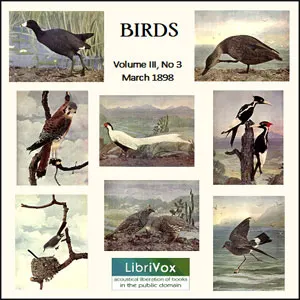
Chapters 24
-
1 01 - Some Bird Lovers 2:30
3, March, 1898. Some bird lovers. The happiness that is added to human lives by love for the lower creatures is beyond telling. Ernest von Vogelweide, the great German lyric poet of the Middle Ages, so loved the birds that he left a large bequest to the monks of Würzburg on condition that they should feed the birds every day on the tombstone over his grave. Of St. Francis of Assisi's love and tenderness for birds and animals, many beautiful stories have been told. The former he particularly loved. And tis related, they were wont to fly to him, while he talked to and blessed them. From the hands of a cruel boy he once rescued a pigeon, emblem of innocence and purity, made a nest for it, and watched over it and its young.
Of George Stevenson, the inventor, a beautiful story is told. One day, in an upper room of his home, he closed the window. Two or three days afterwards, however, he observed a bird flying against and violently beating its wings as though trying to break the window. His sympathy and curiosity were aroused. What could the little creature want? The window was opened, and the bird flew to one particular spot. Alas, one look into the little nest, and the bird with the worm still in its beak, which he had brought to the mother and his four little ones, fluttered to the floor. Stevenson lifted the exhausted bird and tried to revive it, but all his efforts proved in vain. At that time, the force of George Stevenson's mind was changing the face of the earth.
Yet he wept at the sight of the dead family, and grieved because he had all unconsciously been the cause of their death.
-
2 02 - Bird Day 2:15
Bird Day. The United States Department of Agriculture issued in July 1896 a circular suggesting that a bird day be added to the school calendar. In this circular, J. Sterling Morton, Secretary of Agriculture, says, The cause of bird protection is one that appeals to the best side of our natures. Let us yield to the appeal. Let us have a bird day, a day set apart from all other days of the year, to tell the children about the birds. But we must not stop here. We should strive continually to develop and intensify the sentiment of bird protection, not alone for the sake of preserving birds, but also for the sake of replacing as far as possible the barbaric impulses inherent in child nature by the nobler impulses and aspirations that should characterize advanced civilization.
Prof. C. A. Babcock, Superintendent of Schools, Oil City, Pennsylvania, who has acted upon the suggestion in his school, says, The preservation of birds is not merely a matter of sentiment, or of education in that high and fine feeling, kindness to all living things. It has an utilitarian side of vast extent, as broad as our boundless fields and our orchards sweep. The birds are necessary to us. Only by their means can the insects which injure and, if not checked, destroy vegetation be kept within bounds. What is most needed is the knowledge of the birds themselves, their modes of life, their curious ways, and their relation to the scheme of things. To know a bird is to love him. Birds are beautiful and interesting objects of study, and make appeals to children that are responded to with delight.
-
3 03 - March 1:29
March The stormy March has come at last, With wind and cloud and changing skies. I hear the rushing of the blast That through the snowy valley flies. Ah, passing few are they who speak, Wild stormy month. In praise of Thee, yet though Thy winds are loud and bleak, Thou art a welcome month to me. For Thou, to northern lands again, the glad and glorious sun dost bring, and Thou hast joined the gentle train, and wearest the gentle name of spring. And in Thy rain of blast and storm smiles many a long, bright, sunny day. When the changed winds are soft and warm, and heaven puts on the blue of May, then sing aloud the gushing rills, and the full springs from frost set free, that, brightly leaping down the hills, are just set out to meet the sea.
Bryant.
-
4 04 - The Bird's Answer 1:30
The Bird's Answer A little bird sat on the twig of a tree, a-swinging and singing as glad as could be, and shaking his tail and smoothing his dress, and having such fun as you never could guess. And when he had finished his gay little song, he flew down the street and went hopping along, this way and that way, with both little feet, while his sharp little eyes looked for something to eat. A little boy said to him, Little bird, stop, and tell me the reason you go with a hop. Why don't you walk as boys do and men, one foot at a time, like a duck or a hen? Then the little bird went with a hop, hop, hop. and laughed as if he never could stop. And he said, Little boy, there are some birds that talk, and some birds that hop, and some birds that walk.
But most little birds that can sing you a song are so small that their legs are not very strong. To scratch with, or wade with, or catch things, that's why, they hop with both feet. Little boy, good-bye.
-
5 05 - Where Missouri Birds Spend Christmas 3:37
Where Missouri Birds Spend Christmas Of course we know where the English sparrow spends his Christmas, and the snowbird came down in October and is with us yet. Likewise, the blue jay is here in many of our yards, and is quite respectable, like Eugene Fields' boy, now that there are no eggs to eat nor young birds to destroy. Though I have not yet seen him this winter. Sometimes he goes south and digs grubs of the tall, dead southern trees. But we may be interested in where some of our departed friends are Christmasing. All other woodpeckers stay with us. Except the yellow hammer. He has taken to feeding upon the ground a good deal of late and does not like it frozen. The red-breasted woodpecker and our two little sapsuckers, as we call them, are always here in the winter, the most optimistic birds we have.
I heard the nuthatch only a few days ago. I did not see him, but I knew by the way he talked through his nose that he was hanging head down on some nearby tree. The only other little bird that climbs up tree trunks, except the woodpeckers, is the brown creeper, a rather rare bird with us. Some years ago, one of the public school teachers sent me one that a little boy had found so chilled that it was helpless, so I suspect that he ought to spend Christmas further south, for his health. In the woods, the tree sparrow, associating with the snowbird, occasionally sings us a Christmas carol. The only bird here now from which we may expect a song, unless some vernal day should lose the syrinx of the cardinal, or provoke the fee-bee of the crested titmouse.
Christmas is on the vernal side of the winter solstice, and any sunny day thereabout is more like spring than autumn. Sometimes, in warm, swampy places, the fox-sparrow spends the winter about us, but I have never seen any here, though they are on the river about Louisiana, Missouri now, I suspect, along with the winter wren. They both sing occasionally in winter. On our high backbone position here at Mexico, between the rivers, we are not favorably situated for bird study, because the little feathered folks prefer the deep tangles of the river bottoms, and they appreciate the fact that it is naturally warmer there also. Even robins and bluebirds sometimes stop in these over winter here in Missouri.
The doves and blackbirds are mostly in the southern states, but not far, for, eating grain only now, they are after climate rather than food. But such birds as our swallows and the flycatchers, say the pee-wees, bee-martins and their kind, are much farther on where the insects fly all the year round. Some of them are in Florida, and some are in South America, and a few perhaps are banqueting in Old Mexico, studying the silver question. J. N. Baskett, in Mexico, Missouri, Intelligencer.
-
6 06 - The Black Duck 3:47
The Black Duck. Dusky Duck, Black Mallard, Black English Duck, Florida, are some of the names by which this well-known member of the family is recognized throughout the eastern North America, west to Utah, and north to Labrador. It is much less common in the interior than along the Atlantic coast. It is called the characteristic and one of the commonest ducks of New England, where it breeds at large, and from thence northeastward, but is most numerous during the migrations. The nest of the black duck is placed on the ground, in grass or rushes in the neighbourhood of ponds, pools and streams. in meadows and sometimes in swamps. It is a large and neatly arranged structure of weeds and grass, hollowed and lined with down and feathers from the breast of the bird.
In rare species, Mr. Fraser found the nest of this duck in Labrador. Usually placed upon the outreaching branches of stunted spruces, which are seldom higher than four feet. The eggs of this species are from six to twelve in number, usually seven or eight, and vary in color from pale buff to pale greenish buff. The nesting period is from the last of April to the early part of June. The black duck is a very wary creature. Exceedingly difficult of approach. They are found in great numbers, except when congregated on salt water, five to ten being an average flock, starting from pond and feeding ground. During very severe winters, says Hallock, when every sheet of water is bound in with a thick covering of ice, the black ducks are driven to warm spring holes where the water never freezes.
The approach of evening drives the ducks from the bay or sound, where they have been sitting during the day, and they seek these open inland spots for food and shelter. Brush houses are constructed of sedge, cedar boughs, etc., at the mouths of freshwater rivers and creeks, in places where the marshland is low and intersected by branches of the main stream. Here the ducks come to feed at night. These houses are left standing, however, and the wary ducks soon avoid entirely this locality and feed elsewhere. The brush house, building on feeding grounds, cannot be too severely condemned. Hallock observes that of all the birds which, during spring and fall, traverse our country, Probably none equal these ducks in point of size, numbers, and economic value.
The group is confined neither to the seacoast nor to the interior, but is spread out over the whole breadth of the continent, in summer extending its migrations to the furthest north, and in winter proceeding only so far south as it is forced to do by the freezing of the waters of its northern home.
-
7 07 - The Stormy Petrel 2:54
The Stormy Petrel. The Stormy Petrel, Mama, is a very interesting bird. I should like very much to be in a ship and see him walking on the water, wouldn't you? Mama, who thought of the Apostle St. Peter, shook her head. You must be mistaken, Bobby. Said she. I never heard of a bird that could walk on the water. Well, that's what my magazine says, replied Bobby, and I'm sure birds ought to know. Listen. And Bobby, stopping to spell a word now and then, and to ask the meaning of many, managed to inform his mother what the stormy petrel had to say about himself. Though I am the smallest of the web-footed birds, I am a great traveller, read Bobby. Everywhere, over the entire surface of the watery globe, you will find members of my order, far north in the Arctic seas and away down in the southern oceans.
We love the sea and the food which is thrown up by the waves, anything oily or greasy we particularly like. No matter how stormy the weather, nor how high the billows roll, you will see us little fellows with outstretched wings Sweeping along in the hollow trough of the sea, from one side of a ship to the other, now far ahead, then a great way behind, catching up easily with the ship, though making ten knots an hour. What is a knot, Mama? queried Bobby. A knot means a sailor's mile. An engineer says his locomotive runs at the rate of so many miles an hour. A seaman says so many knots. A knot is something more than our English mile. The sailors call us Mother Carey's chickens because we walk and run on the surface of the water.
They think us uncanny for telling bad weather or something else bad for the crew when, let me whisper it in your ear, it is our outstretched wings which uphold us, our wings as well as our broad, flat feet. There is something else I want to tell you, though, before I close. Think of making a lamp out of a bird's body. That is what they do with a stormy petrel's body on a certain island in the Atlantic Ocean. They find our carcasses so oily from the food we eat that all they have to do is to draw a wick through our body, light it, and lo! They have a lamp.
-
8 08 - Wilson's Petrel 4:10
Wilson's Petrel. Petrels are dispersed throughout all the seas and oceans of the world. Wilson's stormy petrel is one of the best known and commonest. It is to be met with Nearly everywhere over the entire watery surface of the globe, far north in the icy regions of the Arctic seas and south to the sunny isles of southern oceans. It breeds...
Dr. J. H.
Kidder Found it on Koguelan Island, southeast of Africa. He had previously seen the birds at the sea coast of the Cape of Good Hope, and on December 14th saw them out by day, feeding on the oily matter floating away from the carcass of a sea elephant. The birds, he says, frequent the rocky parts of hillsides, and flitting about like swallows catch very minute insects. Mother care is chicken! As it is called by sailors, is widely believed to be the harbinger of bad weather, and many superstitions have grown out of the habit which they possess of apparently walking on the surface of the water, as the Apostle St. Peter is recorded to have done. It is the smallest of the web-footed birds, yet few storms are violent enough to keep it from wandering over the waves in search of the food that the disturbed water casts.
The stormy petrel is so exceedingly oily in texture that the inhabitants of the feral islands draw a wick through its body and use it as a lamp. Wilson gives the following account of its habits while following a ship under sail. Quote, Coursing over the waves, down the declivities, up the ascents of the foaming surf that threatens to bend over their head, sweeping along through the hollow troughs of the sea, as in a sheltered valley, and again mounting with the rising billow, and just above its surface, occasionally dropping their feet, which, striking the water, throws the birds up again with additional force, sometimes leaping with both legs parallel. On the surface of the roughest wave for several yards at a time.
Meanwhile, they continue coursing from side to side of the ship's wake, making excursions far and wide, to the right and to the left, now a great way ahead, and now shooting astern for several hundred yards, returning again to the ship, as if she were all the time stationary, though perhaps running at the rate of ten knots an hour. But the most singular peculiarity of this bird is its faculty of standing and even running on the surface of the water, which it performs with apparent facility. When any greasy matter is thrown overboard, these birds instantly collect around it, and face to windward, with their long wings expanded and their webbed feet patting the water. Which the lightness of their bodies and the action of the wind on their wings enable them to do with ease.
In calm weather, they perform the same manoeuvre by keeping their wings just so much in action as to prevent their feet from sinking below the surface.
Rev. Mr. Eaton says that this species nests under large rocks not far from the beach. Egg One White.
-
9 09 - The Stormy Petrel 2:11
The Stormy Petrel A thousand miles from land are we, Tossing about on the stormy sea, From billow to bounding billow cast, Like fleecy snow on the stormy blast. The sails are scattered abroad like weeds, the strong masts shake like quivering reeds, the mighty cables and iron chains, the hull which all earthly strength disdains, they strain and they crack, and hearts like stone, their natural hard proud strength disown.
Up and down, up and down, from the base of the wave to the billow's crown, And amidst the flashing and feathery foam, the stormy petrel finds a home. A home, if such a place may be, for her who lives on the wide, wide sea, on the craggy ice in the frozen air, and only seeketh her rocky lair, to warn her young and teach them to spring, at once o'er the waves on their stormy wing.
O'er the deep, o'er the deep? Where the whale and the shark and the swordfish sleep, Outflying the blast and the driving rain, The petrel telleth her tale in vain. For the mariner curseth the warning bird, Which bringeth him news of the storm unheard. Ah, thus does the prophet of good or ill Meet hate from the creatures he serveth still. Yet he ne'er falters so petrel spring once more o'er the waves on thy stormy wing.
Brian Muller Proctor.
-
10 10 - The Blue-Gray Gnatchatcher 3:40
The Blue-Gray Gnatcatcher Almost everywhere in the United States, this active little bird may be found, inhabiting chiefly open, high woods. Often, he may be seen along streams, Skipping and darting about among the topmost branches of the trees, his long tail elevated and jerking in wren-like fashion, always moving about and ever uttering his wheezy, squeaky notes. Ridgeway says that during the breeding season, the male has a varied song of considerable power but lacking in sweetness, and uttered in an erratic manner, portions of it suggesting a weak imitation of the catbird's medley. It is as a nest builder that the gnatcatcher is best known. Davy, whose life study has been nests and eggs, says that as a work of beauty and ingenious architectural design, the nest of this bird has few equals in this country.
On the whole, it is a rather frail structure, usually built in the small, upright twigs, or saddled on the horizontal limbs of trees at heights ranging from 10 to 50 feet. The nest is a large, compact wall, contracted at the brim, and gracefully turned. The interior is deeply cupped, and the exterior is beautifully ornamented with lichens. The opening is always at the top. Often the nest is attached to a limb of the same diameter as itself, thus appearing as a knot or other excretions.
If, as Basket says, there can be no doubt that a bird may take delight in the skill of its work and the beauty of its home, as well as in its plumage, the dainty residents of the blue-gray gnatcatcher would indicate that the pretty little bird experiences a great amount of pleasure indeed. She lines her nest with soft, downy materials, cotton-like substances of withered blossoms and the silky down of the milkweed. In this, she lays four or five eggs of greenish or bluish white, speckled with chestnut. Colonel Goss describes this bird as as much at home in the shrubby bushes on the hillsides or mesquite growths on the plains as within the treetops of the heavily timbered bottomlands. A nervous, restless species that, in their quest of insect life, nimbly skip from branch to branch with partially spread wings and flirting tails, held more or less erect, now and then darting like a flash into the air to catch the passing flies.
A tireless picture of bustling energy that only ceases with the day. The soft, warbling love song is varied, tender, and full of melody. But so low, the hearer must stop to listen, in order to fully catch its silvery tones.
-
11 11 - The American Coot 3:11
Lee. The American Coot. I have a number of names. Mud Hen, Crow Duck, and Blue Peter. It's all the same to me. What's in a name anyway? Wouldn't a rose smell just as sweet if it were named Blue Peter, too? Well, I am an aquatic bird and can quack with the best of them and swim with them, too. I go along beautifully on the water. My feet are very remarkable, the toes being fringed by a membrane, which assists me greatly in swimming, as well as walking over the ooze. I call them my mudboards. Such a lovely little thing as I was when I came out of my shell. That is what people who saw me at that time say. My down was jet black, and my head a bright orange scarlet mixed with purple and blue. I wish I looked half as handsome now.
But you can't paddle around in the mud all day and keep clean. That is, I can't. My coat is a sooty black now. And I won't be able to change it as long as I live. Do you see that bear patch on my forehead? Well, that accounts for some people's calling me a bald-headed poot. Maybe you will be called that someday, too. I don't often come to dry land, but when I do, I march along very gracefully. I can fly, too, though my wings do appear too short for my size. I just stretched my legs out behind my stumpy tail, spread my wings, and away I go. I swim easily, too, with a peculiar bobbing motion of my head and neck. You should just see a lot of us patter over the water, using our feet as much as our wings when alarmed.
And such a cackling as we do keep up. Why, you can hear us quite half a mile. There is one thing about my face I should like to have changed, and that is my nose. My bill, I mean. It is an ivory white, and no matter how much I stick it in the mud, it will stay white. It is a good mark, you see, for a man with a gun, and I am dreadfully afraid I shall be shot some day. I have seen a number of my mates popped over just on account of their white bills. I visit you in April and leave you in November when the streams freeze over. I hope you will have pleasant weather next month, for I am making preparation to visit you then.
-
12 12 - The American Coot 4:16
Lee. The American Coot Science, in its classification and naming of birds, has rendered it quite easy for anyone to recognize unmistakably anywhere any specimen we have pictured in our magazine. In some sections, this interesting duck is known as the mud hen. In others, the crow duck. In still others as the ivory-billed mud hen. But with the picture in hand or in mind, one need never call the bird any other than its correct name, the American coot. The European coot resembles it, but its average size is slightly larger, its habits, however, being in all respects like those of its American relative. Davy says that this is the waterfowl that the young sportsman persists in shooting as a game bird, but at a riper age he does not hanker after its flesh.
The habitat of the coot is very extensive, covering the whole of North America, Middle America, and the West Indies, north to Greenland and Alaska, south to Veragua and Trinidad. The coot is a summer resident in large marshes and is not often rare in any marshy situation. It arrives the last of April and remains until the last of November. It nests at the same time as the Florida Gallinule, but shows a greater preference for reed patches, in which its nests are usually located, often in from two to four feet of water. The nests are generally larger than those of galanules and rarely composed of other material than the dry stalks of weeds and grasses. They are placed on the ground, just out of the water, or on floating vegetation.
Sometimes immense numbers of coots breed together. The eggs are clay or creamy white, uniformly and finely dotted all over with specks of dark brown and black. From six to twelve eggs have been found in a nest. As winter approaches and the marshes and shallow pools become covered with ice, these birds congregate in immense flocks on the rivers and small lakes and remain until cold weather closes the streams. Mr. Nelson says the coot has a curious habit when approached by a boat in a stream, rising often before the boat is within gunshot and flying directly at the boatman, generally so near that it may be easily brought down. The abundance of ducks and other game birds has caused the members of this family to be but little molested, until within a few years, when amateur sportsmen, finding ducks difficult to obtain, and mud hens, as coots and gallinules are called, conveniently tamed, have turned their batteries upon them and diminished their numbers about many marshes.
In the more retired marshes, however, they still breed abundantly. These birds differ from the Gallinoles in being social, going in flocks, and in preferring the open water. They sport and rest on muskrat houses and bare places of land and dress their feathers there. During the breeding season, they keep near their reedy cover, into which they quickly swim and hide in case of danger. They swim and walk with a nodding motion of the head. They are not expert divers. But go to the bottom when closely pressed and unable to fly. The flesh of the coot is dark and not good eating, and its feathers are not soft and downy. It is therefore not sought after by the pot hunter, nor considered a game bird by the sportsman, for which reasons, as well as the fact that the feathers cannot be used by the ladies for personal adornment, the birds are not shy and are easily approached.
-
13 13 - Interesting Facts About Birds 2:55
Interesting Facts About Birds Senses of sight, smell, and hearing are remarkably acute in birds. This is especially true of sight. Some have three eyelids, the upper and lower, and a membrane which can be drawn over the entire eyeball called the nictitating membrane. The eyes of the eagles and hawks are provided also with a ring of bony plates, by means of which the eye can adjust itself like a telescope, taking in both near and far objects. Birds, except nocturnal species, have no external ear, but hear well. The young of nest-building birds, when born, are blind, naked, and unable to walk. In the hen, the partridge, and the ducks, the young are able to walk, swim, or pick up food as soon as they break the shell.
When molting, at the close of the breeding season, quails usually shed in pairs. The male generally assumes a duller-hued coat than the female. With most birds of prey, the female is the larger. Bird songs are composed of love notes and pleasure notes. We speak of the scream of birds, their chirp, expressions of joy or fear, as in the human voice. Their songs can be set to music. See S. P. Chaney's Wood Notes Wild, in which the songs of many of our common birds are thus reproduced. The odd and peculiar actions of birds, their dances, struts, and posturings, are all expressions of their emotions. The nesting habits of birds are varied. Gulls drop eggs on bare ground or rocks. The Baltimore Oriole and Taylorbird construct hanging nests of elaborate workmanship.
The woodpecker hews out a deep nest in a rotten limb. The kingfisher digs one out of a sandy bank, while the cuckoo takes possession of the nest of some other bird. Most birds select nesting places away from other species, but swallows, English sparrows, grackles, and crows live in communities. There are between 7,000 and 8,000 species of living birds. A few species have become extinct, specimens of which it is the intention of birds to present in future numbers. There are three centers of distribution in the United States. One, the Atlantic States and Mississippi Valley. Two, The Rocky Mountain Plateau. Three. The Pacific Coast. Most of the birds breeding in the northern portions of the United States migrate south during the winter months.
Those remaining are known as residents.
-
14 14 - The Ivory-Billed Woodpecker 3:59
The Ivory-billed Woodpecker. In size, though hardly in beauty, this is indeed the Prince of Woodpeckers, the largest of our North American species. Its length ranges from 19 to 21 inches. There is one other woodpecker, called the Imperial, Which is larger, measuring 23 or 24 inches in length. This bird is found in western Mexico, north along the Sierra Madre, and probably, according to Davey, has not yet been observed within the limits of the United States. The ivory build is now rare, and is apparently restricted to the extreme southern states, especially those bordering the Gulf of Mexico. It is of a wild and wary disposition, making its home in the dark, swampy woodlands. The dense cypress swamps of Florida are one of its favorite haunts.
The nest of the ivory bill is excavated in a tree about 40 feet from the ground, the cavity often being nearly two feet in depth. Three or more eggs are laid. This bird does not remain long in one place, and during the day ranges over an extended territory. Its call is a high, rather nasal, yap, yap, yap, sounding in the distance like the note of a penny trumpet. To use the language of Chapman, Whose handbook is a mine of ornithological knowledge, woodpeckers are rather solitary birds, but are sometimes found associated in scattered companies during their migrations. Above all other birds, they are specially adapted to creep or climb. The peculiar structure of the foot, with its two toes directed forward and two backward, except in one genus, the three-toed, which will appear in the April number of birds, The stout, chisel-like bill is used to cut away wood and expose the hiding places of grubs and so forth, when the long, distensible tongue, with its horny spear-like tip, is thrust in, the food impaled, and drawn out.
All woodpeckers are of value to the farmer. It has been shown that two-thirds to three-fourths of their food consists of insects, chiefly noxious. Wood-boring beetles, both adults and larvae, are conspicuous, and with them are associated many caterpillars, mostly species that burrow into trees. Next in importance are the ants that live in decaying wood, all of which are sought by woodpeckers and eaten in great quantities. Many ants are particularly harmful to timber. For if they find a small spot of decay in the vacant burrow of some wood borers, they enlarge the hole and, as their colony is always on the increase, continue to eat away the wood until the whole trunk is honeycombed. Moreover, these insects are not accessible to other birds, and could pursue their career of destruction unmolested were it not for that the woodpeckers, with beaks and tongues especially fitted for such work, dig out and devour them.
It is thus evident that the woodpeckers are great conservators of forests. To them, more than to any other agency, we owe the preservation of timber from hordes of destructive insects. The ivory-billed woodpecker, living his almost solitary life in the vast and nearly impenetrable cypress swamps, at a height of forty and fifty feet from the ground, is rarely seen by man. The specimens we present in birds are so nearly lifelike That our readers need only imagine themselves in the dense forest of Cyprus to realize a very natural scene.
-
15 15 - The Ivory-Billed Woodpecker 2:38
The Ivory-Billed Woodpecker. Jip-jip-jop! As some call the prince of woodpeckers, I can, I suppose, shout just as loud as I like. Of course, my cousin, the Red-Belly Woodpecker, would turn up his bill and say they only call me the prince because I'm the largest of all the North American woodpeckers. Well, I think that is reason enough, don't you? Some creatures who are not bears have been called princes and kings for less than that, so I have heard. Mr. Redbelly had a great deal to say about, and for himself, in bears last month. He sent his picture to. Poo, he can't compare with me. I am said to be the most magnificent woodpecker of the whole lot. My species is select to, no matter if he does say the whole family of woodpeckers are common.
We are considered rare birds, you don't find us in all localities, no indeed. You will have to travel to the far, far south to catch a glimpse of one of us magnificent fellows. Should you ever go way down in the Suwannee river and walk real easy through the cypress forest, you might get a peep at one of us. But we are wild and shy, and like to travel long distances through the day, no stay-at-home buddies among us. I'm not one of the three-toed woodpeckers I didn't miss the red-belly was so anxious to tell you about. It's very strange how we hear some people are to talk about other people's imperfections. I have four toes, two in front and two behind, so it isn't sour grapes that leads me to speak as I do.
I'll admit my feet are peculiar, my toes assisting me in clinging to an upright surface, and my pointed stiff-tailed feathers serving me to prop me off when resting. I think I'm very fortunate, too, in having such a stour chisel-like bill, and such a horny, spiel-like tongue. With the first, I cut away wood and explored the hiding place of crops. With the latter, I impaled them and drew the food out. Dear, dear, how fearfully and wonderfully we are made, to be sure, birds as well as men. Sing? No, wish I could. But then I have a love song with my mate thinks it's fine. Tis a long rolling call which I beat with my bill.
-
16 16 - The Sparrow Hawk 2:26
The Sparrowhawk. Killy, killy, killy, killy. That's my song, and I don't sing it very low, either. It is for that reason some people call me the killyhawk. The boys who spend much time in the fields are very well acquainted with me. Many a time, I dare say, they have seen me patiently sitting for an hour or more on a lofty branch, waiting for something to turn up. Something does generally turn up, and that is a mouse. Ah, says she, peeking out from her nest, there is nobody around, so I will go out for a walk. And out she comes, not noticing me way up in the tree, of course. Then I dive from my perch and fly directly over her. A mouse can't keep still somehow, and from point to point she runs, zigzagging this way and that way, giving me lots of trouble, for I have to zigzag too.
After a while she stands still for a minute, and so do I, up in the air, my fan-like tail spread out very wide, my head lowered and, well... Pretty soon it's all over with Mrs. Mouse. But mice are a nuisance anyway, don't you think? Just because people have seen me do that little trick, they call me the mouse-hawk. I catch sparrows and other small birds, so they call me the sparrow-hawk, too. I don't care what they call me, to tell you the truth. Just so they let me alone. It's not pleasant to have a stone thrown at you, or a gun pointed your way, if it's loaded. And they generally are loaded, I notice, with something that hurts. My nest? Oh, I don't care for that sort of work, so I never build one.
Any natural hole in a high tree, the deserted hole of a woodpecker or a magpie's nest, is good enough for me. Just a few leaves in the bottom, and on them my mate lays five eggs, sometimes six, sometimes seven.
-
17 17 - The American Sparrow Hawk 3:55
III, No. III, March, 1898. Recorded for LibriVox.org by Phil Schempf. The American Sparrowhawk. Every boy who has been in the fields is familiar with this beautiful little hawk, which is numerous everywhere in North America. As Davy felicitously says, here it may be seen hovering almost motionless in midair. Then, suddenly swooping down to the ground, arises again with perhaps a field-mouse in its talons. From this habit it receives the name of mouse-hawk, although it also preys upon sparrows and other small birds. It is found almost everywhere, though most abundant along streams, where grow the high sycamores, whose natural cavities furnish suitable nesting-places. But meadows and fields are its retreats when in search of food.
It builds no nest, but deposits its eggs in the natural cavities of high trees, often in the deserted holes of woodpeckers, or in crevices in rocks or nooks of outbuildings. In the West, it frequently appropriates a deserted magpie's nest. Eggs of this hawk were taken from a crevice in a stone quarry in the Sayota River, where the birds nested for years. The sparrowhawk often takes possession of boxes intended for pigeons. and it always proves to be a peaceable neighbor. The nests generally contain no lining, but in some cases a slight bed of leaves or grasses on a few chips are used. The eggs are four to six, buffy white, speckled, spotted, and blotched, with light and dark brown. This hawk is not as active or destructive as others of the falcon tribe.
Its flight is usually short and irregular, darting here and there. Often hovering in a suspended manner for several moments at a time. During the summer months, it occasionally kills small birds, but feeds chiefly upon mice, lizards, grasshoppers, crickets, and the like, as they are so much easier to capture than full-grown birds, and to which they rarely turn their attention, until the cold weather drives the other forms of life upon which they so largely feed into their winter beds. The bird that suffers most outside of the horned larks and longspurs is the tree sparrow, as it prefers the hedges and small thickets upon the prairies, instead of the wooded lands, for its sheltered home. Its food, in all such cases, being upon the open lands, and whenever there is snow upon the ground, it drifts against the hedges, and forces the little birds to seek the bare spots quite a distance away.
For the seed's on or fallen from the weeds. Here it is that the hawk, says Goss, successfully performs its work, by darting from a perch and striking the sparrow, either upon the ground or before it can reach its hiding place. The woods are full of voices everywhere, and hundred chipmunks sharp, quick tones are there. The crickets chirp, the partridge drum, the harsh-voiced crows which go and come. In nature's song agree. The breeze that wanders through the firs, the rustle of each leaf that stirs, are whisperings to me. So when swift impulse leads in ways unknown, I follow on without a thought of fear. God reigns, and I can never be alone, with nature near. Tom Carter, Jr.
-
18 18 - Hints on the Study of Winter Birds 3:30
Hints on the study of winter birds. In attractiveness to children, says James E. McDade for the Committee of 60 of Chicago, no Department of Natural History surpasses ornithology. Birds are to be found everywhere. In the city parks and suburban groves, careful observation will reveal objects of study, even in the depths of winter. The following suggestions are based on practical work which has been done in the G.W. Curtis School during the past two years. No satisfactory work can be done until the children have been aroused to sufficient interest to observe birds for themselves. Pictures and descriptions, however valuable as auxiliaries, Can never take the place of personal observation. The best method of arousing this interest is to go out with the children and study the birds.
Opera glasses or field glasses will greatly facilitate observation. As a guide and description, pupils may have in mind the following points. Shape and size of bird. Prevailing color. Marks on head, wings, throat, or tail. Shape of bill. Length of tail. Where found, whether on the ground, in trees, or climbing tree trunks, these and other details should be emphasized. In all this work, strict accuracy must be insisted on. In the beginning, pupils are apt to give inaccurate, and in some instances highly imaginary, descriptions of birds. A good plan is to encourage them to bring in written descriptions of birds they have seen. Such fieldwork may well furnish excellent subject matter for watercolor work, as well as a basis for written compositions.
Good collections of our native birds may be found in the Field Columbian Museum and the Museum of the Chicago Academy of Sciences, and the curators of these institutions will be found ready to give teachers any aid in their power. Mr. McDade mentions the following as the most common winter birds of this vicinity, not including swimmers and waders. The English Sparrow, the Snowbird, the Blue Jay, the Thistlebird, the Black-capped Chickadee, the White-bellied Nuthatch, the Northern Shrike or Butcherbird, the Horned Lark, and the Crow. In many parts of the country there are good collections of birds which are accessible, and which may, by a little inquiry, be found by those interested. We do not hesitate to say, however, that the specimens of birds shown monthly in this magazine have stimulated the successful study of ornithology to a degree never imagined as possible.
The pictures are so true to nature in color and attitude that they are instantly fixed in the mind. We know several instances where children of eight and ten years have become, by its use, so familiar with many birds that they can draw and paint them from memory with considerable fidelity. Byrds is indeed the best means of acquiring speedy as well as accurate knowledge of ornithology desired by those who do not expect to pursue the study in all its scientific ramifications. We refer with confidence to the recognized authorities on the subject. C.C.
-
19 19 - The Silver Pheasant 3:33
The Silver Pheasant. The peasant-cock the woods doth most frequent, where spaniels spring and perch him by the scent. Old Rhype. In beautiful contrast with the golden pheasant, we present this month the magnificent silver or pencil pheasant, also a native of China, which has long been introduced into Europe, but has been considered to be fitted only for the aviary. The pheasant was long thought to have been brought from the banks of the river Phasis, now the Rhioni and Colchis, and introduced into Europe by the Argonauts.
Newton says that, as a matter of fact, nothing is known on this point, and, judging from the recognition of the remains of several species referred to, Both in Greece and in France, it seems not impossible that the ordinary pheasant may have been indigenous to England. But now the Mongolian, the English ring-necked, and the Chinese golden pheasant, each has found a home in some of the states where it is increasing in numbers. Why may not a similar experiment be made with the silver pheasant? On Fox Island in Puget Sound, there is an Oriental pheasant preserve. Mr. Frank Alling, the proprietor, is securing the cooperation of other landowners, and it promises to be a great success. The varieties of pheasants which he is raising include all we have mentioned in this article, as well as the copper, the green, the bronze, and the Asiatic ringnecks, with a curiosity in the shape of a mule produced by crossing and recrossing the copper and Asiatic ringnecks.
The mule hens are very beautiful, But their eggs will not hatch. Oriental quails liberated on the island have increased quite rapidly. Among the many importations are small bantams from Musung, China, for hatching pheasant eggs and rearing the young birds, mandarin ducks from Japan, wild peacocks and bleeding-heart pigeons from Calcutta, India, and Manila, respectively. In England, within recent years, the practice of bringing up pheasants by hand has been extensively followed, and the numbers so reared, say Newton, vastly exceed those that are bred at large. The eggs are collected from birds that are either running wild or kept in a mew, and are placed under domestic hens. But though these prove most attentive foster mothers, much additional care on the part of the keepers is needed, to ensure the arrival and maturity of the chicks.
For being necessarily crowded in a comparatively small space, they are subject to several diseases, which often carry off a large proportion, to say nothing of the risk they run of not being provided with proper food, or of meeting an early death from some predatory animal. As they advance in age, the young pheasants readily take to a wild life, and indeed can only be kept from wandering in every direction, By being plentifully supplied with food, which has to be scattered for them in the places in which it is desired that they should stay.
-
20 20 - Eider Duck Farms 3:10
Eider Duck Farms. The fluffy feathers gathered in Iceland. All accounts I have read about Eider ducks say that nests are robbed of their down twice, the duck supplying it each time from her own body. The third time the drake gives his white down, and this is allowed to remain. declares a writer in good words. But I was told by farmers in Iceland that now they never take the down until the little ones are hatched. It has been found that the birds thrive better and increase faster when they are allowed to live as nature meant them to. So now the poor mothers are no longer obliged to strip themselves of all their down to refurnish their despoiled nests. Sometimes, if the quantity is very great, A little may be taken, but enough must be left to cover the eggs when the duck leaves her nest for food.
A writer from Iceland, in speaking of a visit to one of the Isafjord farms, wrote, On the coast was a wall built of large stones, just above high water level, about three feet high and of considerable thickness at the bottom. On both sides of it, alternate stones had been left out so as to form a series of square compartments for the ducks to make their nests in. Almost every compartment was occupied, and as we walked along the shore, a line of ducks flew out, one after another. The house was a marvel. The earthen walls that surround it and the window embrasures were occupied with ducks. On the ground, the house was fringed with ducks. On the turf slopes of the roof, we could see ducks, and ducks sat on the scraper.
About 10,000 pounds of eiderdown are gathered annually in Iceland, 7,000 being exported to foreign countries. Formerly, the peasants used to receive over 21 shillings a pound, but the price has now fallen to half that amount. The peasants seldom receive money and are obliged to barter their down for merchandise, Furnished by the Danish merchants at the little settlements at the fjords. A pound and a half of down is enough to fill an ordinary bed puff. These very comfortable articles are found in the guest room of every Iceland farm, however poor and small it may be. After a long, hard day in the saddle, the traveler longs for warmth and shelter. These little guest rooms have never had a fire in them.
And built as they are on the ground, there is a dreadful chill on them. Once tucked away in bed, and tired bones lose their pains and stiffness, however, and well covered with the down puff, a delightful sense of comfort follows.
-
21 21 - The Scaled Partridge 1:42
The Scaled Partridge Throughout northwestern Mexico and the border of the United States, from western Texas to New Mexico and southern Arizona, this handsome partridge called the Blue Quail is found in abundance, especially on the dry mesas of the San Pedro Slope, of the Santa Catalina Mountains, up to an altitude of 3,500 feet. In Arizona, they are found in flocks of from six to ten, sometimes more, in the most barren places miles away from water. The blue quail, like all the other western and southwestern species, prefers to trust to safety to its powers of running rather than those of flight. The great trouble is to start them from the ground. A slight depression under a bush serves for the nest of this bird, which is generally lined with a few coarse grasses.
Complete sets of eggs have been found as early as April 25th. The eggs are extremely thick-shelled of a buffy white or cream color. The number laid ranges from eight to sixteen. The habits of this quail do not differ greatly from those of bobwhite, though they have not been fully studied. and the species is of less extensive distribution.
-
22 22 - The Mound Bird 2:30
The Mound Bird.
There are some peculiar birds in the world, and one of the strangest is the Australian Megapod, or Mound Bird, that allows nature to perform the labor of hatching its eggs. In some parts of the island continent are found many mounds of considerable size and height, which the first explorers took for burial mounds. These were made by the Megapodius tumulus, which uses them for hatching its eggs. They have sometimes considerable dimensions. A nest that is fourteen feet high and fifty-five feet in circumference may be regarded as large. Each megapod builds its own nest with materials which it gathers from all sides, And these are exactly what the gardener uses in the month of March to make his forcing beds, namely leaves and decomposing vegetable matter, which by their fermentation give off an appreciable amount of heat.
In the forcing beds, this heat hastens the sprouting of the seeds. In the nest, it suffices for the development and hatching of the young birds. and the mother can go where she likes and occupy herself as she wishes without being troubled by the duties of sitting. In the small islands of Nenefu, in the Pacific, another bird has a somewhat similar habit, in so far as it also abandons its eggs, but in place of obtaining the necessary heat from fermentation, it gets it from the warm sand. The Lepoa, or native pheasant of Australia, Acts like the megapod, and watches the temperature of its mound very closely, covering and uncovering the eggs several times a day to cool them or heat them as becomes necessary.
After hatching, the young bird remains in the mound several hours. It leaves on the second day, but returns for the night, and not until the third day is it able to leave for good the paternal abode.
-
23 23 - The New Tenants 10:37
By Eleonora Kinsley Marble.
Mr. Wren had no need to inquire the cause of his mate's distress, for at this moment a loud and vehement, J, J, J, resounded from an adjacent tree. Ha! said he. It is that villain, Mr. Blue Jay, at last. I have been expecting a call from him for some time. I heard yesterday that he was caught sucking the eggs of Mrs. Red-Eyed Vario, and that Mrs. Dove was mourning more than usual, because out of her four beautiful eggs she had only one left. But never you mind, my dear, never you mind. He daren't go near our nest, you see, for Bridget is out there with her broom, and if he should dare attack us, why?" Well, chirped Mrs. Wren, who at once saw the force of his reasoning. What would you do, Mr. Wren, should he attack us?
I'd like to know, because I am quite sure what dear Papa would have done under the circumstances. So am I, responded Mr. Wren with a chuckle. So am I. So are you what, retorted Mrs. Wren, angrily tapping the perch on which she sat with her foot. Sure what your dear Papa would have done, my dear, under the circumstances? Ha, ha, ha, and Mr. Wren flirted his tail over his head and hopped about in anything but a dignified or warrior-like manner. Mrs. Wren surveyed him with contempt and surprise. Of all the exasperateen creatures, she said, you are the worst. First you whispered and bid me be silent, and now just look at you hopping about and gibbering like an idiot. I wish Mr. Blue Jay would come over here and...
Come over here? Mr. Wren almost turned a somersault in his glee. Come over here, my dear? Not much. Don't you see that kingbird over there with his eye on Mr. Jay? There's going to be a fight, a real knock-down, feather-pulling fight, and I, I won't be in it. And Mr. Wren whistled and chattered and flirted his tail in a greatly relieved and truly funny manner. If I weren't so anxious about the eggs, said Mrs. Wren, I'd stay here and see the fight, too. They are well-matched, both such fine, handsome birds, especially Mr. J. Ah, how it does all remind me of dear Papa. Mr. Wren could have laughed aloud when he thought of her plain, crooked-legged little father, but he only sniffed and said something about Mr.
J being a saucy, impudent dude. But really now, he is handsome, repeated Mrs. Wren. Only see how his head feathers stand up. My, how angry they both are. What can be the matter, I wonder? If you will stop talking for a minute, returned Mr. Wren. Perhaps we can hear. Mr. Blue Jay is a great coward when it comes to fighting one of his size. More than likely, he will sneak away, or fly off screaming loudly at the first signs of attack. If you will stop your chatter, sharply retorted Mrs. Wren, we may hear what they are saying. Listen, can't you? You old thief and pickpocket, shrieked Mr. King Bird, his head feathers standing up like an Indian chief's. "'Whose nest around here are you lying in wait to rob?' "'What business is it of yours?' retorted Mr.
J. with a sneer. "'You old tyrant! A nice fellow, indeed, to be calling people names. "'The pot calling the kettle black. Hmph!' Mr. Kingbird, aware of the many young birds he had eaten in his time, concluded he had best confine himself exclusively to the question of eggs. "'It's only a sneak,' he replied. The morning doves' cries the other day were truly heart-rending. I made up my mind, then, that the very first time you crossed my path I would thrash you. That's right, give it to him, give it to him, cried the birds in chorus, a large number of which, attracted by the quarrel, had formed themselves into a ring about the treetops. He's not only a thief, but a bully, always ready to whip a bird under his size.
Mr. Blue Jay winced for a second, for it is not pleasant to find oneself hated by all his fellow kind. I'll swear, said he, lifting up one foot solemnly, that I have not been near the morning dove's nest this season. Nor the red-eyed varios. Nor the red-eyed varios, affirmed Mr. Blue Jay. Slightly closing one eye and coughing behind his foot. Oh, oh, oh, chorused a dozen voices. We saw him around here this very morning. And I, said a bluebird, saw him destroy the eggs of Mrs. Morning Dove's nest myself. So, sternly said Mr. Kingbird, the rascal adds perjury to his other crimes. It is the duty of every honest citizen of the woods and orchards to rid the world of such a villain. Defend yourself, Mr.
J., or—at this moment, a loud and vehement—Z-E-A! Z-E-A! broke in upon Mr. Kingbird's speech. Ah, Mr. Catbird, he said, his crest suddenly falling. I think I will attend to this case another time. And much to the disappointment of the assembled crowd, Mr. Kingbird took wing and flew away. No sooner was he gone than Mr. Blue Jay nearly doubled himself up with laughter. I thought that would make his feathers fall, he said, resuming his braggart manner. I have noticed how quickly he gets out of the way of Mr. Catbird, though he will fight a hawk, or a crow, or even an eagle. He-he-he, I imitated Mr. Catbird very well, didn't I? And the rogue, to show his powers of mimicry, cried, Zee-ay, zee-ay, again.
Then, caw, caw, like a crow, meowed like a cat, barked like a dog, crowed like a rooster, and finished with a loud, harsh, Kee-oo, kee-oo, which put all the birds to flight. The red-shouldered hawk, they one and all cried, with frightened glances into the air, and Mrs. Wren, forgetting for the moment that it was only Mr. J imitating Mr. Hog, flew over to her nest in the greatest consternation. Well, well, she said afterward with a laugh. It was much ado about nothing, after all. But what a clever fellow that Mr. J is, to be sure. Really, I cannot help but admire him. Rogue, though he is, and with a pretty flutter of her wings, Mrs. Wren gathered the six speckled treasures under her breast and sat down to brood.
I don't see how you could have covered more than six eggs, my dear, said Mr. Wren tenderly. You are such a little body, you know. Mrs. John last year, though, had ten and one brood, did she not? Yes, sniffed Mrs. Wren. And her neighbors have never heard the last of it, such a gossip and braggart as she is. Why, she tells every ladybird that calls on her that her Mr. Wren had three furnished houses when he proposed to her. One in the knot hole of an apple tree, one on top of a very high pole, and the other, well, really I forget, under the roof of a meeting house, I believe. Hmm, said Mr. Wren, turning up his bill. That's the reason she accepted him, I suppose. To my notion, he is a most unattractive fellow, ugly, as he is proud.
Oh, handsome is as handsome does, returned Mrs. Wren, as our landlady says. But you can't deny that he makes my cousin a good husband. It is very foolish for them to boast so, for they can only occupy one house at a time. And surely they have to earn their food by searching for insects and worms, precisely as we do. Then, too, riches take wings sometimes and fly away. And as I told one of my neighbors the other day, I am just as happy in this old tin pot as I would be on top of the highest pole. How glad I am to hear you say that, returned Mr. Wren, tears glistening in his little black eyes. For there can be no true happiness without contentment, as our landlord says. Dear little mate, fourteen days you must sit on the nest.
How tired you will be. Oh, I don't mind that, replied Mrs. Wren. If only our birdlings hatch out pretty and good. Once in a while I will fly off for a little exercise, you know, and, like Mr. John, you will take my place on the nest and keep the eggs warm. Oh, exclaimed Mr. Wren ruefully, I hadn't calculated on doing that, but we will see. I'm off now to get something to eat, and we'll fetch you as delicious a spider or nice fat canker worm as I can find. Ta-ta, love! And off Mr. Wren flew to the orchard, singing as he went. By Christine Peterson.
-
24 24 - Summary 4:13
Summary Black Duck. Anis obscura. Other name, Dusky Duck. North America. Breeds from Illinois and New Jersey to Hudson Bay and Labrador. Winters southward to the Greater Antilles. On the ground, in grass or rushes in the neighborhood of ponds, pools, and streams. Eggs. Eight to twelve. Pale greenish or bluish white, or creamy buff. Wilson's Petrel. Oceanites Oceanus. Atlantic Ocean. Breeds in the southern seas, Kerguelen Island, and migrates northward, spending the summer off our coasts. Nest. in the crevices of rocks. Egg. One. White. Blue-Gray Gnatcatcher. Polyoptilla cerulea. Eastern United States. Breeds from the Gulf States to Northern Illinois, Southern Ontario, and New Jersey, and wanders rarely to Minnesota and Maine.
Winters from Florida southward. Nest. Of fine strips of bark and fine grasses, firmly interwoven and covered with lichens on branch or in crotch of tree, ten to sixty feet up. Eggs. Four or five, bluish-white, thickly spotted and speckled with brown. American Coot. Fulica Americana. Other names. Mud Hen. Crow Duck. Blue Peter. Range. North America, as far north as Alaska and New Brunswick and Greenland, breeds throughout its range. Nest. Of reeds and grasses, among reeds in freshwater marshes. Eggs. Eight to fifteen, pale, buffy white, speckled with chocolate on black. Ivory-billed woodpecker. Campophilus, principalus. Range. Formerly South Atlantic and Gulf States, from North Carolina to Texas, north in the Mississippi Valley to Missouri, southern Illinois, and southern Indiana.
Now restricted to the Gulf States and the lower Mississippi Valley, where only locally distributed. AOU. Nest in the higher part of a tree. Eggs. Three have been found. American Sparrowhawk. Falco sparvarius. Other name, killihawk. From Florida to Hudson Bay, and winters from New Jersey southward. In a hole in a tree, frequently in a woodpecker's deserted nest. Eggs, three to seven, creamy white to rufous, generally finely and evenly marked, with shades of the ground color. Silver pheasant. Phasianus nycthemerus. Other name, Penciled. Throughout China. Scaled Partridge. Calipepla squamata. Other name, Blue quail.
Northwestern Mexico and border of the United States, from western Texas to New Mexico and southern Arizona.
A slight depression under a bush. lined with a few coarse grasses. Eggs, eight to sixteen, of a buffy white or cream color, irregularly dotted with specks of light brown. End of Birds, Volume 3, Number 3, March, 1898.