
Chapters 14
-
1 01 - Too Late for the Stage 18:05
Wheeler. Chapter One. Too late for the stage. Death Notch. Did you ever hear of a more uninviting name for a place, dear reader? If so, you could not well find a harder roll. Where dwelt humanity than Death Notch? Along the whole golden slope of the West? It was said that nobody but rascals and ruff could exist in that lone mining camp, which was confirmed by the fact that it was seldom for weekly stage brought any one there who had come to settle. Even the government officials, cognizant of the lawlessness within the border of Death Notch, hesitated to interfere, because of the desperate character of the residents hardest of the heart. The town lay in a sort of mountain-surrounded basin. On the route from Paiachee, Nevada, to Helena, Montana, and had formerly been an Indian camp, until a well-heeled but notorious young gamble named Paiute Dave had come along and driven the Reds away, as he was able to do, having backing of some forty ruffians of his own stamp.
There being but a comparative handful of the Reds, they had been scattered when Paiute Dave and his gang went to prospecting, and in a short time discovered paying dirt. Since that the population had gradually increased to a hundred and fifty people, nearly all of the ruffian type, and all under the order of the man, Paiute Day, who ruled as king over the others. In the days when the Indians had held possession, the town had been called Saquo. Afterward it had been named Golden Eagle, until a few months passed when, by vote, it had been rechristened Death Notch. Of course there was a reason for this, a reason both peculiar and striking. When the Indians had been driven forth, their chief Red Hatchet had declared vengeance upon the Paleface Two intruders, and cursed the town.
vowing to kill off every pale-face who should enter it, and to mark each death by a notch upon the council pole. This pole was tall young pine that grow just as the edge of the town, and around which it had been the custom of the tribe to hold council. Nor had the chief lied. For several years he and the member of his tribe had waged upon the usurpers. And a score or more had bit the dust, and a notch upon the council tree had recorded each stroke of vengeance. But, as Puyute Dave constantly added new roughs to his gang, the Indians also gradually diminished, until no more death notches had appeared upon the tree. This state of affairs had continued until about three weeks before our story opens.
when a placard had been found tacked to the council tree bearing the following message. Beware! Red Hatchet is not yet gone the way of his forefather, but lives to wreak vengeance upon the town of Death Notch. In the interval of silence he has only been recruiting his fury. Red Hatchet. With the name Death Notch, Paiute Dave, seemed strangely impressed, and at once ordered that the town of Golden Eagle be henceforth known as Death Notch. Death Notch gloried in one important fact. It was the midway stage station between Helena and Pioci, and the terminus of two stage lines. All traffic from Pioci to Helena, or vice versa, had to be transferred at Death Notch From one stage or freight line to another.
As a result, the arrivals and departure of stages being very irregular. It was a thing for passengers or freight to be laid off at Death Notch for a number of days. It was a delay that very few relished. Who knew the bad repute of the place? But there was no help for it. except for passengers to go on a foot through a bowling wilderness. The Wednesday stage of the second week of September wheeled down into Death Notch about noon from the Mount in Trail, and drew up before the poker house. With a noisy rumble for the poker house was the only hostillery afforded transient patronage at Death Notch. Change keys for Helena? yelled out Buck Piper, the driver, and then he threw the ribbons to one of the several bleary-eyed-looking pilgrims who were standing in front of the tavern sunning themselves, and made for the liquor department to moisten his throat, leaving his fares to take care of themselves.
There were but two passengers to-day, and they at once disembarked from the stage. Upon the plank wall in front of the poker house. They were widely at contrast. In appearance, though evidently traveling companions, the one being a pretty young lady, while the other was a long-gourd, loosely constructed colored man, of the darkest ray serene. The young lady evidently was not over seventeen or eighteen years of age. But was the possessor of a fine figure, and prettily chiselled features, set off by starry black eyes and wavy brown hair. She was attired with a long ulsterduster over her dress, a silk scarf about her throat, and a veiled hat upon her head, and was by all odds the trimmest little craft that had anchored in Death-Notch in many a day.
The darky was a very sable individual, with a genuine Negro physique from the thick-lipped mouth of huge dimensions to the rolling, ludicrous eyes and light-curling hair. His feet, too, were of extraordinary size, while the rest of his person seemed hastily constructed and loose-pointed in the extreme. He was attired in white-legged Played pantaloons, too short at the waist and feet by half a foot, a white vest and white shirt with wide cuffs and collar, a swallow-tailed coat cut tight at the waist, and a white silk hat, somewhat the worse for bad usage. In his hand he carried a bag containing an instrument shaped very much like a banjo. The young lady earned a small hand satchel. On leaving the stage-coach, the strangely contrasted pair paused a moment as if in doubt which way to go, and the young lady turned to one of the low-browed, villainous-looking pilgrims lounging on a bench before the tavern.
"'Can you tell me, sir, how long before the stage will leave for Helena?' she asked in a pleasant voice. "'No, Mum, I reckon not.' The address party said, "'Cause how I don't know. There comes Hank Shakespeare, the poet. However maybe he can put you on to what you want to know.' And he indicated a tall, raw-boned individual who was approaching a man who looked as though he might be the possessor of a great deal of brute strength and dog courage, especially the latter, for he was swarthy and ugly of countenance. Wearing a stubble of beard and long matted hair, while his brows were shaggy and his eyes evil and bloodshot. He was attired in stoggy boots, dirty patched overalls and overshirt abattet, shapeless plug hat minus the rim, while in a belt about his waist he wore four large-sized revolvers and a bowie.
Anything but a poet. looked the big bull-whacker, and the young lady was discussing, no doubt, this when he came up and paused to take a survey of her, the coon. Hello. A nigger and a gull, eh? Well, let's all shout and rejoice. We hear a female's voice. Howdy-do, ma'am. Going to settle here? We're just needing a woman in this here camp. Cause how, you see? When their boys want to go courting, they've got to court one another. "'No, I am going to settle here,' the young woman replied, quite promptly. "'I wish to find out what time the stage leaves for Helena.' "'Helena, why, bless you, ma'am. Their next stage won't go for a week. I allow. "'Cause how she started six hours ago. No stage for next Wednesday, sure.' An exclamation of disappointment escaped the young lady.
Oh, that is too bad. I wouldn't have missed reaching Helena for a good deal. Is there no way I can overtake the stage, sir? Reckon not, miss, unless you hoof it, and I opine you wouldn't catch it. Then, if your feet was as large as their niggers, I reckon you might do it for. N. Dexter could not compete. with that fragrant coon's feet, and stand in his show a-winin' their heat. No, Mum, I allow your best halt is to stop right here, in Death Notch, till next stage. I cannot afford to. It seems I must reach Helena, one way or another. Cannot we hire saddle-horses, or purchase them, even in order that we may overtake the stage? Nere a boss. Their only thing with four legs, said Piper's team, is a pair of oxen.
At this juncture, the thirsty Piper appeared upon the scene, wiping his mouth from a recent lubrication in the shape of a bootleg. "'Oh, sir, cannot I prevail upon you to take us on until we overtake the Helena stage?' the girl said, turning to him appealingly. We have an engagement to fulfill, and must be in Helena by Saturday night, or throw it up. Sorry, Mum, but my route don't go no further than here, and I can't accommodate you. The worthy piper piped, taking a chew of tobacco. But I will pay you for it. I'll give you dollars, if you will put us on board the Helena stage. Couldn't take me with a hundred dollars, Mum. For I ain't in Neederton. You can get accommodations, Poker Jack's Ranch, till next week, and I allow of your kin.
Flip their boards right purty, without hiding their ace up your sleeve. Their boys won't let you get lonesome. "'I don't thank you for your assurance, sir,' was the haughty reply. "'Come, Nick. Let's see if we can get a room.' And they entered the office. which also served the purpose of bar and gambling room. A score or more of ruffian-looking fellows were lounging about, but one among the lot, more professing than the rest, arose and came forward as the two travelers entered. He was dressed in white woollen garments, with white shirt and collar, slippers upon his feet, and a round red smoking cap upon his head. In form he was of graceful build, while he was not bad-looking in face, except for a habitual wicker glitter of his black eyes, and a faint cynical expression which lurked under his graceful moustache.
"'Excuse me, but did you wish to see me?' he said, on approaching. "'If you are the proprietor—' "'Yes, sir,' the girl replied, a little timidly. "'Yas.' "'If you be the boss, we'd gwine to tax you. Have you proper accommodations for two fast-class gusts?' The darky put in, with a considerable amount of airiness. "'No, no, not gust. You mean guest,' Nick." The girl interrupted. "'Yes, guest. That's it.' Without perpetual pre-contemplation, I accidentally absented one vowel from the syllable. "'You see, boss, as the stage Dunn went off and left us. We wants to engage apartments and superlative substance. We're on to subsist for several days henceforth until the next vehicle. Dear Peringoats, dis your way.
Ah, yes, I understand. You wish first-class accommodations, which I can furnish. My name is Poker Jack, at your service, and if you will register— I will show you to a couple of rooms. They accordingly went to a desk and registered their names in a book kept for that purpose, the darkie as Nicodemus Johnson, star comedian, the young lady as Miss Virgie Verner of New York. Then Poker Jack escorted them to a suite of rudely furnished rooms upstairs Just over the large bar and gambling room. If you would be so kind, we would prefer our meals sent to our rooms," Miss Verner said. As you like, Miss. Have you any baggage? My baggage will be along on the freight wagon, sir. Then Poker Jack bowed himself out.
After he had gone, the girl called in the darky from the adjoining room.
We shall have trouble in his place. Mark my word, all our men here, and the most evil, repulsive-looking lot I ever came across. Spect you're right, Miss Fergie, but you've just bet your life they doesn't want to come fooling around dis child, or I'll carve em up bad. I summon a half when I see mad. But allowing that we are both brave, What could we do against such overwhelming odds? Should they offer to harm us? Oh, why did we venture here? We shall surely be followed by the human bloodhound, my enemy, and God only knows what evil he can do in this place, where the people look capable of any terrible crime. Oh, I am so tired, so weary of this hunted life. The freight wagon arrived soon after the stage, and unloaded two trunks in front of the poker house.
Upon the end of one was pasted part of a theatre bill, which read, Miss Virgie Verner, the charming vocalist and musician. On the other trunk was the other part of the proclaiming reading, Nicodemus Johnson, banjoist and dancer. A crowd of bystanders stood, read, and pondered over these little announcements. Hank Shakespeare among the rest. "'Yes, sirree,' Bob Talhos buys them a pair a show people. "'Goin' to Helena, and they reckon they can slight us cusses here at Death Notch by not havin' their sarcases here. But they can't not forget Jim. I tell you what, I purpose we trot em down. into the barroom, O'Poker Jack's crib, to-night, and make him give us a show, as well as their fellas at Helena.
What do you say? Bulldog Ben barked yes. A little disgusting-looking ruffian cried, and the whole gang chimed in assent. Therefore it was as good as settled that something was to occur.
-
2 02 - A Compact With the Devil's Son 17:01
Wheeler. Chapter Two. A Compact with the Devil's Own. About sunset of that same day, in a lonely gulch leading off from Death Notch, a young girl was wandering along with a basket upon her arm, now and then plucking a wild flower, and singing the while in spirit with the merry birds that warbled among the branches of the trees around her. She was, at a glance, an Indian, but lighter complexion than the average of her nation, betraying a mixture of white blood in her veins.
Attired in the picturesque garb of an Indian princess, she looked decidedly pretty, with her dusky skin, her eyes of midnight color, and long, sweeping wealth of wavy raven hair, which fell back below her waist. In keeping with the wild scene around her was she, and yet happy and free from care is the merry little chipmunk that darted across her path and disappeared in the shrubbery. Pretty mountain-doves are cooing, sturdy robins gone a-wooing. Wonder what all birds are doing, so happy all they seem.
She sung, as she stopped to pluck a pretty blossom from its stalk. "'And by the way, little bird, suppose you tell us what you are doing?' A voice exclaimed. And the owner, a tall, well-dressed man of prepossessing countenance, and the owner of a monstrous moustache, stepped from a clump of bushes where he had hitherto been concealed. The Indian girl started violently at the sight of him, and would have run away. But he stepped quickly forward and seized her by the arm. "'Hold on, pretty bird. Don't be scared. I will not harm you,' he said laughingly. "'I simply want to have a talk with you.' "'No, no, Siska does not know, pale-faced man. He must let her go.' "'But I can't do that just yet. Come to this log and sit down and answer some questions which I shall ask you, and then I will let you go.' And still retaining a hold of her hand and arm, he forced her to a seat upon a fallen tree close by.
"'There,' he said, when they were both seated. "'Now we are all prepared for a nice little chat.' The girl did not reply. She was evidently greatly frightened. For she was trembling like a leaf. The stranger noted the fact. "'Don't be afraid, my girl,' he repeated. "'I'll not hurt you. Now, to begin with, I want you to tell me how far it is from here to a place called Death Notch.' "'A couple of miles or so.' "'Ah, so near. Well, I'm in luck. Now, what is your name?' "'Cisca, sir. Please let me go.' Red Hatchet would be very angry if he knew I spoke to a pale face. Oh, he would, eh? So, he's one of those rabid old bucks who is dead set on the white race? Red Hatchet is a great warrior, and his anger is to be feared.
Well, then, when you see him next, tell him to slice me a chunk of it, weighing about half a pound, and send it down to Death Notch. Now, Siska, you seem to be a pretty nice girl. "'How'd you like to go along with me to Death Notch, and keep house for me in a snug little ten by twenty?' "'No, no, Siska not like it. She must return to the wigwam of her father.' "'Oh, don't be in a hurry. I'll give you a lot of gold rings and other trinkets if you will go with me, and plenty of money.' "'No, no,' the girl repeated impatiently.
"'Siska not like Paleface. No go with Paleface. Let the Indian girl loose so that she can return to her father's lodge. "'Well, then you must give me a kiss, my bird of the wilderness, and you can go.' "'No, no! Siska, not kiss Paleface,' she answered, struggling to release herself. "'Paleface, bad man, and Red Hatchet be angry at him.' "'That don't matter to me. A kiss I'm going to have before you go.' Or my name's not Carol Carner. So pucker up those pretty lips, my beauty, and submit to the inevitable. "'No, no! Help, help!' she screamed, struggling so violently that he found it impossible to accomplish his design. "'Curse you! You are as strong as a young bear!' He gritted savagely. "'Aha!
I have you now, though, and now for my kiss.' "'Not by a jugful, stranger.' A stern voice cried, accompanied by rapidly approaching footsteps, and the next instant Carol Carner found himself lying at full length upon the ground, while over him stood a handsome fellow in sportish dress. Valiant Deadwood Dick Ha-ha! He laughed sarcastically. What a figure you cut now, don't you, my presuming pilgrim? You reckoned you had this little girl dead to rights, didn't you, you infernal skunk? "'Because she was alone and unprotected? "'But, you see, all signs fail when the wind blows me down.' "'The devil take you!' Carol Carner cried, arising to a sitting posture and rubbing his cheek where the imprint of Deadwood Dick's knuckles were yet to be seen.
"'Who are you that you have this audacity?' "'A cuss from Custer, a bulldog from Boseman, a diabolical devil from Deadwood.' Dick replied dryly, I don't carry any visiting cards, as I generally have a sheriff or marshal after me who carries them and posts them up in every convenient place. Viz. Five hundred dollars reward for the capture of the notorious outlaw, Deadwood Dick, Dead or Alive. Seen any of them gentle little reminders up in this section?
If I had, I should use my own judgment about imparting the information to you. Carol growled, arising to a standing position. I want to know what business you had to strike me. The business of being a consolidated protective association for the protection of widows and orphans and weak humans generally. I found you an unscrupulous knave, attempting to kiss this girl against her will, and I very naturally lost control of my pugilistic members to that extent that you immediately let her alone and set down. You shall answer for the insult, sir. I am going to death-notch. If you take pains to come there also, I'll punish you severely. "'Correct,' Deadwood Dick assented, with a taunting bow. "'You may look for me tonight, Senator.
"'Be kind enough to pedestrianise hence most perceptibly now, will you, "'as your presence is doubtless very disagreeable to this young lady.' "'Yes, I'll go. But remember, you shall yet repent your insult to me.' "'Karner replied fiercely. For fear I may forget the admonition, perhaps I'd best write it down in my diary, was the sport's parting shot, as the stranger turned and stalked down the gulch. When he had gone from view, Dick turned to the Indian girl, who stood a few paces away, regarding him with surprise in her big black eyes. "'There, miss, I've banished the snake, and you need have no fear of his harming you,' he said gallantly. Luck always lets me happen along to lay out such reptiles as he.
Paleface Brave Very Good, and Sisker is grateful to him for driving off the bad Paleface. The girl replied, her eyes lighting up wonderfully. Red Hatchet be very glad when Sisker tells him. Ah, so you are the daughter of the stern-handed chief, Red Hatchet, are you? I am. What does Deadwood Dick know of Red Hatchet? Oh, so you infer that I am Deadwood Dick, eh? You are sharp. I heard the history of Red Hatchet and Death Notch before I came this way. I allow Death Notch is a pretty tough town.
Its lodges are filled with bad men, and Red Hatchet has placed a curse upon their heads, and all who enter the town to stay. Surely you are not going there? Well, I reckon so. Thought I'd drop down that way. See if any one was in trouble, and if so help him out. Then let Siska give you a token, to always shield you from the vengeance of Red Hatchet, or his agents. And she took a large tin star from her pocket, with a ribbon attached it, and pinned it to Dick's vest. Then, turning, she waved a hand at him, and darted into the forest with the speed of a young antelope.
Far up the mountain side, not noticeable from Death Notch, yet from where the town was plainly visible, nestling in the basin, was a great projecting crag, the top of which was a plateau as level as a floor. From the outer edge of the crag to the yawning abyss among the mountains was a sheer descent of, mayhap, five hundred feet.
Death Notch was not at the foot of the mountains from which the crag projected. A low range of hills intervening, but was plainly visible from the plateau with the naked eye, being over a mile distant on a bee-line.
Seated upon a camp-stool on this plateau, on the afternoon of the day which opens our story, engaged in a survey of the town through a powerful field-glass, was an old Indian of bent form and wrinkled features. The wreck of a once great warrior, Now almost in his second childhood from old age. This was the father of the girl, Sisker, Red Hatchet. For hours he had sat there and studied the town through his glass. The varying expressions of his countenance, and the glitter of his dark, baleful eyes, that a revengeful spirit yet rankled in his breast. "'The stage brings to new-comer,' he muttered in good English. proving that he was not untutored like many of his race.
One is a young pale-faced squaw, the other a son of the South. I wonder what brings them. It cannot be that they know of the curse that rests upon the place and all who enter it. Then, for a long time, the outcast chief was silent, but watchful, until a man sorted along down the street whom he recognized through the glass. Though to the naked eye the man looked but a pygmy from the cliff. That is Paiute Dave Devil Paleface. The chief gritted fiercely. Red Hatchet hates him more than all the rest, and yet he lives and enjoys Red Hatchet's possessions, heedless of warnings of death and destruction. He knows Red Hatchet is too old and feeble to take the war-path. Therefore he defies me. But he shall die.
They all shall die, for Red Hatchet has sworn to add new notches to the Council Pole Records of the death of those who drove him and his tribe forth from Sequoia, even if he has to hire it done. Oh, how Red Hatchet hates yonder settlement of pale faces!
And why this hatred, red man? Why this desire to exterminate the people in yonder town? A voice asked. So near to the old chief that he turned with a startled growl, and beheld not what might have been correctly termed a man, but, more appropriately, a human wild beast, for it had all the appearance of a wild animal, with the dwarfed shape of man. The face was entirely covered with hair, the head was hatless, the dwarfed, humpbacked figure was clad in ragged, dirty garments. The nails upon the fingers were long and like the talons of some wild bird.
In the eyes there burnt a wild and natural fire, and the hair upon the head stood in all directions, making the head appear double its real size. Red Hatchet gave vent to a startled grunt at sight of this strange being. Indeed, who wouldn't, for it was not an object calculated to inspire anyone with the bravest feelings. Ugh, devil! The chief uttered, for that was the nearest thing he could compare the intruder to. Yes, devil! The hairy being replied. Old Scavenger, the devil Avenger, the devil Dwarf. But the Red Chief need not fear. Scavenger harms none but the treacherous whites, those of his own blood and color. The red chief also hates the pale faces? Ugh, yes, hating because they drove the red man from his village yonder.
I understand, I understand. Old Scavenger assented. They have wronged me, too, and I madly hate em all. I have registered an oath to spare none, to cut out the hearts of every white devil I meet. Ha, ha! They thought, when they all united to strike me a last blow, that it would kill me, but it only hardened my heart against them. Did the red hatchet ever see the heart of a pale face?
And as he spoke, the demon dwarf drew from his hunting sack a bloody, withered piece of human flesh—a human heart, indeed—and held it aloft with a demonic peal of laughter. That is the heart of the false woman who wedded me for my gold, and deserted me and my kit when she had secured it. Oho! But I hunted her down to death, though, and after they had buried her, thinking to cheat me out of my vengeance, I dug her up and secured my trophy. Ha! Ha! The dwarf's enough for em! The dwarf's enough for em! Red Hatchet's eyes sparkled with enthusiasm. Dwarf Big Heat Brave. He said, Red Hatchet wants great Brave, but his limbs no longer strong for Warpath. He can only meditate vengeance upon his enemies, instead of performing it.
Red Hatchet should get Old Scavenger to strike for him. When he strikes, he strikes to avenge. Red Hatchet has no gold. Or he would readily pay the dwarf avenger to add notches to his council pole in yonder town. Ha! Ha! It is not money I want. I have gold in plenty. But I saw a jewel belonging to Red Hatchet that I would wade through fire or blood to possess. Aye, I'd depopulate yonder town until not a pale-faced dog remained to usurp Red Hatchet's rights. If the Devil Dwarf will do this— Red Hatchet will give him his daughter, if it is to her the pale-face refers.
To her and none other. Swear to give the girl to me to do with as I please, and I will agree that for every person now in yonder town a death-notch shall be made.
Red Hatchet agrees. When he can count the death-notches of all his sworn enemies, and is free to go back to his once pretty village, He will deliver Siska to the devil dwarf to do with as he pleases. Then call the girl. We will tap a vein in her arm, and seal this compact with a draught of her blood, the avenger said. And an hour later the act was carried out to the letter. Death Notch was doomed.
-
3 03 - The Strangers Sing 15:20
Wheeler. Chapter Three. The Stranger Sings. Hank Shakspeare was one of the ruling spirits of Death Notch, inasmuch as he was the bully all over, and always ripe for a quarrel or a spree. One by one he had worsted each of the residents of the town, down to the captain, Paiute Dave, in a fair and square fight, and that fact had by no means lessened his esteem of his own prowess, so that he was never backward about waltzing right into a quarrel. His word, next to that of Paiute Dave, was regarded as law, and the majority of the roughs would have followed him in case of a split rather than the captain, who was of even a worse disposition than his bulldog companion, for he was ever too ready to draw a weapon and shoot down a fellow at little or no offense.
Therefore, when Shakspeare proposed to have a concert from the newly-arrived songsters, no one offered demur thereat, bemused to arouse the ire of the burly bullwhacker. was to give the signal for a fight from the word go. Therefore, after supper, a gang headed by the festive Shakespeare, who had imbibed more bootlegs than was good for acute locomotion, made a precipitate descent into the poker-house, and ordered the drinks, while the poet, with his smile in hand, mounted the deal-table nearest the bar, and addressed the uncouth assemblage around him. Feller citizens, noble representatives of the moral town of Death Notch, It becomes my duty to rise in front of ye like a bellowing buffler bull to make an announcement.
Ay, my noble guzzlers, I've a great bit of news for ye. We're on the eve of a great event. We have in our midst a human phenomenon, as Shakespeare Sr. said. A maiden fair with voice like a dreamer. She sings and she plays. She's a regular screamer. Yes, ye long-eared pilgrims. Your humble servant just made the discovery that Sarah Bernhardt Nielsen, the famous singer, is here in Death Notch, she who has appeared afore all their crowned heads of Europe and Ethiopia. And what do you think, my noble councilmen and taxpayers? What do you surmise this distinguished singist proposes to do? Why, thunderation, sirs, she calculates to give our critical city a Death Notch the Deathshake, and not open her vocal bugle short a hell in her.
Now, then, my prickly pears of the desert, I rise to promulgate the extemporaneous question, Are we to be snubbed like this? Are we to be cheated out of hearing their singest vocalize in our own aristocratic sphere? I say no. In clarion notes I scream nay. Some immortal poet in past ages has said very scantiphily, It pleases mortal man to feast. Music alone to soothe their savage beast. And here's the very beast as requires music to anoint the ragged volcano edge of his erupted bosom. What do you rag, galoots? We invite their gal to favor us with some of her first-class tunes. A cheer was the answer. The idea was favored by all that rough assemblage. Then will I fotch forth their great warbler from her conservatory?
The bull-whacker cried, and leaping from the table and drawing a pair of revolvers, he left the room. Up the stairs, two at a time, he went and rapped at the door of Miss Verner's room, peremptorily. The young woman opened it in great surprise, her face paling as she saw the great, gaunt bull-whacker. "'Scuse me, Mum,' he said, bowing. "'But ye see, the bees have found out that ye're a singist.' "'And they allow that their likeliest thing ye can do is to come down and sing for em. They're dead for music, and though they're rather a rough lot, if ye sing your purtiest, and they're nigger too, I opine you'll be all right.' "'Oh, sir, you must excuse me,' Virgie cried in distress. "'I cannot sing tonight, really I cannot.' "'But you must, Mum.' Ye see how their boys are all on the squee-vieve to hear ye vocalize, and appointed me as a delegate to represent em, and say if ye don't waltz down and sing for em, I am to shoot ye on the spot.
You perceive we're old business. We daisies a death notch. When a mule gets bulky, we always drap em out without any preliminary parley. That for, we allow that if you edify us with a few songs, and the nigger too, Your safety will be an assured fact, and if you don't, we'll hev ter speck for a parson to preach your funeral sermon to-morrow. Oh, Nick, what shall we do? Miss Verner said, turning to the darky, pale and trembling. What shall we do? Speck's de best ting we can do is to give him some music, rather than get de top of our heads blowed off. Breast is your chiles, if he's quine to get in trouble, When De Banjo will get him out. Just you get your guitar, Miss Virginie, and I's a raccoon if we can't stir him up.
Perhaps you're right, Nick, but I wish we had never come here, the girl said as she procured a handsome guitar from her trunk. And then she and the darky, who was armed with a banjo, followed the bullwhacker down the stairs into the crowded barroom. A loud cheer greeted their advent, from the ruffian assemblage. Among whom were many of the most bold and lawless desperadoes on the border, men who had waited in crime and ruffianism all their lives, and had lost all sense of manliness or feeling, further than for their own gratification. "'Hair the stage, mum,' Shakespeare said, indicating the bar counter. "'Shall I help ye up?' "'You need not trouble yourself,' Virgie replied, stepping upon a chair, thence upon a table, and then to the bar.
where three chairs had been placed. Nicodemus followed, and likewise the bull-whacker, Shakspeare, who had evidently assumed the self-appointed position of Master of Ceremonies. For he arose when the two singers were seated, and glanced his audience over with an important ahem, as if to call attention to the fact that he was the central figure of the forthcoming entertainment. "'Feller citizens,' he began, "'this is an awe-inspiring and sublime occasion. When, with swellin' bosom of pride, I am enabled to present for your approval the stars o two countries, Europe and Africa, consolidated into one stupendous aggravation. It does me proud, my noble pack o guzzlers, to represent this great phalanx o talent, and in commemoration o this great occasion my poetical brain-hat conceived a versical offerin', which I beg leave to precipitate at ye, as a prelude o their caterwallin', Immediately to faller.
It is entitled The Biled Shirt, and was founded on true incidents. Then, clearing the big throat, the bull-whacker laid one hand dramatically across his breast, and began. It were six years ago today, when Deadwood first there struck, a tender foot from Jarzy City togged out in spotless duck. Oh, ye bet he were a gallus pill, but a money run amuck. He waltzed into the flush, cursed lap, their flask were squar for deal, though that were some who said that Pete were up to sundry steel. But I could never quite believe that Pete would stoop to feel. Down by their board their tender sat, I seed twere desperate in his eye. As on his snowflake kids he spat and said, "'W' me it's rocks or die." And though no pigtail cuss were he, I thawed a poor Bill nigh.
Says he ter pete his words were low, old pards, I'm broke, I've no dirt, but I'm so dry, give me a show, just go a v'e ag'in my shirt. It's biled and clean, so don't be mean ter lose it wid my feelin's hurt. The cairds was split upon their poot, and dealt the tender he were low, for pete he held an arful hand, and scooped his jags o every show. He raked a trick for every throw. We laid the tender foot to rest. Oh, arsenic, he tucked a bowl. He lost the bile shirt from his breast, and then had sought another goal. We did there white, you see, at best. We chucked him in a prospect hole. A tremendous cheer greeted the conclusion of the bushwhacker's recitation, for the sentiment of the rude effusion hit the rough audience in a tender spot.
Any man guilty of wearing a bile shirt had no sympathy from them. No matter what his troubles. "'Now I'll hear from the nigger,' Shakespeare said, jumping down from his counter among the crowd. "'After the nigger, the gal.' "'I's no nigger, sir,' Nicodemus retorted, arising and glaring down at his audience. "'I's Nicodemus John'sing, a colored gentleman.' This elicited a roar of laughter. But when the darky took hold of the banjo and began to pound it in a wonderfully scientific manner, Accompanying the music with burlesque songs, he held his audience spellbound. No such banjo playing had they ever heard or seen, for he would toss the homely instrument and catch it again without interrupting the current of his playing.
And besides, his songs were laughable in original absurdities, well rendered. Encore after encore greeted his artistic efforts, and each time he responded with something a little better. It was during the darkies' playing that the door opened, and a newcomer strode into the room. A murmur of, "'The captain and Paiute Dave!' passed among those who noticed his entrance. And several nodded to him, and then toward Miss Vernon, who sat beside her sable companion with a pale face and eyes that flashed with indignation at being thus forced to serve as a starting-block for a crowd of ruffians, who had neither pity nor respect for womankind. Paiute Dave was fully on a part with his townsmen, as far as being villainous-looking was concerned.
He was a tall, heavy-set man of some five-and-thirty years, and looked like one who it would be hard to handle in a struggle. In race, he was dark, bloated and sinister, with shaggy brows, cold gray eyes of evil expression, A sensuous mouth shaded by a bristling black mustache, and a thick neck and chin, the latter ornamented with a slight goatee. He was attired in knee-boots, light-colored trousers, red shirt open at the throat, corduroy jacket, and wide-rimmed hat, while a belt about his waist contained a brace of handsomely trimmed revolvers. He paused not far from the door, with his hands thrust in his pockets. Fixed his gaze upon the girl upon the bar, a gaze intense in its evil significance.
Virgie felt it, by some instinct, and turned to glance at the man, met the gaze, and then shudderingly averted her eyes. Though terrible to her were the glances of the others, the eyes of this man sent a thrill of horror through her being. She felt that in him she had a designing villain to cope with, And she was not wrong. Paiute Dave was a villain, a fierce, self-willed ruffian, who hesitated at no dark and terrible deed that would further his purpose. More than one of those who had come to Death Notch to avoid Judge Lynch's noose had fallen by his hand for a trivial offense. And there was not a man in the town who did not stand in fear of him, even including the poetical Shakespeare. After his singing nearly a dozen different comic songs, the audience seemed to grow tired of Nicodemus, and a call was made for the girl to sing.
"'Yes, gal, let's hear from you,' the bull-whacker ordered, rubbing his hands together greedily. "'You're the very nightingale what our ears acheth to hear. Give us a sorter methodist tune suthin, what'll make us feel solemn collie like, as my late lamented namesake, Shakespeare, Had been known on several occasions to remark, "'Ketch a bird on their wing, and force it to sing, and all in good time, you'll have music sublime." Virgie saw that there was nothing left for her to do but comply with the demand of her rough audience, as she was alone, with the exception of Nick, among strangers and without defense. She had already made up her mind to get through the concert as best she could, and afterward attempt to escape from the town.
Therefore, tuning her guitar, which was a fine-toned instrument, she selected a ballad from her repertory entitled, My Dear Old Mother Face, and sung it through in a sweet, pathetic voice. Every man in the room stood in utter silence, as though spellbound, until she had finished, when there was a tremendous outburst of applause. Rude and uncouth, though the auditors, they could but appreciate the beautiful song heartily. Hip, hip, hooray, three cheers for the bar-schlangled spanner. Bow, wow, wow, at this juncture bellowed Bulldog Ben, elbowing forward from the vicinity of a temporary bar, where he had been imbibing numerous bootlegs. That were splendiferous, old gal. That were a regular old hymn right from Halifax, harketh I, Bulldog Benjamin, their majestic mastiff of death notch.
Sweeter by far than Aries and Cilicium. Were that old song about my old mother? I can now see her sarchin' for her neighborit son long the shady banks of other Mississippi. You bettin' if ever I did noble act in my life, I'm gorn to kiss yer for mindin' their old bulldog of his old Maine bulldog. Bow, wow, wow, barketh I. And the ruffian bound nimbly upon the bar. Virgie sprung to her feet with a cry of horror, but before the wretch could lay a hand upon her, there was a sharp crack of a revolver, and he fell bleeding at her feet.
-
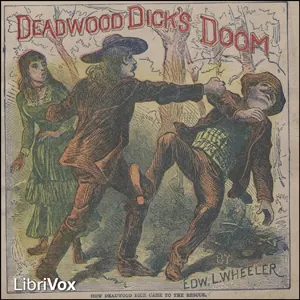
4 04 - Deadwood Dick's Doom 15:48
Wheeler. Chapter Four Deadwood Dick's Doom. It had taken less time to end the life of the ruffian than it has to relate the occurrence, for the bullet entering his heart, he had expired almost as soon as he dropped. For a moment afterward you could have heard a pin drop in the great bar-room of the poker house. So great was the intensity of the silence caused by the shooting. Then came words to the hearing of all, words in a strange, shrill voice, whose significance was plain to all within the room, Except Virgie and Nick. Oho, Death Notch Forty-Seven, and still the spirit of Red Hatchet calls for vengeance. Paiute Dave shall count Seventy, and Deadwood Dick five more. Ha! Ha! Then there was a strange wild peal of laughter without the tavern, that chilled the blood of everyone who heard it, so fearfully suggestive of a demon's triumph it was.
Not a man within the tavern made a move to discover the author of the Laugh Infernal, and of Bulldog Ben's death. Even Paiute Dave's swarthy visage assumed a grayish pallor, as he heard the words of the avenger, and he moved not from his tracks. Shakspeare, the poetical bull-whacker, was the coolest man in the house, and that among men who were habitually hard-hearted, and possessed a sort of brute courage on such occasions. Pop goes the weasel, and there'll be another notch on the council pole, he observed, dragging the body of Bulldog Ben upon his shoulder, dumping it in an obscure corner of the room. Bulldog's gone on his last long canine circuit, and I allow I'll have to compose a doggerel on his Keflamex, or an epidemic for his tombstone.
How'd this be, for instance? Poor Bulldog Ben he barked, and then he jumped the bar a-cording. "'There was a shot. Ben took the part, and antied over Jordan.'" But the poet did not get an encore on this effusion, inasmuch as his auditors were in no humor for anything but strong prose. "'Enough of this nonsense,' Paiute Dave said, striding forward. "'Don't you see that you are all offering yourselves as targets for this secret avenger, whomever he may be? I'll take charge of the girl myself. "'And ye can do as ye want with the nigger. Come, young woman, there's room for such a purty one as you in my cabin, and you're mine.' "'Oh, no, no! I cannot, will not go with you,' Virgie cried, clinging to Dick, in tears and despair.
"'Please let us alone, sir. We are two strangers to all of you, and all we ask is to leave this place unmolested.' "'Can't help that girl.' Piot Dave don't often take a second look at a gal, but when he does he invariably has her if he wants her. So you might as well tumble down from that bar and waltz along with me at once, for I low I'm boss of this town, and things has all has got to go to suit my notion. But jest you look o yer now, sir, cried Nicodemus, drawing himself to full height and striking a dramatic pose with uplifted arm. You surely forget the culminating fact that this yow lady am my protege, and I's sweared by the plants and the heavens to protect her with the last drop of my royal blood.
Yes, sir. Dem's mighty truth, sir, and if you lay a thumb on this young lady's person, I'll draw the razor from my bootleg and cut you wide open. Yow's I will for sure. Oh, I's bad when I's shampooed. "'I's a wadin' butcher barber, sir." Ho-ho! Paiute Dave laughed hoarsely. "'If it wasn't for fresco and Poker Jack's floor with your black gore, I'd blow your brains out, you black cuss. Come, girl, how you goin' to somersault down from that bar, or shall I come up and help ye?' "'Oh, spare me, spare me, sir. Oh, my God, is there no one here to help me?' the poor girl sobbed. "'Nary a durned galoot, my gal,' Paiute Dave declared, with a triumphant chuckle. "'As I allowed before, I'm boss o this burg, and there's not a man higher as durst lift a hand to help ye when I'm around.' "'You lie, you brute, and if you but lay a hand on that girl, I'll bore a hole in your thick skull,' a voice suddenly cried.
The owner of the voice was Deadwood Dick. While Paiute Dave was speaking, he had quietly slipped into the room, and now stood mounted upon a chair, but a few paces in the former's rear, with a pair of cocked thirty-twos in his grasp. Paiute Dave wheeled with a frightful oath, as he heard the words, with his hands upon the butts of his own revolvers, but he desisted from drawing them when he saw that his new opponent had the drop. "'Who are you?' he demanded savagely. And what do you mean by meddling in my business? I mean that if you offer that girl the least molestation, I'll make you up into a perforated porous plaster quicker than a Dutchman can say beer. The support of Dick announced, with the utmost assurance in Saint-Froix.
As to my dramatist person, you may recognize me by the gentle and psalm-like title of Richard Harris, or Edward Harris. Or Deadwood Dick, or any other name you like. Deadwood Dick being my particular appurtenance, when I'm wanted by the sheriff, and so forth, and so forth. You Deadwood Dick? Paiute Dave exclaimed in surprise. And he was not the only one to whom the noted title was apparently familiar. Yes, I am Deadwood Dick, the celebrated cuss from Custer Clime, The diabolical, devil-may-care devotee of road agency. From Deadwood, the hunted Hurricane Harris, just as you see me. And according to a recent act of Congress, if you or any other two-legged individual attempts to harm yonder girl, whoever she may be, I'll agree to furnish him with a free pass over Jordan by the most direct, ethereal line.
I mean business. So let some pilgrim of enterprise and disposition open the market. Young lady, you may descend from the bar, and go to your room or home. I'll agree to take care of any number of these cusses who may attempt to prevent you. Go at your peril, girl. Paiute Dave growled in a rage, watching a chance to draw a weapon. Curse is on you, boys. Why don't you pull your tools and kill this devil's donkey? Reckon we know our biz, boys," the bull-whacker Shakespeare declared knowingly. "'We allow our pelt is worth just as much per C. W. T. as youne, and we ain't in no ways disposed to venture a cruise in unknown regions, just on account of one gal, as Brother Byron us to say. Hang on to tear a firmer, though encumbered bad with tax.
It's cool and very comfortable as compared with Halifax.' And though besieged at every turn with mother-in-laws and maids, you'll find it enough sight better than a good warm birth in Hades. Your cowardly dog's every one of you. Will you let one man bluff ye when there's forty of ye to his one? Look, the girl is going to escape. A hundred dollars to the man who stops her. I'll take it," a ruffian shouted, and leaped toward the bar, from which Virgie was about descending, to stop her. "'And you'll get it,' Dick cried as he fired, then instantly returned the aim of his weapon to the crowd. With scarcely a groan, the ruffian fell headlong to the floor, not dead, as was afterward proven, but stunned by the bullet grazing his skull.
A murmur of protest ran through the crowd, but not another was raised in opposition to the Dakotan's will. Paiute Dave alone uttered a fearful oath. "'You see—' I hold the spotter that trumps at every flop," Harris remarked. When I pair a grenade into a town, I always try to impress upon the minds of the citizens, first of all, the fact that I am able to clean out the whole town, single-handedly, and able to stand up in defense of the weak and unprotected every day in a week, and as many times on Sundays as the hymn-book orders. There, the young lady has gone. Now, gents, what's the damage? I'm willing to settle. One tuff laid out, and a broken window glass. Besides, a ruffle upon the personal pride of our friend here, Paiute David.
What's the expense, David? Your life, the captain cried, his rage in nowise diminished. I'll cut your heart out. Oh, now, really, David, you would not rehearse the tragedy of David and Goliath, would you? You wouldn't amputate my pulse-o-meter, would you, just to satisfy your revengeful spirit? Yes, curse you, but give me advantage of the drop you got, and I'll show you what kind of a man Piot Dave is. Indeed, I am to infer, then, that you are something like a concentrated volcano, done up in a dynamite torpedo, and when you are touched off you scatter death and destruction in the forded directions of a blizzard. I had no idea you were so ferocious, or I should have fainted hours ago. Tell you what I'll do, though, David.
If your thermometer indicates that your steam has attained such momentum that there is danger of your exploding, I'll give you a chance to work off a little of your superfluous wrath. You appear to be a pretty muscular chap, and I flatter myself I have sufficient for usual cases of emergency. Therefore, We will clear the center of room. You take a position at one end, I at the other. Then we will each start for each other. Weaponless, and have a rough-and-tumble scuffle for the mastery. The winner to take the position as boss of the town, the loser to be given one hour to leave it, never to return, except under penalty of death by shooting at sight. Now then, how does that strike you? "'I'll accept the proposition,' Piotte Dave said with a horrid laugh.
"'It won't take me long to break your neck.' "'Well, for your sake, I hope not,' Dick retorted with a smile. "'First, however, I want to know that there will be no interference from the crowd.' "'I'll tend to that, young feller,' Shakespeare declared. "'I'll see that everything goes square.' "'I have a plan as fair for one as for the other.' Paiute Dave said, a villainous glitter in his evil eyes. A few rods up in the gulch is a bottomless bed of quicksand. The weight of a man'll sink him there in five minutes, forever out of sight, and nothing he can do can help him when once he is in it. It has gulped down many a dead body, and some live ones, too, so it's just the hole for a death struggle.
I propose that we go to the edge of this treacherous pocket. And the man who is strong enough to throw his opponent into it shall be the victor, while the victim shall be left to sink in the sand to his death. "'That suits me exactly,'' deadwood Dick responded. "'As soon as the man is thrown into the pocket, the spectator shall march away, chanting his death requiem. Is this perfectly understood?' "'I understand. I allow their boys does.' Paiute Dave grunted. "'A course we do,' declared the loquacious Bullwacker poet. "'Jist as soon as one or t'other o' yours ker flopped into that death's hole, we're to start pell-mell for the poker-house and moisten our bugles, perperatory to sing in the death march o' Solomon.' Correct.
Let's adjourn to the field of action," Deadwood Dick said. "'I came here expectin' to run into difficulty. "'And I'm no the chap to turn tail and back out because of a slight unpleasantness. By the way, if any of you fellows knows anything favorable of this big loafer, I'd suggest that now will be a good time to recall them, before we plant him. After he is dead and gone, you'll not care to remember him." Paiute Dave made a move to draw weapon, but saw that Deadwood's dauntless representative was still on guard, and so desisted. Come. No funny business now, Dick ordered. But lead the way if you want to furnish me a sepulchre of quicksand. I'm anxious to know who is going to draw the prize in this lottery.
Paiute Dave led the way from the tavern. Deadwood Dick went next. Then the Bullwhacker poet and his uncouth associates brought up the rear in single file. A strange-looking procession they made as they marched down the street. Under the light of a soaring full moon. Virgie Werner saw them from the window of her room, and wondered what was going to happen. "'They are going to hang the brave fellow who came to my rescue,' she gasped in horror. "'God forbid!' Down the street to the western terminus of the town, Paiute Dave piloted the way. And soon they came to a dark-looking, verdureless spot, That every experienced eye knew to be a quicksand pocket that it was sure an inevitable death to touch.
This was the place of struggle. Deadwood Dick threw off his jacket to one side and deposited his weapon upon it. Paiute Dave gave his revolvers to the bullwhacker, but did not remove his coat, evidently not deeming it necessary. The two men then walked ten paces in opposite directions, turned, and at the word go, given by one of the bystanders, rushed to meet each other. It was not until they were within arm's reach that Deadwood Dick discovered that the ruffian had a small dagger in his grasp. Too late. They clinched and struggled, and the blade entered Dick's left arm, rendering it perfectly powerless. With the advantage thus gained, it was quick work for Paiute Dave to raise his adversary, and hurl him forward into the mire of the bottomless bed of quicksand.
Then, with victorious shouts, the rough crowd strode away, and Deadwood Dick sunk gradually into the yielding sand to his horrible doom.
-
5 05 - 00 Reward; and 'Calamity' on Deck 14:17
Five Hundred Dollar Reward. And Calamity on Deck. On returning to the poker-house from their moonlight excursion to the remarkable jewel, wild men of Death Notch found that they had another stranger still in their midst, the individual once before described as Carol Carner. He had ridden into the place, registered, and here put up at the poker, and was just engaged in tacking up a placard against the wall, As the crowd swarmed in, headed by victorious Paiute Dave and his right-hand man, the Bull Whacker. Poker Jack's face bore rather a disappointed expression when he saw that Paiute had come back in place of Deadwood Dick. He had hoped, and expected it would be the other way, for though there was no declared warfare between them, they hated each other cordially, and calculated that the quickest man at pulling a pop Would eventually be the death of the other.
Which one, it remained to be told. The man Kiana went on tacking up his placard, and when he had finished, stepped back to inspect his work. The placard was a press-print poster, in bit-type, and bore the following announcement. Five hundred dollar reward. The above reward will be paid for the capture and delivery to the undersigned of a wandering girl calling herself Virginia Verner, but whose real name is Myrtle Morris. She is accompanied by a Negro of companion, and is wanted for the crime of murder. Carol Carner, guardian. Paiute Dave read the notice over and over, and then took a good look at the man who had posted it. "'I allow you won't be apt to find your girl here, Cap.' He said gruffly, "'We don't allow of no petticoats in this here town.' "'Oh, you don't?' Karner said, with imperturbable composure.
"'Well, it won't do no harm to advertise and make sure. Indeed, I am pretty positive the girl is in this town.' "'D'ye mean that?' Paiute demanded angrily, drawing a pistol. "'It ain't healthy for any pilgrim to doubt the word of Paiute Dave.' Experience has taught me not to believe any man till I have tested him. Was the unflinching answer? My sentiment applies no more to you than to the rest. If you gents ever indulge, you'll find I have an open account at the bar. Drink, stranger? Well, I should cough up a cat, exclaimed the disciple of Shakespeare, executing a hop, skip, and jump. If ever a thirsty throng of theologians thrived in this terrible country, we're the ones. Drink? Of course we will.
Bootlegs and eyepiners by the dozen we will dispense in honor of meeting ye, at ye expense. And don't ye forget it, nother. Waltz up, thirsty pilgrims, and inundate ye desert wastes with prime old rib-tickler. Irrigate ye parched and arid systems with their ambrosial nectar. O's D.F.R. Sure, death at forty rods. As there are more toil, Shakespeare used to remark. A gilt-edged jest before breakfast, a sealskin dinner to settle, a horn and a half before supper, and a nightcap to put on your metal. Drink, stranger? On course we will, and I'll take a good straight coffin-nail for mine with a bumble-bee or a wassup in it to give it life. And they did drink to a man, with the exception of Paiute Dave, who gruffly refused.
Watching his opportunity, he left the bar-room unnoticed, and went upstairs. At the door of Virgie's room he knocked softly. More like a woman's knock it was than that of a man. "'Who is there?' Virgie asked, from within a tone whose accents betokened alarm. "'Ah, I am a stranger to you, but if you value your personal safety, open the door.' The villain answered in a feigned voice. Then, as he heard her unlock the door, he chuckled to himself to see how cleverly he had succeeded, until the door partly opened, and he found Virgie standing in the aperture with a cocked revolver in her hand. "'I thought it was you,' she said with more composure than she had yet manifested. "'Now that you are here, you villain, what do you want?' "'You're devilishy independent all at once,' Paiute Dave said in surprise.
"'Because I've got the drop on you,' Virgie retorted. "'I find that he's best who gets aim first in this delectable country, and accordingly I'm ready for you, sly as you were. What do you want, I say?' "'I want to come in. I've important news for you. There's a man downstairs who wants you at about five dollars a pound.' Virgie gave a gasp, and her face turned pale. "'Who?' she demanded. Though she could have told without asking. "'Let me come in if you want to know.' Paiute Dave said grimly, "'A while ago you spurned the friendship of yours truly. Now, maybe, with a wolf howling upon your scent, you'll be glad to accept of it.' "'Between the bite of a wolf and a rattlesnake, I have no choice,' Fergie retorted decisively.
"'And therefore, if you have anything to communicate, you can do it from where you are—or not at all.' Curse you. Then you prefer surrendering to the man downstairs rather than accept of my protection, eh? I shall not surrender, nor accept your protection. Virgie responded. If I am attacked, I shall fight till I see there is no hope, and—then kill myself. Poo! Words are cheap. Listen, and I'll tell you what is the most likely thing for ye to do, as things now stand. This enemy O'yorn, who calls himself Carol Carner, Don't know yet that you're here, and the boys know their biz and won't give it away as long as I say nay. Now, just you marry me, and I'll go down and slit your enemies wizened, and that'll put an end to the matter.
See? I comprehend your magnanimous offer, but emphatically decline. When in need of a husband, I shall select a man, not a wolf in the guise of a man. You may inform Carol Carnot of my presence here, if you like, and tell him also that I have been taking daily practice with a revolver lately, and I shall take advantage of the first opportunity to blow his brains out. Now, or I'll open up practice on you. Go! I mean, Biz.
And, judging by the flash of her eyes, he concluded she was in dead earnest, and took as few steps as possible to carry him out of range of her weapon.
Baffled and savage, he descended the stairs to the street, to cool off his passion and consider. Feeling that he was, he had set his heart on capturing the girl and making her his wife, and the failure just now but strengthened his determination. Carol Carner, although he failed to obtain any information from Paiute Dave concerning the object of his search, was in no wise discouraged. and made it his business during the evening to pump nearly all the ruffs in the saloon who, taking the cue from Dave, all denied any knowledge of the girl. This very unanimity strengthened his suspicions. Excuse me, please, if I refuse to believe you. He said coolly, so positive has been the declaration that the girl is not here, that I am sure she is here.
I demand to see your register. When I registered to-night, I neglected to look it over to see if there had been any previous arrivals. I refuse to let you see the register. Pokerjack replied, an ugly flash in his eyes, as he went on. I'll own up that the girl is here, and when you attempt to take her away, you're a dead man. You or any other two-legged cuss in the town. I've been watching the way things are shipping to-night, and I'll allow that the girl is pure and good, and though I ain't anything to brag on about being a saint. I allow that's enough man left in me to shove four out of six, if Aerie Galoot tries any guru games about that girl. And my name's Poker Jack, from Pioochie. And the landlord of the poker house brought his fist down hard on the bar.
That night, when Death Knot slumbered, a horseman rode stealthily into the town. His form was well wrapped in a long black cloak. A wide-rimmed black hat was slouched down over his forehead to the eyes, which were covered, with the exception of a pair of peepholes, by a black mask, which was in turn met by an immense black beard that touched the man's waist, all giving him a dark and sinister appearance. That his mission was a secret one was evident, for his animal's hoofs were carefully muffled. and made little or no noise as they struck the hard-panned bottom of the gulch.
The strange dark man rode slowly along until he came opposite the poker-house, when he reined his horse close up to the front of the building and halted. Rising in the stirrups and thence to the horse's back, he was able to climb upon the cap of the front door-frame, which he accordingly did, and then crept into the open window, which led into the upper hall.
Pausing a few moments and listening intently, he stole from one door to another along the hall, and repeated the precaution of listening. Nor did he conclude until he had visited every door that opened off from the hall. Then he climbed back to the door of the apartment occupied by Virgie, and softly turned the knob. The door being locked refused to open, at which he did not appear to be much surprised. For he drew a slender pair of nippers from his pocket, and quickly had the door unlocked and opened. Then, stealing softly into the room, he closed it behind him as quietly as he had opened it. The next morning, when Poker Jack took the meals upstairs for Miss Virgie Verna, before any customers were about the establishment to watch him, he found the door wide open, and Miss Verna gone.
Not a little surprised, he opened the communicating door of the darkies' apartment, and found the gent of color lying upon his bed, bound hand and foot, and gagged, with a quilt thrown over his head to shut out any sound he might make.
Pokerjack immediately went to his rescue, and found the poor coon nearly suffocated. As soon as he could gain his breath, he gave vent to a sigh of relief, and gazed about him with ludicrously rolling eyes, To make sure that he was really once more liberated. Oh, de good Lord almighty. I spected I's a gon' clam for Shah, was his exclamation. What's de matter? Boss, what's de reason dis unoffensive Chile is tied up like a lump o dry goods in a quilt frowned over his head? For to keep him from briffin, dat's what I says anxious to know. Well, being somewhat in the dark myself, I naturally looked to you for an exclamation. The host of the poker house replied, "'Don't you know how you came in that plight?' "'Deed, I don't know nothing about it, boss.
All I know is dat when I awoke, "'Dare I was fast, like de leg of a clam in a shell, and wid a great scarcity of breathing stuff. "'Dunna nothing else about it. Deed I don't for sure.' "'Well, this is kind of funnysome,' poker jack declared, scratching his head. "'Someone's been here during the night.' And waltzed off with the girl, that's certain. "'What, Miss Virgie's gone, dear Das?' Nicodemus cried in alarm, springing to his feet, his dark visage growing a shade paler, if indeed such a thing is possible. "'Oh, allow she is,' Jack replied. "'Leastwise she ain't in her room. "'Oh, de good law, amighty. What's to become a me den? I's a dead-gone nigger for sure. Maybe she's got scared. Say, boss, maybe she's got skird, and done gone hid under de bed, or in de washstand, or—not a bit of it.
She's been smuggled after in the night. But the next thing is, who's a smuggler? I allow it won't be healthy for him when I learn who. Had Jack any inclination to keep the matter hushed? He could not well have done so, for it wasn't ten minutes before Nicodemius had spread the news all over the town.
Both Carol Carnar and Paiute Day swore roundly when they heard the news. But Pokerjack eyed them searchingly. One or the other of you know where that girl is. He said to himself, and if no one else is interested in her welfare, it shall not be said that Pokerjack left unto the Mercia two worse brutes than himself.
That day a horseman, or rather a girl dressed in male attire, drew rein before the poker house. And, slipping from the saddle, she strode into the barroom, and took a glance over the crowds therein. The woman was the notorious, free and easy, reckless waif of the rocky western country, Calamity Jane.
-
6 06 - A Very Singular Performance 11:34
Wheeler. Chapter Six, A Very Singular Performance.
Few there were in Death Notch who had not heard of the notorious girl, and several among the lot had seen, and now recognized her, Poker Jack among Deadwood the rest, for Poker had formerly thrived in Deadwood before taking in Pioche and Death Notch. Calamity had changed but little since the time when this pen last introduced her. She was the same graceful pretty girl in breeches that she had always been, but if there was any change it was in the sterner expression of her sad eyes. A murmur of, "'Calmity Jane!" ran through the bar-room as she entered, proving that she was recognized by more than one. "'Yes, Calamity Jane!' she retorted. "'I see I'm not unknown even in this strange place. Better, perhaps, is it so, for you'll have a clearer idea of whom I have to deal with.
I want to know where Deadwood Dick is. That's what I want. I allow you'll say he ain't here, but I won't swallow that. He told me he'd be here over a week ago, and he allus keeps his dates. "'And so you're wanting him, eh?' Paiute Dave grunted from his perch on one end of the bar. "'S'pose likely you're a part of his, ain't they?' "'I low I've been his truest part many a year,' Calamity replied. "'But that's not what I was askin.' "'Where is Deadwood Dick?' "'Well, gal, ef my memory served me right, I lowed last I see to him he was a sinkin' in a bed o' quicksand where I throwed him. We had a tassel, and the best man was to chuck the other one in the quicksand, and the honor fell onto me. He weakened, and I gave him a boost.' "'And I presume if he's kept right on sinkin' ever since, he's arrived down to the maiden kintry o' the washy-washy by this time."
Calamity's heart sunk within her at this declaration, but outwardly she was very calm. She had met Deadwood Dick in the lower mining districts a few weeks before, and he had said, as he took a hand in his, in parting, I'm going up to Death Notch, Janie, on my last adventuresome trail, and after that I'm going to settle down for good in some lonely spot and see if the remainder of my life cannot be passed in more peace and quiet than the past has been. Come to me at Death Notch, Calamity, and the hand you have so long sought shall be yours. We will go hence down the avenue of life, hand in hand together as man and wife." And then he had kissed her good-bye, and she had looked forward eagerly for the appointed time to come when she should go to claim the love and protection of the only man she had ever worshipped.
"'I don't believe a word that you say,' she said in reply to Paiute Sprague. "'But if I learn that what you have said is true, look out for yourself, for, girl though I am, I'll make you pay a bitter penalty for your deed.' Then she turned and left the poker house, a feeling of sadness stealing over her. She soon by inquiry learned the location of the fatal quicksand, and the incidents of the strange struggle between Paiute Dave and Deadwood Dick. Then, leaving her horse to graze, she walked out to the place where the pool of stagnant water covered the treacherous bogmire of death. "'Oh, Dick, Dick!' she moaned, kneeling upon the ground and peering into the pool as if to penetrate into the untold depths.
"'I cannot—will not believe that you have met your death in this awful place!' Somebody, perhaps, may have come along and rescued you at the last moment. God knows I wish I could credit that supposition. Dead? You dead, my brave, true friend? No, no, no! I will never believe it. Never! Until when my own life shall have ebbed out, and I find that my search for you has been fruitless." Tears were strange things in the eyes of Calamity Jane. It was more in her nature to laugh at trouble than cry. But now everything was changed. She had never quite given up the hope that Dick would, at some distant day, recognize her devotion to him, and take her as a wife. When he had told her to come to Deathnotch to become his wife, all the bitterness of her strange young life had seemingly melted into glorious sunshine, and she was happy.
Little wonder, then, that the bitter grief now returned to torture her, when they told her that the famous brave knight had met so terrible a fate, after so many years a safe passage to constant peril. For an hour she knelt by the dark pool. Her tears now dried and a deadly glitter in her eyes, while a stern expression mantled her features. No, I will not be rash enough to kill myself, she murmured, rising to her feet, but will live on, live to hope that he is not dead, to wreak Vengeance on those who, as a people, aim to tread upon and crush him, because—because he was deadwood dick. Ha, ha, ho, ho, laughed a voice just behind her, and she wheeled to behold the dwarf avenger, old scavenger, standing near.
Dick had described him to her, and therefore she had no difficulty in recognizing him, for surely there were no two persons in the West whom nature had made so hideous. Ho, ho! The dwarf chuckled, when she turned to gaze at him. So, you came to look for the devilish road agent in that pool, eh? You don't find him, though, neither do I. Ho, ho! No! He cheated me out of my sweetest morsel of vengeance, curse him! How so? Calamity asked in surprise. Was not Deadwood Dick a friend of you and your daughter, Scavenger? No, no, he was a traitor, a devilish traitor, the murderer of my child, and when I found that pinned to her dress as she lay in death where he left her, I pronounced his doom and that of every other white traitor.
Do you see that? And he held up the note that he had found on Kentucky Kitts' body, see, Half Dime Library, Number 201. Calamity took it from his hands and read it carefully. "'This is not Deadwood Dick's writin', nor a signature, old man,' she said decidedly. "'It is a forgery, trumped up to throw suspicion on Deadwood Dick.' "'Bah! You lie!' Scavenger Ward, suddenly becoming furious. "'You lie like all the rest. They all lie, steal and murder, and I hate'n't hate every man or woman whose face is white. Ha! I kill em, too. Each day have I sworn to add one new death-notch to Red Hatchet's council-pole, and you shall be my victim for today, you. You! Ha! It will be sweet vengeance to kill the girl who loved the devil road agent.
And even while speaking, he drew a long, keen-bladed butcher knife from his belt, and bounded toward her like some ferocious wild beast rather than a human being. Calamity sprung back a pace, and drew a revolver, for she saw that the insane dwarf was bent on her destruction. Stand back, or I'll fire, she cried, but he heeded her not, and she was as good as her word, fired, once, twice, thrice, full at old scavenger's breast. But without appearing to mind the shot, he came on madly, with upraised knife, and nothing was left to her but to turn and run for her life, as her strange foe was evidently bullet-proof. She didn't run toward the town, but up the gulch, and as fast as her feet could carry her, for she was aware that it was now a matter of life or death to her.
Once and again she turned half about while running and sent an unerring shot at the avenger, but they checked not his chase, and he laughed in defiance, brandishing his knife threateningly. And too, he was a remarkably swift runner, and the girl sport soon became aware that he was slowly but surely gaining on her. In the start off she had got several rods away from him, but it promised to be no great length of time ere he should overtake her. Realizing this, Calamity began to wonder what she must do to escape. Could it be that she, too, had come to this unlucky town only to meet her fate as Deadwood Dick had done? Faster, faster grew the chase, both pursuer and pursued, straining every nerve to win.
Nearer and nearer to his victim did the avenger gain, a demoniac grin of triumph upon his features. Suddenly, however, there was a change, a break in the monotony of the race. A man stepped suddenly from behind a point of rock into the gulch, just after calamity had passed, and stood with folded arms facing the oncoming dwarf. Not a weapon did he have in hand. Nor seemed he prepared for battle, yet faced the pursuing avenger composedly. Wrapped from head to foot in a long black cloak, and wearing a tremendous black beard, which, with the addition of a mask and wide-rimmed black hat, slouched down over his forehead, completely hid his features from view. He was a dark and rather sinister individual to behold, the same strange person who had ridden so mysteriously into Death-Notch the night previous.
Nearer and nearer, Oates' scavenger approached, flourishing his knife and making strange contortions, but not an inch did he move, further than to raise his black-gloved hand and point one finger at the dwarf. Had the stranger shown fight, there would have undoubtedly been an immediate struggle, but his queer action seemed to puzzle the crazed creature, and he came to a halt, a dozen yards away, seeming undecided whether to advance further toward the cloaked customer or not. Calamity had halted on the other side of him. Not a little surprised and curious. The black unknown now turned toward her and motioned her with his outstretched hand to approach. The girl obeyed, keeping her weapon ready for instant use.
When, within a few feet of him, he motioned her to stop. Then, turning to the dwarf, he motioned him to pass by on the left-hand side of the gulch. At first Scavenger made no move to obey. But when the stranger stamped his foot imperatively, the girl's pursuer did as he had been motioned to do, nor paused until he stood where calamity had first halted. Now turning to calamity, the dark stranger pointed toward the Death-notch, and said in a deep tone of voice the simple word, "'Go!' "'Correct,' the girl's sport replied with a laugh. "'I'm much obliged to you, and don't need a second invitation.' She went down the gulch, wondering who was this black individual with a voice like a roll of Midsummer Thunder.
She looked around just before turning a slight bend that would hide them from view, and saw that both the Black Unknown and the dwarf yet retained their same relative positions, except that the arm of the Unknown was levelled at the Avenger commandingly. As she looked, too, she saw the hand and arm fall to the Unknown's side, while Scavenger staggered back, turned, and fled up the gulch at the top of his speed. Calamity went back to the town and registered at the poker-house, and was assigned the room from which Virgie Verner had been abducted. Jack," she said to Poker Jack, who had shown her to it, Jack, you were a hard fellow when I used to see you up in Deadwood, and judging by our surroundings, I don't allow you're much saintlier now.
But that won't hinder you from answering me a question. Certainly not, Calamity. Ask anything you choose. Well, I want to know whether or not you really believe that Deadwood Dick sunk in that quicksand. Why, I haven't any reason to believe that he did not. Paiute Dave threw him in, they say, and then he and the gang come back here and left the poor Custis Inc. May the Almighty inflict some terrible penalty upon them, if this is true. But try though I do to become resigned to this conclusion, I do not believe that Deadwood Dick lies at the bottom of that bed of quicksand. Toward dusk that evening, a woman on horseback, attended by two mounted scouts, rode into Death Notch and dismounted before the poker house.
She was an elderly lady, say of fifty-five or sixty, well dressed, and yet one whose face spoke of a life that had not been all sunshine. On dismounting, she immediately entered the bar-room, and after a searching glance around, approached Carol Karner, who was engaged in playing a game of cards with Minor. Karner arose with a flushed face as he saw her approach, as if it was his intention to attempt to escape, but he caught the gleam of something concealed in the woman's hand as it hung by her side, and desisted from any such action. "'I expected to find you if I persevered,' the woman said with sarcasm as he arose and tipped his hat. Please order a private apartment where I can see you and talk business.
-
7 07 - A Villain Unmasked 15:02
Wheeler. Chapter Seven. A Villain Unmasked.
Karner seemed to deem it advisable to humor her, for he immediately led the way upstairs to his own apartment, and when there handed her a chair. "'Be seated,' he said curtly. "'Your visit is unexpected to me. Why do you come here?' "'To effect a settlement with you, villain that you are, such a thing is possible,' the woman retorted bitterly. Carol Connor, have you not one spark of tenderness or mercy in your cruel heart?
Not that I'm aware of, the man replied, seating himself with his heels elevated upon a table and lighting a cigar. I never was overburdened with a reproving conscience, and when it is likely to interfere with any of my plans, I'd do away with it entirely. If you come here thinking that wholesale tears and supplication for mercy will move me, you've greatly missed your reckoning. Carol Connor, take care. Bah! Don't be so foolish as to threaten me, old woman. You can't do anything with me. I can. I can have you arrested for a bigamist. Humph! How are you to prove it? I'll think you a court would decide it. They would pronounce me an adventurer, reprimand me, perhaps, and there the matter would end.
Why, I cannot see that there's any great cause for trouble. It's a simple little story. I, Carol Carner, an adventurer, go down to California for a little recreation, meet and marry the stepdaughter of a rich speculator known as Morris. Both the girl's mother and stepfather approve of the match. When I accommodate them with a little ready-made information that I am a popular mine owner in the Nor'west, and the wedding goes off as merry as a marriage bell should go. Next, in order, develops a little item of family news that Morris has a deal of property and an equal number of debts. In order to save his property, he must deed it to someone, and thereby defraud his creditors of all that he owes.
In this extremity, Morris proposes to deed me two-thirds of all his property, and his stepdaughter the other third, all of which is done legally, and thus things stand, when comes the news from Utah that Carol Carner, a Mormon, has no less than eight fair and buxom wives, to whose loving company he is respectfully invited back. There was a small-sized tornado in the Morris camp then, and Carner's commanded to clear out. First deed back the property. This he kindly refuses to do, and about this time two other sensations arise. News comes that Myrtle, his wife, has inherited an immense fortune by the death of a relative next. Carol Carner, in company with a pair of neighbors, finds Myrtle kneeling over the lifeless body of her stepfather with a bloody knife in her grasp.
What do you suppose is the result? Suppose you are full well aware. Caught in the act, as it were, and realizing the consequences, Myrtle fled, not only from the scene of her strange crime, but from California, accompanied by a family servant. Smarting under the blow of dishonor she had put upon my fair name and reputation, I vowed to hunt her down and hand her over to the law. "'Villain! Monster!' Mrs. Morris gasped. who had been listening with blanched face and flashing eyes. "'Your villainy is without parallel. You know my poor child never committed that murder. You know more about how Mr. Morris died than she.' "'That you will find it a hard thing to prove,' Carnar replied coolly. "'It's easier to surmise a thing than to prove it.
I can prove that I found the girl in a suspiciously murderous position, with a bloody knife in her grasp.' And that is all sufficient in the eyes of the law. When I succeed in capturing her, the law will take her. What? What is this? Have you not found her yet? The mother demanded excitedly. Yes, on two occasions. But she has given me the slip both times, the scoundrel declared composedly. I found her at first. Fulfilling an engagement in a Leadville theatre as Virgie Verner, where her musical accomplishments, together with those of the negro, had secured her a situation. She saw me, however, before I had fared her out and fled. I was soon upon her trail, however, and followed her here to this beautiful burg.
She was here when I came. During last night, was kidnapped from her room, and the darky left behind, bound hand and foot. And you were the kidnapper, Mrs. Morris asserted. Caracana, for God's sake, for the hope of the hereafter, tell me, where is my child? Dead, I hope, the Mormon said decidedly. But even that is a delusion. I know nothing more than I have told you. I did not abduct her. I do not know where she is. You are lying to me. Have it that way if you choose. I would it were so myself. Why have you thus turned against her, you villain, after you married her, deceived her, and wronged her?
Because? Well, for several reasons. One in particular, I don't need any more wives. Having a pretty good stock up at Salt Lake, I only married the girl in the first place because I found life rather monotonous in California. Secondly, I find that with your demise and her demise there are no more immediate heirs extant, and I would come in and inherit the last third of your property, and her recent inheritance too. Consequently, you see, it is only natural that the law should deal promptly with her. While as for you, well, it wouldn't puzzle one much to get rid of you. Exasperating in the extreme was the man's composure in Saint-Foy as he spoke. It but gave evidence of his depravity. "'It is as I supposed,' she said, rising.
"'You are disposed to win your little game, no matter what the risk. "'You will find, however, that a mother's love for her child is an insurmountable barrier to battle with.' "'Ha! Ha! Then you will show your teeth, eh?' he said with a light laugh. Aye, and you shall feel their bite if you further attempt to harm one hair of her head who is dearer to me than life. Then she swept haughtily from the room. "'Hum! Matter's getting a little more business-like,' the Mormon muttered. "'If I mistake not, I couldn't have chosen a better location to terminate the business.' Back from the plateau, which had been the scene of the strange compact between Red Hatchet and Old Scavenger, stood a goodly-sized, strong-built long cabin, surrounded by a fringe of pine-trees whose foliage reached to the ground.
So admirably arranged was this natural screen, it was only on close approach that the cabin could be seen. About the same hour that Carol Carner and Mrs. Morris were holding an interview, a scene was occurring in the mountain cabin, which has a bearing upon our romance. Red Hatchet sat before a fire on the hearth. engaged in smoking his pipe, while he watched the flames leap upward, and at the same time listened to the words of old Scavenger, who stood to one side, leaning upon a rude staff. "'Does Red Hatchet not remember what he promised?' the dwarf demanded angrily, a mad fire burning in his terrible eyes. "'Have ye forgotten that ye gave her to me?' Red Hatchet gave not his child to the dwarf devil to butcher, the chief replied.
in a stern tone. Not till Scavenger has completed the destruction of the Paleface's town shall he lay upon Siska, and then it shall not be to harm her. Siska has become the wife of Devil Dwarf, but he must not harm her. Bah! I want not a wife. I want sweet vengeance. The avenger replied with a wild laugh. Today is past without my adding a death-notch to the record. Every time I fail to secure a victim, I will cut off a finger or toe so that they'll not have it that I failed to have my vengeance. Siska shall furnish me that trophy. No, no, Red Hatchet gasped. You shall not do this. I will not permit it. Then does not Red Hatchet respect the vow he sealed with a draught of blood that Siska should belong to me to do with as I pleased?
If he does not, I will kill him. and then torture the girl. The maniac hissed venomously. I will not be cheated of vengeance. The old chief bowed his head in his hands for a few moments. Then he said, Red Hatchet is the chief of a great tribe, and his word is good, whenever he gives it. The devil dwarf shall have one of the fingers of Siska.
He arose and bobbled to the door of the cabin, which stood open, and, taking a whistle from his pocket, blew a shrill blast upon it. A moment later, Siska came bounding merrily through the trees into the cabin, her dusky face flushed from her mountain ramble. She grew pale as she saw the dwarf, and turned to her father. "'What is it, Red Hatchet, once?' she asked, laying a hand upon his arm. The chief gazed at her a moment irresolutely. Then his face hardened as he led her to a seat. Ciska is a brave girl. Does she remember who it was that drove her people from Sequoy and killed her brothers and mother? The Pale Faces, father, who have ever been the enemies of the Red Race. But why does Red Hatchet ask?
Does Ciska remember being told that Scavenger, the dwarf, has consented to fight the Pale Faces for Red Hatchet, and that Ciska was to be his? Did not Ciska consent to this? I consented because I knew it was Red Hatchet's wish. True. Red Hatchet promised you to scavenge her, and now he asks for one of Siska's fingers, because he has not been successful in killing a pale-face. What has Siska to say? Will she refuse the sacrifice, or will she fulfill Red Hatchet's word of honor to the dwarf? A horrified shudder traversed the Indian girl's frame as she listened, and fixed her gaze upon the horrible hairy visage of the avenger. Can Red Hatchet ask Siska to do this? she demanded, turning her reproachful eyes upon his stern, unpitying face.
It pains Red Hatchet to ask for this sacrifice, and yet Siska knows that he has always kept his promises as good as the gold in these mountains. And then the devil dwarf is carrying out the vengeance upon the pale faces, which Red Hatchet's old age will not allow him to do. "'And if he refuse, I'll kill your father and torture you afterward,' Scavenger said with a diabolical grin. "'Oh, father, I cannot,' Siska cried, covering her eyes with her hands, to shut out the sight of the crazy cut-throat. "'I'd rather you take your tomahawk and kill me yourself.' "'Wah, Siska's but a squaw now.' Not like her brave self. Lay one finger upon the table in scorn as becomes a fearless Indian girl, and tell yonder bloodthirsty pale-faced devil to cut it off.
Red Hatchet has spoken. And this time the tones of the old warrior were proud and filled with stern rebuke. Fired by his coldness, Siska advanced to a rude table nearby, and laying her left forefinger upon the board, She turned fiercely to Scavenger, her eyes flashing fire, and said, "'There, monster, take your coveted prize.' "'Ho-ho, ho-ho, this is vengeance!' the madman cried, striding toward the table, his long, terrible knife in hand. "'When I have cut that off, my thirst shall be satisfied until a pale-faced dog shall come within reach tomorrow.' He reached the table and caught hold of her wrist, Did not execute his hellish purpose, for at the instant he was about to sever the member from the hand, a man bounded quickly into the room, and seizing the dwarf by the leg and shirt collar, raised him by the strength of his arms above his head, then hurled him forward into the capacious fireplace, where a hot fire was burning, for the mountain air was chill.
The next instant the stranger had drawn a sword from a scabbard, which hung at his hip, and stood on guard. It was none other than the stranger in black, who had come to the rescue of Calamity Jane a few hours before. With a howl of rage, the dwarf scrambled from the fireplace, but not before the flames had severely scorched his hands and face, and burned some of the hair therefrom. "'You! You!' he gasped, ungaining his feet, and perceiving who his assailant was. "'Yes, I!' the unknown replied in his deep, thundering voice. Once more we have met, and your little murderous game is foiled. Go, I give you yet until the 10th of September to live. For a moment the avenger gazed in almost speechless fury at the man in black.
Then, with a howl, he fled from the cabin.
-
8 08 - Who Killed Piute Dave? 12:40
Wheeler. Chapter Eight. Who Killed P. U. T. Dave?
When the dwarf was out of sight, the unknown turned to Red Hatchet and gazed at him a moment silently. "'You are like the rest of your red race. A demon!' he said finally, with biting sarcasm. "'I'd be doing your child an act of mercy, you old snake, if I threw you into that fire and allowed you to burn to a crisp.' "'Oh, no, no!' Siska cried, pleadingly. "'Don't do that, sir. He is my father and getting old. Please spare him for my sake.' "'For your sake, then, be it. For I can but remember that I am under deep obligations to you,' the unknown said, bowing. Siska looked surprised. "'The daughter of Red Hatchet is grateful to the dark stranger,' she said, but does not understand why he feels under obligations to her.
"'Nor is there need that she should,' the unknown replied. "'In the meantime, beware of the mad dwarf, and if he again offers to trouble you, shoot him on the spot.' With the parting injunction, the man of mystery turned, and strode from the cabin, out into the early gloaming of the night. Calamity Jane had overheard the conversation between Mrs. Morris and Carol Carner, for it so chanced that her room adjoined that of the Mormon's schemer, and there being only a thin board partition, every word that had been spoken came distinctly to her. "'I will enlist this woman against the Mormon villain,' she said, "'and I allow he'll find his hands full.' She went downstairs into the barroom to see if the California lady was there, but found that she was not.
There was a big crowd of the miners and roughs present, however, among whom was Pioti Dave, and the Bullwhacker poet, Shakspeare. The latter had evidently been indulging in a goodly number of bootlegs, for he was catering to the tastes of the crowd by some very queer antics in a Terpsichorian line. Dance? he roared, with an extra shuffle. Why, galoots, you'd never see your uncle wiggle as number thirteen. I'm a regular old ballet when I get going on single business, and when you give me a feminine gal of good looks, why, old Chesterfield was nowhere with his ideas o exquisite grace. Just to show you, for instance, my festive royal old kids, here's them Calam from Calinartyville. She won't mind trying a mazurky with me, I know.
And he waltzed toward where Calamity had paused, bent on forcing her into a dance with him. But just as he reached her, his eyes became glued upon a little instrument she held in her grasp, which mildly suggested trouble did he advance further. So he halted. "'Why don't you come on?' Calamity asked Drilly. "'Surely you're not afraid of such a little tool as this.' "'But great Jerusalem, you'd let me have it right in the bosom. I'd seed it in your eye.' Well, I low you're a pretty fair guesser, for I shall shoot you, Kerslap, if you lay one of your greasy paws on me. But you'd get yanked for that. Not while I can handle a six. Then you calculate you're a shootist, do you? Right from Shootinville?
I do that same. I presume I am most generally able to look out for number one. But you can't shoot. No siree, Bobtail Hoss. That ain't no mortal that can shoot compared with your uncle, the playful poet of the plains. Why, would you believe it, gal? I'm the first patentee of revolvers I am, and I can out shoot any pilgrim from Carver down to the days of David Crockett. I'll bet you can't, Calamity retorted. She saw that to gain the admiration and respect of these rude men she must surprise them by some extraordinary proceeding, and there is no accomplishment that tickles a Western man so much as an exhibition of perfect marksmanship. In this, calamity was not to be despised, for she had handled weapons too many years not to be well acquainted with their use.
"'I bet you can't knock the neck off a bottle thirty yards off.' Oh, Daniel in the lion's den. What foolishness? Why, gal, for shootin' class I'm noted. I'm the aristocratic, bloated, their party sugar-coated, pop-gun puller of the West. Why, I can toss a liquor glass into the air and plunk a hole through the bottom afore it comes down. You can't do it, Calamity declared, pulling out her purse, and I'll bet just a gold eagle again it. Then I'll turn around and bet that if you can do that, I can take a revolver and put the bullet down the tube of a narrow-necked bottle while it's in the air. A cheer of enthusiasm came from the crowd at this assertion of the girl's sport, while the poet looked rather nonplouced as he surveyed his opponent.
"'Well, dog my cats, if you can do that, there's a heap more nerve in you than you ain't for. I'll just bet you square fifty gold bar that you can't do nothing of the kind. Take it first dose. Put up your collateral. Poker Jack will hold the stakes. The bull-whacker was in earnest, and put up his three-ouncer in Jack's hands forthwith, while Calamity handed him five eagles, and the bet was made. "'Now, then, go ahead and prove your brag,' Shakespeare cried with a grin. "'And when I get your fifty, cuss my golden slippers, if I don't treat their boys to the best that house affords. Oh, I'm a liberal cuss.' "'So I perceive. And when you win a wager on my shootin', you'll need to bet the other way.' Calamity laughed.
"'You pilgrims get to either side now, and leave the center of the room clear for its whole length, so that nobody shall get hurt. It would be a great pity to harm so respectable an assemblage. I could never forgive myself were I to kill half a dozen of you. Now then, you bull-whacker, procure empty bottle and stand halfway down the room to the right side, and when I give the word toss the bottle up in the air, the neck toward me. I will take my position at the upper end of the room here, and if you bottle as I order, I'll agree to put a bullet down the neck so that it will come out the bottom.' Get ready now. Her orders were promptly obeyed. The crowd moved to one side, and she and Shakespeare took their respective positions.
"'Gentlemen, you want to peel your eyes now,' the bull-whacker said, feeling considerable uneasiness as to the result of his wager. "'A gal of starlin' qualities this gal Calam may be, but it won't do nary harm to watch her very close, you see. Therefore peel your eyes and peel em good and watch her little game, cause for me to lose my ducats, boys, it'd be a beastly shame. Say la!' Come, girl. You ready?" Not yet, Calamity answered, taking her position. The light in the room is so bright that it dazzles my eyes. Will someone tie a handkerchief over one of my eyes? You, Poker Jack? The host of the poker house assented, and according to directions effectually blindfolded the left eye of the eccentric girl daredevil.
Now then, one, two, three, she cried, and raising her revolver before she had three. The instant she muttered the momentous word, the bullwhacker tossed a long-necked bottle in the air, as directed, with a—Cai! The next instant there was a loud report, a smashing of glass, a yell of human pain. Down to the floor fell the bottle with the bottom knocked out. Down to the floor fell Paiute Dave, grasping at his side, from which a stream of blood was oozing, dying the floor. Calamity had won her wager. And Piotie Dave had lost his life. Had one bullet done it all? That was a question unanswerable by any present, as all eyes had been riveted upon the bottle as it whirled through the air. It had all occurred in an instant, and brought surprise to everyone, even Calamity, who heard the fall.
"'I'm killed! The cursed girl in breeches did it,' Piotie Dave gasped, blood spurting from his mouth as he spoke. "'Kill her, someone! Cut her heart out!' Back! Calamity cried, tearing the handkerchief from her eyes and leveling her re-cocked weapon at the crowd. This is a lie! I did not shoot that man! Look at the bottle! There is a hole through it! You will at once see that I could not have done both jobs with one bullet! You lie! You lie! Peotie Dave yelled, raising frantically upon his elbow and attempting to draw his revolver. But the exertion was more than he was capable of, and he dropped back upon the floor, dead. For a moment thereafter, The silence in the room was so intense that a pinfall could have been heard.
Then Poker Jack spoke. "'The gal's right, boys,' he said decidedly. "'She could not have bored that hole through the end of the bottle and killed Dave, too.' "'A gal who's clever enough to chuck cold lead into the throat of a bottle when it was tumbling sombersets in the air, and enough possessed of the devil to do most anything I allow.' declared an old miner, with a grunt of disapproval, and this view of the matter also seemed to meet a favorable response from his companions. "'It's a big thing to do, of course,' Poker Jack assented. "'But look! Yonder's a splinter in the door at the other end of the room that shows where the bullet went after going through the bottle.' An exclamation confirmed his declaration.
A bullet was lodged in the door in plain view, in a spot where the door had hitherto been unmarred. "'That don't settle the question, however.' a voice cried, and Carol Karner, who had been standing since the shooting in the doorway that opened into the hall, now advanced into the barroom. "'I've got a little finger to intrude in this pie.'" "'Well, what have you got to say?' Calamity demanded, turning fiercely upon him, for from his voice she knew he was the same man who was dealing so villainously with Mrs. Morris. "'I have this to say,' he replied with a triumphant smile, "'that while all other eyes were turned upon the bottle, mine were upon you, and I saw you fire two revolvers instead of one.
One was levelled at the dead man here, the other at the bottle, and both exploded simultaneously, making one report.' "'My God, what a lie!' calamity Jane gasped. "'Then back! Back, you devils!' as the crowd rushed at her, and she opened rapid fire upon them with two revolvers, resolved to sell her life and liberty dearly. But there were a hundred to one. What could be the result? They had secured her in the hard, unyielding grasp of a dozen pairs of hands in almost a moment, but not until her unerring aim had sent four strong men upon their backs, and several others wounded. Out with her! String her up! roared the bullwhacker poet, who had been one of those to sustain a scratch in the face. Yes, give the murderous hussy a rope, cried Carol Carner.
She deserved it long ago. Hold! Pause before you do this outrage, a deep, stern voice cried, and there entered the room the same strange, black-bearded stranger whom we have known as the Unknown. He had no weapons in his hand to stay the mob that had calamity, Jane, in their power. It was the commanding tone of voice and his dark, forbidding appearance that caused the rude crowd to pause and await an explanation of his advent. Stop! He repeated. This girl belongs to me to kill. I have a mortgage upon the life you would take, and I propose to attend to the foreclosure myself. Still, realizing your revengeful spirit toward her, I will give you a chance to win her for your own disposal. Select some man from your crowd who is an expert at knife-throwing, and we will throw six knives apiece at a round chalk-mark the size of a silver dollar on yonder door while standing twenty paces from the aforesaid door.
The man who puts the most knives nearest the chalk centre shall have the girl. "'That's me every day in the week, you bet,' cried the poet, executing a ludicrous caper. "'Right on my muscle are I at tops and knives, way up to the shoulder. There be's know who I am, and that my specialty is that, and compile in beautiful gems of poetry. Eh, boys, shall we have a little of their blady amusement?' Pioty Dave lay dead upon the floor. These men of Death Notch looked next after him to Shakespeare as their leader, and gave a growl of assent. It is well, the unknown said, for had you refused, you would never have escaped from this place alive, as it is in my power to strike every one of you dead at a single blow.
It was a bold declaration, but it had its effect. The crowd cowered in superstition from the gaze of this dark, forbidding stranger. Go ahead and collect a dozen bowie-knives, and also mark a dollar-sized circle on yonder door, belt high, then pace off twenty steps and lead off, the stranger commanded. Shakspeare followed the instructions promptly, and then, armed with his allowance of knives, took his position. It was now to be a test of skill for the life of Calamity Jane, who was still held a prisoner.
-
9 09 - The Unknown Wins - and Loses 11:42
The Unknown Wins and Loses. It was the Black Unknown who gave the word go, and the bullwhacker hurled his knife directly toward the mark upon the door. Hurled it well, too, for it struck within a couple of inches of the hastily prepared bull's-eye. A cheer went up from the crowd, who had hitherto had no particular amount of faith in the bullwhacker's aim, and it tickled the poet hugely, for he executed a grotesque breakdown in celebrations of his first good throw. Ho! Ho! Who sayeth that their great Peruvian poet ain't on his muscle? he roared with a broad grin. Did you see how purty that noble blade went quivering close to the eye of the bull? This time I'll put out the bovine side entirely, you bet.
But he didn't. The knife went further from the bull's eye than the first one. Car-hoop! I got nervous that time, and put on too much elbow, he cried, a little chagrined. Knife throwing is about as uncertain as life, I tell you. A feller can't tell when he's going to make a miss. Go! The next throw was more successful, for the knife went quivering in the center of the bull's-eye, precisely. That! Feast your eyes on that, will you, and tremble in your boots, the bull-biker shouted, turning to the unknown. Oh, I'm a colt. I'm a snortin', cavortin' war-hoss, right from the histrionic battlefield to Waterloo, where water was first invented. Here goes again for another bull's-eye. And sure enough, he did succeed in putting the blade-point of his fourth knife in the circle close beside its predecessor.
Another round of applause came from the friends of the bull-whacker. "'I guess that surprises our black-bearded friend,' carroll carner ejaculated sarcastically. "'Not so much as an early death will surprise you, sir,' the unknown retorted. "'Indeed. I am pleased to see your man exhibit so much skill in the use of the knife, and presume he will win.' "'You may hope so for your own good, you Mormon devil,' Calamity cried, turning her glittering eyes upon the Salt Lake Riffian. "'For if I get free, you can bet I'll make mincemeat of you!' This, too, elicited quite a cheer, for the Mormon was no favorite among the roughs, despite his effort to establish himself in their confidence. Altogether the audience was getting very enthusiastic.
"'I have no fear of serious consequences,' Karner responded, with provoking composure. "'Nor need you.' The unknown replied grimly. For even if the girl escapes your vengeance, she is not through with me, I fancy. Ha! Ha! No. In what way have I deserved your enmity? Calamity replied, more surprised than ever, for she had believed she would gain her liberty at the hands of the strange, dark individual, whose voice was like the sullen growl of thunder. That remains to be told, he replied. Suffice to say that I hold a mortgagee against your life. which I shall foreclose. If I don't win, you are still the prisoner of these gents you see around you. Go ahead, Sir Bullwacker. You have yet two knives to throw.
And here they go. Just feast your eyes on their Shakespearean wind-up with this exciting dramier. Whiz! Away sped the fifth knife from the poet's hand, and buried its keen point deep in the door a half-foot from the bull's-eye. Bah! "'That don't look as if you were going to win,' Carol Carnar growled. "'You'll lose the girl, you fool, and cheat us out of our vengeance.' "'If he loses her, it's his loose, Pilgrim,' one of the miners said. "'And if Blackbeard wins her fair, he shall have her case or her square, we airy. Ain't that so, boys?' The men of Death Notch gave a nod of assent. Carol Carnar rose up. He had hoped to find no mutiny among the men, so that calamity would not be given to the unknown under any circumstances.
Whiz! Shakespeare's last knife hurtled through the air and entered the bull's-eye, making just half of its allotted number which had entered the circle. Very good, indeed, the unknown said. But I think I can put the whole six in the circle. Pull out your knives, and I will try, at least. Shakespeare obeyed, not nearly so well pleased as he might have been. "'I order to put them all on myself,' he said, "'but every time I get just ready to let fly, "'some consarned line of poetry would just pop into my noodle "'and discomboborate my aim. "'Here's one that popped in just as I heaved the last knife.'" Mary had a little lamb at her at us her kick. She pulled the wool all off its back and made a feather tick.
"'Well, please don't give us any more of the same style, "'or it may injure my aim also.'" The unknown added satirically, as he equipped himself with his knives preparatory to the test. Watch me now, to see that I do it fairly. He then hurled one of the bows toward the door. Thud! It entered the circle exactly in the center, the blade passing through the door up to the hilt, illustrating, strikingly, with what force the missile had been thrown. Pull that knife out. I want to put another in the same place, he said with a faint smile. It was done, and he was as good as his word. He hurled another knife into the same spot. One after another was pulled out, and one after another he buried in the same hole, until he had not only exhausted his own half-dozen, but had also buried the poet's knives there, too, without making it miscalculation in his aim.
When he had finished, he turned to the spectators, with a bit of triumph gleaming in his eyes. "'Have I won, gentlemen?' he demanded with a smile. "'Of course you've gone and won.' "'And I'd be dratted if you didn't do it fair and square, and their gal is you, declares I, William Henry Shakespeare, mayor of this here town of Death Notch. Give us your hand, you galoot, your hand, given a, you hand, and to squeeze just for good luck.' "'No, I thank you. I do not care to shake the hand of a greater robe than myself,' the unknown replied dryly. Then he turned to Calamity. "'Girl, I have won you fairly, and now you are doubly mine. But I do not want you just yet.' and so will give you your liberty for a few days, well knowing that you will not dare to run away.
Gents, give her liberty, and see that she is offered no molestation until I get ready to claim my revenge. Ha! It shall be sweet revenge, the revenge of years maturing.
Then, with a grim laugh, the dark stranger wrapped his cloak closer about him and stalked from the tavern. One or two of the miners went to the door after him, and saw him stride swiftly away up one of the gloomy gulches which centered into the basin like the spokes of a wheel to the hub.
Calamity was then released, but Karner had taken the precaution to escape to his room to save trouble. Just outside of the basin, in the moonlight that streamed into the gulch, the unknown came unexpectedly upon a woman who was seated upon a fallen tree and engaged in a good old-fashioned cry. The new-fashioned cry of today is a combination of sighs and snuffles. Consequently, it occurred to the unknown that this woman's hearty out-and-out cry might safely be pronounced old-fashioned. He was considerably surprised at his discovery, and hesitated about disturbing her. But, resolved to learn her trouble, he finally stepped forward and touched her upon the shoulder. "'Excuse me, madam, but is your trouble of a nature that needs assistance from a strong and willing hand?' Of one whose whole life has been one of trouble?
Mrs. Morris, for it was she, looked up with a start. "'Who are you, sir?' she demanded in alarm, for his dark and forbidding appearance did favorably impress her. "'One who is a gentleman, and a friend to the oppressed, ma'am, even though dark my aspect. Coming accidentally upon you and noting your evident grief, I was prompted to ask if a strong hand could be of assistance in alleviating the trouble. No offense, I trust.' "'Not necessarily, if you are sincere in what you say,' Mrs. Morris replied, a little more assured. "'I am in deep trouble, and fear I can obtain no relief. I have lost my only daughter, and cannot find her. I tracked her to this bad, wicked town of Death-Notch, but only to find that she had suddenly disappeared.' "'Ah, then you are Mrs.
Morris, a California lady?' the unknown said, his surprise doubling, for at first he could form no idea of her identity. "'Yes, I am Mrs. Morris. But how could you know that?' "'Because the circumstances of your daughter's flight to this country are known to me. Your daughter is a guest in my solitary camp in the mountains, and she told me her story. It was I who abducted her from the tavern, that she might not become the victim of her enemy, the Mormon villain. "'God be praised!' the relieved mother cried, clasping her hands joyfully. "'You are sure she is there, safe and well?' "'She was this morning when I left her there, in the care of her negro companion.' Come with me, and you shall soon see her.
How can I ever pay you for this kindness? You have taken a great load from my heart. How far is it to the place where I can see my daughter? Not over a mile. We can soon walk it. Will you take my arm? No, thanks. I am quite strong and love to walk. Lead, and I will follow. Oh, sir, my daughter is of good cheer, is she? Quite brave, considering the trial she has passed through, our judge. Her negro companion is lively enough to cheer her up where she gloomily disposed," the unknown declared, as he led the way up the gulch. Did she tell you why she fled from home? Yes. I could well understand her case, for I came near being caught in such a trap once myself, was the gloomy answer. This being found standing over dead persons does not always signify that one so discovered is guilty.
The guilty one glides away when the unwary and thoughtless approaches. The remainder of the journey was finished in silence. Mrs. Morris was busied with her own thoughts, congratulating herself on having her child in spite of Carol Carner, and wondering if they would be lucky enough to escape from the mountain before he could find and offer them further molestation as he had promised. She felt that he was capable of any villainy, no matter how base. In the course of a half-hour they came to an abrupt termination of the gulch in the face of the mighty towering wall of rock, At the foot of which was a hut of boughs and poles, and in front of that a crane, upon which a kettle hung over a temporary fireplace.
There was no visible stir about the place as they approached, and the unknown quickened his pace. "'They must have gone inside,' he said. But his words belied his belief. He scented trouble. A few steps further, and they came upon an appalling spectacle. Seated upon the ground, with his back leaning against the tree, was Nicodemus Johnsingh, with his banjo in his hands, as if preparatory to playing. But he was stone dead. "'By heaven, there's bad work here!' the unknown cried, bounding forward into the hut. He came out, an instant later, but unaccompanied. "'Your daughter is gone, madam. Some human demon has been here and killed the darky, and carried her off as she is not in the hut.
-
10 10 - A Thwarted Design 12:13
Wheeler. Chapter X. A Thwarted Design. Poor Mrs. Morris again burst into tears on learning her daughter's fate from the unknown's lips. Oh, what shall I do? What can I do toward rescuing my poor child? She cried, nearly frantic with her loss. You can do literally nothing, my dear madam, at present, the unknown answered. It will require a strong, shrewd man to pick the culprit's trail and discover his hiding-place. But it may not have been this dwarf you speak of who has done this terrible work. Might not Carol Karner have discovered this place and carried off poor Myrtle after killing Nick? I judge not. Come, I will show you the way back to the town. What? Not without my making an attempt to discover my poor lost child.
Humph! You'd have poor success, as I before intimated. The best thing for you is to return to town and get accommodations at the tavern. All that can be done toward finding and rescuing your daughter I will attend to in person, with as much interest as though she were my own child. Oh, thank you, sir, thank you. You are a good and noble man. The unknown laughed darkly. Far from that, I am afraid, he said with a grim smile. Still, I am not so bad a man as I might be, you see. Come, let us go. They accordingly left the solitary camp and walked back to Death Notch through the moonlight. The unknown accompanied Mrs. Morris nearly to the tavern, and then took leave of her, promising that he would devote his earnest efforts to the recovery of her daughter.
Mrs. Morris then returned to the hotel and to her room, which she had engaged earlier in the evening. It was a severe blow, this second disappearance of Myrtle to the poor mother, whose expectancy had been so wrought up by the words of the unknown concerning her safety. The following day was a gloomy one. The sky was black with ominous banks of clouds, and a steady unceasing rain poured down from early dawn till dark. Yet within the cabin of the old chief red-hatched, a cheery fire burned upon the hearth, and the chief and his daughter sat before it, the former seeking solace from his pipe, and the latter engaged on some fancy beadwork. "'It is a wild day,' the chief grunted gloom. Such a day it was that Red Hatchet was driven from his town, and nearly all his braves slaughtered.
The thought causes the blood to boil in Red Hatchet's veins, and his spirit thirsts for revenge upon the pale-faced usurpers more than ever before. Then why does not Red Hatchet go forward and claim his property? Was it not deeded to him by the government in exchange for lands in the Colorado Valley, which the government wanted because of their gold and value? True. Who speaks? And the old warrior turned about in surprise, for it was not Siska who had spoken. A young Indian, in full paint and regalia of a war-chief, stood upon the threshold. A strong, stalwart brave of straight build and great muscular beauty, but whose every feature and style of dress proclaimed him to be of a different race of red men than Red Hatchet, who was of a tribe fast becoming extinct—the Pawnees.
The stranger was further from the south, and his features indicated him to be an Apache. "'Who is the brave whose face is covered with war-paint?' Red Hatchet repeated, rising to his feet. "'Dancing Plume is no common brave, but a great chief of the Apache Nation,' was the hearty reply. "'He comes from the lands of Arizona into the north, with his band of braves, to seek a home in the land of game and gold, and also a wife for his wigwam. He hears of the wrongs that the pale-faces have inflicted upon Red Hatchet, and comes to offer consolation. The Apache and the Pawnees have ever been enemies.' Why does Dancing Plume then come and seek conciliation with Red Hatchet? Because Red Hatchet is alone and unprotected, because his spirit cries for revenge upon the Paleface, usurpers of his rights, and Dancing Plume can avenge the Pawnee's wrongs.
His warriors are all young, brave, and strong. They would call it but a play-spell to clear away the Palefaces. Your words sound well, but Red Hatchet is not blind. The Apache has an object in thus coming to the aid of a foe of his race. Which Dancing Plume does not deny. Red Hatchet has a pretty daughter, whose beauty and goodness is known widely. Dancing Plume needs a princess for his wigwam. Red Hatchet is getting old, and needs someone to hunt his game. Dancing Plume would take the Pawnee maiden as his wife, win back the town of Sequoie, and with Red Hatchet dwell there in peace and prosperity. Red Hatchet was silent a few moments. Then he turned to Siska. "'What does my child say to the proposition of the Apache chief?' he asked, his eyes gleaming at the satisfaction afforded him by the younger chief's prospectus.
"'Siska has nothing to say. It was Red Hatchet who gave her to the dwarf. It is for him to say whether he will break his treaty with the dwarf and give Siska to Dancing Plume,' was the reply. "'Ah! Then another claims the Pawnee maiden,' the Apache said. A pale-faced dwarf to whom Red Hatchet promised Siska if he would carry out Red Hatchet's vengeance as Dancing Plume has offered to do, the old chief explained. Show him to me, and it shall be a struggle for the victory, was the young chief's demand. If Dancing Plume falls, his brave shall win back the town and present it to Red Hatchet. Shall it be as the Apache has proposed? Let the Pawnee speak. Red Hatchet agrees, but Dancing Plume must settle the difference with his rival.
Dancing Plume courts battle. Why should he fear a pale-faced dog, when from boyhood he has led at the head of his tribe? The tomahawk shall be dug up. Dancing Plume will go for his braves, and ere another sunrise after the morrow, the war-whoop of the Apache shall echo through these valleys and mountains. Dancing Plume has said it, and he never lies. Then, kissing his hand to Siska, he turned and left the cabin with a firm, stately stride. A bad outlook was there for the town of Death Notch. A worse fate was promised those who had driven the Pawnees from their village, which an unscrupulous Indian agent had illegally assigned to them. Carol Carner prided himself on being a villain, and he had often said it, that the man who could conceive more efficient and novel schemes of rascality than he was hard to find.
The following day... The same that witnessed Dancing Plume's visit to Red Hatchet, in the height of the storm, the Mormon left the town, carrying with him in a bundle a few articles which he calculated he would need. No one paid any attention to his departure except Calamity Jane, and she concluded that he had decided to quit the place before any trouble occurred. About the middle of the afternoon, a stranger rode into the settlement, through the pouring rain, on the back of a scrawny-looking mule, and, dismounting in front of the poker-house, entered the barroom. He was a medium-sized man with bushy red beard and hair, and decidedly seedy-looking. He had not recently visited a clothier, evidently, for his lower limbs were clad in dirty, patched overalls, thrust into the tops of a stodgy pair of boots.
The trousers were in turn met by a greasy red shirt, open at the throat, with accompaniment of a beltful of revolvers at the waist, and a slouch-hat crammed down onto the head until it almost hid from view the eyes. And, dripping with the rain, through which he had come, This sandy-complexioned gent walked into the barroom and up to the bar, and gasped out, "'Whisky!' in a wheezy tone, as if he had not lubricated his internal machinery very recently. Nor did he begin to stop at a mere glass, for no sooner had Poker Jack set the bottle upon the counter than he grabbed it up and allowed the contents to gurgle down his throat. When he had drained it to the last drop, he returned the empty bottle to the astonished bartender with a grateful sigh, at the same time plunking a $10 piece upon the bar.
Stranger, there were powerful bad oil. That aren't a hornet nor even a wasp in it, to give it life," he said in the same wheezy voice. But when a feller's machinery ain't isled, it won't run, and so I had to submit to the inevitable. "'Well, I should allow it didn't cost you much of an effort,' Jack grinned. "'Frey you did it right gracefully, and it'll cost you just five.' "'Take their sawbuck, pard. Take it freely.' "'For I should have given twenty if there'd been only just one good hornet's nest in it.' Then wiping his mouth, he turned gravely to survey the crowd which the pouring rain had driven into the house. It was a motley assemblage of rush-shod humanity, evil, sinister, and not pleasant to contemplate.
For several moments he surveyed them, as if making an inventory of their different natures. Then he mounted a table, cleared his throat, and struck an attitude, as if about to deliver a stump oration. "'Gents, pilgrims.' "'Gloots in general. I want to ask you. Do I look like a cuss who would tell a lie?' he began in oratorical tones. "'Do I look airy a bit less than a second George Washington?' A silence among the crowd was his answer. They had not yet got an inkling of what he were driving at, and preferred to keep Mum. "'Brethren,' the brick-bearded bullwhacker continued after a pause, "'it doth me dollarous to note that ye have yet received no inspiration from the honest reflection of my countenance.' But such is fate.
Bear it in mind, ever hence, beauty's benign, that a man who can juggle down a quart o death-notch petroleum without airy a bumblebee in it is an honest man. Moreover, feller citizens, never look adversely upon one o your own sex, cause he is handsome. It air phenomena peculiar to the male race o whites. I was once just as humbly as airy galoot present, but alas, I've had trouble by his. Dire trouble, and my benign and saintly resignation to the inevitable has added lustre and glorious angelic beauty to my physiognomy, despite all efforts of mine to the contrary. But I'm no saint pilgrims. Not a golden heron, near the sprout of a wing, is there about me. No siree. I'm a warrior. I'm on the warpath, yearning for gore.
Shall I tell you why, my disciples? Aye, I will. Though it shall wring tears from this heart of mine as large as watermelons. To begin with, picture yourself a pleasant home of a well-to-do merchant who never took over seven drinks a day, and which were a wife and sunny-haired child. The devil comes into the house in the figure of a man. His oily tongue tempts the wife. She attempts to flee with the tempter. But her child clings to her skirts and begs her not to go. In a passion, the woman smites her own flesh and blood to the floor and flies with the devil. The child is found by the farm father in a dying condition, and with her departing breath he swars for vengeance. Years pass, but at last it draweth near.
Pards, here before you stands that merchant. Do you wonder he yearns for bug juice to satiate his thirst to revenge? Gar almighty, no, declared Shakespeare. Bile and full clear to my larynx would I be if I'd been through such trouble. "'Course you would. And if I were to assert to you that after years of search I've trailed my faithless wife here to this very house, you'd be willing to lend a helping hand to boost her up to a limb of the first convenient tree, wouldn't you?' "'If ever fabled monster did purge upon a roost, then we're the ver' pilgrims what'll lend our hands to boost,' quoth the poet with a caper. "'For lordy's sake, man, if there's any show for a necktie party, Issue your invitations to us, to onct.
"'Then know that the murderess is in this here house, in the guise of a Mrs. Morris, and I, her deserted husband, seek revenge,' the stranger cried fiercely. "'Hurrah! Give her the rope without parley!' "'Don't,' a voice cried, "'don't dare to disturb that innocent woman. See, this man is an impostor!' And while speaking, Calamity Jane bounded forward from the hall where she had been listening, and tore a false beard from the honest man's face. And there, exposed to the gaze of those he had cleverly deceived, stood Carol Carner, the Mormon.
-
11 11 - The Poet Plots 12:51
Wheeler.
Chapter 11. The Poet Plots. For a moment, after his strange unmasking, Carol Karner stood, confronting the girl sport, almost speechless with rage. Then he drew a knife and rushed fiercely at her, but stopped when he perceived that she held a cocked six in hand. "'Slack up your locomotive, if you please,' she ordered, peremptorily. "'Or I shall perforate you.' "'Don't spect I'd see you leave the tavern, did you, and that I'd tumble to your little game the minute I seed you?' "'Everlasting curses sees you,' the baffled schemer hissed. "'If you put up that pistol, I'll kill you.' "'It would be rather kind of me to give you that advantage, but I can't hardly see the point,' Calamity returned dryly.
"'And I allow that for your own personal safety.' It would be your likeliest move to make yourself scarce about this burg. In other words, I'll give you five minutes to get. If I see enough for your anatomy after that to get a decent aim at, I'll blow you higher than dynamite blowed hell gate. "'But I protest. Gentlemen, I appeal to you for protection,' the scoundrel cried, turning to the rough-shod audience he had just been addressing. Will you see me thus bulldozed by this young tigress in breeches? I allow you'll have to fight your own battle, pilgrim, poetical Shakespeare asserted with a broad grin. You are super fine at pulling sheepskin over our eyes, and we're pine you'll have to rest on your own oars, you bet.
If the gal says git, I allow that is about the healthiest thing you can do. "'Yes, you bet, and you'll need to be expeditious in order to get out of range of my pop-gun in the four minutes that yet remain,' Calamity added, glancing at her watch. "'Come, be moving, or you're a cadaver, sure. I'm recollect if I ever catch you in this town hereafter, I shall pop you over without ceremony.' Connor gazed at her a few seconds, with a face that was livid with rage, then turned. and strode to the door. "'Remember!' he cried, turning and shaking his clenched fist at her. Then he hurried forth into the pouring rain. Calamity followed him to the door, and kept her revolver levelled at him until he had left the basin.
Then she returned to the barroom, from whence she went to her own apartment upstairs.
The poet Bullwacker was a shrewder man than many gave him credit for being. While outwardly blatant and boastful, he was capable of putting this and that together, and forming some pretty correct conclusions. Among others, he had lately conceived a little money-making plan of his own from things that had come to his notice. In the first place, he had, by figuring and guessing, concluded that the girl Virgie Verner, or, more correctly, Myrtle Morris, was of more pecuniary value than ordinary girls, for the reason that she was wanted by two parties, first, by Carol Carner, who had offered five hundred dollars reward for her, and, secondly, by Mrs. Morris. How much could be extorted from her, the bull-whacker had no idea, but he had conceived the notion that she would be glad to pay still more handsomely.
In the second place, he had formed another idea that he could find the girl. He had twice gotten a glimpse of old Scavenger, the Mad Dwarf. He had seen the terrible face of the Avenger, at the tavern window the night of Pinto Dave's death, and knew the dwarf had been the one who had fired the fatal bullet, simultaneous with the report of Calamity Jane's weapon. Something argued to him that Virgie was in Scavenger's power. Thus concluding, the poet formed a determination to obtain the girl himself, if possible, and surrender her to the one who would her. On the day following, which was a pleasant sunny one, he left the town, and spent his time in the mountains and forests that surrounded Death-Notch on every hand.
His object in this was to obtain a glimpse of the dwarf. One glimpse was all he wanted, He could then strike the maniac's trail and follow it, no matter where it led, for not many years before the bull-whacker had been a scout upon the plains, and had acquired great skill in picking and following trails. To solve this here enigma, must see his nabs can take me. Then may Satan all unrig me, and bears and wildcats dig me, if I'd not find that they're a pigmy. He said. Smiting his brow.
It was well along in the day, ere he caught a glimpse of old scavenger descending a mountain path. The dwarf had a haunch of a recently killed deer upon his shoulder, and was evidently making for his camp. No sooner did he spy him than the poet secreted himself hastily in a clump of chaparral, and waited to learn which course the maniac would take after reaching the gulch.
Oh, now I've struck a lead, his trail I'll quickly read, I'll next thing get him treed, and waltz off with their girl and deed, was the poetical thought of the bull-whacker. Scavenger continued to descend the rugged path until he reached the gulch bottom, when he paused and glared around him, as if to assure himself that no one was in the vicinity. His eyes gleamed with a wild, unnatural fire, and altogether he was a horrible object to see. That he was utterly insane, no one could doubt who beheld him. After a moment's survey of his surroundings, he turned and strode up the western course of the gulch, which led into the heart of the wooded mountains.
Allowing him to get fairly out of sight, The bull-whacker then emerged from concealment, and took up the trail, and followed it step for step. "'If I shun't find the girl, I'll be madder than the hornet who out of spite bit off his own ear,' he silicoised. "'I allow, however, that I'm on the right trail.' The dwarf led him a long walk ere the destination came into view, and caution required the trailer to stop. The avengers camp was in the gulch bottom, in a little forest glade. A rude camp-lodge of boughs had been constructed for shelter. Near this, upon a log, sat none other than Virgie Verner, or Myrtle Morris, the Mormon's bride and victim. She was not free, however. A strong, small-linked chain was locked about her waist, and then fastened to the strong limb of a tree overhead, which shaded the spot where she sat.
From his position, which was several rods distant from the camp, Shakspeare could not hear anything that was said by either the fair prisoner or her captor, but he saw the dwarf shake his fist at the former, as he laid down his haunch of meat. "'The cursed little skunk is ugly to her, I opine,' the poet grunted disapprovingly. "'Wonder if I hadn't better pop him over and have done with it.' Gis, however, it would be best to tackle him when he's asleep, and secure him in the real flesh and blood. If I were to put him in a cage, I expect I could hire him out to Barnum as a curiosity. It was getting dark, and not being particularly desirous of shedding human blood, the poet decided to postpone action until the dwarf slept.
In the meantime, Scavenger built a fire. And slicing off some meat from the haunch with his keen knife, spitted it upon a stick, and proceeded to roast it. When he had a sufficient quantity prepared, he laid several pieces upon a chip, and handed the food to Myrtle, who had been watching him with a grave, anxious face. "'There, eat, you girl. That will bring the roses back to your cheek for me to kiss away,' he said with a horrible grin. Myrtle pushed the meat away in disgust. "'I do not want anything to eat, you human beast,' she gasped in horror. "'All I want of you is to release me and to let me go my way.' "'Oh, ho, that would be kind of nice, wouldn't it?' he grunted. "'But you're too much of a hurry, my rosebud.
I wouldn't send you off at night. You must wait till morning.' "'Ah, then will you release me? Oh, please say that you will.' The young woman said, pleadingly, "'Yes, yes, I'll release you, to be sure I will, from every earthly care, trial and temptation. I'll send you where Deadwood Dick's set, my child. Oh, yes, I will. I'll cut your pretty throat, and you'll die easy, and go straight to Jordan's Golden Shores on the broad route.' Myrtle uttered a scream as she comprehended his purpose.
Surely, surely you will not harm me, sir. Only promise me that you won't. What have I ever done that you wish to kill me?" "'Nothing. Nothing at all. But I have sworn to kill every white hellion I could get hold of, and I shall fulfill my oath. Tomorrow, just at sunrise, you shall die, and there will be another notch upon Red Hatchet's tallypole, put there by me. Ha! Ha! Ha!' And he laughed, like a demon incarnate, as he was. Poor Myrtle. What else could she do more appropriate than indulge in a good hearty cry, which she did? It did not affect the avenger, however, for he ate ravenously of raw meat, after which he smoked his pipe, and rolled himself up in his blanket near the fire, preparatory to going to sleep.
Myrtle's chain was of considerable length, So that she could enter the hut and recline upon a bed of boughs which had been provided for her. Outside the camp, the bull-whacker poet waited impatiently for the midnight hour to arrive, having decided that it would be his best time to act.
It came, at last, and he stole stealthily forward, with cat-like tread, into the glade, a cocked revolver in his hand, Ready for use in case necessity compelled him to fight for his prize.
He soon reached the dwarf's side without arousing him. Then, armed with a rope, he sprung upon the unsuspecting avenger, and secured his hands in almost a twinkling, then his feet, so that Scavenger was utterly powerless to move by the time he had fully awakened to a sense of what was going on. "'Curse is on you,' he gasped. Struggling to get free. "'Who are ye? What do you mean? What do you want?' "'My name is William Henry Shakespeare, the poet of the waste. I am philosophical protector of the women's rights,' the bull-whacker declared. "'I'm going to bind you to a tree for wolf fodder, and then waltz off with your captive.' And he was as good as his word. Securely binding the dwarf to a tree, he then entered the tent.
Bound to Myrtle hand and foot, and throwing her over his shoulder, strode away out of the glade, followed by terrible curses from the lips of old scavenger.
-
12 12 - Old Scavenger's Scalp 4:11
Wheeler. Chapter Twelve. Old Scavenger's Scalp. Not long after the departure of the bull-whacker, old Scavenger had quite exhausted his vocabulary of epithets, and relapsed into a more quiet state. Curse the bull-whacker, he hissed. He has robbed me of my vengeance, and tied me here the mercy of the wild beasts, or any passer-by who might be of a disposition to torment me. Ho! Who comes here now? In the early moonlight he saw a man enter the glade, and stride directly toward him. Nearer he approached, and the avenger was enabled to make him out as an Indian in full war-paint. It was Dancing Plume, the Apache. A shiver of dread and doubt went over the dwarf's figure, when he perceived it was not Old Red Hatchet, as he had first believed.
What would the Indian do to him? Perhaps take advantage of his helplessness, and scalp and torture him. Not so demented was Scavenger as to not realize the doubtful comfort of such a proceeding. But Dancing Plume was not that kind of warrior. He was willing and not afraid to meet any enemy face to face, weapon to weapon. He had accidentally discovered the captive dwarf from the edge of the glade, and recognized him as his rival in the suit for the hand of Siska. He resolved to take advantage of the opportunity thus afforded to come to a settlement. Wag! What is the poodle pale-face doing in this shape? he demanded, pausing before the avenger, and surveying him sternly. Why is he bound to a tree?
A cursed bull-whacker took me a prisoner when I was asleep, and left me in this condition, Old Scavenger replied. You're a good Indian. Will you set me free? Dancing Plume will set the Paleface free, but he must draw his knife and fight for his scalp and his life, the Apache chief responded gruffly. But why—what have I even done—that you should wish to force me into a fight? Scavenger demanded in alarm, for, though of great prowess himself, he was aware that the Apaches are wonderfully accomplished in the use of the knife. Poodle Paleface is Dancing Plume's rival. The young warrior answered. He holds a claim upon Siska, the mountain flower, and Dancing Plume also claims her. Therefore, Poodle Paleface must win her by killing the Dancing Plume, or lose her by losing his own life.
As he concluded speaking, the young war chief cut Scavenger's bonds, and then stood on guard, his keen blade ready for use. "'Draw your knife and strike!' He said firmly. It need not take long to find out who wins the mountain maiden. Scavenger measured his opponent with his wild eyes for a moment, and then shook his head doubtingly. The Indian is too skilled with the knife for the pale-face to hope to win. Therefore I'll skip. And even as he spoke he dodged to one side, and ran for dear life. But in this he had counted without his host. His first leap had not taken him so far that he could miss a terrible blow in the back from Dancing Plume's knife—a blow that promised to weaken him beyond the power of flight.
We will pass over the scene that followed as something too horrible to describe. Suffice to say, when he presented himself at the cabin of Red Hatchet that evening, Dancing Plume was dangling from his belt the reeking scalp of the dwarf Avenger.
-
13 13 - Two Sensations 5:17
Two Sensations. Several days passed thereafter, without any incident worthy of mention. Mrs. Morris remained at the poker house in Death-Notch, anxiously awaiting from the unknown tidings of her lost daughter. Calamity kept her company most of the time, and did much to cheer and comfort her. Not a glimpse had been caught of Carol Carnar since his departure at the Order of the girlsport, and it was hoped that he had cleared out for good. On the fourth morning, after the night of the old scavenger's death, the town of Deathnotch was, Build like a sarkis, as one miner remarked. Posters, hand-printed, were stuck up in every conspicuous place, and, what was more, they were the proclamations of two separate parties, each having a different subject to unfold to the gaping assemblage that swarmed forth to read them.
First, and most important to the average citizen, was a poster concerning themselves, which read thus. Notice. To the pale-faced dogs who drove Red Hatchet and his tribe from the town of Sequoy, which the government had given him warning, is given that unless they fly at once their own pale-faced country, their scalps shall hang upon the lodgepole of Dancing Plume, chief of the Apaches. The meaning was plain enough. But the rough men of Death Notch did not take any stock in it. More than one threat had been thus hurled at them by Red Hatchet, but had not been executed. What reason had they to believe that this one would be? The other poster was framed in language more familiar, and ran, Notice.
To every man, female and cherub, when there are classic precincts of Death Notch, On th'er morrow at sunrise I, William Henry Shakespeare, shall expose at public auction from on top of Pictor Rock, nigh your town, their following property, ter'with one purty piece o' humanity, other feminern gentler, age about twenty, good sound teeth, travels purty good jog, sired by a California chap, warranted gentle and good lurkin, found astray in th'er mountains, And will be sold to their highest bidder, to defray expenses a keepin' and transportatin' dog-gond good bargainin'. Purdy as a new-wax figure, just like an angel, but leetle bigger, sweet as blazes bit your life. Chance for pilgrims to get a wife.
A big attendance is desire. William H. Shakespeare, auctioneer. This created more of a sensation than Dancing Plume's proclamation. Calamity read it, and at once communicated the news to Mrs. Morris. "'At your best chance to get back your gal,' she said. "'The one who bids most gets her. But I can do nothing. I have but a hundred dollars with me, and it is more than probable that some ruffian would bid above that sum to get my poor child in his power,' Mrs. Morris answered, in deep distress. "'Oh, dear, what can I do?' "'Well, we'll see,' Calamity said meditatively. There's allus more'n one way out o the woods, and we'll work it somehow. I don't happen to be over-flushed with bits myself, or I might add a little to your pile.
I'll go out and skirmish and see what I can find, for we must be prepared to bid smart tomorrow. She went downstairs, and for a wonder found Poker Jack, the only inmate of the barroom. He was seated, tipped back in an easy chair, engaged in reading, but looked up with a nod. Pleasant morning, Calamity," he saluted. Quite a sensation stirred up again, eh? To break the monotony. "'So it seems, Jack. I low, I did you a squire deal when you were in trouble once. I been dead with it, didn't I?' "'You bet you did, Calamity. And I've always remembered it. Because I'd been subject to a funeral expense but for you.' "'Well, I was handy to help you, and considered you deserved it.' "'And now, if I were to ask a favour of you, what would you say?' "'I'd grant it in a minute, old friend.
You have but to name it.' "'Well, I'll tell you what I want. I want money to bid of Mrs. Morse's daughter to-morrow.' Then she went on and explained the circumstances already known to the reader. Jack listened a few moments, and then scratched his curly head. "'Well, I allow I can do a little toward remedying the difficulty.' He announced. Let the girl go, for what she will. I'll get her. Mrs. Morris can bid as high as her pile goes, and I'll take care of all above it.
-
14 14 - Death Notch No More: A Closing Act 9:15
Wheeler. Chapter 14 Death Notch No More A Closing Act.
The next morning dawned brightly, and by sunrise nearly every man, woman, and child of Death-Notch had forsaken the camp for the scene of Shakespeare's auction. Picture Rock was a high mass of rocks deposited in the gulch, a few hundred rods beyond the town. The sides were almost perpendicular, up and down, rendering it impossible to reach the top of the pile, except by use of a rude stone staircase, which Indians of past ages had hewn out, and these were so arranged that a person at the top could easily defend himself from the attack of a small regiment.
The sides of these rocks were covered by grotesque pictures of Indians, animals, and reptiles, which had been chiselled there by rude and savage sculptors. Upon the top of the rock, two blocks of stone answered the purpose of chairs, and on these The rescuer poet and his prisoner were seated. Poor Myrtle's face was tear-stained, and wore a sorrowful expression, but it lighted up, and she gave a cry of joy when she saw the familiar face of her mother. "'Oh, Mama! Mama!' she cried, putting forth her hands. "'Save me!' "'Yes, my child,' Mrs. Morris cried, tears standing in her eyes. "'Have courage, dearest!' When he saw that his audience had gained about as large proportions as it was likely to, the bull-whacker arose, a pair of cocked revolvers in his hands.
"'Fella citizens,' he cried, "'it does me proud to see you all here. I knew you'd come, "'cause you all want to bid for my prize. She's mine. I captured her, and I'm going to sell her for the highest market price, and I'll shoot the first one who tries to take her afore I'm paid. Now,' How much do I hear for the gal? How much for her? Just as she is. Recollect. Terms of cash. On delivery of goods. Two bits, cried a miner. Fifty dollars, cried another. One hundred, shouted still another. That's it. Keep the ball in motion, boys, the poet cried with enthusiasm. Put all the value on her you can, cause you know I always invite the crowd to drink when the state of my financial will admit.
"'I'll give a hundred more,' Pokerjack said coolly. "'Two? Two hundred dollars a half? Who'll make it three?' "'Five hundred! I'll give five hundred!' a voice cried, the voice of Carol Karner. But just where he stood among the crowd no one could see. "'I'll make it a thousand,' Pokerjack cried. "'I'm going to have the girl, gentlemen, so the rest of you may as well give up.' "'Twelve hundred! We'll see who has the girl!' the voice of Carol Karner again cried, and this time Calamity was on the watch, and saw whence the voice emanated. The Mormon was rigged out with long black beard and hair, and accouted with Myla's habiliments, and was also armed with a pick, shovel, and pan. "'If I keep my word, I'll have to go over and plug him,' she mused.
"'I'll wait and see first how this turns out.' "'I'll raise it to fifteen hundred,' Poga Jack said promptly, "'and I've got the ducats to pay it.' "'Look, look!' someone shouted, and all eyes were turned down the gulch. Coming towards them, mounted upon a flying horse, was the unknown, yelling and waving his hat above his head. Behind him, not hardly out of rifle range, came a dark mass of horsemen. Whose horrible screeches and nodding plumes proclaimed them to be Indians. In an instant, all was consternation and confusion, and flight was made in every direction. No one thought of out but their own safety, except Poker Jack. Even he was alarmed, but saw that action was necessary. He saw the bulwacker desert his prize by leaping from the rocks and seeking flight.
He saw one black-whiskered man make for the staircase, and knew it was the Mormon. Drawing a revolver, he fired at his legs, and brought him down to the ground, howling with rage. Quick! Quick! he cried to Myrtle, running to the foot of the cliff. Jump off, and I'll catch you. Though bound and helpless, she contrived to fall over the edge, and he caught her neatly in his arms.
Then, still carrying her thus, he bade Mrs. Morris follow him, and dashed up a narrow ravine which none of the others had taken. Nor did he pause until he had, with the precautions of a veteran scout, covered their trail, and reached a place of safety in a mountain cleft several miles from the Picture Rocks. Here, for the present, they were in no danger of molestation from foes, either red or or white.
The same could not be said of the others. Like a hurricane of wrath, the warriors under the lead of dancing plume swept down in pursuit of the late residents of Death Notch, and shot down and scalped them without mercy. Some may have escaped, but it is doubtful if many did so. Among the fortunate ones was the unknown, whose horse was fleet enough to carry him beyond the reach of the savages. Only one prisoner was taken back to the ill-fated town of Death Notch, and that one was Calamity Jane. After remaining several days in the mountain, Mrs. Morris and Myrtle, escorted by Poker Jack, started on foot for the nearest railway station, which they reached after about two weeks' travel afoot. From there they returned to California, Jack still accompanying them and defraying their expenses.
And he, having to live a more respectable existence, it is not impossible that Myrtle will reward him with her hand at no far-distant day.
For several days, Calamity was kept locked up in a cabin, which was guarded by savages, and left to herself, except when some food was brought her. One evening, she was greatly surprised to see the unknown enter the cabin. "'Come,' he said. "'Your imprisonment is at an end.' I have, through the kindness of Red Hatchet's daughter, secured your freedom, with the proviso that we both leave this place for ever. She at once consented. If she went with him, her fate could be little, if any worse, than if she remained with the savages. Therefore they both mounted horses, outside the cabin, and rode for ever away from Death Notch.
Two days later they arrived in sight of Pioche. Here the unknown drew rein, and said, "'Calmity! Is it possible my deception has been so clever as to deceive your shrewd eyes all this time? I am Deadwood Dick, who holds a mortgage of betrothal against you.' And he removed the disguise that had saved him since being rescued from the quicksand. Which rescue, he explained, was performed by Sisker, the Pawnee, just as it was almost too late. Doomed he had been, but for her he would have perished from the face of the earth by a terrible death, and he willed that it should be so, ever after, in the minds of the people of Death Notch, and had therefore adopted and maintained the disguise of the unknown.
That night, in a private parlour at Pioche, Dick and the poor, sore-hearted but brave and true calamity, were married, and the author joins in the wishes of his readers that they may live long and prosper. They, the two wild spirits, who had learned each other's faults and each other's worth in lives branded with commingled shame and honour. End of Deadwood Dick's Doom or Calamity Jane's Last Adventure by Edward L. Wheeler.