
Chapters 5
-
1 00 - Preface 5:08
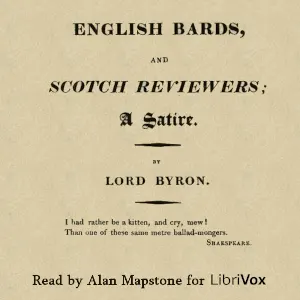
English Bards and Scotch Reviewers A Satire by George Gordon Lord Byron Preface to the third edition. I had rather be a kitten and cry mew than one of these same metre ballad mongers. W. S.
Such shameless bards we have, and yet tis true, there are as mad abandoned critics too. Alexander Pope. All of my friends, learned and unlearned, have urged me not to publish this satire with my name. If I were to be turned from the career of my humour by quibble-quick and paper bullets of the brain, I should have complied with their counsel. But I am not to be terrified by abuse, or bullied by reviewers with or without arms. I can safely say that I have attacked none personally who did not commence on the offensive. An author's works are public property. He who purchases may judge, and publish his opinion if he pleases, and the authors I have endeavored to commemorate may do by me as I have done by them.
I dare say they will succeed better in condemning my scribblings than in mending their own. But my object is not to prove that I can write well, but, if possible, to make others write better. As the poem has met with far more success than I expected, I have endeavoured in this edition to make some additions and alterations to render it more worthy of public perusal. In the first edition of this satire, published anonymously, Fourteen lines on the subject of Bowles' Pope were written and inserted at the request of an ingenious friend of mine who has now in the press a volume of poetry. In the present edition they are erased, and some of my own substituted in their stead. My only reason for this being that which I conceived would operate with any other person in the same manner.
A determination not to publish with my name any productions which are not entirely and exclusively my own composition. With regard to the real talents of many of the poetical persons whose performances are mentioned, or alluded to, in the following pages, it is presumed by the author that there can be little difference of opinion in the public at large. Though, like other sectaries, each has his separate tabernacle of proselytes, by whom his abilities are overrated, his faults overlooked, and his metrical canons received without scruple and without consideration. But the unquestionable possession of considerable genius by several of the writers here censured renders their mental prostitution more to be regretted.
Imbecility may be pitied, or, at worst, laughed at and forgotten. Perverted powers debon the most decided reprehension. No one can wish more than the author that some known and able writer has undertaken their exposure, But Mr. Gifford has devoted himself to Massinger, and in the absence of the regular physician, a country practitioner may, in cases of absolute necessity, be allowed to prescribe his nostrum to prevent the extension of so deplorable an epidemic, provided there be no quackery in his treatment of the malady. A caustic is here offered. As it is to be feared, nothing short of actual cautery can recover the numerous patients afflicted with the present prevalence and distressing rabies of rhyming.
As to the Edinburgh reviewers, it would indeed require a Hercules to crush the Hydra. But if the author succeeds in merely bruising one of the heads of the serpent, though his own hand should suffer in the encounter, he will be amply satisfied. End of preface.
-
2 01 - Lines 1-228 16:14
Lines one to two hundred and fifty-eight. Still must I hear, Shall horse-fittsgerald bawl his creaking couplets in a tavern-hall, and I not sing, Lest haply Scotch reviews Should dub me scribbler And denounce my muse. Prepare for rhyme, I'll publish right or wrong. Fools are my theme, Let satire be my song.
O nature's noblest gift, My grey-goose-quill, Slave of my thought, obedient to my will, Torn from thy parent bird to form a pen, that mighty instrument of little men. The pen, for doom to aid the mental throes of brains that labor, big with verse or prose, though nymphs forsake and critics may deride the lover's solace and the author's pride. What with? What poets dost thou daily raise? How frequent is thy use, how small thy praise, Condemned at length to be forgotten quite, With all the pages which twas thine to write. But thou at least, mine own especial pen, Once laid aside, but now assumed again, Are a task complete, like Hamet's, shall be free. Though spurned by others, yet beloved by me.
Then let us soar to-day no common theme, no eastern vision, no distempered dream, inspires. Our path, though full of thorns, is plain. Smooth be the verse, and easy be the strain. When vice-triumphant holds her sovereign sway, and men through life her willing slaves obey, When folly, frequent harbinger of crime, unfolds her motley store to suit the time. When knaves and fools combined o'er all prevail, when justice halts and right begins to fail, e'en then the boldest start from public sneers, afraid of shame, unknown to other fears, more darkly sin, by satire kept in awe, And shrink from ridicule, though not from law. Such is the force of wit, but not belong to me the arrows of satiric song.
The royal vices of our age demand a keener weapon and a mightier hand. Still there are follies, e'en for me to chase, and yield at least amusement in the race. Laugh when I laugh, I seek no other fame. The cry is up, and scribblers are my game. Speed, Pegasus, ye strains of great and small, Ode, epic, elegy, have at you all. I too can crawl, and once upon a time I poured along the town a flood of rhyme, a schoolboy freak, unworthy praise or blame. I printed. Older children do the same. Tis pleasant sure to see one's name in print. A book's a book, although there's nothing in't. Not that a titled-sounding charm can save, or scrawl or scribbler, from an equal grave. This lamb must own, since his patrician name failed to preserve the spurious farce from shame.
No matter, George continues still to write, though now the name is veiled from public sight. Move by the great example I pursue, the selfsame road, but make my own review. Not seat great Jeffries, yet like him will be, self-constituted judge of poesy. A man must serve his time to every trade, save censure, critics all are ready made. Take hackney jokes from Miller, got by rote, with just enough of learning to misquote. A mind well skilled to find or forge a fault, a term for punning, call it attic salt. To Geoffrey go, be silent and discreet. His pay is just ten sterling pounds per sheet. Fear not to lie, to seem a lucky hit. Shrink not from blasphemy, to a pass for wit. Care not for feeling, pass your proper jest, and stand a critic hated yet caressed.
And shall we own such judgment? No, as soon seek roses in December, ice in June. Hope, constancy in wind, or corn in chaff, believe a woman, or an epitaph, or any other thing that's false before, you trust in critics who themselves are sore, or yield one single thought to be misled by Geoffrey's heart, or Lamb's Boeotian head. To these young tyrants by themselves misplaced, combined usurpers on the throne of taste. To these when authors bend in humble awe, and hail their voice as truth, their word as law. While these are censors, twould be sin to spare. While such are critics, why should I forbear? But yet so near o'er modern worthies run, "'Tis doubtful whom to seek, or whom to shun. Nor know we when to spare, or where to strike.
Our bards and censers are so much alike. Then should you ask me why I venture o'er the path that Pope and Gifford trod before? If not yet sickened, you can still proceed. Go on, my rhyme will tell you as you read." Time was, ere yet in these degenerate days, ignoble themes obtained mistaken praise, when sense and wit, with poesie allied, no fabled graces flourished side by side, from the same fount their inspiration drew, and, reared by taste, bloomed fairer as they grew. Then, in this happy isle, a pope's pure strain, sought the rapt soul to charm, nor sought in vain. A polished nation's praise aspired to claim, and raised the people's as the poet's fame. Like him great Dryden poured the tide of song, in stream less smooth, indeed yet doubly strong.
Then Congreve's scenes could cheer or always melt, for nature then an English audience felt. But why these names, or greater still, retrace, when all to feebler bards resign their place? Yet to such times our lingering looks are cast, when taste and reason with those times are past. Now look around, and turn each trifling page, survey the precious works that please the age. This truth at least let satire's self allow, no dearth of bards can be complained of now. The loaded press beneath her labor groans, and printers' devils shake their weary bones. While Southey's epics cram the creaking shelves, and Little's lyrics shine in hot-pressed 12s. Thus saith the preacher, Nought beneath the sun is new, Yet still from change to change we run, What varied wonders tempt us as they pass.
The cow-pox, tractors, galvanism, and gas, in turns appear to make the vulgar stare till the swan-bubble bursts and all is air. Nor less new schools of poetry arise, where dull pretenders grapple for the prize, or taste a while these pseudo-bards prevail. Each country book-club bows the knee to bail. And hurling lawful genius from the throne, he wrecks a shrine an idol of its own, some leaden calf, but whom it matters not, from soaring southey down to grovelling stot. Behold in various throngs the scribbling crew, for notice eager pass in long review. Each spurs his jaded pegasus apace, And rhyme and blank maintain an equal race. Sonnets on sonnets crowd, and ode on ode, and tales of terror jostle on the road.
Immeasurable measures move along, for simpering folly loves a varied song. Too strange mysterious dullness still the friend admires the strain she cannot comprehend. Thus, lays of minstrels, May they be the last, On half-strung harps wind mournful to the blast, While mountain spirits prate to river sprites, That dames may listen to the sound at nights, And goblin brats of Gilpin Horner's brood decoy young border nobles through the wood, and skip at every step, Lord knows how high, and frighten foolish babes, the Lord knows why, while high-born ladies in their magic cell, forbidding knights to read who cannot spell, Dispatch a courier to a wizard's grave, and fight with honest men to shield a knave.
Next view in state, proud prancing on his roan, the golden-crested, haughty Marmion. Now forging scrolls, now foremost in the fight, not quite a felon yet but half a knight, the gibbet o'er the field prepared to grace. A mighty mixture of the great and base. And think'st thou, Scot, by vain conceit perchance, On public taste to foist thy stale romance, Though Murray with his miller may combine To yield thy muse just half a crown per line? No, when the sons of song descend to trade, Their bays are sear, their former laurels fade. Let such forego the poet's sacred name, who rack their brains for lucre, not for fame. Lo, may they sink to merited contempt, and scorn remunerate the mean attempt. Such be their meed, such still the just reward, of prostituted muse and hireling bard.
For this we spurn Apollo's venal sun, and bid along good-night to Marmion. These are the themes that claim our plaudits now. These are the bards to whom the muse must bow, while Milton, Dryden, Pope, alike forgot, resign their hallowed bays to Walter Scott. The time has been, when yet the muse was young, when Homer swept the lyre, and Maro sung, an epic scarce ten centuries could claim, while all-struck nations hailed the magic name. The work of each immortal bard appears, the single wonder of a thousand years. Empires have moldered from the face of earth, Tongues have expired with those who gave them birth, without the glory such a strain can give, as even in ruin bids the language live. Not so with us, though minor bards contend, on one great work a life of labor's spent.
With eagle pinion soaring to the skies, behold the balladmonger southey rise. To him let Cayman's Milton Tasso yield, Whose annual strains, like armies, take the field. First in the ranks see Joan of Arc advance, The scourge of England, and the boast of France, Though burnt by wicked Bedford for a witch, Behold her statue placed in glory's niche. Her fetters burst, and just released from prison, A virgin phoenix from her ashes risen. Next see tremendous Talibah come on, Arabia's monstrous wild and wondrous sun. Dom Daniel's dread destroyer, who, or through, More mad magicians than the world e'er knew. Immortal hero, all thy foes o'ercome, For ever reign. The rival of Tom Thumb. Since startled meter fled before thy face, Well wert thou doomed the last of all thy race.
Well might triumphant genie bear thee hence, Illustrious conqueror of common sense. Now last and greatest, Madoc spreads his sails, Cacique in Mexico and Prince in Wales. Tells us strange tales, as other travelers do, More old than Mandevilles, and not so true. O southey, southey, cease thy varied song. A bard may chaunt too often and too long, As thou art strong in verse, in mercy spare. A fourth, alas, were more than we could bear. But if, in spite of all the world can say, Thou still wert verseward plod thy weary way, If still in barclay ballads most uncivil Thou wilt devote old women to the devil, The babe unborn thy dread intent may rue, God help thee, Southey, and thy readers too.
-
3 02 - Lines 229-541 22:24
Next comes the dull disciple of thy school, That mild apostate from poetic rule, the simple Wordsworth, Framer of a lay, as soft as evening in his favorite may, who warns his friend to shake off toil and trouble, and quit his books for fear of growing double. Who both by precept and example shows that prose is verse, and verse is merely prose, convincing all by demonstration plain, poetic souls delight in prose insane. And Christmas stories tortured into rhyme contain the essence of the true sublime. Thus when he tells the tale of Betty Foy, the idiot mother of an idiot boy, a moonstruck silly lad who lost his way, and like his bard, confounded night with day. So close on each pathetic part he dwells, and each adventure so sublimely tells, that all who view the idiot in his glory conceive the bard, A hero of the story.
Shall gentle Coleridge pass unnoticed here, to turgid ode and tombid stanza dear? Though themes of innocence amuse him best, yet still obscurities a welcome guest. If inspiration should her aid refuse, to him who takes a pixie for a muse, yet none in lofty numbers can surpass, The bard who soars to elegise an ass. How well the subject suits his noble mind. A fellow-feeling makes us wondrous kind. Oh, wonder-working Lewis, Monk or bard, Who fame wouldst make Parnassus a churchyard. Lo, wreaths of yew not laurel bind thy brow, thy muse a sprite, Apollo sexton thou! Whether on ancient tombs thou tak'st thy stand, by gibbering spectres hail'd thy kindred band, or tracest chaste descriptions on thy page, to please the females of our modest age.
All hail MP! From whose infernal brain Thin-sheeted phantoms glide a grisly train, At whose command grim women throng in crowds, And kings of fire, of water, and of clouds, With small gray men, wild yeagers, and what not, To crown with honor thee and Walter Scott. Again all hail! If tales like thine may please, St. Luke alone can vanquish the disease. E'en Satan's self with thee might dread to dwell, and in thy skull discern a deeper hell. Who in soft guise surrounded by a choir, of virgins melting not to Vesta's fire, with sparkling eyes and cheek by passion flushed, Strikes his wild lyre, whilst listening dames are hushed. Tis little, young Catullus of his day, as sweet but as immoral in his lay.
Grieved to condemn, the muse must still be just, nor spare melodious advocates of lust. Pure is the flame which o'er her altar burns, From grosser incense with disgust she turns, Yet, kind to youth, this expiation o'er, She bids thee mend thy line, and sin no more. For thee, translator of the tinsel-song, To whom such glittering ornaments belong, Hibernian Strangford, With thine eyes of blue, and boasted locks of red or auburn hue, whose plaintive strain each lovesick miss admires, and o'erharmonious Fustian half expires, learn, if thou canst, to yield thine author's sense, nor vend thy sonnets on a false pretence. Think'st thou to gain thy verse a higher place? By dressing caimans in a suit of lace.
Mend, Strangford, Mend thy morals and thy taste. Be warm but pure, be amorous but be chaste. Cease to deceive, thy pilfered harp restore, nor teach the Lucian bard to copy more. In many marble-covered volumes view, Haley, in vain attempting, something new, whether he spins his comedies in rhyme, or scrawl as Wood and Barclay walk against time. His style in youth or age is still the same, for ever feeble and for ever tame. Triumphant firsts see tempers triumph shine, At least I'm sure they triumphed over mine. Of music's triumphs all who read may swear that luckless music never triumphed there. Moravians rise, bestow some meet reward on dull devotion, lo, The sabbath-bard, sepulchral graham, pours his notes sublime, in mangled prose, nor e'en aspires to rhyme, breaks into blank the gospel of St.
Luke, and boldly pilfers from the Pentateuch, and, undisturbed by conscientious qualms, perverts the prophets and purloins the psalms. Hail, sympathy! Thy soft idea brings a thousand visions of a thousand things, and shows, dissolved in nine own melting tears, the maudlin prince of mournful sonneteers. And art thou not their prince, harmonious bowls, thou first great oracle of tender souls? Whether in sighing winds thou seek'st relief, or consolation in a yellow leaf, whether thy muse most lamentably tells, what merry sounds proceed from Oxford bells, or still in bells delighting finds a friend, in every chime that jingles from Ostend. Ah, how much juster were the muses hap! If to thy bells thou wouldst but add a cap!
Delightful bowls, still blessing and still blest, All love thy strain, but children like it best. Tis thine with gentle little's moral song, To soothe the mania of the amorous throng. With thee our nursery damsels shed their tears, Ere miss, as yet, completes her infant years. But in her teens thy whining powers are vain. She quits poor bowls for little's purer strain. Now two soft themes thou scornest to confine, The lofty numbers of a harp like thine. Awake a louder and a loftier strain, such as none heard before or will again. Where all discoveries jumbled from the flood, since first the leaky ark reposed in mud, by more or less are sung in every book, from Captain Noah down to Captain Cook, nor this alone but pausing on the road, The bard sighs forth a gentle episode, and gravely tells, attend each beauteous miss, when first Madeira trembled to a kiss.
Bowles, in thy memory let this precept dwell. Stick to thy sonnets, man, at least they sell. But if some new-born whim or larger bribe, Prompt thy crude brain, and claim thee for a scribe, if chance some bard, though once by dunces feared, now prone in dust, can only be revered. If Pope, whose fame and genius from the first have foiled the best of critics needs the worst, do thou essay, each fault, each failing scan, The first of poets was, alas, but man. Rake from each ancient dunghill every pearl, Consult Lord Fanny, and confide in Curl. Let all the scandals of a former age Perch on thy pen, and flutter o'er thy page. Affect a candor which thou canst not feel, Clothe envy in the garb of honest zeal.
Write, as if St. John's soul could still inspire, and do from hate what Mallet did for hire. Oh, hadst thou lived in that congenial time, To rave with Dennis and with Ralph to rhyme, Thronged with the rest around his living head, Not raise thy hoof against the lion dead, A meet remord had crowned thy glorious gains, And link thee to the dunciad for thy pains. Another epic! Who inflicts again more books of blank upon the sons of men? Boeotian Cottle, rich Bristoa's boast, Imports old stories from the Cambrian coast, And sends his goods to market, all alive, Lines, Forty Thousand, Cantos, Twenty-Five. Fresh fish from Helicon. Who'll buy? Who'll buy? The precious bargain's cheap. In faith, not I.
Too much in turtle, Bristol's sons delight. Too much o'er bowls of rack prolong the night. If commerce fills the purse, she clogs the brain, and Amos Cottel strikes the lyre in vain. In him an author's luckless lot behold, condemned to make the books which once he sold. O Amos Kotl, Phoebus, what a name, to fill the speaking trump of future fame! O Amos Kotl, for a moment think what meagre profits spring from pen and ink! When thus devoted to poetic dreams, who will peruse thy prostituted reams? Oh, pen perverted, paper misapplied! Had Cottle still adorned the counter's side, Bent o'er the desk, or borne to useful toils, Been taught to make the paper which he soils, Ploughed, delved, or plied the oar with lusty limb, He had not sung of Wales, nor I of him.
As Sisyphus, against the infernal steep, rolls the huge rock whose motions ne'er may sleep, so up thy hill, Ambrosial Richmond, heaves, dull Morris, all his granite weight of leaves. Smooth, solid monuments of mental pain, The petrifications of a plodding brain, that ere they reach the top fall lumbering back again. With broken lyre and cheeks serenely pale, Lo, sad Alceus wanders down the vale. Though fair they rose, and might have bloomed at last, his hopes have perished by the northern blast. Nipped in the bud by Caledonian gales, his blossoms wither as the blast prevails. O'er his lost works let classic Sheffield weep. May no rude hand disturb their early sleep. Yet say, why should the bard at once resign his claim to favor from the sacred nine?
For, ever startled by the mingled howl, Of northern wolves that still in darkness prowl. A coward brood which mangle as they prey, by hellish instinct all that cross their way. Aged or young, the living or the dead, no mercy find these harpies must be fed. Why do the injured unresisting yield the calm possession of their native field? Why tamely thus before their fangs retreat, nor hunt the bloodhounds back to Arthur's seat? Health to Immortal Geoffrey. Once in name, England could boast a judge almost the same. In soul so like, so merciful, yet just, some think that Satan has resigned his trust, and given the spirit to the world again, To sentence letters as he sentenced men, with hand less mighty, but with heart as black, with voices willing to decree the rack.
Bread in the courts betimes, though all that law as yet hath taught him is to find a flaw. Since well instructed in the Patriot School to rail at party, though a party tool, who knows? If chance his patrons should restore, back to the sway they forfeited before, his scribbling toils some recompense may meet, and raise this Daniel to the judgment seat. Let Geoffrey's shade indulge the pious hope, and greeting thus present him with a rope. Heir to my virtues, man of equal mind, Skilled to condemn as to traduce mankind, This cord receive, for thee reserved with care, To wield in judgment, and at length to wear. Health to great Geoffrey, Heaven preserve his life, To flourish on the fertile shores of Fife, And guard it sacred in his future wars, since authors sometimes seek the field of Mars.
Can none remember that eventful day, that ever-glorious, almost fatal fray, when Little's leadless pistol met his eye, and Bow Street Myrmidons stood laughing by? O day disastrous, on her firm-set rock! Dunedin's castle felt a secret shock. Dark rolled the sympathetic waves of Forth. Low groaned the startled whirlwinds of the North. Tweed ruffled half his waves to form a tear. The other half pursued its calm career. Arthur's steep summit nodded to its base. The surly toll booth scarcely kept her place. The tollbooth felt, for marble sometimes can, on such occasions feel as much as man. The tollbooth felt defrauded of his charms, if Geoffrey died except within her arms. Nay, last not least, on that portentous morn, the sixteenth story where himself was born, His patrimonial garret fell to ground, and pale Edina shuddered at the sound.
Strewed were the streets around with milk-white reams, flowed all the cannon gate with inky streams. This in his candor seemed the sable dew, that of his valor showed the bloodless hue, and all with justice deemed the two combined, The mingled emblems of his mighty mind. But Caledonia's goddess hovered o'er the field, and saved him from the wrath of Moor. From either pistol snatched the vengeful lead, and straight restored it to her favorite's head. That head, with greater than magnetic power, caught it as Danae caught the golden shower, And though the thickening dross will scarce refine, Augments its ore, and is itself a mine. My son, she cried, ne'er thirst for gore again. Resign the pistol, and resume the pen.
O'er politics and poesy preside, boast of thy country, and Britannia's guide. For long as Albion's heedless sons submit, or Scottish taste decides on English wit, so long shall last thine unmolested reign, nor any dare to take thy name in vain. Behold, a chosen band shall aid thy plan, and own thee chieftain of the critic clan. First in the ranks illustrious shall be seen, the travelled thane, Athenian Aberdeen. Herbert shall wield Thor's hammer, and sometimes In gratitude thou'lt praise his rugged rhymes. Smug Sidney, too, thy bitter page shall seek, And classic Hallam, much renowned for Greek. Scott may perchance his name and influence lend, And paltry pillons shall traduce his friend. While gay Thalia's luckless votary Lamb, as he himself was damned, shall try to damn.
Known by thy name, unbounded by thy sway, thy Holland's banquets shall each toil repay. While grateful Britain yields the praise she owes to Holland's hirings and to learning's foes. Yet mark one caution. Ere thy next review, Spread it like wings of saffron and of blue, Beware lest blundering brotham destroy the sail, Turn beef to bannock, cauliflowers to kale. Thus having said, the kilted goddess kissed her son, and vanished in a Scottish mist. Illustrious Holland, Hard would be his lot, his hirelings mentioned, and himself forgot. Holland, with Henry Petty at his back, the whipper-in and huntsman of the pack. Blessed be the banquet spread at Holland House, where Scotchmen feed and critics may carouse.
Long, long beneath that hospitable roof, Shall Grub Street dine while Duns are kept aloof. See honest Hallam lay aside his fork, resume his pen, review his lordship's work, and, grateful to the founder of the feast, declare his landlord can translate at least. Dunedin, view thy children with delight. They write for food, and feed because they write. And lest when heated with the unusual grape, Some glowing thoughts should to the press escape, And tinge with red the female reader's cheek, My lady skims the cream of each critique, Breathes o'er the page her purity of soul, Reforms each error, and refines the whole.
-
4 03 - Lines 542-828 22:13
Lines 542 to 828. Now to the drama turn. Oh, Motley sight! What precious scenes the wondering eyes invite? Puns and a prince within a barrel pent, and Dybden's nonsense yield complete content. Though now, thank heaven, the rosciomania's o'er, and full-grown actors are endured once more. Yet what avails their vain attempts to please, while British critics suffer scenes like these? While Reynolds vents his damns, poos, and zounds, and commonplace and common sense confounds, while Kenny's world, just suffered to proceed, proclaims the audience very kind indeed, and Beaumont's pilfered Caratac affords a tragedy complete in all but words. Who but must mourn, while these are all the rage, the degradation of our vaunted stage?
Heavens, is all sense of shame and talent gone? Have we no living bard of merit? None? Awake, George Coleman, Cumberland, awake! Ring the alarm-bell, let folly quake! O Sheridan, if aught can move thy pen, Let comedy resume her throne again, Abjure the mummery of German schools, Leave new pizarros to translating fools, Give as thy last memorial to the age One classic drama, and reform the stage. Gods, O'er those boards shall folly rear her head, Where Garrick, Trot, and Kemble lives to tread? On those shall fast display Buffoonery's mask, And Hook conceal his heroes in a cask? Shall sapient managers new scenes produce, From Cherry, Skeffington, and Mother Goose? While Shakspeare, Otway, Massinger, forgot, On stools must moulder, or in closets rot.
Though with what pomp the daily prints proclaim, The rival candidates for attic fame. In grim array, though Lewis spectres rise, Still Skiffington and Goose divide the prize. And sure great Skippington must claim our praise, For skirtless coats and skeletons of plays Renowned alike, Whose genius ne'er confines Her flight to garnish Greenwood's gay designs, Nor sleep with sleeping beauties but anon In five facetious acts come thundering on, While poor John Bull, Bewildered with the scene, stares, wondering what the devil it can mean. But as some hands applaud a venal few, rather than sleep, why, John applauds it too. Such are we now, ah! Wherefore should we turn to what our fathers were, unless to mourn?
Degenerate Britons, Are ye dead to shame, or kind to dulness? Do you fear to blame? Well, may the nobles of our present race watch each distortion of the Naudi's face. Well, may they smile on Italy's buffoons, and worship Catalini's pantaloons. Since their own drama yields no fairer trace of wit than puns, of humor than grimace. Then let Asonia, skilled in every art, to soften manners, but corrupt the heart, pour her exotic follies o'er the town, to sanction vice and hunt decorum down. Let wedded strumpets languish o'er des Hays, and bless the promise which his form displays, while Gaten bounds before the enraptured looks of hoary marquises and stripling dukes. Let high-born lechers, aye the lively prezzle, twirl her light limbs that spurn the needless veil.
Let Angelini bear her breast of snow, wave the white arm and point the pliant toe. Colini trill her love-inspiring song, strain her fair neck and charm the listening throng. Raise not your scythes, oppressors of our vice, reforming saints too delicately nice. By whose decrees our sinful souls to save, No Sunday tankards foam, No barbers shave, And beer undrawn and beers unmown display, Your holy reverence for the sabbath day. All hail at once the patron and the pile Of vice and folly, Grenville and Argyle. Where yon proud palace fashions, hallowed fane, spreads wide her portals for the motley train, behold the new Petronius of the day, the arbiter of pleasure and of play. There the hard eunuch, the hesperian choir, the melting lute, the soft, lascivious lyre, The song from Italy, the steppe from France, the midnight orgy and the mazy dance, the smile of beauty and the flush of wine, for fops, fools, gangsters, knaves, and lords combine.
Each to his humor, comus all allows, champagne, dice, music, or your neighbor's spouse. Talk not to us, ye starving sons of trade, of piteous ruin which ourselves have made. In plenty's sunshine fortune's minions bask, nor think of poverty except on masque, when for the night some lately titled asks, appears the beggar which his grandsire was. The curtain dropp'd the gay briletta o'er, The audience take their turn upon the floor. Now round the room the circling dowagers sweep, Now in loose waltz the thin-clad daughters leap. The first in lengthened line majestic swim, The last display the free unfettered limb. Those four hibernia's lusty sons repair, with art the charms which nature could not spare.
These after husbands wing their eager flight, nor leave much mystery for the nuptial night. Oh, blest retreats of infamy and ease, where, all forgotten but the power to please, Each maid may give a loose to genial thought, each swain may teach new systems, or be taught. There the blithe youngster, just returned from Spain, cuts the light pack, or calls the rattling mane. The jovial castor's set, and seven's the nick, or done, a thousand on the coming trick. If, mad with loss, existence gins to tire, and all your hopes or wish is to expire, here's Powell's pistol ready for your life, and kinder still a paget for your wife. Fit consummation of an earthly race, begun in folly, ended in disgrace, while none but menials o'er the bed of death.
Wash thy red wounds, or watch thy wavering breath. Traduce by liars, and forgot by all, the mangled victim of a drunken brawl, to live like Clodius, and like Falkland fall. Truth. Rouse some genuine barn, and guide his hand, to drive this pestilence from out the land. Even I, least thinking of a thoughtless throng, just skilled to know the right and choose the wrong. Freed at that age when reason's shield is lost, to fight my course through passion's countless host, whom every path of pleasure's flowery way has lured in turn and all have led astray. E'en I must raise my voice, e'en I must feel, Such scenes such men destroy the public wheel. Although some kind censorious friend will say, What art thou better meddling fool than they?
And every brother rake will smile to see, That miracle a moralist in me. No matter! When some bard in virtue strong, Gifford, perchance, shall raise the chastening song, then sleep my pen for ever, and my voice be only heard to hail him and rejoice. Rejoice and yield my feeble praise, though I may feel the lash that virtue must apply. As for the smaller fry who swarm in shoals, from silly halfies up to simple bowls, why should we call them from their dark abode, in Broad St. Giles, or in Tottenham Road? Or since some men of fashion nobly dare to scrawl in verse from Bond Street or the Square? If things of ton their harmless lays indite, Most widely doomed to shun the public sight, What harm? In spite of every critic elf, Sir T.
May read his stanzas to himself. Miles Andrews, still his strength in couplets try, And live in prologue, though his dramas die. Lords, too, are barred, Such things at times befall, and tis some praise in peers to write at all. Yet did or taste or reason sway the times? Ah, who would take their titles with their rhymes? Roscommon, Sheffield, with your spirits fled, no future laurels deck a noble head. No muse will cheer with renovating smile. The paralytic fueling of Carlyle. The puny schoolboy and his early lay Mempardon if his follies pass away. But who forgives the senior's ceaseless verse, Whose hairs grow hoary as his rhymes grow worse? What heterogeneous honours deck the peer? Lord, rhymester, petty Pamphleteer.
So dull in youth, so driveling in his age, his scenes alone had damned our sinking stage. But managers, for one, cried, Hold enough, nor drugged their audience with the tragic stuff. Yet at their judgment let his lordship laugh, and case his volumes in congenial calf. Yes, doff that covering where Morocco shines, and hang a calfskin on those recreant lines. With you, ye druids, rich in native lead, who daily scribble for your daily bread, with you I wore not. Gifford's heavy hand has crushed without remorse Your numerous band. On all the talents, vent your venal spleen. Want your defense, let pity be your screen. Let monadies on fox regale your crew, and Melville's mantle prove a blanket too.
One common theethe waits each hapless bard. And, peace be with you, tis your best reward. Such damning fame as dunciads only give, could bid your lines beyond a morning live. But now at once your fleeting labors close, with names of greater note in blessed repose. Far be it from me unkindly to upbraid the lovely roses prose in masquerade, whose strains the faithful echoes of her mind leave wondering comprehension far behind. Though Belle has lost his nightingales and owls, Matilda snivels still, and Hafitz howls, And Kruska's spirit rising from the dead revives in Laura, Quiz, and X, Y, Z.
When some brisk youth, the tenant of a stall, employs a pen less pointed than his awl, leaves his snug shop, forsakes his store of shoes, St. Crispin quits, and cobbles for the muse. Heavens! How the vulgar stare! How crowds applaud! How ladies read, and literati laud! If chance some wicked wag should pass his jest, Tis sheer ill-nature. Don't the world know best? Genius must guide when wits admire the rhyme, And Kappel-Loft declares, "'Tis quite sublime!' Here, then, ye happy sons of Needle's trade, swains, quit the plough, resigned a useless spade. Lo, Burns and Bloomfield, nay, a greater far, Gifford was born beneath an adverse star, forsook the labours of a servile state, stemmed a rude storm, and triumphed over fate.
Then why no more? If Phoebus smiled on you, Bloomfield, why not on brother Nathan too? Him to the mania not the muse has seized. Not inspiration, but a mind diseased. And now no bore can seek his last abode, no common be enclosed without an ode. O, since increased refinement deigns to smile on Britain's suns and bless our genial isle, let poesy go forth pervade the whole, alike the rustic and mechanic soul. Ye tuneful cobblers, still your notes prolong, compose at once a slipper and a song. So shall the fair your handiwork peruse, your sonnets sure shall please, perhaps your shoes. May moorland weavers boast pindaric skill, and tailors lays be longer than their bill, while punctual bows reward the grateful notes, and pay for poems when they pay for coats.
To the famed throng, now paid the tribute due, Neglected genius, let me turn to you. Come forth, O Campbell, give thy talents scope. Who dares aspire, if thou must cease to hope? And thou, melodious Rogers, rise at last, Recall the pleasing memory of the past. Arise, let blest remembrance still inspire, And strike to wonted tones thy hallowed lyre. Restore Apollo to his vacant throne, Assert thy country's honour, and thine own. What must deserted poesy still weep, Where her last hope with pious cowper sleep? Unless, perchance, from his cold beer she turns, to deck the turf that wraps her minstrel burns. No, though contempt hath marked the spurious brood, the race who rhyme from folly or for food, yet still some genuine sons tis hers to boast, who, least affecting, still affect the most.
Feel as they write, and write but as they feel. Bear witness, Gifford, Southerby, MacNeill. Why slumbers, Gifford? Once was asked in vain. Why slumbers, Gifford? Let us ask again. Are there no follies for his pen to purge? Are there no fools whose backs demand the scourge? Are there no sins for satires barred to greet? Stalk's not gigantic vice in every street? Shall peers or princes tread pollution's path, and scape alike the laws and muses' wrath? Nor blaze with guilty glare through future time eternal beacons of consummate crime? Arouse thee, Gifford! Be thy promise claimed, make bad men better, or at least ashamed. Unhappy White, while life was in its spring, and thy young muse just waved her joyous wing, the spoiler came, and all thy promise fair has sought the grave to sleep forever there.
Oh, what a noble heart was here undone, When science self-destroyed her favorite son! Yes, she too much indulged thy fond pursuit. She sowed the seeds, but death has reaped the fruit. "'Twas thine own genius gave the final blow, And helped to plant the wound that laid thee low. So struck the eagle, stretched upon the plain, no more through rolling clouds to soar again, viewed his own feather on the fatal dart, and winged the shaft that quivered in his heart. Keen were his pangs, but keener far to feel, he nursed the pinion which impelled the steel, while the same plumage that had warmed his nest Drank the last life-drop of his bleeding breast.
-
5 04 - Lines 829-1050 16:14
Lines eight hundred and twenty There be who say, in these enlightened days, that splendid lies are all the poet's praise. That strained invention ever on the wing alone impels the modern bard to sing. Tis true that all who rhyme, nay, all who write, shrink from that fatal word to genius, trite. Yet truth sometimes will lend her noblest fires, and decorate the verse herself inspires. This fact in virtue's name let Crabbe attest, though nature's sternest painter, yet the best. And here let she and genius find a place, whose pen and pencil yield an equal grace, to guide whose hands the sister arts combined, and trace the poet's or the painter's line, whose magic touch can bid the canvas glow, O'erpour the easy rhyme's harmonious flow, While honours doubly merited attend, The poet's rival but the painter's friend.
Blessed is the man who dares approach the bower, Where dwelt the muses at their natal hour, Whose steps have pressed, whose eye has marked afar, The clime that nursed the sons of song and war, The scenes which glory still must hover o'er, her place of birth, her own Archean shore, but doubly blessed is he whose heart expands with hallowed feelings for those classic lands, who rends the vale of ages long gone by, and views their remnants with a poet's eye. Twas thy happy lot at once to view those shores of glory, and to sing them too, and sure no common muse inspired thy pen to hail the land of gods and godlike men. And you, associate bards, who snatched to light those gems too long withheld from modern sight, whose mingling tastes combine to cull the wreath Where Attic Flowers' Aeonian Odors breathe, and all their renovated fragrance flung, to grace the beauties of your native tongue.
Now let those minds that nobly could transfuse the glorious spirit of the Grecian Muse, though soft the echo, scorn a borrowed tone, resign Archaea's lyre and strike your own. Let these, or such as these, with just applause, restore the muses' violated laws. But not in flimsy Darwin's pompous chime, that mighty master of unmeaning rhyme, whose gilded symbols more adorned than clear, the eye delighted but fatigued the ear, in show the simple lyre could once surpass, But now worn down, appear in native brass, while all his train of hovering sylphs around evaporate in similes and sound. Him let them shun, with him let tinsel die, false glare attracts, but more offends the eye. Yet let them not to vulgar Wordsworth stoop, the meanest object of the lowly group.
Whose verse of all but childish prattle void seems blessed harmony to Lamb and Lloyd. Let them but hold, my muse, nor dare to teach, a strain far, far beyond thy humble reach. The native genius, with their feeling given, will point the path and peel their notes to heaven. And thou too, Scot, resign to minstrels rude, the wilder slogan of a border feud. Let others spin their meagre lines for hire, enough for genius if itself inspire. Let Southey sing, although his teeming muse, prolific every spring, be too profuse. Let simple Wordsworth chime his childish verse, and Brother Coleridge lull the babe at nurse. Let Spectre-mongering Lewis aim at most, to rouse the galleries, or to raise a ghost. Let Moore be lewd, let Strangford steal from Moore, and swear that Cayman sang such notes of yore.
Let Haley hobble on, Montgomery rave, and Godly Graham chaunt a stupid stave. Let Sonneteering bowls his strains refine, and whine and whimper to the fourteenth line. Let Stott, Carlyle, Matilda, and the rest, of Grub Street and of Grosvenor Place the best, Scrawl on till Death release us from the strain, Or common sense assert her rights again. But thou, with powers that mock the aid of praise, Shouldst leave to humbler bards ignoble lays. Thy country's voice, the voice of all the nine, demand a hallowed harp. That harp is thine. Say, will not Caledonia's annals yield the glorious record of some nobler field than the vile foray of a plundering clan, whose proudest deeds disgrace the name of man?
Or Marmion's act of darkness fitter food? For outlawed Sherwood's tales of Robin Hood. Scotland, still proudly claim thy native bard, and be thy praise his first, his best reward. Yet not with thee alone his name should live, but own the vast renown a world can give. Be known perchance when Albion is no more, and tell the tale of what she was before. To future times her faded fame recall, And save her glory, though his country fall. Yet what avails the sanguine poet's hope? To conquer ages, and with time to cope? New eras spread their wings, new nations rise, And other victors fill the applauding skies. A few brief generations fleet along, Whose sons forget the poet and his song. E'en now what once loved minstrels scarce may claim, the transient mention of a dubious name.
When fame's loud trump hath blown its noblest blast, though long the sound the echo sleeps at last, and glory, like the phoenix midst her fires, Exhales her odors blazes and expires. Shall Hori Granta call her sable sons, expert in science, more expert at puns? Shall these approach the muse? Ah, no, she flies, and even spurns the great Suetonian prize, though printers condescend to press to soil. With rhyme by hoar and epic blank by hoyle, not him whose page, if still upheld by whist, requires no sacred theme to bid us list. Ye who in Granta's honor would surpass, must mount her pegasus a full-grown ass, a foal well worthy of her ancient dam, whose Helicon is duller than her cam. There, Clark, still striving piteously to please, Forgetting dog rule leads not to degrees.
A would-be satirist, a hired buffoon, A monthly scribbler of some low lampoon, Condemned to drudge the meanest of the mean, And furbish falsehoods for a magazine, Devotes to scandal his congenial mind, himself a living libel on mankind. O dark asylum of a vandler race, at once the boast of learning and disgrace, so sunk in dullness and so lost in shame, that Smythe and Hodgson scarce redeem thy fame. But where fair Isis rolls purer wave, The partial muse delighted loves to lave. On her green banks a greener wreath is wove, To crown the bards that haunt her classic grove. Where Richards wakes a genuine poet's fires, And modern Britons justly praise their sires. For me, Who thus unasked have dared to tell my country what her sons should know too well, zeal for her honor bade me here engage the host of idiots that infest her age.
No just applause her honored name shall lose, as first in freedom dearest to the muse. Oh, would thy bards but emulate thy fame! And rise more worthy, Albion, of thy name. What Athens was in science, Rome in power? What Tyre appeared in her meridian hour? Tis thine at once, fair Albion, to have been, Earth's chief dictatress, ocean's mighty queen. But Rome decayed, and Athens strewed the plain. And Tyre's proud peers lie shattered in the main. Like these thy strength may sink in ruin hurled, and Britain fall, the bulwark of the world. But let me cease and dread Cassandra's fate, with warning ever scoffed at till too late, to themes less lofty still my lay confine, and urge thy bards to gain a name like thine.
Then, hapless Britain, be thy rulers blest, the Senate's oracles, the people's jest, still hear thy motley orators dispense the flowers of rhetoric, though not of sense, while Canning's colleagues hate him for his wit, and old dame Portland fills the place of Pitt. Yet once again adieu, ere this the sale, That wafts me hence is shivering in the gale, and Afrik's coast in Calpe's adverse height, and Stambl's minarets must greet my sight. Thence shall I stray through beauty's native clime, where Kraf is clad in rocks and crowned with snow's sublime. But should I back return no lettered rage, Shall drag my commonplace book on the stage. Let vain Valencia rival luckless Carr, and equal him whose work he sought to mar.
Let Aberdeen and Elgin still pursue the shade of fame through regions of virtue, waste useless thousands on their Phidian freaks, misshapen monuments and maimed antiques. And make their grand saloons a general mart for all the mutilated blocks of art. Of Dardan Tors let Dilettanti tell, I leave topography to classic gel, and, quite content, no more shall interpose, to stun mankind with poesy or prose. Thus far I've held my undisturbed career, Prepared for rancour, steeled against selfish fear. This thing of rhyme I ne'er disdained to own, though not obtrusive, yet not quite unknown, my voice was heard again, though not so loud, my page, though nameless, never disavowed, and now at once I tear the veil away, Cheer on the pack, the quarry stands at bay, unscarred by all the din of Melbourne House, by Lamb's resentment, or by Holland's spouse, by Geoffrey's harmless pistol, Hallam's rage, Edna's brawny sons, and Brimstone Page.
Our men in Buckram shall have blows enough, and feel they too are penetrable stuff. And though I hope not hence unscathed to go, who conquers me shall find a stubborn foe. The time hath been when no harsh sound would fall, from lips that now may seem imbued with gall, nor fools nor follies tempt me to despise, the meanest thing that crawled beneath my eyes. But now, so callous grown, so changed since youth, I've learned to think, and sternly speak the truth, learned to deride the critic's starched decree, and break him on the wheel he meant for me. To spurn the rod a scribbler bids me kiss, nor care if courts and crowds applaud or hiss. Nay, more. Though all my rival rhymesters frown, I too can hunt a poetaster down.
And, armed in proof, the gauntlet cast at once, to Scotch marauder and to Southern dunce. Thus much I've dared to do. How far my lay, hath wronged these righteous times, let others say. This let the world, which knows not how to spare, Yet rarely blames unjustly. Now declare.
End of English Bards and Scots Reviews by George Gordon, Lord Byron.