
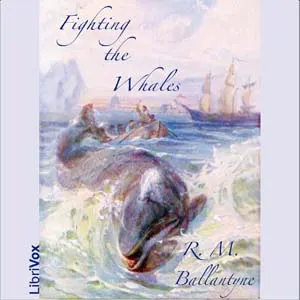
Chapters 10
-
1 01 In Trouble, To Begin With. 13:30
In Trouble to Begin With There are few things in this world that have filled me with so much astonishment as the fact that man can kill a whale. That a fish more than sixty feet long and thirty feet round the body, with the bulk of three hundred fat oxen rolled into one, with the strength of many hundreds of horses, able to swim at a rate that would carry it right round the world in twenty-three days, that can smash a boat to atoms with one slap of its tail and stave in the planks of a ship with one blow of its thick skull, that such a monster can be caught and killed by man is most wonderful to hear of. But I can tell from experience that it is much more wonderful to see. There is a wise saying which I have often thought much upon.
It is this, knowledge is power. Man is but a feeble creature, and if he had to depend on his own bodily strength alone, he could make no head against even the ordinary brutes in this world. But the knowledge which has been given to him by his maker, his clothed man with great power, so that he is more than a match for the fiercest beast in the forest, or the largest fish in the sea. Yet with all his knowledge, with all his experience, and all his power, the killing of a great old sperm whale costs man a long, tough battle. Sometimes it even costs him his life. It is a long time now since I took to fighting the whales. I have been at it, man and boy, for nigh forty years, and many a wonderful sight have I seen, many a desperate battle have I fought in the fisheries of the North and South Seas.
Sometimes, when I sit in the chimney-corner of a winter evening, smoking my pipe with my old messmate, Tom Lokens, I stare into the fire and think of the days gone by till I forget where I am and go on thinking so hard that the flames seem to turn into melting fires. and the bars of the grate into dead fish, and the smoke into sails and rigging, and I go to work cutting up the blubber and stirring the oil pots, or pulling the boar and driving the harpoon at such a rate that I can't help giving a shout, which causes Tom to start and cry, Hello? Bob? My name is Bob Lubbury, you see. Hello? Bob? What's the matter? To which I reply, Tom, can it all be true? Can what be true? says he with a stare of surprise, for Tom is getting into his dotage now.
And then I chuckle and tell him I was only thinking of old times, and so he falls to smoking again, and I to staring at the fire and thinking as hard as ever. The way in which I was first led to go after the whales was curious. This is how it happened. About forty years ago, when I was a boy of nearly fifteen years of age, I lived with my mother in one of the seaport towns of England. There was great distress in the town at that time, and many of the hands were out of work. My employer, a blacksmith, had just died, and for more than six weeks I had not been able to get employment or to earn a farthing. This caused me great distress, for my father had died without leaving a penny in the world, and my mother depended on me entirely.
The money I had saved out of my wages was soon spent, and one morning when I sat down to breakfast my mother looked across the table and said in a thoughtful voice, This meal has cost us our last halfpenny." My mother was old and frail, and her voice very gentle. She was the most trustful, uncomplaining woman I ever knew. I looked up quickly into her face as she spoke. "'All the money gone, mother?' "'Aye, all.' "'It will be hard for you to go without your dinner, Robert, dear.' "'It will be harder for you, mother,' I cried, striking the table with my fist. Then a lump rose in my throat and almost choked me. I could not utter another word. It was with difficulty I managed to eat the little food that was before me.
After breakfast I rose hastily and rushed out of the house, determined that I would get my mother her dinner, even if I should have to beg for it. But I must confess that a sick feeling came over me when I thought of begging. Hurrying along the crowded streets, without knowing very well what I meant to do, I came at last to an abrupt halt at the end of the pier. Here I went up to several people and offered my services in a wild sort of way. They must have thought that I was drunk, for nearly all of them said gruffly that they did not want me. Dinner-time drew near, but no one had given me a job, and no wonder, for the way in which I tried to get one was not likely to be successful. At last I resolved to beg.
Observing a fat, red-faced old gentleman coming along the pier, I made up to him boldly. He carried a cane with a large gold knob on the top of it. That gave me hope, for of course, thought I, he must be rich. His nose, which was exactly the color and shape of the gold knob on his cane, was stuck in the center of a round, good-natured countenance, the mouth of which was large and firm, the eyes bright and blue. He frowned as I went forward, hat in hand, but I was not to be driven back. The thought of my starving mother gave me power to crush down my rising shame. Yet I had no reason to be ashamed. I was willing to work, if only I could have got employment. Stopping in front of the old gentleman, I was about to speak when I observed him quietly button up his breeches pocket.
The blood rushed to my face, and turning quickly on my heel, I walked away without uttering a word. Hello. shouted a gruff voice just as I was moving away. I turned and observed that the shout was uttered by a broad, rough-looking jack-tar, a man of about two or three and thirty, who had been sitting all the forenoon on an old cask, smoking his pipe and basking in the sun. "'Hello,' said he again. "'Well,' said I, "'what do you mean, youngster, by going on in that there fashion all the morning, bothering everybody and making a fool of yourself like that, eh?' "'What's that to you?' said I savagely, for my heart was sore and heavy, and I could not stand the interference of a stranger. "'Oh, it's nothing to me, of course,' said the sailor, picking his pipe quietly with his clasp-knife.
"'But come here, boy, I've something to say to you.' "'Well, what is it?' said I, going up to him somewhat sulkily. The man looked at me gravely through the smoke of his pipe and said, "'You're in a passion, me young buck, that's all. And in case you didn't know it, I thought I'd tell you.' I burst into a fit of laughter. Well, I believe you're not far wrong, but I'm better now. Ah, that's right, said the sailor with an approving nod of his head. Always confess when you're in the wrong. Now, Younger, let me give you a bit of advice. Never get into a passion if you can help it. And if you can't help it, get out of it as fast as possible. And if you can't get out of it, just give a great roar to let off the steam and turn about and run.
There's nothing like that. Passion hain't got legs. You can't hold on to a feller when he's running. If you keep it up till you almost split your timbers, passion has no chance. It must go astern. Now, lad, I've been watching you all the morning, and I see there's a screw loose somewhere. If you'll tell me what it is, see if I don't help you. The kind, frank way in which this was said quite won my heart, so I sat down on the old cask and told the sailor all my sorrows. "'Boy,' said he when I had finished, "'I'll put you in the way of helping your mother. I can get you a berth in my ship, if you're willing to take a trip to the whale-fishery of the South Seas.' "'And who will look after my mother when I'm away?' said I.
The sailor looked perplexed at the question. "'Ah!' "'That's a puzzler,' he replied, knocking the ashes out of his pipe. "'Will you take me to your mother's house, lad?' "'Willingly,' said I, and jumping up, I led the way. As we turned to go, I observed that the old gentleman with the gold-headed cane was leaning over the rail of the pier at a short distance from us. A feeling of anger instantly rose within me, and I exclaimed, loud enough for him to hear, "'I do believe that stingy old chap has been listening to every word we've been saying.' I thought I observed a frown on the sailor's brow as I said this, but he made no remark, and in a few minutes we were walking rapidly through the streets.
My companion stopped at one of those stores so common in seaport towns, where one can buy almost anything, from a tallow candle to a brass cannon. Here he purchased a pound of tea, a pound of sugar, a pound of butter, and a small loaf, all of which he thrust into the huge pockets of his coat. He had evidently no idea of proportion or of household affairs. It was a simple, easy way of settling the matter to get a pound of everything. In a short time we reached our house, a very old one, in a poor neighborhood, and entered my mother's room. She was sitting at the table when we went in, with a large Bible before her, and a pair of horned spectacles on her nose. I could see that she had been out gathering coals and cinders during my absence, for a good fire burned in the grate and the kettle was singing cheerily thereon.
"'I've brought a friend to see you, mother,' said I." "'Good-day, mistress,' said the sailor bluntly, sitting down on a stool near the fire. "'You seem to be going to have your tea.' "'I expect to have it soon,' replied my mother." Indeed, said I, in surprise, have you anything in the kettle? Nothing but water, my son. Has anybody brought you anything, then, since I went out? Nobody. Why, then, mistress, broke in the seaman, how can you expect to have your tea so soon? My mother took off her spectacles, looked calmly in the man's face, laid her hand on the Bible, and said, Because I have been a widow woman these three years, and never once in all that time have I gone a single day without a meal.
When the usual hour came, I put on my kettle to boil, for this word tells me that the Lord will provide. I expect my tea to-night. The sailor's face expressed puzzled astonishment at these words, and he continued to regard my mother with a look of wonder as he drew forth his supplies of food and laid them on the table. In a short time we were all enjoying a cup of tea and talking about the whale-fishery and the difficulty of my going away while my mother was dependent on me. At last the sailor rose to leave us. Taking a five-pound note from his pocket, he laid it on the table and said, "'Mistress, this is all I have in the world, but I've got neither family nor friends, and I'm bound for the South Seas in six days.' So if you'll take it, you're welcome to it, and if your son Bob can manage to cast loose from you without leaving you to sink, I'll take him aboard the ship that I sail in.
He'll always find me at the Bowling Griffin in the high street, or at the end of the pier. While the sailor was speaking, I observed a figure standing in a dark corner of the room near the door, and on looking more closely I found that it was the old gentleman with the nose like his cane knob. Seeing that he was observed, he came forward and said, I trust that you will forgive my coming here without invitation, but I happen to overhear part of the conversation between your son and this seaman, and I am willing to help you over your little difficulty, if you will allow me. The old gentleman said this in a very quick, abrupt way, and looked as if he were afraid his offer might be refused. He was much heated with climbing our long stair, no doubt, and as he stood in the middle of the room puffing and wiping his bald head with a handkerchief, my mother rose hastily and offered him a chair.
"'You are very kind, sir,' she said. "'Do sit down, sir. I am sure I don't know why you should take so much trouble. But, dear me, you are very warm. Will you take a cup of tea to cool you?' "'Thank you, thank you. With much pleasure.' Unless, indeed, your son objects to a stingy old chap sitting beside him. I blushed when he repeated my words and attempted to make some apology. But the old gentleman stopped me by commencing to explain his intentions in short, rapid sentences. To make a long story short, he offered to look after my mother while I was away, and to prove his sincerity, laid down five shillings and said he would call with that sum every week as long as I was absent. My mother, after some trouble, agreed to let me go, and before that evening closed everything was arranged and the gentleman leaving his address went away.
The sailor had been so much filled with surprise at the suddenness of all this that he could scarcely speak. Immediately after the departure of the old gentleman he said, "'Well, good-bye, mistress, good-bye, Bob,' and throwing on his hat in a careless way left the room. "'Stop!' I shouted after him when he had got about half-way down the stair. Hello? What's wrong now? Nothing. I only forgot to ask your name. Tom Lokens, he bellowed in the hoarse voice of a regular boatswain, which was my father's name before me. So saying, he departed, whistling, rule Britannia with all his might. Thus the matter was settled. Six days afterwards I rigged myself out in a blue jacket, white ducks, and a straw hat, and went to sea.
-
2 02 At Sea. 14:24
I was, as my new friend Tom Loken said, as sick as a dog. But in course of time I grew well, and began to rejoice in the cool fresh breezes and the great rolling billows of the sea. Many and many a time I used to creep out to the end of the bowsprit, when the weather was calm, and sit with my legs dangling over the deep blue water and my eyes fixed on the great masses of rolling clouds in the sky, thinking of the new course of life I had just begun. At such times the thought of my mother was sure to come into my mind, and I thought of her parting words. Put your trust in the Lord, Robert, and read his word. I resolved to try to obey her, but this I found was no easy matter, for the sailors were a rough lot of fellows who cared little for the Bible.
But I must say they were a hearty, good-natured set, and much better upon the whole than many a ship's crew that I afterwards sailed with. We were fortunate in having fair winds this voyage, and soon found ourselves on the other side of the line, as we jacktars call the equator. Of course, the crew did not forget the old custom of shaving all the men who had never crossed the line before. Our captain was a jolly old man, And uncommonly fond of sky-larking, he gave us leave to do what we liked the day we crossed the line. So as there were a number of wild spirits among us, we broke through all the ordinary rules, or rather we added on new rules to them. The old hands had kept the matter quiet from us greenhorns, so that although we knew they were going to do some sort of mischief, we didn't exactly understand what it was to be.
About noon of that day I was called on deck and told the old father Neptune was coming aboard, and we were to be ready to receive him. A minute after I saw a tremendous monster come up over the side of the ship and jump on the deck. He was crowned with seaweed and painted in a wonderful fashion. His clothes were dripping wet, as if he had just come from the bottom of the sea. After him came another monster with a petticoat made of sailcloth and a tippet of a bit of old tarpaulin. This was Neptune's wife, and these two carried on the most remarkable antics I ever saw. I laughed heartily, and soon discovered from the tones of their voices which of my shipmates Neptune and his wife were. But my mirth was quickly stopped when I was suddenly seized by several men, and my face was covered over with a horrible mixture of tar and grease.
Six of us youngsters were treated in this way. Then the lather was scraped off with a piece of old hoop-iron, and after being thus shaved, Buckets of cold water were thrown over us. At last, after a prosperous voyage, we arrived at our fishing ground in the South Seas, and a feeling of excitement and expectation began to show itself among the men, insomuch that our very eyes seemed brighter than usual. One night, those of us who had just been relieved from watch on deck were sitting on the lockers down below telling ghost stories. It was a dead calm. And one of those intensely dark, hot nights that cause sailors to feel uneasy, they scarce know why. I began to feel so uncomfortable at last, listening to the horrible tales which Tom Lokens was relating to the men, that I slipped away from them with the intention of going on deck.
I moved so quietly that no one observed me. Besides, every eye was fixed earnestly on Tom, whose deep, low voice was the only sound that broke the stillness of all around. As I was going very cautiously up the ladder leading to the deck, Tom had reached that part of his story where the ghost was just appearing in a dark churchyard dressed in white and coming slowly forward, one step at a time, towards the terrified man who saw it. The men held their breath, and one or two of their faces turned pale as Tom went on with his description, lowering his voice to a hoarse whisper. Just as I put my head up the hatchway, the sheet of one of the sails, which was hanging loose in the still air, passed gently over my head and knocked my hat off.
At any other time I would have thought nothing of this, but Tom's story had thrown me into such an excited and nervous condition that I gave a start, missed my footing, Uttered a loud cry, and fell down the ladder right in among the men with a tremendous crash, knocking over two or three oil cans and a tin bread-basket in my fall, and upsetting the lantern so that the place was instantly pitch dark. I never heard such a howl of terror as these men gave vent to when this misfortune befell me. They rushed upon deck with their hearts and their mouths tumbling and peeling the skin off their shins and knuckles in their haste, and it was not until they heard the laughter of the watch on deck that they breathed freely, and joining in the laugh, called themselves fools for being frightened by a ghost story.
I noticed, however, that for all their pretended indifference, there was not one man among them, Not even Tom Lokens himself, who would go down below to relight the lantern for at least a quarter of an hour afterwards. Feeling none the worse for my fall, I went forward and leaned over the bow of the ship, where I was much astonished by the appearance of the sea. It seemed as if the water was on fire. Every time the ship's bow rose and fell, The little belt of foam made in the water seemed like a belt of blue flame with bright sparkles in it, like stars or diamonds. I had seen this curious appearance before, but never so bright as it was on that night. "'What is it, Tom?' said I as my friend came forward and leaned over the ship's bulwark beside me.
"'It's blue fire, Bob,' replied Tom as he smoked his pipe calmly. Come, you know I can't swallow that," said I. Everybody knows that fire, either blue or red, can't burn in the water. "'Maybe not,' returned Tom. "'But it's blue fire for all that. Leastwise, if it's not, I don't know what else it is.' Tom had often seen this light before, no doubt, but he had never given himself the trouble to find out what it could be. Fortunately, the captain came up just as I put the question, and he enlightened me on the subject. It is caused by small animals," said he, leaning over the side. "'Small animals?' said I, in astonishment. "'Ay, many parts of the sea are full of creatures so small and so thin and colourless that you can hardly see them even in a clear glass tumbler.
Many of them are larger than others, but the most of them are very small.' "'But how do they shine like that, sir?' I asked. "'That I do not know, boy. God has given them the power to shine, just as he has given us the power to walk or speak.' And they do shine brightly, as you see. But how they do it is more than I can tell. I think myself it must be anger that makes them shine, for they generally do it when they are stirred up or knocked about by oars or ships' keels or tumbling waves. But I am not sure that's the reason either, because, you know, we often sail through them without seeing the light, though, of course, they must be there. "'P'raps, sir," said Tom Lokens. "'P'raps, sir, they're sleepy sometimes, and can't be bothered getting angry."
"'Perhaps,' answered the captain, laughing. "'But then again at other times I have seen them shining over the whole sea when it was quite calm, making it like an ocean of milk, and nothing was disturbing them at that time, do you see?' "'I don't know that,' objected Tom. "'They might have been a-fighting among theirselves.' "'Or playing, maybe,' said I. The captain laughed, and, looking up at the sky, said, "'I don't like the look of the weather, Tom Lokens. You're a sharp fellow and have been in these seas before, what say you?' "'We'll have a breeze,' replied Tom briefly. "'More than a breeze,' muttered the captain, while a look of grave anxiety overspread his countenance. "'I'll go below and take a squint at the glass.' "'What does he mean by that, Tom?' said I, when the captain was gone.
"'I never saw a calmer or a finer night. Surely there is no chance of a storm just now.' "'Ay, that shows that you're a young fellow, and haven't got much experience to them seas,' replied my companion. "'Why, boy, sometimes the fiercest storm is brewing behind the greatest calm. And the worst of the thing is that it comes so sudden at times that the masts are torn out of the ship before you can say Jack Robinson.' "'What?' "'And without any warning?' said I. "'Aye, almost without warning, but not altogether without it. You heared the captain say he'd go and take a squint at the glass.' "'Yes.' "'What is the glass?' "'It's not a glass o' grog, you may be sure, nor yet a lookin' glass. It's the weather-glass, boy.
Sure-goin' chaps call it a barometer.' "'And what's the meaning of barometer?' I inquired earnestly. Tom Loken stared at me in stupid amazement. "'Why, boy,' said he, "'you're too inquisitive. I once asked the doctor of a ship that question, and says he to me, "'Tom,' says he, "'a barometer is a glass tube filled with quicksilver or mercury, which is a metal in a soft or fluid state like water, you know, and it's meant for telling the state of the weather.' "'Yes, sir,' I answers. "'I know that well enough.' "'Then why did you ask?' says he, getting into a passion. "'I asked what was the meaning of the word, barometer, sir,' said I. The doctor, he looked grave at that and shook his head. Tom, says he, if I was to go for to explain that word and all about the instrument in a scientific sort of way, do you see, I'd have to sit here and speak to you right on end for six hours or more.
Oh, sir, says I. Don't do it, then. Please don't do it. No more I will, says he, but it'll serve your turn to know that a barometer is a glass for measuring the weight of the air, and somehow or other that lets you know what's a-coming. If the mercury in the glass rises high, all's right. If it falls uncommon low very sudden, look out for squalls. That's all. No matter how smooth the sea may be, or how sweetly all nature may smile, don't you believe it? Taken every inch of canvas at once. That was a queer explanation, Tom. Aye, but it was a true one, as you shall see before long. As I looked out upon the calm sea, which lay like a sheet of glass without a ripple on its surface, I could scarcely believe what he had said, but before many minutes had passed I was convinced of my error.
While I was standing talking to my messmate, the captain rushed on deck and shouted, "'All hands tumble up! Shorten sail! Take in every rag! Look alive, boys! Look alive!' I was quite stunned for a moment by this, and by the sudden tumult that followed. The men, who seemed never to take thought about anything, and who had but one duty, namely to obey orders, ran upon deck and leaped up the rigging like cats. The sheets of nearly all the principal sails were clued up, and ere long the canvas was made fast to the yards. A few of the smaller sails only were left exposed, and even these were close-reefed. Before long a loud roar was heard, and in another minute the storm burst upon us with terrific violence.
The ship at first lay over so much that the masts were almost in the water, and it was as impossible for anyone to walk the deck as to walk along the side of a wall. At the same time the sea was lashed into white foam, and the blinding spray flew over us in a bitter fury. "'Take in the top sails!' roared the captain, but his voice was drowned in the shriek of a gale. The men were saved the risk of going out on the yards, however, for in a few moments more all the sails, except the storm-try sail, were burst and blown to ribbons. We now tried to put the ship's head to the wind and lay-to, by which landsmen will understand that we tried to face the storm and remain stationary. But the gale was so fierce that this was impossible.
The last rag of sail was blown away, and then there was nothing left for us but to show our stern to the gale and scud under bare poles. The great danger now was that we might be pooped. Which means that a huge wave might curl over our stern, fall with terrible fury on our deck, and sink us. Many and many a good ship has gone down in this way, but we were mercifully spared. As our safety depended very much on good steering, the captain himself took the wheel and managed the ship so well that we weathered the gale without damage, farther than the loss of a few sails and light spars. For two days the storm howled furiously. The sky and sea were like ink, with sheets of rain and foam driving through the air, and raging billows tossing our ship about like a cork.
During all this time my shipmates were quiet and grave, but active and full of energy, so that every order was at once obeyed without noise or confusion. Every man watched the slightest motion of the captain. We all felt that everything depended on him. As for me... I gave up all hope of being saved. It seemed impossible to me that anything that man could build could withstand so terrible a storm. I do not pretend to say that I was not afraid. The near prospect of a violent death caused my heart to sink more than once, but my feelings did not unman me. I did my duty quietly, but quickly like the rest. And when I had no work to do, I stood holding on to the weather stanchions, looking at the raging sea, and thinking of my mother, and of the words of kindness and counsel she had so often bestowed upon me in vain.
The storm ceased almost as quickly as it began. And although the sea did not all at once stop the heavings of its angry bosom, the wind fell entirely in the course of a few hours, the dark clouds broke up into great masses that were piled up high into the sky, and out of the midst of these the glorious sun shone in bright rays down on the ocean, like comfort from heaven, gladdening our hearts as we busily repaired the damage that we had suffered from the storm.
-
3 03 Our First Battle. 13:13
Our First Battle. I shall never forget the surprise I got the first time I saw a whale. It was in the forenoon of a most splendid day, about a week after we arrived at that part of the ocean where we might expect to find fish. A light nor'east breeze was blowing, but it scarcely ruffled the sea as we crept slowly through the water with every stitch of canvas set. As we had been looking out for fish for some time past, everything was in readiness for them. The boats were hanging over the side, ready to lower, Tubs for coiling away the ropes, harpoons, lances, etc., all were ready to throw in and start away at a moment's notice. The man in the crow's nest, as they call the cask fixed up at the masthead, was looking anxiously out for whales, and the crew were idling about the deck.
Tom Lokens was seated on the windlass, smoking his pipe, and I was sitting beside him on an empty cask, sharpening a blubber knife. "'Tom,' said I, "'what like is a whale?' "'Why, it's like nothing but itself,' replied Tom, looking puzzled. "'Why, what a queer feller you are to ask questions. I'm sure you've seen plenty of them. You might be able to tell what a whale is like.' "'What it's like? Well, it's like a tremendous big bolster with a head and a tail to it.' "'And how big is it?' "'They're of all sizes, lad.' I've seen one that was exactly equal to three hundred fat bulls, and its rate of going would take it round the whole world in twenty-three days. I don't believe you," said I, laughing.
Don't you? cried Tom. It's a fact, notwithstanding, for the captain himself said so, and that's how I came to know it. Just as Tom finished speaking, the man in the crow's nest roared at the top of his voice. There she blows! That was the signal that a whale was in sight, and as it was the first time we had heard it that season, every man in the ship was thrown into a state of tremendous excitement. "'There she blows!' roared the man again. "'Where away?' shouted the captain. "'About two miles right ahead.' In another moment the utmost excitement prevailed on board. Suddenly, while I was looking over the side, straining my eyes to catch a sight of the whale, which could not yet be seen by the men on deck, I saw a brown object appear in the sea not twenty yards from the side of the ship.
Before I had time to ask what it was, a whale's head rose to the surface and shot up out of the water. The part of the fish that was visible above water could not have been less than thirty feet in length. It just looked as if our longboat had jumped out of the sea, and he was so near that I could see his great mouth quite plainly. I could have tossed a biscuit on his back easily. Sending two thick spouts of frothy water out of his blowholes, forty feet into the air with tremendous noise, he fell flat upon the sea with a clap like thunder, tossed his flukes or tail high into the air, and disappeared. I was so amazed at this sight that I could not speak. I could only stare at the place where the huge monster had gone down.
"'Stand by to lower!' shouted the captain. "'Aye, aye, sir,' replied the men, leaping to their appointed stations, "'for every man in a whale-ship has his post of duty appointed to him, "'and knows what to do when an order is given.' "'Lower away!' cried the captain, whose face was now blazing with excitement. "'In a moment three more boats were in the water. The tubs, harpoons, etc., were thrown in, the men seized the oars, and away they went with a cheer. I was in such a state of flutter that I scarce knew what I did, but I managed somehow or rather to get into a boat, and as I was a strong fellow and a good rower, I was allowed to pull. "'There she blows!' cried the man in the crow's nest, just as we shot from the side of the ship.
There was no need to ask where away this time. Another whale rose and spouted not more than three hundred yards off, and before we could speak a third fish rose in another direction, and we found ourselves in the middle of what is called a school of whales. "'Now, lads,' said the captain who steered the boat in which I rode, "'Bend your backs, my hearties. That fish right ahead of us is a hundred-barrel whale for certain. Give way, boys. We must have that fish.'" There was no need to urge the men, for their backs were strained to the utmost, their faces were flushed, and the big veins in their necks swelled almost to bursting with the tremendous exertion. Hold hard," said the captain in a low voice, for now that we were getting near our prey we made as little noise as possible.
The men at once threw their oars a peak, as they say, that is, raised them straight up in the air, and waited for further orders. We expected the whale would rise near to where we were, and thought it best to rest and look out. While we were waiting, Tom Lokens, who was harpooner of the boat, sat just behind me with all his irons ready. He took this opportunity to explain to me that by a hundred-barrel fish is meant a fish that will yield a hundred barrels of oil. He further informed me that such a fish was a big one, though he had seen a few in the northwest seas that had produced upwards of two hundred barrels. I now observed that the other boats had separated, and each had gone after a different whale.
In a few minutes, the fish we were in chase of rose a short distance off, and sent up two splendid water-spouts high into the air, thus showing that he was what the whalers call a right whale. It is different from the sperm whale, which has only one blowhole, and that a little one. We rode towards it with all our might, and as we drew near, the captain ordered Tom Lokens to stand up, so he at once laid in his oar and took up the harpoon. The harpoon is an iron lance with a barbed point. A whale line is attached to it, and this line is coiled away in a tub. When we were within a few yards of the fish, which was going slowly through the water, all ignorant of the terrible foes who were pursuing him, Tom Mokins raised the harpoon high above his head and darted it deep into its fat side just behind the left fin, and next moment the boat ran aground on the whale's back.
"'Sturn all for your lives!' roared the captain, who, before his order was obeyed, managed to give the creature two deep wounds with his lance. The lance has no barbs to its point, and is used only for wounding after the harpoon is fixed. The bolt was backed off at once, but it had scarcely got a few yards away when the astonished fish whirled its huge body half out of the water, and coming down with a tremendous clap, made off like lightning. The line was passed around a strong piece of wood called the loggerhead, and in running out it began to smoke, and nearly set the wood on fire. Indeed, it would have done so if a man had not kept constantly pouring water upon it. It was needful to be very cautious in managing the line, for the duty is attended with great danger.
If any hit should take place, the line is apt to catch the boat and drag it down bodily under the waves. Sometimes a coil of it gets round a leg or an arm of the man who attends to it, in which case his destruction is almost certain. Many a poor fellow has lost his life in this way. The order was now given to hold on line. This was done, and in a moment our boat was cleaving the blue water like an arrow while the white foam curled from her bows. I thought every moment we should be dragged under, but whenever this seemed likely to happen the line was let run a bit and the strain eased. At last the fish grew tired of dragging us, the line ceased to run out, and Tom hauled in the slack, which another man coiled away in its tub.
Presently the fish rose to the surface a short distance off our weather-bow. "'Give way, boys! Spring your oars!' cried the captain. "'Another touch or two with the lance, and that fish is ours!' The boat shot ahead, and we were about to dart a second harpoon into the whale's side when it took to sounding, which means that it went straight down, head foremost, into the depths of the sea. At that moment, Tom Lokens uttered a cry of mingled anger and disappointment. We all turned round and saw our shipmate standing with a slack line in his hand and such an expression on his weather-beaten face that I could scarce help laughing. The harpoon had not been well fixed. It had lost its hold, and the fish was now free.
"'Gone!' exclaimed the captain with a groan. I remember even yet the feeling of awful disappointment that came over me when I understood that we had lost the fish after all our trouble. I could almost have wept with bitter vexation. As for my comrades, they sat staring at each other for some moments quite speechless. Before we could recover from the state into which this misfortune had thrown us, one of the men suddenly shouted, Hello! There's the mate's boat in distress! We turned at once, and truly there was no doubt of the truth of this, for about half a mile off we beheld our first mate's boat tearing over the sea like a small steamer. It was fast to a fish, and two oars were set up on end to attract our attention.
When a whale is struck, it sometimes happens that the whole of the line in a boat is run out. When this is about to occur, it becomes necessary to hold on as much as can be done without running the boat under the water, and an oar is set up on end to show that assistance is required, either from the ship or from the other boats. As the line grows less and less, another and another oar is hoisted, to show that help must be sent quickly. If no assistance can be sent, the only thing that remains to be done is to cut the line and lose the fish. But a whale line with its harpoon is a very heavy loss, in addition to that of the fish, so that whalers are tempted to hold on a little too long sometimes.
When we saw the mate's boat dashing away in this style, we forgot our grief at the loss of our whale, in our anxiety to render assistance to our comrades, and we rowed towards them as fast as we could. Fortunately, the whale changed its course and came straight towards us, so that we ceased pulling and waited till they came up. As the boat came on, I saw the foam curling up on her bows as she leaped and flew over the sea. I could scarcely believe it possible that wood and iron could bear such a strain. In a few minutes they were almost abreast of us. "'You're holding too hard,' shouted the captain. "'Line's all out!' roared the mate. They were passed almost before these short sentences could be spoken, but they had not gone twenty yards ahead of us when the water rushed in over the bow, and before we could utter a word, the boat and crew were gone.
Not a trace of them remained. The horror of the moment had not been fully felt, however, when the boat rose to the surface keel up, and one after another the heads of the men appeared. The line had fortunately broken, otherwise the boat would have been lost, and the entire crew probably would have gone to the bottom with her. We instantly pulled to the rescue and were thankful to find that not a man was killed, though some of them were a little hurt and all had received a terrible fright. We next set to work to right the upset boat, an operation which was not accomplished without much labor and difficulty. Now, while we were thus employed, our third boat, which was in charge of the second mate, had gone after the whale that had caused us so much trouble, and when we had got the boat righted and began to look about us, we found that she was fast to the fish about a mile to leeward.
"'Hurrah, lads!' cried the captain. "'Luck has not left us yet. Give way, my hearties. Pole-like Britons. We'll get that fish yet.' We were all dreadfully done up by this time, but the sight of a boat fast to a whale restored us at once, and we pulled away as stoutly as if we had only begun the day's work. The whale was heading in the direction of the ship, and when we came up to the scene of action, the second mate had just touched the life. In other words, he had driven the lance deep down into the whale's vitals. This was quickly known by jets of blood being spouted up through the blowholes. Soon after, our victim went into its dying agonies, or, as whelmen say, his flurry. This did not last long.
In a short time he rolled over dead. We fastened a line to his tail, the three boats took the carcass in tow, and, singing a lively song, we rowed away to the ship. Thus ended our first battle with the whales.
-
4 04 'Cutting-in the Blubber' and 'Trying out the Oil'. 12:39
Chapter Four Cutting in the Blubber and Trying Out the Oil The scene that took place on board ship after we caught our first fish was most wonderful. We commenced the operation of what is called cutting in, that is, cutting up the whale, and getting the fat or blubber hoisted in. The next thing we did was to try out the oil or melt down the fat in large iron pots brought with us for this purpose. And the change that took place in the appearance of the ship and the men when this began was very remarkable. When we left port, our decks were clean, our sails white, our masts well scraped. The brass work about the quarter-deck was well polished, and the men looked tidy and clean. A few hours after our first whale had been secured alongside, all this was changed.
The cutting up of the huge carcass covered the decks with oil and blood, making them so slippery that they had to be covered with sand to enable the men to walk about. Then the smoke of the great fires under the melting pots begrimed the masts, sails, and cordage with soot. The faces and hands of the men got so covered with oil and soot that it would have puzzled anyone to say whether they were white or black. Their clothes, too, became so dirty that it was impossible to clean them. But indeed, whalemen do not much mind this. In fact, they take a pleasure in all the dirt that surrounds them, because it is a sign of success in the main object of their voyage. The men in a clean whaleship are never happy.
When everything is filthy and dirty and greasy and smoky and black, decks, rigging, clothes, and person, it is then that the hearty laugh and jest and song are heard, as the crew work busily night and day at their rough but profitable labor. The operations of cutting in and trying out were matters of great interest to me the first time I saw them. After having towed our whale to the ship, cutting in was immediately begun. First, the carcass was secured near the head and tail with chains, and made fast to the ship. Then the great blocks and ropes fastened to the main and foremast for hoisting in the blubber were brought into play. When all was ready, the captain and the two mates with Tom Lokens got upon the whale's body with long-handled sharp spades or digging knives.
With these they fell to work cutting off the blubber. I was stationed at one of the hoisting ropes, and while we were waiting for the signal to hoist away, I peeped over the side and for the first time had a good look at the great fish. When we killed it, so much of its body was down in the water that I could not see it very clearly. But now that it was lashed at full length alongside the ship, and I could look right down upon it, I began to understand more clearly what a large creature it was. One thing surprised me much. The top of its head, which was rough and knotty like the bark of an old tree, was swarming with little crabs and barnacles and other small creatures. The whale's head seemed to be their regular home.
This fish was by no means one of the largest kind, but being the first I had seen, I fancied it must be the largest fish in the sea. Its body was forty feet long, and twenty feet round at the thickest part. Its head, which seemed to me a great, blunt, shapeless thing like a clumsy old boat, was eight feet long from the tip to the blow-holes or nostrils, and these holes were situated on the back of the head, which at that part was nearly four feet broad. The entire head measured about twenty-one feet round. Its ears were two small holes, so small that it was difficult to discover them, and the eyes were also very small for so large a body, being about the same size as those of an ox. The mouth was very large, and the under-jaw had great, ugly lips.
When it was dying, I saw these lips close in once or twice on its fat cheeks, which it bulged out like the leather sides of a pair of gigantic bellows. It had two fins, one on each side, just behind the head. With these, and with its tail, the whale swims and fights. Its tail is its most deadly weapon. The flukes of this one measured thirteen feet across, and with one stroke of this it could have smashed our largest boat in pieces. Many a boat has been sent to the bottom in this way. I remember hearing our first mate tell of a wonderful escape a comrade of his had in the Greenland Sea-fishery. A whale had been struck, and after its first run they hauled up to it again and rowed so hard that they ran the boat right against it.
The harpooner was standing on the bow already, and sent his iron cleverly into the blubber. In its agony the whale reared its tail high out of the water, and the flukes whirled for a moment like a great fan just above the harpooner's head. One glance up was enough to show him that certain death was descending. In an instant he dived over the side and disappeared. Next moment the flukes came down on the part of the boat he had just left and cut it clean off. The other part was driven into the waves, and the men were left swimming in the water. They were all picked up, however, by another boat that was in company, and the harpooner was recovered with the rest. His quick dive had been the saving of his life.
I had not much time given me to study the appearance of this whale before the order was given to hoist away, so we went to work with a will. The first part that came up was the huge lip fastened to a large iron hook called the blubber hook. It was lowered into the blubber room between decks, where a couple of men were stationed to stow the blubber away. Then came the fins, and after them the upper jaw, with the whalebone attached to it. The right whale has no teeth like the sperm whale. In place of teeth, it has the well-known substance called whalebone, which grows from the roof of its mouth in a number of broad, thin, plates, extending from the back of the head to the snout. The lower edges of these plates of whalebone are split into thousands of hairs like bristles, so that the inside roof of a whale's mouth resembles an enormous blacking brush.
The object of this curious arrangement is to enable the whale to catch the little shrimps and small sea blubbers called Medusae, on which it feeds. I have spoken before of these lasts as being the little creatures that gave out such a beautiful pale blue light at night. The whale feeds on them. When he desires a meal, he opens his great mouth and rushes into the midst of a shoal of Medusa. The little things get entangled in thousands among the hairy ends of the whalebone, and when the monster has got a large enough mouthful, he shuts his lower jaw and swallows what his net has caught. The wisdom, as well as the necessity of this arrangement, is very plain. Of course, while dashing through the sea in this fashion with his mouth agape, the whale must keep his throat closed, else the water would rush down it and choke him.
Shutting his throat, then, as he does, the water is obliged to flow out of his mouth as fast as it flows in. It is also spouted up through his blow-holes, and this with such violence that many of the little creatures would be swept out along with it but for the hairy-ended whalebone, which lets the sea-water out, but keeps the Medusa in. Well, let us return to our cutting in. After the upper jaw came the lower jaw and throat, with the tongue. This last was an enormous mass of fat, about as large as an ox, and it weighed fifteen hundred or two thousand pounds. After this was got in, the rest of the work was simple. The blubber of the body was peeled off in great strips, beginning at the neck and being cut spirally towards the tail.
It was hoisted on board by the blocks, The captain and mates cutting, and the men at the windlass hoisting, and the carcass slowly turning round until we got an unbroken piece of blubber, reaching from the water to nearly as high as the main-yard arm. This mass was nearly a foot thick, and it looked like fat pork. It was cut off close to the deck and lowered into the blubber room, where the two men stationed there attacked it with knives, cut it into smaller pieces, and stowed it away. Then another piece was hoisted on board in the same fashion, and so on we went until every bit of blubber was cut off. And I heard the captain remark to the mate when the work was done that the fish was a good fat one, and he wouldn't wonder if it turned out to be worth three hundred pounds sterling.
Now, when this process was going on, a new point of interest arose which I had not thought of before, although my messmate Tom Lokens had often spoken of it on the voyage out. This was the arrival of great numbers of sea-birds. Tom had often told me of the birds that always keep company with whalers, but I had forgotten all about it until I saw an enormous albatross come sailing majestically through the air towards us. This was the largest bird I ever saw, and no wonder, for it is the largest bird that flies. Soon after that, another arrived, And although we were more than a thousand miles from any shore, we were speedily scented out and surrounded by hosts of goonies, stinkards, haglets, gulls, pigeons, petrels, and other sea-birds, which commenced to feed on pieces of the whale's carcass with the most savage gluttony.
These birds were dreadfully greedy. They had stuffed themselves so full in the course of a short time that they flew heavily and with great difficulty. No doubt they would have to take three or four days to digest that meal. Sharks, too, came to get their share of what was going. But these savage monsters did not content themselves with what was thrown away. They were so bold as to come before our faces and take bites out of the whale's body. Some of these sharks were eight and nine feet long, and when I saw them open their horrid jaws, armed with three rows of glistening, white, sharp teeth, I could well understand how easily they could bite off the leg of a man, as they often do when they get the chance.
Sometimes they would come right up on the whale's body with a wave, bite out great pieces of the flesh, turn over on their bellies, and roll off. While I was looking over the side during the early part of that day, I saw a very large shark come rolling up in this way close to Tom Loken's legs. Tom made a cut at him with his blubber spade, but the shark rolled off in time to escape the blow. And after all, it would not have done him much damage, for it is not easy to frighten or take the life out of a shark. "'Hand me an iron and lime, Bob,' said Tom, looking up at me. "'I got a spite ag'int that feller. He's been up twice already. "'Ah, hand it down here, and two or three of you stand by to hold on by the line.
"'There he comes, the big villain.'" The shark came close to the sight of the whale at that moment, and Tom sent the harpoon right down his throat. "'Hold on hard,' shouted Tom. Aye, aye," replied several of the men as they held on to the line, their arms jerking violently as the savage fish tried to free itself. We quickly reaved a line through a block at the four-yard arm and hauled it on deck without much difficulty. The scene that followed was very horrible, for there was no killing the brute. It threshed the deck with its tail and snapped so fiercely with its tremendous jaws that we had to keep a sharp lookout lest it should catch hold of a leg. At last its tail was cut off, the body cut open, and all the entrails taken out.
Yet even after this it continued to flap and thresh about the deck for some time, and the heart continued to contract for twenty minutes after it was taken out and pierced with a knife. I would not have believed this had I not seen it with my own eyes. In case some of my readers may doubt its truth, I would remind them how difficult it is to kill some of those creatures with which we are all familiar. The common worm, for instance, may be cut into a number of small pieces, and yet each piece remains alive for some time after. The skin of the shark is valued by the whalemen because, when cleaned and dry, it is as good as sandpaper, and is much used in polishing the various things they make out of whale's bones and teeth.
When the last piece of blubber had been cut off our whale, the great chain that held it to the ship's side was cast off, and the now useless carcass sank like a stone, much to the sorrow of some of the smaller birds, which, having been driven away by their bigger comrades, had not fed so heartily as they wished, perhaps. But what was lost to the goals was gained to the sharks, which could follow the carcass down into the deep and devour it at their leisure. "'Now, lads,' cried the mate, when the remains had vanished, "'Rouse up the fires! Look alive, my hearties!' "'Aye, aye, sir,' was the ready reply, cheerfully given, as every man sprang to his appointed duty. And so, having cut in our whale, we next proceeded to try out the oil."
-
5 05 A Storm, a Man Overboard, and a Rescue. 9:00
V. Fighting the Whales.
V.
A Storm, A Man Overboard, and A Rescue The scenes in a whaleman's life are varied and very stirring. Sometimes he is floating on the calm ocean, idling about the deck and whistling for a breeze, when all of a sudden a loud cry is heard, There she blows! And in a moment the boats are in the water, and he is engaged in all the toils of an exciting chase. Then comes a battle with the great Leviathan of the deep, with all its risks and dangers. Sometimes he is unfortunate. The decks are clean. He has nothing to do. At other times, he is lucky. Cutting in and trying out, engage all his energies and attention. Frequently, storms toss him on the angry deep and show him, if he will but learn the lesson, how helpless a creature he is, and how thoroughly dependent at all times for life, safety, and success upon the arm of God.
Trying out the oil. Although not so thrilling a scene as many a one in his career, is nevertheless extremely interesting, especially at night, when the glare of the fires in the triworks casts a deep red glow on the faces of the men, on the masts and sails, and even out upon the sea. The triworks consisted of two huge melting-pots fixed upon brickwork fireplaces between the fore and main masts. While some of the men were down in the blubber room cutting the blanket pieces, as the largest masses are called, others were pitching the smaller pieces on deck, where they were seized by two men who stood near a block of wood called a horse with a mincing knife to slash the junks so as to make them melt easily.
These were then thrown into the melting pots by one of the mates who kept feeding the fires with such scraps of blubber as remain after the oil is taken out. Once the fires were fairly set a-going, no other kind of fuel was required than scraps of blubber. As the boiling oil rose, it was baled into copper cooling tanks. It was the duty of two other men to dip it out of these tanks into casks, which were then headed up by our cooper and stowed away in the hold. As the night advanced, the fires became redder and brighter by contrast, the light shone and glittered on the decks, and as we plied our dirty work, I could not help thinking, What would my mother say if she could get a peep at me now? The ship's crew worked and slept by watches, for the fires were not allowed to go out all night.
About midnight, I sat down on the windlass to take a short rest and began talking to one of the men, Fred Borders by name. He was one of the quietest and most active men in the ship, and being quite a young man, not more than nineteen, he and I drew to one another and became very intimate. "'I think we're going to have a breeze, Bob,' said he, as a sharp puff of wind crossed the deck, driving the black smoke to leeward and making the fire flare up in the triworks. "'I hope it won't be a storm, then,' said I, "'for it will oblige us to put out the fires.' Just then Tom Lokens came up, ordered Fred to go and attend to the fires, sat down opposite to me on the windlass, and began to lay down the law in regards to storms.
"'You see, Bob Lubbury,' said he, beginning to fill his pipe, Young fellers like you don't know nothin' bout the weather, cause why? You got no experience. Now, I'll put you up to a dodge consarnin' this very thing. I never found out what was the dodge that Tom, in his wisdom, was to have put me up to, for at that moment the captain came on deck and gave orders to furrow the top-gallant sails. Three or four of us ran up the rigging like monkeys, and in a few minutes the sails were lashed to the yards. The wind now began to blow steadily from the nor'west, but not so hard as to stop our try-works for more than an hour. After that it blew stiff enough to raise a heavy sea, and we were compelled to slack the fires.
This was all the harm it did to us, however, for although the breeze was stiffish, it was nothing like a gale. As the captain and the first mate walked the quarter-deck together, I heard the former say to the latter, I think we had as well taken a reef in the topsails. All hereabouts, the fishing ground is good. We don't need to carry on. The order was given to reduce sail, and the men lay out on the topsail yards. I noticed that my friend, Fred Borders, was the first man to spring up the shrouds and lay out on the main topsail yard. It was so dark that I could scarcely see the masts. While I was gazing up, I thought I observed a dark object drop from the yard. At the same moment, there was a loud shriek, followed by a plunge in the sea.
This was succeeded by the sudden cry, Man overboard! And instantly the whole ship was in an uproar. No one who has not heard that cry can understand the dreadful feelings that are raised in the human breast by it. My heart at first seemed to leap into my mouth and almost choke me. Then a terrible fear, which I cannot describe, shot through me when I thought it might be my comrade Fred Borders. But these thoughts and feelings passed like lightning in a far shorter time than it takes to write them down. The shriek was still ringing in my ears when the captain roared, "'Down your helm! Stand by to lower away the boats!' At the same moment he seized a light hen-coop and tossed it overboard, and the mate did the same with an oar in the twinkling of an eye.
Almost without knowing what I did or why I did it, I seized a great mass of oakum and rubbish that lay on the deck saturated with oil. I thrust it into the embers of the fire and the triworks, and hurled it blazing into the sea. The ship's head was thrown into the wind, and we were brought to as quickly as possible. A gleam of hope arose within me on observing that the mass I had thrown overboard continued still to burn. But when I saw how quickly it went astern, notwithstanding our vigorous efforts to stop the ship, my heart began to sink, and when, a few moments after, the light suddenly disappeared, despair seized upon me, and I gave my friend up for lost. At that moment, strange to say, thoughts of my mother came into my mind.
But there was no time to be lost, and I threw myself with a good deal of energy into the first boat that was lowered and pulled at the oar as if my own life depended on it. A lantern had been fastened to the end of an oar and set up in the boat, and by its faint light I could see that the men looked very grave. Tom Lokens was steering, and I sat near him, pulling the aft oar. "'Do you think we've any chance, Tom?' said I. A shake of the head was his only reply. It must have been hereaway, said the mate, who stood up in the bow with a coil of rope at his feet and a boathook in his hand. Hold on, lads. Did anyone hear a cry? No one answered. We all ceased pulling and listened intently, but the noise of the waves and the whistling of the winds were all the sounds we heard.
What's that floating on the water? said one of the men suddenly. Whereaway? cried everyone eagerly. Right off the lee bow. There, don't you see it? At that moment, a faint cry came floating over the black water and died away in the breeze. The single word, Hurrah, burst from our throats with all the power of our lungs, and we bent to our oars till we well-nigh tore the rollox out of the boat. Hold hard! Stir in awe! roared the mate as we went flying down to leeward, and almost ran over the hen-coop, to which a human form was seen to be clinging with the tenacity of a drowning man. We had swept down so quickly that we shot past it. In an agony of fear, lest my friend should be again lost in the darkness, I leapt up and sprang into the sea.
Tom Lokens, however, had noticed what I was about. He seized me by the collar of my jacket just as I reached the water, and held me with a grip like a vice till one of the men came to his assistance and dragged me back into the boat. In a few moments more we reached the hen-coop, and Fred was saved. He was half dead with cold and exhaustion, poor fellow, but in a few minutes he began to recover, and before we reached the ship he could speak. His first words were to thank God for his deliverance. Then he added, and thanks to the man that flung that light overboard, I should have gone down, but for that it showed me where the hen-coop was. I cannot describe the feeling of joy that filled my heart when he said this.
"'Ay, who was it that throwed that fire overboard?' inquired one of the men. "'Don't know,' replied another. "'I think it was the captain.' "'You'll find that out when we get aboard,' cried the mate. "'Pull away, lads.' In five minutes Fred Borders was passed up the side and taken down below. In two minutes more we had him stripped naked, rubbed dry, wrapped in hot blankets, and sat down on one of the lockers with a hot brick at his feet.
-
6 06 The Whale - Fighting Bulls, Etc. 11:45
M. Ballantine. Chapter Six. The Whale. Fighting Bowls, Etc.
As the reader may perhaps have been asking a few questions about the whale in his own mind, I shall try to answer them, by telling a few things concerning that creature which I think are worth knowing. In the first place, the whale is not a fish. I have applied that name to it, no doubt because it is the custom to do so, but there are great differences between the whales and the fishes. The mere fact that the whale lives in water is not sufficient to prove it to be a fish. The frog lives very much in water. He is born in the water, and when very young he lives in it altogether, would die in fact if he were taken out of it. Yet a frog is not a fish. The following are some of the differences existing between a whale and a fish.
The whale is a warm-blooded animal. The fish is cold-blooded. The whale brings forth its young alive, while most fishes lay eggs or spawn. Moreover, the fish lives entirely under water, but the whale cannot do so. He breathes air through enormous lungs, not gills. If you were to hold a whale's head under water for much longer than an hour, it would certainly be drowned, and this is the reason why it comes so frequently to the surface of the sea to take breath. Whales seldom stay more than an hour under water, and when they come up to breathe, they discharge the last breath they took through their nostrils or blowholes mixed with large quantities of water which they have taken in while feeding.
But the most remarkable point of difference between the whale and the fishes of all kinds is that it suckles its young. The calf of one kind of whale is about fourteen feet long when it is born, and it weighs about a ton. The cow-whale usually has only one calf at a time, and the manner in which she behaves to her gigantic baby shows that she is affected by feelings of anxiety and affection. Such are never seen in fishes, which heartless creatures forsake their eggs when they are laid, and I am pretty sure they would not know their own children if they happened to meet with them. The whale, on the contrary, takes care of her little one, gives it suck, and sports playfully with it in the waves, its enormous heart throbbing all the while, no doubt with satisfaction.
I have heard of a whale which was once driven into shoal water with its calf and nearly stranded. The huge dam seemed to become anxious for the safety of her child, for she was seen to swim eagerly around it, embrace it with her fins, and roll it over in the waves, trying to make it follow her into deep water. But the calf was obstinate, it would not go, and the result was that the boat of a whaler pulled up and harpooned it. The poor little whale darted away like lightning on receiving the terrible iron, and ran out a hundred fathoms of line, but it was soon overhauled and killed. All this time the dam kept close to the side of its calf, and not until a harpoon was plunged into her own side would she move away.
Two boats were after her. With a single wrap of her tail she cut one of the boats in two, and then darted off. But in a short time she turned and came back. Her feelings of anxiety had returned, no doubt, after the first sting of pain was over, and she died at last close to the side of her young one. There are various kinds of whales, but the two sorts that are most sought after are the common whale of the Greenland Seas, which is called the right whale, and the sperm whale of the South Sea. Both kinds are found in the South, but the sperm whale never goes to the North Seas. Both kinds grow to an enormous size, sometimes to seventy feet in length, but there is considerable difference in their appearance, especially about the head.
In a former chapter, I have partly described the head of a right whale, which has whalebone instead of teeth, with its blowholes on the back of the head. The sperm whale has large white teeth in its lower jaw, and none at all in the upper. It has only one blowhole, and that a little one. Much farther forward on its head, so that sailors can tell at a great distance what kind of whales they see, simply by their manner of spouting. The most remarkable feature about the sperm whale is the bluntness of its clumsy head, which looks somewhat like a big log with the ends sawn square off, and this head is about one-third of its entire body. The sperm whale feeds differently from the right whale. He seizes his prey with his powerful teeth, and lives to a great extent on large cuttlefish.
Some of them have been seen to vomit lumps of these cuttlefish as long as a whale-boat. He is much fiercer, too, than the right whale, which almost always takes to flight when struck. But the sperm whale will sometimes turn on its foes and smash their boat with a blow of his blunt head or tail. Fighting whales, as they are called, are not uncommon. These are generally old bulls which have become wise from experience and give the whalers great trouble, sometimes carrying away several harpoons and lines. The lower jaw of one old bull of this kind was found to be sixteen feet long, and it had forty-eight teeth, some of them a foot long. A number of scars about his head showed that this fellow had been in the wars.
When two bull whales take to fighting, Their great effort is to catch each other by the lower jaw, and when locked together they struggle with a degree of fury that cannot be described. It is not often that the sperm whale actually attacks a ship, but there are a few cases of this kind which cannot be doubted. The following story is certainly true, and while it shows how powerful a creature the whale is, it also shows what terrible risk and sufferings the whaleman has frequently to encounter. In the month of August, 1819, the American whale-ship Essex sailed from Nantucket for the Pacific Ocean. She was commanded by Captain Pollard. Late in the autumn of the same year, when in latitude 40 degrees of the South Pacific, a shoal, or school, of sperm whales was discovered, and three boats were immediately lowered and sent in pursuit.
The mate's boat was struck by one of the fish during the chase, and it was found necessary to return to the ship to repair damages. While the men were employed at this, an enormous whale suddenly rose quite close to the ship. He was going at nearly the same rate with the ship, about three miles an hour, and the men, who were good judges of the size of whales, thought that it could not have been less than eighty-five feet long. All at once he ran against the ship, striking her bows and causing her to tremble like a leaf. The whale immediately dived and passed under the ship, and grazed her keel in doing so. This evidently hurt his back, for he suddenly rose to the surface, about fifty yards off, and commenced lashing the sea with his tail and fins as if suffering great agony.
It was truly an awful sight to behold that great monster lashing the sea into foam at so short a distance. In a short time he seemed to recover, and started off at great speed to windward. Meanwhile the men discovered that the blow received by the ship had done her so much damage that she began to fill and settle down at the bows, so they rigged the pumps as quickly as possible. While working them, one of the men cried out. "'God have mercy! He comes again!' This was too true. The whale had turned, and was now bearing down on them at full speed, leaving a white track of foam behind him. Rushing at the ship like a battering ram, he hit her fair on the weather bow and stove it in, after which he dived and disappeared.
The horrified men took to their boats at once, and in ten minutes the ship went down. The condition of the men thus left in three open boats far out upon the sea without provisions or shelter was terrible indeed. Some of them perished, and the rest, after suffering the severest hardships, reached a low island called Ducey's on the 20th of December. It was a mere sand-bank which supplied them only with water and sea-fowl. Still, even this was a mercy for which they had reason to thank God. For in cases of this kind, one of the evils that seamen have most cause to dread is the want of water. Three of the men resolved to remain on this sandbank, for dreary and uninhabited though it was, they preferred to take their chance of being picked up by a passing ship rather than run the risks of crossing the wide ocean in open boats, so their companions bid them a sorrowful farewell and left them.
But this island is far out of the usual track of ships. The poor fellows have never since been heard of. It was the twenty-seventh of December when the three boats left the sandbank with the remainder of the men and began a voyage of two thousand miles toward the island of Juan Fernandez. The mate's boat was picked up about three months after by the ship Indian of London, with only three living men in it. About the same time the captain's boat was discovered by the Dauphin of Nantucket, with only two men living, and these unhappy beings had only sustained life by feeding on the flesh of their dead comrades. The third boat must have been lost, for it was never heard of, and out of the whole crew of twenty men, only five returned home to tell their eventful story.
Before resuming the thread of my narrative, I must not omit to mention that in the head of the sperm whale there is a large cavity, or hole, called the case, which contains pure oil that does not require to be melded, but can be baled at once into casks and stowed away. This is the valuable spermaceti from which the finest candles are made. One whale will sometimes yield fifteen barrels of spermaceti oil from the case of its head. A large fish will produce from eighty to a hundred barrels of oil altogether, sometimes much more, and when whalemen converse with each other about the size of whales, they speak of eighty barrel fish, and so on. Although I have written much about the fighting powers of the sperm whale, it must not be supposed that whales are by nature fond of fighting.
On the contrary, the right whale is a timid creature and never shows fight except in defense of its young, and the sperm whale generally takes to flight when pursued. In fact, most of the accidents that happen to whalemen occur when the wounded monster is lashing the water in blind terror and agony. The whale has three bitter enemies, much smaller but much bolder than himself, and of these he is terribly afraid. They are the swordfish, the thrasher, and the killer. The first of these, the swordfish, has a strong straight horn or sword projecting from his snout, with which he boldly attacks and pierces the whale. The thrasher is a strong fish, twenty feet long and of great weight. Its method of attack is to leap out of the water on the whale's back and deal it a tremendous blow with its powerful tail.
The swordfish and thrasher sometimes act together in the attack, the first stabbing him below and the second belaboring him above, While the whale, unable or too frightened to fight, rushes through the water and even leaps its whole gigantic length into the air in its endeavors to escape. When a whale thus leaps his whole length out of the water, the sailors say he breaches, and breaching is a common practice. They seem to do it often for amusement as well as from terror. But the most deadly of the three enemies is the killer. This is itself a kind of small whale, but it is wonderfully strong, swift, and bold. When one of the killers gets into the middle of his school of whales, the frightened creatures are seen flying in all directions.
His mode of attack is to seize his big enemy by the jaw and hold on until he is exhausted and dies.
-
7 07 Tom's Wisdom - Another Great Battle. 21:06
TOM'S WISDOM. ANOTHER GREAT BATTLE. One day I was standing beside the windlass listening to the conversation of five or six of the men, who were busy sharpening harpoons and cutting knives, or making all kinds of toys and things out of whale's bones. We had just finished cutting in and trying out our third whale, and as it was not long since we reached the fishing ground, we were in high hopes of making a good thing of it that season, so that everyone was in good spirits, from the captain down to the youngest man in the ship. Tom Lokens was smoking his pipe, and Tom's pipe was an uncommonly black one, for he smoked it very often. Moreover, Tom's pipe was uncommonly short, so short that I always wondered how he escaped burning the end of his nose.
Indeed, some of the men said that the redness of the end of Tom's nose was owing to its being baked like a brick by the heat of his pipe. Tom took this pipe from his mouth, and while he was pushing down the tobacco with the end of his little finger, he said, "'D'ye know, lads, I been thinkin.' "'No, have you?' cried one of the men, interrupting him with a look of pretended surprise. "'Well, now, I do think, Miss Mates, that we should axe the mate to make a note of that in the log, for it's not often that Tom Lokens takes to thinkin.' There was a laugh at this, but Tom, turning with a look of contempt to the man who interrupted him, replied, "'I'll tell you what it is, Bill Blunt, if all the thoughts that you think—' "'And especially the jokes that you utter was put down in the log, they'd be so heavy that I do believe they would sink the ship.' "'Well, well,' cried Bill, joining in the laugh against himself, "'if they did, your jokes would be so light and trifling that I do believe they'd floater again.' "'But what have you been a-thinking of, Tom?' "'I've been thinking,' said Tom slowly.
That if a whale makes his breakfast entirely off them little things that you can hardly see when you get them into a tumbler—I forget how the captain calls him—what a tremendous heap of them he must eat in the course of a year." Thousands of them, I suppose, said one of the men. Thousands? cried Tom. I should rather say billions of them. How much is billions, mate? inquired Bill. I don't know. answered Tom. Never could find out. You see, it's heaps upon heaps of thousands, for the thousands come first and the billions afterward. But when I thought I'm coming hard for a long spell at a time, I always get confused, because millions comes in between, you see. And that's puzzling. I think I could give you some notion about these things, said Fred Borders, who had been quietly listening all the time, but never putting in a word, for, as I have said, Fred was a modest, bashful man, and seldom spoke much.
But we had all come to notice that when Fred spoke, he had always something to say worth hearing, and when he did speak, he spoke out boldly enough. We had come to have feelings of respect for our young shipmate, for he was a kind-hearted lad, and we saw by his conversation that he had been better educated than the most of us. So all our tongues stopped as the eyes of the party turned on him. "'Come, Fred, let's hear it, then,' said Tom. "'It's not much I have to tell,' began Fred, "'but it may help to make your minds clearer on this subject. On my first voyage to the whale fishery—you know, lads, this is my second voyage—I went to the Greenland Seas. We had a young doctor aboard with us, quite a youth.
Indeed, he had not finished his studies at college, but he was cleverer for all that than many an older man that had gone through his whole course. I do believe that the reason of his being so clever was that he was forever observing things and studying them, and making notes and trying to find out reasons. He was never satisfied with knowing a thing. He must always find out why it was. One day, I heard him ask the captain, What it was that made the sea so green in some parts of those seas. Our captain was an awfully stupid man. So long as he got plenty of oil, he didn't care two straws for the reason of anything. The young doctor had been bothering him that morning with a good many questions, so when he asked him what made the sea green, he answered sharply, "'I suppose it makes itself green, young man,' and then he turned from him with a fling.
The doctor laughed and came forward among the men and began to tell us stories and ask questions. Ah, he was a real hardy fellow. He would tell you all kinds of queer things, and would pump you dry of all you knew in no time. Well, but the thing I was going to tell you was this. One of the men said to him he had heard that the greenness of the Greenland Sea was caused by the little things like small bits of jelly on which the whales feed. As soon as he heard this he got a bucket and hauled some sea-water aboard, and for the next ten days he was never done working away with the sea-water, pouring it into tumblers and glasses, looking through it by daylight and by lamplight, tasting it and boiling it and examining it with a microscope.
"'What's a microscope?' inquired one of the men. "'Don't you know,' said Tom Lokens, "'why, it's a glass that makes little things seem big when you look through it.' I've heared say that beasts that are so uncommon small that you can't see them at all are made to come into sight and look quite big by means of this glass. But I can't say myself that it's true." But I can, said Fred, for I have seen it with my own eyes. Well, after a good while I made bold to ask the young doctor what he had found out. I found, said he, that the greenness of these seas is in truth caused by uncountable numbers of Medusa. "'That's the word!' shouted Tom Lokens. "'My doocy, that's what the captain calls him.' "'Heave ahead, Fred.' "'Well, then,' continued Fred, "'the young doctor went on to tell me that he had been counting the matter to himself very carefully, and he had found that in every square mile of seawater there were living about eleven quadrillions, nine hundred and ninety-nine trillions of these little creatures.' "'Oh!
Hello!' "'Come now,' we all cried, opening our eyes very wide indeed. "'But I say, how much is that?' inquired Tom Lokens. "'Ah, that's just what I said to the young doctor, and he said to me—' "'I'll tell you what, Fred Borders. No man alive understands how much that is, and what's more, no man ever will. But I'll give you some notion of what it means.' And so he told me how long it would take forty thousand men to count that number of eleven quadrillions, nine hundred and ninety-nine trillions, each man of the forty thousand beginning one, two, three, and going on till the sum of the whole added together would make it up. Now, how long do you think it would take him? Guess. Fred Borders smiled as he said this and looked around the circle of men.
"'I know!' cried one. It would take the whole forty thousand a week to do it. Oh, nonsense. They could do it easy in two days," said another. That shows how little you know about big numbers, observed Tom Lokens, knocking the ashes out of his pipe. I'm pretty sure it couldn't be done in much less than six months, working hard all day and making allowance for only one hour off for dinner. You're all wrong, shipmates, said Fred Borders. That young doctor told me that if they'd begun work at the Day of Creation, they would only have just finished the job last year." "'Oh! Come on! You're joking,' cried Bill Blunt. "'No, I'm not,' said Fred, for I was told afterwards by an old clergyman that the young doctor was quite right, and that anyone who was good at arithmetic could work the thing out for himself in less than half an hour.' Just as Fred said this, there came a loud cry from the masthead that made us all spring to our feet like lightning.
"'There she blows! There she reaches!' The captain was on deck in a moment. "'Where away?' he cried. "'On the lee-beam, sir, sperm-whale about two miles off. There she blows!' Every man was at his station in a moment, for after being some months out, we became so used to the work that we acted together like a piece of machinery. But our excitement never abated in the least. "'Sing out when the ship heads for her.' "'Aye, aye, sir.' "'Keep her away,' said the captain to the man at the helm. "'Bob Ludbury, hand me the spy-glass.' "'Steady,' from the masthead. "'Steady it is,' answered the man at the helm. While we were all looking eagerly out ahead, we heard a thundering snore behind us, followed by a heavy splash.
Turning quickly round, we saw the flukes of an enormous whale sweeping through the air, not more than six hundred yards astern of us. "'Down your helm!' roared the captain. "'Hall up the mainsail and square the yards! Call all hands!' "'All hands, ahoy!' roared Bill Blunt in a voice of thunder, and in another moment every man in the ship was on deck. "'Hoyst and swing the boats!' cried the captain. "'Lower away!' Down went the boats into the water. The men were into their places almost before you could wink, and we pulled away from the ship just as the whale rose the second time, about half a mile away to leeward. From the appearance of this whale we felt certain that it was one of the largest we had yet seen, so we pulled after it with right good will.
I occupied my usual place in the captain's boat, next the bow oar, just beside Tom Lokens, who was ready with his harpoons in the bow. Young boarders pulled the oar directly in front of me. The captain himself steered, and as our crew was a picked one, we soon left the other two boats behind us. Presently a small whale rose close beside us, and sending a shower of spray over the boat, went down in a pool of foam. Before we had time to speak, another whale rose on the opposite side of the boat, and then another on our starboard bow. We had got into the middle of a shoal of whales, which commenced leaping and spouting all around us, little aware of the dangerous enemy that was so near. In a few minutes more, up comes the big one again that we had first seen.
He seemed very active and wild. After blowing on the surface once or twice about a quarter of a mile off, he peeked his flukes and pitched down head foremost. Now then, lads, he's down for a long dive, said the captain. Spring your oars like men. We'll get that fish for certain if you'll only pull. The captain was mistaken. The whale had only gone down deep in order to come up and breach or spring out of the water, for the next minute he came up not a hundred yards from us and leaped his whole length into the air. A shout of surprise broke from the men, and no wonder, for this was the largest fish I ever saw or heard of, and he came up so clear of the water that we could see him from head to tail as he turned over in the air, exposing his white belly to view, and came down on his great side with a crash like thunder that might have been heard six miles off.
A splendid mass of pure white spray burst from the spot where he fell, and in another moment he was gone. "'I do believe it's New Zealand Tom,' cried Bill Blunt, referring to an old bull whale that had become famous among the men who frequented these seas for its immense size and fierceness, and for the great trouble it had given them smashing some of their boats and carrying away many of their harpoons. "'I don't know whether it's New Zealand Tom or not,' said the captain, "'but it's pretty clear that he's an old sperm bull. Give way, lads. We must get that whale whatever it should cost us.' We did not need a second bidding. The size of the fish was so great that we felt more excited than we had yet been during the voyage, so we bent our oars till we almost pulled the boat out of the water.
The other boats had got separated, chasing the little whales, so we had this one all to ourselves. "'Thar she blows," said Tom Lokens in a low voice as the fish came up a short distance astern of us. We had overshot our mark, so turning about we made for the whale, which kept for a considerable time near the top of the water, spouting now and then, and going slowly to windward. We at last got within a few feet of the monster, and the captain suddenly gave the word. Stand up! This was to our harpooner, Tom Lokens, who jumped up on the instant and buried two harpoons deep in the blubber. Stirn all! was the next word, and we backed off with all our might. It was just in time. For in his agony the whale tossed his tail right over our heads.
The flukes were so big that they could have completely covered the boat, and he brought them down flat on the sea with a clap that made our ears tangle, while a shower of spray drenched us to the skin. For one moment I thought it was all over with us, but we were soon out of immediate danger and lay on our oars, watching the writhings of the wounded monster as he lashed the ocean into foam. The water all round us soon became white like milk, and the foam near the whale was red with blood. Suddenly this ceased, and before we could pull up to lance him, he went down, taking the line out at such a rate that the boat spun round, and sparks of fire flew from the loggerhead from the chafing of the rope.
Hold on, cried the captain, and next moment we were tearing over the sea at a fearful rate, with a bank of white foam rolling before us high above our bows and away on each side of us like the track of a steamer, so that we expected at every moment to rush in board and swamp us. I had never seen anything like this before. From the first, I had a kind of feeling that some evil would be flawless. While we were tearing over the water in this way, we saw the other whales coming up every now and then and blowing quite near to us, and presently we passed close enough to the first mate's boat to see that he was fast to a fish and unable, therefore, to render us help if we should need it. In a short time the line began to slack, so we hauled it in hand over hand, and Tom Lokens coiled it away in the tub in the stern of the boat, while the captain took his place in the bow to be ready with the lance.
The whale soon came up, and we pulled with all our might towards him. Instead of making off again, however, he turned round and made straight at the boat. I now thought that destruction was certain, for when I saw his great blunt forehead coming down on us like a steamboat, I felt that we could not escape. I was mistaken. The captain received him on the point of his lance, and the whale has such a dislike to pain that even a small prick will sometimes turn him. For some time we kept dodging round this fellow, but he was so old and wise that he always turned his head to us and prevented us from getting a chance to lance him. At last he turned a little to one side and the captain plunged the lance deep into his vitals.
"'Ha! That's touched his life,' cried Tom, as a stream of blood flew up from his blowholes, a sure sign that he was mortally wounded. But he was not yet conquered. After receiving the cruel stab with the lance, he pitched right down, head foremost, and once more the line began to fly out over the bow. We tried to hold on, but he was going so straight down that the boat was almost swamped, and we had to slack off to prevent our being pulled under water. Before many yards of the line had run out, one of the coils in the tub became entangled. "'Look out, lads!' cried Tom, and at once, throwing the turn off the loggerhead, he made an attempt to clear it. The captain, in trying to do the same thing, slipped.
and fell. Seeing this, I sprang up, and grasping the coil as it flew past, tried to clear it. Before I could think, a turn whipped round my left wrist. I felt a wrench as if my arm had been torn out of the socket, and in a moment I was overboard, going down with almost lightning speed into the depths of this sea. Strange to say, I did not lose my presence of mind. I knew exactly what had happened. I felt myself rushing down, down, down, with terrific speed. A stream of fire seemed to be whizzing past my eyes. There was a dreadful pressure on my brain and a roaring as if of thunder in my ears. Yet even in that dread moment thoughts of eternity, of my sins, and of meeting with my God flashed into my mind, for thought is quicker than the lightning flash.
Of a sudden the roaring ceased, and I felt myself buffeting the water fiercely in my efforts to reach the surface. I know not how I got free, but I suppose the turn of the line must have slackened off somehow. All this happened within the space of a few brief moments, but, oh, they seemed fearfully long to me. I do not think I could have held my breath a second longer. When I came to the surface and tried to look about me, I saw the boat, not more than fifty yards off, and being a good swimmer, I struck out for it, although I felt terribly exhausted. In a few minutes my comrades saw me, and with a cheer put out the oars and began to row towards me. I saw that the line was slack and that they were hauling it in, a sign that the whale had ceased running and would soon come to the surface again.
Before they had pulled half a dozen strokes I saw the water open close beside the boat, and the monstrous head of the whale shot up like a great rock rising out of the deep. He was not more than three feet from the boat, and he came up with such force that more than half his gigantic length came out of the water, Right over the boat. I heard the captain's loud cry, "'Sterna!' But it was too late. The whole weight of the monster's body fell upon the boat. There was a crash and a terrible cry as the whale and the boat went down together. For a few moments he continued to lash the sea in his fury, and the fragments of the boat floated all around him. I thought that every man, of course, had been killed.
But one after another, their heads appeared in the midst of blood and foam, and they struck out for oars and pieces of the wreck. Providentially, the whale, in his tossings, had shot a little away from the spot, else every man must certainly have been killed. A feeling of horror filled my heart as I beheld this, and thought upon my position. Fortunately, I had succeeded in reaching a broken plank, for my strength was now so much exhausted that I could not have kept my head above water any longer without its assistance. Just then I heard a cheer, and the next time I rose on the swell I looked quickly around and saw the mate's boat making for the scene of action as fast as a stout and willing crew could pull.
In a few minutes more I was clutched by the arm and hauled into it. My comrades were next rescued, and we thanked God when we found that none were killed, although one of them had got a leg broken and another an arm twisted out of joint. They all, however, seemed to think that my escape was much more wonderful than theirs, but I cannot say that I agreed with them in this. We now turned our attention to the whale, which had dived again. As it was now loose, we did not know, of course, where it would come up, so we lay still a while. Very soon up he came, not far from us and as fierce as ever. "'Now, lads, we must get that whale,' cried the mate. "'Give way with a will.' The order was obeyed. The boat almost leaped over the swell, and before long another harpoon was in the whale's back.
"'Fast again! Hurrah!' shouted the mate. "'Now for the lance!' He gave the monster two deep stabs while he spoke, and spouting the red stream of life, it rolled on the sea in agony, obliging us to keep well out of its way. I could not look upon the dying struggles of this enormous fish without feelings of regret and self-reproach for helping to destroy it. I felt almost as if I were a murderer, and that the Creator would call me to account for taking part in the destruction of one of his grandest living creatures. But the thought passed quickly from my mind, as the whale became more violent and went into its flurry. It began to lash the sea with such astonishing violence that all the previous struggles seemed as nothing.
The water all round became white like milk, with great streaks of red blood running through it, And the sound of the quick blows of its tail and fins resembled that of dull, hollow thunder. We gazed at this scene in deep silence and with beating hearts. All at once the struggle ceased. The great carcass rolled over, belly up, and lay extended on the sea in death. To me, it seemed as if a dead calm had suddenly fallen around us after a long and furious storm. So great was the change when that whale at length parted with its huge life. The silence was suddenly broken by three hearty cheers, and then, fastening a rope to our prize, we commenced towing it to the ship, which operation occupied us the greater part of the night, for we had no fewer than eight miles to pull.
-
8 08 Death on the Sea. 11:10
was our largest fish of that season. It produced ninety barrels of oil, and was worth about five hundred pounds sterling, so that we did not grieve much over the loss of our boat. But our next loss was of a kind that could not be made up for by oil or money, for it was the loss of a human life. In the whale fishery, men must, like soldiers, expect to risk their lives frequently, and they have too often, alas, to mourn over the loss of a shipmate or friend. Up to this time our voyage had gone prosperously. We had caught so many fish that nearly half our cargo was already completed, and if we should be as lucky the remainder of the voyage, we should be able to return home to Old England much sooner than we had expected.
Of course, during all this time we had met with some disappointments, for I'm not describing everything that happened on that voyage. It would require a much thicker volume than this to tell the half of our adventures. We lost five or six fish by their sinking before we could get them made fast to the ship, and one or two bolted so fast that they broke loose and carried away a number of harpoons and many a fathom of line. But such misfortunes were what we had to look for. Every whaler meets with similar changes of luck, and we did not expect to fare differently from our neighbors. These things did not cause us much regret beyond the time of their occurrence. But it was far otherwise with the loss that now befell us.
It happened one forenoon. I was standing close to the starboard gangway early that morning, looking over the side into the calm water, for there was not a breath of wind. and talking to the first mate who was a gruff, surly man, but a good officer, and kind enough in his way when everything went smooth with him. The things don't go very smooth generally in whaling life, so the mate was oftener gruff than sweet. Bob Labrace, said he, have you got your cutting-in gear in order? I've got a notion that we'll raise the oil this day. All right, sir, said I. You might shave yourself with the blubber-spades. That was a good fish we got last, sir, wasn't it? Pretty good, though I've seen bigger. He gave us a deal of trouble, too, said I.
Not so much as I've seen others give, said he. When I was fishing in the Greenland Seas, we made fast to a whale that cost us I don't know how many hundred dollars. You must know the first mate was a Yankee, and he reckoned everything in dollars. How was that, sir? asked I. Well, it was something in this fashion. We were floating about in the North Atlantic one calm, hot day, just something like this. Only it was the afternoon, not the morning. We were doing nothing and whistling for a breeze when all of a sudden up comes five or six whales all around the ship, as if they had spied her from the bottom of the sea and had come up to have a squint at her. Of course, the boats were manned at once, and in less than no time we were tearing after them like all alive.
But them whales were pretty wildish, I guess. They kept us pulling the best part of five hours before we got a chance at him. My boat was out of sight of the ship before we made fast to a regular snorer, a hundred-barreler at the least. The moment he felt the iron, away he went like the shot out of a gun. But he didn't keep it up long, for soon after another of our boats came up and made fast. Well, for some two or three hours we held fast, but could not haul on to him to use the lance, for the moment we came close up alongside of his tail he peeked flukes and dived, then up again and away as fast as ever. It was about noon before we touched him again, but by that time two more harpoons were made fast and two other boats cast tow-lines aboard of us, and were hauled along.
That was four boats and more than sixteen hundred fathoms a line, besides four harpoons it was passed to that whale. And yet for all that he went ahead as fast as we could have rowed, taking us along with him quite easy. A breeze having sprung up, our ship overhauled us in the course of the afternoon, and towards evening we sent a line on board to see if that would stop the big fish, and the topsails were lowered so as to throw some of the ship's weight on him. But the irons drew out with a string. However, we determined to try it again. Another line was sent aboard about eight o'clock, and the topsails were lowered, but the line snapped immediately. Well, we held on to that whale the whole of that night, and at four o'clock next morning, just thirty-six hours after he was first struck, two fast lines were taken aboard the ship.
The breeze was fresh and against us, So the top-gallant sails were taken in, the courses hauled up, and the top sails clued down. Yet, I assure you, that whale towed the ship dead against the wind for an hour and a half, at the rate of two miles an hour, and all the while beating the water with his fins and tail so that the sea was in a continual foam. We did not kill that fish till after forty hours of the hardest work I ever went through. Some of my shipmates seemed to doubt the truth of this story, but for my part I believed it, because the mate was a grave, truthful man, though he was gruff, and never told lies as far as I knew. Moreover, a case of the same kind happened some years afterward to a messmate of mine while he was serving aboard the Royal Bounty on the Twenty Eighth of May, 1817.
I know that some of the stories which I now tell must seem very wild and unlikely to landsmen. But those who have been to the whale-fishery will admit that I tell nothing but the truth, and if there are any of my readers who are still doubtful, I would say go and read the works of Captain Scoresby. It is well known that this whaling captain was a truly religious man who gave up the fishing, though it turned him in plenty of money, and became a minister of the gospel with a small income. So it's not likely that he would have told what was untrue. Well, in his works we find stories that are quite as remarkable as the one I have just told, some of them more so. For instance, he tells us of one whale in the Greenland Seas, which was not killed till it had drawn out ten thousand, four hundred and forty yards, or about six miles of line, fastened to fifteen harpoons, besides taking one of the boats entirely under water, which boat was never seen again.
The mate told us two or three more stories, and a lot of us were gathered round him, listening eagerly, for there is nothing Jack likes so much as a good yarn, when all of a sudden the man at the mast-head sang out that a large sperm whale was spouting away, two points off the lee bow. Of course, we were at our posts in a moment. "'There she blows! There she breeches!' sung the lookout. "'Lower away!' roared the captain. The boats were in the water, and the men on their seats in a moment. The whale we were after was a very large one. We could see that, for after two hours hard pulling, we got near enough to throw a harpoon, and after it was fixed, he jumped, clean out of the water. Then there was the usual battle.
It was fierce and long, so long that I began to fear we would have to return empty-handed to the ship. We put ten harpoons into him, one after another, and had a stiff run between the fixing of each. It is astonishing, the difference between the fish. One will give you no trouble at all. I have often seen a good big fellow killed in half an hour. Another will take you half a day, and perhaps you may lose him after all. The whale we were now after at last took to showing fight. He made two or three runs at the boat, but the mate, who was in command, pricked him off with the lance cleverly. At last we gave him a severe wound, and immediately he dived. That was into his life, remarked Tom Lokens as we sat waiting for him to come up again.
The captain's boat was close to ours, about ten yards off. We had not to wait long. The sudden stoppage and slacking off of all the lines showed that the whale was coming up. All at once I saw a dark object rising directly under the captain's boat. Before I could make out what it was, almost before I could think, The boat flew up into the air as if a powder magazine had exploded beneath it. The whale had come up and hit it with his head right on the keel so that it was knocked into pieces, and the men, oars, harpoons, lances, and tackles shot up in confusion into the air. Immediately after that the whale went into his flurry, but we paid no attention to him in our anxiety to pick up our companions.
They all came to the surface quickly enough, but while some made for the boats vigorously, Others swam slowly and with pain, showing that they were hurt, while one or two floated as if dead upon the water. Most of the men had escaped with only a few cuts and bruises, but one poor fellow was hauled out of the water with a leg broken, and another was so badly knocked about the head that it was a long time before he was again fit for duty. The worst case, however, was that of poor Fred Borders. He had a leg broken and a severe wound in the side from a harpoon, which had been forced into the flesh over the barbs so that we could hardly get it drawn out. We laid him in the stern of the boat, where he lay for some time insensible, but in a short time he revived and spoke to us in a faint voice.
His first words were, I'm dying, messmates. "'Don't say that, Fred,' said I, while my heart sank within me. "'Cheer up, my boy. You'll live to be the death of many a whale yet. See? Put your lips to this can. It'll do you good.' He shook his head gently, being too weak to reply. "'We had killed a big fish that day, and we knew that when he was tried in we should have completed our cargo. But there was no cheer given when the monster turned over on his side. And the pull to the ship that evening seemed to us the longest and heaviest we ever had, for our hearts were very sad. Next day, Fred was worse, and we all saw that his words would come true. He was dying. I was permitted to nurse my poor messmate, and I spent much of my time in reading the Bible to him, at his own request.
He lived about a week after the accident, and then he died. We buried our shipmate in the usual sailor fashion. We wrapped him in his hammock with a cannonball at his feet to sink him. The captain read the burial service at the gangway, and then, in deep silence, we committed his corpse to the deep.
-
9 09 News from Home - A Gam. 17:03
News from Home. Agam. The death of poor Fred Borders cast a gloom over the ship for many days. Every one had respected, and many of us had loved the lad, so that we mourned for him long and truly. But a sailor's life is such a rough one, requiring so much energy and hearty goodwill to his work, that he cannot afford to allow the sorrows of his heart to sit long on his countenance. In a day or two after, no one would have supposed we had lost one of our best men. Whales appeared in great numbers around us. The old cry of "'Dar she blows!" ran out frequently from the masthead, and the answering cry from the captain, "'Where away?' was followed by the "'Stand by to lower! Lower away!' Then came the chase with all its dangers and excitement, the driving of the harpoon, the sudden rush of the struck fish, the smoke and sparks of fire from the loggerhead, the plunging of the lance, the spouting blood, the flurry at the end, and the wild cheer as we beheld our prize floating calmly on the sea.
And in the midst of such work, we forgot for a time the solemn scene we had so recently witnessed. But our hearts were not so light as before, and although we did not show it, I know full well that many a joke was checked, and many a laugh repressed for the memory of our dead shipmate. The man who was most affected by his death was the captain, but we were not prepared for the great change that soon appeared in his manner and conduct. After a time he laughed with the rest of us at a good joke, and cheered as loud as the best when a big fish turned belly up. But his behavior to us became more gentle and kind, and he entirely gave up the habit of swearing. He also forbade working on Sunday. Many a whale have I seen sporting and spouting near us on that day, but never did we lower a boat or touch a harpoon on Sunday.
Some of the men grumbled at this and complained of it to each other, but they never spoke so as to let the captain hear, and they soon gave up their grumbling, for the most of us were well pleased with the change, and all of us had agreed to it. The first Sunday after Fred's death, the captain assembled the crew on the quarter-deck and spoke to us about it. "'My lad,' said he, I've called you aft to make a proposal that may perhaps surprise some of you. Up to this time you know very well there has been little difference aboard this ship between Saturday and Sunday. Since our poor shipmate died, I have been thinking much on this matter, and I have come to the conclusion that we shall rest from all work on Sunday, except such as must be done to work the ship.
Now, lads, you know me well enough by this time. I have never been a religious man all my life, and I don't pretend to say that I'm one now. I'm not very learned on this matter, and can't explain myself very well. But what think you, lads? Shall we give the whales a rest on Sundays? We all agreed to this at once, for the effect of the captain's speech was great upon us. It was not so much what he said as the way in which he said it. He was by nature a bold, determined man who never flinched from danger or duty, and when we heard him talking in that way, we could scarcely believe our ears. This was all that was said about the matter between us and the captain, but we had many a hot discussion in the forecastle amongst ourselves after that.
Some were in favor of the new move, and said stoutly that the captain was a sensible fellow. Others said he was becoming an old wife, and that no luck would follow the ship. In the course of time, however, we found the benefit of the change in every way, And the grumblers were silenced, because in spite of their wise shakings of the head, we filled the ship with oil as full as she could hold, much sooner than we had expected. Shore-going people have but little notion of the ease with which the heart of a jactar is made to rejoice when he is out on a long voyage. His pleasures and amusements are so few that he is thankful to make the most of whatever is thrown in his way. In the whale fisheries, no doubt, he has more than enough of excitement.
But after a time he gets used to this and begins to long for a little variety, and of all the pleasures that fall to his lot, that which delights him most is to have a gam with another ship. Now a gam is the meeting of two or more whale-ships, their keeping company for a time, and the exchanging of visits by the crews. It is neither more nor less than a jollification on the sea, the inviting of your friends to feast and make merry in your floating house. There is this difference, however, between a gam at sea and a party on land, that your friends on the ocean are men whom you perhaps never saw before and whom you will likely never meet again. There is also another difference. There are no ladies at a gam.
This is a great want, for man is but a rugged creature when away from the refining influence of woman. But in the circumstances, of course, it can't be helped. We had a gam one day on this voyage with a Yankee whale-ship, And a first-rate gam it was, for as the Yankee had gamed three days before with another English ship, we got a lot of news second-hand. And as we had not seen a new face for many months, we felt toward those Yankees like brothers, and swallowed all they had to tell us like men starving for news. It was on a fine calm morning, just after breakfast, that we fell in with this ship. We had seen no whales for a day or two, but we did not mind that, for our hold was almost full of oil barrels.
Tom Lokens and I were leaning over the starboard bulwarks, watching the small fish that every now and then darted through the clear blue water like arrows, and smoking our pipes in silence. Tom looked uncommonly grave, and I knew that he was having some deep and knowing thoughts of his own which would leak out in time. All at once he took his pipe from his mouth and stared earnestly at the horizon. "'Bob,' said he, speaking very slowly, "'if there—' Ain't a ship right off the starboard beam? I'm a Dutchman. You don't mean it, said I, starting with a feeling of excitement. Before another word could be uttered, the cry of, Sail, ho! came ringing down from the masthead. Instantly the quiet of the morning was broken.
Sleepers sprang up and rubbed their eyes. The men below rushed wildly up the hatchway. The cook came tearing out of his own private den, flourishing a soup-ladle in one hand and his tormentors in the other. The steward came tumbling up with a lump of dough in his fist that he had forgot to throw down in his haste, and the captain bolted up from the cabin without his hat. "'Where away?' cried he, with more than his usual energy. "'Right off the starboard beam, sir.' Square the yards. Look alive, my hearties," was the next order, for although the calm sea was like a sheet of glass, a light air, just sufficient to fill our top-gallant sails, enabled us to creep through the water. "'Hurrah!' shouted the men, as we sprang to obey.
"'What does she look like?' roared the captain. "'A big ship, sir, I think,' replied the lookout. "'But I can only just make out the top of her main to Gallon Sol.' Sailors scorned to speak of top-gallant sails. Gradually, one by one, the white sails of the stranger rose up like cloudlets out of the sea, and our hearts beat high with hope and expectation as we beheld the towering canvas of a full-rigged ship rise slowly into view. "'Show our colors,' said the captain. In a moment the Union Jack of Old England was waving at the masthead in the gentle breeze, and we watched anxiously for a reply. The stranger was polite. His colors flew up a moment after and displayed the stripes and stars of America.
"'Yankee!' exclaimed some of the men in a tone of slight disappointment. "'I may remark that our disappointment arose simply from the fact that there was no chance, as we supposed, of getting news from home out of a ship that must have sailed last from America. For the rest, we cared not whether they were Yankees or Britons. They were men who could speak the English tongue. That was enough for us.' "'Never mind, boys,' cried one. We'll have a jolly-gam, that's a fact. So we will, said another, and I'll get news of my mad Irish cousin, Terence O'Flanagan, who went out to seek his fortin in Americae, with two shillings and a broken knife in his pocket. And it's been said he's got into a government situation of some sort, connected with the jails, whether as captain or lieutenant of police or turnkey, I'm not rightly sure.
More likely as a lieutenant of one of the cells, observed Bill Blunt, laughing. "'Don't speak ill of a better man than yourself behind his back,' retorted the owner of the Irish cousin. "'Stand by to lower the jolly-boat,' cried the captain. "'Aye, aye, sir. Lower away!' In a few minutes we were leaping over the calm sea in the direction of the strange ship, for the breeze had died down and we were too eager to meet with new faces and to hear the sound of new voices to wait for the wind. To our joy we found that the Yankee had had a gam, as I have already said, with an English ship a few days before, so we returned to our vessel loaded with old newspapers from England, having invited the captain and crew of the Yankee to come aboard of us and spend the day.
While preparation was being made for the reception of our friends, we got hold of two of the old newspapers, and Tom Lokens seized one while Bill Blunt got the other, and both men sat down on the windlass to retell the news to a crowd of eager men who tried hard to listen to both at once, and so could make nothing out of either. "'Hold hard, Tom Lokens,' cried one. "'What's that you say about the emperor, Bill?' "'The emperor of Ruchah,' said Bill Blunt, reading slowly and with difficulty, Is... Stop a bit, Miss Mates. What can this word be? The Emperor of Russia is... Blowed up with gunpowder and shattered to a thousand paces, said Tom Lokens, raising his voice with excitement as he read from his paper an account of the blowing up of a mountain fortress in India.
Oh, come, I say, one at a time, if you please, cried a harpooner. A feller can't get a word of sense out of such a jumble. "'Come, messmates,' cried two or three voices, as Tom stopped suddenly and looked hard at the paper. "'Go ahead. What have you got there that makes you look as wise as an owl? Has war been and broke out with the French?' "'I do believe he's reading the births, marriages, and deaths,' said one of the men, peeping over Tom's shoulder. "'Read them out, then, can't you?' cried another. "'I say, Bill Blunt, I think this concerns you,' cried Tom. Isn't your sweetheart's name Susan Croft? That's a fact, said Bill, looking up from his paper. And who has got a word to say again the prettiest lass in all Liverpool?
Nobody's got a word to say against her, replied Tom. But she's married, that's all. Bill Blunt leaped up as if he had been shot, and the blood rushed to his face as he seized the paper and tried to find the place. Where is it, Tom? Let me see it with my own two eyes. Oh. Here it is. The poor man's face grew paler and paler as he read the following words. Married at Liverpool on the fifth by the Reverend Charles Manson, Edward Gordon Esquire to Susan, youngest daughter of Admiral Croft. A perfect roar of laughter drowned the remainder of the sentence. Well done, Bill Blunt! Mr. Blunt will have to call him hereafter, said Tom, with a grim smile. I had no notion you thought so much of yourself as to aim at an Admiral's daughter.
All right, my hearty's chaff away, said Bill, fetching a deep sigh of relief, while a broad grin played on his weather-beaten visage. There's two Susan Crofts, that's all. But I wouldn't give my Susan for all the Admiral's daughters that ever walked in shoe leather. Hello. Here come the Yankees," cried the captain, coming on deck at that moment. Our newspapers were thrown down at once, and we prepared to receive our guests, who, we could see, had just put off from their ship in two boats. But before they had come within a mile of us, their attention, as well as ours, was riveted on a most extraordinary sight. Not more than a hundred yards ahead of our ship, a whale came suddenly to the surface of the water, seeming by its wild motions to be in a state of terror.
It continued for some time to struggle, and lashed the whole sea around it into a white foam. At once the boats were lowered from both ships, and we went after this fish, but his motions were so violent that we found it utterly impossible to get near enough to throw a harpoon. When we had approached somewhat closely, we discovered that it had been attacked by a killer fish, which was fully twenty feet long and stuck to it like a leech. The monster's struggles were made in trying to shake itself free of this tremendous enemy, but it could not accomplish this. The killer held him by the under jaw and hung on there, while the whale threw himself out of the water in his agony, with his great mouth open like a huge cavern and the blood flowing so fast from the wound that the sea was died for a long distance round.
The killer fought like a bulldog. It held on until the whale was exhausted, but they passed away from us in such a confused struggle that a harpoon could not be fixed for an hour after we first saw them. On this being done, the killer let go, and the whale, being already half dead, was soon killed. The Yankee boats were the first to come up with this fish, so the prize belonged to them. We were well pleased at this, as we could afford to let them have it, seeing that we could scarcely have found room to stow away the oil in our hold. It was the Yankees' first fish, too, so they were in great spirits about it, and towed it to their ship, singing, Yankee Doodle with all their might. As they passed our boat, the captain hailed them.
"'I wish you joy of your first fish, sir,' said he to the Yankee captain. "'Thank you, stranger. I guess we're in luck, though it ain't a big one. I say, what sort of brute was that that had hold of him? Never seed such a critter in all my life?' "'He's a killer,' said our captain. "'A killer?' Guess he just is, and no mistake. If we hadn't helped him, he'd have done the job for himself. What does he kill him for? To eat him, but I'm told he only eats the tongue. You'll not forget that you've promised to gam with us tonight, cried our captain, as they were about to commence pulling again. All right, stranger. One half will come tonight before sundown. T'other half tomorrow, if the calm holds.
Good day. Give way, lads. The men dipped their oars and resumed their song while we pulled back to our ship. We did not offer to help them because the fish was a small one and the distance they had to go not great. It was near sunset when, according to promise, the Yankees came on board and spent a long evening with us. They were a free, open-hearted, boastful, conceited, good-humored set of fellows, and a jolly night we had of it in the forecastle, while the mates and captains were enjoying themselves and spinning their yarns in the cabin. Of course we began with demands for home news, and when we had pumped out of them every drop they had, we began to sing songs and to spin yarns. And it was now that my friend Tom Lokens came out strong, and went on at such a rate that he quite won the hearts of our guests.
Tom was not noisy, and he was slow in his talk, but he had the knack of telling a good story. He never used a wrong word, or a word too many, and having a great deal of humor, men could not help listening when he began to talk. After this we had a dance, and here I became useful, being able to play Scotch Reels and Irish Jigs on the fiddle. Then we had songs and yarns again. Some could tell of furious fights with whales that made our blood boil. Others could talk of the green fields at home until we almost fancied we were boys again. And some could not tell stories at all. They had little to say, and that little they said ill. And I noticed that many of those who were perfect boys would cry loudest to be heard, though none of us wanted to hear them.
We used to quench such fellows by calling loudly for a song with a rousing chorus. It was not till the night was far spent and the silver moon was sailing through the starry sky that the Yankees left us and rode away with a parting cheer.
-
10 10 Return Home. 5:16
Return Home. Six months after our game with the Yankees, Tom Lokens and I found ourselves seated once more in the little garret beside my dear old mother. "'Deary me, Robert, how changed you are!' "'Changed, mother? I should think so. If you'd gone through all that I've done and seen since we last sat together in this room, you'd be changed, too.' "'And have you really seen the whales, my boy?' continued my mother, stroking my face with her old hand. "'Seen them? Aye, and killed them, too, many of them.' "'You've been in danger, my son,' said my mother earnestly. "'But God has preserved you safe through it all.' Aye, mother. He has preserved my life in the midst of many dangers," said I, for which I am most thankful.
There was a short silence after this, during which my mother and I gazed earnestly at each other, and Tom Loken smoked his pipe and stared at the fire. "'Robert, how big is a whale?' inquired my mother suddenly. "'How big? Why, it's as big as a small ship, only it's longer and not quite so fat.' Robert, replied my mother gravely, you didn't used to tell untruths. You must be joking. Joking? Mother, I was never more earnest in my life. Why, I tell you that I've seen, aye, and helped to cut up whales that were more than sixty feet long, with heads so big that their mouths could have taken in a boat. Why, mother, I declare to you that you could put this room into a whale's mouth, and you and Tom and I could sit round this table and take our tea upon his tongue quite comfortable.
Isn't that true, Tom? My mother looked at Tom, who removed his pipe, puffed a cloud of smoke, and nodded his head twice, very decidedly. Moreover, said I, a whale is so big and strong that it can knock a boat right up into the air and break in the sides of a ship. One day a whale fell right on top of one of our boats and smashed it all to bits. Now that's a real truth. Again my mother looked at Tom Lokens, and again that worthy man puffed an immense cloud of smoke and nodded his head more decidedly than before. Being anxious to put to flight all her doubts at once, he said solemnly, "'Old woman, that's a fact.' "'Robert,' said my mother, "'tell me something about the whales.' Just as she said this, the door opened, and in came the good old gentleman with the nose like his cane knob, and with as good a heart as ever beaten a human breast.
My mother had already told me that he came to see her regularly once a week ever since I went to see, except in summer, when he was away in the country, and that he had never allowed her to want for anything. I need scarcely say that there was a hearty meeting between us three, and that we have much to say to each other. But in the midst of it all, my mother turned to the old gentleman and said, Robert was just about to tell me something about his adventures with the whales. "'That's capital,' cried the old gentleman, rubbing his hands. "'Come, Bob, my boy, let's hear about him.' Being thus invited, I consented to spin them a yarn. The old gentleman settled himself in his chair. My mother smoothed her apron, folded her hands, and looked meekly into my face.
Tom Loken spilled his pipe, stretched out his foot to poke the fire with the toe of his shoe, and began to smoke like a steam engine. Then I cleared my throat and began my tale, and before I had done talking that night, I had told them all that I have told in this little book, almost word for word. Thus ended my first voyage to the South Seas. Many and many a trip have I made since then, and many a wonderful sight have I seen, both in the South and in the North. But if I were to write an account of all my adventures, my little book would grow into a big one. I must therefore come to a close. The profits of this voyage were so great that I was enabled to place my mother in a position of comfort for the rest of her life, which, alas, was very short.
She died about six months after my return. I nursed her to the end, and when I laid her dear head in the grave, my heart seemed to die within me, for I felt that I had lost one of God's most precious gifts—an honest, gentle, pious mother. I'm getting to be an old man now. But I am comfortable and happy, and as I have more than enough of this world's goods and no family to care for, my chief occupation is to look after the poor, and particularly the old women who live in my neighborhood. After the work of the day is done, I generally go and spend the evening with Tom Lokens, who lives nearby and is stout and hardy still, Or he comes and spends it with me, and while we smoke our pipes together we often fall to talking about those stirring days when, in the strength and hope of youth, we sailed together to the South Seas and took to fighting the whales.
The End