
Chapters 1
-
1 How to Tell the Birds from the Flowers 9:13
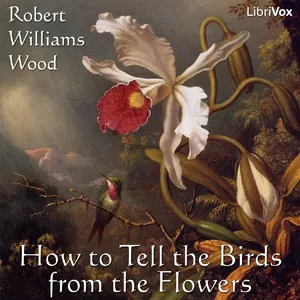
How to Tell the Birds from the Flowers, a Manual of Flornithology for Beginners. Verses and Illustrations by Robert Williams Wood.
The Bird and the Burdock. Who is there who has never heard about the burdock and the bird? And yet how very, very few discriminate between the two. Well, even Mr. Burbank can't transform a bird into a plant.
The Clover. The Plover. The Plover and the Clover can be told apart with ease, by paying close attention to the habits of the bees. For entomologists aver, the bee can be in clover, while etymologists concur there is no bee in plover.
The crow, the crocus. Some are unable, as you know, to tell the crocus from the crow. The reason why is just because they are not versed in nature's laws. The noisy, cawing crows all come, obedient to the crow custom. A large crow caucous to convoke, you never hear the crocus croak.
The roo, the rooster. Of rooster the rudiment clearly is roo. and the bird from the plant where you probably grew. You can easily tell them apart without fail by merely observing the roolux detail.
The Parrot. The Carrot. The Parrot and the Carrot we may easily confound. They are very much alike in looks and similar in sound. We recognize the Parrot by its clear articulation, for carrots are unable to engage in conversation.
The Pee. The Peewee. To tell the pee-wee from the pee requires great perspicacity. Here in the pod we see the pee, while perched close by is the pee-wee. The pee he hears the pee-wee peep, while pee-wee sees the wee pee-weep. There'll be but little time to see how pee-wee differs from the pee.
The Pelican, The Panicle. The Panicle and Pelican have often been confused. The letters which spell pelican in panicle are used. You never need confound the two. There are many ways of telling. The simplest thing that one can do is to observe the spelling.
The hen. The lichen. The lichens lie on rocks and bark. They look somewhat like hens. Hensley. They lie, we may remark. A difference of tense.
The hawk. The hollyhock. To recognize this bird of prey, the broody hen you should survey. She takes her chicks on daily walks among the neighboring hollyhocks, while with the hawk association is quite beyond her toleration.
The cowbird, the cowslip, growing in myers and gold attired, the cowslip has been much admired. Although its proper name, we're told, is really the marsh marigold, The cowboy picture, I suspect, is absolutely incorrect. We make such errors now and then, a sort of cowslip off the pen.
Asparro. Asparagus. The sparrow, from flying, is quite out of breath. In fact, he has worked himself almost to death, while the lazy asparagus, so it is said, spends all of his time in the asparagus bed.
The turn. The turnip. To tell the turnip from the turn, A thing which every one should learn. Observe the turnip in the air, see how he turns, and now compare. Him with this inert vegetable, who does to turn is quite unable, for he is rooted to the spot, while, as we see, the turn is not. He is not always doomed to be, this bound to earth eternally, for cooked to a turn may be inferred, to change the turnip to the bird. Observe the turnip in the pot, The turn is glad that he is not.
The old gander, the oleander. The gander loves to promenade around the farmer's poultry-yard, while, as we see, the oleander is quite unable to meander.
The Blue Mountain Lorrie, the Blue Morning Glory. The Blue Mountain Lorrie spends most of his time in climbing about in a tropical clime. We therefore our efforts need only confine to minutely observing the clime of the vine.
The Quail, The Kale. The California quail is said to have a tail upon his head, while contrarywise we style the kale, a cabbage-head, upon a tail. It is not hard to tell the two. The quail commences with a cue.
The Pican, The Toucan. Very few can tell the toucan from the pecan. Here's a new plan. To take the toucan from the tree requires immense agility. Well, anyone can pick with ease the pecans from the pecan trees. It's such an easy thing to do that even the toucan he can too.
The oak, the orchid. We saw the meat when out to walk, either the orchid or the oak. The oak, indeed, is only known to dwellers in the Arctic zone. While orchids can be found in legions within the equatorial regions, the graceful orchid on its stalk resembles so the awkward auk. Tis plain we must some means discover to tell the two from one another. The obvious difference, to be sure, is merely one of temperature. For Eskimos, perhaps the auk performs the duties of the stork.
The Catbird? The catnip. The catbird's call resembles that emitted by the pussycat, while catnip growing by the wall is never known to caterwall. Its odor, though, attracts the kits and throws them in catniption fits.
The Ibis, the Ibiscus. The sacred Ibis tells his beads, and gravely from his prayer-book reads. The Ibis, therefore, we may say, Is classified a bird of prey. Hibiscus we have heard related. The crimson eye is designated. Their difference is plain indeed. The flower is red. The bird can read.
The butterball, the buttercup. The little buttercup can sing, from morn till night, like anything. The quacking of the butterball cannot be called a song at all. Read this the flower may learn to know. Its song is reproduced below.
The Bay, the Jay. The blue jay, as we plainly see, resembles much the green bay tree. The difference between the two is obviously one of you, though this is not the only way To tell the blue jay from the bay.
The Pipe. The Snipe. Observe the common Indian pipe, likewise the hybrid English snipe, who is distinguished, as we see, by his superior pedigree.
The Rock. The Shamrock. Observe how peacefully the cows among the little Shamrock sprouts, in contrast with the reactions frantic when they perceive the rock gigantic. We need but watch their occupation, and seek no other explanation.
The Lark. The Larkspur. The Larkspur's likeness to the Lark is surely worthy of remark, although to see it we require the aid of a small magnifier, which circumstance, of course, implies their difference is one of size.
Puffin. Nuffin. Upon this cake of ice is perched The paddle-footed puffin, to find his double we have searched, but have discovered nothing.
Other's Apology Not everyone is always able to recognize a vegetable, for some are guided by tradition, while others use their intuition. And even I make no pretence of having more than common sense. Indeed, these strange homologies are in most flornitologies, and I have freely drawn upon The works of Gray and Audubon, avoiding though the frequent blunders of those who study nature's wonders.
End of How to Tell the Birds from the Flowers by Robert Williams Wood.