
Chapters 30
-
1 01 - Part First - Part 1 27:53
Trilby.
But my pincean est une blonde, une blonde que l'on connaît. Elle n'a qu'une robe au monde, l'ondeur irête et qu'un bonnet.
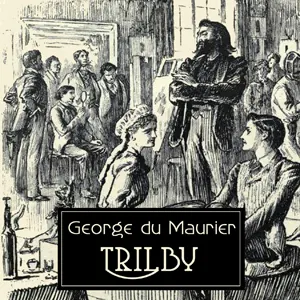
It was a fine, sunny, showery day in April. The big studio window was open at the top, and let in a pleasant breeze from the northwest. Things were beginning to look shipshape at last. The big piano, a semi-grand by Broadwood, had arrived from England by the little quickness, la petite vitesse, as the goods trains are called in France, and lay, freshly tuned, alongside the eastern wall. On the wall opposite was a panoply of foils, masks, and boxing-gloves. A trapeze, a knotted rope, and two parallel cords, supporting each a ring, depended from a huge beam in the ceiling. The walls were of the usual dull red, relieved by plaster casts of arms and legs and hands and feet, and Dante's mask, and Michelangelo's alto rilievo of Lida and the Swan, and a centaur and Lapith from the Elgin marbles.
On none of these had the dust as yet had time to settle. There were also studies in oil from the nude, copies of Titian, Rembrandt, Velasquez, Rubens, Tintoret, Leonardo da Vinci, None of the school of Botticelli, Mantegna, and Co., a firm whose merits had not as yet been revealed to the many. Along the walls, at a great height, ran a broad shelf, on which were other casts in plaster, terra-cotta imitation bronze. A little Theseus, a little Venus of Milo, a little Descobulus, a little flayed man threatening high heaven, An act that seemed almost pardonable under the circumstances. A lion and a boar by Barry, an anatomical figure of a horse, with only one leg left and no ears, a horse's head from the pediment of the Parthinan, eardus also, and the bust of Clichy, with her beautiful low brow, her sweet, wan gaze, and the ineffable forward shrug of her dear shoulders, That makes her bosom as a nest, a rest, a pillow, a refuge, the likeness of a thing to be loved and desired forever, and sought for and wrought for and fought for, by generation after generation of the sons of men.
Near the stove hung a gridiron, a frying-pan, a toasting-fork, and a pair of bellows. In an adjoining glazed-corner cupboard were plates and glasses, black-handled knives, pewter-spoons, and three-pronged steel forks, a salad bowl, vinegar cruets, an oil-flask, two mustard pots, English and French, and such like things, all scrupulously clean. On the floor, which had been stained and waxed at considerable cost, Lay two cheetah-skins, and a large Persian praying-rug. One-half of it, however, under the trapeze, and at the end farthest from the window, beyond the model throne, was covered with coarse matting, that one might fence or box without slipping down, and splitting oneself in two, or fall without breaking any bones.
Two other windows of the usual French size and pattern, With shutters to them and heavy curtains of bays, opened east and west, to let in dawn or sunset, as the case might be, or haply keep them out. And there were alcoves, recesses, irregularities, odd little nooks and corners, to be filled up as time wore on, with endless personal knick-knacks, bibelots, private properties, and acquisitions. Things that make a place genial, home-like, and good to remember, and sweet to muse upon, with fond regret, in after years. And an immense divan spread itself in width and length and delightful thickness just beneath the big north window, the business window. A divan so immense that three well-fed, well-contented Englishmen could all lie lazily smoking their pipes on it at once, without being in each other's way, and very often did.
At present, one of these Englishmen, a Yorkshire man, by the way, called Taffy, and also the Man of Blood, because he was supposed to be distantly related to a baronet, was more energetically engaged. Bare-armed, in his shirt and trousers, he was twirling a pair of Indian clubs round his head. His face was flushed, and he was perspiring freely and looked fierce. He was a very big young man, fair, with kind but choleric blue eyes, and the muscles of his brawny arm were strong as iron bands. For three years he had borne Her Majesty's commission, and had been through the Crimean campaign without a scratch. He would have been one of the famous six hundred in the famous charge at Balaclava, but for a sprained ankle, caught playing leap-frog in the trenches, which kept him in hospital on that momentous day.
So that he lost his chance of glory or the grave, and this humiliating misadventure had sickened him of soldiering for life. And he never quite got over it. Then, feeling within himself an irresistible vocation for art, he had sold out, and here he was in Paris, hard at work, as we see. He was good-looking, with straight features, but I regret to say that, besides his heavy, plungous moustache, he wore an immense pair of drooping auburn whiskers. Of the kind that used to be called Piccadilly-weepers, and were afterwards affected by Mr. Southern in Lord Dundreary. It was a fashion to do so, then, for such of a gilded youth as could afford the time and the hair. The bigger and fairer the whiskers, the more beautiful was thought the youth.
It seems incredible in these days, when even Her Majesty's household brigade—the Go about with smooth cheeks and lips, like priests or play-actors. What's become of all the gold used to hang and brush their bosoms?
Another inmate of this blissful abode, Sandy, the lad of Cockpen, as he was called, sat in similarly simple attire at his easel. Painting at a lifelike little picture of a Spanish Toreador serenading a lady of high degree in broad daylight. He had never been to Spain, but he had a complete Toreador's kit, a bargain which he had picked up for a mere song in the Boulevard du Temple, and he had hired the guitar. His pipe was in his mouth, reversed, for it had gone out. And the ashes were spilled all over his trousers, where holes were often burned in this way. Quite graciously, and with a pleasing Scotch accent, he began to declaim, A street there is in Paris famous, For which no rhyme our language yields.
Rue neuf, thy pitty shong its naimes, The new street of the little fields. And then, in his keen appreciation of the immortal stanza, he chuckled audibly, with a face so blithe and merry, and well pleased, that it did one good to look at him. He also had entered life by another door. His parents, good pious people in Dundee, had intended that he should be a solicitor, as his father and grandfather had been before him. And here he was in Paris famous, painting toreadors and spouting the ballad of the bouillabaisse, as he would often do out of sheer lightness of heart, much oftener indeed than he would say his prayers. Kneeling on the divan, with his elbow on the window-sill, was a third and much younger youth.
The third he was, little Billy. He had pulled down the green bays-blind, And was looking over the roofs and chimney-pots of Paris, and all about with all his eyes, munching the while a roll and a savory servaloe, in which there was evidence of much garlic. He ate with great relish, for he was very hungry. He had been all the morning at Carell's studio, drawing from the life. Little Billy was small and slender, about twenty or twenty-one, And had a straight white forehead, veined with blue, large dark-blue eyes, delicate regular features, and coal-black hair. He was also very graceful and well-built, with very small hands and feet, and much better dressed than his friends, who went out of their way to outdo the denizens of the quartier latin in careless eccentricity of garb, and succeeded.
And in his winning and handsome face there was just a faint suggestion of some possible, very remote Jewish ancestor. Just a tinge of that strong, sturdy, irrepressible, indomitable, indelible blood, which is of such priceless value in diluted, homoeopathic doses. Like the dry white Spanish wine called Montijo, which is not meant to be taken pure. But without a judicious admixture of which, no sherry can go round the world and keep its flavour intact. Or like the famous Bulldog strain, which is not beautiful in itself, and yet just for lacking a little of the same, no greyhound can ever hope to be a champion. So at least I have been told by wine-merchants and dog-fanciers, the most veracious persons that can be.
Fortunately for the world, and especially for ourselves, most of us have in our veins at least a minim of that precious fluid, whether we know it or show it or not. Tant pis pour les autres. As little Billy munched, he also gazed at the busy place below, the Place Saint-Anatole-des-Arts, at the old houses opposite, some of which were being pulled down. No doubt lest they should fall of their own sweet will. In the gaps between he would see discolored old cracked dingy walls, with mysterious windows and rusty iron balconies of great antiquity, sights that set him dreaming dreams of medieval French love and wickedness and crime, bygone mysteries of Paris. One gap went right through the block, and gave him a glimpse of the river, the Cite, and the ominous Old Morgue.
A little to the right rose the great towers of Notre-Dame de Paris into the chequered April sky. Indeed, the top of nearly all Paris lay before him, with a little stretch of the imagination on his part, and he gazed with a sense of novelty, An interest and a pleasure for which he could not have found any expression in mere language. Paris, Paris, Paris. The very name had always been one to conjure with. Whether he thought of it as a mere sound on the lips and in the ear, or as a magical written or printed word for the eye. And here was the thing itself at last. And he... He himself ipsissimus, in the very heart of it, to live there and learn there as long as he liked, and make himself the great artist he longed to be.
Then, his meal finished, he lit a pipe, and flung himself on the divan and sighed deeply, out of the overfull contentment of his heart. He felt he had never known happiness like this, never even dreamed its possibility. And yet his life had been a happy one. He was young and tender, was little Billy. He had never been to any school, and was innocent of the world and its wicked ways, innocent of French, especially, and the ways of Paris and its Latin quarter. He had been brought up and educated at home, had spent his boyhood in London with his mother and sister, who now lived in Devonshire on somewhat straitened means. His father, who was dead, had been a clerk in the Treasury. He and his two friends, Taffy and the lad, had taken this studio together.
The lad slept there, in a small bedroom of the studio. Taffy had a bedroom at the Hotel de Sème, in the street of that name. Little Billy lodged at the Hotel Corneille, in the Place de l'Odion. He looked at his two friends, and wondered if any one, living or dead, had ever had such a glorious pair of chums as these. Whatever they did, whatever they said, was simply perfect in his eyes. They were his guides and philosophers as well as his chums. On the other hand, Taffy and the lad were as fond of the boy as they could be. His absolute belief in all they said and did touched them, nonetheless that they were conscious of its being somewhat in excess of their deserts. His almost girlish purity of mind amused and charmed them, and they did all they could to preserve it, even in the quartier latin, where purity is apt to go bad, if it be kept too long.
They loved him for his affectionate disposition, his lively and caressing ways, and they admired him far more than he ever knew. For they recognized in him a quickness, a keenness, a delicacy of perception, in matters of form and color, a mysterious facility and felicity of execution, a sense of all that was sweet and beautiful in nature, and a ready power of expressing it, that had not been vouchsafed to them in any such generous profusion. And which, as they ungrudgingly admitted to themselves and each other, amounted to true genius. And when one within the immediate circle of our intimates is gifted in this abnormal fashion, we either hate or love him for it, in proportion to the greatness of his gift, according to the way we are built.
So Taffy and the lad loved little Billy. Loved him very much indeed. Not but what little Billy had his faults. For instance, he didn't interest himself very warmly in other people's pictures. He didn't seem to care for the lad's guitar-playing Toreador, nor for his serenaded lady. At all events, he never said anything about them, either in praise or blame. He looked at Taffy's realisms, For Taffy was a realist, in silence, and nothing tries true friendship so much as silence of this kind. But then, to make up for it, when they all three went to the Louvre, he didn't seem to trouble much about Titian either, or Rembrandt, or Velasquez, Rubens, Veronese, or Leonardo. He looked at the people who looked at the pictures, Instead of at the pictures themselves, especially at the people who copied them, the sometimes charming young lady-painters.
And these seemed to him even more charming than they really were. And he looked a great deal out of the Louvre windows, where there was much to be seen, more Paris, for instance, Paris, of which he could never have enough. But when, surfeited with classical beauty, they all three went and dined together, and Taffy and the lad said beautiful things about the old masters, and quarrelled about them, he listened with deference and rapt attention, and reverentially agreed with all they said, and afterwards made the most delightfully funny little pen-and-ink sketches of them, saying all these beautiful things. which he sent to his mother and sister at home. So life-like, so real, that you could almost hear the beautiful things they said, so beautifully drawn that you felt the old masters couldn't have drawn them better themselves, and so irresistibly drawn that you felt that the old masters could not have drawn them at all, any more than Milton could have described the quarrel between Sayrie Gamp and Betsy Prigg, No one, in short, but Little Billy.
Little Billy took up the ballad of the bouillabaisse where the lad had left it off, and speculated on the future of himself and his friends, when he should have got to forty years, an almost impossibly remote future. These speculations were interrupted by a loud knock at the door, and two men came in. First, a tall, bony individual of any age between thirty and forty-five, of Jewish aspect, well-featured but sinister. He was very shabby and dirty, and wore a red beret and a large velveteen cloak, with a big metal clasp at the collar. His thick, heavy, languid, lustreless black hair fell down behind his ears on to his shoulders, In that musician-like way that is so offensive to the normal Englishman.
He had bold, brilliant black eyes, with long, heavy lids, a thin, sallow face, and a beard of burnt-up black, which grew almost from under his eyelids. And over it his moustache, a shade lighter, fell in two long spiral twists. He went by the name of Svengali. And spoke fluent French with a German accent, and humorous German twists and idioms, and his voice was very thin and mean and harsh, and often broke into a disagreeable falsetto. His companion was a little swarthy young man, a gipsy possibly, much pitied with a small-pox, and also very shabby. He had large, soft, affectionate brown eyes, like a King Charles' Spaniel. He had small, nervous, veiny hands, with nails bitten down to the quick, and carried a fiddle and a fiddlestick under his arm, without a case, as though he had been playing in the street.
"'Ponchour, mes enfants,' said Svengali. Je vous amène mon ami Gekko, qui joue du violon comme un hanche. Little Billy, who adored all sweet musicians, jumped up and made Gekko as warmly welcome as he could in his early French. Ha! Le piano! exclaimed Zvengali, flinging his red beret on it and his cloak on the ground. J'espère qu'il est pas. Et pient-accord? And sitting down on the music-stool, he ran up and down the scales with that easy power, that smooth, even crispness of touch which reveal the master. Then he fell to playing Chopin's Impromptu in A-flat so beautifully that little Billy's heart went nigh to bursting with suppressed emotion and delight. He had never heard any music of Chopin's before, nothing but British provincial home-made music melodies with variations.
Annie Laurie, the last rose of summer, the blue bells of Scotland, innocent little motherly and sisterly tinklings, invented to set the company at their ease on festive evenings, and make all-round conversation possible for shy people. Who fear the unaccompanied sound of their own voices, and whose genial chatter always leaves off directly the music ceases. He never forgot that impromptu, which he was destined to hear again one day in strange circumstances.
Then Svengali and Gekot made music together, divinely, little fragmentary things, Sometimes consisting of but a few bars, but these bars of such beauty and meaning. Scraps, snatches, short melodies, meant to fetch, to charm immediately, or to melt, or sadden, or madden, just for a moment, and that knew just when to leave off. Chardash, gipsy dances, hungarian love-plains. Things little known out of Eastern Europe in the fifties of this century, till the Laird and Taffy were almost as wild in their enthusiasm as Little Billy, a silent enthusiasm too deep for speech.
And when these two great artists left off to smoke, the three Britishers were too much moved even for that, and there was a stillness.
Suddenly there came a loud knuckle-rapping at the outer door, and a portentous voice of great volume, and that might almost have belonged to any sex, even an angel's, uttered the British milkman's yodel. Milk below! And before anyone could say entre, a strange figure appeared, framed by the gloom of the little ante-chamber. It was the figure of a very tall and fully developed young female, clad in the grey overcoat of a French infantry soldier, continued netherwards by a short striped petticoat, beneath which were visible her bare white ankles and insteps, and slim, straight, rosy heels, clean-cut and smooth as the back of a razor. Her toes lost themselves in a huge pair of male slippers, which made her drag her feet as she walked.
She bore herself with easy, unembarrassed grace, like a person whose nerves and muscles are well in tune, whose spirits are high, who has lived much in the atmosphere of French studios, and feels at home in it. This strange medley of garments was surmounted by a small bare head with short, thick, wavy brown hair, and a very healthy young face, which could scarcely be called quite beautiful at first sight, since the eyes were too wide apart, the mouth too large, the chin too massive, the complexion a mass of freckles. Besides, you can never tell how beautiful Or, how ugly a face may be, till you have tried to draw it. But a small portion of her neck, down by the collar-bone, which just showed itself between the unbuttoned lapels of her military coat-collar, was of a delicate, privet-like whiteness that is never to be found on any French neck, and a very few English ones.
Also, she had a very fine brow. Broad and low, with thick, level eyebrows, much darker than her hair. A broad, bony, high bridge to her short nose, and her full, broad cheeks were beautifully modeled. She would have made a singularly handsome boy.
-
2 02 - Part First - Part 2 28:31
Trilby by George du Maurier.
As the creature looked round at the assembled company, and flashed her big white teeth at them in an all-embracing smile of uncommon width and quite irresistible sweetness, simplicity, and friendly trust, one saw at a glance that she was out of the common clever, simple, humorous, honest, brave, and kind, and accustomed to be genially welcomed wherever she went. Then suddenly closing the door behind her, dropping her smile, and looking wistful and sweet, with her head on one side and her arms akimbo, you're all English now, aren't ye? she exclaimed. I heard the music, and I thought I'd just come in for a bit, and pass the time of day. You don't mind? Trilby, that's my name, Trilby O'Farrell. She said this in English with an accent half Scotch and certain French intonations, and in a voice so rich and deep and full as almost to suggest an incipient tenore robusto.
And one felt instinctively that it was a real pity she wasn't a boy. She would have made such a jolly one. "'We're delighted, on the contrary,' said little Billy. and advanced a chair for her. But she said, "'Oh, don't mind me. Go on with the music,' and set herself down, cross-legged, on the model throne near the piano. As they still looked at her, curious and half-embarrassed, she pulled a paper parcel containing food out of one of the coat-pockets, and exclaimed, "'I'll just take a bite, if you don't object.' I'm a model, you know, and it's just rung twelve. The rest... I'm posing for Durien, the sculptor, on the next floor. I pose to him for the altogether. The altogether? asked little Billy.
Yes, l'ensemble, you know. Head, hands, and feet, everything, especially feet. That's my foot, she said. kicking off her big slipper and stretching out the limb. "'It's the handsomest foot in all Paris. There's only one in all Paris to match it, and here it is.' And she laughed heartily, like a merry peal of bells, and stuck out the other. And in truth they were astonishingly beautiful feet, such as one only sees in pictures and statues, A true inspiration of shape and color, all made up of delicate lengths and subtly modulated curves and noble straightness and happy little dimpled arrangements in innocent young pink and white. So that little Billy, who had the quick, prehensile, aesthetic eye, and knew by the grace of heaven what the shapes and sizes and colors of almost every bit of man, woman, or child should be, and so seldom are, was quite bewildered to find that a real, bare, live human foot could be such a charming object to look at, and felt that such a base or pedestal lent quite an antique and Olympian dignity to a figure that seemed just then rather grotesque, in its mixed attire of military overcoat and female petticoat, and nothing else.
Poor Trilby. The shape of those lovely slender feet, that were neither large nor small, facsimiled in dusty, pale plaster of Paris, survives on the shelves and walls of many a studio throughout the world, And many a sculptor yet unborn has yet to marvel at their strange perfection in studious despair. For when Dame Nature takes it into her head to do her very best, and bestow her minutest attention on a mere detail, as happens now and then, once in a blue moon, perhaps, she makes it uphill work for poor human art to keep pace with her. It is a wondrous thing, the human foot, like the human hand, even more so, perhaps. But unlike the hand, with which we are so familiar, it is seldom a thing of beauty in civilized adults who go about in leather boots or shoes, so that it is hidden away in disgrace, a thing to be thrust out of sight and forgotten.
It can sometimes be very ugly indeed, the ugliest thing there is, even in the fairest and highest and most gifted of her sex. And then it is of an ugliness to chill and kill romance, and scatter love's young dream, and almost break the heart. And all for the sake of a high heel, and a ridiculously pointed toe. Mean things at the best. Conversely, when Mother Nature has taken extra pains in the building of it, and proper care, or happy chance, has kept it free of lamentable deformations, indurations, and discolorations, all those gruesome, boot-begotten abominations which have made it so generally unpopular, the sudden sight of it, uncovered, comes as a very rare and singularly pleasing surprise, To the eye that has learned how to see.
Nothing else that Mother Nature has to show, not even the human face divine, has more subtle power to suggest high physical distinction, happy evolution, and supreme development, the lordship of man over beast, the lordship of man over man, the lordship of woman over all. En voila de l'Ilocence. A propos de bottes.
Trilby had respected Mother Nature's special gift to herself, had never worn a leather-boot or shoe, had always taken as much care of her feet as many a fine lady takes of her hands. It was her one coquetry, the only real vanity she had. Jekko, his fiddle in one hand and his bow in the other, stared at her in open-mouthed admiration and delight, as she ate her sandwich of soldiers bread and fromage a la crme, quite unconcerned. When she had finished, she licked the tips of her fingers clean of cheese, and produced a small tobacco-pouch from another military pocket, made herself a cigarette, and lit it and smoked it. Inhaling the smoke in large whiffs, filling her lungs with it, and sending it back through her nostrils with a look of great beatitude.
Svengali played Schubert's Rosamonde, and flashed a pair of languishing black eyes at her with intent to kill. But she didn't even look his way. She looked at little Billy, at Big Taffy, At the lad, at the casts and studies, at the sky, the chimney-pots over the way, the towers of Notre-Dame, just visible from where she sat. Only when he finished, she exclaimed, «My eye! C'est rudement bien tapé, cette musique là. Ce mont c'est pas gai, vous savez. Comment ça s'appelle? » It is called the Rosamund of Schubert, mademoiselle. replied Svengali. I will translate. "'And what's that, Rosamond?' said she. "'Rosamond was a princess of Cyprus, mademoiselle, and Cyprus is an island.' "'Ah, and Schubert, then, where's that?' "'Schubert is not an island, mademoiselle.
Schubert was a compatriot of mine, and made music, and played the piano.' Just like me. Ah! Schubat was a monsieur, then. Don't know him. Never heard his name. That's a pity, mademoiselle. He had some talent. You like this better, perhaps. And he strummed. Messieurs les étudiants s'en vont à la chaumière pour y danser le cancan. Striking wrong notes and banging out a key. A hideously grotesque performance. "'Yes, I like that better. It's gayer, you know. Is that also composed by a compatriot of yours?' asked the lady. "'Heaven forbid, mademoiselle!' And the laugh was against Svengali.
But the real fun of it all, if there was any, lay in the fact that she was perfectly sincere. "'Are you fond of music?' asked Little Billy. "'Oh, ain't I just?' she replied. "'My father sang like a bird. He was a gentleman and a scholar, my father was. His name was Patrick Michael O'Farrell, fellow of Trinity, Cambridge. He used to sing Ben Bolt. Do you know Ben Bolt?' "'Oh, yes, I know it well,' said Little Billy. "'It's a very pretty song.' "'I can sing it,' said Miss O'Farrell. "'Shall I?' "'Oh, certainly, if you will be so kind.' Miss O'Farrell threw away the end of her cigarette, put her hands on her knees as she sat cross-legged on the model throne, and, sticking her elbows well out, she looked up to the ceiling with a tender, sentimental smile, and sang the touching song.
Oh, don't you remember sweet Alice, Ben Bolt? Sweet Alice, with hair so brown? C. C.
As some things are too sad and too deep for tears, so some things are too grotesque and too funny for laughter. Of such a kind was Miss O'Farrell's performance of Ben Bolt. From that capacious mouth and through that high-bridged bony nose there rolled a volume of breathy sound, not loud, but so immense that it seemed to come from all round, to be reverberated from every surface in the studio. She followed, more or less, the shape of the tune, going up when it rose and down when it fell, but with such immense intervals between the notes as were never dreamed of in any mortal melody. It was as though she could never once have deviated into tune, never once have hit upon a true note, even by a fluke.
In fact, as though she was absolutely tone-deaf, and without ear, although she stuck to the time correctly enough. She finished her song amid an embarrassing silence. The audience didn't quite know whether it were meant for fun or seriously. One wondered if she were not paying out Svengali for his impertinent performance of Monsieur Les Estudiens. If so, it was a capital piece of impromptu tit-for-tat admirably acted. And a very ugly gleam yellowed the tawny black of Svengali's big eyes. He was so fond of making fun of others that he particularly resented being made fun of himself, couldn't endure that anyone should ever have the laugh of him.
At length, little Billy said, "'Thank you so much. It's a capital song.' "'Yes!' said Miss O'Farrell. It's the only song I know, unfortunately. My father used to sing it, just like that, when he felt jolly after hot rum and water. It used to make people cry. He used to cry over it himself. I never do. Some people think I can't sing a bit. All I can say is that I've often had to sing it six or seven times running, in lots of studios. I vary it, you know. Not the words, but the tune. You must remember that I've only taken to it lately. Do you know Litof? Well, he's a great composer, and he came to Durian's the other day, and I sang Ben Bolt, and—what do you think he said? Why, he said, Madame Alboni couldn't go nearly so high or so low as I did, and that her voice wasn't half so big.
He gave me his word of honor. He said I breathed as natural and straight as a baby, and all I want is to get my voice a little more under control. That's what he said. "'Qu'est-ce qu'elle dit?' asked Svengali. And she said it all over again to him in French, quite French-French, of the most colloquial kind. Her accent was not that of the Comdie Francaise, Nor yet that of the Faubourg Saint-Germain, nor yet that of the shop or the pavement. It was quaint and expressive, funny without being vulgar. Parpleu! He was right, Littolphe, said Zwingali. I assure you, Mademoiselle, that I have never heard a voice that can equal yours. You have a talent quite exceptional. She blushed with pleasure, and the others thought him a beastly cad for poking fun at the poor girl in such a way, and they thought Monsieur Litolphe another.
She then got up and shook the crumbs of her coat, and slipped her feet into Durien's slippers, saying in English, Well, I've got to go back. Life ain't all beer and skittles, and more's the pity. But what's the odds, so long as you're happy? On her way out, she stopped before Taffy's picture. A chiffonier with his lantern bending over a dust-heap. For Taffy was, or thought himself, a passionate realist in those days. He has changed. And now paints nothing but King Arthur's, and Guinevere's, and Lancelot's, and Elaine's, and floating ladies of Chalet.
That Schiffenier's basket isn't hitched high enough, she remarked. How could he tap his pick against the rim, and make the rag fall into it, if it's hitched only halfway up his back? And he's got the wrong sabots, and the wrong lantern. "'It's all wrong.' "'Dear me,' said Taffy, turning very red, "'you seem to know a lot about it. It's a pity you don't paint yourself.' "'Ah! Now you're cross,' said Miss O'Farrell. "'Oh, my, I!' She went to the door and paused, looking round benignly. "'What nice teeth you've all three got!' That's because you're Englishmen, I suppose, and clean them twice a day. I do, too. Trilby O'Farrell, that's my name, Forty-eight, rue des Pousscailloux, pose pour l'ensemble quand on se l'amuse.
Va-t'enville et fais tout ce qui concerne son état. Don't forget. Thanks all, and good-bye. En v'la une originale, said Zvengali. "'I think she's lovely,' said little Billy, the young and tender. "'Oh, heavens, what angels' feet! It makes me sick to think she sits for the figure. I'm sure she's quite a lady.' And in five minutes or so, with the point of an old compass, he scratched in white on the dark-red wall a three-quarter profile outline of Trilby's left foot, which was perhaps the more perfect poem of the two. Slight as it was, this little piece of impromptu etching, in its sense of beauty, in its quick-ceasing of a peculiar individuality, its subtle rendering of a strongly received impression, was already the work of a master.
It was Trilby's foot, and nobody else's, nor could have been. And nobody else but little Billy could have drawn it in just that inspired way. Qu'est-ce que c'est, Ben Bolt? inquired Dzeko, upon which little Billy was made by Taffy to sit down to the piano and sing it. He sang it very nicely with his pleasant little throaty English baritone. It was solely in order that little Billy should have opportunities of practicing this graceful accomplishment of his, for his own and his friend's delectation, that the piano had been sent over from London, at great cost to Taffy and the lad. It had belonged to Taffy's mother, who was dead. Before he had finished the second verse, Svengali exclaimed, Mais c'est tout a fait chantilly.
Allons, GECO, chouez nous ça. And he put his big hands on the piano over little Billy's, pushed him off the music-stool with his great gaunt body, and, sitting on it himself, he played a masterly prelude. It was impressive to hear the complicated richness and volume of the sounds he evoked, After little Billy's gentle tink-a-tink. And Jekko, cuddling lovingly his violin and closing his upturned eyes, played that simple melody as it had probably never been played before. Such passion, such pathos, such a tone. And they turned it and twisted it, and went from one key to another, playing into each other's hands. Zvengali taking the lead. And fugued, and cannoned, and counterpointed, and battle-dawed, and shuttlecocked it, high and low, soft and loud, in minor, in pizzicato, and in sordino, adagio, andante, allegretto, scherzo, and exhausted all its possibilities of beauty, till their susceptible audience of three was all but crazed with delight and wonder.
And the masterful Ben Bolt, and his over-tender Alice, and his too-submissive friend, and his old schoolmaster, so kind and so true, and his long-dead schoolmates, and the rustic porch, and the mill, and the slab of granite so gray. And the dear little nook by the clear running brook were all magnified into a strange, almost holy, poetic dignity, And splendor quite undreamed of by whoever wrote the words and music of that unsophisticated little song, which has touched so many simple British hearts that don't know any better, and among them, once, that of the present scribe, long, long ago. Sacre pleut, il choue bien, le chico, eh? said Svengali, when they had brought this wonderful double improvisation to a climax and a close.
C'est mon élève. Je le fais chanter sur son violon. C'est comme si c'était moi qui chantais. Ah, si j'avais pour deux sous de voix, je serais le premier chanteur du monde. I cannot sing, he continued. I will translate him into English without attempting to translate his accent, which is a mere matter of judiciously transposing P's and B's and T's and D's and F's and G's and K's, and turning the soft French J into SH, and a pretty language into an ugly one. I cannot sing myself, I cannot play the violin, but I can teach. Hein, chico? And I have a pupil. Hein, chico? La petite honone? And here he leered all around with a leer that was not engaging. The world shall hear of la petite honorine some day.
Hein, chico? Listen all. This is how I teach la petite honorine. Play me a little accompaniment in pizzicato. And he pulled out of his pocket a kind of little flexible flageolet, of his own invention, it seems, which he screwed together and put it to his lips. And on this humble instrument he played Ben Boldt, while Jekko accompanied him, using his fiddle as a guitar, His adoring eyes fixed in reverence on his master. And it would be impossible to render in any words the deftness, the distinction, the grace, power, pathos, and passion with which this truly phenomenal artist executed the poor old tuppenny tune on his elastic penny whistle. For it was little more. Such thrilling, vibrating, piercing tenderness, now loud and full, a shrill scream of anguish, now soft as a whisper, a mere melodic breath, more human almost than the human voice itself.
A perfection, unattainable even by Jekko, a master, on an instrument which is the acknowledged king of all. So that the tear, which had been so close to the brink of little Billy's eye while Jekko was playing, Now rose and trembled under his eyelid, and spilled itself down his nose. And he had to dissemble, and surreptitiously mop it up with his little finger, as he leaned his chin on his hand, and cough a little husky, unnatural cough, pour se donner une contenance. He had never heard such music as this, never dreamed such music was possible. He was conscious, while it lasted, that he saw deeper into the beauty, the sadness of things, the very heart of them, and their pathetic evanescence, as with the new inner eye, even into eternity itself, beyond the veil.
A vague cosmic vision that faded when the music was over, but left an unfading reminiscence of its having been, And a passionate desire to express the like some day through the plastic medium of his own beautiful art.
When Zwingali ended, he leered again on his dumb-struck audience, and said, That is how I teach La Bedite Honorine to sing. That is how I teach Dzeko to play. That is how I teach Il Bel Canto. It was lost, the bel canto, but I found it in a dream. I and nobody else. I, Zwingali, I, I, I! But that is enough of music. Let us play at something else. Let us play at this! he cried, jumping up and seizing a foil and bending it against the wall. "'Come along, little Billy, and I will show you something more you don't know.' So little Billy took off coat and waistcoat, donned mask and glove and fencing-shoes, and they had an assault of arms, as it is nobly called in French, and in which poor little Billy came off very badly.
The German Pole fenced wildly, but well. Then it was the lard's turn, and he came off badly too. So then Taffy took up the foil and redeemed the honor of Great Britain, as became a British Housa and a man of blood. For Taffy, by long and assiduous practice in the best school in Paris, and also by virtue of his native aptitudes, was a match for any maitre d'arme in the whole French army. And Svengali got what for. And when it was time to give up play and settle down to work, others dropped in. French, English, Swiss, German, American, Greek. Curtains were drawn and shutters opened. The studio was flooded with light, and the afternoon was healthily spent in athletic and gymnastic exercises till dinner-time.
But little Billy, who had had enough of fencing and gymnastics for the day, amused himself by filling up with black and white and red chalk strokes the outline of Trilby's foot on the wall. Lest he should forget his fresh vision of it, which was still to him as the thing itself. An absolute reality, born of a mere glance, a mere chance, A happy caprice.
-
3 03 - Part First - Part 3 22:50
Durien came in and looked over his shoulder. and exclaimed, Tiens, le pied de Trilby ? Vous avez fait ça d'après nature ? Non. De mémoire, alors ? Oui. Je vous en fais mon compliment. Vous avez eu la main heureuse. Je voudrais bien avoir fait ça, moi. C'est un petit chef-d'œuvre que vous avez fait là, tout bonnement, mon cher. Mais vous élaborez trop. De grâce, n'y touchez plus. And little Billy was pleased, and touched it no more, for Durien was a great sculptor and sincerity itself. And then, well, I happened to forget what sort of day this particular day turned into at about six of the clock. If it was decently fine... The most of them went off to dine at the Restaurant de la Couronne, kept by Pertrin, in the Rue de Monsieur, who gave you of his best to eat and drink for twenty Sol Parisie, or one franc in the coin of the Empire.
Good distending soups, omelettes that were only too savory, lentils, red and white beans, meat so dressed and sourced and seasoned, That you didn't know whether it was beef or mutton, flesh, fowl, or good red herring, or even bad, for that matter, nor very greatly cared. And just the same lettuce, radishes, and cheese, of gruyre or brie, as you got at the Trois-Fres Provenceaux, but not the same butter. And to wash it all down, generous wine in wooden bross, that stained a lovely aesthetic blue. Everything it was spilled over. And you hobnobbed with models, male and female, students of law and medicine, painters and sculptors, workmen and lanchisseuses and grisettes, and found them very good company, and most improving to your French, if your French was of the usual British kind, and even to some of your manners, if these were very British indeed.
And the evening was innocently wound up with billiards, cards, or dominoes at the Café du Luxembourg opposite, or at the Thetre du Luxembourg, in the Rue de Madame, to see funny farces with screamingly droll Englishmen in them. Or, still better, at the Jardin Bullier, La Closerie des Lilas, to see the students dance the Cancan. Or try and dance it yourself. which is not so easy as it seems. Or, best of all, at the Thetre de Lodillon, to see some piece of the classical repertoire. Or, if it were not only fine, but a Saturday afternoon into the bargain, the lad would put on a necktie and a few other necessary things, and the three friends would walk arm-in-arm to Taffy's Hotel in the Rue des Seines, And wait outside till he had made himself as presentable as the lad, which did not take very long.
And then—Little Billy was always presentable—they would, arm in arm, the huge taffy in the middle, descend the rue de Seine, and cross a bridge to the Cite, and have a look in at the morgue. Then back again to the quays on the Rive-Gauche, by the Pont-Neuf, To wend their way westward. Now on one side to look at the print and picture shops, and the magazines of bric-a-brac, and haply sometimes buy thereof. Now on the other to finger and cheapen the second-hand books for sale on the parapet, and even pick up one or two utterly unwanted bargains, never to be read or opened again. When they reached the Pont des Arts, they would cross it, Stopping in the middle to look up the river towards the old cit and Notre-Dame, eastward, and dream unutterable things, and try to utter them.
Then, turning westward, they would gaze at the glowing sky, and all it glowed upon—the corner of the Tuileries and the Louvre, the many bridges, the chamber of deputies, The Golden River narrowing its perspective and broadening its bed, as it went, flowing and winding on its way between Passy and Grenelle, to St. Claude, to Rouen, to the Havre, to England, perhaps, where they didn't want to be just then. And they would try and express themselves to the effect that life was uncommonly well worth living in that particular city at that particular time of the day and year and century, at that particular epoch of their own mortal and uncertain lives. Then, still arm in arm, and chatting gaily across the courtyard of the Louvre, Through gilded gates, well guarded by reckless imperial zouaves, up the arcade at rue de Rivoli, as far as the rue Castiglione, where they would stare with greedy eyes at the window of the great corner pastry-cook, and marvel at the beautiful assortment of bonbons, pralines, drage, marron-glace, saccharine, crystalline substances of all kinds and colors, As charming to look at as an illumination, precious stones, delicately frosted sweets, pearls and diamonds, so arranged as to melt in the mouth.
Especially, at this particular time of the year, the monstrous Easter-egg, of enchanting hue, enshrined like costly jewels in caskets of satin and gold. And the Laird, who was well read in his English classics, and liked to show it, would opine that they managed these things better in France. Then across the street, by a great gate, into the Alice des Feuillants, and up to the Place de la Concorde, to gaze, but quite without base envy, at the smart people coming back from the Bois de Boulogne, For even in Paris, carriage people have a way of looking bored, of taking their pleasure sadly, of having nothing to say to each other as though the vibration of so many wheels, all rolling home the same way every afternoon, had hypnotized them into silence, idiocy, and melancholia.
And our three musketeers of the brush? Would speculate on the vanity of wealth and rank and fashion, on the satiety that follows in the wake of self-indulgence and overtakes it, on the weariness of the pleasures that become a toil, as if they knew all about it, had found it all out for themselves, and nobody else had ever found it out before. Then they found out something else. Namely, that the sting of healthy appetite was becoming intolerable. So they would betake themselves to an English eating-house in the rue de la Madeleine, on the left-hand side near the top, where they would renovate their strength and their patriotism on British beef and beer, and household bread, and bracing, biting, stinging yellow mustard, and heroic horse-radish, and noble apple-pie, and Cheshire cheese, and get through as much of these in an hour or so as they could for talking, talking, talking, such happy talk, as full of sanguine hope and enthusiasm, of cocksure commendation or condemnation of all painters, dead or alive, of modest but firm belief in themselves and each other, as a Paris Easter egg is full of sweets and pleasantness, for the young.
And then a stroll on the crowded, well-lighted boulevards, and a bock at the café there, at a little three-legged marble table right out on the genial asphalt-side pavement, still talking nineteen to the dozen. Then home by dark, old, silent streets, and some deserted bridge to their beloved Latin quarter, The morgue gleaming cold and still and fatal in the pale lamplight. And Notre Dame pricking up its watchful twin towers, which have looked down for so many centuries on so many happy, sanguine, expansive youths, walking arm in arm by twos and threes, and forever talking, talking, talking.
The lad and little Billy would see Taffy safe to the door of his hotel Garni in the rue de Seine, where they would find much to say to each other before they said good-night, so much that Taffy and little Billy would see the lad safe to his door, in the Place Saint-Anatole-les-Arts. And then a discussion would arise between Taffy and the lad on the immortality of the soul, let us say, Or the exact meaning of the word gentleman, or the relative merits of Dickens and Thackeray, or some such recondite and quite unhackneyed theme. And Taffy and the lad would escort little Billy to his door in the Place de l'Odion, and he would re-escort them both back again, and so on till any hour you please. Or again, if it rained, and Paris through the studio window loomed lead-coloured, with its shiny slate roofs under skies that were ashen and sober, and the wild west wind made woeful music among the chimney-pots, and little grey waves ran up the river the wrong way, and the morgue looked chill and dark and wet, and almost uninviting, even to three healthy-minded young Britons, They would resolve to dine and spend a happy evening at home.
Little Billy, taking with him three francs, or even four, would dive into back streets and buy a yard or so of crusty new bread, well burned on the flat side, a fillet of beef, a litter of wine, potatoes and onions, butter, a little cylindrical cheese called Bondon de Neufchatel, Tender, curly lettuce with chervil, parsley, spring onions, and other fine herbs, and a pot of garlic, which would be rubbed on a crust of bread to flavor things with. Taffy would lay the cloth English-wise, and also make the salad, for which, like everybody else I ever met, he had a special recipe of his own, putting in the oil first and the vinegar after. And indeed his salads were quite as good as everybody else's.
The lad, bending over the stove, would cook the onions and beef into a savory Scotch mess, so cunningly that you could not taste the beef for the onions, nor always the onions for the garlic. And they would dine far better than at Le Pertrins. Far better than at the English restaurant in the rue de la Madeleine. Better than anywhere else on earth. And after dinner, what coffee, roasted and ground on the spot? What pipes and cigarettes of Caporal, by the light of the three shaded lamps, while the rain beat against the big north window? And the wind went howling round the quaint old medieval tower at the corner of the rue Vieille des Trois Mauvais-Ladres, the old street of the three bad lepers, and the damp logs hissed and crackled in the stove.
What jolly talk into the small hours! Thackeray and Dickens again, and Tennyson and Byron, who was not deed yet in those days, And Titian, and Velasquez, and Young Millet, and Holman Hunt, just out, and M. Ingres, and M. Delacroix, and Balzac, and Stendhal, and Georges Sande, and the good Dumas, and Edgar Allan Poe's, and the glory that was Greece, and the grandeur that was Rome. Good, honest, innocent, artless prattle, not of the wisest, perhaps. Nor redolent of the very highest culture, which, by the way, can mar as well as make, nor leading to any very practical result, but quite pathetically sweet from the sincerity and fervour of its convictions, a profound belief in their importance, and a proud trust in their lifelong immutability.
O happy days and happy nights, Sacred to art and friendship. Oh, happy times of careless impecuniosity. And youth and hope and health and strength and freedom. With all Paris for a playground, and its dear old unregenerate Latin quarter for a workshop and a home. And, up to then, no killjoy complications of love.
No, decidedly no. Little Billy had never known such happiness as this, never even dreamed of its possibility.
A day or two after this, our opening day, but in the afternoon, when the fencing and boxing had begun, and the trapeze was in full swing, Trilby's, milk below, was sounded at the door, and she appeared. Clothed this time and in her right mind, as it seemed, a tall, straight, flat-backed, square-shouldered, deep-chested, full-bosomed young grisette, in a snowy-frilled cap, a neat black gown and white apron, pretty-faded, well-darned brown stockings, and well-worn, soft, grey, square-toed slippers of list. Without heels and originally shapeless, but which her feet, uncompromising and inexorable as boot-trees, had ennobled into everlasting classic shapeliness, and stamped with an unforgettable individuality, as does a beautiful hand its well-worn glove.
A fact little Billy was not slow to perceive. with a curious conscious thrill that was only half aesthetic.
Then he looked into her freckled face, and met the kind and tender mirthfulness of her gaze, and the plucky frankness of her fine wide smile, with a thrill that was not aesthetic at all, nor the reverse, but all of the heart. And in one of his quick flashes of intuitive insight, He divined, far down beneath the shining surface of those eyes, which seemed for a moment to reflect only a little image of himself against the sky beyond the big north window, a well of sweetness, and floating somewhere in the midst of it, the very heart of compassion, generosity, and warm sisterly love. And under that— Alas, at the bottom of all, a thin, slimy layer of sorrow and shame. And just as long as it takes for a tear to rise and gather and choke itself back again, this sudden revelation shook his nervous little frame with a pang of pity and the nightly wish to help.
But he had no time to indulge in such soft emotions. Trilby was met on her entrance by friendly greetings on all sides. "'Tiens, c'est la grande Trilby!' exclaimed Jules Guineau through his fencing mask. "'Comment, t'es déjà debout après hier soir? Avons-nous assez rigolé chez Mathieu, hein? Crenons d'un nom, quelle noce! V'là une cremaillère qui peut se vanter d'être diantrement bien pendue, j'espère. Et la petite santé, ce matin?' Eh eh, mon vieux, answered Trilby, sa boule hôte apparemment. Et toi, et Victorine, comment casse-porte à cette heure ? Elle avait un fier coup de chasse là, c'est-il jobard, hein ? De s'fiche pas comme ça devant le monde ? Tiens, v'la Gontran, ça marche-t'il, Gontran, Zouzou de mon cœur ?
Comme sur des roulettes, ma biche. C'est Gontran, et il y a s'lzouzou. A corporal in the zouave. "'Mais tu t'es donc mise chiffonnière à présent? T'as fait banqueroute?' For Trilby had a chiffonnier's basket strapped on her back, and carried a pick and lantern. "'Mais oui, mon bon,' she said. "'Dame, pas d'venne hier soir, t'as bien vu? Dans la dèche jusqu'aux homoplates, mon pauvre caporal sous off. Nom d'un canon. Faut bien vivre, est-ce pas? Little Billy's heart-sluces had closed during this interchange of courtesies. He felt it to be of a very slangy kind, because he couldn't understand a word of it, and he hated slang. All he could make out was the free use of the tu and the toi, and he knew enough French to know that this implied a great familiarity which he misunderstood.
So that Jules Gineau's polite inquiries whether Trilby were none the worse after Mathieu's housewarming, which was so jolly, Trilby's kind solicitude about the health of Victorine, who had very foolishly taken a drop too much on that occasion, Trilby's mock regrets that her own bad luck at cards had made it necessary that she should retrieve her fallen fortunes by a rag-picking, All these innocent, playful little amenities, which I have tried to write down just as they were spoken, were couched in a language that was as Greek to him, and he felt out of it, jealous and indignant. "'Good afternoon to you, Mr. Taffy,' said Trilby in English. "'I've brought you these objects of art and virtue, to make the peace with you.
They are the real thing, you know.' I borrowed them from le P. Martin, chiffonier en gros et en détail, grand-officier de la Légion d'Honneur, membre de l'Institut, etc., Treize rue du Puy-d'Amour, Retschaussée au fond de la cour à gauche, vis-à-vis le Mont de Pieter. He's one of my intimate friends, and—you don't mean to say you're the intimate friend of a rackpicker, exclaimed the good Taffy. Oh, yes, pourquoi pas? I never brag. Besides, there ain't any beastly pride about le Père Martin, said Trilby with a wink. You'd soon find that out if you were an intimate friend of his. This is how it's put on. Do you see? If you'll put it on, I'll fasten it for you, and show you how to hold the lantern and handle the pick.
You may come to it yourself some day, you know. Il ne faut jurer de rien. Père Martin will pose for you in person, if you like. He's generally disengaged in the afternoon. He's poor, but honest, you know, and very nice and clean, quite the gentleman. He likes artists, especially English. They pay. His wife sells bric-a-brac and old masters. Rembrandt's from two francs fifty upwards. They've got a little grandson, a love of a child. I'm his godmother. "'You know French, I suppose?' "'Oh, yes,' said Taffy, much abashed. "'I'm very much obliged to you, very much indeed. I—'y a—'y a pas de quoi,' said Trilby, divesting herself of her basket and putting it, with the pick and the lantern, in a corner.
Et maintenant le temps d'absorber une fine de fin sec, et je me la brise.' En m'attend à l'ambassade d'Autriche, et puis zut, allez toujours, mes enfants, en avant la boxe.
-
4 04 - Part First - Part 4 16:29
Trilby by George de Morier. Taffy brought her a cup of coffee, and conversed with her in polite formal French very well and carefully pronounced, and the laird kept trying to do likewise. His French was of that honest English kind that breaks up the stiffness of even an English party, and his jolly manners were such as to put an end to all shyness and constraint, and make self-consciousness impossible. Others dropped in from neighboring studios, the usual cosmopolite crew. It was a perpetual come and go in this particular studio between four and six in the afternoon. There were ladies, too, en chevaux, in caps and bonnets, some of whom knew Trilby, and thee'd endowed with familiarity and friendly affection, while others mamoiseled her with distinct politeness, and were mamoiseled and madamed back again, absolument comme a l'ambassade d'Autriche.
As Trilby observed to the laird with a British wink that was by no means ambassadorial. Then Svengali came and made some of his grandest music, which was all completely thrown away on Trilby as fireworks on a blind beggar. For all she held her tongue so piously. Fencing and boxing and trapezing seemed to be more in her line, and indeed, to a tone-deaf person, Taffy lunging his full spread with a foil, in all the splendor of his long, lithe, youthful strength, was a far gainlier sight than Spengali at the keyboard, flashing his languid, bold eyes with a sickly smile from one listener to another, as if to say, N'est-ce pas que chez suis pot? N'est-ce pas que chez tous chignis? N'est-ce pas que chez suis sublime enfant?
Then entered Durian, the sculptor. who had been presented with a beguinoire at the Port Saint-Martin to see la dame au camalia, and he invited Trilby and another lady to dine with him au cabaret and share his box. So Trilby didn't go to the Austrian embassy after all. As the laird observed to little Billy, with such good imitation of her wink, that little Billy was bound to laugh. But little Billy was not inclined for fun. A dullness, a sense of disenchantment, had come over him, as he expressed it to himself with pathetic self-pity. A feeling of sadness and longing that is not akin to pain, and resembles sorrow only as the mist resembles the rain. And the sadness, if he had known, was that all beautiful young women with sweet kind faces and noble figures and goddess-like extremities should not be good and pure as they were beautiful.
And the longing was a longing that Trilby could be turned into a young lady, say the vicar's daughter in a little Devonshire village, his sister's friend and co-teacher at the Sunday School, a simple, pure, and pious maiden of gentle birth. For he adored piety in women, although he was not pious by any means. His inarticulate, intuitive perceptions were not of form and color secrets only, but strove to pierce the veil of deeper mysteries in impetuous and dogmatic boyish scorn of all received interpretations. For he flattered himself that he possessed the philosophical and scientific mind, and piqued himself on thinking clearly, and was intolerant of human inconsistency. That small reserve portion of his ever-active brain, which should have lay and follow while the rest of it was at work or play, perpetually plagued itself about the mysteries of life and death, and was for ever propounding unanswerable arguments against the Christian belief.
Through a kind of inverted sympathy with the believer. Fortunately for his friends, little Billy was both shy and discreet, and very tender of other people's feelings. So he kept all his immature juvenile agnosticism to himself. To atone for such ungainly strong-mindedness in one so young and tender, he was a slave of many little traditional observances, which have no very solid foundation in either science or philosophy. For instance, he wouldn't walk under a ladder for worlds, nor sit down thirteen to dinner, nor have his hair cut on a Friday, and was quite upset if he happened to see the new moon through glass. And he believed in lucky and unlucky numbers, and dearly loved the sights and scents and sounds of high mass in some dim old French cathedral, and found them secretly comforting.
Let us hope that he sometimes laughed at himself, if only in his sleeve. And with all his keenness of insight into life, he had a well-brought-up middle-class young Englishman's belief in the infallible effacy of gentle birth.
For gentle he considered his own, and Taffy's, and the Laird's, and that of most of the good people he had lived among in England. All people, in short, whose two parents and four grandparents had received a liberal education and belonged to the professional class, and with this belief he combined, or thought he did, a proper democratic scorn for bloated dukes and lords, and even poor inoffensive baronets, and all the landed gentry, everybody who was born an inch higher up than himself. It is a fairly good middle-class social creed, if you can only stick to it through life, in despite of life's experience. It fosters independence and self-respect, and not a few stodgy practical virtues as well.
At all events, it keeps you out of bad company, which is to be found both above and below. In media tutusimus ibis. And all this melancholy preoccupation on little Billy's part, from the momentary gleam and dazzle of a pair of over-perfect feet in an over-aesthetic eye, too much enamored of mere form. Reversing the usual process, he had idealized from the base upward. Many of us, older and wiser than little Billy, have seen in lovely female shapes the outer garment of a lovely female soul. The instinct which guides us to do this is, perhaps, a right one, more often than not. But more often than not, also, lovely female shapes are terrible complicators of the difficulties and dangers of this earthly life, especially for their owner, and more especially if she be a humble daughter of the people.
Poor and ignorant, of a yielding nature, too quick to love and trust, this is all so true as to be trite, so trite as to be a common platitude. A modern teller of tales, most widely and most justly popular, tells us of Californian heroes and heroines who, like Lord Byron's corsair, were linked with one virtue and a thousand crimes. And so dexterously does he weave his story that the young person may read it and learn nothing but good. My poor heroine was a converse of these engaging criminals. She had all the virtues but one. But the virtue she lacked, the very one of all that plays the title role, and gives its generic name to all the rest of that goodly company, was of such a kind that I have found it impossible so to tell her history, as to make it quite fit and proper reading for the ubiquitous young person so dear to us all.
Most deeply to my regret, for I had fondly hoped it might one day be said of me that whatever my other literary shortcomings might be, I, at least, had never penned a line which a pure-minded young British mother might not read aloud to her little blue-eyed babe as it lies sucking its little bottle in its little bassinet. Fate had willed it otherwise. Would indeed that I could duly express poor Trilby's one shortcoming in some not-too-familiar medium, in Latin or Greek, let us say, lest the young person— in this ubiquitousness of hers, for which heaven is praised, should happen to pry into these pages when her mother is looking another way. Latin and Greek are languages the young person should not be taught to understand, seeing that they are highly improper languages, deservedly dead, in which pagan bards who should have known better have sung the filthy loves of their gods and goddesses.
But at least I am scholar enough to enter one little latin plea on Trilby's behalf, the shortest, best, and most beautiful plea I can think of. It was once used in extenuation and condemnation of the frailties of another poor, weak woman, presumably beautiful, and a far worse offender than Trilby, but who, like Trilby, repented of her ways and was most justly forgiven. Quia multum, umabit. Whether it be an aggravation of her misdeeds or an extenuating circumstance, no pressure of want, no temptations of greed or vanity, had ever been factors in urging Trilby on her downward career after her first false step in that direction. The result of ignorance, bad advice, from her mother, of all people in the world, and base betrayal.
She might have lived in guilty splendor had she chosen, but her wants were few. She had no vanity, and her tastes were of the simplest, and she earned enough to gratify them all, and to spare. So she followed love, for love's sake only. Now and then, as she would have followed art if she had been a man, capriciously, desultorily, more in a frolicsome spirit of camaraderie than anything else, like an amateur, in short, A distinguished amateur who is too proud to sell his pictures, but willingly gives one away now and then to some highly valued and much-admiring friend. Sheer gaiety of heart and genial good-fellowship, the difficulty of saying nay to Ernest's pleading. She was bonne camarade et bonne fille before everything.
Though her heart was not large enough to harbor more than one light love at a time, Even in that latin quarter of genially capricious hearts, it had room for many warm friendships, and she was the warmest, most helpful, and most compassionate of friends, far more serious and faithful in friendship than in love. Indeed, she might almost be said to possess a virginal heart. So little did she know of love's heartaches, and raptures, and torments, and clingings, and jealousies. With her it was lightly come, and lightly go. And never come back again, as one or two, or perhaps three, picturesque bohemians of the brush or chisel had found, at some cost to their vanity and self-esteem, perhaps even to a deeper feeling.
Who knows? Chobie's father, as she had said, had been a gentleman, the son of a famous Dublin physician and friend of George, the fourth's. He had been a fellow of his college, and had entered holy orders. He also had all the virtues but one—the He was a drunkard, and began to drink quite early in life. He soon left the church, and became a classical tutor, and failed through this besetting sin of his, and fell into disgrace. Then he went to Paris, and picked up a few English pupils there, and lost them, and earned a precarious livelihood from hand to mouth, anyhow, and sank from bad to worse. And when his worst was about reached, He married the famous tartaned and tam-o'-shantered barmaid at the Montaigneurs-Ecosse in the Rue de Paris-Poisson.
A very fishy paradise, indeed. She was a most beautiful highland lassie of low degree, and she managed to support him, or helped him to support himself, for ten or fifteen years. Chilby was born to them, and was dragged up in some way, à la Grasse de Dieu. Patrick Leferle soon taught his wife to drown all care and responsibility in his own simple way, and opportunities for doing so were never lacking to her. Then he died, and left a posthumous child, born ten months after his death, alas, and whose birth cost its mother her life. Then Trilby became a Blanchisseuse de Fins, and in two or three years came to grief through her trust in a friend of her mother's, Then she became a model besides, and was able to support her little brother, whom she dearly loved.
At the time this story begins, this small waif and stray was empchant with the Père Martin, the rag-picker, and his wife, the dealer in bric-a-brac and inexpensive old masters. They were very good people, and had grown fond of the child, who was beautiful to look at, and full of pretty tricks and pluck and cleverness, A popular favorite in the Rue du Puy d'Armour, in its humble neighborhood. Trilby, for some freak, always chose to speak of him as her godson, and as the grandchild of Le Pire and Le Mere Martin, so that these good people had almost grown to believe that he really belonged to them. And almost everyone else believed that he was a child of Trilby, in spite of her youth, and she was so fond of him that she didn't mind in the least.
He might have had a worse home. Le Mare Martin was pious, or pretended to be. Le Pire Martin was the reverse, but they were equally good for their kind, and though coarse and ignorant and unscrupulous in many ways, as was natural enough, they were gifted in a very full measure with the saving graces of love and charity, especially he, And if people are to be judged by their works, this worthy pair are no doubt both equally well compensated by now for the trials and struggles of their sordid earthly life. So much for Trilby's parentage. And as she sat and wept at Madame Doche's impersonation of la dame au Camilla with her hand in durians, she vaguely remembered as in a waking dream Now the noble presence of Taffy, as he towered cool and erect, foil in hand, gallantly waiting for his adversary to breathe.
Now the beautiful, sensitive face of little Billy, and his deferential courtesy. Enduring the anthrax, her heart went out in friendship to the jolly, scarched laird of Cockpin, who came out now and then with such terrible French oaths and abominable expletives, and in the presence of ladies, too. Without the slightest notion of what they meant. For the laird had a quick ear and a craving to be colloquial and idiomatic before everything else, and made many awkward and embarrassing mistakes. It would be with him as though a polite Frenchman should say to a fair daughter of Albion, "'Dee, my eyes, meese, your tea is getting blank cold. Let me tell that good old blank of a Jules to bring you another cup.' And so forth, till time and experience taught him better.
It is perhaps well for him that his first experiments in conversational French were made in the unconventional circle of the Place Saint-Anatole des Arts.
-
5 05 - Part Second - Part 1 20:05
Dieu qui fait bon la regarder, la gracieuse, bonne et belle, Nobody knew exactly how Spengali lived, and very few knew where or why. He occupied a roomy, dilapidated garret, au sixième, in the rue Tirliard, with truckle-bed and a pianoforte for furniture, and very little else. He was poor, for in spite of his talent, he had not yet made his mark in Paris. His manners may have been accountable for this. He would either fawn or bully, and could be grossly impertinent. He had a kind of cynical humor, which was more offensive than amusing, and always laughed at the wrong thing, at the wrong time, in the wrong place. And his laughter was always derisive and full of malice, and his egotism and conceit were not to be borne, and then he was both tawdry and dirty in his person.
More greasily, mattedly unkempt than even a really successful pianist has any right to be, even in the best society. He was not a nice man, and there was no pathos in his poverty, a poverty that was not honourable, and need not have existed at all, for he was constantly receiving supplies from his own people in Austria, his old father and mother, his sisters, his cousins, and his aunts, hard-working frugal folk, Of whom he was the pride and the darling. He had but one virtue, his love of his art, or rather his love of himself as a master of his art, the master. For he despised or affected to despise all other musicians, living or dead, even those whose work he interpreted so divinely, and pitied them for not hearing Svengali give utterance to their music, which, of course, they could not utter themselves.
He had been the best pianist of his time at the conservatory in Leipzig, and indeed there was perhaps some excuse for this overweening conceit, since he was able to lend a quite peculiar individual charm of his own to any music he played, except the highest and best of all in which he conspicuously failed. He had to draw the line just above Chopin, where he reached his highest level. It will not do to lend your own quite peculiar individual charm to Handel and Bach and Beethoven, and Chopin is not bad as a pisale. He had ardently wished to sing, and had studied hard to that end in Germany, in Italy, in France, with the forlorn hope of evolving from some inner recess a voice to sing with. But nature had been singularly harsh to him in this one respect, inexorable.
He was absolutely without voice, beyond the harsh, hoarse, weak raven's croak he used to speak with, and no method availed to make one for him. But he grew to understand the human voice as perhaps no one has understood it before or since. So in his head he went for ever singing, singing, singing, as probably no human nightingale has ever yet been able to sing out loud for the glory and delight of his fellow-mortals. Making unheard, heavenly melody of the cheapest, trivialest tunes. Tunes of the cafe concert, tunes of the nursery, the shop-parlour, the guard-room, the schoolroom, the pothouse, the slum. There was nothing so humble, so base even, but what his magic could transform it into the rarest beauty without altering a note.
This seems impossible, I know. But if it didn't, where would the magic come in? Whatever of heart or conscience—pity, love, tenderness, manliness, courage, reverence, charity—endowed him at his birth, had been swallowed up by this one faculty, and nothing of them was left for the common uses of life, he poured them all into his little, flexible flageolet. Svengali playing Chopin on the pianoforte, even, or especially, Svengali playing Ben Bolt on that penny whistle of his, Was as one of the heavenly host. Svengali walking up and down the earth, seeking whom he might cheat, betray, exploit, borrow money from, make brutal fun of, bully if he dared, cringe to if he must, man, woman, child, or dog, was about as bad as they make em.
To earn a few pence when he couldn't borrow them, he played accompaniments at café concerts, and even then he gave offence. For in his contempt for the singer he would play too loud, and embroider his accompaniments with brilliant improvisations of his own, and lift his hands on high, and bring them down with a bang in sentimental parts, and shake his dirty mane, and shrug his shoulders, and smile and leer at the audience, and do all he could to attract their attention to himself. He also gave a few music lessons. Not at ladies' schools, let us hope, for which he was not well paid, presumably, since he was always without a sou, always borrowing money that he never paid back, and exhausting the pockets and the patience of one acquaintance after another.
He had but two friends. There was Gekko, who lived in a little garret close by in the Impasse des Ramonneurs, and who was second violin in the orchestra of the gymnase, and shared his humble earnings with his master, To whom, indeed, he owed his great talent, not yet revealed to the world. Svengali's other friend and pupil was, or rather had been, the mysterious Honorine, of whose conquest he was much given to boast, hinting that she was une jeune femme du monde. This was not the case. Mlle Honorine Cahen, better known in the quartier latin as Mimi La Salope, was a difty, drabby little dolly mop of a jewess, a model for the figure, a very humble person indeed, socially. She was, however, of a very lively disposition, and had a charming voice, and a natural gift of singing so sweetly that you forgot her accent, which was that of the Tusquilla de Plucanaille.
She used to sit at Carrel's, and during the pose she would sing. When little Billy first heard her, he was so fascinated that it made him sick to think she sat for the figure—an effect, by the way, that was always produced upon him by all specially attractive figure models of the gender sex, for he had a reverence for woman, and before everything else he had for the singing woman an absolute worship. He was especially thrall to the contralto, The deep, low voice that breaks and changes in the middle, and soars all at once into a magnified, angelic boy treble. It pierced through his ears to his heart, and stirred his very vitals. He had once heard Madame Albany, and it had been an epoch in his life.
He would have been an easy prey to the sirens. Even beauty paled before the lovely female voice singing in the middle of the note. The nightingale killed the bird of paradise. I need hardly say that poor Mimi La Salope had not the voice of Madame Albany, nor the art. But it was a beautiful voice of its little kind, always in the very middle of the note, and her artless art had its quick seduction. She sang little songs of Berengese. Grand-mère, parlez-nous de lui, or T'en souviens-tu, disait un capitaine. Or, Enfoncez-moi qui suis Lisette, and such like pretty things that almost brought the tears to little Billy's easily moistened eyes. But soon she would sing little songs that were not by Beranger, little songs with slang words little Billy hadn't French enough to understand, but from the kind of laughter with which the points were received by the rapins in Carel's studio.
He guessed these little songs were vile, Though the touching little voice was as that of the seraphim still, and he knew the pang of disenchantment and vicarious shame. Svengali had heard her sing at the Brasserie des Porcherons in the Rue du Crapeau-Vollant, and had volunteered to teach her. And she went to see him in his garret, and he played to her, and leered and ogled, and flashed his bold, black, beady, juice-eyes into hers. And she straightway mentally prostrated herself in reverence and adoration before this dazzling specimen of her race, so that her sordid, mercenary little gutter-draggled soul was filled with the sight and the sound of him, as of a lordly, godlike, shorn-playing, cymbal-banging hero and prophet of the Lord God of Israel, David and Saul in one.
And then he set himself to teach her. Kindly and patiently at first, calling her sweet little pet names. His Rose of Sharon, his Pearl of Pabillon, his Casel-eyed little Jerusalem Skylark, promised her that she should be the Queen of the Nightingales. But before he could teach her anything, he had to unteach her all she knew. Her breathing, the production of her voice, its emission, everything was wrong. She worked indefatigably to please him, and soon succeeded in forgetting all the pretty little sympathetic tricks of voice and phrasing mother nature had taught her. But though she had an exquisite ear, she had no real musical intelligence, no intelligence of any kind except about sous and centimes.
She was as stupid as a little downy owl, and her voice was just a light native warble, a thrussel's pipe. All in the head and nose and throat, a voice he didn't understand for once, a thing of mere youth and health and bloom and high spirits, like her beauty, such as it was, beauté du diable, beauté d'en est. She did her very best, and practised all she could in this new way, and sang herself hoarse. She scarcely ate or slept for practising. He grew harsh and impatient, and coldly severe. And of course she loved him all the more. And the more she loved him, the more nervous she got, and the worse she sang. The voice cracked. Her ear became demoralized. Her attempts to vocalize grew almost as distressing as Trilby's.
So that he lost his temper completely, and called her terrible names, and pinched and punched her with his big bony hands, till she wept, worse than Niobe, and borrowed money of her, five-franc pieces, Even Franks and demi-franks, which he never paid her back, and browbeaten bullied and bully-ragged her till she went quite mad for love of him, and would have jumped out of his sixth-floor window to give him a moment's pleasure. He did not ask her to do this. It never occurred to him, and would have given him no pleasure to speak of. But one fine Sabbath morning, a Saturday, of course, He took her by the shoulders and plucked her, neck and crop, out of his garret, with the threat that, if she ever dared to show her face there again, he would denounce her to the police.
An awful threat to the likes of poor Mimi La Salope. For where did all those five-franc pieces come from, eh? With which she had tried to pay for all the singing lessons that had been thrown away upon her? Not from merely sitting to painters, eh? Thus the little gazelle-eyed Jerusalem skylark went back to her native streets again, a mere mud-lark of the Paris slums. Her wings clipped, her spirit quenched and broken, and with no more singing left in her than a common or garden sparrow, not so much, and so no more of La Baudie Donnerine. The morning after this adventure, Svengali woke up in his garret with a tremendous longing to spend a happy day For it was Sunday, and a very fine one. He made a long arm and reached his waistcoat and trousers off the floor, and emptied the contents of their pockets on to his tattered blanket.
No silver, no gold, only a few sous and two sous pieces. Just enough to pay for a meagre premier-déjeuner. He had cleared out Gecko the day before, and spent the proceeds, ten francs at least, in one night's riotous living. Pleasures in which Gecko had had no share, and he could think of no one to borrow money from but little Billy, Taffy, and the Laird, whom he had neglected and left untapped for days. So he slipped into his clothes, and looked at himself in what remained of a little zinc mirror, and found that his forehead left little to be desired, but that his eyes and temples were decidedly grimy. Wherefore he poured a little water out of a little jug into a little basin, And twisting the corner of his pocket-handkerchief round his dirty forefinger, he delicately dipped it and removed the offending stains.
His fingers, he thought, would do very well for another day or two as they were. He ran them through his matted black mane, pushed it behind his ears, and gave it the twist he liked. And that was so much disliked by his English friends. Then he put on his beret and his velveteen cloak, and went forth into the sunny streets with a sense of the fragrance and freedom and pleasantness of Sunday morning in Paris in the month of May. He found little Billy sitting in a zinc hip-bath, busy with soap and sponge, and was so tickled and interested by the sight that he quite forgot for the moment what he had come for. Himmel! Why the devil are you doing that? he asked in his German Hebrew French. "'Doing what?' asked little Billy, in his French of Stratford at Bow.
"'Sitting in water and playing with a cake of soap and a sponge. "'Why, to try and get myself clean, I suppose?' "'Ach! and how the devil did you get yourself dirty, then?' To this little Billy found no immediate answer, and went on with his ablutions, after the hissing, splashing, energetic fashion of Englishmen. And Svengali laughed loud and long at the spectacle of a little Englishman trying to get himself clean, Tachon de Sonnetoyer. When such cleanliness had been attained, as was possible under the circumstances, Svengali begged for the loan of two hundred francs, and little Billy gave him a five-franc piece. Content with this, ford demure, the German asked him when he would be trying to get himself clean again.
As he would much like to come and see him do it. Demain matin, a votre service, said little Billy, with a courteous bow. What? Monday too? Got in Himmel! You try to get yourself clean every day? And he laughed himself out of the room, out of the house, out of the Place de Laudion, all the way to the Rue de Seine. where dwelt the Man of Blood, whom he meant to propitiate with the story of that original little Billy trying to get himself clean, that he might borrow another five-franc piece, or perhaps two. As the reader will no doubt anticipate, he found Taffy in his bath also, and fell to laughing with such convulsive laughter, such twistings, screwings, and doublings of himself up, such pointings of his dirty forefinger at the huge naked Briton, But Taffy was offended, and all but lost his temper.
What the devil are you cackling at? Sacred head of pig that you are! Do you want to be pitched out of that window into the Rue de Seine, you filthy black Hebrew sweep? Just you wait a bit. I'll wash your head for you. And Taffy jumped out of his bath, such a towering figure of righteous Herculean wrath, that Svengali was appalled and fled. Donna Vetter! he exclaimed, as he tumbled down the narrow staircase of the Hotel de Seine. What for a thick head! What for a pig-dog! What for a rotten, brutal, verflute karl of an Englander! Then he paused for thought. Now will I go to that Scottish Englander, in the Place Saint-Anatole-des-Arres, for that other five-franc piece. But first will I wait a little while till he has perhaps finished trying to get himself clean.
So he breakfasted at the crmerie Souchet, in the rue Clopin Clopin, and, feeling quite safe again, he laughed and laughed till his very sides were sore. Two Englanders in one day, as naked as your hand, a big one and a little one, trying to get themselves clean. He rather flattered himself he had scored off those two Englanders. After all, he was right, perhaps, from his point of view. You can get as dirty in a week as in a lifetime, so what's the use of taking such a lot of trouble? Besides, so long as you are clean enough to suit your kind, to be any cleaner would be priggish and pedantic, and get you disliked. Just as Svengali was about to knock at the laird's door, Trilby came downstairs from Durian's, very unlike herself.
Her eyes were red with weeping, and there were great black rings round them. She was pale under her freckles. "'Fous savez du chacrin, mademoiselle?' asked he. She told him that she had neuralgia in her eyes, a thing she was subject to, that the pain was maddening and generally lasted twenty-four hours. "'Perhaps I can cure you. Come in here with me.' The laird's ablutions, if he had indulged in any that morning, were evidently over for the day. He was breakfasting on a roll and butter. and coffee of his own brewing. He was deeply distressed at the sight of poor Trilby's sufferings, and offered whisky and coffee and ginger-nuts, which she would not touch. Svengali told her to sit down on the divan, and sat opposite to her, and bade her look him well into the white of her eyes.
Then he made little passes and counter-passes on her forehead, and temples, and down her cheek and neck. Soon her eyes closed and her face grew placid. After a while, a quarter of an hour, perhaps, he asked her if she suffered still. Oh, presque plus de temps, monsieur. C'est le ciel.
-
6 06 - Part Second - Part 2 19:31
In a few minutes more he asked the laird if he knew German. Just enough to understand, said the laird, who had spent a year in Dusseldorf, And Svengali said to him in German, See, she sleeps not. But she shall not open her eyes. Ask her. Are you asleep, Miss Trilby? asked the laird. No. Then open your eyes and look at me. She strained to open her eyes, but could not, and said so. Then Svengali said again in German, She shall not open her mouth. Ask her. Why couldn't you open your eyes, Miss Trilby? She strained to open her mouth and speak, but in vain. She shall not rise from the divan, ask her. But Trilby was spellbound, and could not move. "'I will now set her free,' said Svengali. And lo, she got up and waved her arms, and cried, "'Vive la Prusse, me voilà And in her gratitude she kissed Svengali's hand, and he leered and showed his big brown teeth and the yellow whites at the top of his big black eyes, and drew his breath with a hiss.
Now I'll go to Durian's and sit. How can I thank you, monsieur? You have taken all my pain away. Yes, mademoiselle, I have got it myself. It is in my elbows. But I love it, because it comes from you. Every time you have pain, you shall come to me, Twelve Rue Tirliard. Au sixième, au-dessus de Pontresol, and I will cure you and take your pain myself. Oh, you are too good. And in her high spirits she turned round on her heel and uttered her portentous war-cry, Milk below. The very rafters rang with it, and the piano gave out a solemn response. What is that you say, mademoiselle? Oh, it's what the milkmen say in England. It is a wonderful cry, mademoiselle, Wunder-schön. It comes straight through the heart.
It has its roots in the stomach, and blossoms into music on the lips like the voice of Madame Albany. Voce sous les labres. It is good production. C'est un cri du coeur. It will be blushed with pride and pleasure. Yes, mademoiselle, I know only one person in the whole world who can produce the voice so well as you. I give you my word of honor. Who is it, monsieur, yourself? Ach, no, mademoiselle, I have not that privilege. I have, unfortunately, no voice to produce. It is a waiter at the Café de la Rotonde in the Palais Royal. When you call for coffee, he says, Boom! In basso profondo. Tiff Stima F. Molle below the line. It is phenomenal. It is like a cannon. A cannon also has very good production, mademoiselle.
They pay him for it a thousand francs a year because he brings many customers to the Café de la Rotonde, where the coffee isn't very good, although it costs three sous a cup a dearer than at the Café La Souille in the rue Flambert-Gervain. When he dies, they will search all France for another, and then all Germany, where the good waiters come from, and the cannons, but they will not find him, and the Café de la Rotonde will be bankrupt unless you will consent to take his place. Will you permit that I shall look into your mouth, mademoiselle? She opened her mouth wide, and he looked into it. Himmel! The roof of your mouth is like the dome of the Pantheon. There is room in it for toutes les gloires de la France, and a little to spare.
The entrance to your throat is like the middle porch of Saint-Sulpice, when the doors are open for the faithful on All Saints' Day. And not one tooth is missing. Thirty-two British teeth as white as milk, and as big as knuckle-bones. And your little tongue is scooped out like the leaf of a pink peony. And the bridge of your nose is like the belly of a Stradivarius. What a sounding-board! And inside your beautiful big chest the lungs are made of leather, and your breath it embalms, like the breath of a beautiful white heifer fed on the buttercups and daisies of the fatalite. And you have a quick, soft, susceptible heart, and a heart of gold, mademoiselle. All that sees itself in your face. Votre cœur est un lutte suspendu.
Aussitôt qu'on le touche, il raisonne. What a pity you have not also the musical organization. Oh, but I have, monsieur. You heard me sing Ben Bolt, didn't you? What makes you say that? Svengali was confused for a moment. Then he said, When I play the Rosemond of Schubert, mademoiselle, you look the other way and smoke a cigarette. You look at the big taffy, at the little billy, at the pictures on the walls, or out of window, at the sky, the chimney-pots of Notre-Dame de Paris. You do not look at Spengali. Spengali, who looks at you with all his eyes and plays you the Rosemond of Schubert. "'Oh, my eye!' exclaimed Trilby. "'You do use lovely language.' But never mind, mademoiselle, when your pain arrives, then shall you come once more to Spengali, and he shall take it away from you, and keep it himself, for a souvenir of you, when you are gone.
And when you have it no more, he shall play you the Rosemond of Schubert, all alone for you. And then, messieurs les étudiants, montez à la Chaumiere, because it is Gaia. And you shall see nothing, hear nothing, think of nothing but Svengali, Svengali, Svengali. Here he felt his peroration to be so happy and effective that he thought it well to go at once, and make a good exit. So he bent over Trilby's shapely freckled hand, and kissed it, and bowed himself out of the room, without even borrowing his five-franc piece. "'He's a rum-un, ain't he?' said Trilby. "'He reminds me of a big hungry spider.' And makes me feel like a fly. But he's cured my pain. He's cured my pain. Ah! You don't know what my pain is when it comes.
I wouldn't have much to do with him all the same," said the laird. I'd sooner have any pain than have it cured in that unnatural way. And by such a man as that! He's a bad fellow, Svengali. I'm sure of it. He mesmerized you. That's what it is. Mesmerism. I've often heard of it, but never seen it done before. They get you into their power, and just make you do any blessed thing they please—lie, murder, steal, anything—and kill yourself into the bargain when they've done with you. It's just too terrible to think of. So spake the laird earnestly, solemnly, surprised out of his usual self, and most painfully impressed. And his own impressiveness grew upon him and impressed him still more. He loomed quite prophetic.
Cold shivers went down Trilby's back as she listened. She had a singularly impressionable nature, as was shown by her quick and ready susceptibility to Svengali's hypnotic influence. And all that day as she posed for Durian, to whom she did not mention her adventure, she was haunted by the memory of Svengali's big eyes and the touch of his soft, dirty fingertips on her face, and her fear and her repulsion grew together. And Zvengali, Zvengali, Zvengali, Zvengali, went ringing in her head and ears till it became an obsession, a dirge, a knell, an unendurable burden, almost as hard to bear as the pain in her eyes. Zvengali, Zvengali, Zvengali.
At last she asked Durian if he knew him. Parbleu, si je connais Zvengali, qu'est-ce que t'en penses? Quand il sera mort, ça fera une fameuse crapule. de Moin. Chez Carel. Carel's atelier or painting school was in the rue Notre-Dame des Potiron-Saint-Michel, at the end of a large courtyard, where there were many large dirty windows facing north, and each window lit the light of heaven into a large dirty studio. The largest of these studios, and the dirtiest, was Carel's, where some thirty or forty art students drew and painted from the nude model every day but Sunday, From eight till twelve, and for two hours in the afternoon, except on Saturdays, when the afternoon was devoted to much-needed orgean sweepings and cleanings.
One week the model was male, the next female, and so on, alternating through the year. A stove, a model thrown, stools, boxes, some fifty strongly-built low chairs with backs, a couple of score easels, and many drawing boards completed the mobiliers. The bare walls were adorned with endless caricatures, descharges, in charcoal and white chalk, and also the scrapings of many pallets, polychromous decoration not unpleasing. For the freedom of the studio and the use of the model, each student paid 10 francs a month to the massier, or senior student, the responsible bellwether of the flock. Besides this, it was expected of you, on your entrance or initiation, that you should pay for your footing.
Your bienvenue, some thirty, forty or fifty francs, to be spent on cakes and rum punch all round. Every Friday, Monsieur Carral, a great artist, and also a stately, well-dressed and most courteous gentleman, duly decorated with the red rosette of the Legion of Honour, came for two or three hours, and went the round, spending a few minutes at each drawing board or easel, ten or even twelve when the pupil was an industrious and promising one. He did this for love, not money, and deserved all the reverence with which he inspired this somewhat irreverent and most unruly company, which was made up of all sorts. Greybeards, who had been drawing and painting there for thirty years or more, and remembered other masters than Carel, and who could draw and paint a torso almost as well as Titian or Velasquez, almost but not quite, and who could never do anything else, and were fixtures at Carel's for life.
Younger men, who in a year or two, or three or five, or ten or twenty, were bound to make their mark, and perhaps follow in the footsteps of the master. Others as conspicuously singled out for failure and future mischance. For the hospital, the gerrit, the river, the morgue, or worse, the traveller's bag, the road, or even the paternal counter. Irresponsible boys, mere rapin, all laugh and chaff and mischief. Blague et bague Parisienne. Little lords of misrule, wits, butts, bullies, the idle and industrious apprentice, the good and the bad, the clean and the dirty, especially the latter, all more or less animated by a certain esprit de corps, and working very happily and genially together, on the whole, and always willing to help each other with sincere artistic counsel, if it was asked for seriously, though it was not always couched in terms very flattering to one's self-love.
Before little Billy became one of this band of brothers, he had been working for three or four years in a London art school, drawing and painting from the life. He had also worked from the antique in the British Museum, so that he was no novice. As he made his debut at Carrel's one Monday morning, he felt somewhat shy and ill at ease. He had studied French most earnestly at home in England, and could read it pretty well, and even write it and speak it after a fashion, But he spoke it with much difficulty, and found studio French a different language altogether from the formal and polite language he had been at such pains to acquire. Ohllendorf does not cater for the Quartier Latin.
Acting on Taffy's advice, for Taffy had worked under Carrel, Little Billy handed sixty francs to the Macières for his Bienvenue, a lordly sum, and this liberality made a most favourable impression. and went far to destroy any little prejudice that might have been caused by the daintiness of his dress, the cleanliness of his person, and the politeness of his manners. A place was assigned to him, and an easel, and a board, for he elected to stand at his work and begin with a chalk drawing. The model a male was posed, and work began in silence. Monday mornings is always rather sulky everywhere, except perhaps in duty. During the ten minutes rest three or four students came and looked at little Billy's beginnings, and saw at a glance that he thoroughly well knew what he was about, and respected him for it.
Nature had given him a singularly light hand, or rather two, for he was ambidextrous and could use both with equal skill, and a few months' practice at a London life school had quite cured him of that purposeless indecision of touch, which often characterizes the apprentice hand for years of apprenticeship, and remains with the amateur for life. The lightest and most careless of his pencil strokes had a precision that was inimitable, and a charm that specially belonged to him and was easy to recognize at a glance. His touch on either canvas or paper was like Svengali's on the keyboard. Unique. As the morning ripened, little attempts at conversation were made, little breakings of the ice of silence.
It was Lambert A youth with a singularly facetious face, who first woke the stillness with the following uncalled-for remarks in English very badly pronounced. Have you seen my father's old shoes? I have not seen your father's old shoes. Then, after a pause, have you seen my father's old hat? I have not seen your father's old hat. Presently another said, Je trouve qu'il a une jolie tête, l'anglais. But I will put it all into English. I find that he has a pretty head, the Englishman. What say you, Barrizel? Yes, but why has he got eyes like brandy-balls to a penny? Because he's an Englishman. Yes, but why has he got a mouth like a guinea-pig, with two big teeth in front, like the double-blank at Domino's?
Because he's an Englishman. Yes, but why has he got a back without any bend in it, as if he'd swallowed the colonne Vendôme as far up as the Battle of Auslitz? Because he's an Englishman. And so on till all the supposed characteristics of little Billy's outer man were exhausted. Then, Papelard, what? I should like to know if the Englishman says his prayers before going to bed. Ask him. Ask him yourself. I should like to know if the Englishman has sisters, and if so, how old and how many and what sex. Ask him. Ask him yourself. I should like to know the detailed and circumstantial history of the Englishman's first love, and how he lost his innocence. Ask him, etc., etc., etc. Little Billy, conscious that he was the subject of conversation, grew somewhat nervous.
Soon he was addressed directly. Dis donc, l'anglais. Quoi? said Little Billy. Avez-vous une soeur? Oui. Est-ce qu'elle vous ressemble? Non. C'est bien dommage. Est-ce qu'elle dit ses prières le soir en se couchant? A fierce look came into Little Billy's eyes, and a redness to his cheeks, and this particular form of overture to friendship was abandoned. Presently, Lambert said, Si nous mettions l'anglais à l'échelle... Little Billy, who had been warned, knew what this ordeal meant. They tied you to a ladder and carried you in procession up and down the courtyard, and if you were nasty about it, they put you under the pump. During the next rest it was explained to him that he must submit to this indignity, and the ladder, which was used for reaching the high shelves round the studio, was got ready.
Little Billy smiled a singularly winning smile, and suffered himself to be bound with such good humour that they voted it wasn't amusing. and unbound him, and he escaped the ordeal by ladder. Taffy had also escaped, but in another way. When they tried to seize him, he took up the first rapin that came to hand, and using him as a kind of club, he swung him about so freely, and knocked down so many students and easels and drawing boards with him, and made such a terrific rumpus that the whole studio had to cry for packs. Then he performed feats of strength, of such a surprising kind, That the memory of him remained in Carrel's studio for years, and he became a legend, a tradition, a myth. It is now said, in what still remains of the quartier Latin, that he was seven feet high, and used to juggle with the massier and model as with a pair of billiard-balls, using only his left hand.
To return to Little Billy. When it struck twelve, the cakes and rum punch arrived, a very goodly sight that put everyone in a good temper. The cakes were of three kinds. Babas, madeleines and savarin. Three sous apiece, four pence, half penny, the set of three. No nicer cakes are made in France, and they are as good in the Quartier Latin as anywhere else. No nicer cakes are made in the whole world that I know of. You must begin with the madeleine, which is rich and rather heavy, then the baba, and finish up with the savarin, which is shaped like a ring, very light and flavoured with rum, and then you must really leave off. The rum punch was tepid, very sweet, and not a bit too strong. They dragged the model thrown into the middle, and a chair was put on for little Billy, who dispensed his hospitality in a very polite and attractive manner, helping the massier first, and then the other greybeards in the order of their greyness, and so on down to the model.
Presently, just as he was about to help himself, he was asked to sing them an English song. After a little pressing, he sung them a song about a gay cavalier who went to serenade his mistress, and a ladder of ropes and a pair of masculine gloves that didn't belong to the gay cavalier, but which he found in his lady's bower. A poor sort of song, but it was the nearest approach to a comic song he knew. There are four verses to it, and each verse is rather long. It does not sound at all funny to a French audience, and even with an English one, Little Billy was not good at comic songs. He was, however, much applauded at the end of each verse. When he had finished, he was asked if he were quite sure there wasn't any more of it, and they expressed a deep regret, and then each student, straddling on his little thick-set chair as on a horse, and clasping the back of it in both hands, galloped round Little Billy's throne, quite seriously, the strangest procession he had ever seen.
It made him laugh till he cried. So that he could not eat or drink.
-
7 07 - Part Second - Part 3 18:47
Then he served more punch and cake all round, and just as he was going to begin himself, Pabellard said, "'Say, you others, I find that the Englishman has something of truly distinguished in the voice. Something of sympathetic, of touching, something of je ne sais quoi. Bouchard dit, Yes, yes, something of je ne sais quoi. That's the very phrase, n'est-ce pas, vous autres? That is a good phrase that Papallart has just invented to describe the voice of the Englishman. He is very intelligent, Papallart. Chorus. Perfect! Perfect! He has the genius of characterization, Pappeler. Dis donc, l'anglais, once more that beautiful song, hein? Nous vous en prions tous. Little Billy willingly sang it again, with even greater applause, and again they galloped, but the other way round and faster, so that little Billy became quite hysterical and laughed till his sides ached.
Then Du Bois. I find there is something of very capitous and exciting in English music, of very stimulating. And you, Bouchardy? Bouchardy. Oh, me! It is above all the words that I admire. They have something of passionate, of romantic. These gloves, these gloves, they do not belong to me. I don't know what that means, but I love that sort of je ne sais quoi, in short. Just one small longle, only once the bar couplets. So he sang it a third time all four verses, while they leisurely ate and drank and smoked, and looked at each other, nodding solemn commendation of certain phrases in the song. Très bien, très bien. Ah, voilà qui est bien réussi. Et pas tant ça. Très fin, etc., etc. For, stimulated by success and rising to the occasion, He did his very utmost to surpass himself in emphasis of gesture and accent and histrionic drollery, heedless of the fact that not one of his listeners had the slightest notion what his song was about.
It was a sorry performance. And it was not till he had sung it four times that he discovered the whole thing was an elaborate, impromptu farce, of which he was the but, and that all of his royal spread, not a crumb or a drop, was left for himself. It was the old fable of the fox and the crow, and to do him justice he laughed as heartily as any one, as if he thoroughly enjoyed the joke, and when you take jokes in that way people soon leave off poking fun at you. It is almost as good as being very big, like Taffy, and having a choleric blue eye. Such was little Billy's first experience of Karel's studio, where he spent many happy mornings, and made many good friends. No more popular student had ever worked there within the memory of the grayest graybeards, none more amiable, more genial, more cheerful, self-respecting, considerate, and polite, and certainly none with greater gifts for art.
Carrel would devote at least fifteen minutes to him, and invited him often to his own private studio, and often on the fourth or fifth day of the week, a group of admiring students would be gathered by his easel, watching him as he worked. C'est un rude lapin, l'anglais. Au moins, il sait son orthographe en peinture, ce cocolat. Such was the verdict on little Billy at Karel's studio, and I can conceive no much loftier praise. Young as she was, seventeen or eighteen or thereabouts, and also tender, like little Billy, Trilby had singularly clear and quick perceptions in all matters that concerned her tastes, fancies, or affections, and thoroughly knew her own mind, and never lost much time in making it up.
On the occasion of her first visit to the studio in the Place Saint-Anatole-des-Arres, it took her just five minutes to decide that it was quite the nicest, homeliest, genialest, jolliest studio in the whole quartier Latin, or out of it, and its three inhabitants, individually and collectively, were more to her taste than anyone else she had ever met. In the first place they were English, and she loved to hear her mother tongue and speak it. It awoke all manner of tender recollections, sweet reminiscences of her childhood, her parents, her old home, such a home as it was, or rather such homes, for there had been many flittings from one poor nest to another. The O'Ferrells had been as birds on the bough.
She had loved her parents very dearly, and, indeed, with all their faults, they had many endearing qualities, the qualities that so often go with those particular faults, Charm, geniality, kindness, warmth of heart, the constant wish to please, the generosity that comes before justice, and lends its last sixpence and forgets to pay its debts. She knew other English and American artists, and had sat to them frequently for the head and hands. But none of these, for general agreeableness of aspect or manner, could compare in her mind with the stalwart and magnificent Taffy, the jolly fat laird of Cockpen, The refined, sympathetic, and elegant little Billy, and she resolved that she would see as much of them as she could, that she would make herself at home in that particular studio, and necessary to its locataire, and without being the least bit vain or self-conscious, she had no doubts whatever of her power to please, to make herself both useful and ornamental if it suited her purpose to do so.
Her first step in this direction was to borrow Père Martin's basket and lantern and pick. He had more than one set of these trade properties, for the use of taffy, whom she feared she might have offended by the freedom of her comments on his picture. Then, as often as she felt it to be discreet, she sounded her war-cry at the studio door and went in and made kind inquiries, and, sitting cross-legged on the model throne, ate her bread and cheese, and smoked her cigarette, and passed the time of day, as she chose to call it, telling them all such news of the quartier as had come within her own immediate ken. She was always full of little stories of other studios, which, to do her justice, were always good-natured, and probably true.
Quite so, as far as she was concerned. She was the most literal person alive, and she told all these ragots, cancans, et portains d'atelier, in a quaint and amusing manner. The slightest look of gravity or boredom on one of those three faces, and she made herself scarce at once. She soon found opportunities for usefulness also. If a costume were wanted, for instance, she knew where to borrow it, or hire it, or buy it cheaper than any one anywhere else. She procured stuffs for them at cost price, as it seemed, and made them into draperies and female garments of any kind that was wanted, and sat in them for the Toreador's sweetheart. She made the mantilla herself, for Taffy's starving dressmaker, about to throw herself into the Seine, for little Billy's studies of the beautiful French peasant girl in his picture, now so famous, called The Picture Goes to the Well.
Then she darned their socks and mended their clothes, and got all their washing done properly and cheaply at her friend Madame Boisse's, in the rue des Cloitres-Saint-Petronie. And then again, when they were hard up and wanted a good round sum of money for some little pleasure excursion, Such as a trip to Fontainebleau or Barbizon for two or three days. It was she who took their watches and scarf-pins and things to the Mount of Piety in the street of the Well of Love, where dwelt ma tante, which is French for my uncle in this connection, in order to raise the necessary funds. She was, of course, most liberally paid for all these little services, rendered with such pleasure and goodwill. Far too liberally, she thought.
She would have been really happier doing them for love. Thus, in a very short time, she became a persona gratissima. A my, and ever-welcome vision of health and grace and liveliness, and unalterable good-humour, always ready to take any trouble to please her beloved Angliche, as they were called by Madame Vinard, the handsome, shrill-voiced concierge, who was almost jealous. For she was devoted to the English too, and so was M. Vinard, and so were the little Vinard. She knew when to talk, and when to laugh, and when to hold her tongue, and the sight of her sitting cross-legged on the model iron, donning the layered socks, or sewing buttons on his shirts, or repairing the smoke-holes in his trousers, was so pleasant that it was painted by all three.
One of these sketches, in water-colour, Little Billy, sold the other day at Christie's for a sum so large that I hardly dare to mention it. It was done in an afternoon. Sometimes, on a rainy day, when it was decided they should dine at home, she would fetch the food and cook it, and lay the cloth, and even make the salad. She was a better saladist than Taffy, a better cook than the Laird, a better caterer than Little Billy, and she would be invited to take her share in the banquet. And on these occasions her tremulous happiness was so immense that it would be quite pathetic to see, almost painful, and their three British hearts were touched by thoughts of all the loneliness and homelessness, the expatriation, the half-conscious loss of taste, that all this eager, childish clinging revealed.
And that is why, no doubt, that with all this familiar intimacy there was never any hint of gallantry or flirtation in any shape or form whatever, Bonne camaraderie, voilà tout. Had she been little Billy's sister, she could not have been treated with more real respect, and her deep gratitude for this unwanted compliment transcended any passion she had ever felt. As the good La Fontaine Sir Pritterly says, Ces animaux vivaient entre eux comme cousins. Cette union si douce et presque fraternelle, édifiait tous les voisins. And then they talk. It was to her as the talk of the gods in Olympus, save that it was easier to understand, and she could always understand it. For she was a very intelligent person, in spite of her woefully neglected education, and most ambitious to learn, a new ambition for her.
So they lent her books, English books, Dickens, Thackeray, Walter Scott, which she devoured in the silence of the night, the solitude of her little attic in the Rue des And new worlds were revealed to her. She grew more English every day, and that was a good thing. Trilby speaking English and Trilby speaking French were two different beings. Trilby's English was more or less that of her father, a highly educated man. Her mother, who was a Scotchwoman, although an uneducated one, had none of the ungainliness that mars the speech of so many English women in that humble rank. No droppings of the H, no broadening of the O's and A's. Drilby's French was that of the quartier latin, droll, slangy, piquant, quaint, picturesque, quite the reverse of ungainly, but in which there was scarcely a turn of phrase that would not stamp the speaker as being hopelessly, emphatically, no lady.
Though it was funny without being vulgar, it was perhaps a little too funny. And she handled her knife and fork in the dainty English way, as no doubt her father had done, and his, and indeed, when alone with them, she was so absolutely like a lady, that it seemed quite odd, though very seductive, to see her in a grisette's cap, and dress, and apron, so much for her English training. But enter a Frenchman or two, and a transformation effected itself immediately. A new incarnation of Trilbyness. So droll and amusing that it was difficult to decide which of her two incarnations was the more attractive. It must be admitted that she had her faults, like little Billy. For instance, she would be miserably jealous of any other woman who came to the studio to sit, or scrub, or sweep, or do anything else, even of the dirty, tipsy old hag who sat for Taffy's found drowned, as if she couldn't have sat for it herself.
And then she would be cross and sulky. But not for long, an injured martyr, soon ready to forgive and be forgiven. She would give up any sitting to come and sit to her three English friends. Even Durian had serious cause for complaint. Then her affection was exacting. She always wanted to be told one was fond of her. And she dearly loved her own way, even in the sewing on of buttons and the darning of socks, which was innocent enough. But when it came to the cutting and fashioning of garments for a Toreador's bride, It was a nuisance not to be borne. What could she know of Toreador's brides and their wedding dresses? the Laird would indignantly ask, as if he were a Toreador himself, and this was the aggravating side of her irrepressible trilbiness.
In the caressing, demonstrative tenderness of her friendship, she made the soft eyes at all three indiscriminately. But sometimes little Billy would look up from his work as she was sitting to Taffy, or the Laird, and find her gray eyes fixed on him with an all-enfolded gaze, so piercingly, penetratingly, and utterly sweet, and kind and tender, such a brooding, dove-like look of soft and warm solicitude, that he would feel a flutter at his heart, and his hand would shake so that he could not paint. And in a waking dream he would remember that his mother had often looked at him like that when he was a small boy, and she, a beautiful young woman, untouched by care or sorrow, And the tear that always lay in readiness so close to the corner of little Billy's eye would find it very difficult to keep itself in its proper place, unshed.
And at such moments the thought that Trilby sat for the figure would go through him like a knife. She did not sit promiscuously to anybody who asked, it is true, but she still sat to Durian, to the great Jerome, to Monsieur Carel, who scarcely used any other model. It was poor Trilby's sad distinction that she surpassed all other models, as Calypso surpassed her nymphs. And whether by long habit, or through some obtuseness in her nature, or lack of imagination, she was equally unconscious of self with her clothes on, or without, truly she could be naked and unashamed, in this respect an absolute savage. She would have ridden through Coventry like Lady Godiva, but without giving it a thought beyond wondering why the streets were empty, and the shops closed, and the blinds pulled down.
Would even have looked up to Peeping Tom's shutter with a friendly nod, had she known he was behind it. In fact, she was absolutely without that kind of shame, as she was without any kind of fear. But she was destined soon to know both fear and shame. And here it would not be amiss for me to state a fact well known to all painters and sculptors who have used the nude model, except a few shady pretenders whose purity, not being of the right sort, has gone rank from too much watching. Namely, that nothing is so chaste as nudity. Venus herself, as she drops her garments and steps on to the model throne, leaves behind her on the floor every weapon in her armory by which she can pierce to the grosser passions of man.
The more perfect her unveiled beauty, the more keenly it appeals to his higher instincts. And where her beauty fails, as it almost always does somewhere in the Venuses who sit for hire, The failure is so lamentably conspicuous in the studio light, the fierce light that beats on this particular throne, that Don Juan himself, who has not got to paint, were fain to hide his eyes in sorrow and disenchantment, and fly to other climes. All beauty is sexless in the eyes of the artist at his work, the beauty of man, the beauty of woman, the heavenly beauty of the child, which is the sweetest and best of all. Indeed, it is woman, lovely woman, whose beauty falls the shortest for sheer lack of proper physical training.
As for Trilby, G., to whom she sat for his phryne, once told me that the sight of her, thus, was a thing to melt Sir Galahad, yet sober Silenus, and chasten Jove himself, a thing to quixotise a modern French masher. I can well believe him. For myself, I only speak of Trilby as I have seen her, clothed and in her right mind. She never sat to me. Any Phryne never bared herself to me, nor did I ever dream of asking her. I would as soon have asked the Queen of Spain to let me paint her legs. But I have worked for many female models in many countries, some of them the best of their kind. I have also, like Svengali, seen Taffy trying to get himself clean, either at home or in the swimming-baths of the Seine, and never a sitting woman among them all, who could match for grace or finish or splendor of outward form, That mighty Yorkshireman sitting in his tub or sunning himself, like Ilysses, at the Bain-Henri IV, or taking his running header, à la Hussard, off the springboard at the Bain-des-Lignies, with a group of wandering Frenchmen gathered round.
Up he shot himself into mid-air with a sounding double downward kick, parabolically. Then, turning a splendid semi-demi-sumersault against the sky, down he came headlong, his body straight and stiff as an arrow, And made his clean hole in the water without splash or sound to reappear a hundred yards farther on. Sac à papier! Quel gaillard que cet anglais, hein? A-t-on jamais vu un torse pareil? Et les bras, donc? Et les jambes non d'un tonnerre? Matin, j'aimerais mieux être en colère contre lui qu'il ne sort en colère contre moi. Etc, etc, etc. Omne ignotum pro magnifico. End of part three, part second. Record. According to Estelle Jobson, Rome, Italy.
-
8 08 - Part Second - Part 4 18:01
Org. Recording by Jersey City, Frankie. Trilby by George de Mauryay. Part Second. Part Four. If our climate were such that we could go about without any clothes on, we probably should, in which case, although we should still murder and lie, and steal, and bear false witness against their neighbor, and break the sabbath day, and take the Lord's name in vain. Much deplorable wickedness of another kind would cease to exist for sheer lack of mystery, and Christianity would be relieved of its hardest task in this sinful world, and Venus Aphrodite, alias Asselgia, would have to go a-begging, along with the tailors and the dressmakers and bootmakers, and perhaps our bodies and limbs would be as those of the Theseus and Venus of Milo, Who was no Venus except in good looks.
At all events there would be no cunning cruel deceptions, no artful taking in of artless inexperience, no unduly hurried waking up from love's young dream, no handing down the posterity of hidden ugliness and weakness, and worse. And also many a flower, now born to blush unseen, would be reclaimed from its desert, and suffered to hold its own, and flaunt away with the best in the inner garden of roses. And poor Miss Gale, the figure model, would be permitted to eke out her slender earnings by teaching calisthenics in deportment to the daughters of the British upper-middle class at Miss Pinkerton's Academy for Young Ladies, the Mall, Chiswick. And here let me humbly apologize to the casual reader for the length and possible irrelevancy of this digression, and for its subject.
To those who may find matter for sincere disapprobation, or even grave offence, in a thing that has always seemed to me so simple, so commonplace, as to be hardly worth talking or writing about, I can only plead sincerity equal to theirs, and as deep a love and reverence for the gracious, goodly shape that it is God said to have made after his own image for inscrutable purposes of his own. Nor, indeed, am I pleading for such a subversive and revolutionary measure as the wholesale abolition of clothes, being the chilliest of mortals, and quite unlike Mr. Theseus, or Mr. Ilseus, either. Sometimes Trilby would bring her little brother to the studio, and the Place Saint-Antol des Arts, in his beaux habitus de pelix, his hair well curled and pomatum'd, his hands and face well washed.
He was a very engaging little mortal. The Laird would fill his pockets full of Scotch goodies and paint him as a little Spaniard. In The Fils du Toreador, a sweet little Spaniard with blue eyes and curly locks as light as toe, and a complexion of milk and roses, in singular and piquant contrast to his swarthy progenitors. Taffy would use him as an Indian club or dumb-bell to the child's infinite delight and swing him on the trapeze and teach him le boxe. And the sweetness and fun of his shrill, happy, infantile laughter, which was like an echo of trilby's, only an octave higher, so moved and touched and tickled One, that Taffy had to look quite fierce so he might hide the strange delight of tenderness that somehow filled his manly bosom at the mere sound of it, lest little Billy and the laird should think him goody-goody.
And the fiercer Taffy looked, the less the small mite was afraid of him. Little Billy made a beautiful water-colour sketch of him. just as he was, and gave it to Trilby, who gave it to Le Pierre Martin, who gave it to his wife, with strict instructions not to sell it as an old master. Alas, it is an old master now, and heaven only knows who has got it. Those were happy days for Trilby's little brother, happy days for Trilby, who was immensely fond of him and very proud. And the happiest day of all was when the Trois Anglices took Trilby and Gineau, for so the mite was called, To spend the Sunday in the woods at Moudon, and breakfast and dine at the Garde Chimp Trez, swings, peep-shows, donkey-rides, shooting at a mark with crossbows and little pellets of clay, and smashing little plaster figures and winning macaroons, losing oneself in the beautiful forest, catching newts and tadpoles and young frogs, making music on merlitons.
Trilby singing Ben Bolt into a mirlitron was a thing to be remembered, whether one would or no. Trilby on this occasion came out in a new character, and damoiselle, with a little black bonnet and a grey jacket of her own making. To look at, but for her loose, square-toed, heel-less silk boots laced up to the inner side, she might have been the daughter of an English dean, until she undertook to teach the laird some favourite can-can steps. And then the laird himself, it must be admitted, no longer looked like the son of a worthy, God-fearing, sabbath-keeping Scotch solicitor. This was after dinner in the garden at Le Lodge de Guerre Champtre. Taffy and Junot, and little Billy, made the necessary music on their merletons, and the dancing soon became general, with plenty also to look on, for the guard had many customers who dined there on summer Sundays.
It is no exaggeration to say that Trilby was far and away the belle of that particular ball, and there have been worse balls in much finer company and far plainer women. Trilby lightly dancing the can-can—there are can-cans and can-cans—was a singularly gainly and seductive person at Verre in Cisse Petitier. Here again she was funny without being vulgar. And for mere grace, even in a can-can, she was the forerunner of Miss Kate Vaughan, and for sheer fun, the precursor of Miss Nellie Farrin. And the laird trying to dance after her, Dong Song Le Kong Kong, as he called it, was too funny for words, and of genuine popular success as a true test of humor, no greater humorist ever danced a pas siol.
What Englishmen could do in France during the fifties, and yet manage to preserve their self-respect, and even the respect of their respectable French friends. Voila, l'espice de horn, qu'est j'ere suis, said the laird. Every time he bowed in acknowledgment of the applause that greeted his performance of various solo steps of his own, Scotch reels and sword dancing that came in admirably. Then, one fine day—as a judgment on him, no doubt—the laird fell ill, and the doctor had to be sent for, and he ordered a nurse. But Trilby would hear of no nurses, not even a sister of Charity. She did all the nursing herself, and never slept a wink for three successive days and nights. On the day the laird was out of all danger, the delirium was passed, and the doctor found poor Trilby fast asleep by the bedside.
Madame Venerd, at the bedroom door, put her fingers to her lips and whispered, Quel bonheur il est suave, même le docteur, excusez il dit ses prières, en anglais ses breves grcon. The good old doctor, who didn't understand a word of English, listened, and heard the laird's voice, weak and low, but quite clear and full of heartfelt fervour, intoning solemnly, Green herbs, red peppers, mussels, saffron, soles, onions, garlic, roach, and dace. All these you eat at Terre's tavern. In that one dish of bouillabaisse. Ah, mais qu'est très bien de ce part, ce brave jeune homme. Render gracieux et quel qu'on le danger est pass. Très bien, très bien. Septic and Voltairian, as he was, and not the friend of prayer, the good doctor was touched, for he was old, and therefore kind and tolerant, and made allowances.
And afterwards he said such sweet things to Trilby about it all. And about her admirable care of his patient that she positively wept with delight like sweet Alice with hair so brown whenever Ben Bolt gave her a smile. All this sounds very goody-goody, but it is true. So it will be easily understood now that Trois-Anglices came in time to feel for Trilby quite a peculiar regard, and looked forward with sorrowful forebodings to the day when this singular and pleasant little quartet would have to be broken up, each of them To spread his wings and fly away on his own account, and poor Trilby to be left behind all by herself. They would even frame little plans whereby she might better herself in life, and avoid the many snares and pitfalls that would beset her lonely path in the quartier latin when they were gone.
Trilby never thought of such things as these. She took short views of life and troubled herself about no morrows. There was, however, one jarring figure in her little fool's paradise. A baleful and most ominous figure that constantly crossed her path, and came between her and the sun, and threw its shadow over her, and that was Svengali. He also was a frequent visitor at the studio in the Place Saint-Antol, where much was forgiven him for the sake of his music, especially when he came with Gecko, and they made music together. But it soon became apparent that they did not come there to play to the three Anglichs. It was to see Trilby. whom they both had taken it into their heads to adore, each in a different fashion.
Gecko with a humble dog-like worship that expressed itself in mute, pathetic deference and looks of lowly self-deprecation, of apology for his own unworthy existence, and as though the only requital that he would ever dare to dream of were a word of decent politeness, a glance of tolerance or good-will, a mere bone to a dog. Spengali was a bolder wooer. When he cringed, it was with a mock humility full of sardonic threats. When he was playful, it was with a terrible playfulness, like that of a cat with a mouse, a weird, ungainly cat, and most unclean. A sticky, haunted, long, lean, uncanny, black spider-cat, if there is such an animal outside of a bad dream. It was a great grievance to him that she had suffered from no more pains in her eyes.
She had, but preferred to endure them rather than seek relief from him. So he would playfully try to mesmerize her with his glance, and sidle up nearer and nearer to her, making passes and counter-passes with stern command in his eyes, till she would shake and shiver and almost sicken with fear, and all but feel the spell come over her as in a nightmare, and rouse herself with a great effort and escape. If Taffy were there, he would interfere with a friendly, now then, old fellow, none of that, and a jolly slap on the back, which would make Svengali cough for an hour and paralyze his mesmeric powers for a week. Svengali had a stroke of good fortune. He played at three grand concerts with Gekko, and had a well-deserved success.
He even gave a concert of his own, which made a furore, and blossomed out into beautiful and costly clothes of quite original color and shape and pattern, so that people would turn round and stare at him in the street, a thing he loved. He felt his fortune was secure, and ran into debt with tailors, hatters, shoemakers, jewelers, but paid none of his old debts to his friends. His pockets were always full of printed slips, things that had been written about him in the papers, and he would read them aloud to everybody he knew. Especially to Trilby, as she sat darning socks on the model throne while the fencing and boxing were in train. And he would lay his fame and his fortune at her feet, on condition that she should share her life with him.
Ach himmel, Trilby, he would say. You don't know what it is to be a great pianist like me, Bienn. What is your little Billy, with his stinking oil-bladders, sitting mum in his corner, his mall-stick and his palette in one hand, and his twiddling little fooder-pig's hair-brush in the other? What noise does he make? When his little fool of a picture is finished, he will send it to London, and they will hang it on a wall with a lot of others, all in a line like recruits called out for inspection, and the yawning public will walk by in procession and inspect and say, Damn! Svengali will go to London himself. Ha, ha! He will be all alone on a platform and play as nobody else can play, and hundreds of beautiful English Airmen will see and hear and go mad with love for him.
Prinzessin, Comtesin, Serene English, Altasin. They will soon lose their serenity and their highness when they hear Svengali. They will invite him to their palaces and pay him a thousand francs to play for them, and after he will loll in the best armchair, and they will sit all round him on footstools and bring him tea and gin and kitchen and Marvin's glazes and lean over him and fan him, for he is tired after playing them for a thousand francs of Chopin. Ha! Ha! Ha! Now all about And he will not look at them even. He will look inward at his own dream, and his dream will be about Drilby, to lay his talent, his glory, his thousand francs at her beautiful white feet. Their stupid, big, fat, toe-headed, putty-nosed husbands will be mad with jealousy, long to box him.
But they will be afraid, huck, those beautiful Anclesis. They will think it an honour to mend his shirts, to sew buttons on his pantaloons, to darn his socks, as you are doing now for that sacred imbecile of a Scotsman who is always trying to paint toreadors, or that sweating, pig-headed bullock of an Englander who is always trying to get himself dirty and then to get himself clean again. Eh, de capo himo! What big socks are those? What potato sacks? Look at your taffy. What is he good for but to bang great musicians on the back with his big bare paws? He finds that draw, the bollock. Look at your Frenchman there, your damn conceited verflush pig-dogs of Frenchmen, Durin, Birzil, Bouchardi. What can a Frenchman talk of heen?
Only himself, and run down everybody else. His vanity makes me sick. He always thinks the world is talking about him, the fool. He forgets that there is a fellow called Svengali for the world to talk about. I tell you, Drupi, it is about me the world is talking, me and no one else. Me, me, me. Listen what they say in Le Figaro. Reads it. What do you think of that, eh? What would your durian say if people wrote of him like that? But you are not listening, Seperment, great big she-fool that you are, Sheepshead, Dumkopf, Donnerwetter. You are looking at the chimney-pots when Svengali talks. Look a little lower down between the houses on the other side of the river. There is a little ugly grey building there, and inside are eight slanting slabs of brass.
All in a row, like beds in a school dormitory, and one fine day, you shall lie asleep on one of those slabs, you, Drilby, who would not listen to Svengali, and therefore lost him. And over the middle of you will be a little leather apron, and over your head a little brass tap, and all day long and all night the cold water shall trickle, trickle, trickle all the way down your beautiful white body to your beautiful white feet till they turn green, and your poor, damp, draggly, muddy rags will hang above you from the ceiling for your friends to know you by. Drip, drip, drip, but you will have no friends. And people of all sorts, strangers, will stare at you through the big plate-glass window. Englanders, chauvonniers, painters and sculptors, workmen, Pui, Pui, old hags of washerwomen, and say, Ah, what a beautiful woman was that.
Look at her. She ought to be rolling in her carriage and pair. And just then, who should come by, rolling in his carriage and pair, smothered in furs and smoking a big cigar of Havana but Svengali? Who will jump out and push the canali aside and say, Ha, ha, that is the Grand Rilpi? Who had not listened to Svengali, but looked at the chimney-pots when he told her of his manly love, and—hey, dammit, Svengali, what the devil are you talking about to Trilby about? You're making her sick, can't you see? Leave off, and go to the piano, man, or I'll come and slap you on the back again. Thus would that sweating, pig-headed bullock of an Englander stop Svengali's love-making and release Trilby from bad quarters of an hour.
Then, Svengali— who had a wholesome dread of the pig-headed bullock, would go to the piano and make impossible discords and say, Dear Drilby, come and sing Pen Paul. I'm thirsting for those so beautiful chest notes. Come. Poor Trilby needed little pressing when she was asked to sing, and would go through her lamentable performance to the great discomfort of little Billy. It lost nothing of its grotesqueness from Svengali's accompaniment, which was a triumph of cacophony, and he would encourage her, Trispen, Trispen, say est. When it was over, Svengali would test her ear, as he called it, and strike the C in the middle, and then F just above, and ask which was the highest, and she would declare they were both exactly the same.
It was only when he struck a note in the bass and another in the treble that she could perceive any difference, and said that the first sounded like Perry Martin blowing up his wife, and the second like her little godsend trying to make the peace between them. She was quite tone-deaf and didn't know it, and he would pay her extravagant compliments on her musical talent till Taffy would say, "'Look here, Svengali, let's hear you sing a song,' and he would tickle him so masterfully under the ribs that the creature howled and became quite hysterical. Then Svengali would vent his love of teasing on little Billy, and pin his arms behind his back and swing him round, saying, Himmel, what's this for an arm?
It's like a girl's. It's strong enough to paint, said little Billy. And what's this for a leg? It's like a matchstick. It's strong enough to kick if you don't leave off, said little Billy. The young and tender would let out his little heel and kick the German shins, and just as the German was going to retaliate, Big Taffy would pin his arms and make him sing another song, much more discordant than Trilby's, for he didn't dream of kicking Taffy. Of that you may be sure. Such was Spengali, only to be endured for the sake of his music. Always ready to vex, frighten, bully, or torment anyone or anything smaller and weaker than himself, from a woman or a child to a mouse or a fly.
-
9 09 - Part Third - Part 1 23:22
Trilby by George Dumourier. Part Third Part One.
Part Delas, Neut Delas, La Mer. Ni dame, ni demoiselle, qui soit l'en tout bien parfaite elle. C'est un songe que dit penser. Dieu, qu'il fait bon la regarder.
One lovely morning in late September, at about eleven or so, Taffy and the Laird sat in the studio, each opposite his picture, smoking, nursing his knee, and saying nothing. The heaviness of Monday weighed on their spirits more than usual, for the three friends had returned late on the previous night from a week spent at Barbizon and in the forests of Fontainebleau. A heavenly week amongst the painters, Rousseau, Millet, Corbeau, Daubigny, let us suppose, and others less known to fame to this day. Little Billy especially had been fascinated by all this artistic life, in blouses and sabbats and immense straw hats and panamas, and had sworn to himself and to his friends that he would some day live and be there, painting the forest as it is, and peopling it with beautiful people out of his own fancy, leading a healthy outdoor life of simple wants and lofty aspirations.
At length Taffy said, Bother work this morning. I feel much more like a stroll in the Luxembourg gardens, and lunch at the Café de l'Odion, where the omelettes are good and the wine isn't blue. The very thing I was thinking of myself, said the lad. So Taffy slipped on his old shooting-jacket and his old Harrow cricket-cap with a peak turned the wrong way, and the lad put on an old greatcoat of Taffy's that reached up to his heels, and a battered straw hat that they had found in the studio when they took it, and both sallied forth into the mellow sunshine on the way to carols. For they meant to seduce little Billy from his work, that he might share their laziness, greediness, and general demoralization.
And whom should they meet, coming down the narrow, tarreded, rue Vier des Trois Mauvais-Ladres, but little Billy himself, with an air of general demoralization so tragic they were quite alarmed. He had his paint-box and field easel in one hand and his little valise in the other. He was pale, his hat on the back of his head, his hair starting at all sixes and sevens like a six Scotch terrier's. "'Good Lord, what's the matter?' said Taffy. "'Oh, la, she's sitting at Carol's.' "'Who's sitting at Carol's?' "'Trilby! Sitting to all those ruffians! There she was! Just as I opened the door! I saw her, I tell you! The sight of her was like a blow between the eyes, and I bolted! I shall never go back to that beastly hole again!
I'm off to Barbizon to paint the forest! I was coming round to tell you! Good-bye!' Stop a minute! Are you mad?" said Taffy, collaring him. "'Let me go, Taffy! Let me go, damn it! I'll come back in a week, but I'm going now. Let me go, do you hear?' "'But look here. I'll go with you. No, I want to be alone, quite alone. Let me go, I tell you. I shan't let you go unless you swear to me, on your honour, that you're right till you get there, and every day you get back. Swear. All right, I swear. Honour bright. Now there. Good-bye, good-bye. Back on Sunday. Good-bye.' And he was off. "'Now what the devil does that mean?' asked Taffy, much perturbed. I suppose he's shocked at seeing Trilby in that geyser, this geyser, ungeys sitting at Carroll's.
He's such an odd little chap, and I must say I'm surprised at Trilby. It's a bad thing for her when we're away. What could have induced her? She's never sat in a studio of that kind before. I thought she only sat to do in an old Carroll. They walked for a while in silence. Do you know? I've got a horrid idea. The little fool's in love with her. I've long had a horrid idea that she's in love with him. That would be a very stupid business, said Taffy. They walked on brooding over those two horrid ideas, and the more they brooded, considered and remembered, the more convinced they became that both were right. "'I hear's a pretty kettle of fish,' said the laird. "'And talking of fish, let's go and lunch.' And so demoralized were they that Taffy ate three omelettes without thinking, and the laird drank two half-bottles of wine, and Taffy three, and they walked about the whole of that afternoon for fear Chilby should come to the studio, and were very unhappy.
This is how Chilby came to sit at Carroll's studio. Carroll had suddenly taken it into his head that he would spend a week there and paint a figure among his pupils, that they might see and paint with, and if possible, like him. And he had asked Chilby, as a great favour, to be the model. And Chilby was so devoted to the great Carol that she readily consented. So that Monday morning found her there, and Carol posed her as Ingrid's famous figure in his picture called La Source, holding an earthenware pitcher on her shoulder. And the work began in religious silence. Then, in five minutes or so, little Billy came, bursting in, and as soon as he caught sight of her, he stopped and stood as one petrified, his shoulders up, his eyes staring.
Then, lifting his arms, he turned and fled. Qu'est-ce qu'il a donc, ce little Billy? exclaimed one or two students, for they had turned his nickname into French. Perhaps he's forgotten something, said another. Perhaps he's forgotten to brush his teeth and part his hair. Perhaps he has forgotten to say his prayers, said Parizel. He'll come back, I hope, exclaimed the master, and the incident gave rise to no further comment. But Chilby was much disquieted, and fell to wondering what on earth was the matter. At first she wondered in French, French of the Quartier Latin. She had not seen little Billy for a week, and wondered if he were ill. She had looked forward so much to his painting her. Painting her beautifully, and hoped he would soon come back and lose no time.
And then she began to wander in English, nice, clean English, of the studio in the Place de Saint-Anne-Tor-des-Arts, her father's English, and suddenly a quick thought pierced her through and through, and made the flesh tingle on her insteps and the backs of her hands, and bathed her brow in temples with sweat. She had good eyes, and little Billy had a singularly expressive face. Could it possibly be that he was shocked at seeing her sitting there? She knew that he was peculiar in many ways. She remembered that neither he nor Taffy nor the laird had ever asked her to sit for the figure, though she would have been only too delighted to do so for them. She also remembered how little Billy had always been silent whenever she alluded to her posing for the autogadre, as she called it, and had sometimes looked pained and always very grave.
She turned alternately pale and red, pale and red, all over again and again, as the thought grew up in her, and soon the growing thought became a torment. This newborn feeling of shame was unendurable, its birth a travail that racked and rent every fibre of her moral being, and she suffered agonies beyond anything she had ever felt in her life. What is the matter with you, my child? Are you ill? asked Carol, who, like everyone else, was very fond of her, and to whom she had sat as a child. L'enfance de Siches, now in Luxembourg gallery, was painted from her. She shook her head, and the work went on. Presently she dropped her pitcher. That broke into bits, and putting two hands to her face, she burst into tears and sobs, and there, to the amazement of everybody, She stood crying like a big baby.
La source aux larmes? What is the matter, my poor dear child? said Carol, jumping up and helping her off the throne. Oh, I don't know. I don't know. I am ill, very ill. Let me go home. And with the kind solicitude and dispatch, they helped her on with her clothes, and Carol sent for a cab and took her home. And on the way, she dropped her head on his shoulder and wept. and told him all about it as well as she could, and Monsieur Carroll had tears in his eyes too, and wished to heaven he had never induced her to sit for the figure either then or at any other time, and pondering deeply and sorrowfully on such terrible responsibility he had grown-up daughters of his own, he went back to the studio, and in an hour's time they had got another model and another pitcher, and went to work again.
So the pitcher went to the well once more. And Trilby? As she lay disconsolate on her bed all that day and the next, and all the next again, thought of her past life with agonies of shame and remorse that made the pain in her eyes seem as a light and welcome relief, for it came and tortured worse and lasted longer than it had ever done before. But she soon found, to her miserable bewilderment, that mind aches are the worst of all. Then she decided, She must write to one of the Trois Anglices, and chose the Laird.
She was more familiar with him than with the other two. It was impossible not to be familiar with the Laird, if he liked one, as he was so easy-going and demonstrative, for all that he was such a canny Scot. Then she had nursed him through his illness. She had often hugged and kissed him before the whole studio full of people, and even when quite alone with him, it always seemed natural for her to do so. It was like a child caressing a favourite young uncle or elder brother, and though the good laird was the least susceptible of mortals, he would often find these innocent blandishments a somewhat trying ordeal. She had never taken such a liberty with Taffy, and as for little Billy, she would sooner have died.
And so she wrote to the laird. I give her letter without the spelling, which was often faulty, though her nightly readings had much improved it. My dear friend, I am very unhappy. I was sitting at Carrel's in the rue de Porte-Tyront, and little Billy came in, and was so shocked and disgusted he ran away and never came back. I saw it all in his face. I sat there because M. Carrel asked me to. He has always been very kind to me, M. Carrel, ever since I was a child, and I would do anything to please him, but never that again. He was there too. I never thought anything about sitting before. I said first as a child to Monsieur Carrel. Mama made me, and made me promise not to tell Papa, and so I didn't.
It soon seemed as natural to sit for people as to run errands for them, or wash and mend their clothes. Papa wouldn't have liked my doing that, either, though he wanted the money badly, and so he never knew. I have said for thee altogether, to several other people besides, Mr. Jerome, Dorian, the two Henquins, and Ernil Baratier, and for heads and hands to lots of people, and for feet only to Charles Fort, André Besson, Mathieu Dumoulin, and Collinet, nobody else. It seemed as natural for me to sit as for a man. Now I see the awful difference.
I have done dreadful things besides. As you must know, as all the quartier knows, Baratien, Besson, but not Durien, though people think so, nobody else, I swear, except old M. Panck at the beginning, who was Mama's friend. It makes me almost of the shame and misery to think of it. For that's not like sitting. I knew how wrong it was all along, and there's no excuse for me, none. Though lots of people do as bad, and nobody in the quartier seems to think any the worse of them, if you and Taffy and little Billy cut me, I really think I shall go mad and die. Without your friendship, I shouldn't care to live a bit. Oh, dear Sandy, I love your little finger better than any man or woman I ever met. And little Taffy's and little Billy's little fingers, too.
What shall I do? I dare not go out for fear of meeting one of you. Will you come and see me? I am never going to sit again, not even for the face and hands. I am going to go back to being a blanchisseur Dauphin with my old friend, Angèle Boise, who is getting on very well indeed, in a rue des cloîtres Sainte-Petronille. You will come and see me, won't you? I shall be in all day till you do, or else I will meet you somewhere, if you will tell me where and when. Or else I will go and see you in the studio, if you are sure to be alone. You don't keep me waiting long for an answer. You don't know what I am suffering. Your ever-loving, faithful friend, Trilby O'Farrell.
She sent this letter by hand, and the lad came in less than ten minutes after she had sent it, and she hugged and kissed and cried over him so that he was almost ready to cry himself. But he burst out laughing instead, which was better and more in his line, and very much more comforting, and talked to her so nicely and kindly and naturally that by the time he left her humble attic in the Rue des Pousquilloux, her very aspect, which had quite shocked him when he first saw her, had almost become what it usually was. The little room under the leads, with its sloping roof and mansard window, was as scrupulously neat and clean as if its tenant had been a holy sister who taught the noble daughters of France at some convent of the Sacred Heart.
There were nasturtiums and mignonettes on the outer window-sill, and Convalvulus was trained to climb around the window. As she sat by his side on the narrow white bed, clasping and stroking his painty, turpentiney hand, and kissing it every five minutes, he talked to her like a father, as he told Taffy afterwards. and scolded her for having been so silly as not to send for him directly or come to the studio. He said how glad he was, how glad they would all be that she was going to give up sitting for the figure. Not, of course, that there was any real harm in it, but it was better not, and especially how happy it would make them feel she intended to live straight for the future. Little Billy was to remain at Barbizon for a little while.
But she must promise to come and dine with Taffy and himself that very day, and cook the dinner, and when he went back to his picture, Les Nostes de Torriador, saying to her as he left, A ce soir, donc, Mise cette tonnerre de nom de Dieu, he left the happiest woman in the whole Latin quarter behind him. She had confessed and had been forgiven.
And with shame and repentance and confession and forgiveness had come a strange new feeling that— of a dawning self-respect. Hitherto, for Trilby, self-respect had meant little more than the mere cleanliness of her body, in which she had always revelled. Alas, it was one of the conditions of her humble calling. It now meant another kind of cleanliness, and she would luxuriate in it for evermore, and the dreadful past, never to be forgotten by her, should be so lived down as in time, perhaps, to be forgotten by others.
The dinner that evening was a memorable one for Trilby. After she had washed up the knives and forks and plates and dishes, she put them by, she sat and sewed. She wouldn't even smoke her cigarettes. It reminded her so of things and scenes she now hated. No more cigarettes for Trilby O'Farrell. They all talked of little Billy. She heard about the way he had been brought up, about his mother and sister, the people he had always lived among. She also heard, and her heart alternately rose and sank as she listened, what his future was likely to be, and how rare his genius was, and how great, if his friends were to be trusted, fame and fortune would soon be his, such fame and fortune as fall to the lot of very few, unless anything should happen to spoil his promise, and mar his prospects in life, and ruin a splendid career, and the rising of the heart was all for him, The sinking for herself.
How could she ever hope to be even the friend of such a man? Might she ever hope to be his servant, his faithful, humble servant?
Little Billy spent a month at Barbizon, and when he came back, it was with such a brown face that his friends hardly knew him, and he brought with him such studies as made his friends sit up. The crushing sense of their own hopeless inferiority was lost in wonder at his work, In love and enthusiasm for the workman. Their little Billy, so young and tender, so weak of body, so strong of purpose, so warm of heart, so light of hand, so keen and quick and piercing of brain and eye, was their master, to be stuck on a pedestal, and looked up to, and bowed down to, to be watched and warden worshipped for evermore.
When Chilby came in from her work at six, And he shook hands with her, and said, "'Hullo, Trilby.' Her face turned pale to the lips, her under-lip quivered, and she gazed down at him, for she was among the tallest of her sex, with such a moist, hungry, wide-eyed look of humble, craving adoration that the laird felt his worst fears were realised, and the look little Billy sent up in return filled the manly bosom of Taffy with an equal apprehension. Then they all four went and dined together at Le Petrin, and Trilby went back to her Blanchiserie Dauphin.
Next day, little Billy took his work to show Carol, and Carol invited him to come and finish his picture. The picture goes to the well, at his own private studio, an unheard-of favor, which the boy accepted with a thrill of proud gratitude and affectionate reverence. So little was seen for some time of little Billy at the studio at the Place de Saint-Denot-de-Zart, and little of Trilby—the Blanchisseuse Dufin has not many minutes to spare from our irons—but they often met at dinner, and on Sunday mornings Trilby came to repair the laird's linen, and don his socks, and look after his little comfits, as usual, and spend a happy day. And on Sunday afternoons, the studio would be as lively as ever, with the fencing and the boxing, the piano playing and fiddling, all as it used to be.
And week by week, the friends noticed a gradual and subtle change in trilby. She was no longer slangy in French, unless it were now and then, by a slip of the tongue, no longer so facetious and droll. And yet she seemed even happier than she had ever seemed before. Also she grew thinner, Especially in the face, where the bones of her cheeks and jaws began to show themselves, and these bones were constructed on such right principles as were those of her brow and chin and the bridge of her nose, that the improvement was astonishing, almost inexplicable. Also, she lost her freckles as the summer waned, and herself went less into the open air, and she let her hair grow, and made of it a small knot at the back of her head, and showed her little flat ears.
Which were very charming, and just in the right place, very far back and rather high, little Billy could not have placed them better himself. Also, her mouth, always too large, took on a firmer and sweeter outline, and her big British teeth were so white and regular that even the Frenchman forgave them their British bigness. And a new soft brightness came into her eyes that no one had ever seen there before. They were stars, just twin grey stars. Or rather, planets, just thrown off by some new sun, for the steady, mellow light they gave out was not entirely their own.
Favorite types of beauty changed with each succeeding generation. These were the days of Buckner's aristocratic album beauties, with lofty foreheads, oval faces, little aquiline noses, heart-shaped little mouths, Soft-dimpled chins, drooping shoulders, and long side ringlets that fell over them. The Lady Arabellas, and the Lady Clementinas, Musidoras, and Medoras. A type that will, perhaps, come back to us some day. May the present scribe be dead. Trilby's type would be indefinitely more admired now than in the fifties. Her photograph would be in the shop windows. Sir Edward Burne-Jones, If I may make so bold as to say so, would perhaps have marked her for his own, in spite of her almost too exuberant joyousness and irrepressible vitality.
Rossetti might have evolved another new formula from her. Sir John Millet, another old one of the kind that is always new and never sates nor palls, like Clyde, let us say, ever old and ever new as love itself. Chilby's type, was in singular contrast to the type Gavarnier had made so popular in the Latin Quarter at the period we are writing of, so that those who fell so readily under her charm were rather apt to wonder why. Moreover, she was thought much too tall for her sex, and in her day, and in her station in life, and especially for the country she lived in, she hardly looked up to a beau gendarme, and a beau gendarme was nearly as tall as a dragon de la garde, who was nearly as tall as an average English policeman.
Not that she was a giantess by any means. She was about as tall as Miss Ellen Terry, and that is a charming height, I think.
End of part one part third recording by erich V. Johannesburg, South Africa.
-
10 10 - Part Third - Part 2 22:08
One day Taffy remarked to the laird, "'Hang it! I'm blessed if Trilby isn't the handsomest woman I know. She looks like a grande dame masquerading as a grisette, almost like a joyful saint at times. She's lovely by jove. I couldn't stand her hugging me as she does you. There'd be a tragedy—say, the slaughter of little Billy.' "'Ah, Taffy, my boy,' rejoined the laird. "'When those long, sisterly arms are round my neck, it isn't me she's hugging.' And then, said Taffy, what a trump she is! Why, she's as upright and straight and honorable as a man! And what she says to one about oneself is always so pleasant to hear. That's Irish, I suppose. And what's more, it's always true. Ah, that's Scotch, said the laird, and tried to wink at little Billy, but little Billy wasn't there.
Even Svengali perceived the strange metamorphosis. Ah, Kdrilby, he would say, on a Sunday afternoon. How beautiful you are! It drives me mad. I adore you. I like you thinner. You have such beautiful bones. Why do you not answer my letters? What? You do not read them? You burn them? And yet I—donner, whether I forgot! The grisettes of the quarter-latin have not learned how to read or write. They have only learned how to dance the can-can with the dirty little pig-dog monkeys they call men. Sacrament! We will teach the little pig-dog monkeys to dance something else some day, we Germans. We will make music for them to dance to. Born, born! Better than the waiter at the Café de la Rotande, hein? And the grisettes of the quarter-latin shall pour us out your little white wine.
Votre petit, fine as your pig-dog monkey of a poet says. Your rotten Varflucht de Musette. Who has got such a splendid future behind him? Bah! What do you know of Monsieur Alfred de Musette? We've got a poet, too, my Druby. His name is Heinrich Heen. If he's still alive, he lives in Paris in a little street off the Champs-Elysées. He lies in bed all day long, and only sees out of one eye, like the Countess Han Han. He adores French Gazette. He married one. Her name is Matilda, and she has gotten suffen-fussen like you. He would adore you, too, for your beautiful... bones. He would like to count them one by one, for he is very playful, like me, Ach! And Ach! What a beautiful skeleton you will make!
And very soon, too, because you do not smile on your madly-loving Svengali. You burn his letters without reading them. You shall have a nice little mahogany glass case all to yourself in the museum of the Ecole de Medicine, and Svengali shall come in his new fur-lined coat, smoking his big cigar of the Havana, and push the dirty carabines out of the way, and look through the holes of your eyes into your stupid empty skull, and up the nostrils of your high bony-sounding board of a nose, without either a tip or a lip to it, and into the roof of your big mouth with your thirty-two big English teeth, and between your big ribs and to your big chest where the big leather lungs used to be, and say, Ach, what a pity she had no more music on her than a big tom-cat.
And then he will look all down your bones to your Poor crumbling feet, and say, Hock, what a fool she was not to answer Svengali's letter, and the dirty carabiners shall— Shut up, you sacred fool, or I'll precious soon spoil your skeleton for you. Thus the short-tempered Taffy, who had been listening. Then Svengali, scowling, would play Chopin's funeral march more divinely than ever, and where the pretty soft part comes in, he would whisper to Trilby, That is Spengali coming to look at you in your little mahogany glass case. And here let me say that these vicious imaginations of Spengalis, which looked so tame in English print, sounded much more ghastly in French, pronounced with a Hebrew-German accent, and uttered in his hoarse, rasping nasal, throaty rook's caw, his big yellow teeth barring themselves in a mongrel canine snarl, his heavy upper eyelids drooping over his insolent black eyes.
Besides which, as he played the lovely melody, he would go through a ghoulish pantomime, as though he were taking stock of the different bones in her skeleton, with greedy but discriminating approval, and when he came down to the feet, he was almost droll in the intensity of his terrible realism. But Trilby did not appreciate his exquisite fooling, and felt cold all over. He seemed to her a dread powerful demon. who but for Taffy, who alone could hold him in check, oppressed and weighed on her like an incubus, and she dreamed of him oftener than she dreamed of Taffy, the laird, or even Little Billy. Thus, pleasantly and smoothly, and without much change or adventure, things went on till Christmas-time.
Little Billy seldom spoke of Trilby, or Trilby of him. Work went on every morning at the studio in the Place Saint-Antoine d'Arts, and pictures were begun and finished, little pictures that didn't take long to paint, the Laird's Spanish bull-fighting scenes, in which the bull never appeared, and which he sent to his native Dundee and sold there. Taffies, tragic little dramas of life in the slums of Paris, starvings, drownings, suicides by charcoal and poison, which he sent everywhere, but did not sell. Little Billy was painting all this time at Carrel's studio. his private one, and seemed preoccupied and happy when they all met at mealtime, and less talkative even than usual. He had always been the least talkative of the three, more prone to listen and no doubt to think the more.
In the afternoon people came and went as usual, and boxed and fenced and did gymnastic feats, and felt Taffy's biceps, which by this time equalled Mr. Sandow's. Some of these people were very pleasant and remarkable, and have become famous since then in England, France, America, or have died, or married, and come to grief or glory in other ways. It is the ballad of the bouillabaisse all over again. It might be worthwhile my trying to sketch some of the more noteworthy, now that my story is slowing for a while, like a French train when the engine-driver sees a long, curved tunnel in front of him, as I do, and no light at the other end. My humble attempts at characterization might be useful as memoirs de pour servir to future biographers.
Besides, there are other reasons, as the reader will soon discover. There was Duraine, for instance, Trilby's especial French adorer. Pour le bon motif as son of the people. A splendid sculptor, a very fine character in every way, so perfect indeed that there is less to say about him than any of the others. Modest, Ernest, simple, frugal, chaste, and of untiring industry, living for his art, and perhaps also a little for Trilby, whom he would have been only too glad to marry. He was Pygmalion. She was his Galatea, a Galatea whose marble heart would never beat for him. Duraine's house is now the finest in the Parc-Monceau. His wife and daughters are the best-dressed women in Paris, and he one of the happiest of men.
But he will never quite forget, poor Galatea, the belle aux petits-el-pter aux d'oxes telons de rose. Then there was Vincent, a Yankee medical student who could both work and play. He is now one of the greatest oculists in the world, and Europeans cross the Atlantic to consult him. He can still play, and when he crosses the Atlantic himself for that purpose, he has to travel incognito like a royalty, lest his play should be marred by work. And his daughters are so beautiful and accomplished that British dukes have sighed after them in vain. Indeed, these fair young ladies spend their autumn holiday in refusing the British aristocracy. We are told so in the society papers, and I can quite believe it.
Love is not always blind, and if he is, Vincent is the man to cure him. In those days he prescribed for us all round, and punched and stethoscoped us, and looked at our tongues for love, and told us what to eat, drink, and avoid, and even where to go for it. For instance, late one night little Billy woke up in a cold sweat and thought himself a dying man. He had felt seedy all day and taken no food, so he dressed and dragged himself to Vincent's hotel and woke him up and said, "'Oh, Vincent, Vincent, I'm a dying man,' and all but fainted in his bed. Vincent felt him all over with the greatest care and asked him many questions. Then, looking at his watch, he delivered himself thus. "'Three-thirty.
Rather late. But still, look here, little Billy. Do you know the how?' On the other side of the water, where they sell vegetables? Oh, yes, yes, what vegetables shall I... Listen. On the north side are two restaurants, Bordiere and Barrette. They remain open all night. Now go straight off to one of those tuck shops and tuck in as big a supper as you possibly can. Some people prefer Barrette. I prefer Bordiere myself. Perhaps you'd better try Bordiere first, and Barrette after. At all events, lose no time, so off you go. Thus he saved little Billy from an early grave. Then there was the Greek, a boy of only sixteen but six feet high and looking ten years older than he was, and able to smoke even stronger tobacco than Taffy himself, and color pipes divinely.
He was a great favorite in the Place Saint-Antoine, for his bonhomie, his niceness, his warm geniality. He was the capitalist of the select circle, and nobly lavish of his capital. He went by the name of... Palluflois Bois Pallapologos Petri Lepetro Lycococonus. For so he was Christian by the Laird, because his real name was thought much too long, and much too lovely for the quarter Latin, and reminded one too much of the Isles of Greece, where Burning Sappho loved and sang. What was he learning in the Latin Quarter? French? He spoke French like a native. Nobody knows. But when his Paris friends transferred their Bohemia to London, Where were they ever made happier and more at home than in his lordly parental abode, or fed with nicer things?
That abode is now his, and lordlier than ever, as becomes the dwelling of a millionaire and city magnate, and its gray-bearded owner is as genial and as jolly and as hospitable as in the old Paris days, but he no longer colors pipes. Then there was Carnegie, fresh from Balliol, redolent of the varsity. He introduced himself then for the diplomatic service, and came to Paris to learn French as it is spoke, and spent most of his time with his fashionable English friends on the right side of the river, and the rest with Taffy, the Laird, and Little Billy on the left. He is now only a rural dean, and speaks the worst French I know, and speaks it wherever and whenever he can. It serves him right, I think.
He was fond of lords, and knew some—at least he gave one that impression—and often talked of them, and dressed so beautifully that even little Billy was abashed in his presence. Only Taffy, in his threadbare, out-at-elbows shooting-jacket and cricket-cap, and the laird, in his tattered straw hat and Taffy's old overcoat down to his heels, dared to walk arm-in-arm with him. They insisted on doing so, as they listened to the band in the Luxembourg gardens. And his whiskers were even longer and thicker and more golden than Taffy's own. But the mere sight of a boxing-glove made him sick. Then there was the yellow-haired Antony, a Swiss, the idle apprentice, Leroy des Trans, as we called him, to whom everything was forgiven, as to Francois Villelan, a cas de ses gentilicis, surely, for all his reprehensible pranks, the gentlest and most lovable creature that ever lived in Bohemia, or out of it.
Always in debt, like Svengali, for he had no more notion of the value of money than a humming-bird, and gave away in reckless generosity to his friends what in strictness belonged to his endless creditors like Svengali. Humorous, witty, and a most exquisite and original artist, and also somewhat eccentric in his attire, Though scrupulously clean, so that people would stare at him as he walked along, a thing that always gave him dire offence, but unlike Svengali, full of delicacy, refinement, and distinction of mind and manner, void of any self-conceit, and, in spite of the irregularities of his life, the very soul of truth and honour, as gentle as he was chivalrous and brave. The warmest, staunchest, sincerest, most unselfish friend in the world, and, as long as his purse was full, the best and drollest boon companion in the world.
But that was not for ever. When the money was gone, Then would Antony hie him to some beggarly attic in some lost Parisian slum, and write his own epithet in lovely French or German verse, or even English, for he was an astounding linguist, and telling himself that he was forsaken by family, friends, and mistresses alike, look out of his casement over the Paris chimney-pots for the last time, and listen once more to the harmonies of nature, as he called it, and aspire towards the infinite, and bewail the... The cruel deceptions of his life, and finally lay himself down to the sheer starvation. And as he lay and waited for his release that was so long in coming, he would beguile the weary hours by mumbling a crust watered with his own salt tears, and decorating his epithet with fanciful designs of the most exquisite humor, pathos and beauty, these early illustrated epithets of the young Anthony, of which there still exists a goodly number, are now priceless, as all collectors know all over the world.
Fainter and fainter would he grow, and finally, on the third day or thereabouts, a remittance would reach him from some long-suffering sister or aunt in Farleusane, or else the fickle mistress or faithless friend, who had been looking for him all over Paris, would discover his hiding-place. The beautiful epithet would be walked off in triumph to Le Père Marquasse in the Rue du Gouette, and sold for twenty, fifty, a hundred francs, and then Vogue la Galire, and back again to Bohemia. Dear Bohemia, and all its joys, as long as the money lasted, he poised a couple. And now that his name is a household word in two hemispheres, and he himself an honor and a glory to the land he has adopted as his own, he loves to remember all this, and look back from the lofty pinnacle on which he sits perched up aloft to the impecunious days of his idle apprenticeship, the Balm temps oil von Etitzel And with all that quixotic dignity of his, so famous is he as a wit, that when he jokes, and he is always joking, people laugh first and then ask what he was joking about.
And you can make your own mild funiments raise a roar by merely prefacing them as, Anthony once said... The present scribe has often done so, and if by a happy fluke you should some day hit upon a really good thing of your own, good enough to be quoted, be sure it will come back to you after many days prefaced as Anthony once said. And these jokes are so good-natured that you almost resent their being made at anybody's expense but your own, never from Anthony. The aimless jest that striking has caused pain, the idle word that he'd wished back again. Indeed, in spite of his success, I don't suppose he ever made an enemy in his life. And here, let me add, lest there be any doubt as to his identity, that he is now tall and stout and strikingly handsome, though rather bald, and such an aristocrat in bearing, aspect and manner, that you would take him for a blue-blooded descendant of the Crusaders, instead of the son of a respectable burgher in Lucene.
Then there was Lorimer. The industrious apprentice, who is now also well pinnacled on high, himself a pillar of the Royal Academy, probably if he lives long enough its future president, the duly knighted and baronaded Lord Mayor of all the Plastic Arts, except one or two, perhaps, here and there, that are not altogether without some importance. Maybe this not be for many, many years, Lorimer himself would be the first to say so. Tall, thin, red-haired, and well-favored, he was a most eager, earnest, and painstaking young enthusiast of precocious culture, who read improving books, and did not share in the amusements of the Quartelatin, but spent his evenings at home with Handel, Michelangelo, and Dante, on the respectable side of the river.
Also, he went into good society sometimes, with dress-coat on, and a white tie, and his hair parted in the middle. But in spite of these blemishes on his otherwise exemplary record as an art student, he was the most delightful companion, the most affectionate, helpful, and sympathetic of friends. May he live long and prosper. Enthusiast as he was, he could only worship one god at a time. It was either Michelangelo, Phidias, Paul Veronesi, Tintoret, Raphael, or Titian. Never a modern. Moderns didn't exist. And so thorough-going was he in his worship, and so persistent in voicing it, that he made those immortals quite unpopular in the place de Saint-Antoine d'Arts. We grew to dread their very names.
Each of them would last him a couple of months or so, and then he would give us a month's holiday, and then take up another. Antony did not think much of Lorimer in those days, nor Lorimer of him, for all they were such good friends, and neither of them thought much of little Billy, whose pinnacle of Pure, unadulterated fame, is now the highest of all—the highest, probably, that can be for a mere painter of pictures. And what is so nice about Lorimer, now that he is a graybeard, an acomedician, an accomplished man of the world and society, is that he admires Antony's genius more than he can say, and reads Mr. Rudyard Kipling's delightful stories as well as Dante's Inferno. Anne can listen with delight to the lovely songs of Signor Tosti, who has not precisely founded himself on Handel, can even scream with laughter at a comic song, even a nigger melody, so at least that it be but sung in well-bred and distinguished company, for Lorimer is no bohemian.
Shoo-fly, don't you bother me, for I belong to the company G. Both these famous men are happily and most beautifully married, grandfathers, for all I know, and move in the very best society. Lorimer, always, I'm told. Antony, now and then. L'Haut, as it used to be called in French Bohemia, meaning dukes and lords, and even royalties, I suppose, and those who love them, and whom they love. That is the best society, isn't it? At all events, we are assured it used to be. But that must have been before the present scribe. A meek and somewhat innocent outsider had been privileged to see it with his own little eye. And when they happened to meet there, Antony and Lorimer, I mean, I don't expect they rush very wildly into each other's arms, or talk very fluently about old times, nor do I suppose their wives are very intimate.
None of our wives are, not even Taffy's and the Laird's. O Orestes, O Pylides! O ye impecunious, unpinnacled young inseparables of 18, 19, 20, or even 25! Who share each other's thoughts and purses, and wear each other's clothes, and swear each other's oaths, and smoke each other's pipes, and respect each other's lights of love, and keep each other's secrets, and tell each other's jokes, and pawn each other's watches, and merry-make together on the proceeds, and sit all night by each other's bedsides in sickness, and comfort each other in sorrow and disappointment with silent manly sympathy. Wait till you get to forty year. Wait even till each or either of you gets himself a little pinnacle of his own, be it ever so humble.
Nay, wait till either or each of you gets himself a wife. History goes on repeating itself, and so do novels. And this is a platitude, and there's nothing new under the sun. Nay, de sisi, as the idiomatic laird would say in the language he adores, may de sisi a niisi ni la. Then there was Dodor. The handsome young dragon de Lagarde, a full private, if you please, with a beardless face and damask rosy cheeks, and a small waist and narrow feet like a lady's, and who, strange to say, spoke English just like an Englishman, and his friend Gontra and Elise Ouzuz, a corporal in the Zouaves. Both of these worthies had met Taffy in the Crimea, and frequented the studio in the Quarter Latin, where they adored, and were adored by, the grissettes and models especially Trilby.
Both of them were distinguished for being the worst subjects, les plus mauvaises garniments, of their respective regiments, yet both were special favorites, not only with their fellow-rankers, but with those in command, from their colonels downward. Both were in the habit of being promoted to the rank of corporal or brigadier, and degraded to the rank of private next day for general misconduct, the result of a too exuberant delight in their promotion. Neither of them knew fear, envy, malice, temper, or low spirits, ever said or did an ill-natured thing, ever even thought one, ever had an enemy but himself. Both had the best or the worst manners going, according to their company, whose manners they reflected.
They were true chameleons. Both were always ready to share their last ten-soup piece, not that they ever seemed to have one, with each other or anybody else, or anybody else's last ten-soup piece, with you, to offer you a friend's cigar, to invite you to dine with any friend they had, to fight with you, or for you, at a moment's notice, and they made up for all the anxiety, tribulation, and sorrow they caused at home by the endless fun and amusement they gave to all outside. It was a pretty dance they led. But our three friends at the place Saint-Antoine, who hadn't got to pay the Pipers, loved them both, especially Dodor.
-
11 11 - Part Third - Part 3 20:55
One fine Sunday afternoon, little Billy found himself studying life and character in that most delightful and festive scene, La Fête de Saint-Cloud. and met Dodor and Zuzu there, who hailed him with delight, saying, Nous allons joliment jubilé, nom d'un pipe, and insisted on his joining in their amusements, and paying for them, roundabouts swings, the giant, the dwarf, the strong man, the fat woman, to whom they made love, and were taken too seriously and turned out, the menagerie of wild beasts, whom they teased and aggravated till the police had to interfere. Also alfresco dancers, Where their can-can step was of the wildest and most unbridled character, till a sous-officier or a gendarme came in sight, and then they danced quite mincingly and demurely, or maitre d'école, as they called it, to the huge delight of an immense and ever-increasing crowd, and the disgust of all truly respectable men.
They also insisted on little Billy's walking between them, arm in arm, And talking to them in English whenever they saw coming towards them a respectable English family with daughters, it was the dragoon's delight to get himself stared at by fair daughters of Albion for speaking as good English as themselves, a rare accomplishment in a French trooper, and Zuzu's happiness to be thought English, too, though the only English he knew was the phrase, I will not, I will not, which he had picked up in the Crimea, and repeated over and over again when he came within earshot. of a pretty English girl. Little Billy was not happy in these circumstances. He was no snob, but he was a respectably brought-up young Briton, of the higher middle class, and it was not quite pleasant for him to be seen by fair country women of his own, walking arm in arm on a Sunday afternoon with a couple of French private soldiers, and uncommonly rowdy ones at that.
Later they came back to Paris together on the top of an omnibus, among a very proletarian crowd, and there the two facetious warriors immediately made themselves pleasant all round, and became very popular, especially with the women and children, but not, I regret to say, through the propriety, refinement, and discretion of their behaviour. Little Billy resolved that he would not go a-pleasuring with them any more. However, they stuck to him through thick and thin, and insisted on escorting him all the way back to the Quartier Latin by the Pont de la Concorde and the rue de Lille in the Faubourg Saint-Germain. Little Billy loved the Faubourg Saint-Germain, especially the rue de Lille. He was fond of gazing at the magnificent old mansions, the hotels of the old French noblesse, or rather the outside walls thereof.
The grand sculptured portals with the armorial bearings and the splendid old historic names above them. Hotel de this, Hotel de that, Roin-Chabaut, Montmorency, La Rochefoucauld-Liancourt, La Tour d'Auvergne. He would forget himself in romantic dreams of past and forgotten French chivalry which these glorious names called up, for he knew a little of French history, loving to read Froissart and Saint-Simon, and the genial Brantome. Halting opposite one of the finest and oldest of all these gateways, his especial favorite labeled Hotel de la Roche-Marthe, in letters of faded gold over a ducal coronet, and a huge escutcheon of stone, he began to descant upon its architectural beauties and noble proportions to Le Zouzou.
Parbleu, said Le Zouzou, connu, farceur. Why, I was born there. On the 6th of March, 1834, at 530 in the morning. Lucky day for France, eh? Born there? What do you mean? In the porter's lodge? At this juncture the two great gates rolled back. A liveried Suisse appeared, and an open carriage and a pair came out, and in it were two elderly ladies and a younger one. To little Billy's indignation, the two incorrigible warriors made the military salute, and the three ladies bowed stiffly and gravely. And then, to little Billy's horror this time, one of them happened to look back, and Zuzu actually kissed his hand to her. "'Do you know that lady?' asked little Billy, very sternly. "'Parbleu, si je la connais.
Why, it's my mother. Isn't she nice? She's rather cross with me just now.' "'Your mother? Why, what do you mean? What on earth would your mother be doing in that big carriage and at that big house?' "'Parbleu, farceur. She lives there.' Lives there? Why, who and what is she, your mother? The Duchesse de la Roche-Martel Parbleu. And that's my sister, and that's my aunt. Princesse de Chevogne-Bafframont. She's the patron of that chic equipage. She's a millionaire, my aunt Chevogne. Well, I never. What's your name, then? Oh, my name? Hang it. Let me see. Well, Gontran. Xavier, François, Marie, Joseph, Damory, de Brissac, de Rancevaux, de La Roche-Martelle, Boisegur, at your service. Quite correct, said Dodor, l'enfant dit vrai.
Well, I never. And what's your name, Dodor? Oh, I'm only a humble individual, and answer to the one-horse name of Theodore Rigoleux de la Farce. But Zuzu's an awful swell, you know. His brother's the Duke. Little Billy was no snob, but he was a respectably brought-up young Briton of the higher middle class, and these revelations, which he could not but believe, astounded him so that he could hardly speak. Much as he flattered himself that he scorned the bloated aristocracy, titles are titles, even French titles, and when it comes to Dukes and Princesses, who live in houses like the Hotel de la Roche-Martelle. It's enough to take a respectably brought-up young Briton's breath away. When he saw Taffy that evening, he exclaimed, "'I say, Zuzu's mother's a Duchess.' "'Yes, the Duchesse de la Roche-Martelle Boisegur.' "'You never told me.' "'You never asked me.
"'It's one of the greatest names in France. "'They're very poor, I believe.' "'Poor?' You should see the house they live in. I've been there to dinner, and the dinner wasn't very good. They let a great part of it, and live mostly in the country. The Duke is Zuzu's brother, very unlike Zuzu. He's consumptive and unmarried, and the most respectable man in Paris. Zuzu will be the Duke some day. And Dodor, he's a swell too, I suppose. He says he's de something or other. Yes, rigolo de la farce. I've no doubt he descends from the Crusaders too. His name seems to favour it anyhow, and such lots of them do in this country. His mother was English, and bore the worthy name of Brown. He was at school in England.
That's why he speaks English so well, and behaves so badly, perhaps. He's got a very beautiful sister, married to a man in the sixtieth rifles, Jack Reeve, a son of Lord Reeveley's. A selfish sort of chap. I don't suppose he gets on very well with his brother-in-law. Poor Dodor! His sister's about the only living thing he cares for, except Zuzu. I wonder if the bland and genial M. Theodore, Notre-Sueur Theodore, now junior partner in the great haberdashery firm of Passville et Rigolo, on the Boulevard des Capucines, and a pillar of the English chapel in the Rue Marbeuf, is very hard on his employees and his employees if they are a little late at their counters on a Monday morning. I wonder if that stuck-up stingy, stodgy, communard-shooting, church-going, time-serving, place-hunting, pious-eyed, pompous old prig, martinet and philistine, M.
le maréchal-duc de la Roche-Martelle Boisegure, ever tells Madame la maréchale-duchesse, nay, Hanks, of Chicago, how once upon a time Dodor and he... We will tell no tales out of school. The present scribe is no snob. He is a respectably brought-up old Briton of the higher middle class—at least he flatters himself so—and he writes for just such old Philistines as himself, who date from a time when titles were not thought so cheap as to-day. Alas, all reverence for all that is high and time-honoured and beautiful seems at a discount. So he has kept his blackguard duquel, Zouave, for the bouquet of this little show, The final bonne bouche in his bohemian menu, that he may make it palatable to those who only look upon the good old quartier latin, now no more to speak of as a very low, common, vulgar quarter, indeed, deservedly swept away, where Mr.
The Students, shocking bounders and cads, had nothing better to do, day and night, than mount up to a horrid place called the Thatched House, La Chaumiere, Pour y danser le cancan ou le Robert Macaire, toujours, toujours, toujours, la nuit comme le jour, et yup, yup, tra-la-la-la, la-la-la-la." Christmas was drawing near. There were days when the whole quartier latin would veil its iniquities under fogs almost worthy of the Thames Valley between London Bridge and Westminster, and out of the studio window the prospect was a dreary blank. No morgue. No towers of Notre-Dame, not even the chimney-pots over the way, not even the little medieval toy turret at the corner of the rue Vieille des Trois Mauvais-Ladres, Little Billy's Delight.
The stove had to be crammed till its sides grew a dull, deep red before one's fingers could hold a brush or squeeze a bladder. One had to box or fence at nine in the morning that one might recover from the cold bath and get warm for the rest of the day. Taffy and the Laird grew pensive and dreamy, childlike and bland, and when they talked it was generally about Christmas at home in Merry England, and the distant land of cakes, and how good it was to be there at such a time, hunting, shooting, curling, and endless carouse. It was, Ho! for the Jolly West riding, and, Hey! for the bonnets of Bonnie Dundee, till they grew quite homesick and wanted to start by the very next train. They didn't do anything so foolish.
They wrote over to friends in London for the biggest turkey, the biggest plum pudding that could be got for love or money, with mince-pies and holly and mistletoe, and sturdy, short, thick English sausages, half a Stilton cheese, and a sirloin of beef, two sirloins, in case one should not be enough. For they meant to have a Homeric feast in the studio on Christmas Day, Taffy, the Laird, and Little Billy, and invite all the delightful chums I have been trying to describe, and that is just why I try to describe them. Durien, Vincent, Anthony, Lorimer, Carnegie, Petroli, Coconazin, Zouzou, and Dodeur. The cooking and waiting should be done by Trilby, her friend, Angèle Boisse, Monsieur and Madame Vinard, and such little Vinards as could be trusted with glass and crockery and mince-pies, and if that was not enough, They would also cook themselves, and wait upon each other.
When dinner should be over, supper was to follow with scarcely any interval to speak of, and to partake of this other guests should be bidden, Spengali and Gecko, and perhaps one or two more, no ladies. For, as the unsusceptible Laird expressed it in the language of a ghillie he had once met at a servant's dance in a highland country house, them women spiles the ball. Elaborate cards of invitation were sent out in the designing and ornamentation of which the Laird and Taffy exhausted all their fancy. Little Billy had no time. Wines and spirits and English beers were procured at great cost from M. E. Delevagnez. In the Rue Saint-Honorin, and liqueurs of every description, Chartreuse, Corasseau, Ratafier de Cassis, and Anissette, no expense was spared.
Also truffled galantines of turkey, tongues, hams, rilette de tour, pate de foie gras, fromage d'Italie, which has nothing to do with cheese, saucisson d'arles et de lion, with and without garlic, cold jellies, peppery and salt, everything that French charcutiers and their wives can make out of French pigs, or any other animal, whatever, beast, bird or fowl, even cats and rats, for the supper. And sweet jellies and cakes, and sweetmeats and confections of all kinds, from the famous pastry-cook at the corner of the rue Castiglione. Mouths went watering all day long in joyful anticipation. They watered, somewhat sadly now, at the mere remembrance of these delicious things, the mere immediate sight or scent of which, in these degenerate latter days, would no longer avail to promote any such delectable secretion.
Ella! Ahim, ah, vey, haidimi. Oh, oh, in point of fact, alas! That is the very exclamation I wanted. Christmas Eve came round. The pieces of resistance and plum pudding and mince pies had not yet arrived from London, but there was plenty of time. Les Trois Angliches dined at Le Père Trans, as usual, and played billiards and dominoes at the Café de Luxembourg. and possessed their souls in patience till it was time to go and hear the midnight mass at the Madeleine, where Ruculli, the great baritone of the Opéra Comique, was retained to sing Adam's famous Noel. The whole quartier seemed alive with the Réveillon. It was a clear, frosty night, with a splendid moon just past the full, and most exhilarating was the walk along the quays on the Rive-Gauche, over the Pont de la Concorde, and across the Place thereof, and up the thronged rue de la Madeleine, to the massive Parthenaic place of worship that always has such a pagan worldly look of smug and prosperous modernity.
They struggled manfully, and found standing a kneeling-room among that fervent crowd, and heard the impressive service with mixed feelings, as became two Britons of very advanced liberal and religious opinions, not with the unmixed contempt of the proper British Orthodox, Who were there in full force, one may be sure. But their susceptible hearts soon melted at the beautiful music, and in mere sensuous attendrissement they were quickly in unison with all the rest. For as the clock struck twelve, out pealed the organ, and uprose the finest voice in France. Minuit, chrétien, c'est l'heure solenale, où l'homme-dieu descendit parmi nous. And a wave of religious emotion rolled over little Pilly and submerged him.
Swept him off his little legs, swept him out of his little self, drowned him in a great seething surge of love. Love of his kind, love of love, love of life, love of death, love of all that is, and ever was, and ever will be. A very large order, indeed, even for little Billy. And it seemed to him that he stretched out his arms for love to one figure especially beloved. Beyond all the rest, one figure erect on high, with arms outstretched to him, in more than common fellowship of need, not the sorrowful figure crowned with thorns, for it was in the likeness of a woman, but never that of the virgin mother of our Lord. It was Trilby, Trilby, Trilby, a poor fallen sinner and waif, all but lost amid the scum of the most corrupt city on earth.
Trilby, weak and mortal like himself, and in woeful want of pardon, and in her grey, dove-like eyes he saw the shining of so great a love that he was abashed, for well he knew that all that love was his, and would be his for ever, come what would or could. Peuple debout, chante ta deliverance. Noel, noel, voici le Redempteur. So sang and rang and pealed and echoed the big, deep, metallic, baritone bass above the organ, above the incense, above everything else in the world, till the very universe seemed to shake with the rolling thunder of that great message of love and forgiveness. Thus at least felt little Billy, whose way it was to magnify and exaggerate all things under the subtle stimulus of sound, and the singing human voice had especially strange power to penetrate into his inmost depths, Even the voice of man.
And what voice, but the deepest and gravest and grandest there is, can give wordy utterance to such a message as that, the epitome, the abstract, the very essence of all collective humanity's wisdom at its best. Little Billy reached the Hotel Corneille that night in a very exalted frame of mind indeed, the loftiest, lowliest mood of all. Now see what sport we are of trivial, base, ignoble earthly things. Sitting on the doorstep and smoking two cigars at once, he found Ribaud, one of his fellow-lodgers, whose room was just under his own. Ribaud was so tipsy that he could not ring. But he could still sing, and did so at the top of his voice. It was not the Noel of Adam that he sang. He had not spent his Réveillon in any church.
With the help of a sleepy waiter, little Billy got the bacchanalian into his room, and lit his candle for him, and, disengaging himself from his magdalen embraces, left him to wallow in solitude. As he lay awake in his bed, trying to recall the deep and high emotions of the evening, he heard the tipsy hog below tumbling about his room, and still trying to sing his senseless ditty. Allons, gisers, rougis mon ver, Du jus divin dans mon coeur est toujours jaloux, Et puis à table, bacchante aimable, Et nivrons-nous, hee, les glouglous sont des rendez-vous. Then the song ceased for a while, and soon there were other sounds, as on a channel steamer. Glouglou, indeed. Then the fear rose in little Billy's mind, lest the drunken beast should set fire to his bedroom curtains.
All heavenly visions were chased away for the night. Our hero, half-crazed with fear, disgust, and irritation, lay wide awake, his nostrils on the watch for the smell of burning chintz or muslin, and wondered how an educated man, for Riebaud was a law student, could ever make such a filthy beast of himself as that. It was a scandal, a disgrace. It was not to be borne. There should be no forgiveness for such as Riebaud, not even on Christmas Day. He would complain to Madame Paul, the patron. He would have Ribot turned out into the street. He would leave the hotel himself the very next morning. At last he fell asleep, thinking of all he would do. Thus, ridiculously and ignominiously for little Billy, ended the Réveillon.
Next morning he complained to Madame Paul, and though he did not give her warning, nor even insist on the expulsion of Ribot, who, as he heard with a hard heart, was bien malade ce matin. He expressed himself very severely on the conduct of that gentleman, and on the dangers from fire that might arise from a tipsy man being trusted alone in a small bedroom with chintz curtains and a lighted candle. If it hadn't been for himself, he told her, Ribot would have slept on the doorstep, and serve him right. He was really grand in his virtuous indignation, in spite of his imperfect French. And Madame Paul was deeply contrite for her peccant lodger and profuse in her apologies, and little Billy began his twenty-first Christmas Day like a Pharisee, thanking his star that he was not as ribaud.
-
12 12 - Part Fourth - Part 1 18:48
Félicité passé, qui ne peut revenir, Tourmant de ma pensée, que n'ai-je en te perdant, perdu le souvenir. The expected hamper had not turned up in the Place Saint-Anatole-des-Arts. All Madame Vina's kitchen battery was in readiness. Trilby and Madame Angelboise were in the studio, their sleeves turned up and ready to begin. At twelve, the Trois-Englishes and the two fairs Blanchisseurs sat down to lunch in a very anxious frame of mind, and finished a pate de foie gras and two bottles of Burgundy between them. Such was their disquietude. The guests had been invited for six o'clock. Most elaborately, they laid the cloth on the table they had borrowed from the Hotel de Seine, and settled who was to sit next to whom, and then unsettled it and quarrelled over it, Trilby, as was her wont in such matters, assuming an authority that did not rightly belong to her, and, of course, getting her own way in the end.
And that, as the laird remarked, was her confounded Trilbyness. Two o'clock. Three. Four, but no hamper. Darkness had almost set in. It was simply maddening. They knelt on the divan, with their elbows on the window-sill, and watched the street lamps popping into life along the quays, and looked out through the gathering dusk for the van from the chemin de Ferdunord, and gloomily thought of the morgue, which they could still make out across the river. At length, the Laird and Trilby went off in a cab to the station. A long drive, and lo! Before they came back, the long-expected hamper arrived at six o'clock, and with it Durian, Vincent, Anthony, Lorimer, Carnegie, Petroly-Coconazza, Dodor, and L'Zuzu, the last two in uniform, as usual, and suddenly the studio, which had been so silent, dark, and dull, with Taffy and little Billy sitting hopeless and despondent round the stove, Became a scene of the noisiest, busiest, and cheerfullest animation.
The three big lamps were lit, and all the Chinese lanterns. The pieces of resistance and the pudding were whisked off by Trilby, Ingele, and Madame Vinard to other regions. The porter's Lodge and Durian Studio, which had been lent for the purpose, and everyone was pressed into the preparations for the banquet. There was plenty for idle hands to do. Sausages to be fried for the turkey, stuffing made, and sauces, salads mixed, and punch, holly hung in festoons all round and about, a thousand things. Everybody was so clever and good-humoured that nobody got in anybody's way. Not even Carnegie, who was in evening dress, to the lads' delight. So they made him do the scullions' work, cleaning, rinsing, peeling, etc.
The cooking of the dinner was almost better fun than the eating of it, and though there were so many cooks, Not even the broth was spoiled, cockaliki, from a receipt of the Laird's. It was ten o'clock before they sat down to that most memorable repast. Zuzu and Dordor, who had been the most useful and energetic of all its cooks, apparently quite forgot they were due at their respective barracks at that very moment. They had only been able to obtain la permission de dix heures. If they remembered it, The certainty that next day Zuzu would be reduced to the ranks for the fifth time, and Dodor confined to his barracks for a month, did not trouble them in the least. The waiting was as good as the cooking.
The handsome, quick, authoritative Madame Vinard was in a dozen places at once, and openly prompted, rebuked, and bully-ragged her husband into a proper smartness. Pretty little Madame Angèle moved about as deftly and as quietly as a mouse. Which, of course, did not prevent them both from genuinely joining in the general conversation whenever it wandered into French. Trilby, tall, graceful, and stately, and also swift of action, though more like Juno or Diana than Hebe, devoted herself more especially to her own particular favorites, Durian, Taffy, the Laird, Little Billy, and Dodor and Zuzu, whom she loved, and tutoied en bons camarades, as she served them with all there was of the choicest.
The two little vinaurs did their little best. They scrupulously respected the mince-pies, and only broke two bottles of oil and one of Harvey sauce, which made their mother furious. To console them, the laird took one of them on each knee, and gave them of his share of plum pudding and many other unaccustomed good things, so bad for their little French tum-tums. The genteel Carnegie had never been at such a queer scene in his life. It opened his mind, and Dodor and Zuzu, between whom he sat, The laird thought it would do him good to sit between a private soldier and a humble corporal, taught him more French than he had learned during the three months he had spent in Paris. It was a specialty of theirs.
It was more colloquial than what is generally used in diplomatic circles, and stuck longer in the memory, but it hasn't interfered with his preferment in the church. He quite unbent. He was the first to volunteer a song, without being asked, When the pipes and cigars were lit, and after the usual toasts had been drunk, Her Majesty's Health, Tennyson, Thackeray, and Dickens, and John Leach. He sang with a very cracked and rather hiccupy voice. His only song, it seems, an English one, of which the burden, he explained, was French. Vive le, vive le, vive le, vive le, vive le, vive le, And Zuzu and Dodor complimented him so profusely on his French accent that he was with difficulty prevented from singing it all over again.
Then everybody sang in rotation. The Laird, with a capital barytone, sang, Hey, little Dee, for the Lowlands Low, which was encored. Little Billy sang, Little Billy. Vincent sang, Old Joe kicking up behind and a four, and the Yalla-Galla kicking up behind Old Joe. A capital song with words of quite a masterly scansion. Anthony sang, Le Cir de Framboisie. Enthusiastic Encore. Lorimer, inspired no doubt by the occasion, sang the Hallelujah Chorus, and accompanied himself on the piano, but failed to obtain an Encore. Durian sang, Plaisir d'amour ne dure qu'un moment, Chagrin d'amour dure toute la vie. It was his favourite song, and is one of the beautiful songs of the world, and he sang it very well.
And it became popular in the Quartier Latin ever after. The Greek couldn't sing, and very wisely didn't. Zuzu sang capitally a capital song, in praise of Levin. Taffy, in a voice like a high wind, and with a very good imitation of the Yorkshire brogue, sang a Somersetshire hunting-ditty, ending, "'Of this here song should I be axed the reason for to show. I don't exactly know.' I don't exactly know, but all my fancy dwells upon Nancy, and I sing Tally Ho.
It is a quite super-excellent ditty, and haunts my memory to this day, and one felt sure that Nancy was a dear and a sweet, wherever she lived and when. So Taffy was encored twice, once for her sake, once for his own. And finally, to the surprise of all, the bold dragoon sang, in English, My Sister Dear. out of Masaniello, with such pathos, and in a voice so sweet and high and well in tune, that his audience felt almost weepy in the midst of their jollification, and grew quite sentimental, as Englishmen abroad are apt to do when they are rather tipsy, and hear pretty music, and think of their dear sisters across the sea, or their friends' dear sisters. Madame Vinard interrupted her Christmas dinner on the model throne to listen, and wept and wiped her eyes quite openly.
and remarked to Madame Boise, who stood modestly close by, "'Il est gentil tout plein, ce dragon. Mon Dieu, comme il chante bien, il est angliche aussi, il paraît. Ils sont joliment bien élevés, tous ces angliches. Tous plus gentils les uns que les autres, et quant à M. Littre Billy, on lui donnerait le bon Dieu sans confession.'" And Madame Boise agreed. Then Svengali and Gecko came, and the table had to be laid and decorated anew, for it was supper-time. Supper was even jollier than dinner, which had taken off the keen edge of their appetites, so that everyone talked at once—the true test of a successful supper. Except when Antony told some of his experiences of Bohemia. For instance, how, after staying at home all day for a month to avoid his creditors, he became reckless one Sunday morning and went to the Bain des Lignes, and jumped into a deep part by mistake, and was saved from a watery grave by a bold swimmer, who turned out to be his bootmaker, Satori.
To whom he owed sixty francs, of all his duns the one he dreaded the most, and who didn't let him go in a hurry. Whereupon Svengali remarked that he also owed sixty francs to Satori. Mais comme je ne me bagne jamais, je n'ai rien à craindre. Whereupon there was such a laugh that Svengali felt he had scored off Antony at last, and had a prettier wit. He flattered himself that he'd got the laugh of Antony this time. And after supper, Svengali and Gekko made such lovely music that everybody was sobered and athirst again, and the punch bowl, wreathed with holly and mistletoe, was placed in the middle of the table, and clean glasses set all around it. Then Dodor and Zuzu stood up to dance with Trilby and Madame Angel, and executed a series of can-can steps, which, though they were so inimitably droll that they had each and all to be encored, were such that not one of them need have brought the blush of shame to the cheek of modesty.
Then the lair danced a sword dance over two T-squares, and broke them both. And Taffy, bearing his mighty arms to the admiring gaze of all, did dumbbell exercises, with little Billy for a dumbbell, and all but dropped him into the punch bowl, and tried to cut a pewter ladle in two with Dodo's sabre, and sent it through the window, and this made him cross, so that he abused French sabres, And said they were made of worse pewter than even French ladles. And the lads intentiously opined that they managed these things better in England, and winked at little Billy. Then they played at cockfighting, with their wrists tied across their shins, and a broomstick thrust in between. Thus, manacled, you are placed opposite your antagonist, and try to upset him with your feet, and he you.
It is a very good game. The cuirassier and the zouave, playing at this, got so angry, and was so irresistibly funny a sight, that the shouts of laughter could be heard on the other side of the river, so that a sergent de ville came in and civilly requested them not to make so much noise. They were disturbing the whole quartier, he said, and there was quite a rassemblement outside. So they made him tipsy, and also another policeman, who came to look after his comrade, and yet another, These guardians of the Peace of Paris were trust and made to play at cock-fighting, and were still funnier than the two soldiers, and laughed louder and made more noise than any one else, so that Madame Vinar had to remonstrate with them till they got too tipsy to speak, and fell fast asleep, and were laid, next to each other, behind the stove.
The fin de siècle reader disgusted the thought of such an orgy, as I have been trying to describe. Must remember that it happened in the fifties, when men, calling themselves gentlemen, and being called so, still wrenched off door-knockers and came back drunk from the Derby, and even drank too much after-dinner before joining the ladies, as is all duly chronicled, and set down in John Leech's immortal pictures of life and character out of punch. Then Monsieur and Madame Vinard and Trilby and Angèle Boise bade the company good-night, Trilby being the last of them to leave. Little Billy took her to the top of the staircase, and there he said to her. "'Trilby, I have asked you nineteen times, and you have refused.
Trilby once more, on Christmas night, for the twentieth time. Will you marry me? If not, I leave Paris to-morrow morning, and never come back. I swear it on my word of honour.' Trilby turned very pale, and leaned her back against the wall, and covered her face with her hands. Little Billy pulled them away. "'Answer me, Trilby.' "'God forgive me.' "'Yes,' said Trilby. And she ran downstairs, weeping. It was now very late. It soon became evident that little Billy was in extraordinarily high spirits, in an abnormal state of excitement. He challenged Zwingali to spar, and made his nose bleed, and frightened him out of his sardonic wits. He performed wonderful and quite unsuspected feats of strength.
He swore eternal friendship to Dodor and Zuzu. And filled their glasses again and again, and also, in his innocence, his own, and trinqued with them many times running. They were the last to leave, except the three helpless policemen, and at about five or six in the morning, to his surprise, he found himself walking between Dodon and Zouzou by a late windy moonlight in the Rue Vieilles des Trois Mauvais Ladres, now on the one side of the frozen gutter, now on the other, now in the middle of it. Stopping them now and then to tell them how jolly they were and how dearly he loved them. Presently his hat flew away and went rolling and skipping and bounding up the narrow street, and they discovered that as soon as they let each other go to run after it, they all three sat down.
So Dodo and little Billy remained sitting, with their arms round each other's necks and their feet in the gutter, while Zuzu went after the hat on all fours and caught it, and brought it back in his mouth like a tipsy retriever. Little Billy wept for sheer love and gratitude, and called him a cariotide, in English, and laughed loudly at his own wit, which was quite thrown away on Zuzu. No man ever had such dear, dear French. No man ever was so happy. After sitting for a while in love and amity, they managed to get up on their feet again, each helping the other, and in some never-to-be-remembered way they reached the Hotel Corneille. There they sat little Billy on the doorstep and rang the bell, and seeing some one coming up the Place de l'Odéon, and fearing he might be a sergent de ville, they bid little Billy a most affectionate but hasty farewell, kissing him on both cheeks in French fashion, and contrived to get themselves round the corner and out of sight.
Little Billy tried to sing Zouzou's drinking song. Qu'est de plus doux que les glouglous, les glouglous du vin à quatre sous? The stranger came up. Fortunately, it was no Sergent de Ville, but Ribot, just back from a Christmas tree, and a little family dance at his aunt, Madame Kolb, the Alsatian banker's wife, in the rue de la Chaussée d'Antin. Next morning, poor little Billy was dreadfully ill. He had passed a terrible night. His bed had heaved like the ocean with oceanic results. He had forgotten to put out his candle. But fortunately, Ribot had blown it out for him, after putting him to bed and tucking him up like a real good Samaritan. And next morning, when Madame Paul brought him a cup of tisane de Chiendan, which does not happen to mean a hair of the dog that bit him, she was kind, but very severe, on the dangers and disgrace of intoxication, and talked to him like a mother.
If it had not been for kind, Mr. Ribot, she told him, the door-step would have been his portion. And who could say he didn't deserve it? And then think of the danger of fire from a tipsy man all alone in a small bedroom with chintz curtains and a lighted candle. Ribaud was kind enough to blow out my candle, said little Billy humbly. Ah, dame, said Madame Po, with much meaning. Au moins, il a un bon cœur, Monsieur Ribaud. And the cruelest song of all was when the good-natured and incorrigibly festive Ribaud came and sat by his bedside, and was kind and tenderly sympathetic. and got him a pick-me-up from the chemist's, unbeknown to Madame Paul. Croix-Dieu, vous vous êtes cramant bien amusé hier soir.
Quelle boss, hein? Je paris que c'était plus drôle que chez ma tante Kolb. All of which, of course, it is unnecessary to translate, except perhaps the word boss, which stands for nos, which stands for a jolly good spree. In all his innocent little life, little Billy had never dreamed of such humiliation as this. Such ignominious depths of shame and misery and remorse, he did not care to live. He had but one longing, that Trilby, dear Trilby, kind Trilby, would come and pillow his head on her beautiful white English bosom, and lay her soft, cool, tender hand on his aching brow, and there let him go to sleep, and sleeping die. He slept and slept, with no better rest for his aching brow than the pillow of his bed in the Hotel Corneille, And failed to die this time, and when, after some forty-eight hours or so, he had quite slept off the fumes of that memorable Christmas debauch, he found that a sad thing had happened to him, and a strange.
It was as though a tarnishing breath had swept over the reminiscent mirror of his mind, and left a little film behind it, so that no past thing he wished to see therein was reflected with quite the old pristine clearness. As though the keen, quick, razor-like edge of his power to reach and re-evoke the bygone charm and glamour and essence of things had been blunted and coarsened. As though the bloom of that special joy, the gift he unconsciously had of recalling past emotions and sensations and situations, and making them actual once more by a mere effort of the will, had been brushed away. And he never recovered the full use of that most precious faculty, the boon of youth and happy childhood, And which he had once possessed, without knowing it in such singular and exceptional completeness.
He was to lose other precious faculties of his over-rich and complex nature, to be pruned and clipped and thinned, that his one supreme faculty of painting might have elbow-room to reach its fullest, or else you could never have seen the wood for the trees. Or vice versa. Which is it?
-
13 13 - Part Fourth - Part 2 22:52
Org. Recording by Barry Eades. Trilby by Georges Du Maurier. Part Fourth. Part Two. On New Year's Day, Taffy and the Laird were at their work in the studio, when there was a knock at the door, and Monsieur Venard, Cap in hand, respectfully introduced a pair of visitors, an English lady and gentleman. The gentleman was a clergyman, small, thin, round shoulders, with a long neck, weak-eyed, and dryly polite. The lady was middle-aged, though still young-looking, very pretty, with grey hair, very well-dressed, very small, full of nervous energy, with tiny hands and feet. It was little Billy's mother, and the clergyman, the Reverend Thomas Baggett, was her brother-in-law. Their faces were full of trouble, so much so that the two painters did not even apologize for the carelessness of their attire or for the odor of tobacco that filled the room.
Little Billy's mother recognized the two painters at a glance, from the sketches and descriptions of which her son's letters were always full. They all sat down. After a moment's embarrassed silence, Mrs. Baggett exclaimed, addressing Taffy. Mr. Wayne, we are in terrible distress of mind. I don't know if my son has told you, but on Christmas Day he engaged himself to be married. To be married? exclaimed Taffy and the laird, for whom this was news indeed. Yes, to be married to a Miss Trilby O'Farrell, who, from what he implies, is in quite a different position in life from himself. Do you know the lady, Mr. Wayne? Oh, yes, I know her very well indeed. We all know her. Is she English? She's an English subject, I believe.
Is she a Protestant or a Roman Catholic? inquired the clergyman. A—a—upon my word, I really don't know. You know her very well indeed, and you don't— "'Know that, Mr. Wayne?' exclaimed Mr. Baggett. "'Is she a lady, Mr. Wayne?' asked Mrs. Baggett, somewhat impatiently, as if that were a much more important matter. By this time the laird had managed to basely desert his friend. He got himself into his bedroom, and from thence, by another door, into the street and away. "'A lady?' said Taffy. "'A—' It so much depends upon what that word exactly means, you know. Things are so—a—so different here. Her father was a gentleman, I believe, a fellow of Trinity, Cambridge, and a clergyman, if that means anything.
He was unfortunate and all that, a intemperate, I fear, and not successful in life. He has been dead six or seven years. And her mother? I really know very little about her mother. Except that she was very handsome, I believe, and of inferior social rank to her husband. She's also dead. She died soon after him. What is the young lady, then? An English governess, or something of that sort? Oh, no, no, a—nothing of that sort, said Taffy. And inwardly, you coward, you cad of a Scotch thief of a sneak of a laird, to leave all this to me. What? Has she independent means of her own, then? A—not that I know of. I should even say decidedly not. What is she, then? She's at least respectable, I hope. At present, she's a—a—a Blanc-Bassouz-de-Fa.
That is considered respectable here. Why, that's a washerwoman, isn't it? Well, rather better than that, perhaps. De-fas, you know. Things are so different in Paris. I don't think you'd say she was very much like a washerwoman, to look at. Is she good-looking, then? Oh, yes, extremely so. You may well say that—very beautiful, indeed. About that, at least, there is no doubt whatever. And of unblemished character? Taffy, red and perspiring, as if he were going through his Indian Club exercise, was silent, and his face expressed a miserable perplexity. But nothing could equal the anxious misery of those two maternal eyes so wistfully fixed on his. After some seconds of a most painful stillness, the lady said, "'Can't you—oh, can't you give me an answer, Mr.
Wynn? Oh, Mrs. Baggett, you have placed me in a terrible position. I—I love your son just as if he were my own brother. This engagement is a complete surprise to me. A most painful surprise. I'd thought of many possible things, but never of that. I cannot—I really must not conceal from you that it would be an unfortunate marriage for your son, from a—a worldly point of view, you know. Although both I and Macalester have a very deep and warm regard for poor Trilby O'Farrell, indeed a great admiration and affection and respect. She was once a model. A model, Mr. Wynn? What sort of a model? There are models and models, of course. Well, a model of every sort, in every possible sense of the word. Head, hands, feet, everything.
A model for the figure? Well, yes. Oh, my God, my God, my God, cried Mrs. Baggett, and she got up and walked up and down the studio in a most terrible state of agitation, Her brother-in-law following her and begging her to control herself. Her exclamations seemed to shock him, and she didn't seem to care. "'Oh, Mr. Wynn, Mr. Wynn! If you only knew what my son is to me, to all of us, always has been. He has been with us all his life till he came to this wicked, accursed city.' My poor husband would never hear of his going to any school, for fear of all the harm he might learn there. My son was as innocent and pure-minded as any girl, Mr. Wynn. I could have trusted him anywhere, and that's why I gave way and allowed him to come here, of all places in the world, all alone.
Oh, I should have come with him. Fool, fool, fool that I was. Oh, Mr. Wynn, he won't see either his mother or his uncle. I found a letter from him at the hotel saying he'd left for Paris, and I don't even know where he's gone. Can't you—can't Mr. Macalester do anything to avert this miserable disaster? You don't know how he loves you both. You should see his letters to me and to his sister. They are always full of you. Indeed, Mrs. Baggett. You can count on Macalester and me for doing everything in our power. But it is of no use our trying to influence your son. I feel quite sure of that. It is to her we must make our appeal. Oh, Mr. Wynn, to a washerwoman, a figure model, and heaven knows what besides, and with such a chance as this.
Mrs. Baggett, you don't know her. She may have been all that, but strange as it may seem to you, and seems to me for that matter, she's a—she's—she's—she's—she's—she's—she's—she's—she's—she's—she's—she's—she's—she's—she's—she's—she's—she's—she's—she's—she's—she's—she's—she's—she's—she's—she's—she's—she's—she's—she's—she's—she's—she's—she's—she's—she's—she's—she's—she's—she's—she's—she Upon my word of honour, I really think she's about the best woman I ever met, the most unselfish, the most—ah! She's a beautiful woman. I can well see that. She has a beautiful nature, Mrs. Baggett. You may believe me or not as you like, and it is to that I shall make my appeal, as your son's friend, who has his interests at heart.
And let me tell you that deeply as I grieve for you in your present distress, my grief and concern for her are far greater. What? Grief for her if she marries my son? No, indeed. But if she refuses to marry him? She may not do so, of course, but my instinct tells me she will. Oh, Mr. Wynn, is that likely? I will do my best to make it so. With such an utter trust in her unselfish goodness of heart and her passionate affection for your son as—how do you know she has all this passionate affection for him? Oh, Macalester and I have long guessed it, though we never thought this particular thing would come of it. I think, perhaps, that first of all you ought to see her yourself. You would get quite a new idea of what she really is.
You would be surprised, I assure you. Mrs. Baggett shrugged her shoulders impatiently, and there was silence for a minute or two. And then, just as in a play, Trilby's, Milk Below, was sounded at the door, and Trilby came into the little antechamber, and, seeing strangers, was about to turn back. She was dressed in a grisette in her Sunday gown and pretty white cap, for it was New Year's Day, and looking her very best. Taffy called out, Come in, Trilby. And Trilby came into the studio. As soon as she saw Mrs. Baggett's face, she stopped short, erect, her shoulders a little high, her mouth a little open, her eyes wide with fright, and pale to the lips, a pathetic, yet commanding, magnificent, and most distinguished apparition, in spite of her humble attire.
The little lady got up and walked straight to her, and looked up into her face that seemed to tower so. Trilby breathed hard. At length, Mrs. Baggett said, in her high accents, "'You are Mrs. Trilby O'Farrell?' "'Oh, yes, yes, I am Trilby O'Farrell, and you are Mrs. Baggett. I can see that.' A new tone had come into her large, deep, soft voice, so tragic, so touching, so strangely in accord with her whole aspect just then, so strangely in accord with the whole situation, that Taffy felt his cheeks and lips turn cold, and his big spine thrill and tickle all down his back. Oh, yes, you are very, very beautiful. There's no doubt about that. You wish to marry my son? I've refused to marry him nineteen times, for his own sake.
He will tell you so himself. I am not the right person for him to marry. I know that. On Christmas night he asked me for the twentieth time. He swore he would leave Paris next day for ever if I refused him. I hadn't the courage. I was weak, you see. It was a dreadful mistake. Are you so fond of him? Fond of him? Aren't you? I'm his mother, my good girl. To this Trilby seemed to have nothing to say. You have just said yourself you are not a fit wife for him. If you are so fond of him— Will you ruin him by marrying him, drag him down, prevent him from getting on in life, separate him from his sister, his family, his friends? Trilby turned her miserable eyes to Taffy's miserable face, and said, Will it really be all that, Taffy?
Oh, Trilby, things have got all wrong and can't be righted. I'm afraid it might be so. Dear Trilby, I can't tell you what I feel, but I can't tell you lies, you know. Oh, no, Taffy. You don't tell all lies. Then Trilby began to tremble very much, and Taffy tried to make her sit down, but she wouldn't. Mrs. Baggett looked up into her face, herself breathless with keen suspense and cruel anxiety, almost imploring. Trilby looked down at Mrs. Baggett very kindly, put out her shaking hand, and said, "'Good-bye, Mrs. Baggett. I will not marry your son. I promise you.' I will never see him again. Mrs. Baggett caught and clasped her hand and tried to kiss it, and said, "'Don't go yet, my dear good girl.
I want to talk to you. I want to tell you how deeply I—' Good-bye, Mrs. Baggett,' said Trilby once more, and disengaging her hand, she walked swiftly out of the room. Mrs. Baggett seemed stupefied, and only half content with her quick triumph. "'She will not marry your son, Mrs. Baggett.' I only wish to God she'd marry me. Oh, Mr. Wynn, said Mrs. Baggett, and burst into tears. Ah! exclaimed the clergyman, with a feebly satirical smile and a little cough and sniff that were not sympathetic. Now, if that could be arranged, and I've no doubt there wouldn't be much opposition on the part of the lady. Here he made a little complimentary bow. It would be a very desirable thing all round. "'It's tremendously good of you, I'm sure, to interest yourself in my humble affairs,' said Taffy.
"'Look here, sir. I'm not a great genius like your nephew, and it doesn't much matter to any one but myself what I make of my life. But I can assure you that if Trilby's heart were set on me as it is on him, I would gladly cast in my lot with hers for life. She's one in a thousand. She's the one sinner that repenteth, you know.' "'Ah, yes!' To be sure, to be sure. I know all about that. Still, facts are facts, and the world is the world, and we've got to live in it," said Mr. Baggett, whose satirical smile had died away under the gleam of Taffy's choleric blue eye. Then said the good Taffy, frowning down on the parson, who looked mean and foolish, as people can sometimes do, even with right on their side.
And now, Mr. Baggett, I can't tell you how very keenly I have suffered during this—a—this most painful interview, on account of my very deep regard for Trilby O'Farrell. I congratulate you and your sister-in-law on its complete success. I also feel very deeply for your nephew. I am not sure that he has not lost more than he will gain by a—by the—a—the success of this—a—this interview, in short. Taffy's eloquence was extinguished. and his quick temper was getting the better of him. Then Mrs. Baggett, drying her eyes, came and took his hand in a very charming and simple manner and said, Mr. Wynn, I think I know what you are feeling just now. You must try and make some allowance for us. You will, I am sure, when we are gone, and you have had time to think a little.
As for that noble and beautiful girl, I only wished that she were such that my son could marry her, in her past life, I mean. It is not her humble rank that would frighten me. Pray, believe that I am quite sincere in this. And don't think too heartily of your friend's mother. Think of all I shall have to go through with my poor son, who is deeply in love, and no wonder, and who has won the love of such a woman as that, and who cannot see at present how fatal to him such a marriage would be. I can see all the charm and believe in all the goodness in spite of all. And, oh, how beautiful she is, and what a voice! All that counts for so much, doesn't it? I cannot tell you how I grieve for her. I can make no amends.
Who could, for such a thing? There are no amends, and I shall not even try. I will only write and tell her all I think and feel. You will forgive us, won't you? And in the quick, impulsive warmth and grace and sincerity of her manner as she said all this, Mrs. Baggett was so absurdly like little Billy that it touched Big Taffy's heart. And he would have forgiven anything, and there was nothing to forgive. Oh, Mrs. Baggett, there's no question of forgiveness. Good heavens! It is all so unfortunate, you know. Nobody's to blame. That I can see. Good-bye, Mrs. Baggett. Good-bye, sir. And so saying, he saw them down to their remiss. in which sat a singularly pretty young lady of seventeen or so, pale and anxious, and so like little Billy that it was quite funny, and it touched Big Taffy's heart again.
When Trilby went out into the courtyard in the place St. Anna Tauldezza, she saw Miss Baggett looking out of the carriage window, and in the young lady's face, as she caught her eye, an expression of sweet surprise and sympathetic admiration, with lifted eyebrows and parted lips, just such a look as she had often got from little Billy. She knew her for his sister at once. It was a sharp pang. She turned away, saying to herself, Oh, no, I will not separate him from his sister, his family, his friends. That would never do. That settled anyhow. Feeling a little dazed and wishing to think, she turned up the Roubaix de Mauvelaba. which was always deserted at this hour. It was empty, but for a solitary figure sitting on a post, with its legs dangling, its hands in its trousers pockets, an inverted pipe in its mouth, a tattered straw hat on the back of its head, and a long gray coat down to its heels.
It was the laird. As soon as he saw her, he jumped off his post and came to her, saying, "'Oh, Trilby, what's it all about? I couldn't stand it. I ran away. Little Billy's mother there. Yes, Sandy dear, I've just seen her. Well, what's up? I promised her never to see little Billy any more. I was foolish enough to promise to marry him. I refused many times these last three months, and then he said he'd leave Paris and never come back, and so, like a fool, I gave way. I've offered to live with him and take care of him and be his servant, to be everything he wished but his wife. But he wouldn't hear of it. Dear, dear little Billy, he's an angel, and I'll take precious good care. No harm shall ever come to him through me.
I shall leave this hateful place and go and live in the country. I suppose I must manage to get through life somehow. Days are so long, aren't they? And there's such a lot of them. I know of some poor people who were once very fond of me, and I could live with them and help them and keep myself. The difficulty is about Gineau. I thought it all out before it came to this. I was well prepared, you see. She smiled in a forlorn sort of way, with her upper lip drawn tight against her teeth, as if someone were pulling her back by the lobes of her ears. Oh, but Trilby, what shall we do without you? Taffy and I, you know. You've become one of us. Now, how good and kind of you to say that? exclaimed poor Trilby, her eyes filling.
Why, that's just all I lived for till all this happened. But it can't be any more now, can it? Everything is changed for me. The very sky seems different. Ah, Durian's little song, plaisir de mots, chagrin de mots. It's all quite true, isn't it? I shall start immediately, and take Jeannot with me, I think. But where do you think of going? Ah, I mayn't tell you that, Sandy dear. Not for a long time. Think of all the trouble there'd be. Well, there's no time to be lost. I must take the bull by the horns. She tried to laugh, and took him by his big side-whiskers and kissed him on the eyes and mouth, and her tears fell on his face. Then, feeling unable to speak, she nodded farewell and walked quickly up the narrow winding street.
When she came to the first bend, She turned round and waved her hand, and kissed it two or three times, and then disappeared. The Laird stared for several minutes up the empty thoroughfare, wretched, full of sorrow and compassion. Then he filled himself another pipe and lit it, and hitched himself on to another post, and sat there dangling his legs and kicking his heels, and waited for the Bagot's Cab to depart. that he might go up and face the righteous wrath of Taffy like a man, and bear up against his bitter reproaches for cowardice and desertion before the foe. Next morning Taffy received two letters. One, a very long one, was from Mrs. Baggett. He read it twice over, and was forced to acknowledge that it was a very good letter, the letter of a clever, warm-hearted woman, but a woman also whose son was to her as the very apple of her eye.
One felt she was ready to flay her dearest friend alive in order to make little Billy a pair of gloves out of the skin if he wanted a pair, but one also felt she would be genuinely sorry for the friend. Taffy's own mother had been a little like that, and he missed her every day of his life. Full justice was done by Mrs. Baggett to all Trilby's qualities of head and heart and person. But at the same time she pointed out, with all the cunning and ingeniously casuistic logic of her sex, when it takes no special pleading, even when it has right on its side, what the consequences of such a marriage must inevitably be in a few years, even sooner—the quick disenchantment, the lifelong regret on both sides.
He could not have found a word to controvert her arguments, save perhaps in his own private belief that Trilby and Little Billy were both exceptional people, and how could he hope to know Little Billy's nature better than the boy's own mother? And if he had been the boy's elder brother in blood, as he already was in heart and affection, would he, should he, could he, have given his fraternal sanction to such a match? Both as his friend and his brother, he felt it was out of the question.
-
14 14 - Part Fourth - Part 3 35:08
The other letter was from Trilby. In her bold, careless handwriting, that sprawled all over the page, and her occasionally imperfect spelling. It ran thus. My dear, dear Taffy, this is to say good-bye. I'm going away, to put an end to all this misery, for which nobody's to blame but myself. The very moment after I'd said yes to little Billy, I knew perfectly well what a stupid fool I was, and I've been ashamed of myself ever since. I had a miserable week, I can tell you. I knew how it would all turn out. I am dreadfully unhappy, but not half so unhappy as if I married him, and he were ever to regret it and be ashamed of me. And of course he would, really, even if he didn't show it, good and kind as he is, an angel.
Besides, of course I could never be a lady. How could I? Though I ought to have been one, I suppose. But everything seems to have gone wrong with me, though I never found it out before. And it can't be righted. Poor Papa. I am going away with Janot. I've been neglecting him shamefully. I mean to make up for it all now. You mustn't try and find out where I am going. I know you won't, if I beg you, nor anyone else. It would make everything so much harder for me. Angèle knows. She has promised me not to tell. I should like to have a line from you very much. If you send it to her, she will send it on to me. Dear Taffy, next to little Billy, I love you and the Laird better than anyone else in the whole world.
I've never known real happiness till I met you. You have changed me into another person. You, and Sandy, and little Billy. Oh, it has been a jolly time, though it didn't last long. It will have to do for me for life. So good-bye. I shall never, never forget, and remain, with dearest love, your ever faithful and most affectionate friend. Trilby O'Farrell. P.S., When it has all blown over and settled again, if it ever does, I shall come back to Paris, perhaps, and see you again some day.
The good Taffy pondered deeply over this letter, read it half a dozen times at least, and then he kissed it, and put its bag into its envelope, and locked it up. He knew what very deep anguish underlay the somewhat trivial expression of her sorrow. He guessed how Trollby, so childishly impulsive and demonstrative, in the ordinary intercourse of friendship, would be more reticent than most women in such a case as this. He wrote to her warmly, affectionately, at great lent, and sent the letter as she had told him. The laird also wrote a long letter full of tenderly worded friendship and sincere regard. Both expressed their hope and believe that they would soon see her again, when the first bitterness of her grief would be over, and that the old pleasant relations would be renewed.
And then, feeling wretched, they went and silently lunched together at the Café de l'Odion, where the omelettes were good and the wine wasn't blue. Late that evening, they sat together in the studio, reading. They found they could not talk to each other very readily without Little Belly to listen. Three's company sometimes, and two's none. Suddenly there was a tremendous getting up in the dark stairs outside in a violent hurry, and Little Belly burst into the room like a small whirlwind, haggard, out of breath, almost speechless at first with excitement. Trilby, where is she? What's become of her? She's run away. Oh, she's written me such a letter. We were to have been married, at the embassy.
My mother, she's been meddling. And that cursed old ass, that beast. My uncle. They've been here. I know all about it. Why didn't you stick up for her? I did, as well as I could. Sandy couldn't stand it, and cut. You stuck up for her. You—why— You agreed with my mother that she oughtn't to marry me. You, you false friend—you! Why, she's an angel! Far too good for the likes of me. You know she is. As—as for her social position and all that—what degrading rot! Her father was as much a gentleman as mine. Besides, what the devil do I care for her father? It's her I want. Her—her—her, I tell you. I can't live without her. I must have her back. I must have her back. Do you hear? We were to have lived together at Barbizon all our lives, and I was to have painted stunning pictures like those other fellows there.
Who cares for their social position, I should like to know? Or that of their wives? Damn social position! We've often said so, over and over again. An artist's life should be away from the world, above all that meanance. And paltriness. All in his work. Social position, indeed. Over and over again we've said what fitted, beast all wrought it all was. A thing to make one sick and shut oneself away from the world. Why say one thing, and act another? Love comes before all. Love levels all. Love. And art. And beauty. Before such beauty as Strelby's rank doesn't exist. Such rank as mine, too. God, I'll never paint another stroke till I've got her back. Never, never, never, I tell you. I can't. I won't.
And so the poor boy went on, cheering and raving about in his rampage, knocking over chairs and easels, stammering and shrieking, mad with excitement. They tried to reason with him. To make him listen, to point out that it was not her social position alone that unfettered her to be his wife and the mother of his children, etc. It was no good. He grew more and more uncontrollable, became almost unintelligible. He stammered, so. A pitiable sight, and pitiable to hear.
Oh, oh, good heavens! Are you so precious immaculate, you two, that you should throw stones at poor Cholby? What a shame, what a hideous shame it is, that there should be one law for the woman and another for the man. Poor weak women. Poor soft, affectionate things that beasts of men are always running after, and pestering, and ruining, and trampling underfoot. Oh, it makes me sick. It makes me sick. And finally he gasped and screamed, and fell down in a fit on the floor. The doctor was sent for. Taffy went in a cab to the Hotel de Lille et d'Albillon to fetch his mother, and poor little Billy, quite unconscious, was undressed by Sandy and Madame Vinard, and put into the Laird's bed. The doctor came, and not long after, Mrs.
Bagoe and her daughter. It was a serious case. Another doctor was called in. Beds were got and made up in the studio for the two grief-stricken ladies, and thus closed the eve of what was to have been poor Little Billy's wedding day, it seems. Little Billy's attack appears to have been a kind of epileptic seizure. It ended in brain fever and other complications. A long and tedious illness. It was many weeks before he was out of danger, and his convalescence was long and tedious, too. His nature seemed changed. He lay languid and listless, never even mentioned Trilby, except once to ask if she had come back, and if anyone knew where she was, and if she had been written to. She had not, it appears.
Mrs. Bagoe had thought it was better not, And Taffy and the laird agreed with her that no good could come of writing. Mrs. Bagot felt bitterly against the woman, who had been the cause of all this trouble, and bitterly against herself for her injustice. It was an unhappy time for everybody. There was more unhappiness still to come. One day in February, Madame Angèle Boise called on Taffy and the laird in the temporary studio where they worked. She was in terrible tribulation. Trilby's little brother had died of scarlet fever, and was buried, and Trilby had left her hiding-place the day after the funeral, and have never come back, and this was a week ago. She and Jeannot had been living at a village called Fiberay, in La Sarte, lodging with some poor people she knew, she washing and working with her needle till her brother fell ill.
She had never left his bedside for a moment, night or day, and when he died her grief was so terrible that people thought she would go out of her mind, and the day after he was buried she was not to be found anywhere. She had disappeared, taking nothing with her, not even her clothes, simply vanished, and left no sign, no message of any kind. All the ponds had been searched, All the wells, and the small stream that flows through Vibray, and the old forest. Taffy went to Vibray, cross-examined everybody he could, communicated with the Paris police, but with no result, and every afternoon, with a beating heart, he went to the morgue. The news was, of course, kept from Little Billy. There was no difficulty about this.
He never asked a question. Hardly ever spoke. When he first got up and was carried into the studio, he asked for his picture. The picture goes to the well, and looked at it for a while, and then shrugged his shoulders and laughed. A miserable sort of laugh, painful to hear and see. The laugh of a cold old man, who laughs so as not to cry. Then he looked at his mother and sister, and saw the sad havoc that grief and anxiety had wroth in them. It seemed to him, as in a bad dream, that he had been mad for many years, a cause of endless sickening terror and distress, and that his poor, weak, wandering wits had come back at last, bringing in their train cruel remorse and a remembrance of all the patient love and kindness that had been lavished on him for many, many years.
His sweet sister, his dear long-suffering mother, what had really happened to make them look like this? And taking them both in his feeble arms, he fell a-weeping, quite desperately, and for a long time. And when his weeping-fit was over, when he had quite wept himself out, he fell asleep. And when he awoke, he was conscious that another sad thing had happened to him. And that, for some mysterious cause, his power of loving, had not come back with his wandering wits, had been left behind, and it seemed to him that it was gone forever and ever, would never come back again, not even his love for his mother and sister, not even his love for Trelby, where all that had once been was a void, a gap, a blankness.
Truly, if Trilby had suffered much, she had also been the innocent cause of terrible suffering. Poor Mrs. Bago, in her heart, could not forgive her. I feel this is getting to be quite a sad story, and that it is high time to cut this part of it short. As the warmer weather came and little Billy got stronger, the studio became more lively. The ladies' beds were removed to another studio on the next landing, which was vacant, and the friends came to see little Billy, and made life more easy for him and his mother and sister. As for Taffy and the laird, they had already long been to Mrs. Bugo as a pair of crutches, without whose invaluable help she could never have held herself upright to pick her way in all this maze of trouble.
Then Mr. Carroll came every day to chat with his favorite pupil, and gladdened Mrs. Bagot's heart, and also Durian, Carnegie, Petrolli Coconus, Vincent, Anthony, Lorimer, Dodor, and Zouzou. Mrs. Bagot thought the last two irresistible, when she had once been satisfied that they were gentlemen, in spite of appearances. And, indeed, they showed themselves to great advantage, And though they were so much the opposite to little Billy in everything, she felt almost maternal towards them, and gave them innocent, good, motherly advice, which they swallowed with attendrissement, not even stealing a look at each other. And they held Mrs. Bagot's wall, and listened to Mrs. Bagot's sacred music with upturned, pious eyes, and mealy mouths that butter wouldn't melt in.
It is good to be a soldier, and detrimental. You touch the hearts of women, and charm them, old and young, high or low, excepting, perhaps, a few worldly mothers of marriageable daughters. They take the sticking of your tongue in the cheek for the wearing of your heart on the sleeve. Indeed, good women all over the world, and ever since it began, Have loved to be bamboozled by these genial roistering daredevils who haven't got a penny to bless themselves with, which is so touching, and are supposed to carry their lives in their hands even in piping times of peace. Nay, even a few rare bad women sometimes, such women as the best and wisest of us, are often ready to sell our souls for.
A lightsome eye, a soldier's mien, a feather of the blue, a doublet of the Lincoln green, no more of me you knew, my love, no more of me you knew, as if that wasn't enough and to spare. Little Billy could hardly realize that these two polite and gentle and sympathetic sons of Mars were the lively Griggs, who had made themselves so pleasant all round. And in such a singular manner, on the top of that St. Cloud omnibus, and he admired how they had added hypocrisy to their other crimes. Zwingali had gone back to Germany, it seemed, with his pockets full of napoleons and big Havana cigars, and wrapped in an immense fur-lined coat, which he meant to wear all through the summer. But little Gecko often came with his violin, and made lovely music, And that seemed to do little Billy more good than anything else.
It made him realize, in his brain, all the love he could no longer feel in his heart. The sweet melodic phrase, rendered by a master, was as wholesome, refreshing balm to him while it lasted, as manna in the wilderness. It was the one good thing within his reach, never to be taken from him as long as his eardrums remained, and he could hear a master play. Poor Gecko treated the two English ladies, the Bao O, as if they had been goddesses, even when they accompanied him on the piano. He begged their pardon for every wrong note they struck, and adopted their tenpi, that is the proper technical term, I believe, and turned scherzos and allegretos into funeral dirges to please them, and agreed with them, poor little traitor, that it all sounded much better like that.
Oh Beethoven, oh Mozart, did you turn in your grapes? Then one fine afternoon, little Billy was taken for drives to the Bois de Boulogne with his mother and sister in an open fly And generally Taffy as a fourth. To Pasi, Auteuil, Boulogne, St. Claude, Meudon, there are many charming places, within an easy drive of Paris. And sometimes Taffy or the Laird would escort Mrs. and Miss Bagot to the Luxembourg gallery, the Louvre, the Palais-Royal, to the Comédie-Francaise, once or twice, and on Sundays, now and then, to the English chapel in the rue de Marbeuf. It was all very pleasant, and Mrs. Baggett looks back on the days of her brother's convalescence as among the happiest in her life. And they would, all five, dine together in the studio, with Madame Vinard to wait, and her mother, a cordon bleu, for Cook.
And the whole aspect of the place was changed and made fragrant, sweet, and charming by all this new feminine invasion and occupation. And what is sweeter to watch than the dawn and growth of love's young dream, when strength and beauty meet together by the couch of a beloved invalid? Of course, the sympathetic reader will foresee how readily the stalwart Taffy fell a victim to the charms of his friend's sweet sister, and how she grew to return his more than brotherly regard, and how, One lovely evening, just as March was going out like a lamp, to make room for the first of April, little Billy joined their hands together, and gave them his brotherly blessing. As a matter of fact, however, nothing of this kind happened.
Nothing ever happens but the unforeseen. Patienza.
Then, at lunch one day. It was a fun, sunny, showery day in April. By-the-bye, and the big studio window was open at the top, and let in a pleasant breeze from the northwest. Just as when our little story began, a railway omnibus drew up at the Porte Cochere in the Place Saint-Anatole-des-Arts, and carried away to the station of the Chemin de Père du Nord. Little Billy and his mother and sister, and all their belongings, the famous picture Had gone before, and Taffy and the laird rode with them, their faces very long, to see the last of the dear people, and of the train that was to bear them away from Paris. And little Billy, with his quick, prehensile, aesthetic eye, took many a long and wistful parting gaze at many a French thing he loved, from the grey towers of Notre Dame downward.
Heaven only knew when he might see them again. So he tried to get their aspect well by heart, that he might have the better store of beloved shape and color memories, to chew the cud of, when his lost powers of loving and remembering clearly should come back, and he lay awake at night and listened to the wash of the Atlantic along the beautiful red sandstone coast at home. He had a faint hope that he should feel sorry at parting with Taffy and the laird. But when the time came for saying good-bye, he couldn't feel sorry in the least for all he tried and strained so hard. So he thanked them so earnestly and profusely for all their kindness and patience and sympathy, as did also his mother and sister, that their hearts were too full to speak, And their manner was quite gruff.
It was a way they had when they were deeply moved, and didn't want to show it. And as he gazed out of the carriage window at their two forlorn figures looking after him when the train steamed out of the station, his sorrow at not feeling sorry made him look so haggard and so woe-begun that they could scarcely bear the sight of him departing without them. And almost felt as if they must follow by the next train, and go and cheer him up in Devonshire, and themselves too. They did not yield to this amiable weakness. Sorrowfully, arm in arm, with trailing umbrellas, they recrossed the river, and found their way to the Café de Lodion, where they ate many omelettes in silence, and dejectedly drank of the best they could get, and were very sad indeed.
Nearly five years have elapsed since we bid farewell and au revoir to Taffy and the Laird at the Paris Station of the Chemin de Père du Nord, and wished little Billy and his mother and sister God-speed on their way to Devonshire, where the poor sufferer was to rest and lie fallow for a few months, and recruit his lost strength and energy, that he might follow up his first and well-deserved success, which, perhaps, Contributed just a little to his recovery. Many of my readers well remember his splendid debut at the Royal Academy in Trafalgar Square, with that now so famous canvas, The Pitcher Goes to the Well, and how it was sold three times over on the morning of the private view, the third time for a thousand pounds, just five times what he got it for himself.
That was thought a large sum in those days for a beginner's picture, two feet by four. I am well aware that such a vulgar test is no criterion whatever for a picture's real merit. But this picture is well known to all the world by this time, and sold only last year at Christie's, more than thirty-six years after it was painted, for three thousand pounds. Thirty-six years! That goes a long way, to redeem even three thousand pounds of all their cumulative vulgarity. The pitcher is now in the National Gallery, with that other canvas by the same hand, the moon-dial. There, they hang together, for all who care to see them, his first and his last, the blossom and the fruit. He had not long to live himself, And it was his good fortune, so rare among those whose work is probably destined to live forever, that he succeeded at his first go-off.
And his success was of the best and most flattering kind. It began high up, where it should, among the masters of his own craft. But his fame, Filtered quickly down to those immediately beneath, and threw these to wider circles, and there was quite enough of opposition and vilification and coarse abuse of him to clear it of any suspicion of cheapness or evanescence. What better antiseptic can there be than the Philistine's deep hate? What sweeter, fresher, whole-summer music than the sound of his voice when he doth so furiously rage? Yes, that is good production, as Vengali would have said. C'est un cri du cœur. And then, what popular acclaim brings the great dealers and the big checks? Up rises the printed howl of the duffer, the disappointed one, the wounded thing with an angry cry, the prosperous and happy bagman that should have been.
Who has given up all for his art, and finds he can't paint and make himself a name after all, and never will, so falls to writing about those who can. And what writing? To write in hissing this praise of our more successful fellow-craftsmen, and of those who admire him. That is not a clean or pretty trade. It seems, alas, an easy one. And it gives pleasure to so many. It does not even want good grammar, but it pays, well enough even to start and run a magazine with, instead of scholarship and taste and talent. Humor, sense, wit, and wisdom. It is something like the purveying of pornographic pictures. Some of us look at them and laugh, and even buy. To be a purchaser is bad enough, but to be a purveyor thereof—ah!
A poor devil of a crackit soprano! Are there such people still? Who has been turned out of the pope's courier, because he can't sing in tune, after all? Think of him yelling and queaking his treble rage at Stanley, Simms Reeves, La Blache, poor, lost, beardless nondescript. Why not fly to other climes, where at least thou mightst hide from us thy woeful crack, and keep thy miserable secret to thyself? Are there no harm still left to Istanbul, for the likes of thee to sweep and clean, no women's beds to make, and slops to empty, and doors and windows to bar, and tails to carry, and the pasha's confidence and favor and protection to win? Even that is a better trade, than pandering for higher to the basest instinct of all—the dirty pleasure we feel, some of us, in seeing mud and dead cats and rotten eggs flung at those we cannot but admire, and secretly envy.
All of which eloquence means that little Billy was pitched into right and left, as well as overpraised. And it all rolled off him like water of a duck's back, both praise and blame. It was a happy summer for Mrs. Baggett, a sweet compensation for all the anguish of the winter that had gone before, with her two beloved children together under her wing, and all the world, for her, rinking with praise of her boy, the apple of her eye, so providentially rescued from the very jaws of death. and from other dangers almost as terrible to her fiercely jealous maternal heart. And his affection for her seemed to grow with his returning health. But alas, he was never again to be quite the same light-hearted, innocent, expansive lad he had been before that fatal year spent in Paris.
One chapter of his life was closed, never to be reopened, never to be spoken of again by him to her, by her to him. She could neither forgive nor forget. She could but be silent. Otherwise he was pleasant and sweet to live with, and everything was done to make his life at home as sweet and pleasant as a loving mother could. As could a most charming sister, and others' sisters who were charming too, and much disposed to worship at the shrine of this young celebrity, who woke up one morning in their little village to find himself famous, and bore his blushing honors so meekly, and among them the vicar's daughter, his sister's friend, and co-teacher at the Sunday School, a simple, pure, And pious maiden of gentle birth, everything he once thought a young lady should be.
And her name, it was Alice, and she was sweet, and her hair was brown, as brown. And if he no longer found the simple country pleasures, the junketings and picnics, the garden parties and innocent little musical evenings, quite so exciting as of old, he never showed it. Indeed, there was much that he did not show, and that his mother and sister tried in vain to guess. Many things. And among them, one thing that constantly preoccupied and distressed him—the numbness of his affections. He could be as easily demonstrative to his mother and sister as though nothing had ever happened to him. From the mere force of a sweet old habit, even more so out of sheer gratitude and compunction. But alas, he felt that in his heart he could no longer care for them in the least.
Nor for Taffy, nor the Laird, nor for himself, not even for Trilby. Of whom he constantly thought, but without emotion, and of whose strange disappearance he had been told, and the story had been confirmed, in all its details, by Angle Boise, to whom he had written. It was as though some part of his brain, where his affections were seated, had been paralyzed, while all the rest of it was as keen and as active as ever. He felt like some poor live bird, or beast, or reptile, a part of whose cerebrum, or cerebellum, or whatever it is, had been dug out by the vivisector for experimental purposes, and the strongest emotional feeling he seemed capable of was his anxiety and alarm about this curious symptom, and his concern as to whether he ought to mention it or not.
He did not do so, for fear of causing distress. Hoping that it would pass away in time, and redoubled his caresses to his mother and sister, and clung to them more than ever, and became more considerate of others in thought and manner, word and deed, than he had ever been before, as though by constantly assuming the virtue he had no longer, he would gradually coax it back again. There was no trouble he would not take to give pleasure to the humblest. Also, his vanity about himself had become as nothing, and he missed it almost as much as his affection. Yet he told himself over and over again that he was a great artist, and that he would spare no pains to make himself a greater. But that was no merit of its own.
Two plus two equals four. Also two times two equals four. That peculiarity was no reason why four should be conceited. For what was four but a result either way? Well, he was like four, just an inevitable result of circumstances over which he had no control, a mere product or sum, and though he meant to make himself as big as a four as he could, to cultivate his peculiar fourness, he could no longer feel the old conceit, and self-complacency. And they had been a joy, and it was hard to do without them. At the bottom of it all was a vague, disquieting unhappiness, a constant fidget. And it seemed to him, and much to his distress, that such mild unhappiness would be the greatest he could ever feel henceforward, but that, such as it was, it would never leave him.
And that his moral existence would be forevermore one long gray, gloomy blank, the glimmer of twilight, never glad, confident morning again. So much for little Billy's convalescence. Then one day, in the late autumn, he spread his wings and flew away to London, which was very ready, with open arms, to welcome William Baggett, the already famous painter.
Little Billy.
End of part four recording by J. C. Guan, Montreal, July, 2010.
-
15 15 - Part Fifth - Part 1 19:16
Little Billy, an interlude. Then the mortal coldness of the soul, like death itself, comes down. It cannot feel for others' woes. It dare not dream its own. That heavy chill has frozen o'er the fountain of our tears, and, though the eye may sparkle yet, tis where the ice appears. Though wit may flash from fluent lips, and mirth distract the breast, through midnight hours that yield no more their former hope of rest, tis but as ivy leaves around a room turret wreathe, All green and widely fresh without, but worn and gray beneath. When Taffy and the Laird went back to the studio in the place Saint-Anatole-des-Arts, and resumed their ordinary life there, it was with a sense of desolation and dull bereavement beyond anything they could have imagined, and this did not seem to lessen as the time wore on.
They realized for the first time how keen and penetrating and unintermittent had been the charm of those two central figures, Trilby and Little Billy, and how hard it was to live without them, after such intimacy as had been theirs. Oh, it has been a jolly time, though it didn't last long. So Trilby had written in her farewell letter to Taffy, and these words were true for Taffy and the laird as well as for her. And that is the worst of those dear people who have charm. They are so terrible to do without, when once you have got accustomed to them and all their ways. And when, besides being charming, they are simple, clever, affectionate, constant, and sincere, like Trilby and Little Billy, then the lamentable hole that its appearance makes is not to be filled up.
And when they are full of genius, like Little Billy, and like Trilby, Funny without being vulgar, for so she always seemed to the laird and Taffy, even in French, in spite of her Gallic audacities of thought, speech, and gesture. All seemed to have suffered change. The very boxing and fencing were gone through perfunctory, for mere health's sake, and a thin layer of adipose deposit began to soften the outlines of the hills and dales on Taffy's mighty forearm. Dodor and L'Zuzu no longer came so often, now that the charming little Billy and his charming mother, and still more charming sister, had gone away. Nor Carnegie, nor Anthony, nor Lorimer, nor Vincent, nor the Greek. Jekyll never came at all.
Even Zvangeli was missed, little as he had been liked. It is a dismal and sulky-looking piece of furniture, a grand piano that nobody ever plays, With all its sound and its souvenirs locked up inside, a kind of mausoleum, a lopsided coffin, trestles and all, so it went back to London by the little quickness, just as it had come. Thus Taffy and the laird grew quite sad and moppy, and lunched at the Café de l'Odion every day, till the goodness of the omelette spalled, And the redness of the wine there got on their nerves and into their heads and faces, and made them sleepy till dinner-time. And then, waking up, they dressed respectably, and dined expensively, like gentlemen, in the Palais-Royal, or the Passage Choiseul, or the Passage des Panoramas, for three francs, three francs fifty, even five francs a head, and half a franc to the waiter, and went to the theatre almost every night, on that side of the water, and more often than not they took a cab home, each smoking a panatella's, which cost twenty-five centimes, five sous, two shillings, and top-pence.
Then they feebly drifted into quite distant society, like Lorimer and Carnegie, with dress-coats and white ties on, and their hair parted in the middle and down the back of the head, and brought over the years in a bunch at each side, as was the English fashion in those days, and subscribed to Galignani's messenger, and had themselves proposed and seconded for the Cercle Anglais in the rue Saint-Nitouche, a circle of British Philistines of the very deepest eye, and went to hear divine service on Sunday mornings in rue Marbeuf. Indeed, by the end of the summer they had sunk it to such depth of demoralization that they felt they must really have a change, and decided on giving up the studio in the Place Saint-Anatole-des-Arts, and leaving Paris for good, and going to settle for the winter in Dusseldorf, which is a very pleasant place for English painters who do not wish to overwork themselves, as the laird well knew, having spent a year there.
It ended in Taffy's going to Antwerp for the Kermesse, to paint the Flemish drunkard of our time just as he really is, and the lairds going to Spain, so that he might study torredors from the life. I may as well state here that the lairds torredor pictures, which had had quite a vogue in Scotland as long as he had been content to paint Diem in the Place Saint-Anaton-les-Arts, quite ceased to please, or sell, after he had been to Seville and Madrid. So he took to painting Roman cardinals and Neapolitan piferari from the depth of his consciousness, And was so successful that he made up his mind he would never spoil his market by going to Italy. So he went and painted his cardinals and his piferari in Algiers, and Taffy joined him there, and painted Algerian Jews, just as they really are, and didn't sell them.
And then they spent a year in Munich, and then a year in Dusseldorf, and a winter in Cairo, and so on. And all this time Taffy who took everything au grand sérieux, especially the claims and obligations of friendship, corresponded regularly with little Billy, who wrote him long and amusing letters back again, and had plenty to say about his life in London, which was a series of triumphs, artistic and social, and you would have thought from his letters, modest though they were, that no happier young man, or more elate, was to be found anywhere in the world. It was a good time in England, just then, for young artists of promise, a time of evolution, revolution, change and development, of the founding of new schools and the crumbling away of old ones, a keen struggle for existence, a surviving of the fit, a preparation, let us hope, for the ultimate survival of the fittest.
And among the many glories of this particular period, Two names stand out very conspicuously, for the immediate and, so far, lasting fame their bearers achieved, and the wide influence they exerted, and continue to exert still. The world will not easily forget Frederick Walker and William Bagot, those two singularly gifted boys, whom it soon became the fashion to bracket together, to compare and to contrast, as one compares and contrasts Thackeray and Dickens, Carlyle and Marcaille, Tennyson and Browning, a futile though pleasant practice, of which the temptations seem irresistible. Yet why compare the lily and the rose? These two young masters had the genius and the luck to be the progenitors of much of the best art-work that has been done in England during the last thirty years, in oils, in water-colour, in black and white.
They were both essentially English and of their own time, both absolutely original, receiving their impressions straight from nature itself. Uninfluenced by any school, ancient or modern, they founded schools instead of following any, and each was a law unto himself, and a lawgiver unto many others. Both were equally great in whatever they attempted—landscape, figures, birds, beasts, or fishes. Who does not remember the Fishmonger's Shop by F. Walker, or W. Baggert's little piebald piglings, and their venerable black mother, and their immense fat wallowing pink pepper? An ineffable charm of poetry and refinement, of pathos and sympathy, and delicate humor combined, an incomparable ease and grace and felicity of workmanship, belong to each.
And yet in their work, are they not as wide apart as the Poles? Each complete in himself, and yet a complement to the other. And, oddly enough, they were both singularly alike in aspect, both small and slight, though beautifully made, with tiny hands and feet, always arrayed as the lilies of the field, for all they toiled and spun so arduously. Both had regularly feted faces of a noble cast and most winning character. Both had the best and simplest manners in the world. And no way of getting themselves much and quickly and permanently liked. Que la terreur leur soit légère. And who can say that the fame of one is greater than the others? Their pinnacles are twin, I venture to believe, of just an equal height and width and thickness like their bodies in this life.
But unlike their frail bodies in one respect, no taller pinnacles are to be seen, methinks. In all the garden of the deathless dead painters of our time, and none more built to last. But it is not with the art of little Billy, nor with his fame as a painter, that we are chiefly concerned in this unpretending little tale, except in so far as they have some bearing on his character and his fate. I should like to know the detailed history of the Englishman's first love, and how he lost his innocence. Ask him! Ask him yourself. Thus, Paplard and Bouchardy, on the morning of little Billy's first appearance at Carrel's studio in the rue des Potiron-Saint-Michel. And that is the question the present scribe is doing his little best to answer.
A good-looking, famous, well-bred and well-dressed youth finds that London society opens its door very readily. He hasn't long to knock. And it would be difficult to find a youth more fortunately situated, handsomer, more famous, better dressed, or better bred, more seemingly happy and successful, with more attractive qualities and more condomable folks, than little Billy, as Taffy and the laird found him when they came to London after their four or five years in foreign parts, their Vandaria. He had a fine studio and a handsome suite of rooms in Fitzroy Square. Beautiful specimens of his unfinished work, endless studies, hung on his studio walls. Everything else was as nice as it could be—the furniture, the bibelots, and bric-a-brac, the artistic foreign and eastern knick-knacks, and draperies and hang-ins and curtains and rugs, the semi-grand piano by Collard and Collard.
That immortal canvas, the moon-dial, Just begun, and already commissioned by Moses Lyon, the famous picture dealer, lay on his easel. No man worked harder and with teeth more clenched than little Billy when he was at work. None rested or played more discreetly when it was time to rest or play. The glass on his mantelpiece was full of cards of invitation, reminders, pretty mauve and pink and lilac-scented notes, Nor were coronets wanting on many of these hospitable little missives. He had quite overcome his fancied aversion for bloated dukes and lords and the rest—we all do sooner or later, if things go well with us—especially for their wives and sisters and daughters and female cousins, even their mothers and aunts.
In point of fact, and in spite of his tender years, he was in some danger, for his art, of developing into that type so adored by sympathetic women who haven't got much to do. The friend, the tame cat, the platonic lover, with many loves, the squire of dames, the trusty one, of whom husbands and brothers have no fear, the delicate, harmless, dilettante of Eros, the dainty shepherd who dwells dans le pays du Tendre, and stops there. The woman flatters, And the man confides, and there is no danger whatever, I'm told, and I'm glad. One man loves his fiddle, or, alas, his neighbors sometimes, for all the melodies he can wake from it. It is but a selfish love. Another, who is no fiddler, may love a fiddle too, for its symmetry, its neatness, its color, its delicate grainings, The lovely lines and curves of its back and front, for its own sake, so to speak.
He may have a whole gallery full of fiddles to love in this innocent way, a harem, and yet not know a single note of music, or even care to hear one. He will dust them, and stroke them, and take them down, and try to put them in tune, pizzicato, and put them back again, And call them ever such sweet little pet exotic names, viol, viola, viola d'amore, viol di gamba, violino mio, and breathe his little troubles into them, and they will give back inaudible little murmurs in sympathetic response, like a damp Aeolian harp. But he will never draw a bow across the strings, nor wake a single chord, or discord. And who shall say he is not wise in his generation? It is but an old-fashioned Philistine notion that fiddles were only made to be played on.
The fiddles themselves are beginning to resent it, and rightly, I wote—in this harmless fashion, little Billy was friends with more than one fine lady, de Parlemonde. Indeed, he had been reproached by his more bohemian brothers of the brush for being something of a tuft-hunter. Most unjustly. But nothing gives such keen offence to our unsuccessful brother, bohemian or bourgeois, as our sudden intimacy with the so-called great, the little lords and ladies of this little world. Not even our fame and success, and all the joy and pride they bring us, are so hard to condone, so embittering, so humiliating, to the jealous fraternal heart. Alas, poor humanity! That the mere countenance of our betters, if they are our betters, should be thought so priceless a boon, so consummate an achievement, so crowning a glory, as all that.
A dirty bit of orange-peen, the stump of a cigar, once trod on by a princely heel, how beautiful they are! Little Billy was no tuft hunter. He was the tuft hunted, or had been. No one of his kind was ever more persistently, resolutely, hospitably hurried than this young hair with many friends by people of rank and fashion. And at first he thought them most charming, as they so often are, these graceful, gracious, gay, good-natured stoics and barbarians, whose manners are as easy and simple as their morals. But how much better? And who, at least, have this charm that they can wallow in untold gold, when they happen to possess it, without ever seeming to stink of the same? Yes, they bear wealth gracefully, and the want of it more graceful is still.
And these are pretty accomplishments that have yet to be learned by our new aristocracy of the shop and counting-house, Jew or gentle, which is everywhere elbowing its irresistible way to the top and front of everything, Both here and abroad. Then he discovered that, much as you might be with them, you could never be of them unless perchance you managed to hook on by marrying one of their ugly ducklings, their failures, their remnants. And even then life isn't all beer and skittles for a rank outsider, I'm told. Then he discovered that he didn't want to be of them in the least, especially at such a cost as that. And that to be very much with them was apt to poll, like everything else. Also, he found that they were very mixed, good, bad, and indifferent, and not always very dainty or select in their predilections, since they took unto their bosoms such queer outsiders, just for the sake of being amused a little while, that their capricious favor ceased to be an honor and a glory, if it ever was, and then their fickleness.
Indeed, he found, or thought he found, that they could be just as clever, as liberal, as polite or refined, as narrow, insolent, swaggering, coarse, and vulgar, as handsome, as ugly, as graceful, as ungainly, as modest or conceited, as any other upper class of the community, and indeed some lower ones. Beautiful young women! who had been taught how to paint pretty little landscapes with an ivy-mantled rune in the middle distance, talked technically of painting to him the pair-à-pair, as though they were quite on the same artistic level, and didn't mind admitting it in spite of the social gulf between. Hideous old Frumse, ushers or bees, yet with unduly bared necks and shoulders that made him sick, patronized him and gave him good advice, and told him to emulate Mr.
Buckner, both in his genius and his manners, since Mr. Buckner was the only gentleman who ever painted for hire, and they promised him, in time, an equal success.
-
16 16 - Part Fifth - Part 2 19:10
Here and there, some sweet old darling specially enslaved him by her kindness. Grace, knowledge of life, and tender womanly sympathy, like the dowager Lady Chislehurst, or some sweet young one, like the lovely Duchess of Towers, by her beauty, wit, good-humour, and sisterly interest in all he did, and who in some vague, distant manner constantly reminded him of Trilby, although she was such a great and fashionable lady. But just such darlings, old or young, were to be found with still higher ideals in less exalted spheres, and were easier of access with no impassable gulf between, spheres where there was no patronizing, nothing but deference and warm appreciation and delicate flattery from men and women alike, and where the aged Venises, whose prime was of the days of Waterloo, went with their historical remains duly shrouded like ivy-mantled ruins.
and in the middle distance. So he actually grew tired of the great before they had time to tire of him, incredible as it may seem, and against nature. And this saved him many a hard burning, and he ceased to be seen at fashionable drums or gatherings of any kind, except in one or two houses where he was especially liked and made welcome for his own sake. Such as Lord Chisylhurst's in Piccadilly, where the moon-dial found a home for a few years before going to its last home and final resting-place in the National Gallery. R.I.P. Or Baron Stoppenheim's in Cavendish Square, where many lovely little water-colors signed W.B. Occupied Places of Honor on gorgeously gilded walls. Or the gorgeously gilded bachelor rooms of Mr.
Moses Lyon, the picture dealer in Upper Country Street. For little Billy. I much grieve to say it of a hero of romance, was an excellent man of business. That infinitesimal dose of the good old oriental blood kept him straight, and not only made him stick to his last through thick and thin, but also to those whose foot his last was found to match, for he couldn't or wouldn't alter his last. He loved to make as much money as he could, that he might spend it royally in pretty gifts to his mother and sister, whom it was his pleasure to load in this way, and whose circumstances had been very much altered by his quick success. There was never a more generous son or brother than little Billy of the clouded heart, that couldn't love any longer.
As a set-off to all these splendors, it was also his pleasure now and again to study London life at its lower den, the easiest end of all. Whitechapel, the mineries, the docks, Radcliffe Highway, Rotherhithe, soon got to know him well, and he found much to interest him and much to like among their denizens, and made as many friends there among sheep-carpenters, excisemen, longshoremen, jack-taws, and what not, as in Basewater and Billgravia. Or Bloomsbury. He was especially fond of frequenting sing-songs, or free and easies, where good hard-working fellows made of an evening to relax and smoke and drink and sing, round a table well loaded with steaming tumblers and pewter pots, at one end of which sits Mr.
Sherman in all his glory, and at the other Mr. Weiss. They are open to any one who can afford a pipe, a screw of tobacco, and a pint of beer, and who is willing to do his best and sing a song. No introduction is needed. As soon as any one has seated himself and made himself comfortable, Mr. Chairman taps the table with his long clay pipe, begs for silence, and says to his vis-a-vis, Mr. Weiss, it strikes me as the gentleman as he's just come in has got a singing face. Perhaps, Mr. Weiss, you'll be so very kind as just to ask the falsely gentleman to oblige us with harmony. Mr. Weiss then puts it to the newcomer, who, thus appealed to, simulates a modest surprise, and finally professes his willingness, like Mr.
Barker's, then, clearing his throat a good many times, looks up to the ceiling, and after one or two unsuccessful starts in different keys, bravely sings Kathleen Mavonin, let us say, perhaps in a touchingly sweet Tino voice. Kathleen, maverning, the great dawn is briking, the owner of the untoward's guard on the hill. And little Billy didn't mind the dropping of all these ages, if the voice was sympathetic and well in tune, and the sentiment simple, tender and sincere. Or else, with a good rolling jingo bass, it was, Ought to hook our men, and we'll fight and we'll conquer again and again. And no imperfection of accent, in little Billy's estimation, subtracted one jot from the manly British pluck that found expression in these noble sentiments, nor added one tittle to their swaggering, blatant and idiotically aggressive vulgarity.
Well, the song finishes with general applause all round. Then the chairman says, "'You are the song, sir,' and drinks, and all do the same. Then Mr. Weiss asks, What shall we have the pleasure of saying, sir, after that very nice harmony? And the blushing vocalist, if he knows the ropes, replies, A roast-leggger mutton in Newgate, and nobody to eat it. Or else, may him as he's going up the hill of prosperity never meet a friend coming down. Or else, ears to earth are snares or sorrows and doubles or joys. Or else, ears to earth, shares or joys and doubles are expenses. and so forth. More drink, more applause, and many ear-ears. And Mr. Weiss says to the singer, "'You call, sir. Will you be so good as to call on some other gentleman for harmony?' And so the evening goes on.
And nobody was more quickly popular at such gatherings, or sang better songs, or proposed more touching sentiments, or filled either chair or vice-chair with more grace and dignity than little Billy. Not even Dodon or Zuzu could have beaten him at that. And he was as happy, as genial, and polite, as much at his ease, in these humble gatherings as in the gilded sounds of the great, where grand pianos are, and hired accompanists, and highly-paid singers, and a good deal of talk while they sing. So his powers of quick, Wide, universal sympathy grew and grew, and made up to him a little for his lost power of being especially fond of special individuals. For he made no close friends among men, and ruthlessly snubbed all attempts at intimacy, all advances towards an affection which he felt he could not return, and more than one enthusiastic admirer of his talent and his charm was forced to acknowledge that, with all his gifts, he seemed heartless and capricious.
As ready to drop you as he had been to take you up. He loved to be wherever he could meet his kind, high or low, and felt as happy on a penny steamer as on the yacht of a millionaire, on the crowded knife board of an omnibus, as on the box seat of a nobleman's drag. Happier. He liked to feel the warm contact of his fellow man at either shoulder and at his back, and didn't object to a little honest crime. And I think all this genial, caressing love of his kind, this depth and breadth of human sympathy, are patent in all his work. On the whole, however, he came to prefer for society that of the best and cleverness of his own class, those who live and prevail by the professional exercise of their own specially trained and highly educated wits, the skilled workmen of the brain, from the Lord Chief Justice of England downward, the salt of the earth, in his opinion, and stuck to them.
There is no class so genial and sympathetic as our own, in the long run, even if it be but the criminal class. None where the welcome is likely to be so genuine and sincere, so easy to win, so difficult to outstay, if we be but decently pleasant and successful. None where the memory of us will be kept so green, if we leave any memory at all. So little Billy found it expedient, when he wanted rest and play, to seek them at the houses of those whose rest and play were like his own. Little house in a seeming happy life, journey, full of toil and strain and endeavor, oases of sweet water and cooling shade, where the food was good and plentiful, though the tents might not be of cloth of gold, where the talk was of something more to his taste than court or sport or narrow party politics, The new beauty, the coming match of the season, the coming ducal conversion to Rome, the last elopement in high life, the next, and where the music was that of the greatest music-makers that can be, who found rest and play in making better music for love than they ever made for hire, and were listened to as they should be, with understanding and religious silence, and all the fervent gratitude they deserved.
There were several such houses in London then. And I still, thank heaven! And little Billy had his little billet there, and there he was wont to drown himself in waves of lovely sound, or streams of clever talk, or rivers of sweet feminine adulation, seas, oceans, a somewhat relaxing bath, and forget for a while his everlasting chronic plague of heart insensibility, which no doctor could explain or cure, and to which he was becoming gradually resigned, as one does to deafness or blindness or locomotora, Taisha, for it had lasted nearly five years. But now and again, during sleep, and in a blissful dream, the lost power of loving—of loving mother, sister, friend—would be restored to him, just as with a blind man who sometimes dreams he has recovered his sight, and the joy of it would wake him to the sad reality, till he got to know, even in his dream, That he was only dreaming after all, whenever that priceless boon seemed to be his own once more, and did his utmost not to wake.
And these were nights to be marked with a white stone, and remembered. And nowhere was he happier than at the houses of the great surgeons and physicians who interested themselves in his strange disease. When the little billies of this world fall ill, the great surgeons and physicians, like the great singers and musicians, Do better for them, out of mere love and kindness, than for the princes of the earth, who pay them thousand gainy fees and load them with honors. And of all these notable London houses, none was pleasanter than that of Cornelis, the great sculptor. And little Billy was such a favorite in that house, that he was able to take his friends Taffy and the laird there the very day they came to London.
First of all, they dined together. At a delightful little Franco-Italian pothouse near Leicester Square, where they had bouillabaisse, imagine the laird's delight, and spaghetti, and poulet rotti, which is such a different affair from a roast bowl, and salad, which Taffy was allowed to make and mix himself, and they all smoked just where they sat, the moment they had swallowed their food, as had been their way in the good old Paris days. That dinner was a happy one for Taffy and the laird, with their little billy apparently unchanged, as demonstrative, as genial and caressing as ever, and with no swagger to speak of, and with so many things to talk about that were new to them, and of such delightful interest.
They also had much to say, but they didn't say very much about Paris, for fear of waking up heaven knows what sleeping dogs. And every now and again, in the midst of all these pleasant for gathering and communion of long-parted friends, the pangs of little Billy's miserable mind-malady would shoot through him like poisoned arrows. He would catch himself thinking how fat and fussy and serious about trifles Tiffy had become, and what a shiftless, feckless, feudal duffer was the laird, and how greedy they both were, And how red and coarse their ears and gills and cheeks grew as they fed, and how shiny their faces, and how little he would care, try as he might, if they both fell down dead under the table.
And this would make him behave more caressingly to them, more genially and demonstratively than ever, for he knew it was all a gruesome physical ailment of his own, which he could no more help than a cataract in his eye. Then, catching sight of his own face and form in a mirror, he would curse himself for a puny, misbegotten shrimp, a nymph, an abortion, a hundred-tent bigger, by the side of the Herculean taffy or the burly laird of Cogpen, then sixpen north or halfpence, a wretchly overrated follower of a poor trivial craft, a mere light amuser. For what did pictures matter, or whether they were good or bad? Except to the drivers who painted them, the dealers who sold them, the idle, uneducated, persproud fools who bought them and stuck them up on their walls because they were told.
And he felt that if a dynamite shell were beneath the table where they sat, and its fuse were smoking under their very noses, he would neither wish to warn his friends nor move himself. He didn't care. And all this made him so lively and brilliant in his talk, so fascinating and droll and witty, that Taffy and the laird wondered at the improvement success and the experience of life had wrought in him, and marvelled at the happiness of his lot, and almost found it in their warm, affectionate hearts to feel a touch of envy. Oddly enough, in a brief flash of silence, entre la poire and le fromage, they heard a foreigner at an adjoining table, one of a very noisy group, exclaimed, «Mais quand je vous dis que je l'ai entendu, moi, la Spengali...» Et même qu'elle a chanté l'impromptu de Chopin absolument comme si c'était un piano qu'on jouait.
Voyons. «Farceur, la bonne blague!» Said another. And then the conversation became so noisily general it was no good listening any more. «Sfengali?» How funny that name should turn up! I wonder what's become of our Spengali, by the way, observed Taffy. I remember he's playing Chopin's Impromptu, said little Billy. What a singular coincidence. There were to be more coincidences that night. It never rains them, but it pours. So our three friends finished their coffee and liquid up, and went to Cornelis, three in a hansom, like Mars, a smoke in their pipes and cigars. Sir Louis Cornelis, as everybody knows, lives in a palace on Camden Hill, A house of many windows, and whichever window he looks out of, he sees his own garden, and very little else.
In spite of his eighty years, he works as hard as ever, and his hand has lost but little of its cunning. But he no longer gives those splendid parties that made him almost as famous a host as he was an artist. When his beautiful wife died, he shut himself up from the world, and now he never stirs out of his house and grounds, Except to fulfill his duties at the Royal Academy, and dine once a year with the Queen. It was very different in the early sixties. There was no pleasanter or more festive house than his in London, winter or summer. No lordlier host than he, no more irresistible hostesses than Lady Cornley's and her lovely daughters. And if ever music had a right to call itself divine, it was there you heard it.
On late Saturday nights, during the London season, when the foreign birds of song came over to reap the harvest in London town. It was on one of the most brilliant of these Saturday nights that Taffy and the Laird, chaperoned by Little Billy, made their debut at Magellan Lodge, and were received at the door of the immense music-room by a tall, powerful man with splendid eyes and a grey beard, and a small velvet cap on his head. and by a Greek matron so beautiful and stately and magnificently attired that they felt inclined to sink them on their bended knees as in the presence of some overwhelming Eastern royalty, and were only prevented from doing so, perhaps, by the simple, sweet, and cordial graciousness of her welcome.
And whom should they be shaking hands with next but Antony, Lorimer, and the Greek? Each with a beard and mustache of nearly fabulous growth. But they had no time for much exuberant greeting, for there was a sudden piano crash, and then an immediate silence, as though for pins to drop, and Signor Guglini and the wondrous maiden Adelina Patti sang the miserere out of Signor Verdi's most famous opera, to the delight of all but a few very superior ones who had just read Mendelssohn's letters, or misread them, and despised Italian music, and thought cheaply of mere virtuosity, either vocal or instrumental. When this was over, little Billy pointed out all the lions to his friends, from the Prime Minister down to the present scribe, who was right glad to meet them again and talk of old Lang Syne, and present them to the daughters of the house and other charming ladies.
Then Rucouli, the great French baritone, sang Durian's favorite song, Chagrin d'amour dure toute la vie. With quite a little drawing-room voice, but quite as divinely as he had sung Noël, Noël at the Madeleine in full blast, one certain Christmas Eve our three friends remembered well. End of Part Two, Part Fifth. by Nadine Kertboulet, Copenhagen, Denmark.
-
17 17 - Part Fifth - Part 3 25:14
by Jersey City Frankie. Trilby by George Du Maurier.
Then there was a violin solo by Young Joachim. Then is now the greatest violinist of his time, and a solo on the pianoforte by Madame Schumann, his only peeress. And these came as a wholesome check to the levity of those for whom all music is but an agreeable pastime, a mere emotional delight, in which the intellect has no part, and also as a well-deserved humiliation to all virtuosi who play so charmingly that they make their listeners forget the master who invented the music, and the lesser master who interprets it. For these two men and women, the highest of their kind, never let you forget it was Sebastian Bach they were playing, playing in absolute perfection, in absolute forgetfulness of themselves, so that if you weren't up to Bach you didn't have a very good time.
But if you were— or wished it to be understood, or thought you were. You seized your opportunity, and you scored. And by the earnestness of your rapt, entranced immobility, and the stony, gorgon-like intensity of your gaze, you rebuked the frivolous, as you had rebuked them before by the listlessness and carelessness of your bored resignation to the Signorina Padis Trills and Faurete Urours, or M. Roclet's pretty little French mannerisms. And what added so much to the charm of this delightful concert was that the guests were not packed together sardine-wise, as they are at most concerts. They were comparatively few and well chosen, and could get up and walk about and talk to their friends between the pieces, and wander off into other rooms and look at endless beautiful things.
And stroll in the lovely grounds by moon or star or Chinese lantern light. And there the frivolous could sit and chat and laugh and flirt when Bach was being played inside, and the earnest wander up and down together in sole communion, through darkened walks and groves and alleys where the sound of French or Italian warblings could not reach them, and talk in earnest tones of the great Zola, or Guy de Mouff's Pont, and Pierre Lotti, and exult in beautiful English over the inferiority of English literature, English art, English music, and English everything else. For these high-minded ones, who can only bear the sight of classical pictures and the sound of classical music, do not necessarily read classical books in any language.
No Shakespeare's, or Dante's, or Moliere's, or Goethe's for them. They know a trick worth two of that. And the mere fact that these three immortal French writers of light Books I have just named had never been heard of at this particular period doesn't very much matter. They had cognate predecessors whose names I happen to forget. Any stick will do to beat a dog with, and history is always repeating itself. Fadio, or Flaubert, let us say, or for those who don't know French and cultivate an innocent mind, Miss Austen, for to be dead and buried is almost as good as to be French and immortal, and Sebastian Bach, and Sandro Barraccelli, That all the arts should be represented. These names are rather discrepant, but they make very good sticks for dog-beating, and with a thorough knowledge and appreciation of these, or the semblance thereof, you were well equipped in those days to hold your own among the elect of intellectual London circles, and snub the Philistine to rights.
Then, very late, a tall, good-looking, swarthy foreigner came in, with a roll of music in his hands, and his entrance made quite a stir. You heard all around, here's Glorioli, or echo Glorioli, or voici Glorioli, till Glorioli got on your nerves. And beautiful ladies, ambassadresses, female celebrities of all kinds, fluttered up to him, and beautiful ladies, Ambassadresses, female celebrities of all kinds, fluttered up to him and cajoled and fawned as Svengali would have said, Prinzessin, Contessin, Serene English, Altasin, and they soon forgot their highness and their serenity. For with very little pressing, Glorioli stood up on the platform, with his accompanist by his side at the piano, and in his hands a sheet of music at which he never looked.
He looked at the beautiful ladies, and ogled and smiled, and from his scarcely parted, moist, thick, bearded lips, which he always licked before singing, there issued the most ravishing sounds that had ever been heard from the throat of man, or woman, or boy. He could sing both high and low, and soft and loud, and the frivolous were bewitched, as was only to be expected, but even the earnestness of all, caught, surprised, rapt, astounded, shaken, tickled, teased, harrowed, tortured, tantalized, aggravated, seduced, demoralized, degraded, corrupted into mere naturalness, forgot to dissemble their delight. And Sebastian Bach, the especially adored of all really great musicians, and also, alas, of many priggish outsiders who don't know a single note and can't remember a single tune, was well forgotten for the night.
And who were more enthusiastic than the two great players who had been playing Bach that evening? For these, at all events, were broad and Catholic and sincere, and knew what was beautiful, whatever its kind. It was but a simple little song that Glorioli sang, as light and pretty as it could well be, almost worthy of the words it was written to. And the words are de Mosset's, and I love them so much I cannot resist the temptation of setting them down here for the mere sensuous delight of writing them, as though I had just composed them myself. Bonjour, Suzanne, mes fleurs de tes bois, et tu toujours le plaisir l'eurent, Grand voyage dans l'Italie. Du paradis, je fais des vers, je fais l'amour.
Mais ta même porte, je passe devant ta maison. Ouvre ta porte, Susan. Depuis mon départ, qui part trop taut, revend trop tard, mais qu'importe, je passe de vent, de maison, ouvre de porte. Bonjour, Suzanne. And when it began, and while it lasted, and after it was over, one felt really sorry for all the other singers. And nobody sang any more that night, for Glorioli was tired and wouldn't sing again, and none were bold enough or disinterested enough to sing after him. Some of my readers may remember that meteoric bird of song who, though a mere amateur, would condescend to sing for a hundred guineas in the saloons of the great, as M. Jordan sold cloth, who would sing still better for love and glory in the studios of his friends, For Glorioli, the biggest, handsomest, and most distinguished-looking Jew that ever was one of the seferdim, one of the seraphim, hailed from Spain, where he was junior partner in the great firm of Morales, Perelis, Gonzalez, and Glorioli, wine-merchants, Malaga.
He traveled for his own firm. His wine was good, and he sold much of it in England, but his voice would bring him far more gold in the month he spent here. For his wines have been equaled, if it be not libelous to say so, but there was no voice like his anywhere in the world, and no more Finnish singer. Anyhow, his voice got into little Billy's head more than any wine, and the boy could talk of nothing else for days and weeks, and was so exuberant in his expressions of delight and gratitude that the great singer took a real fancy to him, especially when he was told that this fervent boyish admirer was one of the greatest of English painters. And, as a mark of his esteem, privately confided to him after supper that every century two human nightingales were born, only two, a male and a female, and that he, Glorioli, was the representative male, rossignol, of the Suisse de Saint-de-Nivon-Cécile.
"'I can well believe that. And the female, your mate, that should be le rossignol, if there is such a word?' inquired little Billy. "'Ah, mon ami, it was Elboni.' Till the petite Edeline patty came out a year or two ago, and now it is La Spengale. La Spengale? Oui, mon fay, you will hear her some day. Et vous, moi, en Dieres de Nouvelle. Why, you don't mean to say that she's got a better voice than Madame Elboni? Mon ami, an apple is an excellent thing. Until you have tried a peach. Her voice, to that of Elboni, is as a peach to an apple. I give you my word of honor. But, bah, the voice is a detail. It's what she does with it. It's incredible. It gives one cold all down the back. It drives you mad.
It makes you weep hot tears by the spoonful. Ah, the tear, mon fait, Tenez, I can draw everything but that. Tenez, I can only madden with love but la spangali, and then, in the middle of it all, prrrt, she makes you laugh. Ah, la beurre, fie rire avec de l'arme plein le yo. Vula, qu'y me pas, mon ami, when I heard her, it made me swear that even I would never try to sing any more. It seemed too absurd, and I kept my word for a month at least. And you know, je sais que quoi de moi—you are talking of La Spengale, I bet, said Signor Spartia. Oui, Parbleau, you have heard her? Yes, at the end of last winter, rejoined, the greatest singing-master in the world. Je ne suis fou, hélas, I thought I could teach a woman how to sing, till I heard that Blackard Spengale's pupil.
He has married her, they say? That blackguard spengali exclaimed little Billy. Why, that must be a spengali I knew in Paris, a famous pianist, a friend of mine. That's the man. Also, un famous crepule, so vuo respect. His real name is Adler. His mother was a Polish singer, and he was a pupil at Lipsic Conservatario. But he's an immense artist, and a great singing master. To teach a woman like that, and such a woman, belle comme une une, mes bec comme un pot. I tried to talk to her. All she can say is, Jabul, or Doche, or Nein, or So. Not a word of English, or French, or Italian. Though she sings them, oh, but divinely, it is bel canto come back to the world after a hundred years. But what voice is it?
asked Little Billy. Every voice a mortal woman can have. Three octaves, four, and of such a quality that people who can't tell one tune from another cry with pleasure at the mere sound of it directly they hear her, just like anybody else. Everything that Paganini could do with his violin, she does with her voice, only better. And what a voice! Un vrai bois! Now, I don't mind petting that you are speaking of the Svenkali, said Herr Kreutzer, the famous composer, joining in. Quelle merfiel heen? I heard her at St. Petersburg. At the winter ballast, the women all went mat, and pulled off their burls and teamants, and kept them to her, went down on their knees, and cried, and kissed her hands. She did not say one thirt.
She did not even smile. The men shniffled in the corners, and looked at the pictures, and disimpled, of an I, Johann Krautzer, if an the emperor. You're joking, said Little Billy. My vrent, I never choke when I talk about the singing. You will hear her some say yourself, and you will agree with me that there are two classes of people who sing. In the one class, Les Vincali. In the other, all the other singers. And does she sing good music? I don't know. All music is good when she sings it. I forget the song. I can only think of their singer. Any good singer can sing a beautiful song, and give pleasure, I ze both. But I would sooner hear the Svencali sing a scale than any party else sing the most beautiful song in the world.
Even of my own, that is perhaps. How zung ze great Italian singers of ze last century. It was a lost art, and she has found it, and she must have begun to sing before she began to speak, or else she would not have had ze time to learn all ze knows, for she is not yet zeerty. She sings in Paris in October, got ze donk, and comes here after Christmas to sing to Trury Lane. Trulian kiffs her ten thousand pounds.
I wonder now—why, that must be the woman I heard at Warsaw two years ago, or three, said young Lord Widow. It was at Count Silke Dosh's. He'd heard her sing in the streets with a tall, black-bearded ruffian who accompanied her on a guitar in a little, fiddling, gipsy fellow. She was a handsome woman, with hair down to her knees, but stupid as an owl. She sang at Silzok's. And all the fellows went mad, and gave her their watches and diamond studs and gold scarf-pins. By God, I never heard or saw anything like it. I don't know much about music myself. Couldn't tell God saved the Queen from Pop Ghost the Weasel if the people didn't get up and stand and take their hats off. But I was mad as the rest.
Why, I gave her a little German silver vinaigrette I'd just bought for my wife, hanged if I didn't. And I was only just married, you know. It's the peculiar twang of her voice, I suppose. And hearing all this, little Billy made up his mind that life had still something in store for him, since he would some day hear Lesfengali. Anyhow, he wouldn't shoot himself till then.
Thus the night wore itself away. The Prinzessin, Comtesin, and Serene, English, Altesin, and other ladies of less exalted rank, Departed home in cabs and carriages, and hostess and daughters went to bed. Late sitters of the ruder sex supped again, and smoked and chatted and listened to comic songs and recitations by celebrated actors. Noble dukes hobnobbed with low comedians. World-famous painters and sculptors sat at the feet of Hebrew capitalists and H-less millionaires. Judges, cabinet ministers, eminent physicians and warriors and philosophers saw Sunday morning steal over Camden Hill, and through the many windows of Mitchell and Lodge, and listen to the pipe of half-awakened birds, and smelt the freshness of the dark summer dawn.
And as Taffy and the Laird walked home to the old hummus by daylight, they felt that last night was ages ago, and that since then they had foregathered with much there was of the best in London. And then they reflected that much there was of the best in London were still strangers to them, except by reputation, for there had not been time for many introductions, and this had made them feel a little out of it, and they found they hadn't had such a very good time after all, and there were no cabs, and they were tired, and their boots were tight. And the last they had seen of little Billy before leaving was a glimpse of their old friend in a corner of Lady Cornley's boudoir gravely playing cup and ball with Fred Walker for sixpences, both so wrapped in the game that they were unconscious of anything else, and both playing so well with either hand that they might have been professional champions.
And that saturnine young Sawbones, Jake Tallboys, now Sir Jake's, and one of the most genial of Her Majesty's physicians, who sometimes after supper Harper and Champagne was given to the thoughtful, sympathetic, and acute observations of his fellow-man, remarked to the laird in a whisper that was almost convivial, "'Rather an enviable pair. Their united ages amount to forty-eight or so, their united weights to about fifteen stone. And they couldn't carry you or me between them, but if you were to roll all the other brains that have been under this roof tonight into one—'I You wouldn't reach the sum of their united genius. I wonder which of the two is most unhappy. The season over, the songbirds flown, summer on the wane, his picture, The Moon Dial, sent to Moses Lyons, the picture dealer in Conduit Street.
Little Billy felt the time had come to go and see his mother and sister in Devonshire, and make the sun shine twice as brightly for them during a month or so, and the dew fall softer. So one fine August morning found him at the Great Western Station, the nicest station in all London, I think, except the stations that book you to France and far away. It always seemed so pleasant to be going west. Little Billy loved that station, and often went there for a mere stroll, to watch the people starting on their westward way, following the sun towards Heaven knows what joys or sorrows, and envy them their sorrows or their joys. Any sorrows or joys that were not merely physical, like a chocolate drop or a pretty tune, a bad smell or a toothache.
And as he took a seat in the second-class carriage, it would be third in these democratic days, South Corner, back to the engine, with Silas Mariner and Darwin's Origin of the Species, which he was reading for the third time, and Punch, and other literature of a lighter kind to beguile him on his journey, he felt rather bitterly how happy he could be if the little spot or knot or blot or clot which paralyzed the convolution of his brain, where he kept his affections, could but be conjured away. The dearest mother, the dearest sister in the world, in the dearest little seaside village or town that ever was, And other dear people, especially Alice, sweet Alice, with her hair so brown, his sister's friend, the simple, pure, and pious maiden of his boyish dreams, and himself, but for the wretched little killjoy's cerebral occlusion, as sound, as healthy, as full of life and energy as he had ever been.
And when he wasn't reading Silas Marner, or looking out the window at the flying landscape and watching it revolve around its middle distance, as it always seemed to do, he was sympathetically taking stock of his fellow-passengers and mildly envying them, one after another, indiscriminately. A fat, old, wheezy philistine with a bulbous nose and only one eye, who had a plain, sickly daughter, to whom he seemed devoted, body and soul, An old lady, who still wept furtively at recollections of the parting with her grandchildren which had taken place at the station. They had borne up wonderfully, as grandchildren do. A consumptive curate, on the opposite corner, seat by the window, whose tender, anxious wife, sitting by his side, seemed to have no thoughts in the whole world but for him, and her patient eyes were his stars of consolation.
Since he turned to look into them almost every minute, and always seemed a little happier for doing so. There is no better stargazing than that. So little Billy gave her up his corner seat that the poor sufferer might have those stars where he could look into them comfortably without turning his head. Indeed, as was his wont with everybody, little Billy made himself useful and pleasant to his fellow-travellers in many ways. So many that long before they had reached their respective journey's ends, they had almost grown to love him as an old friend, and longed to know who the singularly attractive and brilliant youth this Genial, dainty, benevolent little princekin could possibly be, who was dressed so fashionably, and yet went second class, and took such kind thoughts of others, and then wondered at the happiness that must be his at merely being alive, and told him more of their troubles in six hours than they had told many an old friend in a year.
But he told them nothing about himself, that self he was so sick of, and let them to wonder. At his own journey's end, the farthest end of all, he found his mother and sister waiting for him in a beautiful little pony-carriage, his last gift, and with them sweet Alice, and in her eyes for one brief moment that unconscious look of love-surprise which is not to be forgotten for years and years and years, which can only be seen by the eyes that meet it, and which, for the time it lasts, just a flash, makes all women's eyes look exactly the same. told, and it seemed to little Billy that, for the twentieth part of a second, Alice had looked at him with Trilby's eyes, or his mother's, when that he was a little tiny boy.
It all but gave him the thrill he thirsted for. Another twentieth part of a second, perhaps, and his brain trouble would have melted away, and little Billy would have come into his own again, the kingdom of love. A beautiful human eye. Any beautiful eye—a dogs, a deer, a donkey, an owl even—to think of all that it can look, and all that it can see, all that it can even seem sometimes. What a prince among gems! What a star! But a beautiful eye that lets the broad white light of infinite space, so bewildering and garish and diffused, into one pure virgin heart, to be filtered there, and lets it out again, duly warmed, softened, Concentrated, sublinated, focussed to a point as in a precious stone, that it may shed itself a love-laden effigence into some stray fellow-heart close by, through pupil and iris, entre quarts ze jult, the very elixir of life.
Alas, that such a crown jewel should ever lose its luster and go blind. Not so blind or dim, however, but it can still see well enough to look before and after and inward and upward, and drown itself in tears and yet not die. And that's the dreadful pity of it. And this is a quite uncalled-for digression, and I can't think why I should have gone out of my way at considerable pains to invent it. In fact, of this ere song should I be axed the reason for to show. I don't exactly know, I don't exactly know, but all my family dwells upon Nancy. How pretty Alice has grown, Mother. Quite lovely, I think, and so nice, but she was always as nice as she could be. So observed little Billy to his mother that evening as they sat in the garden and watched the crescent moon sink to the Atlantic.
Ah, my darling Willie, if you could only guess how happy you would make your poor old mammy by growing fond of Alice, and Blanche, too. What a joy for her! Good heavens, Mother, Alice is not for the like of me. She's for some splendid young Devon Squire, six foot high, and aggered, and whiskered within an inch of his life. Ah, my darling Willie, you are not of those who ask for love in vain. If you only knew how she believes in you, she almost beats your poor old mammy at that. And that night he dreamed of Alice, that he loved her as a sweet good woman should be loved, and knew even in his dream that it was but a dream. But, oh, it was good, and he managed not to wake, and it was a night to be marked with a white stone, and still in his dream she had kissed him, and healed him of his brain-trouble forever.
But when he woke next morning, alas, his brain-trouble was with him still, and he He felt that no dream kiss would ever cure it, nothing but a real kiss from Alice's own pure lips. And he rose, thinking of Alice, and dressed and breakfasted, thinking of her, and how fair she was, and how innocent, and how well and carefully trained up the way she should go, the beau ideal of a wife. Could she possibly care for a shrimp like himself? For in his love of outward form he could not understand that any woman who had eyes to see should ever quite condone the signs of physical weakness in man in favour of any mental gifts or graces whatsoever.
-
18 18 - Part Fifth - Part 4 39:22
Little Greek that he was. He worshipped the athlete, and opined that all women without exception, all English women especially, must see with the same eyes as himself. He had once been vain and weak enough to believe in Trelby's love, with a taffy standing by, a careless, unsusceptible taffy who was like unto the gods of Olympus. And Trelby had given him up at a word. A hint for all his frantic clinging. She would not have given up Taffy, pour si peu, had Taffy but lifted a little finger. It is always, just whistle and I'll come to you, my lad, with the likes of Taffy. But Taffy hadn't even whistled. Yet still he kept thinking of Alice. And he felt he couldn't think of her well enough till he went out for a stroll by himself on a sheep trimmed down.
So he took his pipe and his Darwin, and out he strolled into the early sunshine, up the green-red lane, past the pretty church—alice's father's church. And there, at the gate, patiently waited for his mistress, sat Alice's dog. An old friend of his, whose welcome was a very warm one. Little Billy thought of Thackeray's lovely poem, In Pendidness. She comes, she's here, she's past. May Heaven go with her. Then he and the dog went on together to a little bench on the edge of the cliff, within sight of Alice's bedroom window. It was called the Honeymooner's Bench.
That look, that look, that look, ah, but Trilby had looked like that, too, and there are many taffies in Devon. He sat himself down, and smoked, and gazed at the sea below, which the sun, still in the east, had not yet filled with glare, and robbed of the lovely sapphire blue, shot with purple and dark green, that comes over it now and again, of a morning, on that most beautiful coast. There was a fresh breeze from the west, and the long, slow billows broke into creamier foam than ever, which reflected itself as a tender white gleam in the blue concavities of their shining shoreward curbs as they came rolling in. The sky was all of turquoise, but for the smoke of a distant steamer, a long, thin horizontal streak of dun.
And there were little brown or white sails here and there, dotting, and the stately ships went on. Little Billy tried hard to feel all this beauty with his heart as well as his brain, as he had so often done when a boy, and cursed his insensibility out loud for at least the thousand and first time. Why couldn't these waves of air and water be turned into equivalent waves of sound, that he might feel them through the only channel that reaches his emotions? That one joy was still left to him. But alas, alas, he was only a painter of pictures, and not a maker of music.
He recited break, break, break to Alice's dog, who loved him, and looked up into his face with sapient, affectionate eyes, and whose name, like that of so many dogs in fiction, and so few in fact, was simply Trey. For little Billy was much given to monologues out loud, and profuse quotations from his favorite bards. Everybody quoted that particular poem, either mentally or aloud, when they sat on that particular bench. Except a few old-fashioned people who still said, Roll on, thou deep and dark blue ocean, roll.
Or people of the very highest culture, who only quoted the nascent and crescent Robert Browning. Or people of no culture at all, who simply held their tongues, and only felt the more. Trey listened silently. Ah, Trey. The best thing but one to do with the sea is to paint it. The next best thing to that is to bathe in it. The best of all is to lie asleep at the bottom. How would you like that? And on thy ribs the limpid sticks, and in thy heart the squall shall play. Tree's tail became as a wagging point of interrogation, and he turned his head first on one side. And then on the other, his eyes fixed on Little Billy's, his face irresistible in its genial doggy wistfulness. "'Trey, what a singularly good listener you are, and therefore what singularly good manners you've got.
I suppose all dogs have,' said Little Billy. And then, in a very tender voice, he exclaimed, "'Alice, Alice, Alice!' And Trey uttered a soft, cooing, nasal croon in his head register, though he was a baritone dog by nature, with portentous, warlike chest tones of the jingle order. Trey, your mistress, is a parson's daughter, and therefore twice as much of a mystery as any other woman in this puzzling world. Tray, if my heart weren't stopped with wax, like the ears of the companions of Ulysses when they rode past the sirens. You've heard of Ulysses, Tray? He loved a dog. If my heart weren't stopped with wax, I should be deeply in love with your mistress. Perhaps she would marry me if I asked her.
There's no accounting for tastes, and I know enough of myself to know that I should make her a good husband. That I should make her happy, and I should make two other women happy besides. As for myself personally, Trey, it doesn't very much matter. One good woman would do as well as another, if she's equally good-looking. You doubt it? Wait till you get a pimple inside your bump of—your bump of—wherever you keep your fondness, Trey. For that's what's the matter with me. A pimple. Just a little clot of blood at the root of a nerve, and no bigger than a pin's point. That's a small thing to cause such a lot of wretchedness and wreck a fellow's life, isn't it? Oh, curse it. Curse it, curse it. Every day and all day long.
And just as small a thing will take it away, I'm told. Ah, grains of sand are small things, and so are diamonds. But diamond or grain of sand, only Alice has got that small thing. Alice alone in all the world has got the healing touch for me now—the hands, the lips, the eyes. I know it. I feel it. I dreamed it last night. She looked me well in the face, and took my hand—both hands—the And kissed me, eyes and mouth, and told me how she loved me. Ah, what a dream it was! And my little cot melted away like a snowflake on the lips. And I was my old self again, after many years. And all through, that kiss of a pure woman. I've never been kissed by a pure woman in my life, never, except by my dear mother and sister.
And mother and sisters don't count when it comes to kissing. Ah, sweet physician that she is, and better than all. It will all come back again with a rush, just as I dreamed, and we will have a good time together, we three. But your mistress is a parson's daughter, and believes everything she's been taught from a child, just as you do. At least I hope so. And I like her for it. And you too? She has believed her father. Will she ever believe me, who thinks so differently? And if she does, will it be good for her? And then, where will her father come in? Oh, it's a bad thing to live and no longer believe and trust in your father, Trey, to doubt either his honesty or his intelligence. For he— with your mother to help, has taught you all the best he knows, if he has been a good father, till someone else comes and teaches you better, or worse.
And then, what are you to believe of what good still remains of all that early teaching, and how are you to sift the wheat from the chaff? Kneel, undisturbed, fair saint. I, for one, will never seek to undermine thy faith in any father on earth. Or above it. Yet there she kneels in her father's church, her pretty head bowed over her clasped hands, her cloak and skirts falling in happy folds above her. I see it all, and underneath, that poor sweet soft pathetic thing of flesh and blood, the eternal woman, great heart and slender brain, forever enslaved or enslaving, never self-sufficing, never free. That dear, weak, delicate shape, so cherishable, so perishable, that I've had to paint so often, and know so well by heart, and love.
Ah, I love it. Only painter fellows and sculptor fellows can ever quite know the fullness of that pure love. There she kneels and pours forth her praise, or a plaint, meekly and duly. Perhaps it's for me she's praying. Leave thou thy sister when she prays. She believes her poor little prayer will be heard and answered somewhere up aloft. The impossible will be done. She wants what she wants so badly, and prays for it so hard. She believes. She believes. What doesn't she believe, Trey? The world was made in six days. It is just six thousand years old. Once it all lay smothered under rainwater for many weeks, miles deep, because there were so many wicked people about somewhere down in Judea, where they didn't know everything.
A costly kind of clearance. And then there was Noah, who wasn't wicked, and his most respectable family, and his Ark, and Jonah, and his whale, and Joshua, and Joshua, And the sun, and what not. I remember it all, you see, and—oh, such wonderful things that have happened since. And there's everlasting agony for those who don't believe as she does. And yet she is happy, and good, and very kind, for the mere thought of any live creature in pain makes her wretched.
After all, if she believes in me— She'll believe in anything. Let her. Indeed, I'm not sure that it's not rather ungainly for a pretty woman not to believe in all these good old cosmic taradiddles, as it is for a pretty child not to believe in Little Red Riding Hood, and Jack and the Bainstalk, and more Jana and the Forty Thieves. We learned them at our mother's knee, and how nice they are. Let us go on believing them as long as we can. Till the child grows up and the woman dies, and it's all found out. Yes, Trey, I will be dishonest for her dear sake. I will kneel by her side if ever I have the happy chance, and ever after, night and morning, and all day long on Sundays, if she wants me to. What will I not do for that one pretty woman who believes in me?
I will respect even that belief. And do my little best to keep it alive forever. It is much too precious an earthly boon for me to play ducks and drakes with. So much for Alice, Trey, your sweet mistress and mine. But then there's Alice's Papa, and that's another pair of sleeves, as we see in France. Ought one ever to play at make-believe with a full-grown man for any consideration whatever, even though he be a parson, and a possible father-in-law? There's a case of conscience for you? When I ask him for his daughter, as I must, and he asks me for my profession of faith, as he will, what can I tell him? The truth? And now I regret to say, the reticent little Billy is going to show his trusty, four-footed friend, the least attractive side of his many-sided nature, its modernity, its dreary scepticism, his own unhappy portion of La Maladie du Siècle.
But then, what will he say? What allowances will he make for a poor little, weak-kneed, well-meaning waif of a painter-fellow like me? Whose only choice lay between Mr. Darwin and the Pope of Rome, and who has chosen once and forever, and that, long ago, before he'd ever even heard of Mr. Darwin's name. Besides, why should he make allowances for me? I don't for him. I think no more of a parson than he does of a painter fellow. And that's precious little, I'm afraid. What will he think of a man who says, Look here, the god of your belief isn't mine, and never will be, but I love your daughter, and she loves me, and I'm the only man to make her happy. He's no Jephthah. He's made of flesh and blood, although he's a parson, and loves his daughter as much as Shylock loved his.
Tell me, Trey, thou that livest among parsons, What man, not being a parson himself, can guess how a parson would think, an average parson, confronted by such a poser as that? Does he, dare he, can he ever think straight, or simply, on any subject, as any other man thinks, hedged in as he is by so many limitations? He is as shrewd, vain, worldly, self-seeking, ambitious, Jealous, censorious, and all the rest, as you or I try, for all his Christian profession, and just as fond of his kith and kin. He is considered a gentleman, which perhaps you and I are not, unless we happen to behave as such. It is a condition of his noble calling. Perhaps it's in order to become a gentleman that he's become a parson.
It's about as short a royal road as any, to that enviable distinction, as short almost as Her Majesty's Commission, and much safer, and much less expensive, within reach of the sons of most fairly successful butchers and bakers and candlestick-makers. While still a boy, he has bound himself irrevocably to certain beliefs, which he will be paid to preserve and preach, and in force through life, and act up to through thick and thin, at all events, in the eyes of others, even his nearest and dearest, even the wife of his bosom. They are his bread and butter, these beliefs, and a man mustn't quarrel with his bread and butter. But a parson must quarrel with those who don't believe as he tells them.
Yet, a few years thinking and reading an experience of life, one would suppose might possibly just shake his faith a little. Just as though instead of being parson he had been tinker, teller, soldier, sailor, gentleman, apothecary, plowboy, thief, and teach him that many of these beliefs are simply childish, and some of them very wicked indeed, and most immoral. It is very wicked and most immoral to believe, or affect to believe, and tell others to believe, that the unseen, unspeakable, unthinkable immensity were all part and parcel of, source of eternal, infinite, indestructible life and light, and might, is a kind of wrathful, glorified, and self-glorifying ogre in human shape, with human passions, and most inhuman hates, who suddenly makes us, out of nothing, one fine day, just for a freak, And makes us so badly that we fell the next, and turned us adrift the day after.
Damn does from the very beginning. Ab ovo. Ab ovo usci ad marum. Ha! Ha! And ever since never gave us a chance. Oh, merciful father, indeed! Why, the prince of darkness was an angel in comparison, and a gentleman into the bargain. Just think of it, A finger in every little paltry pie, an eye and an ear at every keyhole, even that of the larder, to catch us tripping, and find out if we're praising loud enough, or grovelling low enough, or fasting hard enough. Poor God-forsaken worms. And if we're naughty and disobedient, everlasting torment for us, torture of so hideous a kind that we wouldn't inflict it on the basest criminal. Not for one single moment. Or else, if we're good and do as we are bid, an eternity of bliss so futile, so idle, and so tame, that we couldn't stand it for a week.
But for thinking of its one horrible alternative, and of our poor brother forever and ever roasting away, and howling for the drop of water he never gets.
Everlasting flame, or everlasting dishonor. Nothing between. Isn't it ludicrous as well as pitiful, a thing to make one snigger through one's tears? Isn't it a grievous sin to believe in such things as these, and go about teaching and preaching them, and being paid for it, a sin to be heavily chastised, and a shame? What a legacy! They were shocking bad artists, those conceited, narrow-minded Jews, whose poor old doting monks and priests and bigots of the gruesome, dark age of faith. They couldn't draw a bit. No perspective, no anatomy, no chiaroscuro. In its woeful image, they managed to evolve for us out of the depths of their fathomless ignorance. In their zeal to keep us off, all the forbidden fruit we're also fond of.
Because we were built like that. And by whom? By our maker, I suppose. Who also made the forbidden fruit, and made it very nice, and put it so conveniently for you and me to see and smell and reach, Trey. And sometimes even pick, alas! And even at that, it's a failure, this precious image. Only the very foolish little birds are frightened into good behavior. The naughty ones laugh and wink at each other, and pull out its hair and beard when nobody's looking, and build their nests out of the straw it's stuffed with—the naughty little birds in black especially—and pick up what they want under its very nose, and thrive uncommonly well, and the good ones fly away out of sight, and some day, perhaps, find a home in some happy, useful fatherland far away where the father isn't a bit like this.
Who knows? And I'm one of the good little birds, Drey. At least I hope so. And that unknown father lives in me, whether I will or not. And I love him, whether he be or not, just because I can't help it. And with the best and bravest love that can be, the perfect love that believeth no evil, and seeketh no reward, and casteth out fear. For I'm his father, As much as he's mine, since I've conceived the thought of him, after my own fashion. And he lives in you, too, Trey, you and all your kind. Yes, good dog, you king of beasts. I see it in your eyes. Ah, bon Dieu, Père, le Dieu des bonnes gens. Oh, if we only knew for certain, Trey, what martyrdom would we not endure, you and I, with a happy smile and a grateful heart?
For sheer love of such a father. How little should we care for the things of this earth? But the poor parson, he must willy-nilly go on believing, or affecting to believe, just as he is told, word for word, or else, good-bye to his wife and children's bread and butter, his own preferment, perhaps even his very gentility, That gentility of which his master thought so little, and he and his are apt to think so much, with, possibly, the Archbishop Rick of Canterbury at the end of it, the baton de marechale that lies in every clerical knapsack. What a temptation! One is but human. So how can he be honest without believing certain things? To believe, which, without shame, one must be as simple as a little child, as, by the way, he is so cleverly told to be in these matters, and so cleverly tells us, and so seldom is himself on any other matter whatever, his own interests, other people's affairs, the world, the flesh, and the devil.
And that's clever of him, too. And if he chooses to be as simple as a little child, Why shouldn't I treat him as a little child for his own good, and fool him to the top of his little bent for his dear daughter's sake, that I may make her happy, and thereby him too?
And if he is not quite so simple as all that, and makes artful little compromises with his conscience, for a good purpose, of course, why shouldn't I make artful little compromises with mine? And for a better purpose still, and try to get what I want in the way he does. I want to marry his daughter far worse than he can ever want to live in a palace, and ride in a carriage, and pair with a miter on the panels. If he cheats... Why shouldn't I cheat too? If he cheats... He cheats everybody all round, the wide, wide world, and something wider and higher still that can't be measured, something, in himself. I only cheat him. If he cheats, he cheats for the sake of very worldly things indeed. Tithes, honors, influence, power, authority, social consideration, and respect.
Not to speak of bread and butter. I only cheat for the love of a lady fair, and cheating for cheating. I like my cheating best. So whether he cheats or not, I'll—confound it! What would old Taffy do in such a case, I wonder? Oh, bother! It's no good wondering what old Taffy would do. Taffy never wants to marry anybody's daughter. He doesn't even want to paint her. He only wants to paint his beastly ragamuffins and thieves and drunkards, and be left alone. Besides, Taffy's as simple as a little child himself, and couldn't fool anyone, and wouldn't if he could, not even a parson. But if anyone tries to fool him, my eyes, don't he cut up rough, and call names, and kick up a shindy, and even knock people down?
That's the worst of fellows like Taffy. They're too good for this world and too solemn. They're impossible and lack all sense of humor. In point of fact, Taffy's a gentleman. Poor fellow. Et puis, voila. I'm not simple. Worst luck. And I can't knock people down. I only wish I could. I can only paint them. And not even that. As they really are. Good old Taffy. Faint heart never won, fair lady. Oh, happy happy thought. I'll be brave and win. I can't knock people down, or do dody deeds, but I'll be brave in my own little way. The only way I can. I'll simply lie through thick and thin. I must. I will. Nobody need ever be a bit the wiser. I can do more good by lying than by telling the truth, and make more deserving people happy, including myself and the sweetest girl alive.
The end shall justify the means. That's my excuse—my only excuse. And this lie of mine is on so stupendous a scale that it will have to last me for life. It's my only one, but its name is Lion. And I'll never tell another as long as I live. And now that I know what temptation really is, I'll never think any harm of any parson any more. Never, never, never.
So the little man went on, as if he knew all about it, had found it all out for himself, and nobody else had ever found it out before. And I am not responsible for his ways of thinking. which are not necessarily my own. It must be remembered, in extenuation, that he was very young, and not very wise, no philosopher, no scholar, just a painter of lovely pictures. Only that, and nothing more. Also, that he was reading Mr. Darwin's immortal book for the third time, and it was a little too strong for him. Also, that all this happened in the early sixties, long ere religion had made up her mind to meet science halfway, and hobnob and kiss and be friends. Alas, before such a lying down of the lion and the lamp can ever come to pass, religion will have to perform a larger share of the journey than half, I fear.
Then, still carried away by the flood of his own eloquence, For he had never had such an innings as this, nor such a listener. He again apostrophized the dog, Trey, who had been growing somewhat inattentive, like the reader, perhaps, in language more beautiful than ever. Oh, to be like you, Trey, and secrete love and goodwill from morn till night, from night till morning, like saliva, without effort. With never a moment's cessation of flow, even in disgrace and humiliation. How much better to love than to be loved? To love as you do, my Trey, so warmly, so easily, so unremittingly, to forgive all wrongs and neglect and injustice so quickly and so well, and forget a kindness never. Lucky dog that you are.
Oh, could I feel as I have felt. Or be, as I have been. Or weep, as I could once have wept, or many a vanished scene. As springs and deserts found seem sweet, all brackish though they be, so midst this withered waste of life though tears would flow to me. What do you think of those lines, Trey? I love them, because my mother taught them to me when I was about your age, six years old, or seven. And before the bard who wrote them had fallen, like Lucifer, son of the morning. Have you ever heard of Lord Byron, Trey? He, too, like Ulysses, loved the dog. And many people think that's about the best there is to be said of him nowadays. Poor Humpty Dumpty! Such a swell as he once was! Not all the king's horses, nor all the— Here, Trace jumped up suddenly and bolted.
He saw someone else he was fond of, and ran to meet him. It was the vicar, coming out of his vicarage. A very nice-looking vicar, fresh, clean, alert, well tanned by sun and wind and weather. A youngish vicar still, tall, stout, gentlemanlike, shrewd, kindly, worldly, A trifle pompous, and authoritative more than a trifle. Not much given to abstract speculation, and thinking fifty times more of any sporting and orthodox young country squire, well inched, and well acrid, and well whiskered, than of all the painters in Christendom.
When Greeks joined Greeks, then was the tug of war, thought little Billy, and he felt a little uncomfortable. Alice's father had never loomed so big and impressive before, or so distressingly nice to look at. Welcome, my Apelles, to your own country, which is growing quite proud of you, I declare. Young Lord Archie Waring was saying only last night that he wished he had half your talent. He's crazed about painting, you know, and actually wants to be a painter himself. The poor dear old Marcus is quite sore about it. With this happy exordium, the parson stopped and shook hands, and they both stood for a while, looking seaward. The parson said the usual things about the sea—its blueness, its grayness, its greenness, its beauty, its sadness, its treachery.
"'Who shall put forth on thee, unfathomable sea?' "'Who, indeed?' answered little Billy, quite agreeing. I vote we don't, at all events. So they turned inland. The parson said the usual things about the land, from the country gentleman's point of view, and the talk began to flow quite pleasantly, with quoting of the usual poets, and capping of quotations in the usual way, for they had known each other many years, both here and in London. Indeed, the vicar had once been little Billy's tutor. And thus, amicably, they entered a small wooded hollow. Then the vicar, turning of a sudden his full blue gaze on the painter, asked sternly, "'What books that you've got in your hand, Willie?' "'Ah, ah, it's The Origin of Species by Charles Darwin.
I'm very fond of it. I'm reading it for the third time. It's very g-good.' It accounts for things, you know. Then, after a pause, and still more sternly, what place of worship do you most attend in London, especially of an evening, William?
Then stammered little Billy, all self-control forsaking him. I don't attend any place of worship at all—morning, afternoon, or evening. I've long given up going to church altogether. I can only be frank with you. I'll tell you why. And as they walked along, the talk drifted on to very momentous subjects indeed, and led, unfortunately, to a serious falling out—for which probably both were to blame—and closed in a distressful way at the other end of the little wooded hollow, a way most sudden and unexpected, and quite grievous to relate. When they emerged into the open, the parson was quite white, and the painter crimson. "'Sir,' said the parson, squaring himself up to more than his full height and breadth and dignity, his face big with righteous wrath, his voice full of strong menace, "'Sir, you're—you're a—' "'You're a thief, sir, a thief.
You're trying to rob me of my saviour. Never you dare to darken my doorstep again.' "'Sir,' said little Billy with a bow, "'if it comes to calling names, you're—you're a—no, you're Alice's father. And whatever else you are besides, I'm another for trying to be honest with a parson. So good morning to you.' And each walked off in an opposite direction, stiff as pokers, and Trey stood between, looking first at one receding figure, then at the other, disconsolate. And thus little Billy found out that he could no more lie than he could fly. And so he did not marry sweet Alice after all, and no doubt was it ordered for her good and his. But there was a tribulation for many days in the house of Pagot, and for many months in one tender, pure, and pious bosom.
And the best and the worst of it all is that, not very many years after. The good vicar, more fortunate than most clergymen who dabble in stocks and shares, grew suddenly very rich through a lucky speculation in Irish beer, And suddenly also took to thinking seriously about things, as a man of business should, more seriously than he had ever thought before. So, at least, the story goes in North Devon, and it is not so new as to be incredible. Little doubts grew into big ones. Big doubts resolved themselves into downright negations. He quarrelled with his bishop. He quarrelled with his dean. He— Even quarrelled with his poor, dear old Marcus, who died before there was time to make it up again.
And finally he felt it in his duty, in conscience, to secede from a church which had become too narrow to hold him, and took himself and his belongings to London, where at least he could breathe. But there he fell into a great disquiet, for the long habit of feeling himself always en And being looked up and listened to without contradiction, of exercising influence and authority in spiritual matters, and even temporal, of impressing women especially, with his commanding presence, his fine, sonorous voice, his lofty brow, so serious and smooth, his soft, big, waving hands, which soon lost their country tan. All this had grown as a second nature to him. The breath of his nostrils, a necessity of his life.
So he rose to be the most popular positivist preacher of his day, and pretty broad at that. But his dear daughter Alice, she stuck to the old faith, and married a venerable High Church archdeacon, who very cleverly clutched at And caught her, and saved her for himself, just as she stood shivering on the very brink of Rome. And they were neither happy nor unhappy together. Un mnage bourgeois, ni beau, ni laid, ni bon, ni mauvais. And thus, alas, the bond of religious sympathy that counts for so much in united families no longer existed between father and daughter, and the heart's division divided them.
Ce que c'est que de nous, the pity of it. And so, no more of sweet Alice with hair so brown.
End of part fifth recording by J. C. Gwon, Montreal, June, 2010.
-
19 19 - Part Sixth - Part 1 22:18
Vraiment, la reine auprès d'elle était laide, quand vers le soir elle passait sur le pont de Tolède, Un corset noir, un chapelet du temps de Charlemagne ornait son cou. Le vent qui vient à travers la montagne me rendra fou. Danser, chanter, villageois, la nuit tombe. Sabine, un jour, à tout donne, sa beauté de colombe et son amour pour un anneau du comte de Saldagne, pour un bijou. Le vent qui vient à travers la montagne m'a rendu fou.
Behold, our three musketeers of the brush once more reunited in Paris, famous after long years. In emulation of the good Dumas, we will call it Cinquen. It was a little more. Taffy stands for porthos, and athos rolled into one, since he is big and good-natured, and strong enough to assommer un homme d'un coup de poing, and also stately and solemn. Of aristocratic and romantic appearance, and not too fat, not too much en bonk-pong, as the laird called it, and also he does not dislike a bottle of wine, or even two, and looks as if he had a history. The laird, of course, is d'artagnan, since he sells his pictures well, and by the time we are writing of, has already become an associate of the Royal Academy, Like Quentin Durward, this d'Artagnan, was a Scotsman.
Ah, wasna here a rogui, this piper of Dundee? And little Billy, the dainty friend of Duchesses, must stand for Aramis, I fear. It will not do to push the simile too far. Besides, unlike the good Dumas, one has a conscience. One does not play ducks and drakes with historical facts. or tamper with historical personages, and if Athos, Porters, and Company are not historical by this time, I should like to know who are. Well, so are Taffy, the Laird, and Little Billy. Tout ce qu'il y a de plus historique. Our three friends, well-groomed, frock-coated, shirt-collared within an inch of their lives, duly scarfed and scarf-pinned, Chimney-pot-hatted, and most beautifully trousered, and Balmorely booted, or neatly spatted, or whatever was most correct at the time, are breakfasting together on coffee rolls and butter at a little round table in the huge courtyard of an immense caravanseray, paved with asphalt, and covered in at the top with a glazed roof that admits the sun and keeps out the rain and the air.
A magnificent old man as big as taffy, in black cloth coat and breeches, and black silk stockings, and a large metal chain round his neck and chest, looks down like Jove from a broad flight of marble steps, as though to welcome the coming guests, who arrive in cabs and railway omnibuses through a huge archway on the boulevard, or to speed those who part through a lesser archway opening on to a side street. Bon voyage, messieurs et dames. At countless other little tables, other voyagers are breakfasting, or ordering breakfast, or, having breakfasted, are smoking and chatting, and looking about. It is a babble of tongues. The cheerfullest, busiest, merriest scene in the world, apparently the costly place of rendezvous for all wealthy Europe and America.
An atmosphere of bank-notes and gold. Already Taffy has recognized, and been recognized by, half a dozen old fellow-croymans, of unmistakable military aspect like himself, and three canny Scotsmen have discreetly greeted the laird, and, as for little Billy, He is constantly jumping up from his breakfast and running to this table or that, drawn by some irresistible British smile of surprised and delighted female recognition. What? You here? How nice! Come over to hear Las Vingales, I suppose. At the top of the marble steps, in a long terrace, with seats and people sitting, From which tall glazed doors, elaborately carved and gilded, give access to luxurious drawing-rooms, dining-rooms, reading-rooms, lavatories, postal and telegraph offices, and all round and about are huge square green boxes, out of which grow tropical and exotic evergreens all the year round, with beautiful names that I have forgotten.
And leaning against these boxes are placards announcing what theatrical or musical entertainments will take place in Paris that day or night. And the biggest of these placards, and the most fantastically decorated, informs the cosmopolite world that Madame Zwingali intends to make her first appearance in Paris that very evening at 9 p. C. in the Cirque des Bachi-Bazouques, rue Saint-Honoré. Our friends had only arrived the previous night, but they had managed to secure stalls a week beforehand. No places were any longer to be got for love or money. Many people had come to Paris on purpose to hear Las Bengali, many famous musicians from England and everywhere else, but they would have to wait many days.
The fame of her was like a rolling snowball that had been rolling all over Europe for the last two years, wherever there was snow to be picked up in the shape of golden ducats. Their breakfast over, Taffy, the Laird, and Little Billy, Cigar in mouth, arm in arm, the huge Taffy in the middle, comme autrefois, crossed the sunshiny boulevard into the shade, and went down the rue de la Paix. Through the Place Vendôme and the Rue Castiglione to the Rue de Rivoli, quite leisurely, and with a tender midriff warming sensation of freedom and delight at almost every step. Arrived at the corner pastry-cooks, they finished the stumps of their cigars, and they looked at the well-remembered show in the window.
Then they went in and had Taffy and Madeleine, the Laird, Baba, and Little Billy, and Savarin, and each, I regret to say, a liquor glass of rum, de La Jamaique.
After this, they sauntered through the Tuileries Gardens, and by the quay to their favorite Pont des Arts, and looked up and down the river, comme autrefois. It is an enchanting prospect at any time and under any circumstances. But on a beautiful morning in mid-october, when you haven't seen it for five years, and are still young, and almost every stock and stone that meets your eye, every sound, every scent, has some sweet and subtle reminder for you. Let the reader have no fear. I will not attempt to describe it. I shouldn't know where to begin, nor when to leave off. Not but what many changes had been wrought. Many old landmarks were missing, and among them, as they found out a few minutes later, and much to their chagrin, the good old morgue.
They inquired of a gardien de la Paix, who told them that a new morgue, une bien jolie morgue, ma foi, and much more commodious and comfortable than the old one, had been built beyond Notre Dame, A little to the right. "'Monsieur devrait voir ça. On y est très bien.' But Notre-Dame herself was still there, and La Sainte-Chapelle, and Lopont-Neuf, and the equestrian statue of Henry IV. C'est toujours ça. And as they gazed and gazed, each framed unto himself, mentally, a little picture of the themes they had just left. And thought of Waterloo Bridge, and St. Paul's, and London, but felt no home-sickness whatever, no desire to go back in a hurry. And looking down the river westward, there was but little change.
On the left-hand side, the terraces and garden of the Hotel de La Roche-Martelle, the sculptured entrance of which was in the rue de Lille, Still overstocked the neighboring houses, and shaded the quay with tall trees, whose lightly falling leaves yellowed the pavement for at least a hundred yards of frontage, or backage, rather, for this was but the rear of that stately place. "'I wonder if Zuzu has come into his dukedom yet,' said Taffy. "'And Taffy the realist, Taffy, the modern of moderns, also said many beautiful things about old historical French dukedoms, which, in spite of their plentifulness, were so much more picturesque than English ones, and constituted a far more poetical and romantic link with the past, partly on account of their beautiful, high-sounding names.
Amory de Brissac de Roncevaux de La Roche-Martel Boissegure. What a gorgeous mouthful! Why, the very sound of it is the redolent of the twelfth century. Not even Howard of Norfolk can beat that. For Taffy was getting sick of this ghastly, thin-faced time of ours, as he sadly called it, quoting from a strange and very beautiful poem called Foustine, who had just appeared in The Spectator, and which our three enthusiasts already knew by heart. And beginning to love all things that were old and regal and rotten and forgotten, and of bad repute, and to long to paint them just as they really were.
Ah, they manage these things better in France, especially in the twelfth century, and even the thirteenth, said the laird. Still, Howard of Norfolk isn't bad at a pinch. Fout de Mioff, he continued, winking at little Billy. And they promised themselves that they would leave cards on Zuzu, and if he wasn't a duke, invite him to dinner, and also Dodor, if they could manage to find him. Then along the quay, and up the rue de Seine, and by well-remembered little mystic ways, to the old studio in the Place Saint-Anatole-des-Arts. Here they found many changes. A row of houses on the north side by Baron Haussmann, The well-named, a boulevard, was being constructed right through the place. But the old house had been respected, and looking up, they saw the big north window of their good old abode, blindless and black and black, but for a white placard in the middle of it, with the words, «Alois, un atelier et une chambre à coucher.» They entered the courtyard through the little door in the porte-cochère, and beheld Madame Vunard standing on the step of her loge, her arms akimbo, giving orders to her husband, who was sawing locks for firewood, as usual at that time of the year, and telling him he was the most helpless log of the lot.
She gave them one look, threw up her arms, and rushed at them, saying, Ah, mon Dieu, les trois angliches! And they could not have complained to have any lack of warmth in her greeting or in M. Vinar's. Ah, mais quel bonheur de vous revoir! Et comme vous avez bonnemine tous, et M. Lettribilly, donc, il a grandi, etc., etc. Mais vous allez boire la goutte avant tout. Vite, Vinar, la ratafia de cassis que M. Durian nous a envoyée la semaine dernière. And they were taking them to the lodge, and made free of it. Welcomed like prodigal sons, a fresh bottle of blackcurrant brandy was tapped, and did duty for the fatted calf. It was an ovation, and made quite a stir in the quartier.
Le retour des trois anglices, Cinq ans après. She told them all the news, about Bouchardy, Papellaard, Jules Le Guinot, who was now the new ministre de la Guerre. Barizel, who had given up the arts and gone into his father's business, Umbrellas. Durien, who had married six months ago, and had a superb atelier in the rue Thibou, and was coining money about her own family. Aguilay, who was going to be married to the son of the Charbonnier at the corner of the rue de la Canicule. Un bon mnage, Bien solide. Niniche, who was studying the piano at the Conservatoire, and had won the silver medal, Isidore, who, alas, had gone to the bad, perdue par les femmes, or si joli garçon, vous concevez, ça ne lui a pas porté bonheur, par exemple.
And yet she was proud, and said his father would never have had the pluck. A dix-huit ans, pensez donc. And that good Monsieur Carel, he is dead, you know, and Monsieur Savet-Ca? Yes, he died at Dieppe, his natal town, during the winter, from the consequences of an indigestion. Que voulez-vous? He always had the stomach so feeble. And a beautiful interment, Monsieur, Five Thousand People, in spite of the rain, Car il pleuvait, And Mr. Le Maire and his adjunct walking behind the huss, and the gendarmerie, and the douanerie, and the battalion of the deuxième chasseurs à pieds, with their music, and all the sapper-pompiers, en grande tenue, with their beautiful brass helmets. And the town was there, following so there was nobody left to see the procession go by.
Que c'était beau! Mon Dieu, que c'était beau! Ce que j'ai pleuré de voir ça! N'est-ce pas, Vinard? Dame, oui, ma biche, je crois bien. It might have been M. Le Maire himself that one was entering in person. Ah, Savoyant, Vinart. Thou art not going to compare the mayor of Dieppe to a painter like M. Carel? Certainly not, ma biche, but still M. Carel was a great man all the same, in his way. Besides, I wasn't there, nor thou, either, as to that. Mon dieu, comme il est idiot, Savinard, of a stupidity to cut with a knife. Why, thou mightst almost be a mayor thyself, sacred imbecile that thou art. And that animated discussion arose between husband and wife as to the prospective merits of a country mayor on one side, and a famous painter, and a member of the institute on the other, during which les trois anglices were left out in the cold.
When Madame Vinard had sufficiently routed her husband, which did not take very long, she turned to them again, and told them that she had started a magasin de Brick-à-Barack. Vous verrez ça. Yes, the studio had been to Lett for three months. Would they like to see it? Here were the keys. They would, of course, prefer to see it by themselves, alone. Je comprends ça et vous verrez ce que vous verrez. Then they must come and drink once more again, the drop, and inspect her magasin de bric-a-brac. So they went up, all three, and let themselves into the old place where they had been so happy, and one of them for a while so miserable. It was changed indeed. Bare of all furniture, for one thing, shabby and unswept, with a pathetic air of dilapidation, spoliation, Desecration, and a musty, shut-up smell.
The windows so dirty you could hardly see the new houses opposite. The floor, a disgrace. All over the walls were caricatures in charcoal and white chalk, with more or less incomprehensible legends, very vulgar and trivial in course, some of them, and pointless, for Trois-Englishes. But among these... Touching to relate, they found under a square of plate-glass that had been fixed on the wall by means of an oak frame, Little Billy's old black-and-white and red chalk sketch of Chalby's left foot, as fresh as if it had been done only yesterday. Over it was written, Souvenir de la Grande Trilby, par WB, Littre Bellet, and beneath, Pauvre trilby, la belle et bonne et chère, je suis son pied, devine qui voudra, que le tendre ami, la chérissante à guerre, encadrera d'elle, et d'un amour sincère, ce souvenir charmant qu'un caprice inspirât, qu'un souffle emportera.
J'étais jumeau, qu'est devenu mon frère ? Hélas, hélas, l'amour nous égara. Éternité nous unira, j'espère, et nous ferons comme autrefois la paire au fond de l'ébyen chaste, où nul ne troublera, Trilby qui dormira. Ô tendre ami, sans nous qu'allez-vous faire, la porte est close où Trilby demeura. Le paradis est loin, et sur la terre, qui nous fut douce, et lui sera légère. Taffy drew a long breath into his manly bosom, and kept it there as he read this characteristic French doggerel, for so he chose to call this touching little symphony in air and rah. His huge frame thrilled with tenderness and pity and fond remembrance, and he said to himself, letting out his breath, Dear, dear Trilby, ah, if you had only cared for me, I wouldn't have to let you give me up.
Not for anyone on earth. You would, mate, for me. And that, as the reader had guessed long ago, was Big Taffy's history. The laird was also deeply touched, and could not speak. Had he been in love with Trilby, too? Had he ever been in love with anyone? He couldn't say, but the thought of Trilby's sweetness and unselfishness, her gaiety, her innocent kissing and caressing, her drollery and frolicsome grace, her way of filling whatever place she was in with her presence, the charming sight and the genial sound of her, and felt that no girl, No woman, no lady he had ever seen yet, was a match for this poor wave and stray, this long-legged, can-can dancing, quartier latin grisette, and heaven knows what besides.
Hang it all, he mentally ejaculated. I wish to goodness I'd married her myself.
Little Billy said nothing either. He felt unhappier, than he had ever once felt for five long years. To think that he could gaze on such a memento as this, a thing so strongly personal to himself, with dry eyes and a quiet pulse, and he, unemotionally, dispassionately, wished himself dead, and buried for at least a thousand and first time.
All three possessed casts of Trilby's hands and feet, and photographs of herself. But nothing so charmingly suggestive of Trelby as this little masterpiece of a true artist, this happy fluke of a happy moment. It was Trelbyness itself, as the laird thought, and should not be suffered to perish.
June 2010.
-
20 20 - Part Sixth - Part 2 20:52
They took the keys back to Madame Gignard in silence. She said, "'Vous avez vu, n'est-ce pas, messieurs?' Le pied de Trilby, c'est bien gentil, c'est M. Durien qui a fait mettre le verre quand vous êtes partis, et M. Guineau qui a composé l'épitaphe. Pauvre Trilby, qu'est-ce qu'elle est devenue ? Comme elle était bonne fille, hein ? Et si belle ! Et comme elle était vive ! Elle était vive ! Elle était vive ! Et comme elle vous aimait tous bien, et surtout M. Littroby, n'est-ce pas ? She insisted on giving them each another liquor glass of Thurien's Ratafia de Cassis, and took them to see her collection of Brick-A-Brac across the yard, a gorgeous show, and explained everything about it. How she had begun, in quite a small way, but was making it a big business.
Voyez, c'est a pendule. It is of the time of Louis Onze, who gave it with his own hands to Madame de Pompadour. I bought it at a sale in... Combien? said Delaird. Cent-cinquante francs, monsieur. C'est bien bon marché. Une véritable occasion. Et... Je prends, said Delaird, meaning, I take it. Then she showed them a beautiful brocade gown, which she had picked up a bargain at. Combien? said Delaird. Ah, ça, c'est trois cents francs, monsieur, mais... Je prends, said Delaird. Et voici des souliers qui vont avec, et que... Je... But here. Taffy took de laird by the arm and dragged him force out of this too seductive sirenscape. De laird told her where to send his purchases, and with many expressions of love and goodwill on both sides, they tore themselves away from Monsieur and Madame Vinard.
De laird, however, rushed back for a minute, and hurriedly whispered to Madame Vinard. Oh! Et le pied de Trilby, sur le mur. Vous savez, avec le verre et tout le reste, coupez le mur. Comprenez? Combien? Ah, monsieur, said Mme Binard, c'est un peu difficile, vous savez, couper un mur comme ça. On parlera au propriétaire, si vous voulez, et ça pourrait peut-être s'arranger. Si c'est en bois, seulement il faut... Je prends, said Delaird, and waved his hand in farewell. They went up the rue Vieille des Trois-Movelladres, and found that about twenty yards of a high wall had been pulled down, just at the bend where the laird had seen the last of Trilby. As she turned round and kissed her hand to him, and they beheld within a quaint and ancient long-neglected garden, a gray old garden with tall warty black-bolt trees, And damp, green, mossy paths that lost themselves under the brown and yellow leaves, and mold, and muck, which had drifted into heaps here and there.
The accumulation of years. A queer old faded pleasance, with wasted bowers, and dilapidated carved stone benches, and weather-beaten discolored marble statues, noseless, armless, earless fawns, and hamadryads. And at the end of it, in a tumble-down state of utter ruin, a still-inhabited little house with shabby blinds and window curtains, and broken window-panes mended with brown paper. A pavillon de fleurs that must have been quite beautiful a hundred years ago. The once mysterious love resort of long-buried abbeys with light hearts and well-forgotten lords and ladies gay. Red-heeled, patched, powdered, frivolous and shameless, but oh, how charming to the imagination of the 19th century! And right through the ragged lawn, where lay, upset in the long dewy grass, a broken dalt perambulated by a tattered polychinelle, went a desecrating track, made by cartwheels and horses' roofs, and this, no doubt, was to be a new street.
Perhaps, as Taffy suggested, La Rue Neuve des Trois Mauvais-Ladres, The New Street of the Three Bad Lepers. Ah, Taffy, sententiously appunt the laird with his usual wink at little Billy. I've no doubt the old lepers were the best, bad as they were. I'm quite sure of it, said Taffy, with sad and sober conviction, and a long-drawn sigh. I only wish I had a chance of painting one, just as he really was. How often they had speculated on what lay hidden behind that lofty old brick wall, and now this melancholy little peep into the once festive past, the touching sight of this odd old poverty-stricken abode of heaven knows what present grief and desolation, which, a few strikes, of the pickaxe had laid bare, seemed to chime in with their own gray mood that had been so bright and sunny an hour ago, and they went on their way quite dejectedly for a stroll through the Luxembourg gallery and gardens.
The same people seemed to be still copying the same pictures in the long, quiet, genial room so pleasantly smelling of oil paint. Rosa Bonheur's Labourage Nivernais, Herbert's malaria, Couture's decadent romance. And in the formal dusty gardens were the same Paiupius and Zouzous still walking with the same Nounous, or sitting by their sides on benches by formal ponds with gold and silver fish in them, and just the same old couples petting the same Tootous and Loulous. Then they thought they would go and lunch at Le Pertrins, the restaurant de la In the Rue du Luxembourg, for the sake of old Langsne. But when they got there, the well-remembered fumes of that humble refectory, which had once seemed not unappetizing, turned their stomachs.
So they contented themselves with warmly greeting Lepertrin, who was quite overjoyed to see them again, and anxious to turn the whole establishment topsy-turvy that he might entertain such guests as they deserved. Then the laird suggested an omelette at the Café de Lodion, but Taffy said in his masterful way, Damn the Café de Lodion! And hailing a little open fly, they drove to Le Doyen's, or some such place, in the Champs-Elysees, where they feasted and became three prosperous Britons out for a holiday in Paris. Three irresponsible musketeers, lords of themselves and Lutetia, Beati Posse Dentis, and afterwards had themselves driven in an open carriage and pair through the Bois de Boulogne, on the Fete de Saint-Claude, or what still remains of it, for it lasts six weeks.
The scenes of so many of Dodor's and Zouzou's exploits in past years and found it more amusing than the Luxembourg gardens, the lively and irrepressible spirit of Dodor seemed to pervade it still. But it doesn't want the presence of a Dodor to make the blue-bloused sons of the Gallic people, and its neatly shod, white-capped daughters, delightful to watch as they take their pleasure. And the laird, thinking perhaps of Hampstead Heath on an Easter Monday, must not be blamed for once more quoting his favorite phrase, the pretty little phrase with which the most humorous and least exemplary of British parsons began his famous journey to France. When they came back to the hotel to dress and dine, the laird found he wanted a pair of white gloves for the concert.
On Père de Gange Blanc, As he called it, and they walked along the boulevards till they came to a haberdasher's shop of very good and prosperous appearance, and going in, were received graciously by the patron, a portly little bourgeois, who waved them to a tall and aristocratic and very well-dressed young commie behind the counter, saying, Une paire de gants blancs pour, monsieur. And what was the surprise of our three friends? In recognizing Dodor, the gay Dodor, Dodor l'irrésistible, quite unembarrassed by his position, was exuberant in his delight at seeing them again, and introduced them to the patron and his wife and daughter, Monsieur, Madame, and Mademoiselle Pasophil. As it soon became pretty evident that, in spite of his humble employment in that house, he was a great favorite in that family, And especially with Mademoiselle.
Indeed, Monsieur Passeffil invited our three heroes to stay and dine, then and there. But they compromised matters by asking Dodor to come and dine with them at the hotel, and he accepted with alacrity. Thanks to Dodor, the dinner was a very lively one, and they soon forgot the regretful impression of the day. They learned that he hadn't got a penny in the world, and had left the army, and had, for two years, kept the books at Le Père Passophil's, and served his customers, and won his good opinion, and his wife's, and especially his daughters, and that soon he was to be not only his employer's partner, but his son-in-law, and that, in spite of his impecuniosity, He had managed to impress them with the fact that in marrying a rigolo de la farce she was marrying a very splendid match indeed.
His brother-in-law, the Honorable Jack Reeves, had long cut him for a bad lot. But his sister, after a while, had made up her mind that to marry Mademoiselle Pazephile wasn't the worst he could do. At all events, it would keep him out of England. And that was a comfort. And passing through Paris, she had actually called on the Passophile family, and they had fallen prostrate before such splendor, and no wonder, for Mrs. Jack Reeve was one of the most beautiful, elegant, and fashionable women in London, the smartest of the smart. "'And how about le Zouzou?' asked little Billy. "'Ah, old I don't see much of him. We no longer quite move in the same circles, you know. Not that he's proud, or me, either.
But he's a sub-lieutenant, in the guides, an officer. Besides, his brother's dead, and he's the Duke de la Roche-Martelle, and the special pet of the Empress. He makes her laugh more than anybody. He's looking out for the biggest heiress he can find, and he's pretty safe to catch her. With such a name as that. In fact, they say his quarter already. Miss Tlavenia Hunks of Chicago. Twenty million dollars. At least, so the Figaro says. Then he gave them news of other old friends, and they did not part till it was time for them to go to the Cirque des Bashi-Bazouques, and after they had arranged to dine with his future family on the following day. In the rue Saint-Honor was a long double file of cabs and carriages, slowly moving along to the portals of that huge hall, Le Cirque du Baschibazouk.
Is it there still, I wonder? I don't mind betting not. Just as this period of the Second Empire there was a mania for demolition and remolition, If there is such a word, I have no doubt my Parisian readers would search the Rue Saint-Honor for the Salle des Bashi-Bazouques in vain. Our friends were shown to their stalls, and looked around in surprise. This was before the days of the Albert Hall, and they had never been in such a big place of the kind before. Or one so regal in aspect, so gorgeously imperial, with white and gold and crimson velvet, so dazzling with light, so crammed with people from floor to roof, and cramming itself still. A platform carpeted with crimson cloth had been erected in front of the gates where the horses had once used to come in, and their fair riders, and the two jolly English clans, And the beautiful noble man with the long frock-coat and brass buttons, and soft high boots, and four in-hand whip.
La Chambrerie.
In front of this was a lower stand for the orchestra. The circus itself was filled with stalls, stalls d'orchestre. A pair of crimson curtains hid the entrance to the platform at the back. And by each of these stood a small page, ready to draw it aside and admit the diva. The entrance to the orchestra was by a small door under the platform, and some thirty or forty chairs and music-stands grouped around the conductor's estrade were waiting for the band. Little Billy looked round and recognized many countrymen and countrywomen of his own, many great musician celebrities especially. whom he had often met in London. Tears upon tears of people rose up all round in a widening circle, and lost themselves in a daisy mist of light at the top.
It was like a picture by Martin. In the imperial box were the English ambassadors and his family, with an august British personage sitting in the middle, in front, his broad blue ribbon across his breast, and his opera-glass to his royal eyes. Little Billy had never felt so excited, so exhilarated, by such a show before, nor so full of eager anticipation. He looked at his programme, and saw that the Hungarian band, the first that had yet appeared in Western Europe, I believe, would play an overture of gypsy dances. Then, Madame Zwingali, would sing Un air connu sans accompagnement, and afterwards other airs, including the Nussbaum of Schumann, for the first time in Paris, it seemed. Then, the rest of ten minutes, then more Xardas, then the diva, would sing Malbrouc sans va Tenguer, of all things in the world, and finish up with Un impromptu de Chopin sans parole.
Truly, A somewhat incongruous bill of fare. Close under the stroke of nine, the musicians came in and took their seats. They were dressed in the foreign hussar uniform that was now become so familiar. The first violin had scarcely sat down before our friends recognized in him their old friend Gekko. Just as the clock struck, Svengali, in irreproachable evening dress, Tall and stout, and quite splendid in appearance, notwithstanding his long black mane, which had been curled, took his place at his desk. Our friends would have known him at a glance, in spite of the wonderful alteration time and prosperity had wrought in his outward man.
He bowed right and left, to the thunderous applause that greeted him, gave his three little button-tops, And the lovely music began at once. We have grown accustomed to strains of this kind during the last twenty years, but they were new then, and their strange seduction was a surprise as well as an enchantment. Besides, no such band as Vingali's had ever been heard, and in listening to this overture the immense crowd almost forgot that was a mere preparation for the great musical event, and tried to anchor it. But Zvengali merely turned round and bowed. There were to be no anchors that night. Then a moment of silence and breathless suspense. Curiosity on tiptoe. Then the two little page boys each drew a silken rope, and the curtains parted and looped themselves up on each side symmetrically, and a tall female figure appeared, Clad in what seemed like a classical dress of cloth of gold, embroidered with garnets and beetles'-wings.
Her snowy arms and shoulders bare, a gold coronet of stars on her head, her thick, light-brown hair tied behind and flowing all down her back to nearly her knees, like those ladies in hairdressers' shops who sit with their backs to the plate-class window to advertise the merits of some particular hair-wash. She walked slowly down to the front, her hands hanging at her sides in quite a simple fashion, and made a slight inclination of her head and body towards the imperial box, and then to right and left. Her lips and cheeks were rouged, her dark, level eyebrows nearly met at the bridge of her short, high nose. Through her parted lips you could see her large, glistening white teeth, Her gray eyes looked straight at Zwingari.
Her face was thin, and had a rather haggard expression, in spite of its artificial freshness, but its contour was divine, and its character so tender, so humble, so touchingly simple and sweet, that one melted at the sight of her. No such magnificent or seductive apparition has ever been seen before, or Sins, on any stage or platform, not even Miss Ellen Terry, as the priestess of Artemis in the late laureate's play, The Cup. The house rose at her as she came down to the front, and she bowed again to right and left, and put her hand to her heart, quite simply, and with a most winning natural gesture, an adorable Like the graceful and unconscious schoolgirl, quite innocent of stage deportment.
It was Trilby. Trilby, the tone deaf, who couldn't sing one single note in tune. Trilby, who couldn't tell a C from an F. What was going to happen?
Our three friends were almost turned to stone in the immensity of their surprise. Yet the big taffy was trembling all over, the layered jaw had all but fallen on to his chest. Little Billy was staring, staring his eyes almost out of his head. There was something to them so strange and uncanny about it all, so oppressive, so anxious, so momentous.
Montreal, June 2010.
-
21 21 - Part Sixth - Part 3 20:01
The applause had at last subsided. Trelby stood with her hands behind her, one foot, the left one, On a little stool that had been left there on purpose, her lips parted, her eyes on Svengali's, ready to begin. He gave his three beats, and the band struck a chord. Then, at another beat from him, but in her direction, she began, without the slightest appearance of effort, without any accompaniment whatever, he, still beating time, conducting her, in fact, as if she had been, and orchestra herself. Prête-moi ta plume pour écrire un mot. Ma chandelle est morte, je n'ai plus de feu. Ouvre-moi ta porte pour l'amour de Dieu.
This was the absurd old nursery rhyme with which Las Bengali chose to make her debut before the most critical audience in the world. She sang it three times over, the same verse, there is but one. The first time she sang it without any expression whatever, not the slightest, just the words and the tune in the middle of her voice, and not loud at all, Just as a child sings who is thinking of something else, or just as a young French mother sings who is darning socks by a cradle and rocking her baby to sleep with her foot. But her voice was so immense in its softness, richness, freshness, that it seemed to be pouring itself from all round, its intonation absolutely mathematically pure, One felt it to be not only faultless, but infallible.
And the seduction, the novelty of it, the strangely sympathetic quality. How can one describe the quality of a peach or a nectarine to those who have only known apples? Until Les Vengali appeared, the world had only known apples. Catalanes, Genilins, Crises, Abonis, Patis. The best apples, that can be, for sure, but still only apples. If she had spread a pair of large white wings, and gracefully fluttered up to the roof, and perched upon the chandelier, she could not have produced a greater sensation. The like of that voice has never been heard, nor ever will be again. A woman archangel might sing like that. Or some enchanted princess out of a fairy tale. Little Billy had already dropped his face into his hands and hid his eyes in his pocket handkerchief.
A big tear had fallen onto Taffy's left whisker. The laird was trying hard to keep his tears back. She sang the verse a second time, with but little added expression, and no louder. But with a sort of Breathy whitening of her voice that made it, like a broad heavenly smile of universal motherhood, turn into sound. One felt all the genial gaiety and grace of impishness of Pierrot and Columbine, idealized into folligsome beauty and holy innocence, as though they were performing for the saints in Paradise. A baby Columbine with a cherub for clown. The dream of it all came over you for a second or two, a revelation of some impossible golden age, priceless, never to be forgotten. How on earth did she do it?
Little Billy had lost all control over himself, and was shaking with his suppressed sobs. Little Billy, who hadn't shed a single tear for five long years. Half the people in the house were in tears, but tears of sheer delight, of delicate inner laughter. Then she came back to earth, and saddened and veiled and darkened her voice as she sang the verse for the third time. And it was a great and sombre tragedy, too deep for any more tears, and somehow or other, Poor Columbine, forlorn and betrayed and dying, out in the cold at midnight, sinking down to hell, perhaps, was making her last frantic appeal. It was no longer Pierrot and Columbine. It was Marguerite. It was Faust. It was the most terrible and pathetic of all possible human tragedies, but expressed with no dramatic or histrionic exaggeration of any sort, but mere tone, slight, subtle changes in the quality of the sound, too quick and elusive to be taken count of, but to be felt with.
Oh, what poignant sympathy! When the song was over, the applause did not come immediately. And she waited, with her kind, wide smile, as if she were well accustomed to wait like this. And then the storm began, and grew, and spread, and rattle, and echoed, voice, hands, feet, sticks, umbrellas. And down came the bouquets, which the little page-boys picked up, and Trilby bowed to front and right and left, in her simple debonair fashion. It was her usual triumph. It had never failed, whatever the audience, whatever the country, whatever the song. Little Billy didn't applaud. He sat, with his head in his hands, his shoulders still heaving. He believed himself to be fast asleep and in a dream, and was trying his utmost not to wake, for a great happiness was his.
It was one of those nights to be marked with a white stone. As the first bars of the song came pouring out of her parted lips, whose shape he so well remembered, and her dove-like eyes looked straight over Zwingali's head, straight in his own direction, nay, at him, Something melted in his brain, and all his long-lost power of loving came back with a rush. It was like this sudden curing of a deafness that had been lasting for years. The doctor blows through your nose into your Eustachian tube with a little India-rubber machine. Some obstacle gives way. There is a snap in your head, and straightway you hear better than you had ever heard in all your life, almost too well, and all your life is once more changed for you.
At Lent he sat up again in the middle of the Svingali's singing of the Nussbaum, and saw her, and saw the Laird sitting by him, and Taffy, their eyes riveted untrebly, and knew for certain that it was no dream this time. And his joy was almost a pain. She sang the Nussbaum to its heavenly accompaniment, as simply as she had sung the previous song. Every separate note was a highly-finished gem of sound, linked to the next by a magic bond. You did not require to be a lover of music to fall beneath the spell of such a voice as that, the mere melodic phrase had all but ceased to matter. Her phrasing, consummate as it was, was as simple as a child's. It was as if she said, See, what does the composer count for?
Here is about as beautiful a song as was ever written, with beautiful words to match, and the words have been made French for you by one of your smartest poets. But what do the words signify any more than the tune, or even the language? The nousbaum is neither better nor worse than, mon ami Pierrot, when I am the singer. For I am Svengali, and you shall hear nothing, see nothing, think of nothing but Svengali, Svengali, Svengali. It was the apotheosis of voice and virtuosity. It was il bel canto, come back to earth after a hundred years, the bel canto of Vivarelli, let us say, who sang the same song every night to the same king of Spain for a quarter of a century, and was rewarded with the dukedom and wealth beyond the dreams of avarice.
And indeed, Here was this immense audience, made up of the most cynically critical people in the world, and the most anti-German, assisting with rapt ears and streaming eyes, at the imagined spectacle of a simple German damsel, a Mädchen, a Fraulein, just Verlobte, a future Hausfrau, sitting under a walnut-tree in some suburban garden, a Berlin, Around her. Her family and her friends probably drinking beer, and smoking long porcelain pipes, and talking politics or business, and cracking innocent elaborate old German jokes with bated breath, lest they should disturb her maiden dream of love. And all as though it were a scene in Elysium, and the Fraulein, a nymph of many fountains either, and her people Olympian gods and goddesses.
And such, indeed, they were when Trilby sang of them.
After this, when the long frantic applause had subsided, she made a gracious bow to the royal British opera-glass, which had never left her face, and sang Ben Bolt in English. And then, Little Billy remembered there was such a person as Bengali in the world, and recalled his little flexible flageolet. That is how I teach Gecko. That is how I teach La Bédite Honorine. That is how I teach Il Bel Canto. It was lost, Il Bel Canto, and I found it in a dream. Ay, Bengali. And his old cosmic vision of the beauty and sadness of things. The very heart of them, and their pathetic evanescence, came back with a tenfold clearness, that heavenly glimpse beyond the veil, and with it a crushing sense of his own infinitesimal significance by the side of the glorious pair of artists, one of whom had been his friend, and the other his love.
A love who had offered to be his humble mistress and slave, Not feeling herself good enough to be his wife. It made him sick and faint to remember, and filled him with hot shame, and then and there his love for Trilby became as that of a dog for its master. She sang once more Chanson de Printemps by Gounod, who was present and seemed very hysterical. And the first part of the concert was over, and people had time to draw breath and talk over this new wonder, this revelation of what the human voice could achieve. And an immense hum filled the hall, astonishment, enthusiasm, ecstatic delight.
But our three friends found little to say, for what they felt there were as yet no words. Taffy and the laird looked at little Billy, who seemed to be looking inward at some transcendent dream of his own, with red eyes, and his face all pale and drawn, and his nose very pink and rather thicker than usual, and the dream appeared to be out of the common, blissful, though his eyes were swimming still.
For his smile was almost idiotic in his rapture. The second part of the concert was still shorter than the first, and created, if possible, a wilder enthusiasm. Trilby only sang twice. Her first song was Malbrouc, Saint-Votre-en-Guerre. She began it quite lightly and merrily, like a jolly march, in the middle of her voice, which had never as yet revealed any exceptional compass or range. People laughed quite frankly at the first verse. Malbrook, s'en va ton guerre, Mironton, Mironton, Mirontenne, Malbrook, s'en va ton guerre, Ne sais qu'on reviendra, Ne sais qu'on reviendra, Ne sais qu'on reviendra, Ne sais qu'on reviendra.
De Mironton, Mirontenne was the very essence of high martial resolve and heroic self-confidence. One would have left a forlorn hope after hearing it once.
Il reviendra à Pâques, Mironton, Mironton, Mirontene, Il reviendra à Pâques, ou à la Trinité. People still laughed, though the Mironton, Mirontene betrayed an uncomfortable sense of the dawning of doubts and fears, vague forebodings. La trinite se passe, Mironton, Mironton, Mirontene, La trinite se passe, Marbout ne revient pas. And there, especially in the Mironton, Mirontene, a note of anxiety revealed itself, so poignant, so acutely natural and human, that it became a personal anxiety of one's own, causing the heart to beat, and one's breath was short. Madame, a sa tour, monte, mi ronton, mi rontaine, Madame, a sa tour, monte, si haut qu'elle peut monter. Oh, how one's heart went with her.
Anne, sister Anne, do you see anything? Elle voit de loin son page, Myronton, Myronton, Myrontaine, Elle voit de loin son page, Toutes un noir habillé. One is almost sick with the sense of impending calamity. It is all but unbearable. Mon page, mon beau page, mi rondon, mi rondon, mi rondaine, mon page, mon beau page, quelle nouvelle a porté? And here? Little Billy begins to weep again, and so does everybody else. The Murenton-Murentaine is an agonized wheel of suspense. Poor bereaved Duchess, poor Sarah Jennings, did it all announce itself to you just like that? All this while the accompaniment had been quite simple, just a few obvious ordinary chords. But now, quite suddenly, without a single modulation or note of warning, down goes the tune, a full major third, from E to C, into the graver depths of Trilby's great Contralto, so solemn and ominous that there is no more weeping, but the flesh creeps, the accompaniment slows, and elaborates itself, the march becomes a funeral march, with muted strings, and quite slowly.
Au Nouvelle Queue Myronton, myronton, myrontaine, aux nouvelles que j'apporte, vos beaux yeux vont pleurer. Richer and richer grows the accompaniment. The mironton mirontaine becomes a dirge. Quittez vos habits rose, mironton mirontaine, quittez vos habits rose, et vos satin brochet. Here, the ding-donging of a big bell seems to mingle with the score, and very slowly, so impressively, that the news will ring forever in the ears and hearts of those who hear it from Las Vengali's lips. Le sieur malbrouc est mort, mi rondon mi rondon mi rondaine, le sieur malbrouc est mort, est mort et enterré, and thus, It ends quite abruptly. And this heart-rending tragedy, this great historical epic in two dozen lines, at which some five or six thousand gay French people are sniffling and mopping their eyes like so many niobs, is just a common old French comic song, a mere nursery ditty, like Little Bo Peep, to the tune.
We won't go home till morning till daylight doth appear. And after a second or two of silence, oppressive and impressive as that which occurs at a burial where the handful of earth is being dropped on the coffin lid, the audience bursts once more into madness, and Lasvengari, who accepts no encores, has to bow for nearly five minutes, standing amid a sea of flowers. Then comes her great and final performance. The orchestra swiftly plays the first four bars of the bass in Japan's impromptu, A-flat, and suddenly, without words, as a light nymph catching the whirl of a double-skipping rope, Lasvengali breaks in and vocalizes that astounding piece of music that so few pianists can even play. But no pianist has ever played it like this.
No piano has ever given out such notes as these. Every single phrase is a string of perfect gems, of purest ray serene, strung together on a loose golden thread. The higher and shriller she sings, the sweeter it is, higher and shriller than any woman had ever sung before.
-
22 22 - Part Sixth - Part 4 18:16
Frankie.
Waves of sweet and tender laughter, the very heart and essence of innocent High-spirited girlhood, alive to all that is simple and joyous and elementary in nature. The freshness of the morning, the ripple of the stream, the click of the mill, the lisp of the wind in the trees. The song of the lark in the cloudless sky, the sun and the dew, the scent of early flowers in summer woods and meadows. The sight of birds and bees and butterflies and frolicsome young animals at play, all the sights and scents and sounds that are the birthright of happy children, happy savages in favored climes, things within the remembrance and the reach of most of us, all this, the memory and the feel of it, are in Trilby's voice as she warbles that long, smooth, lilting, dancing laugh that That shower of linked sweetness, that wondrous song without words, and those who hear it feel it all, and remember it with her.
It is irresistible. It forces itself on you. No words, no pictures could ever do the like, so that the tears that are shed out of all these many French eyes are tears of pure, unmixed delight and happy reminiscence. Chopin, it is true, may have meant something quite different. A hot-house, perhaps, with orchids and arum lilies, and... tuberoses and hydrangeas, but all this is neither here nor there, as the Laird would say. Then comes the slow movement, the sudden adagio, with its capricious ornaments, the waking of the virgin heart, the stirring of the sap, the dawn of love, its doubts and fears and questionings. And the mellow, powerful, deep chest notes are like the pealing of great golden bells, with a light little pearl shower tinkling round drops from the upper fringes of her grand voice as she shakes it.
Then back again, the quick part, childhood once more, de capo, only quicker, hurry, hurry, but distinct as ever, loud and shrill and sweet beyond compare, drowning the orchestra, of a piercing quality quite ineffable, a joy there is no telling, a clear, purling, A crystal stream that gurgles and foams and bubbles along over sunlit stones. A wonder, a world's delight. And there is not a sign of effort, of difficulty overcome. All through Trilby smiles her broad, angelic smile, her lips well parted, her big white teeth glistening as she gently jerks her head from side to side, in time to Svengali's baton, as if to shake the willing notes out quicker and higher and shriller. And in a minute or two it is all over.
Like the lovely bouquet of fireworks at the end of the show, and she lets what remains of it, the out and away, like the afterglow of fading Bengal fires, her voice receding into the distance, coming back to you like an echo from all round, from anywhere you please, quite soft, hardly more than a breath, but such a breath. Then one last chromatically ascending rocket, pianissimo, up to E and Alt, and then darkness and silence. And after a little pause, the many-headed rises as one, and waves its hats and sticks and handkerchiefs, and stamps and shouts, Vive la Spengale! Vive la Spengale! Spengale steps on to the platform by his wife's side, and kisses her hand, and they both bow themselves backward through the curtains, which fall, to rise again and again on this astounding pair.
Such was la Spengale's debut in Paris. It had lasted Little over an hour, one quarter of which at least had been spent in plaudits and courtesies. The writer is no musician, alas, as no doubt his musical readers have found out by this, save in his thraldom to music of not too severe a kind, and laments the clumsiness and inadequacy of this wild, though somewhat ambitious, attempt to recall an impression received more than thirty years ago, To revive the ever-blessed memory of that unforgettable first night at the Cirque du Besche-Bezouques. Would that I could transcribe here Berlioz's famous series of twelve articles, entitled Les Vengali, which were republished from L'Elaire et Lyon, and are now out of print.
Or Theophile Gautier's elaborate rhapsody, Madame Vengali, Ingue aux Femmes, in which he proves that one need not have a musical ear, He hadn't. To be enslaved by such a voice as hers, and more than the eye for beauty, this he had, to fall the victim of her celestial form and face. It is enough, he says, to be simply human. I forget in which journal this eloquent tribute appeared. It is not to be found in his collected works. Or the Intemperate Thetribe, by Herr Blengner, as I will christen him, on the tyranny of the prima donna called Svengalismus. In which he attempts to show that mere virtuosity carried to such a pitch is mere vishiosity, bass acrobatismus of the vocal chords, a hysteric appeal to morbid Gaelic sentimentalismus, and that this monstrous development of a phenomenal larynx, this degrading cultivation and practice of the abnormalismus of a mere physical peculiarity, are death and destruction to all true music, since they place Mozart and Beethoven, and even himself, on a level with Bellini, Donizetti, Offenbach, any Italian tune-tinkler and balladmonger, of the hated Paris pavement, and can make the highest music of all, even his own, go down with the common French herd at the very first hearing, just as if it were some idiotic refrain of the cafe chantant.
So much for Blagnerismus versus But I fear there is no space within the limits of this humble tale for these masterpieces of technical musical criticism. Besides, there are other reasons. Our three heroes walked back to the boulevards, the only silent ones, amid the throng that poured through the Rue Saint-Honor, and the Cirque de Beige-Bezouques emptied itself of its over-excited audience. They went arm in arm, as usual, but this time little Billy was in the middle. He wished to feel on each side of him the warm and genial contact of his two beloved old friends. It seemed as if they had suddenly been restored to him after five long years of separation. His heart was overflowing with affection for them, too full to speak just yet.
Overflowing, indeed, with the love of love, the love of life, the love of death, the love of all that is and ever was and ever will be, just as in his old way. He could have hugged them both in the open street, before the whole world, and the delight of it was that this was no dream, about that there was no mistake. He was himself again at last, after five years, and wide awake, and he owed it all to Trilby. And what did he feel for Trilby? He couldn't tell yet. It was too vast as yet to be measured, and, alas, it was weighed with such a burden of sorrow and regret that he might well put off the thought of it a little while longer, and gather in what Blissey might. Like the man whose hearing has been restored after long years, he would revel in the mere physical delight of hearing for a space, and not go out of his way as yet to listen for the bad news that was already in the air and would come to roost quite soon enough.
Taffy and the laird were silent also. Trilby's voice was still in their ears and hearts, her image in their eyes, and utter bewilderment still oppressed them and kept them dumb. It was a warm and balmy night, almost like midsummer, and they stopped at the first cafe they met on the Boulevard de la Medellin. Comme Autrefouce. and ordered box of beer, and sat at a table on the pavement, the only one unoccupied, for the cafe was already crowded, the hum of lively talk was great, and Las Vengali was in every mouth. The laird was the first to speak. He emptied his bock at a draught, and called for another, and lit a cigar, and said, I don't believe it was Trilby after all. It was the first time her name had been mentioned between them that evening, and for five years.
"'Good heavens,' said Daffy. "'Can you doubt it?' "'Oh, yes, that was Trilby,' said Little Billy." Then the laird proceeded to explain that, putting aside the impossibility of Trilby's ever being taught to sing in tune, and her well-remembered loathing of Spengali, he had narrowly scanned her face through his opera-glass, and found that, in spite of a likeness quite marvellous, there were well-marked differences. Her face was narrower and longer, her eyes larger, and their expression not the same. Then she seemed taller and stouter, and her shoulders broader and more drooping, and so forth. But the others wouldn't hear of it, and voted him cracked, and declared they even recognized the peculiar twang of her old speaking voice and the voice she now sang with, especially when she sang low down.
And they all three fell to discussing the wonders of her performance like everybody else all around, little Billy leading, with an eloquence and a seeming of technical musical knowledge that quite impressed them, and made them feel happy and at ease, for they were anxious for his sake about the effect this sudden and so unexpected sight of her would have upon him after all that had passed. He seemed transcendently happy and elate, incomprehensibly so, in fact, and looked at them Both with quite a new light in his eyes, as if all the music he had heard had troubled not only his joy in being alive, but his pleasure at being with them. Evidently, he had quite outgrown his old passion for her, and that was a comfort indeed.
But little Billy knew better. He knew that his old passion for her had all come back, and was so overwhelming and immense that he could not feel it just yet, nor yet the hideous pangs of a jealousy so consuming that it would burn up his life. He gave himself another twenty-four hours. But he had not to wait so long. He woke up after a short, uneasy sleep that very night to find that the flood was over him, and he realized how hopelessly, desperately, wickedly, insanely he loved this woman, who might have been his, but was now the wife of another man, a greater than he, and one to whom she owed it that she was more glorious than any other woman on earth, a queen among queens, a goddess. For what was any earthly throne compared to that she established in the hearts and souls of all who came within the sight and hearing of her?
Beautiful as she was, besides, beautiful, beautiful! And what must be her love for the man who had taught her and trained her, and revealed her towering genius to herself and to the world? A man resplendent also, handsome and tall and commanding, a great artist from the crown of his head to the sole of his foot. And the remembrance of them, hand in hand, master and pupil, husband and wife, smiling and bowing in the face of all that splendid tumult they had called forth, and could quell, stung and tortured and maddened him so that he could not lie still, but got up and raged, and rampaged up and down his hot, narrow, stuffy bedroom, and longed for his old familiar brain disease to come back and narcotise his trouble, and be his friend and stay with him till he died.
Where was he to fly for relief from such new memories as these, which would never cease, and the old memories, and all the glamour and grace of them that had been so suddenly called out of the grave? And how could he escape now that he felt the sight of her face and the sound of her voice would be a craving, a daily want, like that of some poor, starving outcast for warmth in meat and drink? And little innocent, pathetic, ineffable, well-remembered sweetness of her changing face kept Painting themselves on his retina, and incomparable tones of this new thing, her voice, her infinite voice, went ringing in his head till he all but shrieked aloud in his agony. And then that poisoned and delirious sweetness of those mad kisses, by hopeless fancy feigned on lips that are for others.
And then the gruesome physical jealousy, that miserable inheritance of all artistic sons of Adam, that plague and torment of the dramatic plastic imagination, which can idealize so well, and yet realize, alas, so keenly. After three or four hours spent like this, he could stand it no longer. Madness was lying his way, so he hurried on a garment, and went and knocked at Taffy's door. "'Good God! What's the matter with you?' explained the good Taffy, as little Billy tumbled into his room, Oh, Taffy, Taffy, I've gone mad, I think, and then, shivering all over and stammering incoherently, he tried to tell his friend what was the matter with him with great simplicity. Taffy, in much alarm, slipped on his trousers and made little Billy get into his bed, and sat by his side holding his hand.
He was greatly perplexed. Fearing the recurrence of another attack like that of five years back, he didn't dare leave him for an instant to wake the laird and send for a doctor. Suddenly, little Billy buried his face in the pillow and began to sob, and some instinct told Taffy this was the best thing that could happen. The boy had always been a highly-strung, emotional, over-excitable, over-sensitive, and quite uncontrolled Mammy's darling. A cry-baby sort of chap, who had never been to school. It was all a part of his genius, and also a part of his charm. It would do him good once more to have a good blub after five years. After a while, little Billy grew quieter, and then suddenly he said— What a miserable ass, you must think me.
What an unmanly duffer. Why, my friend? Why, for going on in this idiotic way? I really couldn't help it. I went mad, I tell you. I've been walking up and down my room all night till everything seemed to go round. So have I. You? What for? The very same reason. What? I was just as fond of Trillsby as you were. Only she happened to prefer you. What? cried little Billy again. You were fond of Trilby? I believe you, my boy. In love with her? I believe you, my boy. She never knew it then. Oh, yes, she did. She never told me then. Didn't she? That's like her. I told her at all events. I asked her to marry me. Well, I am damned. When? That day we took her to Moudin with Gino, and dined at the Garde Chambre, and she danced the can-can with Sandy.
Well, I am—and she refused you? Apparently so. Well, I—why on earth did she refuse you? I suppose she had already begun to fancy you, my friend, Ilyne Tougier-Honotre. Fancy me? Prefer me? To you? Well, yes, it does seem odd, eh, old fellow? But there's no accounting for taste, you know. She's built on such an ample scale herself, I suppose, that she likes little unscontrastes, you see. She's very maternal, I think. Besides, you're a smart little chap, and you ain't half bad. And you've got brains and talent and lots of cheek and all that. I'm rather a ponderous kind of party. Well, I'm damned.
C'est comme car? I took it lying down, you see. Does the laird know? No, and I don't want him to, nor anybody else. Taffy, what a regular, downright old Trump you are. Glad you think so. Anyhow, we're both in the same boat, and we've got to make the best of it. She's another man's wife, and probably she's very fond of him. I'm sure she ought to be, cat as he is, after all he's done for her, so there's an end of it. Ah, there'll never be an end of it for me. Never, never. Oh, never, my God! She would have married me but for my mother's meddling. And that stupid old ass, my uncle. What a wife! Think of all she must have in her heart and brain, only to sing like that. And, oh, Lord, how beautiful she is, a goddess!
Oh, the brow and the cheek and the chin! and the way her head's put on. Did you ever see anything like it? Oh, if only I hadn't written and told my mother I was going to marry her. Why, we should have been man and wife for five years by this time, living at Barbizon, painting away like mad. Oh, what a heavenly life! Oh, curse all officious meddling with other people's affairs. Oh, oh! There you go again. What's the good? And where do I come in, my friend? I should have been no better off, old fellow, worse than ever, I think. Then there was a long silence. At length, little Billy said, "'Taffy, I can't tell you what a trump you are. All I've ever thought of you—and God knows that's enough—will be nothing to what I shall always think of you after this.' "'All right, old chap.
And now I think I'm all right again—for a time, and I shall cut back to bed. Good night.' "'Thanks more than I can ever express.' And little Billy, restored to his balance, cut back to his own bed, just as the day was breaking.
-
23 23 - Part Seventh - Part 1 21:11
The moon made thy lips pale, beloved. The wind made thy bosom chill. The night did shed on thy dear head, its frozen dew, And thou didst lie, with the bitter breath of the naked sky, might visit thee at will.
Next morning our three friends lay late abed, and breakfasted in their rooms. They had all three passed white nights, even the laird, who had tossed about, and pressed his sleepless pillow till dawn, so excited had he been by the wonder of Trilby's reincarnation, so perplexed by his own doubts as to whether it was really Trilby or not. And certain haunting tones of her voice, that voice so cruelly sweet, which clothed the stillness with a clang so utterly new, so strangely heart-piercing and seductive that the desire to hear it once more became nostalgic, almost an ache, certain bits and bars and phrases of the music she had sung, unspeakable felicities and facilities of execution, sudden exotic warmths, fragrances, tendernesses, graces, depths, and breaths, Quick changes from grave to gay, from rough to smooth, from great metallic brazen clangors to soft golden suavities.
All the varied modes of sound we try so vainly to borrow from vocal nature, by means of wind and reed and string. All this new trilbyness kept echoing in his brain all night, for he was of a nature deeply musical, and sleep had been impossible to him. As when we dwell upon a word we know, repeating till the word we know so well becomes a wonder, and we know not why. So dwelt the laird upon the poor old tune, Ben Bolt, which kept singing itself over and over again in his tired consciousness, and maddened him with novel, strange, unhackneyed, unsuspected beauties, such as he had never dreamed of in any earthly music. It had become a wonder, and he knew not why. They spent what was left of the morning at the Louvre, and tried to interest themselves in the marriage of Cana, and the woman at the well, and van Dyck's man with the glove, and the little princess of Velasquez, and Lisa Joconda's smile.
It was of no use trying. There was no sight worth looking at in all Paris but Trilby, in her gold raiment, no other princess in the world, no smile but hers, When through her parted lips came bubbling Chopin's impromptu. They had not long to stay in Paris, and they must drink of that bubbling fountain once more, coote que coote. They went to the Salle des Bagi-Bazouques, and found that all seats all over the house had been taken for days and weeks, and the queue at the door had already begun, and they had to give up all hopes of slaking this particular thirst. Then they went and lunched perfunctorily, and talked desultorily over lunch, and read criticisms of Las Bengales debut in the morning papers, a chorus of journalistic acclamation gone mad, a frenzied eulogy in every key.
But nothing was good enough for them. Brand new words were wanted. Another language. Then they wanted a long walk, and could think of nowhere to go in all Paris. That immense Paris, where they had promised themselves to see so much that the week they were to spend there had seemed too short. Looking in a paper, they saw it announced that the band of the Imperial Guides would play that afternoon in the Pre-Catalan, Bois de Boulogne, and thought they might as well walk there as anywhere else, and walk back again in time to dine with the passe-fille, a prandial function which did not promise to be very amusing, but still it was something to kill the evening with, since they couldn't go and hear Trilby again.
Outside the prcatalan, they found a crowd of cabs and carriages, saddle-horses, and grooms. One might have thought oneself in the height of the Paris season. They went in and strolled about here and there, and listened to the band, which was famous, it has performed in London at the Crystal Palace, and they looked about and studied life, or tried to. Suddenly they saw, sitting with three ladies, one of whom the eldest was in black, A very smart young officer, a guide, all red and green and gold, and recognized their old friend Zuzu. They bowed, and he knew them at once, and jumped up and came to them, and greeted them warmly, especially his old friend Taffy, whom he took to his mother, the lady in black, and introduced to the other ladies, the younger of whom, strangely unlike the rest of her countrywomen, was so lamentably, so pathetically plain, That it would be brutal to attempt the cheap and easy task of describing her.
It was Miss Lavinia Hunks, the famous American millenares, and her mother. Then the good Zuzu came back and talked to the lad and little Billy. Zuzu, in some subtle and indescribable way, had become very ducal, indeed. He looked extremely distinguished, for one thing, in his beautiful guide's uniform, and was most gracefully and winningly polite. He inquired warmly after Mrs. and Miss Bago, and begged little Billy would recall him to their amiable remembrance when he saw them again. He expressed most sympathetically his delight to see little Billy looking so strong and so well. Little Billy looked like a pallid little washed-out ghost after his white night. They talked of Dodor. He said how attached he was to Dodor, and always should be, but Dodor, it seemed, had made a great mistake in leaving the army, and going into a retail business, petit commerce.
He had done for himself de gringoles. He should have stuck to the dragon. With a little patience and good conduct, he would have won his epaulette, and then one might have arranged for him a good little marriage, un parti convenable. For he was, très-joli garçon d'odeur, bonne tournure, et très-gentiment né, c'est très-ancien, les rigolos, Dans le poitou, je crois, la farce, et tout ça, tout a fait bien. It was difficult to realize that this polished and discreet and somewhat patronizing young man of the world was the jolly dog who had gone after little Billy's hat on all fours in the rue Vieille des Trois Mauvais-Ladres, and brought it back in his mouth, the cariatide. Little Billy knew that M.
le Duc de La Roche-Marre d'Elboisegur had quite recently delighted a very small and select and most august imperial supper-party at Compiègne, with this very story not blinking a single detail of his own share in it, and he had given a most touching and sympathetic description of le joli petit peintre anglais qui s'appelait Littre Billy et ne pouvait pas se tenir sur ses jambes. and who pleurait d'amour fraternel dans les bras de mon copain Dodor. Ah, monsieur Gantran, ce que je donnerais pour avoir vu ça, had said the greatest lady in France. Un de mes oives a quatre pattes dans la rue, un chapeau dans la bouche, oh, c'est impaillable. Zouzou kept these blackguard bohemian reminiscences for the imperial circle alone, to which it was suspected that he was secretly rallying himself.
Among all outsiders, especially within the narrow precincts of the cream of the noble Faubourg, which remained aloof from the Tuileries, he was a very proper and gentlemanlike person indeed, as his brother had been, and in his mother's fond belief, très bien pensant, très bien vu, à Frosdorf et à Rome. On lui aurait donné le bon Dieu sans confession, as Madame Vinard had said of little Billy. They would have shriven him at sight, and admitted him to the Holy Communion on trust. He did not present little Billy and the laird to his mother, nor to Mrs. and Miss Hunks. That honour was reserved for the man of blood alone. Nor did he ask where they were staying, nor invite them to call on him. But in parting he expressed the immense pleasure it had given him to meet them again, and the hope he had of some day shaking their hands in London.
As the friends walked back to Paris together, it transpired that the man of blood had been invited by Madame Duchesse-Mère, Maman Duchesse, as Zuzu called her, to dine with her next day, and meet the Hunxes at a furnished apartment she had taken in the Place Vendome. For they had let, to the Hunxes, the Hotel de la Roche-Martel in the Rue de Lille. They had also been obliged to let their place in the country, le Chateau des Boisegures, to Monsieur Despoirs, or Despoirs, As he chose to spell himself on his visiting cards, the famous soap manufacturer. Un très brave homme, à ce qu'on dit, and his only son, by the way, soon after, married Mlle Jean-Adelède d'Amory Brissac de Rencevaux de Brossegure de La Roche-Martelle.
Il ne fait pas gracher nous à présent, je vous assure, Madame Duchesse-Mère had pathetically said to Taffy. But had given him to understand that things would be very much better for his son in the event of his marriage with Miss Hanks. "'Good heavens,' said Little Billy, on hearing this. "'That grotesque little bogey in blue! Why, she's deformed!' she squints. "'She's a dwarf and looks like an idiot. Millions or no millions, the man who marries her is a felon.'" As long as there are stones to break and a road to break them on, the able-bodied man who marries a woman like that for anything but pity and kindness, and even then dishonours himself, insults his ancestry, and inflicts on his descendants a wrong that nothing will ever redeem.
He nips them in the bud. He blasts them forever. He ought to be cut by his fellow-men, sent to Coventry, to jail, to penal servitude for life. He ought to have a separate hell to himself when he dies. He ought to— Shut up, you little blaspheming ruffian," said the laird. Where do you expect to go to yourself with such frightful sentiments? And what would become of your beautiful old twelfth-century dukedoms, with a hundred yards of back frontage opposite the Louvre, on a beautiful historic river, and a dozen beautiful historic names, and no money if you had your way? And the laird wank his historic wink. Twelfth-century dukedoms be damned! said Tuffy. Au grand sérieux, as usual. Little Billy's quite right, and Zuzu makes me sick.
Besides, what does she marry him for? Not for his beauty either, I guess. She's his fellow criminal, his deliberate accomplice, par t'cheps delicti, accessory before the act and after. She has no right to marry at all. Tar and feathers and a rail for both of them, and for Maman Duchesse, too. And I suppose that's why I refused her invitation to dinner. And now let's go and dine with Dodor. Anyhow, Dodor's young woman doesn't marry him for a dukedom, or even his deux. Mais bien pour ses beaux yeux. And if the rigolo of the future turn out less nice to look at than their sire, and not quite so amusing, there will probably be a great improvement on him in many other ways. There's room enough. and to spare.
"'Ear, ear!' said little Billy, who always grew flippant when Taffy got on his high horse. "'Your health and song, sir, them's my sentiments to a tea. What shall we have the pleasure of drinking after that wery nice harmony?' After which they walked on in silence, each, no doubt, musing on the general contrariness of things, and imagining what splendid little winds, or bago, Or MacAllister's might have been ushered into a decadent world for its regeneration if fate had so willed it that a certain magnificent and singularly gifted grisette, etc., etc., etc. Mrs. and Miss Hanks passed them as they walked along in their beautiful blue barouche with sea-springs, un huy-russeur. Maman Duchesse passed them in a hired fly.
Zouzou passed them on horseback. Tout Paris passed them. But they were none the wiser, and agreed that the show was not a patch on that in Hyde Park during the London season. When they reached the Place de la Concorde, it was that lovely hour of a fine autumn day in beautiful bright cities, when all the lamps are lit in the shops and streets, and under the trees, and it is still daylight. A quick fleeting joy, and as a special treat on this particular occasion the sun set, and up rose the yellow moon over eastern Paris, and floated above the chimney-pots of the Tuileries. They stopped to gaze at the homeward procession of cabs and carriages, as they used to do in the old times. Tout Paris was still passing.
Tout Paris is very long. They stood among a little crowd of sightseers like themselves, little Billy right in front, in the road. Presently a magnificent open carriage came by, more magnificent than even the Hunkses. with liveries and harness quite vulgarly resplendent, almost Napoleonic. Lolling back in it lay Monsieur and Madame Svengali, he with his broad-brimmed felt sombrero over his long black curls, wrapped in costly furs, smoking his big cigar of the Havana. By his side, La Svengali, also in sables, with a large black velvet hat on, her light brown hair done up in a huge knot on the nape of her neck. She was rouged and pearl-powdered, and her eyes were blackened beneath, and thus made to look twice their size.
But in spite of all such disfigurements, she was a most splendid vision, and caused quite a little sensation in the crowd as she came slowly by. Little Billy's heart was in his mouth. He caught Svengali's eye, and saw him speak to her. She turned her head and looked at him, standing there. They both did. Little Billy bowed. She stared at him with a cold stare of disdain, and cut him dead. So did Spengali. And as they passed, he heard them both snigger. She with a little high-pitched flippant snigger, worthy of a London barmaid. Little Billy was utterly crushed, and everything seemed turning around. The Laird and Taffy had seen it all without losing a detail. The Spengalis had not even looked their way.
The laird said, "'It's not Trilby, I swear. She could never have done that. It's not in her. And it's another face altogether, I'm sure of it.' Taffy was also staggered and in doubt. They caught hold of little Billy, each by an arm, and walked him off to the boulevards. He was quite demoralized, and wanted not to dine at Basfi. He wanted to go straight home at once. He longed for his mother as he used to long for her, when he was in trouble as a small boy, and she was away from home. Longed for her, desperately, to hug her, and hold her, and fondle her, and be fondled for his own sake and hers. All his old love for her had come back in full, with what arrears! All his old love for his sister, for his old home.
When they went back to the hotel to dress, For Dodo had begged them to put on their best evening war-paint, so as to impress his future mother-in-law. Little Billy became fractious and intractable, and it was only on Taffy's promising that he would go all the way to Devonshire with him on the morrow, and stay with him there, that he could be got to dress and dine. The huge Taffy lived entirely by his affections, and he hadn't many to live by—the Laird, Trilby, and Little Billy. Trilby was unattainable, the laird was quite strong and independent enough to get on by himself, and Taffy had concentrated all his faculties of protection and affection on little Billy, and was equal to any burden or responsibility all this instinctive young fathering might involve.
In the first place, little Billy had always been able to do it quite easily, and better than any one else in the world, the very things Taffy most longed to do himself and couldn't. And this inspired the good Taffy with a chronic reverence and wonder he could not have expressed in words. Then little Billy was physically small and weak, and incapable of self-control. Then he was generous, amiable, affectionate, transparent as crystal, without an atom of either egotism or conceit, and had a gift of amusing you and interesting you by his talk, and its complete sincerity, that never palled. And even his silence was charming. One felt so sure of him. There was hardly any sacrifice, little or big, that Big Taffy was not ready and glad to make for little Billy.
On the other hand, there lay, deep down under Taffy's surface, irascibility and earnestness about trifles, and beneath his harmless vanity of the strong man, a long-suffering patience, a real humility, a robustness of judgment, a sincerity and all-roundness, A completeness of sympathy that made him very good to trust, and safe to lean upon. Then his powerful and impressive aspect, his great stature, the gladiator-like poise of his small round head on his big neck and shoulders, his huge deltoids and deep chest and slender loins, his clean-cut ankles and wrists, all the long and bold and highly finished athletic shapes of him, that easy grace of strength that made all his movements a pleasure to watch.
And any garment look well when he wore it. All this was a perpetual feast to the quick, prehensile, aesthetic eye. And then he had such a solemn, earnest, lovable way of bending pokers round his neck, and breaking them on his arm, and jumping his own height, or near it, and lifting up arm-chairs by one leg with one hand, and what not else?
So that there was hardly any sacrifice, little or big, that little Billy would not accept from Big Taffy as a mere matter, of course, a fitting and proper tribute rendered by bodily strength to genius. Par nobile fratrum. Well met, and well mated for fast and long-enduring friendship. The family banquet at Monsieur Pasfys would have been dull, but for the irrepressible Dordeur. And still more for the laird of Cockpen, who rose to the occasion and surpassed himself in geniality, drollery, and eccentricity of French grammar and accent. Monsieur Pasfi was also a droll in his own way, and had the quickly familiar jocose facetiousness that seems to belong to the successful middle-aged bourgeois all over the world, when he's not pompous instead.
He can even be both sometimes. Madame Pasfi was not jocose. She was much impressed by the aristocratic splendor of Taffy, the romantic melancholy and refinement of little Billy, and their quiet and dignified politeness. She always spoke of Dodor as Monsieur de Lafarce, though the rest of the family, and one or two friends who had been invited, always called him Monsieur Theodore, and he was officially known as Monsieur Rigolo. Whenever Madame Pasfi addressed him, or spoke of him in this aristocratic manner, which happened very often, Dodor would wink at his friends with his tongue in his cheek. It seemed to amuse him beyond measure. Mademoiselle Ernestine was evidently much too in love to say anything, and seldom took her eyes off Monsieur Theodore, whom she had never seen in evening dress before.
It must be owned that he looked very nice, more ducal than even Zouzou, and to be Madame de Lafarce en perspective, And the future owner of such a brilliant husband as Dodor was enough to turn a stronger little bourgeois head than Mademoiselle Ernestine's. She was not beautiful, but healthy, well-grown, well-brought-up, and presumably of a sweet, kind, and amiable disposition, an ingénie fresh from her convent. Innocent as a child, no doubt, and it was felt that Dodor had done better for himself, and for his race, than Monsieur le Duc. Little dodos need have no fear.
End of part. Part 7. Recording by Estelle Jobson. Rome, Italy.
-
24 24 - Part Seventh - Part 2 19:34
After dinner, the ladies and gentlemen left the dining room together and sat in a pretty salon overlooking the boulevard. Where cigarettes were allowed, and there was music. Mademoiselle Ernestine laboriously played Les Cloches du Monasterre, by M. Lefebvre-Royli, if I'm not mistaken. It's the most bourgeois piece of music I know. Then Dodor, with his sweet high voice so strangely pathetic and true, sang goody-goody little French songs of innocence, of which he seemed to have an endless repertoire to his future wife's conscientious accompaniment. To the immense delight, also, of all his future family, who were almost in tears, and to the great amusement of the laird, at whom he winked in the most pathetic parts, putting his forefinger to the side of his nose like Noah Claypole in Oliver Twist.
The wonder of the hour Las Vengali was discussed, of course. It was unavoidable. But our friends did not think it necessary to reveal that she was La Grande Trilby. That would soon transpire by itself. And indeed, before the month was a week older, the papers were full of nothing else. Madame Spengali, La Grande Trilby, was the only daughter of the Honorable and Reverend Sir Lord O'Farrell. She had run away from the primeval forests and lonely marshes of Le Dublin to lead a free and easy life among the artists of the Quartier Latin of Paris, une vie de bohme. She was the Venus anodymine from top to toe. She was blanche comme neige avec un volcan dans le coeur. Castes of her alabaster feet could be had at Broutiani's, in the rue de la Sorciere Saint-Denis.
He made a fortune. Monsieur Ingris had painted her left foot on the wall of a studio in the Place Saint-Anatole-des-Arts, and an eccentric Scotch milord, le Comte de Poncoq, had bought the house, containing the flat, Containing the studio containing the wall on which it was painted, had had the house pulled down, and the wall framed and glazed, and sent to his castle in Edinburgh. This, unfortunately, was in excess of the truth. It was found impossible to execute the lad's wish, on account of the material the wall was made of. So the Lord Count of Pencock, such was Madame Wiener's version of Sandy's nickname, had to forgo his purchase. Next morning our friends were in readiness to leave Paris.
Even the Laird had had enough of it, and longed to get back to his work again. A Hari Kiri in Yokohama. He had never been to Japan, but no more had anyone else in those early days. They had just finished breakfast, and were sitting in the courtyard of the hotel, which was crowded, as usual. Little Billy went into the hotel post-office to dispatch a note to his mother. Sitting sideways there at a small table and reading letters was Svengali, of all people in the world. But for these two and a couple of clerks, the room was empty. Svengali looked up. They were quite close together. Little Billy, in his nervousness, began to shake and half put out his hand, and drew it back again, seeing the look of hate on Svengali's face.
Svengali jumped up, put his letters together, and, passing by Little Billy on his way to the door, called him Verfluchter Schweinhund, and deliberately spat in his face. Little Billy was paralyzed for a second or two. Then he ran after Svengali, and caught him just at the top of the marble stairs, and kicked him, and knocked off his hat and made him drop all his letters. Svengali turned around and struck him over the mouth, and made it bleed, and Little Billy hit out like a fury, but with no effect. He couldn't reach high enough. For Svengali was well over six feet. There was a crowd round them in a minute, including the beautiful old man in the court suit and gold chain, who called out, "'Vit, vite!
Un commissaire de police!' a cry that was echoed all over the place. Taffy saw the row, and shouted, "'Bravo, little hun!' and, jumping up from his table, jostled his way through the crowd. And little Billy, bleeding and gasping and perspiring and stammering, said, "'He spat in my face, Taffy! Damn him! I'd never even spoken to him! Not a word, I swear!' Svengali had not reckoned on Taffy's being there. He recognized him at once and turned white. Taffy, who had dog-skin gloves on, Put out his right hand, and deftly seized Svengali's nose between his fore and middle fingers, and nearly pulled it off, and swung his head two or three times backward and forward by it, and then from side to side, Svengali holding on to his wrist, and then letting him go, gave him a sounding open-handed smack on his right cheek.
And a smack on the face from Taffy, even in play, was no joke, I'm told. It made one smell brimstone, and see and hear things that didn't exist. Spengali gasped worse than little Billy, and couldn't speak for a while. Then he said, Lâche, grand lâche! Que vous en ferait, mais de moins! At your orders, said Taffy, in beautiful French, and drew out his card-case, and gave him his card in quite the orthodox French manner, adding, I shall be here till to-morrow at twelve. But that is my London address, in case I don't hear from you before I leave. I'm sorry, but you really mustn't spit. You know it's not done. I will come to you whenever you send for me, even if I have to come from the end of the world.
Très bien, très bien, said a military-looking old gentleman close by, who gave Taffy his card, in case he might be of any service, and who seemed quite delighted at the row. And indeed it was really pleasant to note with what smooth-flowing, rhythmical spontaneity the good Taffy could always improvise these swift little acts of summary retributive justice—no hurry, or scurry, or flurry, whatever—not an inharmonious gesture, not an infelicitous line—the very poetry of violence, and almost its only excuse. Whatever it was worth, this was Taffy's special gift, and it never failed him at a pinch. When the commissaire de police arrived, all was over. Svengali had gone away in a cab, and Taffy put himself at the disposition of the commissaire.
They went into the post-office and discussed it all with the old military gentleman and the major-dome in velvet, and the two clerks who had seen the original insult. And all that was required of Taffy and his friends for the present was their names, pre-names, titles, qualities, age, address, nationality, occupation, C'est une affaire qui s'arrangeront autrement et autre part, had said the military gentleman, Monsieur le Général Comte de la Tour aux Loups. So it blew over quite simply, and all that day a fierce unholy joy burned in Taffy's choleric blue eye. Not, indeed, that he had any wish to injure Trilby's husband, or meant to do him any grievous bodily harm, whatever happened. But he was glad to have given Svengali a lesson in manners.
That Svengali should injure him never entered into his calculations for a moment. Besides, he didn't believe Svengali would show fight, and in this he was not mistaken. But he had for hours the feel of that long, thick, shapely Hebrew nose being kneaded between his gloved knuckles, and a pleasing sense of the effectiveness of the tweak he had given it. So he went about chewing the cud of that heavenly remembrance all day, till reflection brought remorse, and he felt sorry, for he was really the mildest-mannered man that ever broke a head. Only the sight of little Billy's blood, which had been made to flow by such an unequal antagonist, had roused the old Adam. No message came from Spengali to ask for the names and addresses of Taffy's seconds, so Dodor and Zuzu Not to mention Mr.
the General Count of the Two Relurals, as the laird called him, were left undisturbed, and our three musketeers went back to London, clean of blood, whole of limb, and heartily sick of Paris. Little Billy stayed with his mother and sister in Devonshire till Christmas, Taffy staying at the village inn. It was Taffy who told Mrs. Bagor about Las Vengali's all but certain identity with Trilby, after Little Billy had gone to bed, tired and worn out. the night of their arrival. "'Good heavens,' said poor Mrs. Bagot. "'Why, that's the new singing woman who's coming over here. There's an article about her in to-day's Times. It says she's a wonder, and that there's no one like her. Surely that can't be the Miss O'Farrell I saw in Paris.' "'It seems impossible, but I'm almost certain it is, and Willie has no doubts in the matter.
On the other hand, Macalester declares it isn't.' Oh, what trouble! So that's why poor Willie looks so ill and miserable. It's all come back again. Could she sing at all then, when you knew her in Paris? Not a note. Her attempts at singing were quite grotesque. Is she still very beautiful? Oh, yes. There's no doubt about that, more than ever. And her singing? Is that so very wonderful? I remember that she had a beautiful voice in speaking. Wonderful? Ah, yes, I never heard or dreamed the like of it. Grizi, Alboni, Patti, not one of them to be mentioned in the same breath. Good heavens! Why, she must be simply irresistible. I wonder you're not in love with her yourself. How dreadful these sirens are, wrecking the peace of families.
You mustn't forget that she gave way at once at a word from you, Mrs. Bago, and she was very fond of Willie. She wasn't a siren then. Oh, yes, oh, yes, that's true. She behaved very well. She did her duty. I can't deny that. You must try and forgive me, Mr. Wynne. Although I can't forgive her—that dreadful illness of poor Willie's—that bitter time in Paris. And Mrs. Bagoor began to cry, and Taffy forgave. Oh, Mr. Wynne, let us still hope that there's some mistake, that it's only somebody like her. Why, she's coming to sing in London after Christmas. My poor boy's infatuation will only increase. What shall I do? Well, she's another man's wife, you see. So Willie's infatuation is bound to burn itself out as soon as he fully recognizes that important fact.
Besides, she cut him dead in the Champs-Elysées, and her husband and Willie had a row next day at the hotel, and cuffed and kicked each other. That's rather a bar to any future intimacy, I think. Oh, Mr. Wynne, my son, cuffing and kicking a man whose wife he's in love with. Good heavens! Oh, it was all right. The man had grossly insulted him, and Willie behaved like a brick, and got the best of it in the end, and nothing came of it. I saw it all. "'Oh, Mr. Wynn, and you didn't interfere?' "'Oh, yes, I interfered, and everybody interfered. It was all right, I assure you. No bones were broken on either side, and there was no nonsense about calling out or swords or pistols and all that. Thank heaven!' In a week or two little Billy grew more like himself again.
and painted endless studies of rocks and cliffs and sea, and Taffy painted with him, and was very content. The vicar and little Billy patched up their feud. The vicar also took an immense fancy to Taffy, whose cousin, Sir Oscar Wynne, he had known at college, and lost no opportunity of being hospitable and civil to him, and his daughter was away in Algiers. And all the nobility and gentry of the neighborhood, including the poor dear Marquis, one of whose sons was in Taffy's old regiment, were civil and hospitable also to the two painters, and Taffy got as much sport as he wanted, and became immensely popular. And they had, on the whole, a very good time till Christmas, and a very pleasant Christmas, if not an exuberantly merry one.
After Christmas, little Billy insisted on going back to London, to paint a picture for the Royal Academy, and Taffy went with him, and there was dullness in the house of Bagor, And many misgivings in the maternal heart of its mistress. And people of all kinds, high and low, from the family at the court to the fishermen on the little pier and their wives and children, missed the two genial painters, who were the friends of everybody, and made such beautiful sketches of their beautiful coast. Las Vengali has arrived in London. Her name is in every mouth. Her photograph is in the shop windows. She is to sing at Jay's Monster Concerts next week. She was to have sung sooner, but it seems some hitch has occurred, a quarrel between Monsieur Svengali and his first violin, who is a very important person.
A crowd of people, as usual, only bigger, is assembled in front of the windows of the stereoscopic company in Regent Street, gazing at presentments of Madame Svengali in all sizes and costumes. She is very beautiful, there is no doubt of that, and the expression of her face is sweet, and kind and sad, and of such a distinction that one feels an imperial crown would become her even better than her modest little coronet of gold stars. One of the photographs represents her in classical dress, with her left foot on a little stool, in something of the attitude of the Venus of Milo, except that her hands are clasped behind her back. And the foot is bare, But for a Greek sandal, and so smooth and delicate and charming, and with so rhythmical a set and curl of the five slender toes, the big one slightly tip-tilted and well apart from its longer and slighter and more aquiline neighbor, that this presentment of her sells quicker than all the rest.
And a little man who, with two bigger men, has just forced his way in front, says to one of his friends, "'Look, Sandy, look, the foot!' Now have you got any doubts? Oh, yes, those are Trilby's toes, sure enough," says Sandy, and they all go in and purchase largely. As far as I have been able to discover, the row between Spengali and his first violin had occurred at a rehearsal in Drury Lane Theatre. Spengali, it seems, had never been quite the same since the 15th of October previous, and that was the day he had got his face slapped and his nose tweaked by Taffy in Paris. He had become short-tempered and irritable, especially with his wife—if she was his wife. Svengali, it seems, had reasons for passionately hating little Billy.
He had not seen him—for five years—not since the Christmas festivity in the Place Saint-Anatal, when they had sparred together after supper, and Svengali's nose had got in the way on this occasion, and had been made to bleed. But that was not why he hated little Billy. When he caught sight of him standing on the curb in the Place de la Concorde and watching the procession of tout Paris, he knew him directly, and all his hate flared up. He cut him dead, and made his wife do the same. Next morning he saw him again in the hotel post-office, looking small and weak and flurried, and apparently alone, and being an Oriental, Israelite, Hebrew Jew, he had not been able to resist the temptation of spitting in his face, since he must not throttle him to death.
The minute he had done this, he had regretted the folly of it. Little Billy had run after him, and kicked and struck him, and he had returned the blow and drawn blood. And then, suddenly, and quite unexpected, had come upon the scene that apparition so loathed and dreaded of old, the pig-headed Yorkshire man, the huge British Philistine, the irresponsible Bull, the Junker, the ex-Crimeon, who had always reminded him of the brutal and contemptuous sword-clanking, spur-jingling aristocrats of his own country, ruffians that treated Jews like dogs. Callous as he was to the woes of others, the self-indulgent and highly-strung musician was extra sensitive about himself, a very bundle of nerves, and especially sensitive to pain and rough usage, and by no means physically brave.
The stern choleric, invincible blue eye of the hated northern gentile had cowed him at once, and that violent tweaking of his nose, that heavy, open-handed blow on his face, had so shaken and demoralized him that he had never recovered from it. He was thinking about it always, day and night, and constantly dreaming at night that he was being tweaked and slapped over again by a colossal nightmare taffy, and waking up in agonies of terror, rage, and shame. All healthy sleep had forsaken him. Moreover, he was much older than he looked, nearly fifty, and far from sound. His life had been a long, hard struggle. He had for his wife, slave and pupil, a fierce, jealous kind of affection that was a source of endless torment to him, for, indelibly graven in her heart, which he wished to occupy alone, was the never-fading image of the little English painter, And of this she made no secret.
Gecko no longer cared for the master. All Gecko's dog-like devotion was concentrated on the slave and pupil, whom he worshipped with a fierce but pure and unselfish passion. The only living soul that Svengali could trust was the old Jewess, who lived with them, his relative. But even she had come to love the pupil as much as the master. On the occasion of this rehearsal at Drury Lane, He, Svengali, was conducting, and Madame Svengali was singing. He interrupted her several times, angrily and most unjustly, and told her she was singing out of tune, like a verfluchte tomcat, which was quite untrue. She was singing beautifully, Home, sweet home. Finally he struck her two or three smart blows on her knuckles with his little baton, and she fell on her knees, weeping and crying out.
Oh, oh, Svengali, ne me battez pas, mon ami. Je fais tout ce que je peux. On which little Gecko had suddenly jumped up and struck Svengali on the neck near the collarbone. And then it was seen that he had a little bloody knife in his hand, and blood flowed from Svengali's neck. And at the sight of it, Svengali had fainted, and Madame Svengali had taken his head on her lap, looking dazed and stupefied as in a waking dream. Gecko had been disarmed. But as Svengali recovered from his faint and was taken home, the police had not been sent for, and the affair was hushed up, and a public scandal avoided. But la Svengali's first appearance to Monsieur J.'s despair had to be put off for a week, for Svengali would not allow her to sing without him, nor, indeed, would he be parted from her for a minute, or trust her out of his sight.
-
25 25 - Part Seventh - Part 3 19:29
The wound was a slight one. The doctor who attended Svengali described the wife as being quite imbecile. No doubt from grief and anxiety. But she never left her husband's bedside for a moment, and had the obedience and devotion of a dog. When the night came round for the postponed debut, Svengali was allowed by the doctor to go to the theatre, but he was absolutely forbidden to conduct. His grief and anxiety at this were uncontrollable. He raved like a madman, and Monsieur J was almost as bad. M. J. had been conducting the Svengali banded rehearsals during the week, in the absence of its master. An easy task. It had been so thoroughly drilled, and knew its business so well that it could almost conduct itself, and it had played all the music it had to play, much of which consisted of accompaniments to la Svengali's songs, many times before.
Her repertoire was immense, and Svengali had written these orchestral scores with great care and felicity. On the famous night, it was arranged that Svengali should sit in a box alone, exactly opposite his wife's place on the platform, where she could see him well, and a code of simple signals was arranged between him and Monsieur J., and the band, so that virtually he might conduct himself from his box, should any hesitation or hitch occur. This arrangement was rehearsed the day before, a Sunday, and had turned out quite successfully, and Las Vengali had sung in perfection in the empty theatre. When Monday evening arrived, everything seemed to be going smoothly. The house was soon crammed to suffocation, all but the middle box on the grand tier.
It was not a promenade concert, and the pit was turned into guinea stalls. The promenade concerts were to begin a week later. Right in the middle of these stalls sat the Laird and Taffy and Little Billy. The band came in by degrees and tuned their instruments. Eyes were constantly being turned to the empty box, and people wondered what royal personages would appear. Monsieur J. took his place amid immense applause and bowed in his inimitable way, looking often at the empty box. Then he tapped and waved his baton, and the band played its Hungarian dance music with immense success, When this was over there was a pause, and soon some signs of impatience from the gallery. Monsieur J had disappeared.
Taffy stood up, his back to the orchestra, looking round. Someone came into the empty box, and stood for a moment in front, gazing at the house. A tall man, deathly pale, with long black hair and a beard. It was Svengali. He caught sight of Taffy and met his eyes, and Taffy said, "'Good God, look, look!' Then little Billy and the laird got up and looked, and Svengali for a moment glared at them, and the expression of his face was so terrible with wonder, rage, and fear that they were quite appalled, and then he sat down, still glaring at Taffy, the whites of his eyes showing at the top, and his teeth bared in a spasmodic grin of hate. Then thunders of applause filled the house, and turning round and seating themselves, Taffy and Little Billy and the Laird saw Trilby being led by Jay down the platform, between the players to the front, her face smiling rather vacantly, her eyes anxiously intent on Svengali in his box.
She made her bows to right and left, just as she had done in Paris. The band struck up the opening bars of Ben Bolt, with which she was announced to make her debut. She still stared, but she didn't sing, and they played the little symphony three times. One could hear Monsieur J in a hoarse, anxious whisper, saying, Mais chantez donc, Madame, pour l'amour de Dieu. Commencez donc, commencez. She turned round with an extraordinary expression of face, and said, Chantez. Pourquoi donc voulez-vous que je chante moi? Chantez quoi, alors? Mais... Ben Bolt, parbleu, chantait. Ah, Ben Bolt, oui, je connais ça. Then the band began again, and she tried, but failed to begin herself. She turned round and said, Comment diable voulez-vous que je chante avec tout ce train qu'ils font, ces diables de musiciens?
Mais, mon Dieu, madame, qu'est-ce que vous avez donc? cried Mr. J. J'ai que j'aime mieux chanter sans toute cette satanée musique, Parbleu. J'aime mieux chanter toute seule. Sans musique, alors. Mais chantez, chantez. The band was stopped. The house was in a state of indescribable wonder and suspense. She looked all round and down at herself, and fingered her dress. Then she looked up to the chandelier with a tender, sentimental smile, and began, Oh, don't you remember sweet Alice, Ben Bolt? Sweet Alice with hair so brown, who wept with delight when you gave her a smile. She had not got further than this when the whole house was in an uproar. Shouts from the gallery, shouts of laughter, hoots, hisses, catcalls, cockcrowes.
She stopped and glared like a brave lioness, and called out, Qu'est-ce que vous avez donc tous, tas de vieilles pommes cuites que vous êtes. Est-ce qu'on a peur de vous? And then suddenly, Why, you're all English, aren't you? What's all the row about? What have you brought me here for? What have I done I should like to know? And in asking these questions, the depth and splendour of her voice was so extraordinary, its tone so pathetically feminine, yet so full of hurt and indignant command, that the tumult was stilled for a moment. It was the voice of some being from another world, Some insulted daughter of a race more puissant and nobler than ours, a voice that seemed as if it could never utter a false note.
Then came a voice from the gods in answer. "'Oh, you're English, are you? Why don't you sing as you're bought to sing? You've got voice enough, anyhow. Why don't you sing in tune?' "'Sing in tune,' cried Trilby. "'I didn't want to sing at all. I only sang because I was asked to sing. That gentleman asked me, that French gentleman with the white waistcoat. I won't sing another note. Oh, you won't, won't you? Then let us have our money back, or we'll know what for. And again the din broke out, and the uproar was frightful. Monsieur Jay screamed out across the theatre. Swengali, Swengali, qu'est-ce qu'elle a donc, votre femme? Elle est devenue folle. Indeed, she had tried to sing Ben Bolt. But had sung it in her old way, as she used to sing it in the Quartier Latin, the most lamentably grotesque performance ever heard out of a human's throat.
"'Svengali! Svengali!' shrieked poor M. J., gesticulating towards the box where Svengali was sitting, quite impassable, gazing at M. J., and smiling a ghastly, sardonic smile, a rictus of hate and triumphant revenge, as if he were saying, I've got the laugh of you all this time. Taffy, the laird, little Billy, the whole house were now staring at Svengali, and his wife was forgotten. She stood vacantly looking at everybody and everything—the chandelier, Monsieur J., Svengali in his box, the people in the stalls, in the gallery, and smiling as if the noisy scene amused and excited her. Svengali! Svengali! Svengali! The whole house took up the cry derisively. Monsieur Jay led Madame Svengali away.
She seemed quite passive. That terrible figure of Svengali sat still, immovable, watching his wife's retreat, still smiling his ghastly smile. All eyes were now turned on him once more. Monsieur Jay was then seen to enter his box with a policeman and two or three other men, one of them in evening dress. He quickly drew the curtains, too. Then, a minute or two after, he reappeared on the platform, bowing and scraping to the audience, as pale as death, and called for silence, the gentleman in evening dress by his side, and this person explained that a very dreadful thing had happened, that Monsieur Svengali had suddenly died in that box of apoplexy or heart disease, that his wife had seen it from her place on the stage, and had apparently gone out of her senses, which accounted for her extraordinary behaviour.
He added that the money would be returned at the doors, and begged the audience to disperse quietly. Taffy, with his two friends behind him, forced his way to a stage door he knew. The laird had no longer any doubts on the score of Trilby's identity. This Trilby, at all events? Taffy knocked and thumped till the door was opened, and gave his card to the man who opened it. stating that he and his friends were old friends of Madame Svengali, and must see her at once. The man tried to slam the door in his face, but Taffy pushed through and shut it on the crowd outside, and insisted on being taken to Monsieur J. immediately, and was so authoritative and big, and looked such a swell, that the man was cowed and led him.
There passed an open door, through which they had a glimpse of a prostrate form on a table, A man partially undressed, and some men bending over him. Doctors, probably. That was the last they saw of Svengali. Then they were taken to another door, and Monsieur J. came out, and Taffy explained who they were, and they were admitted. Svengali was there, sitting in an armchair by the fire, while several of the band stood round, gesticulating, and talking German, or Polish, or Yiddish. Gecko on his knees was alternately chafing her hands and feet. She seemed quite dazed. But at the sight of Taffy, she jumped up and rushed at him, saying, "'Oh, Taffy dear! Oh, Taffy! What's it all about? Where on earth am I?
What an age since we met!' Then she caught sight of the laird and kissed him. And then she recognised little Billy. She looked at him for a long while in great surprise, and then shook hands with him. How pale you are! And so changed. You've got a moustache. What's the matter? Why are you all dressed in black with white cravats as if you were going to a funeral? Where's Bengali? I should like to go home. Where... What do you call home? I mean, where is it? asked Taffy. C'est à l'Hôtel de Normandie dans le Haymarket. On va vous y conduire, madame, said Monsieur Jay. Yes, that's it, said Trilby. Hotel de Normandie. But Svengali, where is he? And there, Madame, he is very sick. What is he? What is he?
How funny you look with your mustache, little Billy. Dear, dear little Billy, so pale, so very pale. Are you ill too? Oh, I hope not. How glad I am to see you again. You can't tell. Though I promised your mother I wouldn't. Never, never. Where are we now, dear little Billy? Monsieur Jay seemed to have lost his head. He was constantly running in and out of the room, distracted. The bandsmen began to talk, and tried to explain in incomprehensible French to Taffy. Gecko seemed to have disappeared. It was a bewildering business. Noises from outside, the tramp and bustle and shouts of the departing crowd, people running in and out and asking for Monsieur Jay. Policemen, firemen, and what not. Then little Billy, who had been exerting the most heroic self-control, suggested that Trilby should come to his house in Fitzroy Square, first of all, and be taken out of all this, and the idea struck Taffy as a happy one, and it was proposed to Monsieur J., who saw that our three friends were old friends of Madame Spengali's, and people to be trusted, and he was only too glad to be relieved of her, and gave his consent.
Little Billy and Taffy drove to Fitzroy Square to prepare Little Billy's landlady, who was much put out at first having such a novel and unexpected charge imposed on her. It was all explained to her that it must be so, that Madame Svengali, the greatest singer in Europe and an old friend of her tenants, had suddenly gone out of her mind from grief at the tragic death of her husband, and that for this night, at least, the unhappy lady must sleep under that roof, indeed in Little Billy's own bed. and that he would sleep at a hotel, and that a nurse would be provided at once. It might be only for that one night, and that the lady was quiet as a lamb, and would probably recover her faculties after a night's rest.
A doctor was sent for from close by, and soon Trilby appeared. With the laird, and her appearance and her magnificent sables impressed Mrs. Godwin. The landlady brought her figuratively on her knees. Then Taffy, the laird, and little Billy departed again and dispersed to procure a nurse for the night, to find Gecko, to fetch some of Trilby's belongings from the Hotel de Normandie, and her maid. The maid, the old German Jewess and Svengali's relative, distracted by the news of her master's death, had gone to the theatre. Gecko was in the hands of the police. Things had got to a terrible pass, but our three friends did their best and were up most of the night. So much for Las Vengali's debut in London.
The present scribe was not present on that memorable occasion, and has written this inadequate and most incomplete description partly from hearsay and private information, partly from the reports in the contemporary newspapers. Should any surviving eye-witness of that lamentable fiasco read these pages, and see any gross inaccuracy in this bald account of it, The P.S. will feel deeply obliged to the same for any corrections or additions, and these will be duly acted upon and greatfully acknowledged in all subsequent additions, which will be numerous, no doubt, on account of the great interest still felt in La Spengali, even by those who never saw or heard her, and they are many, and also because the present scribe is better qualified, by his opportunities, for the compiling of this brief biographical sketch than any person now living.
With the exception, of course, of Taffy and the Laird, to whose kindness, even more than to his own personal recollections, he owes whatever it may contain of serious historical value. Next morning they all three went to Fitzroy Square. Little Billy had slept at Taffy's rooms in German Street. Trilby seemed quite pathetically glad to see them again. She was dressed simply and plainly in black. Her trunks had been sent from the hotel. The hospital nurse was with her. The doctor had just left. He had said that she was suffering from some great nervous shock. A pretty safe diagnosis. Her wits had apparently not come back, and she seemed in no way to realize her position. Ah, what it is to see you again, all three.
It makes one feel glad to be alive. I've thought of many things, but never of this, never. Three nice, clean Englishmen, all speaking English, and such dear old friends. Ah, j'aime tant ça, c'est le ciel. I wonder I've got a word of English left. Her voice was so soft and sweet and low that these ingenious remarks sounded like a beautiful song, and she made the soft eyes at them all three, one after another, in her old way, and the soft eyes quickly filled with tears. She seemed ill and weak and worn out, and insisted on keeping the laird's hand in hers. What's the matter with Svengali? He must be dead. They all three looked at each other, perplexed. Ah, he's dead. I can see it in your faces.
He's got heart disease. Oh, I'm sorry. Oh, very sorry indeed. He was always very kind, poor Svengali. Yes, he's dead," said Taffy. And Gecko, dear little Gecko, is he dead too? I saw him last night. He warmed my hands and feet. Where were we? No, Gecko's not dead. But he's had to be locked up for a little while. He struck Svengali, you know. You saw it all. I? No, I never saw it. But I dreamt something like it. Gecko with a knife, and people holding him, and Svengali bleeding on the ground. That was just before Svengali's illness. He'd cut himself in the neck, you know, with a rusty nail, he told me. I wonder how? But it was wrong of Gecko to strike him. They were such friends. Why did he? Well, it was because Svengali struck you with his conductor's wand when you were rehearsing.
Struck you on the fingers and made you cry. Don't you remember? Struck me? Rehearsing? Made me cry? What are you talking about, dear Taffy? Svengali never struck me. He was kindness itself, always. And what should I rehearse? Well, the songs you were to sing at the theatre in the evening. Sing at the theatre? I never sang at any theatre, except last night, if that big place was a theatre, and they didn't seem to like it. I'll take precious good care never to sing in a theatre again. How they howled! And there was Vingali in the box opposite, laughing at me. Why was I taken there? And why did that funny little Frenchman in the white waistcoat ask me to sing? I know very well I can't sing well enough to sing in a place like that.
What a fool I was. It all seems like a bad dream. What was it all about? Was it a dream, I wonder? Well, but you don't remember singing at Paris, in the Salle des Baches Bazouques, and at Vienna, St. Petersburg? Lots of places. What nonsense, dear! You're thinking of someone else. I never sang anywhere. I've been to Vienna and St. Petersburg, but I never sang there. Good heavens! Then there was a pause, and our three friends looked at her helplessly.
-
26 26 - Part Seventh - Part 4 20:39
Little Billy said, "'Tell me, Trilby, what made you cut me dead when I bowed to you in the Place de la Concorde, and you were riding with Spengali in that swell carriage?' I never rode in a swell carriage with Svengali. Omnibuses were more in our line. You're dreaming, dear little Billy. You're taking me for somebody else. And as for my cutting you, why, I had sooner cut myself into little pieces. Where were you staying with Svengali in Paris? I rarely forget. Were we in Paris? Oh, yes, of course. Hotel Bertrand, Place Notre-Dame de Victoire. How long have you been going about with Svengali? Oh, months, years, I forget. I was very ill. He cured me. Ill? What was the matter? Oh, I was mad with grief and pain in my eyes, and wanted to kill myself when I lost my dear little Jeannot at Vibray.
I fancied I hadn't been careful enough with him. I was crazed. Don't you remember writing to me there, Taffy, through Angèle Boisse? Such a sweet letter you wrote. I know it by heart. And you too, Sandy? And she kissed him. "'I wonder where they are, your letters. I've got nothing of my own in the world, not even your dear letters, nor little Billy's. Such lots of them.' "'Well, Svengali used to write to me, too. And then he got my address from Angel. When Jonon died, I felt I must kill myself or get away from Briebray, get away from the people there, So, when he was buried, I cut my hair short, and got a workman's cap and blouse and trousers, and walked all the way to Paris without saying anything to anybody.
I didn't want anybody to know. I wanted to escape from Spengali, who wrote that he was coming there to fetch me. I wanted to hide in Paris. When I got there at last, it was two o'clock in the morning, and I was in dreadful pain, and had lost all my money, thirty francs, through a hole in my trousers pocket. Besides, I had a row with the carter in the ala. He thought I was a man, and hit me, and gave me a black eye, just because I patted his horse and fed it with a carrot I'd been trying to eat myself. He was tipsy, I think. Well, I looked over the bridge at the river, just by the morgue, and wanted to jump in. But the morgue sickened me, so I hadn't the pluck. Svengali used to be always talking about the morgue, and my going there some day.
He used to say he'd come and look at me there. And the idea made me so sick I couldn't. I got bewildered and quite stupid.
Then I went to Angès, in the rue des Cloîtres-Saint-Petronil, and waited about. But I hadn't the courage to ring, so I went to the Place Saint-Anatole-des-Arts, and looked up at the old studio window, and thought how comfortable it was in there, with the big settee near the stove and all that, and felt inclined to ring up Madame Vinard. And then I remembered little Billy was ill there, And his mother and sister were with him. Angèle had written me, you know. Poor little Billy. There he was, very ill. So I walked about the place and up and down the rue des Trois Mauvais-Ladres. Then I went down the rue de Seine to the river again, and again I hadn't the pluck to jump in. Besides, there was the sergent de Ville, who followed and watched me.
And the fun of it was that I knew him quite well, and he didn't know me a bit. It was Celestin Beaumolet. who got so tipsy on Christmas night, don't you remember, the tall one who was pitted with the smallpox. Then I walked about till near daylight. Then I could stand it no longer and went to Svengali's, in the rue Tirliard. But he'd moved to the rue de Saint-Père, and I went there and found him. I didn't want to, a bit, but I couldn't help myself. It was fate, I suppose. He was very kind, and cured me almost directly, and got me coffee and bread and butter, the best I ever tasted. and a warm bath from Bidefrere in the Rue Savonarole. It was heavenly, and I slept for two days and two nights. And then he told me how fond he was of me, and how he would always cure me, and take care of me and marry me, if I would go away with him.
He said he would devote his whole life to me, and took a small room for me next to his. I stayed with him there a week, never going out or seeing anyone, mostly asleep. I'd caught a chill. He played in two concerts, and made a lot of money, and then we went away to Germany together, and no one was a bit the wiser. And did he marry you? Well, no. He couldn't, poor fellow. He'd already got a wife living, and three children, which he declared were not his. They live in Elberfeld in Prussia. She keeps a small, sweet-stuffed shop there. He behaved very badly to them. But it was not through me. He'd deserted them long before. But he used to send them plenty of money when he'd got any. I made him, for I was very sorry for her.
He was always talking about her, and what she said, and what she did, and imitating her saying her prayers, and eating pickled cucumber with one hand, and drinking schnapps with the other, so as not to lose any time, till he made me die of laughing. He could be very funny, Svengali, though he was German, poor dear, and then Gecko joined us, and Marta. Who's Marta? His aunt. She cooked for us and all that. She's coming here presently. She sent word from the hotel. She's very fond of him. Poor Marta. Poor Gecko. What will they ever do without Svengali? Then what did he do to live? Oh, he played at concerts, I suppose, and all that. Did you ever hear him? Yes, sometimes Marta took me. At the beginning, you know, he was always very much applauded.
He plays beautifully. Everybody said so. Did he never try and teach you to sing? Oh, my, not he. Why, he always laughed when I tried to sing, and so did Marta, and so did Gecko. It made them roar. I used to sing Ben Bolt. They used to make me just for fun and going to Fitz. I didn't mind a scrap. I'd had no training, you know. Was there anybody else he knew, any other woman? Not that I know of. He always made out he was so fond of me that he couldn't even look at another woman, poor Svengali. Here her eyes filled with tears again. He was always very kind, but I never could be fond of him in the way he wished, never. It made me sick even to think of. Once I used to hate him in Paris in the studio, don't you remember?
He hardly ever left me, and then Marta looked after me, For I've always been weak and ill, and often so languid that I could hardly walk across the room. It was that three days' walk from Vibray to Paris. I never got over it. I used to try and do all I could, be a daughter to him, as I couldn't be anything else, mend his things and all that, and cook him little French dishes. I fancy he was very poor at one time. We were always moving from place to place. But I always had the best of everything. He insisted on that. Even if he had to go without himself. It made him quite unhappy when I wouldn't eat, so I used to force myself. Then, as soon as I felt uneasy about things, or had any pain, he would say, D'or, ma mignonne, and I would sleep at once for hours, I think, and wake up, oh, so tired, and find him kneeling by me, always so anxious and kind, and Marta and Gecko, and sometimes we had the doctor, And I was ill in bed.
Gecko used to dine and breakfast with us. You've no idea what an angel he is, poor little Gecko. But what a dreadful thing to strike Svengali. Why did he? Svengali taught him all he knows. And you knew no one else, no other woman? No one that I can remember, except Marta, not a soul. And that beautiful dress you had on last night? It isn't mine. It's on the bed upstairs, and so's the fur cloak. They belong to Marta. She's got lots of them—lovely things—silk, satin, velvet, and lots of beautiful jewels. Marta deals in them, and makes lots of money. I've often tried them on. I'm very easy to fit, she said, being so tall and thin. And poor Svengali would kneel down and cry, and kiss my hands and feet, and tell me I was his goddess and empress and all that—and which I hate, and Marta used to cry, too, and then he would say, Et maintenant d'or, ma mignonne.
And when I woke up, I was so tired that I went to sleep again on my own account. But he was very patient. Oh, dear me! I've always been a poor, helpless, useless log and burden to him. Once I actually walked in my sleep, and woke up in the market-place at Prague, and found an immense crowd and poor Svengali bleeding from the forehead in a feint on the ground. He'd been knocked down by a horse and cart, he told me. He'd got his guitar with him. I suppose he and Gecko had been playing somewhere, for Gecko had his fiddle. If Gecko hadn't been there, I don't know what we should have done. You never saw such queer people as they were, such crowds. You'd think they'd never seen an Englishwoman before.
The noise they made and the things they gave me. Some of them went down on their knees and kissed my hands and the skirts of my gown. He was ill in bed for a week after that, and I nursed him, and he was very grateful. Poor Spengali. God knows I felt grateful to him for many things. Tell me how he died. I hope he hadn't much pain. They told her it was quite sudden, from heart disease. Ah, I knew he had that. He wasn't a healthy man. He used to smoke too much. Marta used always to be very anxious. Just then Marta came in. Marta was a fat elderly Jewess of a rather grotesque and ignoble type. She seemed overcome with grief, but all prostrate. Trilby hugged and kissed her, and took of her bonnet and shawl, and made her sit down in a big armchair, and got her a footstool.
She couldn't speak a word of anything but Polish and a little German. Trilby had also picked up a little German, and with this, and by means of signs, and no doubt through a long intimacy with each other's ways, they understood each other very well. She seemed a very good old creature, and very fond of Trilby, but in mortal terror of the three Englishmen. Lunch was brought up for the two women and the nurse, and our friends left them, promising to come again that day. They were utterly bewildered. And the laird would have it that there was another Madame Spengali somewhere, the real one, and that Trilby was a fraud, self-deceived and self-deceiving, quite unconsciously so, of course. Truth looked out of her eyes, as it always had done.
Truth was in every line of her face. The truth only—nothing but the truth could ever be told in that voice of Velvet, which rang as true when she spoke as that of any thrush or nightingale, however rebellious it might be now—that and, for ever, perhaps, to artificial melodic laws and limitations and restraints. The long training it had been subjected to had made it a wonder, a world's delight, and though she might never sing another note, her mere speech would always be more golden than any silence, whatever she might say. Except on the one particular point of her singing, she had seemed absolutely sane. So, at least, thought Taffy, the Laird, and little Billy. And each thought to himself, besides, that this last incarnation of trilbyness was quite the sweetest, most touching, most endearing of all.
They had not failed to note how rapidly she had aged. Now that they had seen her without her rouge and pearl powder, she looked thirty, at least. She was only twenty-three. Her hands were almost transparent in their waxen whiteness. Delicate little frosty wrinkles had gathered round her eyes. There were grey streaks in her hair. All strength and straightness and elasticity seemed to have gone out of her with the memory of her endless triumphs—if she really was, las Vengali—and of her many wanderings from city to city all over Europe. It was evident enough that the sudden stroke which had destroyed her power of singing had left her physically a wreck. But she was one of those rarely gifted beings who cannot look or speak or even stir without waking up and satisfying some vague longing that lies dormant in the hearts of most of us—that Men and women alike.
Grace, charm, magnetism, whatever the nameless seduction should be called that she possessed to such an unusual degree, she had lost none of it when she lost her high spirits, her buoyant health, and energy her wits. Tuneless and insane, she was more of a siren than ever, a quite unconscious siren, without any guile, who appealed to the heart, all the more directly and irresistibly, that she could no longer stir the passions. All this was keenly felt by all three, each in his different way, by Taffy and Little Billy especially. All her past life was forgiven, her sins of omission and commission, and whatever might be her fate, recovery, madness, disease, or death, the care of her till she died or recovered should be the principal business of their lives.
Both had loved her, all three perhaps, One had been loved by her as passionately, as purely, as unselfishly, as any man could wish to be loved, and in some extraordinary manner had recovered, after many years, at the mere sudden sight and sound of her. His lost share in our common inheritance, the power to love, and all its joys and sorrow, without which he had found life not worth living, though he had possessed every other gift and blessing in such abundance. "'Oh, Circe, poor Circe, dear Circe, divine enchantress, that you were,' he said to himself in his excitable way, "'a mere look from your eyes, a mere note of your heavenly voice, has turned a poor, miserable, callous brute back into a man again, and I will never forget it, never.
And now that a still worse trouble than mine has befallen you, you shall always be first in my thoughts till the end.' And Taffy felt pretty much the same. Though he was not by way of talking to himself so eloquently about things as little Billy. As they lunched, they read the accounts of the previous evening's events in different papers, three or four of which, including the Times, had already got leaders about the famous but unhappy singer who had been so suddenly widowed and struck down in the midst of her glory. All these accounts were more or less correct. In one paper it was mentioned that Madame Svengali was under the roof in care of Mr. William Baggore, the painter in Fitzroy Square. The inquest on Svegali was to take place that afternoon, and also Gecko's examination at the Bow Street Police Court for his assault.
Taffy was allowed to see Gecko, who was remanded till the result of the post-mortem, and should be made public. But beyond inquiring most anxiously and minutely after Trilby, and betraying the most passionate concern for her, he would say nothing, and seemed indifferent as to his own fate. When they went to Fitzroy Square late in the afternoon, They found that many people, musical, literary, fashionable, and otherwise, and many foreigners, had called to inquire after Madame Spengali, but no one had been admitted to see her. Mrs. Godwin was much elated by the importance of her new lodger. Trilby had been writing to Angèle Boise, at her old address in the rue des Cloîtres-Saint-Petronil, in the hope that this letter would find her still there, She was anxious to go back and be a Blanchisseuse Dauphin with her friend.
It was a kind of nostalgia for Paris, the Quartier Latin, her clean old trade. This project our three heroes did not think it necessary to discuss with her just yet. She seemed quite unfit for work of any kind. The doctor who had seen her again had been puzzled by her strange physical weakness, and wished for a consultation with some special authority. Little Billy, who was intimate with most of the great physicians, wrote about her to Sir Oliver Calthorpe. She seemed to find a deep happiness in being with her three old friends, and talked and listened with all her old eagerness and geniality, and much of her old gaiety, in spite of her strange and sorrowful position. But for this it was impossible to realize that her brain was affected in the slightest degree, Except when some reference was made to her singing, and this seemed to annoy and irritate her as though she were being made fun of.
The whole of her marvellous musical career, and everything connected with it, had been clean wiped out of her recollection. She was very anxious to get into other quarters, that little Billy should suffer no inconvenience, and they promised to take rooms for her and Marta on the morrow. They told her cautiously all about Spengali and Gecko. She was deeply concerned, but betrayed no such poignant anguish as might have been expected. The thought of Gecko troubled her most, and she showed much anxiety as to what might befall him. Next day she moved with Marta to some lodgings in Charlotte Street, where everything was made as comfortable for them as possible. Sir Oliver saw her with Dr. Thorne, the doctor who was attending her, and Dr.
Jake's Tullboys. Sir Oliver took the greatest interest in her case, Both for her sake and his friend Little Billy's. Also his own, for he was charmed with her. He saw her three times in the course of the week, but could not say for certain what was the matter with her, beyond taking the very gravest view of her condition. For all he could advise or prescribe, her weakness and physical prostration increased rapidly, through no cause he could discover. Her insanity was not enough to account for it. She lost weight daily. She seemed to be wasting and fading away from sheer general atrophy. Two or three times he took her and Marta for a drive. On one of these occasions, as they went down Charlotte Street, she saw a shop with transparent French blinds in the window, and through them some French women with neat white caps ironing.
It was a French blanc chisserie dauphin, and the sight of it interested and excited her so much that she must needs insist on being put down and on going into it. Je voudrais bien parler à la patronne, si ça ne le d'arrange pas, she said. The patronne, a genial Parisian, was much astonished to hear a great French lady, in costly garments, evidently a person of fashion and importance, applying to her rather humbly for employment in the business, and showing a thorough knowledge of the work, and of the Parisian workwoman's colloquial dialect. Marta managed to catch the patronne's eye, and tapped her own forehead significantly, And Sir Oliver nodded. So the good woman humored the great lady's fancy, and promised her abundance of employment whenever she should want it.
Employment! Poor Trilby was hardly strong enough to walk back to the carriage, and this was her last outing. But this little adventure had filled her with hope and good spirits, for she had as yet received no answer from Angèle Boise. who was in Marseilles, and had begun to realize how dreary the Quartier Latin would be without Jeunot, without Angèle, without the Trois Angliches in the Place Saint-Anatole-des-Arts. She was not allowed to see any of the strangers who came and made kind inquiries. This her doctors had strictly forbidden. Any reference to music or singing irritated her beyond measure. She would say to Marta in bad German, Tell them, Marta, what nonsense it is. They are taking me for another.
They are mad. They are trying to make a fool of me. And Marta would betray a great uneasiness, almost terror, when she was appealed to in this way.
-
27 27 - Part Eighth - Part 1 20:52
Trilby by Georges de Mauryen. Part Eight. Part One. La vie est vaine. Un peu d'amour. Un peu de haine. Et puis bonjour. La vie est brève. Un peu d'espoir. Un peu de rêve, et puis, bon soir. Svengali had died from heart disease. The cut he had received from Gecko had not, apparently, as far as the verdict of a coroner's inquest could be trusted, had any effect in aggravating his malady or hastening his death. But Gecko was sent for trial at the Old Bailey, and sentenced to hard labor for six months, a sentence which, if I remember right, Gave rise to much comment at the time. Taffy saw him again, but with no better result than before. He chose to preserve an obstinate silence on his relations with the Spengalis and their relations with each other.
When he was told how hopelessly ill and insane Madame Spengali was, he shed a few tears, and said, Ah, pauvrette, pauvrette! Ah, monsieur, je l'aimais temps, je l'aimais temps! Il n'y en a pas beaucoup comme elle. Dieu de misère, c'est un ange du paradis. And not another word was to be got out of him. It took some time to settle Svengali's affairs after his death. No will was found. His old mother came over from Germany, and two of his sisters, but no wife. The comic wife and the three children, and the sweet-stuff shop in Elberfeld had been humorous inventions of his own. A kind of Mrs. Harris. He left three thousand pounds, every penny of which, and of far larger sums that he had spent, had been earned by Las Vengali.
But nothing came to Trilby of this, nothing but the clothes and jewels he had given her, and in this respect he had been lavish enough, and there were countless costly gifts from emperors, kings, great people of all kinds. Trilby was under the impression that all these belonged to Marta. Marta behaved admirably. She seemed bound hand and foot to Trilby, by a kind of slavish adoration as that of a plain old mother for a brilliant and beautiful but dying child. It soon became evident that, whatever her disease might be, Trilby had but a very short time to live. She was soon too weak even to be taken out in a bath-chair, and remained all day in her large sitting-room with Marta, And there, to her great and only joy, she received her three old friends every afternoon, and gave them coffee and made them smoke cigarettes of cuperel as of old.
And their hearts were daily harrowed as they watched her rapid decline. Day by day she grew more beautiful in their eyes, in spite of her increasing pallor and emaciation. Her skin was so pure and white and delicate, and the bones of her face so admirable. Her eyes recovered all their old humorous brightness when les Trois-Englishes were with her, and the expression of her face was so wistful and tender for all her playfulness, so full of eager clinging to existence and to them, that they felt the memory of it would haunt them for ever, and be the sweetest and saddest memory of their lives. Her quick though feeble gestures, full of reminiscences of the vigorous and lively girl they had known a few years back, Sent waves of pity through them, and pure brotherly love, and the incomparable tones and changes and modulations of her voice, as she chattered and laughed, bewitched them almost as much as when she had sung the Nussbaum of Schumann in the Salle de Bachibazouk.
Sometimes Lorimer came, and Antony, and the Greek. It was like a genial little court of Bohemia. And Lorimer, Antony, the Laird, and little Billy made those beautiful chalk and pencil studies of her head, which are now so well known, all so singularly like her, and so singularly unlike each other. Trilby vue à travers quatre tempéraments. These afternoons were probably the happiest poor Trilby had ever spent in her life, with these dear people around her, speaking the language she loved, talking of old times and jolly Paris days, She never thought of the morrow. But later at night, in the small hours, she would wake up with a start from some dream full of tender and blissful recollections, and suddenly realize her own mischance, and feel the icy hand of that which was to come before many morrows were over, and taste the bitterness of death so keenly that she longed to scream out loud, and get up, and walk up and down, and wring her hands at the dreadful thought of parting for ever.
But she lay motionless, and mum as a poor little frightened mouse in a trap, for fear of waking up the good old tired Marta, who was snoring at her side.
And in an hour or two the bitterness would pass away, the creeps and the horrors, and the stoical spirit of resignation would steal over her—the balm, the blessed calm—and all her old bravery would come back. And then she would sink into sleep again, and dream more blissfully than ever, till the good Marta woke her with a motherly kiss and a fragrant cup of coffee. And she would find, feeble as she was, and doomed as she felt herself to be, that joy cometh of a morning, and life was still sweet for her, with yet a whole day to look forward to. One day she was deeply moved at receiving a visit from Mrs. Bago, who, at little Billy's earnest desire, had come all the way from Devonshire to see her.
As the graceful little lady came in, pale and trembling all over, Trilby rose from her chair to receive her, and rather timidly put out her hand, and smiled in a frightened manner. Neither could speak for a second. Mrs. Bagor stood stock-still by the door, gazing with all her heart in her eyes, at the so terribly altered Trilby, the girl she had once so dreaded. Trilby, who seemed also bereft of motion, and whose face and lips were ashen, exclaimed, "'I am afraid I haven't quite kept my promise to you, after all. But things have turned out so differently. Anyhow, you needn't have any fear of me now.' At the mere sound of that voice, Mrs. Bagor, who was as impulsive, emotional, and unregulated as her son, rushed forward, crying, "'Oh, my poor girl!
my poor girl!' and caught her in her arms, and kissed and caressed her, and burst into a flood of tears, and forced her back into her chair, hugging her as if she were a long-lost child. "'I love you now as much as I always admired you. Pray believe it.' "'Oh, how kind of you to say that,' said Trilby, her own eyes filling. "'I'm not at all the dangerous or designing person you thought.' I knew quite well I wasn't a proper person to marry your son all the time, and told him so again and again. It was very stupid of me to say yes, at last. I was miserable directly after, I assure you. Somehow I couldn't help myself. I was driven. Oh, don't talk of that, don't talk of that. You've never been to blame in any way.
I've long known it. I've been full of remorse. You've been in my thoughts always, night and day. Forgive a poor, jealous mother. As if any man could help loving you, or any woman either. Forgive me. Oh, Mrs. Bagot, forgive you? What a funny idea. But anyhow, you have forgiven me, and that's all I care for now. I was very fond of your son, as fond as could be. I am now, but in quite a different sort of way, and, you know, the sort of way you must be, I fancy. There was never another like him that I ever met. Anywhere. You must be so proud of him. Who wouldn't? Nobody's good enough for him. I would have been only too glad to be his servant, his humble servant. I used to tell him so, but he wouldn't hear of it.
He was much too kind. He always thought of others before himself. And oh, how rich and famous he's become. I've heard all about it. And it did me good. It does me more good to think of than anything else, far more than if I were to ever be so rich and famous myself, I can tell you, this from Las Vengali, whose overpowering fame, so utterly forgotten by herself, was still ringing all over Europe, whose lamentable illness and approaching death were being mourned and discussed, and commented upon, in every capital of the civilized world. As one distressing bulletin appeared after another. She might have been a royal personage. Mrs. Bagot knew, of course, the strange form her insanity had taken, and made no allusion to the flood of thoughts that rushed through her own brain as she listened to this towering goddess of song, this poor, mad queen of the nightingales, humbly gloating over her son's success.
Poor Mrs. Bagot had just come from Little Billy's, in Fitzroy Square, close by. There she had seen Taffy in a corner of Little Billy's studio, laboriously answering endless letters and telegrams from all parts of Europe, for the good Taffy had constituted himself, Trilby's secretary, and homme d'affaires, unknown to her, of course. And this was no sinecure, though he liked it, putting aside the numerous people he had to see and be interviewed by. There were kind inquiries and messages of condolence and sympathy from nearly all the crowned heads of Europe through their chamberlains, applications for help from unsuccessful musical stragglers all over the world to the pre-eminently successful one, beautiful letters from great and famous people, musical or otherwise, disinterested offers of service, interested proposals for engagements when the present trouble should be over, Beggings for an interview from famous impresarios, to obtain which no distance would be thought too great, etc., etc., etc.
It was endless in English, French, German, Italian, in languages quite incomprehensible. Many letters had to remain unanswered. Taffy took an almost malicious pleasure in explaining all this to Mrs. Bago. Then there was a constant rolling of carriages up to the door, and a thundering of little Billy's knocker. Lord and Lady Palmerston wish to know. The Lord Chief Justice wishes to know. The Dean of Westminster wishes to know. The Marchioness of Westminster wishes to know. Everybody wishes to know if there is any better news of Madame Spengali. These were small things, truly. But Mrs. Bagon was a small person, from a small village in Devonshire, and one whose heart and eye had hitherto been filled by no larger image than that of little Billy, And little Billy's fame, as she now discovered for the first time, did not quite fill the entire universe.
And she mustn't be too much blamed if all these obvious signs of a world-wide colossal celebrity impressed and even awed her a little. Madame Svengali! Why, this was the beautiful girl whom she remembered so well, whom she had so grandly discarded with a word, and who had accepted her congé. So meekly in a minute, whom, indeed, she had been cursing in her heart for years, because—because what? Poor Mrs. Bagon felt herself turn hot and red all over, and humbled herself to the very dust, and almost forgot that she had been in the right, after all, and that La Grande Trilby was certainly no fit match for her son. So she went quite humbly to see Trilby. and found a poor, pathetic, mad creature still more humble than herself, who still apologized for—for what?—a poor, pathetic, mad creature who had clean forgotten that she was the greatest singer in all the world, one of the greatest artists that had ever lived, but who remembered with shame and contrition that she had once taken the liberty of yielding, after endless pressure and repeated disinterested refusals of her own, And out of sheer irresistible affection, to the passionate pleadings of a little obscure art student, a mere boy, no better off than herself, just as penniless and insignificant a nobody.
But the son of Mrs. Buggle. All due sense of proportion died out of the poor lady as she remembered and realized all this. And then Trilby's pathetic beauty, so touching, so winning. In its rapid decay, the nameless charm of look and voice and manner that was her special appanage, and which her malady and singular madness had only increased. Her childlike simplicity, her transparent forgetfulness of self—all these so fascinated and entranced Mrs. Bargore, whose quick susceptibility to such impressions was just as keen as her son's. That she very soon found herself all but worshipping this fast-fading lily, for so she called her in her own mind, quite forgetting, or affecting to forget, on what very questionable soil the lily had been reared, and through what strange vicissitudes of evil and corruption it had managed to grow so tall and white and fragrant.
Oh, strange, compelling power of weakness and grace and prettiness combined! and sweet, sincere, unconscious, natural manners. Not to speak of world-wide fame. For Mrs. Baggore was just a shrewd little conventional British country matron of the good upper-middle-class type, bristling all over with provincial proprieties and respectabilities, a philistine of the philistines, in spite of her artistic instincts. One who for years had, rather unjustly, Thought of Trilby as a wanton and perilous siren, an unchaste and unprincipled and most dangerous daughter of Heth, and the special enemy of her house. And here she was, like all the rest of us monads and nomads and bohemians, just sitting at Trilby's feet, a washerwoman, a figure model, and heaven knows what besides, and she had never even heard her sing.
It was truly comical to see and hear. Mrs. Buggor did not go back to Devonshire. She remained in Fitzroy Square at her son's, and spent most of her time with Trilby, doing and devising all kinds of things to distract and amuse her, and lead her thoughts gently to heaven, and soften for her the coming end of all. Trilby had a way of saying, and especially of looking, thank you, that made one wish to do as many things for her as one could, if only to make her say and look it again. And she had retained much of her old, quaint, and amusing manner of telling things, and had much to tell still left of her wandering life, although there were so many strange lapses in her powers of memory, gaps, which, if they could only have been filled up, would have been full of such surpassing interest.
Then she was never tired of talking and hearing of little Billy, and that was a subject of which Mrs. Buggor could never tire either. Then there were the recollections of her childhood. One day, in a drawer, Mrs. Bagour came upon a faded dargerotype of a woman in a tam-er-shanter, with a face so sweet and beautiful and saint-like that it almost took her breath away. It was Trilby's mother. "'Who and what was your mother, Trilby?' "'Ah, poor Mama,' said Trilby. And she looked at the portrait a long time. "'Ah, she was ever so much prettier than that. Mama was once a demoiselle du That's a barmaid, you know, at the Montagnard-Ecossais, in the Rue du Paradis-Poissonniere, a place where men used to drink and smoke without sitting down.
That was unfortunate, wasn't it? Papa loved her with all his heart, although, of course, she wasn't his equal. They were married at the Embassy in the Rue du Faubourg-Saint-Honoré. Her parents weren't married at all. Her mother was the daughter of a boatman, on Loch Ness, near a place called Drumnadrochit. But her father was the Hon. Colonel Desmond. He was related to all sorts of great people in England and Ireland. He behaved very badly to my grandmother and to poor Mama. His own daughter deserted them both. Not very honorable of him, was it? And that's all I know about him. And then she went on to tell of the home in Paris that might have been so happy, but for her father's passion for drink.
of her parents' deaths, and little Jeunot, and so forth. And Mrs. Bago was much moved and interested by these naive revelations, which accounted in a measure for so much that seemed unaccountable in this extraordinary woman, who thus turned out to be a kind of cousin, though on the wrong side of the blanket, to no less a person than the famous Duchess of Towers. With what joy would that ever kind and gracious lady have taken poor Trilby to her bosom had she only known? She had once been all the way from Paris to Vienna, merely to hear her sing. But unfortunately the Spengalis had just left for St. Petersburg, and she had her long journey for nothing. Mrs. Bagwell brought her many good books, and read them to her.
Dr. Cummings on the approaching end of the world, and other works of a like comforting tendency for those who are just about to leave it—the pilgrim's progress, sweet little tracts, and what not. Trilby was so grateful that she listened with much patient attention. Only now and then a faint gleam of amusement would steal over her face, and her lips would almost form themselves to ejaculate, Oh, my, aye! Then Mrs. Bago, as a reward for such winning docility, would read her David Copperfield, and that was heavenly indeed. But the best of all was for Trilby to look over John Leach's pictures of life and character, just out. She had never seen any drawings of Leach before, except now and then in an occasional punch that turned up in the studio in Paris, and they never palled upon her, and taught her more of the aspect of English life—the life she loved—the than any book she had ever read.
She laughed and laughed, and it was almost as sweet to listen to as if she were vocalizing the quick part in Chopin's Impromptu. One day she said, her lips trembling, "'I can't make out why you're so wonderfully kind to me, Mrs. Bagall. I hope you have not forgotten who and what I am, and what my story is. I hope you haven't forgotten that I'm not a respectable woman.' "'Oh, my dear child!' Don't ask me. I only know that you are you. And I am I. And that is enough for me. You're my poor, gentle, patient, suffering daughter, whatever else you are. More sinned against than sinning, I feel sure. But there, I've misjudged you so, and been so unjust, that I would give worlds to make you some amends.
Besides, I should be just as fond of you if you had committed a murder, I really believe. You're so strange. You're irresistible. Did you ever in all your life meet anybody that wasn't fond of you?" Trilby's eyes moistened with tender pleasure at such a pretty compliment. Then, after a few minutes' thought, she said, with engaging candour, and quite simply, No, I can't say I ever did. That I can think of just now, but I've forgotten such a lot of people.
-
28 28 - Part Eighth - Part 2 18:52
Part Eighth Part Two.
One day Mrs. Bagoe told Trilby that her brother-in-law, Mr. Thomas Bagoe, would much like to come and talk to her. "'Was that the gentleman who came with you to the studio in Paris?' "'Yes.' "'Why, he's a clergyman, isn't he? What does he want to come and talk to me about?' "'Ah, my dear child,' said Mrs. Bargaul, her eyes filling. "'Trilby was thoughtful for a while, and then said, "'I'm going to die, I suppose. "'Oh, yes, oh, yes, there's no mistake about that.' Dear Trilby, we are all in the hands of an almighty merciful God. And the tears rolled down Mrs. Bagall's cheeks.
After a long pause during which she gazed out of the window, Trilby said, in an abstracted kind of way, as though she were talking to herself, Après tout ce pas déjà si raide de claquer, j'en ai tant vu qui en passait par là, au but du fossé la culpute ma foi. What are you saying to yourself in French, Trilby? Your French is so difficult to understand. Oh, I beg your pardon. I was thinking it's not so difficult to die, after all. I've seen such lots of people do it. I've nursed them, you know, Papa, and Mama, and Jono, and Angèle Boisse's mother-in-law, and a poor casseur de pierres, Colin Maigret, who lived in the Impasse des Topes, Saint-Germain. He'd been run over by an omnibus in the rue Vaugirard.
And had to have both his legs cut off just above the knee. They, none of them, seemed to mind dying a bit. They weren't a bit afraid. I'm not. Poor people don't think much of death. Rich people shouldn't either. They should be taught when they're quite young to laugh at it and despise it like the Chinese. The Chinese die of laughing just as their heads are being cut off and cheat the executioner. It's all in the day's work, and we're all in the same boat. So who's afraid? Dying is not all, my poor child. Are you prepared to meet your Maker face to face? Have you ever thought about God and the possible wrath to come if you should die unrepentant? Oh, but I shan't. I've been repenting all my life.
Besides, there'll be no wrath for any of us, not even the worst. Y'our a amnesty general. Papa told me so. And he'd been a clergyman, like Mr. Thomas Bagall. I often think about God. I'm very fond of him. One must have something perfect to look up to and be fond of, even if it's only an idea, even if it's too good to be true. Though some people don't even believe he exists. Le Père Martin didn't. But, of course, he was only a chiffonier, and doesn't count. One day, though Durien, the sculptor, who's very clever, And a very good fellow, indeed, said, Voix-tu, Trilby? I am very much afraid he doesn't really exist, Le Bon Dieu. Most unfortunately for me, for I adore him. I never do a piece of work without thinking how nice it would be if I could only please him with it.
And I've often thought myself how heavenly it must be to be able to paint, or sculpt, or make music, or write beautiful poetry for that very reason. Why, once on a very hot afternoon we were sitting, a lot of us, in the courtyard outside la Mere Martin's shop, drinking coffee with an old invalid called Bastide Lendormie, one of the vieille garde, who'd only got one leg and one arm and one eye, and everybody was very fond of him. Well, a model called Mimila Salope came out of the Mont-de-Piette opposite, and Père Martin called out to her to come and sit down. and gave her a cup of coffee, and asked her to sing. She sang a song of Perangès about Napoleon the Great, in which it says, Parlez-nous de lui, grand-mère, grand-mère, parlez-nous de lui.
I suppose she sang it very well, for it made old Bastille Lindormie cry, and when Père Martin blaguered him about it, he said, Cet égal, voyez-vous, to sing like that is to pray. And then I thought how lovely it would be if I could only sing like Mimi La Salope. And I've thought so ever since, just to pray. What, Trilby? If you could only sing like... Oh, but never mind. I forgot. Tell me, Trilby, do you ever pray to him as other people pray? Pray to him? Well, no, not often. Not in words, and on my knees, and with my hands together, you know. Thinking's praying very often. Don't you think so? And so's being sorry and ashamed when one's done a mean thing, and glad when one's resisted a temptation, and grateful when it's a fine day and one's enjoying oneself without hurting anyone else.
What is it but praying when you try and bear up after losing all you cared to live for? And very good praying, too. There can be prayers without words just as well as songs, I suppose. And Svengali used to say that songs without words are the best. And then it seems mean to be always asking for things. Besides, you don't get them any the faster that way, and that shows. La Mère Martin used to be always praying, and Père Martin said always to laugh at her. Yet he always seemed to get the things he wanted oftenest. I prayed once, very hard indeed. I prayed for Jeannot not to die.
Well, but how do you repent, Trilby, if you do not humble yourself and pray for forgiveness on your knees? Oh, well, I don't exactly know. Look here, Mrs. Bago, I'll tell you the lowest and meanest thing I ever did. Mrs. Bago felt a little nervous. I'd promised to take Jeunot on Palm Sunday to Saint-Philippe-de-Roule, to hear l'abbé Bergamo. But Durian, that's the sculptor, you know, asked me to go with him to Saint-Germain, where there was a fair or something, and with Mathieu, who was a student in law, and a certain Victorine Le Tellier, who was Mathieu's mistress, in fact, a lace mender in the rue Sainte-Maritone-la-Pochard. And so I went on Sunday morning to tell Jeannot that I couldn't take him.
He cried so dreadfully that I thought I'd give up the others and take him to Saint-Philippe as I'd promised. But then Durien and Mathieu and Victorine drove up and waited outside, and so I didn't take him, and went with them, and I didn't enjoy anything at all. I was miserable. They were in an open carriage with two horses. It was Mathieu Street, and Jeunot might have ridden on the box by the coachman without being in anybody's way. But I was afraid they didn't want him, as they didn't say anything. And so I didn't dare ask, and Jonon saw us drive away, and I couldn't look back. And the worst of it is that when we were halfway to Saint-Germain, Durien said, "'What a pity you didn't bring Jonon.' And they were all sorry I hadn't.
It was six or seven years ago, and I really believe I thought of it every day, and sometimes in the middle of the night. Ah, and when Jonon was dying, and when he was dead, the remembrance of that Palm Sunday.' And if that's not repenting, I don't know what is. Oh, Trilby, what nonsense! That's nothing! Good heavens! Putting off a small child! I'm thinking of far worse things. When you were in that quartier latin, you know, sitting to painters and sculptors, surely so attractive as you are. Oh, yes. I know what you mean. It was horrid, and I was frightfully ashamed of myself. And it wasn't amusing a bit. Nothing was, till I met your son and Taffy and dear Sandy Macalester. But then it wasn't deceiving or disappointing anybody or hurting their feelings.
It was only hurting myself. Besides, all that sort of thing in women is punished severely enough down here, God knows, unless one's a Russian empress like Catherine the Great, or a grande dame like lots of them, or a great genius like Madame Rachel or Georges Sand. Why? If it hadn't been for that and sitting for the figure, I should have felt myself good enough to marry your son, although I was only a Blanchisseuse Dauphin. You've said so yourself. And I should have made him a good wife, of that I feel sure. He wanted to live all his life at Barbizon, and paint, you know, and didn't care for society in the least. Anyhow, I should have been equal to such a life as that. Lots of their wives are Blanchisseuses over there, or people of that sort.
And they get on very well indeed, and nobody troubles about it. So I think I've been pretty well punished, richly as I've deserved to. Trilby, have you ever been confirmed? I forget. I fancy not. Oh dear, oh dear! And do you know about our Blessed Saviour and the Atonement and the Incarnation and the Resurrection? Oh yes, I used to, at least. I used to have to learn the catechism on Sundays. Mama made me. Whatever her faults and mistakes were, poor Mama was always very particular about that. It all seemed very complicated, but Papa told me not to bother too much about it, but to be good. He said that God would make it all right for us somehow, in the end, all of us. And that seems sensible, doesn't it?
He told me to be good. And not to mind what priests and clergymen tell us. He'd been a clergyman himself, and he knew all about it, he said. I haven't been very good. There's not much doubt about that, I'm afraid. But God knows I've repented often enough, and sore enough. I do now. But I'm rather glad to die, I think. And not a bit afraid, not a scrap. I believe in poor Papa, though he was so unfortunate. He was the cleverest man I ever knew. And the best, except Taffy and the Laird and your dear son. There'll be no hell for any of us, he told me so, except what we make for ourselves and each other down here. And that's bad enough for anything. He told me that he was responsible for me. He often said so, and that Mama was too, and his parents for him, and his grandfathers and grandmothers for them, and so on up to Noah and ever so far beyond, and God.
For us all. He told me always to think of other people before myself, as Taffy does, and your son, and never to tell lies or be afraid, and keep away from drink, and I should be all right. But I've sometimes been all wrong, all the same, and it wasn't Papa's fault, but poor Mama's and mine, and I've known it and been miserable at the time and after. And I'm sure to be forgiven. Perfectly certain, and so will everybody else, even the wickedest that ever lived. Why, just give them sense enough in the next world to understand all their wickedness in this, and that'll punish them enough for anything, I think. That's simple enough, isn't it? Besides, there may be no next world. That's on the cards too, you know, and that will be simpler still.
Not all the clergymen in all the world, not even the Pope of Rome, will ever make me doubt Papa, or believe in any punishment, after what we've all got to go through here. Ce sera trop bête. So that if you don't want me to very much, and he won't think it unkind, I'd rather not talk to Mr. Thomas Bagoe about it. I'd rather talk to Taffy, if I must. He's very clever, Taffy. Though he doesn't often say such clever things as your son does, or paint nearly so well, and I'm sure he'll think Papa was right. And, as a matter of fact, the good Taffy, in his opinion on this solemn subject, was found to be at one with the late Reverend Patrick Michael O'Farrell, and so was the Laird, and so, to his mother's shocked and pained surprise, was little Billy.
And so were Sir Oliver Calthorpe and Sir Jakes. then Mr. Talboys, and Dr. Thorne, and Antony, and Lorimer, and the Greek. And so, in after years, when grief had well pierced and torn and riddled her through and through, and time and age had healed the wounds, and nothing remained but the consciousness of great inward scars of recollection, to remind her how deep and jagged and wide the wounds had once been, did Mrs. Bago herself.
Late on one memorable Saturday afternoon, just as it was getting dusk in Charlotte Street, Trilby, in her pretty blue dressing-gown, lay on the sofa by the fire, her head well propped, her knees drawn up, looking very placid and content. She had spent the early part of the day dictating her will to the conscientious Tuffy. It was a simple document, although she was not without many valuable trinkets to leave. Quite a fortune! Souvenirs from many men and women she had charmed by her singing, from royalties downward. She had been looking over them with the faithful Marta, to whom she had always thought they belonged. It was explained to her that they were gifts of Svengali's, since she did not remember when and where and by whom they were presented to her, except a few that Svengali had given her himself, with many passionate expressions of his love, which seems to have been deep and constant and sincere.
None the less so, perhaps, that she could never return it. She had left the bulk of these to the faithful Marta. But to each of the Trois-Englishes she had bequeathed a beautiful ring, which was to be worn by their brides, if they ever married, and the brides didn't object. To Mrs. Bargaud she left a pearl necklace, to Miss Bargaud her gold coronet of stars, and pretty And most costly gifts to each of the three doctors who had attended her, and been so assiduous in their care, and who, as she was told, would make no charge for attending on Madame Spengali. And studs and scarf-pins to Antony, Lorimer, the Greek, Dodor, and Zouzou. And to Carnegie, a little German silver vinaigrette, which had once belonged to Lord Widow.
And pretty souvenirs to the Vinards, Angle Boisse, Durian, and others. And she left a magnificent gold watch and chain to Gecko, with the most affectionate letter and a hundred pounds, which was all she had in money of her own. She had taken great interest in discussing with Taffy the particular kind of trinket which would best suit the idiosyncrasy of each particular legatee, and derived great comfort from the business-like and sympathetic conscientiousness with which the good Taffy entered upon all these minutiae. He was so solemn and serious about it, and took such pains. She little guessed how his dumb but deeply feeling heart was harrowed. This document had been duly signed and witnessed and entrusted to his care, and Trilby lay tranquil and happy, and with the sense that nothing remained for her but to enjoy the fleeting hour, and make the most of each precious moment as it went by.
She was quite without pain of either mind or body. And surrounded by the people she adored—Taffy, the Laird, and little Billy, and Mrs. Bago, and Marta, who sat knitting in a corner, with her black mittens on, and her brass spectacles. She listened to the chat, and joined in it, laughing as usual. Love in her eyes sat playing as she looked from one to another, for she loved them all beyond expression. Love on her lips was straying and warbling in her breath whenever she spoke. And her weakened voice was still larger, fuller, softer than any other voice in the room, in the world, of another kind, from another sphere. A cart drove up. There was a ring at the door, and presently a wooden packing-case was brought into the room.
At Trilby's request it was opened, and found to contain a large photograph, framed and glazed, of Svengali, in the military uniform of his own Hungarian band, which he had always worn until he came to Paris and London, where he conducted an ordinary evening dress. And looking straight out of the picture, straight at you, he was standing by his desk with his left hand turning over a leaf of music, and waving his baton with his right. It was a splendid photograph, by a Viennese photographer, and a most speaking likeness, and Svengali looked truly fine, all made up of importance and authority, And his big black eyes were full of stern command. Marta trembled as she looked. It was handed to Trilby, who exclaimed in surprise, She had never seen it.
She had no photograph of him, and had never possessed one. No message of any kind, no letter of explanation, accompanied this unexpected present, which, from the postmarks on the case, seemed to have travelled all over Europe to London, out of some remote province in eastern Russia. Out of the mysterious East, the poisonous East, birthplace and home of an ill wind that blows nobody good. Trilby laid it against her legs as on a lectern, and lay gazing at it with close attention for a long time, making a casual remark now and then as, "'He was very handsome, I think,' or, "'That uniform becomes him very well. Why has he got it on, I wonder?' The others went on talking, and Mrs. Bargall made coffee.
-
29 29 - Part Eighth - Part 3 26:41
Presently Mrs. Baggett took a cup of tea to Trilby, and found her still staring untently at the portrait. But with her eyes dilated and quite a strange light in them, Trilby, Trilby, your coffee. What is the matter, Trilby? Trilby was smiling with fixed eyes and made no answer. The others got up and gathered round her in some alarm. Marta seemed terror-stricken, and wished to snatch the photograph away, but was prevented from doing so. One didn't know what the consequences might be. Taffy rang the bell, and sent a servant for Dr. Thorne, who lived close by, in Fitzroy Square. Presently, Trulby began to speak, quite softly, in French. «Encore une fois? Bon, je veux bien. Avec la voix blanche, alors, n'est-ce pas?
Et puis foncer au milieu. Et pas trop vite en commençant. Battez bien la mesure, Zwingali. Que je puisse bien voir, car il fait déjà nuit. C'est ça. Allons, Guéco, donne-moi le ton. Then she smiled, and seemed to beat time softly by moving her head a little from side to side, her eyes intent on Svengalis in the portrait. And suddenly she began to think Chopin's impromptu in A-flat. She hardly seemed to breathe as the notes came pouring out without words, mere vocalizing. It was as if breath were unnecessary for so little voice as she was using, though there was enough of it to fill the room, to fill the house, to drown her small audience in holy, heavenly sweetness. She was a consummate mistress of her art.
How that could be seen, and also how splendid had been her training. It all seemed as easy to her as opening and shutting her eyes, and yet how utterly impossible to anybody else. Between wonder, enchantment, and alarm, they were frozen to statues. All except Marta, who ran out of the room, crying, Vida to Ruc. Vida to Ruc. She sang it just as she had sung it at the Salle des Bachibouzouk, only it sounded still more ineffably seductive, as she was using less voice, using the essence of her voice, in fact, the pure spirit, the very cream of it. There can be little doubt that these four waters were by that enchanted couch were listening to not only the most divinely beautiful, but also the most astounding feat of musical uterines ever heard out of a human throat.
The usual effect was produced. Tears were streaming down the cheeks of Mrs. Baggett and Little Billy. Tears were in the laird's eyes, a tear on one of Taffy's whiskers. Tears of sheer delight.
When she came back to the quick movement again, after the Adagio, her voice grew louder and shriller, and sweet with a sweetness not of this earth, and went on, increasing in volume, as she quickened the time, nearing the end, and then came the dying away into all but nothing, a mere melodic breath, and then—and then—and then The little soft, chromatic ascending rocket up to E and alt, the last parting caress, which Zvengali had introduced as a finale, for it does not exist in the piano score. When it was over, she said, « Ça y est-il, cette fois, Zvengali. Ah, tant mieux, à la fin, c'est pas malheureux. Et maintenant, mon ami, je suis fatigué. Bonsoir. » Her head fell back on the pillow, and she lay fast asleep.
Mrs. Baggett took the portrait away gently. Little Billy knelt down and held Trilby's hand in his, and felt for her pulse, and could not find it. He said, "'Trilby, Trilby,' and put his ear to her mouth to hear her breathe. Her breath was inaudible. But soon she folded her hands across her breast, and uttered a little short sigh, and in a weak voice said, Svengali, Svengali, Svengali. They remained in silence round her for several minutes, terror-stricken. The doctor came. He put his hand to her heart, his ear to her lips. He turned up one of her eyelids, and looked at her eye. And then— His voice quivering with strong emotion, he stood up and said, "'Madame Zwingali's trials and sufferings are all over.' "'Oh, good God!
Is she dead?' cried Mrs. Bagut. "'Yes, Mrs. Bagut. She has been dead several minutes, perhaps a quarter of an hour.' Vingt ans après. Porto Satos, alias Taffy Wine, is sitting to breakfast, opposite his wife. At a little table in the courtyard of that huge caravanseret on the Boulevard des Capucines, Paris, where he had sat more than twenty years ago with the Laird and Little Billy, where, in fact, he had Paul Vignali's nose. Little is changed in the aspect of the place. The same cosmopolite company, with more of the American element, perhaps. The same arrivals and departures in railway omnibuses, cabs. hired carriages, and airing his calls on the marble steps, stood just another colossal and beautiful old man in black cloth coat and knee-breeches and silk stockings as of yore, with probably the very same pinch-back chain.
Where do they breed, these magnificent old Frenchmen? In Germany, perhaps, where all the good big waiters come from. And also— The same fine weather. It is always fine weather in the courtyard of the Grand Hotel. As De Laerdes would say, they manage these things better there. Taffy wears a short beard, which is turning gray. His kind blue eye is no longer choleric, but mild and friendly, as frank as ever, and full of humorous patience. He has grown stouter. He is very big indeed, in all three dimensions, but the symmetry and gainliness of the athlete belongs to him still in movement and repose, and his clothes fit him beautifully, though they are not new, and show careful beating and brushing and ironing, and even a faint suspicion of all but imperceptible fine drawing here and there.
What a magnificent old man he will make some day, should the Grand Hotel ever run short of them. He looks as if he could be trusted down to the ground, in all things, little or big, as if his word were as good as his bond, and even better, his wink as good as his word, his nod as good as his wink, and in truth, as he looks, so he is. The most cynical disbeliever in the grand old name of gentleman, and its virtues as a noun of definition, would almost be justified in quite dogmatically asserting at sight, and without even being introduced, that at all events Taffy is a gentleman, inside and out, up and down, from the crown of his head, which is getting rather bold, to the sole of his foot, by no means a small one, Or a lightly shod, expide Herculum.
Indeed, this is always the first thing people say of Taffy. And the last. It means, perhaps, that he may be a trifle doll. Well, one can't be everything. Portos was a trifle doll, and so was Athos, I think, and likewise his son, the faithful Viscount of Braselon. Bon Chien Chasse de Rasse. And so was Wilfred of Ivanhoe, the Disinherited, and Edgard, the Lord of Ravenswood, and so, for that matter, was Colonel Newcombe, of immortal memory. Yet, who does not love them? Who would not wish to be like them, for better, for worse? Taffy's wife is unlike Taffy in many ways, but fortunately for both, very like him in some. She is a little woman, very well-shaped, very dark, with black, wavy hair, and very small hands and feet, a very graceful, handsome, and vivacious person.
By no means dull, full, indeed, of quick perceptions and intuitions, deeply interested in all that is going on about and around her, and with always lots to say about it, but not too much. She distinctly belongs to the rare and ever-blessed and most precious race of charmers. She had fallen in love with the stalwart Taffy more than a quarter of a century ago in the Place de Saint-Anatole-des-Arts, where he and she and her mother had attended the sick couch of little Billy. But she had never told her love. Tout vient à point, à qui c'est attendre. That is a capital proverb, and sometimes even a true one. Blanche Bagot had found it to be both. One terrible night, never to be forgotten, Taffy lay fast asleep in bed, at his rooms, in German Street.
For he was very tired. Grief tires more than anything, and brings a deeper slumber. That day, He had followed Trilby to her last home in Kensal Green, with Little Billy, Mrs. Baggett, the Laird, Anthony, the Greek, and Durien, who had come over from Paris on purpose, as chief mourners, and very many other people, noble, famous or otherwise, English and foreign, a splendid and most representative gathering, As was duly chronicled in all the newspapers here and abroad, a fitting ceremony to close the brief but splendid career of the greatest pleasure-giver of our time. He was awakened by a tremendous ringing at the street-door bell, as if the house were on fire, and then there was a hurried scrambling up in the dark, a tumbling over stairs and kicking against banisters, and little Billy had burst into his room, Calling out, "'Oh, Taffy, Taffy!
I'm going mad! I'm going mad! I'm done for!' "'All right, old fellow. Just wake till I strike a light.' "'Oh, Taffy, I haven't slept for four nights. Not a wink. She'd died with s—s—s—dammit! I can't get it out—that Rufin's name on her lips. It was just as if he were calling her from the tomb.' She recovered her senses the very minute she saw his photograph. She was so fond of him she forgot everybody else. She's gone straight to him, after all, in some other life. To sleep for him, and sing for him, and help him to make better music than ever. Oh, oh, oh, oh, Taffy, oh. Uh oh, catch, hold. Catch.
And little Billy had all but fallen on the floor in a fit, and all the old miserable business of five years before had begun over again. There has been too much sickness in this story, so I will tell as little as possible of poor little Billy's long illness. His slow and only partial recovery, the paralysis of his powers as a painter, his quick decline, his early death, His manly, calm, and most beautiful surrender, the wedding of the moth with the star, of the night with the morrow. For all but blameless as his short life had been, and so full of splendid promise and performance, nothing ever became him better than the way he left it. It was as if he were staring on some distant holy quest, like some gallant knight of old, a bagot to the rescue in another life.
It shook the infallibility of a certain vicar down to its very foundations, and made him think more deeply about things than he had ever thought yet. It gave him pause, and so wrung his heart that when, at the last, He stopped to kiss his poor young dead friend's pure white forehead. He dropped a bigger tear on it than Little Billy, once so given to the dropping of big tears, had ever dropped in his life. But it is all too sad to write about. It was by Little Billy's bedside in Devonshire that Taffy had grown to love Blanche Baguette, And not very many weeks after it was all over that Taffy had asked her to be his wife, and in a year they were married, and a very happy marriage it turned out—the one thing that poor Mrs.
Baggett still looks upon as a compensation for all the griefs and troubles of her life. During the first year or two Blanche had perhaps been the most ardently loving of the well-assorted pair. That beautiful look of love, surprised, which makes all women's eyes look the same, came into hers whenever she looked at Taffy, and filled his heart with tender compunction, and a queer sense of his own unworthiness. Then a boy was born to them, and that look fell on the boy, and the good Taffy caught it as it passed him by, and he felt a helpless, absurd jealousy. That was none the less painful for being so ridiculous. And then that look fell on another boy, and yet another, so that it was through these boys that she looked at their father.
Then his eyes caught the look, and kept it for their own use, and he grew never to look at his wife without it, and as no daughter came, She retained for life the monopoly of that most sweet and expressive regard.
They are not very rich. He is a far better sportsman than he will ever be a painter. And if he doesn't sell his pictures, it is not because they are too good for the public taste. Indeed, he has no illusions on that score himself, even if his wife has. He is quite the least conceited art duffer I ever met, and I have met far many worse duffers than Taffy. Would only that I might kill off his cousin, Sir Oscar, and Sir Oscar's five sons—the wines are good at sons—and his seventeen grandsons, and the fourteen cousins, and their numerous male progeny, that stands between Taffy and the baronetcy, and whatever property goes with it, So that he might be Sir Taffy, and dear Blanche Baguette, that was, might be called, My Lady.
This Shakespearean holocaust would scarcely cost me a pang. It is a great temptation, when you have duly slain your first hero, to enrich hero number two beyond the dreams of avarice, and provide him with a title and castle and park, as well as a handsome wife and a nice family. But truth is inexorable, and besides, they are just as happy as they are. They are well enough, anyhow, to spend a week in Paris, at last, and even to stop at the Grand Hotel. Now that two of their sons are at Harrow, where their father was before them, and the third is safe at a preparatory school at Elstray, Hertz. It is their first outing since the honeymoon, and the laird should have come with them. But the good laird of Cockpen, who is now a famous royal academician, is preparing for a honeymoon of his own.
He has gone to Scotland to be married himself, to wed a fair and clever countrywoman of just a suitable age, for he has known her ever since she was a bright little lassie in short frocks, and he, A promising A.R.A., the pride of his native Dundee, a marriage of reason, and well-seasoned affection, and mutual esteem, and therefore sure to turn out a happy one. And in another fortnight or so, the pair of them will very possibly be sitting to breakfast opposite each other at that very corner table in the courtyard of the Grand Hotel, and she will laugh, at everything he says, and they will live happily ever after. So much for hero number three, D'artagnan. Here's to you, Sandy Mallister, canniest, genialist, and most humorous of Scots, most delicate and dainty and fanciful of British painters.
I trink you'll halt, meet your families. May you live long and prosper. So Taffy and his wife, have come for their second honeymoon, their Italian summer honeymoon, alone, and are well content that it should be so. Two's always company for such a pair—the amusing one and the amusable—and they are making the most of it. They have been all over the Cartier-Latin, and revisited the well-remembered spot, and even been allowed to enter the old studio through the kindness of the concierge. Who is no longer Madame Viner. It is tenanted by two American painters, who are coldly civil on being thus disturbed in the middle of their work. The studio is very spick and span, and most respectable. Trilby's foot and the poem, and a sheet of plate glass have been improved away, and a bookshelf put in their place.
The new concierge, who has only been there a year, Knows nothing of Chilby, and of the Vinard, only that they are rich and prosperous, and live somewhere in the south of France, and that M. Vinard is mayor of his commune. Que le bon Dieu les bénisse, c'était de bien braves gens. Then, Mr. and Mrs. Tuffy have also been driven, in an open calche, with two horses, through the bois de Boulogne, to Saint-Cloud, and to Versailles. Where they lunched at the Hotel des Reservoirs, parlez-moi de ça, and to Saint-Germain, and to Meudon, where they lunched at La Loge du Gare de Champetre, a new one. They have visited De Salon, De Louvre, the porcelain-manufactury at Sèvres, De Gobelins, De Hôtel-Cluny, The Invalides, with Napoleon's Tomb, and seen half a dozen churches, including Notre-Dame and de Sainte-Chapelle.
And done with the Dodor and their charming villa near Asnières, and with the Zouzous, and the splendid Hotel de la Roche-Martel, with the Durians in the Parc Monceau. Dodor's food was best, and Zouzous worst, and at Durians the company and talk were so good that one forgot to notice the food. And that was a pity. And the young Dodors are all right, and so are the young Durians. As for the young Zouzous, there aren't any, and that's a weight off one's mind. And they've been to the Varietes, and seen Madame Chaumont, and to the Français, and seen Sarah Bernhardt, and Coquelin, and Tolaunay, and to the Opera, and heard Monsieur Lassalle. And today, being their last day, they are going to Lays and Flayne about the boulevards, and buy things, And lunch anywhere, sur le Pouce, and do de bois once more, and see tout Paris, and dine early at Durand's, or Brignon's, or else the Café des Ambassadeurs, and finish up the well-spent day at De Mouches d'Espagne, the new theatre in the Boulevard Poissonniere, to see Madame Cantaridi in Petit Bonheur de Contrebonde, which, they are told, is immensely droll and quite proper.
Funny, without being vulgar. Dodor was their informant. He had taken Madame Dodor to see it three or four times. Madame Cantaridi, as everybody knows, is a very clever but extremely plain old woman, with a cracked voice, of spotless reputation, and the irreproachable mother of a grown-up family, whom she had brought up in perfection. They have never been allowed to see their mother and grandmother act, not even the sons. Their excellent father, who adores both them and her, has drawn the line at that. In private life she is quite the lady, but on stage, well, go and see her, and you will understand how she comes to be the idol of the Parisian public. For she... is the true and liberal dispenser to them of that modern esprit gaulois which would make the good Rabelais turn uneasily in his grave and blush there like a Benedictine sister.
And truly, she deserves the reverential love and gratitude of her cher Parisien. She amused them all through the Empire during the Ani Terrible. She was their only stay and comfort. And has been their chief delight ever since, and is now. When they come back from La Revanche, may Madame Cantaride be still at her post, Les Mouches d'Espagne, to welcome the returning heroes, and exult and crow with them in her funny, crackled old voice, or happily even console them once more, as the case may be. Victors or vanquished, they will laugh the same. Mrs. Taffy is a poor French scholar. One must know French very well indeed, and many other things besides, to seize the subtle points of Madame Cantaridi's play, and by-play.
But Madame Cantaridi has so droll a face and voice, and such very droll Odd movements that Mrs. Taffy goes into fits of laughter as soon as the quaint little old lady comes on the stage. So heartily does she laugh, that a good Parisian bourgeois turns round and remarks to his wife. V'la une jolie petite anglaise qui n'est pas beugueule au moins. Et le gros boeuf avec les yeux bleus en boule de loto, c'est son mari sans doute. Il n'a pas l'air trop content par exemple celui-là. The fact is that the good Taffy, who knows French very well indeed, is quite scandalized and very angry with Dodor for sending them there, and as soon as the first act is finished he means, without any fuss, to take his wife away.
As he sits patiently, too indignant to laugh at what is really funny in the piece—much of it is vulgar without being funny—he finds himself watching a little white-haired man in the orchestra, a fiddler, The shape of whose back seems somehow familiar, as he plays an obligato accompaniment to a very broadly comic song of Madame Cantarides. He plays beautifully, like a master, and a loud applause is as much for him as for the vocalist.
-
30 30 - Part Eighth - Part 4 25:22
Presently, this fiddler turns his head so that his profile can be seen. and Taffy recognizes him. After five minutes thought, Taffy takes a leaf out of his pocket-book, and writes in perfectly grammatical French. Dear Gecko, you have not forgotten Taffy Wine, I hope, and Littrobilly, and Littrobilly's sister, who is now Mrs. Taffy Wine. We leave Paris tomorrow, and would like very much to see you once more. Will you, after the play, come and sup with us at the Café Anglais? If so, look up and make yes with the head, and enchant. You're well devoted. Taffy wine.
He gives this folded to an attendant for Le premier violon, celui qui a des cheveux blancs. Presently, he sees Gecko receive the note, And read it, and ponder for a while. Then Gecko looks round the theatre, and Taffy waves his handkerchief, and catches the eye of the premier violon, who makes yes with the head. And then, the first act over, Mr. and Mrs. Wine leave the theatre. Mr. explaining why, and Mrs. very ready to go. as she was beginning to feel strangely uncomfortable without quite realizing as yet what was emiss with the lively Madame Cantaridi. They went to the Café Anglais, and bespoke a nice little room on the entre-sols overlooking the boulevard, and ordered a nice little supper, salami of something, very good, mayonnaise of lobster, and one or two other dishes, better still.
and Chambertin of the best. Taffy was particular about these things on a holiday, and regardless of expense. Porthos was very hospitable, and liked good food and plenty of it, and Athos dearly loved good wine. And then they went and sat at a little round table outside of the Café de la Paix, on the Boulevard, near the Grand Opera, where it is always very gay. And studied Perry's life, and nursed their appetites till supper-time. At half-past eleven, Gecko made his appearance, very meek and humble. He looked old, ten years older than he really was, much bowed down, and as if he had roughed it all his life, and had found living a desperate, long, hard grind. He kissed Mrs. Taffy's hand, and seemed half inclined to kiss Taffy's toe, and was almost cheerful in his pleasure at meeting them again, and his gratitude at being asked to sup with them.
He had soft, clinging, caressing manners like a nice dog's that made you his friend at once. He was obviously genuine, and sincere, and quite pathetically simple, as he always had been. At first he could scarcely eat for nervous excitement, but Taffy's fine example and Mrs. Taffy's genial, easy-going cordiality, and a couple of glasses of Chambertin, soon put him at his ease and woke up his dormant appetite, which was a very large one, poor fellow. He was told all about little Billy's death, and deeply moved to hear the cause which had brought it about, And then they talked of Trilby. He pulled her watch out of his waistcoat pocket, and reverently kissed it, exclaiming, Ah, c'est un ange, un ange du paradis.
When I tell you I lived with them for five years, oh, her kindness, Dio, Dio Maria. It was Gecko this, and Gecko that, and poor Gecko you're to take. How it worries me. And, Keiko, how tired and pale you look! You distress me so, looking like that. Shall I mix you a Maytruck? And, Keiko, you love artichokes, a la Barrigoule. They remind you of Paris. I have heard you say so. Well, I have found out where to get artichokes, and I know how to do them, a la Barrigoule. And you shall have them for dinner to-day, and to-morrow, and all the week after. And we did. Ah! Dear, kind one, what did I really care for artichokes à la barrigule? And it was always like that, always, and to Svengali and old Marta just the same.
And she was never, well, never, toujours souffrante.
And it was she who supported us all, in luxury and splendor sometimes. And what an artist, said Taffy. Ah, yes. But all that was Svengali. You know Svengali was the greatest artist I ever met, Monsieur. Svengali was a demon, a magician. I used to think him a god. He found me playing in the streets for copper coins, and took me by the hand, and was my only friend, and taught me all I ever knew, and yet he could not play my instrument. And now he is dead. I have forgotten how to play it myself. That English chill. It demoralized me, ruined me forever. Ah, quel enfer, mon de Dieu. Pardon, madame. I am just good enough to play the obligato at the mouche d'Espagne when the old cantaridi sings. Viens, mon mari qui regarde.
Prends garde, ne me chatouille plus. It does not want much of an obligato. Hein, a song so noble and so beautiful as that. And that song, monsieur, All Paris is singing it now. And that is the Paris that went mad when Shelby sang the noussbaum of Schumann at the Salle des Bachilles Bouzouk. You heard her? Well... And here, poor Gecko tried to laugh a little sardonic laugh in falsetto, like Svengali's, full of scorn and bitterness, and very nearly succeeded. But what made you strike him with... with that knife, you know? Ah, monsieur, it had been coming on for a long time. He used to work Trilby too hard. It was killing her. It killed her at last. And then, at the end, he was unkind to her, and scolded her and called her names, horrid names.
And then, one day in London, he struck her. He struck her on the fingers with his baton, and she fell down on her knees and cried. Monsieur, I would have defended Trilby against a locomotive going grande vitesse, against my own father, against the Emperor of Austria, against the Pope. And I am a good Catholic, Monsieur. I would have gone to the scaffold for her, and to the devil after. And he piously crossed himself. But Bengali, wasn't he very fond of her? Oh, yes, Monsieur. Candessa, passionately. But she did not love him as he wished to be loved. She loved Littrebelli, monsieur, Littrebelli, the brother of Madame. And I suppose that Svengali grew angry and jealous at last. He changed as soon as he came to Paris.
Perhaps Paris reminded him of Littrebelli, and reminded Trilby, too. But how on earth did Svengali ever manage to teach her how to sing like that? She had no ear for music whatever when we knew her. Gecko was silent for a while, and Taffy filled his glass, and gave him a cigar, and lit one himself. Monsieur, no, that is true. She had not much ear, but she had such a voice as had never been heard. Svengali knew that. He had found it out long ago. Litloff had found it out too. One day Svengali heard Litloff tell Mayor That the most beautiful female voice in Europe belonged to an English grisette who sat as a model to sculptors in the Quartier Latin, but that, unfortunately, she was quite tone-deaf, and couldn't sing one single note in tune.
Imagine how Svengali chuckled. I see it from here. Well, we both taught her together for three years, morning, noon, and night. Six, eight hours a day. It used to split me the heart, to see her worked like that. We took her voice note by note. There was no end to her notes, each more beautiful than the other. Velvet and gold, beautiful flowers, pearls, diamonds, rubies, drops of dew and honey, peaches, oranges, and lemons. Au revoir. All the perfumes and spices of the Garden of Eden, Svengali with his little flexible flageolet, I with my violin, that is how we taught her to make the sounds, and then how to use them. She was a phinomen, monsieur. She could keep on one note and make it go through all the colors in the rainbow, according to the way Svengali looked at her.
It would make you laugh, it would make you cry, but cry or laugh, It was the sweetest, the most touching, the most beautiful note you ever heard, except all her others, and each had as many overtones as the bells in the Carrion de Notre-Dame. She could run up and down the scales, chromatic scales, quicker and better and smoother than Zwingali on the piano, and more in tune than any piano. And her shake, ah, twin stars, monsieur, She was the greatest contralto, the greatest soprano the world has ever known. The like of her has never been. The like of her will never be again. And yet, she only sang in public for two years. Ah! Those breaks and runs and sudden leaps from darkness to light and black again, from earth to heaven, those slurs and swoops and slides a la Paganini, from one note, To another.
Like a swallow flying. Or a gull. Do you remember them? How they drove you mad? Let any other singer in the world try to imitate them. They would make you sick. That was Zwingali. He was a magician. And how she looked, singing. Do you remember? Her hands behind her, her dear sweet slender foot, On a little stool, her thick hair lying down all along her back, and that good smile, like the Madonna's, so soft and bright and kind. Ah, Baloussaldi, Dio. It was to make you weep for love, merely to see her.
C'est à vous faire pleurer d'amour, rien que de la voir. That was Trilby, Nightingale and Bird of Paradise in one. Enfin, she could do anything, utter any sound she liked, when once Svengali had shown her how, and he was the greatest master that ever lived, and when once she knew a thing, she knew it. Et voilà. How strange, said Taffy, that she should have suddenly gone out of her senses that night at Drury Lane, and so completely forgotten it all. I suppose she saw Svengali in the box opposite, and that drove her mad. And then Taffy told the little fiddler about Trilby's death-song, like a swan's, and Svengali's photograph. But Gecko had heard it all from Martha, who was now dead. Gecko sat and smoked and pondered for a while, and looked from one to the other.
Then he pulled himself together, with an effort so to speak, and said, Monsieur. She never went mad. Not for one moment. What? Do you mean to say she deceived us all? Non, Monsieur. She could never deceive anybody, and never would. She had forgotten. Voilà tout. But hang it all, my friend. One doesn't forget such a— Monsieur, listen. She is dead. And Zwingali is dead, and Martha also. And I have a good little malady that will kill me soon, God Zydank, and without much pain. I will tell you a secret. There were two Trilbys. There was the Trilby you knew, who could not sing one single note in tune. She was an angel of paradise. She is now. But— She had no more idea of singing than I have of winning a steep chase at the Croix-de-Bernie.
She could no more sing than a fiddle can play itself. She could never tell one tune from another, one note from the next. Do you remember how she tried to sing Ben Bolt that day when she first came to the studio in the Place Saint-Anatole-des-Arts? It was droll, hein? A se boucher les oreilles. Well, that was Trilby, your Trilby. That was my Trilby, too. And I loved her as one loves an only love, an only sister, an only child, a gentle martyr on earth, a blessed saint in heaven. And that Trilby was enough for me. And that was the Trilby that loved your brother, madame. Oh, but with all the love that was in her, he did not know what he had lost, your brother. Her love, it was immense, like her voice, and just as full of celestial sweetness and sympathy.
She told me everything. The pauvre little milly, ce qu'il a perdu. But all at once, prout, presto, Augenblick, with one wave of his hand over her, with one look of his eye, with a word, Svengali could turn her into the other Trilby. His. Trilby, and make her do whatever he liked. You might have run a red-hot needle into her, and she would not have felt it. He had but to say d'or, and she suddenly became an unconscious Trilby of marble, who could produce wonderful sounds, just the sounds he wanted, and nothing else, and think his thoughts, And wish his wishes, and love him, at his bidding, with a strange, unreal, factitious love. Just his own love for himself turned inside out, a l'envers, and reflected back on him, as from a mirror, un echo, un simulacre, quoi, pas autre chose.
It was not worth having. I was not even jealous. Well, That was the trilby he taught how to sing, and—and I helped him, God of heaven forgive me—that trilby was just a singing machine, an organ to play upon, an instrument of music, a Stradivarius, a flexible flagellet of flesh and blood, a voice, and nothing more—just the unconscious voice that Bengali sang with. For it takes two to sing like La Zwingali, monsieur, the one who has got the voice, and the one who knows what to do with it. So that when you heard her sing the Nussbaum, the Impromptu, you heard Zwingali singing with her voice, just as you heard Joachim play a charcon of Bach with his fiddle. Here Joachim's fiddle. What does it know of Sebastian Bach?
As for Chaconne, he s'en m'occupe un mal, ce fameux violon. And our Trilby. What did she know of Schumann? Chopin. Nothing at all. She mocked herself not badly of noose-palms and impromptu's. They would make her yawn to demantibulate her jaws. When Svengali's Trilby was being taught to sing, when Svengali's Trilby was singing or singed to you as if she were singing, Our trilby had ceased to exist. Our trilby was fast asleep. In fact, our trilby was dead. Ah, monsieur, that trilby of Zungalis, I have heard her sing to kings and queens in royal palaces as no woman has ever sung before or since. I have seen emperors and granddukes kiss her hand, monsieur, and their wives and daughters kiss her lips and weep.
I have seen the horses taken out of her sledge and the pick of the nobility drag her home to the hotel, with torchlights and choruses and shoutings of glory, and long life to her, and serenades all night under the window. She never knew. She heard nothing, felt nothing, saw nothing. She bowed to them, right and left, like a queen. I have played the fiddle for her while she sang in the streets at fairs and festas and Kermessen, and seen the people go mad to hear her, and once at Prague, Swingali fell down in a fit from sheer excitement, and then suddenly our Trilby woke up and wondered what it was all about. And we took him home, and put him to bed, and left him with Martha, and Trilby and I went together arm in arm, All over the town, to fetch a doctor and buy things for supper.
And that was the happiest hour in all my life. Ah! What an existence! What travels! What triumphs! What adventures! Things to fill a book! A dozen books! Those five happy years, with those two trilbys! What recollections! I think of nothing else, night or day, even as I play the fiddle for old Cantaridi. And, to think how often I have played the fiddle for Las Vengali, to have done that is to have lived. And then, to come home to Trilby, our Trilby, the real Trilby. Gott sei dank, ich habe geliebt und gelebet, geliebt und gelebet, geliebt und gelebet. Christo di Dio, sweet sister in heaven, O dieu de misere, je pitié de nous.
His eyes were red, and his voice was high and shrill, and tremulous and full of tears. These remembrances were too full for him. And perhaps also the chambertin. He put his elbows on the table, and hid his face in his hands, and wept, muttering to himself in his own language, whatever that might have been, Polish probably, as if he were praying. Taffy and his wife got up and leaned on the window-bar, and looked out on the deserted boulevards, where an army of scavengers, noiseless and taciturn, was cleansing the asphalt roadway. The night above was dark, but the star-dials hinted of morn, and a fresh breeze had sprung up, making the leaves dance and rustle on the sycamore-trees along the boulevard.
A nice little breeze, just the sort of little breeze to do Paris good. A four-wheel cab came by at a foot-pace, the driver humming a tune. Taffy held him. He said, "'Viens, monsieur,' and drew up. Taffy rang the bell, and asked for the bill, and paid it. Gecko had apparently fallen asleep. Taffy gently woke him up, and told him how late it was. The poor little man seemed dazed and right tipsy, and looked older than ever—sixty, seventy, any age you like. Taffy helped him on with his greatcoat, and, taking him by the arm, led him downstairs, giving him his card, and telling him how glad he was to have seen him, and that he would write him from England—a promise that was kept, one may be sure. Gecko uncovered his fuzzy white head, and took Mrs.
Taffy's hand and kissed it, and thanked her warmly for her si bon et sympathique accueil. Then Taffy all but lifted him into the cab, the jolly cabman saying, « Ah bon, connais bien celui-là, vous savez, celui qui joue du violon aux mouches d'Espagne. Il a soupé le bourgeois, n'est-ce pas, monsieur? Petite bonheur de contrebande, hein? Ayez pas peur, on aura soin de lui. » Il joue joliment bien, monsieur, n'est-ce pas? Taffy shook Gecko's hand and asked, «Où restez-vous, Gecko? » Rude et pousse-cailloux, au cinquième. « How strange! » said Taffy to his wife. « How touching! Why, that's where Trilby used to live. The very number, the very floor. » « Oui, oui, » said Gecko, waking up. « C'est l'ancienne monserre d'être-il-lui.
J'ai su depuis douze ans. J'y suis, j'y reste. And he laughed feebly at his mild little joke. Taffy told the address to the cabman and gave him five francs. Merci, monsieur. C'est de l'autre côté de l'eau, près de la Sorbonne, c'est pas ? On vous aura soin du bourgeois, soyez tranquille. Ayez pas peur. Quarante-huit, on y va. Bonsoir, monsieur et dame. And he clucked his whip and rattled away, singing. V'la mon mari qui regarde, prends garde, ne me châteauille plus. Mr. and Mrs. Wyne walked back to the hotel, which was not far. She hung up to his big arm, and crept close to him, and shivered a little. It was quite chilly. Their footsteps were very audible in the stillness. Pit, pat, floppity-clop.
Otherwise, they were both silent. They were tired, yawny, sleepy, and very sad, and each was thinking, And knew the other was thinking, that a week in Paris was just enough, and how nice it would be, in just a few hours more, to hear the rooks cawing round their own quiet little English country home, where three jolly boys would soon be coming for the holidays. And there we leave them to their useful, humdrum, happy domestic existence, that which there is no better that I know of. At their time of life, and no better time of life than theirs. O, pourtant, être mieux qu'au sein de sa famille? That blessed harbor of refuge well within our reach, and having really cut our wisdom teeth at last, and learned the robes, and left off hankering after the moon, we can do with so little down here.
A little work, a little play, to keep us going, and so good day. A little warmth, a little light, of love's bestowing, and so good-night. A little fun, to match the sorrow, of each day's growing, and so good-morrow. A little trust, that when we die, we reap our sowing, and so good-bye.
August 2010.